Copyright ©The McGraw-Hill Companies, Inc. Permission required for reproduction or display
CHAPTER 10
CHROMOSOME ORGANIZATION
AND MOLECULAR STRUCTURE
INTRODUCTION
 Chromosomes are the structures that contain the
genetic material
 They are complexes of DNA and proteins
 The genome comprises all the genetic material
that an organism possesses
 In bacteria, it is typically a single circular chromosome
 In eukaryotes, it refers to one complete set of nuclear
chromosomes
 Note:

Eukaryotes possess a mitochondrial genome

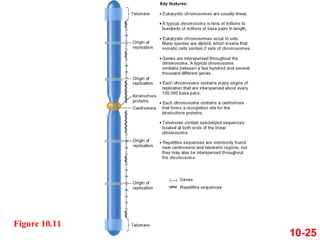
Plants also have a chloroplast genome
10-2Copyright ©The McGraw-Hill Companies, Inc. Permission required for reproduction or display
INTRODUCTION
 The main function of the genetic material is to store
information required to produce an organism
 The DNA molecule does that through its base sequence
 DNA sequences are necessary for
 1. Synthesis of RNA and cellular proteins
 2. Proper segregation of chromosomes
 3. Replication of chromosomes
 4. Compaction of chromosomes
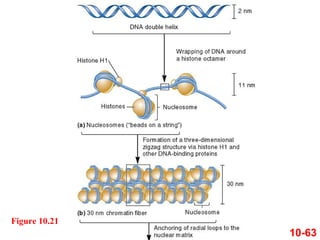

So they can fit within living cells
10-3Copyright ©The McGraw-Hill Companies, Inc. Permission required for reproduction or display
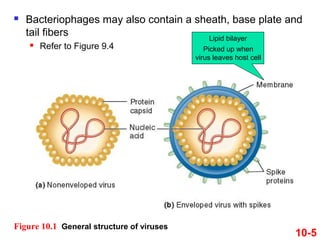
 Viruses are small infectious particles containing
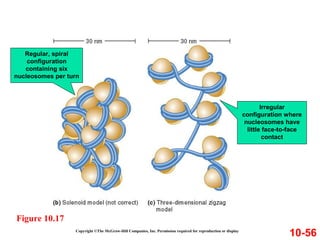
nucleic acid surrounded by a capsid of proteins
 Refer to Figure 10.1
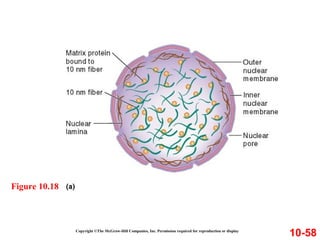
 For replication, viruses rely on their host cells
 ie., the cells they infect
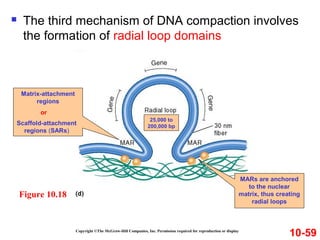
 Most viruses exhibit a limited host range
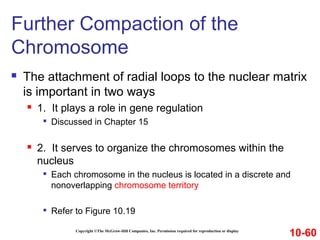
 They typically infect only specific types of cells of one
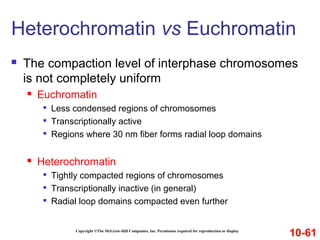
host species
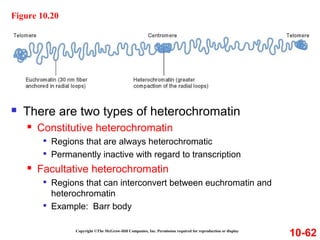
Copyright ©The McGraw-Hill Companies, Inc. Permission required for reproduction or display
10.1 VIRAL GENOMES
10-4
Figure 10.1 General structure of viruses
10-5
 Bacteriophages may also contain a sheath, base plate and
tail fibers
 Refer to Figure 9.4
Lipid bilayer
Picked up when
virus leaves host cell
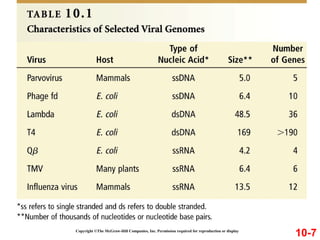
 A viral genome is the genetic material of the virus
 Also termed the viral chromosome
 The genome can be
 DNA or RNA
 Single-stranded or double-stranded
 Circular or linear
 Viral genomes vary in size from a few thousand to
more than a hundred thousand nucleotides
Copyright ©The McGraw-Hill Companies, Inc. Permission required for reproduction or display
Viral Genomes
10-6
Copyright ©The McGraw-Hill Companies, Inc. Permission required for reproduction or display
10-7
 The bacterial chromosome is found in a region
called the nucleoid
 Refer to Figure 10.3
 The nucleoid is not membrane-bounded
 So the DNA is in direct contact with the cytoplasm
Copyright ©The McGraw-Hill Companies, Inc. Permission required for reproduction or display
10.2 BACTERIAL
CHROMOSOMES
10-10
 Bacteria may have one to four identical copies of
the same chromosome
 The number depends on the species and growth
conditions
 Bacterial chromosomal DNA is usually a circular
molecule that is a few million nucleotides in length
 Escherichia coli  ~ 4.6 million base pairs
 Haemophilus influenzae  ~ 1.8 million base pairs
 A typical bacterial chromosome contains a few
thousand different genes
 Structural gene sequences (encoding proteins) account
for the majority of bacterial DNA
 The nontranscribed DNA between adjacent genes are
termed intergenic regions
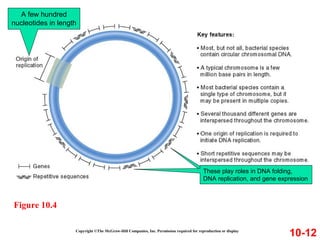
 Figure 10.4 summarizes the key features of
bacterial chromosomes
Copyright ©The McGraw-Hill Companies, Inc. Permission required for reproduction or display
10-11
Copyright ©The McGraw-Hill Companies, Inc. Permission required for reproduction or display
10-12
Figure 10.4
A few hundred
nucleotides in length
These play roles in DNA folding,
DNA replication, and gene expression
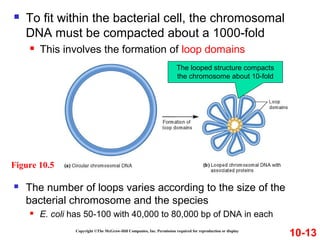
 To fit within the bacterial cell, the chromosomal
DNA must be compacted about a 1000-fold
 This involves the formation of loop domains
Copyright ©The McGraw-Hill Companies, Inc. Permission required for reproduction or display
10-13
Figure 10.5
 The number of loops varies according to the size of the
bacterial chromosome and the species
 E. coli has 50-100 with 40,000 to 80,000 bp of DNA in each
The looped structure compacts
the chromosome about 10-fold
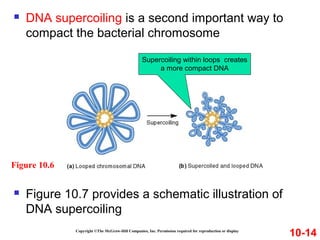
 DNA supercoiling is a second important way to
compact the bacterial chromosome
Copyright ©The McGraw-Hill Companies, Inc. Permission required for reproduction or display
10-14
Figure 10.6
 Figure 10.7 provides a schematic illustration of
DNA supercoiling
Supercoiling within loops creates
a more compact DNA
 The control of supercoiling in bacteria is
accomplished by two main enzymes
 1. DNA gyrase (also termed DNA topoisomerase II)

Introduces negative supercoils using energy from ATP
 Refer to Figure 10.9

It can also relax positive supercoils when they occur
 2. DNA topoisomerase I

Relaxes negative supercoils
 The competing action of these two enzymes
governs the overall supercoiling of bacterial DNA
Copyright ©The McGraw-Hill Companies, Inc. Permission required for reproduction or display
10-18
 Eukaryotic species contain one or more sets of
chromosomes
 Each set is composed of several different linear chromosomes
 The total amount of DNA in eukaryotic species is
typically greater than that in bacterial cells
 Chromosomes in eukaryotes are located in the
nucleus
 To fit in there, they must be highly compacted

This is accomplished by the binding of many proteins

The DNA-protein complex is termed chromatin
Copyright ©The McGraw-Hill Companies, Inc. Permission required for reproduction or display
10.3 EUKARYOTIC
CHROMOSOMES
10-21
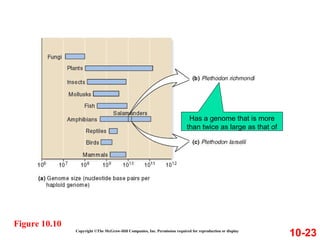
 Eukaryotic genomes vary substantially in size
 Refer to Figure 10.10a
 In many cases, this variation is not related to
complexity of the species
 For example, there is a two fold difference in the size of
the genome in two closely related salamander species
 Refer to Figure 10.10b
 The difference in the size of the genome is not because
of extra genes

Rather, the accumulation of repetitive DNA sequences
 These do not encode proteins
Copyright ©The McGraw-Hill Companies, Inc. Permission required for reproduction or display
10-22
Copyright ©The McGraw-Hill Companies, Inc. Permission required for reproduction or display
10-23
Figure 10.10
Has a genome that is more
than twice as large as that of
 A eukaryotic chromosome contains a long, linear
DNA molecule
 Refer to Figure 10.11
 Three types of DNA sequences are required for
chromosomal replication and segregation
 Origins of replication
 Centromeres
 Telomeres
Copyright ©The McGraw-Hill Companies, Inc. Permission required for reproduction or display
Organization of Eukaryotic
Chromosomes
10-24
10-25
Figure 10.11
 Genes are located between the centromeric and
telomeric regions along the entire chromosome
 A single chromosome usually has a few hundred to
several thousand genes
 In lower eukaryotes (such as yeast)
 Genes are relatively small
 They contain primarily the sequences encoding the
polypeptides
 ie: Very few introns are present
 In higher eukaryotes (such as mammals)
 Genes are long
 They tend to have many introns
Copyright ©The McGraw-Hill Companies, Inc. Permission required for reproduction or display
10-26
 Sequence complexity refers to the number of
times a particular base sequence appears in
the genome
 There are three main types of repetitive
sequences
 Unique or non-repetitive
 Moderately repetitive
 Highly repetitive
Copyright ©The McGraw-Hill Companies, Inc. Permission required for reproduction or display
Repetitive Sequences
10-27
 Unique or non-repetitive sequences
 Found once or a few times in the genome
 Includes structural genes as well as intergenic areas
 Moderately repetitive
 Found a few hundred to a few thousand times
 Includes

Genes for rRNA and histones

Origins of replication

Transposable elements
 Discussed in detail in Chapter 17
Copyright ©The McGraw-Hill Companies, Inc. Permission required for reproduction or display
Repetitive Sequences
10-28
 Highly repetitive
 Found tens of thousands to millions of times
 Each copy is relatively short (a few nucleotides to several
hundred in length)
 Some sequences are interspersed throughout the genome

Example: Alu family in humans
 Discussed in detail in Chapter 17
 Other sequences are clustered together in tandem arrays

Example: AATAT and AATATAT sequences in Drosophila

These are commonly found in the centromeric regions
Copyright ©The McGraw-Hill Companies, Inc. Permission required for reproduction or display
Repetitive Sequences
10-29
10-38Copyright ©The McGraw-Hill Companies, Inc. Permission required for reproduction or display
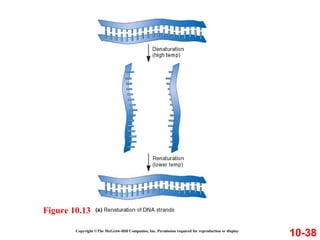
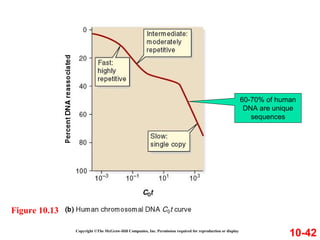
Figure 10.13
Copyright ©The McGraw-Hill Companies, Inc. Permission required for reproduction or display
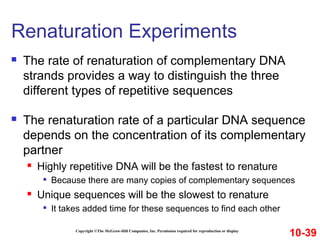
 The rate of renaturation of complementary DNA
strands provides a way to distinguish the three
different types of repetitive sequences
 The renaturation rate of a particular DNA sequence
depends on the concentration of its complementary
partner
 Highly repetitive DNA will be the fastest to renature

Because there are many copies of complementary sequences
 Unique sequences will be the slowest to renature

It takes added time for these sequences to find each other
Renaturation Experiments
10-39
10-42Copyright ©The McGraw-Hill Companies, Inc. Permission required for reproduction or display
Figure 10.13
60-70% of human
DNA are unique
sequences
Copyright ©The McGraw-Hill Companies, Inc. Permission required for reproduction or display
 If stretched end to end, a single set of human
chromosomes will be over 1 meter long!
 Yet the cell’s nucleus is only 2 to 4 µm in diameter

Therefore, the DNA must be tightly compacted to fit
 The compaction of linear DNA in eukaryotic
chromosomes involves interactions between DNA
and various proteins
 Proteins bound to DNA are subject to change during the
life of the cell

These changes affect the degree of chromatin compaction
Eukaryotic Chromatin Compaction
10-43
Copyright ©The McGraw-Hill Companies, Inc. Permission required for reproduction or display
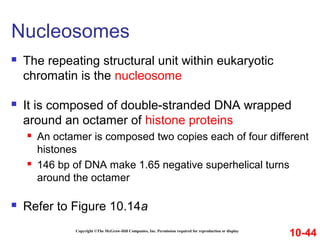
 The repeating structural unit within eukaryotic
chromatin is the nucleosome
 It is composed of double-stranded DNA wrapped
around an octamer of histone proteins
 An octamer is composed two copies each of four different
histones
 146 bp of DNA make 1.65 negative superhelical turns
around the octamer
 Refer to Figure 10.14a
Nucleosomes
10-44
Copyright ©The McGraw-Hill Companies, Inc. Permission required for reproduction or display
10-45
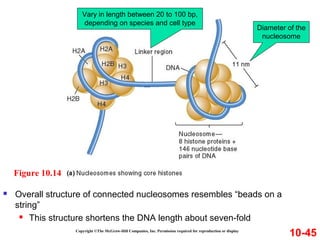
 Overall structure of connected nucleosomes resembles “beads on a
string”
 This structure shortens the DNA length about seven-fold
Figure 10.14
Vary in length between 20 to 100 bp,
depending on species and cell type
Diameter of the
nucleosome
Copyright ©The McGraw-Hill Companies, Inc. Permission required for reproduction or display
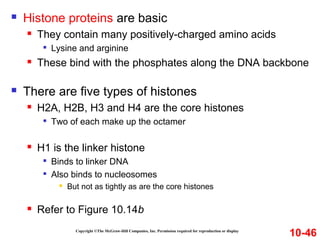
 Histone proteins are basic
 They contain many positively-charged amino acids

Lysine and arginine
 These bind with the phosphates along the DNA backbone
 There are five types of histones
 H2A, H2B, H3 and H4 are the core histones

Two of each make up the octamer
 H1 is the linker histone

Binds to linker DNA

Also binds to nucleosomes
 But not as tightly as are the core histones
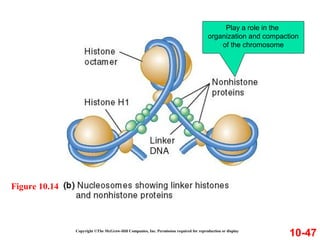
 Refer to Figure 10.14b
10-46
Copyright ©The McGraw-Hill Companies, Inc. Permission required for reproduction or display
10-47
Figure 10.14
Play a role in the
organization and compaction
of the chromosome
Copyright ©The McGraw-Hill Companies, Inc. Permission required for reproduction or display
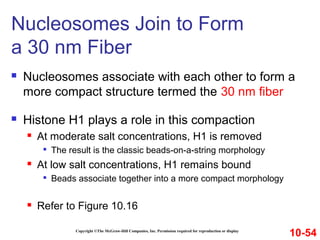
 Nucleosomes associate with each other to form a
more compact structure termed the 30 nm fiber
 Histone H1 plays a role in this compaction
 At moderate salt concentrations, H1 is removed

The result is the classic beads-on-a-string morphology
 At low salt concentrations, H1 remains bound

Beads associate together into a more compact morphology
 Refer to Figure 10.16
Nucleosomes Join to Form
a 30 nm Fiber
10-54
Copyright ©The McGraw-Hill Companies, Inc. Permission required for reproduction or display
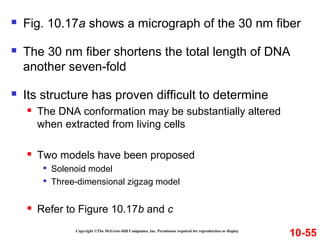
 Fig. 10.17a shows a micrograph of the 30 nm fiber
 The 30 nm fiber shortens the total length of DNA
another seven-fold
 Its structure has proven difficult to determine
 The DNA conformation may be substantially altered
when extracted from living cells
 Two models have been proposed

Solenoid model

Three-dimensional zigzag model
 Refer to Figure 10.17b and c
10-55
Copyright ©The McGraw-Hill Companies, Inc. Permission required for reproduction or display
10-56
Figure 10.17
Regular, spiral
configuration
containing six
nucleosomes per turn
Irregular
configuration where
nucleosomes have
little face-to-face
contact
Copyright ©The McGraw-Hill Companies, Inc. Permission required for reproduction or display
 The two events we have discussed so far have
shortened the DNA about 50-fold
 A third level of compaction involves interaction
between the 30 nm fiber and the nuclear matrix
 The nuclear matrix is composed of two parts
 Nuclear lamina
 Internal matrix proteins

10 nm fiber and associated proteins
Further Compaction of the
Chromosome
10-57
Copyright ©The McGraw-Hill Companies, Inc. Permission required for reproduction or display
10-58
Figure 10.18
Copyright ©The McGraw-Hill Companies, Inc. Permission required for reproduction or display
10-59
Figure 10.18
 The third mechanism of DNA compaction involves
the formation of radial loop domains
Matrix-attachment
regions
Scaffold-attachment
regions (SARs)
or
MARs are anchored
to the nuclear
matrix, thus creating
radial loops
25,000 to
200,000 bp
Copyright ©The McGraw-Hill Companies, Inc. Permission required for reproduction or display
 The attachment of radial loops to the nuclear matrix
is important in two ways
 1. It plays a role in gene regulation

Discussed in Chapter 15
 2. It serves to organize the chromosomes within the
nucleus

Each chromosome in the nucleus is located in a discrete and
nonoverlapping chromosome territory

Refer to Figure 10.19
Further Compaction of the
Chromosome
10-60
Copyright ©The McGraw-Hill Companies, Inc. Permission required for reproduction or display
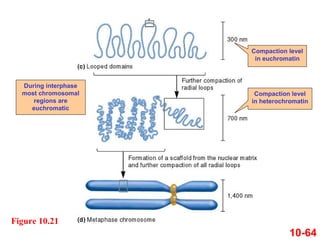
 The compaction level of interphase chromosomes
is not completely uniform
 Euchromatin

Less condensed regions of chromosomes

Transcriptionally active

Regions where 30 nm fiber forms radial loop domains
 Heterochromatin

Tightly compacted regions of chromosomes

Transcriptionally inactive (in general)

Radial loop domains compacted even further
Heterochromatin vs Euchromatin
10-61
Copyright ©The McGraw-Hill Companies, Inc. Permission required for reproduction or display
 There are two types of heterochromatin
 Constitutive heterochromatin

Regions that are always heterochromatic

Permanently inactive with regard to transcription
 Facultative heterochromatin

Regions that can interconvert between euchromatin and
heterochromatin

Example: Barr body
10-62
Figure 10.20
10-63
Figure 10.21
10-64
Figure 10.21
Compaction level
in euchromatin
Compaction level
in heterochromatin
During interphase
most chromosomal
regions are
euchromatic
Copyright ©The McGraw-Hill Companies, Inc. Permission required for reproduction or display
 As cells enter M phase, the level of compaction
changes dramatically
 By the end of prophase, sister chromatids are entirely
heterochromatic
 Two parallel chromatids have an overall diameter of
1,400 nm
 These highly condensed metaphase chromosomes
undergo little gene transcription
Metaphase Chromosomes
10-65
Copyright ©The McGraw-Hill Companies, Inc. Permission required for reproduction or display
 In metaphase chromosomes the radial loops are
highly compacted and stay anchored to a scaffold
 The scaffold is formed from the nuclear matrix
 Histones are needed for the compaction of radial
loops
 Refer to Figure 10.22
Metaphase Chromosomes
10-66
Copyright ©The McGraw-Hill Companies, Inc. Permission required for reproduction or display
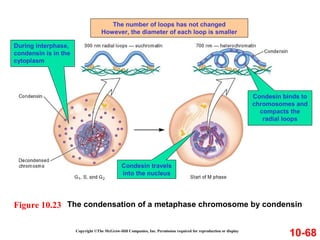
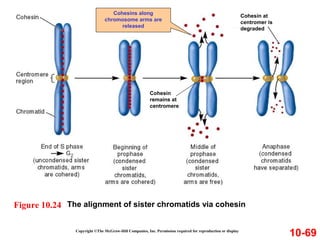
 Two multiprotein complexes help to form and
organize metaphase chromosomes
 Condensin

Plays a critical role in chromosome condensation
 Cohesin

Plays a critical role in sister chromatid alignment
 Both contain a category of proteins called SMC
proteins
 Acronym = Structural maintenance of chromosomes
 SMC proteins use energy from ATP and catalyze
changes in chromosome structure
10-67
10-68
The condensation of a metaphase chromosome by condensinFigure 10.23
Copyright ©The McGraw-Hill Companies, Inc. Permission required for reproduction or display
The number of loops has not changed
However, the diameter of each loop is smaller
Condesin travels
into the nucleus
Condesin binds to
chromosomes and
compacts the
radial loops
During interphase,
condensin is in the
cytoplasm
10-69
The alignment of sister chromatids via cohesinFigure 10.24
Copyright ©The McGraw-Hill Companies, Inc. Permission required for reproduction or display
Cohesins along
chromosome arms are
released
Cohesin
remains at
centromere
Cohesin at
centromer is
degraded

Dna 9

  • 1.
    Copyright ©The McGraw-HillCompanies, Inc. Permission required for reproduction or display CHAPTER 10 CHROMOSOME ORGANIZATION AND MOLECULAR STRUCTURE
  • 2.
    INTRODUCTION  Chromosomes arethe structures that contain the genetic material  They are complexes of DNA and proteins  The genome comprises all the genetic material that an organism possesses  In bacteria, it is typically a single circular chromosome  In eukaryotes, it refers to one complete set of nuclear chromosomes  Note:  Eukaryotes possess a mitochondrial genome  Plants also have a chloroplast genome 10-2Copyright ©The McGraw-Hill Companies, Inc. Permission required for reproduction or display
  • 3.
    INTRODUCTION  The mainfunction of the genetic material is to store information required to produce an organism  The DNA molecule does that through its base sequence  DNA sequences are necessary for  1. Synthesis of RNA and cellular proteins  2. Proper segregation of chromosomes  3. Replication of chromosomes  4. Compaction of chromosomes  So they can fit within living cells 10-3Copyright ©The McGraw-Hill Companies, Inc. Permission required for reproduction or display
  • 4.
     Viruses aresmall infectious particles containing nucleic acid surrounded by a capsid of proteins  Refer to Figure 10.1  For replication, viruses rely on their host cells  ie., the cells they infect  Most viruses exhibit a limited host range  They typically infect only specific types of cells of one host species Copyright ©The McGraw-Hill Companies, Inc. Permission required for reproduction or display 10.1 VIRAL GENOMES 10-4
  • 5.
    Figure 10.1 Generalstructure of viruses 10-5  Bacteriophages may also contain a sheath, base plate and tail fibers  Refer to Figure 9.4 Lipid bilayer Picked up when virus leaves host cell
  • 6.
     A viralgenome is the genetic material of the virus  Also termed the viral chromosome  The genome can be  DNA or RNA  Single-stranded or double-stranded  Circular or linear  Viral genomes vary in size from a few thousand to more than a hundred thousand nucleotides Copyright ©The McGraw-Hill Companies, Inc. Permission required for reproduction or display Viral Genomes 10-6
  • 7.
    Copyright ©The McGraw-HillCompanies, Inc. Permission required for reproduction or display 10-7
  • 8.
     The bacterialchromosome is found in a region called the nucleoid  Refer to Figure 10.3  The nucleoid is not membrane-bounded  So the DNA is in direct contact with the cytoplasm Copyright ©The McGraw-Hill Companies, Inc. Permission required for reproduction or display 10.2 BACTERIAL CHROMOSOMES 10-10  Bacteria may have one to four identical copies of the same chromosome  The number depends on the species and growth conditions
  • 9.
     Bacterial chromosomalDNA is usually a circular molecule that is a few million nucleotides in length  Escherichia coli  ~ 4.6 million base pairs  Haemophilus influenzae  ~ 1.8 million base pairs  A typical bacterial chromosome contains a few thousand different genes  Structural gene sequences (encoding proteins) account for the majority of bacterial DNA  The nontranscribed DNA between adjacent genes are termed intergenic regions  Figure 10.4 summarizes the key features of bacterial chromosomes Copyright ©The McGraw-Hill Companies, Inc. Permission required for reproduction or display 10-11
  • 10.
    Copyright ©The McGraw-HillCompanies, Inc. Permission required for reproduction or display 10-12 Figure 10.4 A few hundred nucleotides in length These play roles in DNA folding, DNA replication, and gene expression
  • 11.
     To fitwithin the bacterial cell, the chromosomal DNA must be compacted about a 1000-fold  This involves the formation of loop domains Copyright ©The McGraw-Hill Companies, Inc. Permission required for reproduction or display 10-13 Figure 10.5  The number of loops varies according to the size of the bacterial chromosome and the species  E. coli has 50-100 with 40,000 to 80,000 bp of DNA in each The looped structure compacts the chromosome about 10-fold
  • 12.
     DNA supercoilingis a second important way to compact the bacterial chromosome Copyright ©The McGraw-Hill Companies, Inc. Permission required for reproduction or display 10-14 Figure 10.6  Figure 10.7 provides a schematic illustration of DNA supercoiling Supercoiling within loops creates a more compact DNA
  • 13.
     The controlof supercoiling in bacteria is accomplished by two main enzymes  1. DNA gyrase (also termed DNA topoisomerase II)  Introduces negative supercoils using energy from ATP  Refer to Figure 10.9  It can also relax positive supercoils when they occur  2. DNA topoisomerase I  Relaxes negative supercoils  The competing action of these two enzymes governs the overall supercoiling of bacterial DNA Copyright ©The McGraw-Hill Companies, Inc. Permission required for reproduction or display 10-18
  • 14.
     Eukaryotic speciescontain one or more sets of chromosomes  Each set is composed of several different linear chromosomes  The total amount of DNA in eukaryotic species is typically greater than that in bacterial cells  Chromosomes in eukaryotes are located in the nucleus  To fit in there, they must be highly compacted  This is accomplished by the binding of many proteins  The DNA-protein complex is termed chromatin Copyright ©The McGraw-Hill Companies, Inc. Permission required for reproduction or display 10.3 EUKARYOTIC CHROMOSOMES 10-21
  • 15.
     Eukaryotic genomesvary substantially in size  Refer to Figure 10.10a  In many cases, this variation is not related to complexity of the species  For example, there is a two fold difference in the size of the genome in two closely related salamander species  Refer to Figure 10.10b  The difference in the size of the genome is not because of extra genes  Rather, the accumulation of repetitive DNA sequences  These do not encode proteins Copyright ©The McGraw-Hill Companies, Inc. Permission required for reproduction or display 10-22
  • 16.
    Copyright ©The McGraw-HillCompanies, Inc. Permission required for reproduction or display 10-23 Figure 10.10 Has a genome that is more than twice as large as that of
  • 17.
     A eukaryoticchromosome contains a long, linear DNA molecule  Refer to Figure 10.11  Three types of DNA sequences are required for chromosomal replication and segregation  Origins of replication  Centromeres  Telomeres Copyright ©The McGraw-Hill Companies, Inc. Permission required for reproduction or display Organization of Eukaryotic Chromosomes 10-24
  • 18.
  • 19.
     Genes arelocated between the centromeric and telomeric regions along the entire chromosome  A single chromosome usually has a few hundred to several thousand genes  In lower eukaryotes (such as yeast)  Genes are relatively small  They contain primarily the sequences encoding the polypeptides  ie: Very few introns are present  In higher eukaryotes (such as mammals)  Genes are long  They tend to have many introns Copyright ©The McGraw-Hill Companies, Inc. Permission required for reproduction or display 10-26
  • 20.
     Sequence complexityrefers to the number of times a particular base sequence appears in the genome  There are three main types of repetitive sequences  Unique or non-repetitive  Moderately repetitive  Highly repetitive Copyright ©The McGraw-Hill Companies, Inc. Permission required for reproduction or display Repetitive Sequences 10-27
  • 21.
     Unique ornon-repetitive sequences  Found once or a few times in the genome  Includes structural genes as well as intergenic areas  Moderately repetitive  Found a few hundred to a few thousand times  Includes  Genes for rRNA and histones  Origins of replication  Transposable elements  Discussed in detail in Chapter 17 Copyright ©The McGraw-Hill Companies, Inc. Permission required for reproduction or display Repetitive Sequences 10-28
  • 22.
     Highly repetitive Found tens of thousands to millions of times  Each copy is relatively short (a few nucleotides to several hundred in length)  Some sequences are interspersed throughout the genome  Example: Alu family in humans  Discussed in detail in Chapter 17  Other sequences are clustered together in tandem arrays  Example: AATAT and AATATAT sequences in Drosophila  These are commonly found in the centromeric regions Copyright ©The McGraw-Hill Companies, Inc. Permission required for reproduction or display Repetitive Sequences 10-29
  • 23.
    10-38Copyright ©The McGraw-HillCompanies, Inc. Permission required for reproduction or display Figure 10.13
  • 24.
    Copyright ©The McGraw-HillCompanies, Inc. Permission required for reproduction or display  The rate of renaturation of complementary DNA strands provides a way to distinguish the three different types of repetitive sequences  The renaturation rate of a particular DNA sequence depends on the concentration of its complementary partner  Highly repetitive DNA will be the fastest to renature  Because there are many copies of complementary sequences  Unique sequences will be the slowest to renature  It takes added time for these sequences to find each other Renaturation Experiments 10-39
  • 25.
    10-42Copyright ©The McGraw-HillCompanies, Inc. Permission required for reproduction or display Figure 10.13 60-70% of human DNA are unique sequences
  • 26.
    Copyright ©The McGraw-HillCompanies, Inc. Permission required for reproduction or display  If stretched end to end, a single set of human chromosomes will be over 1 meter long!  Yet the cell’s nucleus is only 2 to 4 µm in diameter  Therefore, the DNA must be tightly compacted to fit  The compaction of linear DNA in eukaryotic chromosomes involves interactions between DNA and various proteins  Proteins bound to DNA are subject to change during the life of the cell  These changes affect the degree of chromatin compaction Eukaryotic Chromatin Compaction 10-43
  • 27.
    Copyright ©The McGraw-HillCompanies, Inc. Permission required for reproduction or display  The repeating structural unit within eukaryotic chromatin is the nucleosome  It is composed of double-stranded DNA wrapped around an octamer of histone proteins  An octamer is composed two copies each of four different histones  146 bp of DNA make 1.65 negative superhelical turns around the octamer  Refer to Figure 10.14a Nucleosomes 10-44
  • 28.
    Copyright ©The McGraw-HillCompanies, Inc. Permission required for reproduction or display 10-45  Overall structure of connected nucleosomes resembles “beads on a string”  This structure shortens the DNA length about seven-fold Figure 10.14 Vary in length between 20 to 100 bp, depending on species and cell type Diameter of the nucleosome
  • 29.
    Copyright ©The McGraw-HillCompanies, Inc. Permission required for reproduction or display  Histone proteins are basic  They contain many positively-charged amino acids  Lysine and arginine  These bind with the phosphates along the DNA backbone  There are five types of histones  H2A, H2B, H3 and H4 are the core histones  Two of each make up the octamer  H1 is the linker histone  Binds to linker DNA  Also binds to nucleosomes  But not as tightly as are the core histones  Refer to Figure 10.14b 10-46
  • 30.
    Copyright ©The McGraw-HillCompanies, Inc. Permission required for reproduction or display 10-47 Figure 10.14 Play a role in the organization and compaction of the chromosome
  • 31.
    Copyright ©The McGraw-HillCompanies, Inc. Permission required for reproduction or display  Nucleosomes associate with each other to form a more compact structure termed the 30 nm fiber  Histone H1 plays a role in this compaction  At moderate salt concentrations, H1 is removed  The result is the classic beads-on-a-string morphology  At low salt concentrations, H1 remains bound  Beads associate together into a more compact morphology  Refer to Figure 10.16 Nucleosomes Join to Form a 30 nm Fiber 10-54
  • 32.
    Copyright ©The McGraw-HillCompanies, Inc. Permission required for reproduction or display  Fig. 10.17a shows a micrograph of the 30 nm fiber  The 30 nm fiber shortens the total length of DNA another seven-fold  Its structure has proven difficult to determine  The DNA conformation may be substantially altered when extracted from living cells  Two models have been proposed  Solenoid model  Three-dimensional zigzag model  Refer to Figure 10.17b and c 10-55
  • 33.
    Copyright ©The McGraw-HillCompanies, Inc. Permission required for reproduction or display 10-56 Figure 10.17 Regular, spiral configuration containing six nucleosomes per turn Irregular configuration where nucleosomes have little face-to-face contact
  • 34.
    Copyright ©The McGraw-HillCompanies, Inc. Permission required for reproduction or display  The two events we have discussed so far have shortened the DNA about 50-fold  A third level of compaction involves interaction between the 30 nm fiber and the nuclear matrix  The nuclear matrix is composed of two parts  Nuclear lamina  Internal matrix proteins  10 nm fiber and associated proteins Further Compaction of the Chromosome 10-57
  • 35.
    Copyright ©The McGraw-HillCompanies, Inc. Permission required for reproduction or display 10-58 Figure 10.18
  • 36.
    Copyright ©The McGraw-HillCompanies, Inc. Permission required for reproduction or display 10-59 Figure 10.18  The third mechanism of DNA compaction involves the formation of radial loop domains Matrix-attachment regions Scaffold-attachment regions (SARs) or MARs are anchored to the nuclear matrix, thus creating radial loops 25,000 to 200,000 bp
  • 37.
    Copyright ©The McGraw-HillCompanies, Inc. Permission required for reproduction or display  The attachment of radial loops to the nuclear matrix is important in two ways  1. It plays a role in gene regulation  Discussed in Chapter 15  2. It serves to organize the chromosomes within the nucleus  Each chromosome in the nucleus is located in a discrete and nonoverlapping chromosome territory  Refer to Figure 10.19 Further Compaction of the Chromosome 10-60
  • 38.
    Copyright ©The McGraw-HillCompanies, Inc. Permission required for reproduction or display  The compaction level of interphase chromosomes is not completely uniform  Euchromatin  Less condensed regions of chromosomes  Transcriptionally active  Regions where 30 nm fiber forms radial loop domains  Heterochromatin  Tightly compacted regions of chromosomes  Transcriptionally inactive (in general)  Radial loop domains compacted even further Heterochromatin vs Euchromatin 10-61
  • 39.
    Copyright ©The McGraw-HillCompanies, Inc. Permission required for reproduction or display  There are two types of heterochromatin  Constitutive heterochromatin  Regions that are always heterochromatic  Permanently inactive with regard to transcription  Facultative heterochromatin  Regions that can interconvert between euchromatin and heterochromatin  Example: Barr body 10-62 Figure 10.20
  • 40.
  • 41.
    10-64 Figure 10.21 Compaction level ineuchromatin Compaction level in heterochromatin During interphase most chromosomal regions are euchromatic
  • 42.
    Copyright ©The McGraw-HillCompanies, Inc. Permission required for reproduction or display  As cells enter M phase, the level of compaction changes dramatically  By the end of prophase, sister chromatids are entirely heterochromatic  Two parallel chromatids have an overall diameter of 1,400 nm  These highly condensed metaphase chromosomes undergo little gene transcription Metaphase Chromosomes 10-65
  • 43.
    Copyright ©The McGraw-HillCompanies, Inc. Permission required for reproduction or display  In metaphase chromosomes the radial loops are highly compacted and stay anchored to a scaffold  The scaffold is formed from the nuclear matrix  Histones are needed for the compaction of radial loops  Refer to Figure 10.22 Metaphase Chromosomes 10-66
  • 44.
    Copyright ©The McGraw-HillCompanies, Inc. Permission required for reproduction or display  Two multiprotein complexes help to form and organize metaphase chromosomes  Condensin  Plays a critical role in chromosome condensation  Cohesin  Plays a critical role in sister chromatid alignment  Both contain a category of proteins called SMC proteins  Acronym = Structural maintenance of chromosomes  SMC proteins use energy from ATP and catalyze changes in chromosome structure 10-67
  • 45.
    10-68 The condensation ofa metaphase chromosome by condensinFigure 10.23 Copyright ©The McGraw-Hill Companies, Inc. Permission required for reproduction or display The number of loops has not changed However, the diameter of each loop is smaller Condesin travels into the nucleus Condesin binds to chromosomes and compacts the radial loops During interphase, condensin is in the cytoplasm
  • 46.
    10-69 The alignment ofsister chromatids via cohesinFigure 10.24 Copyright ©The McGraw-Hill Companies, Inc. Permission required for reproduction or display Cohesins along chromosome arms are released Cohesin remains at centromere Cohesin at centromer is degraded