Somatic Cell Nuclear Transfer
          Josh Reichman
What is it?
Somatic cell nuclear transfer (SCNT) is a
method of cloning an organism that involves
removing the nucleus from a somatic cell and
putting it in an egg cell.
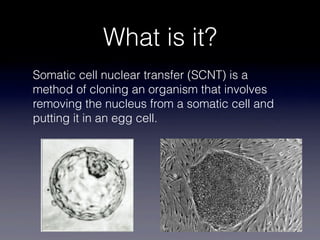
What is it?
Somatic cell nuclear transfer (SCNT) is a
method of cloning an organism that involves
removing the nucleus from a somatic cell and
putting it in an egg cell.
The Steps
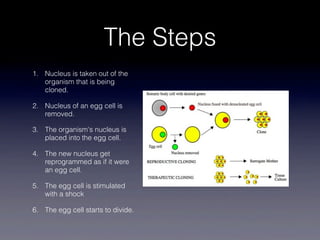
1. Nucleus is taken out of the
   organism that is being
   cloned.

2. Nucleus of an egg cell is
   removed.

3. The organism's nucleus is
   placed into the egg cell.

4. The new nucleus get
   reprogrammed as if it were
   an egg cell.

5. The egg cell is stimulated
   with a shock

6. The egg cell starts to divide.
The Steps
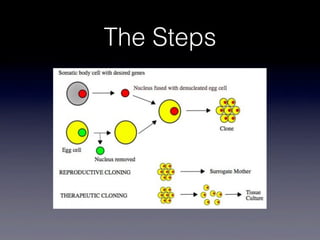
1. Nucleus is taken out of the
   organism that is being
   cloned.

2. Nucleus of an egg cell is
   removed.

3. The organism's nucleus is
   placed into the egg cell.

4. The new nucleus get
   reprogrammed as if it were
   an egg cell.

5. The egg cell is stimulated
   with a shock

6. The egg cell starts to divide.
The Steps
Notable Uses
Somatic cell nuclear transfer is mostly
used in animal cloning. One of the most
famous clones, Dolly the Sheep, used
this method of cloning.
Notable Uses
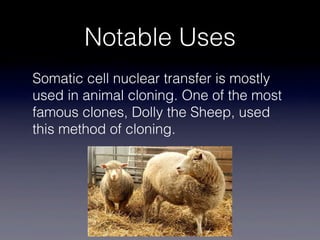
Somatic cell nuclear transfer is mostly
used in animal cloning. One of the most
famous clones, Dolly the Sheep, used
this method of cloning.
Limitations
• It takes a lot of tries to get a successful
  clone

• The procedure is manual

• Some of the wanted DNA is not transferred

• Some of the original egg's DNA is left
  behind

• Results in a close, but not perfect clone
Controversy
1. Cloning of humans
2. The requirement of eggs
   from a female
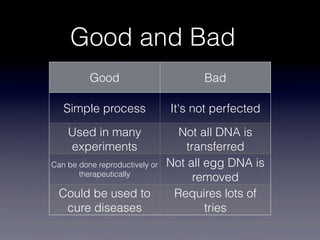
Good and Bad
          Good                         Bad

   Simple process               It's not perfected
    Used in many                  Not all DNA is
    experiments                     transferred
Can be done reproductively or   Not all egg DNA is
       therapeutically
                                      removed
  Could be used to               Requires lots of
   cure diseases                        tries
Gallery
Thank you for your
      time

Somatic cell nuclear_transfer

  • 2.
    Somatic Cell NuclearTransfer Josh Reichman
  • 4.
    What is it? Somaticcell nuclear transfer (SCNT) is a method of cloning an organism that involves removing the nucleus from a somatic cell and putting it in an egg cell.
  • 5.
    What is it? Somaticcell nuclear transfer (SCNT) is a method of cloning an organism that involves removing the nucleus from a somatic cell and putting it in an egg cell.
  • 8.
    The Steps 1. Nucleusis taken out of the organism that is being cloned. 2. Nucleus of an egg cell is removed. 3. The organism's nucleus is placed into the egg cell. 4. The new nucleus get reprogrammed as if it were an egg cell. 5. The egg cell is stimulated with a shock 6. The egg cell starts to divide.
  • 9.
    The Steps 1. Nucleusis taken out of the organism that is being cloned. 2. Nucleus of an egg cell is removed. 3. The organism's nucleus is placed into the egg cell. 4. The new nucleus get reprogrammed as if it were an egg cell. 5. The egg cell is stimulated with a shock 6. The egg cell starts to divide.
  • 10.
  • 13.
    Notable Uses Somatic cellnuclear transfer is mostly used in animal cloning. One of the most famous clones, Dolly the Sheep, used this method of cloning.
  • 14.
    Notable Uses Somatic cellnuclear transfer is mostly used in animal cloning. One of the most famous clones, Dolly the Sheep, used this method of cloning.
  • 17.
    Limitations • It takesa lot of tries to get a successful clone • The procedure is manual • Some of the wanted DNA is not transferred • Some of the original egg's DNA is left behind • Results in a close, but not perfect clone
  • 20.
    Controversy 1. Cloning ofhumans 2. The requirement of eggs from a female
  • 23.
    Good and Bad Good Bad Simple process It's not perfected Used in many Not all DNA is experiments transferred Can be done reproductively or Not all egg DNA is therapeutically removed Could be used to Requires lots of cure diseases tries
  • 26.
  • 27.
    Thank you foryour time

Editor's Notes