Transforming Technologies:
Teaching and Learning in the
Digital Age
Session 7:
E-Assessment
Learning outcomes
• To discuss different types of assessment and
feedback and how technology-enhanced learning
approaches can be used.
• To engage in and evaluate a peer assessment
activity using Moodle.
• To explore and critique case studies and examples
of the use of e-assessment and feedback and
consider their applicability to your context.
• To use a matrix to assess a digital artefact, in
relation to the formal course assessment.
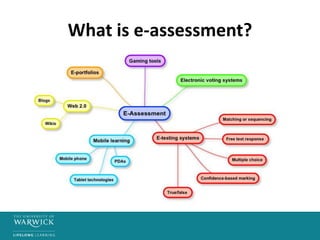
What is e-assessment?
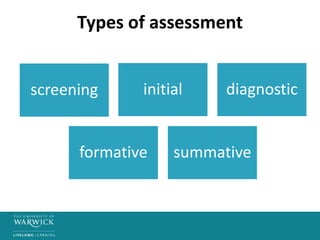
Types of assessment
screening initial diagnostic
formative summative
New ways of working or electronic
replicas?
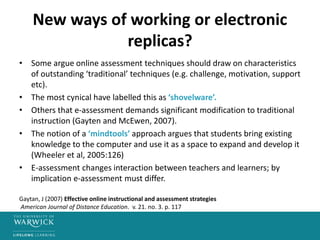
• Some argue online assessment techniques should draw on characteristics
of outstanding ‘traditional’ techniques (e.g. challenge, motivation, support
etc).
• The most cynical have labelled this as ‘shovelware’.
• Others that e-assessment demands significant modification to traditional
instruction (Gayten and McEwen, 2007).
• The notion of a ‘mindtools’ approach argues that students bring existing
knowledge to the computer and use it as a space to expand and develop it
(Wheeler et al, 2005:126)
• E-assessment changes interaction between teachers and learners; by
implication e-assessment must differ.
Gaytan, J (2007) Effective online instructional and assessment strategies
American Journal of Distance Education. v. 21. no. 3. p. 117
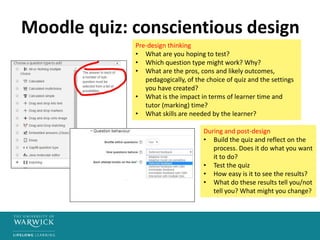
Moodle quiz: conscientious design
Pre-design thinking
• What are you hoping to test?
• Which question type might work? Why?
• What are the pros, cons and likely outcomes,
pedagogically, of the choice of quiz and the settings
you have created?
• What is the impact in terms of learner time and
tutor (marking) time?
• What skills are needed by the learner?
During and post-design
• Build the quiz and reflect on the
process. Does it do what you want
it to do?
• Test the quiz
• How easy is it to see the results?
• What do these results tell you/not
tell you? What might you change?
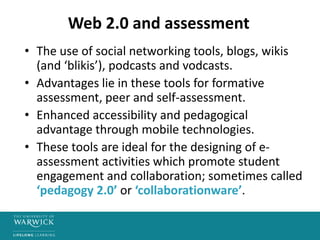
Web 2.0 and assessment
• The use of social networking tools, blogs, wikis
(and ‘blikis’), podcasts and vodcasts.
• Advantages lie in these tools for formative
assessment, peer and self-assessment.
• Enhanced accessibility and pedagogical
advantage through mobile technologies.
• These tools are ideal for the designing of e-
assessment activities which promote student
engagement and collaboration; sometimes called
‘pedagogy 2.0’ or ‘collaborationware’.
Wikis and blogs
• Promotes shared authorship, ‘student as producer’ and democratic
access.
• Collaborative approaches, peer, self-assessment and reflection have
known pedagogical advantages.
• ‘Darwikinism’ – ecology of content which is fit for purpose:
competition + co-operation.
• Possibility of ‘vandalism’ due to free-form nature.
• Difficulties with citation and tracing contributions.
• ‘Closed environment scenarios’ can support the audit trail and
authenticate assessment using these tools.
(Boulos et al, 2006)
Boulos, MNK (2006) Wikis, blogs and podcasts: a new generation of Web-based tools for virtual
collaborative clinical practice and education
BMC Medical Education. v. 6. no. 1. 2006. p. 41
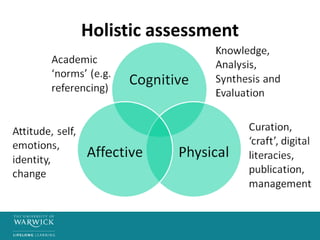
Holistic assessment
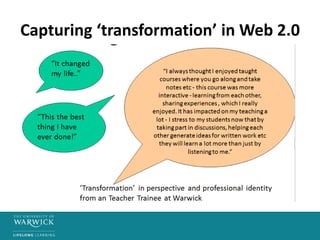
Capturing ‘transformation’ in Web 2.0
Mobile learning and assessment
• M-learning (mobile) and U-learning
(ubiquitous) ‘authentic learning’ and
‘personalisation’ are all terms used to
associated with mobile technologies.
• Continuous ‘social connectedness’ – a
continued dialogue between peers and tutors.
• Student motivation
and willingness to
‘persist’
“Without the mobile
technology I would have had
to do a lot more writing, and
because I don’t like writing I
suspect I would have skipped
out a lot of my ideas....”
COCHRANE, Thomas and BATEMAN, Roger (2010). Smartphones give
you wings: pedagogical affordances of mobile Web 2.0. Australasian
Journal of Educational Technology, 26 (1), 1-14.
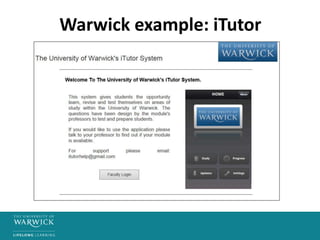
Warwick example: iTutor
E-Feedback
• Feedback is “the most important aspect of the assessment
process in raising achievement” (Bloxham and Boyd, 2007:7).
• Recent research has found audio feedback to have advantages
over written in terms of retention of content and likelihood of
engagement.
• London Met University (Lunt and Curran, 2010) found audio
feedback to be beneficial to both staff and students, with the
latter 10 times more likely to read their feedback.
• Audio feedback can be achieved easily through podcast
techniques or combined with written feedback through
screencast approaches.
Bloxham, S., and P. Boyd. (2007). Developing effective assessment in higher education: A practical guide.
Maidenhead: Open University Press.
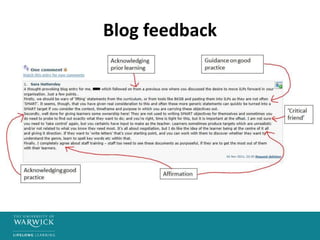
Blog feedback
• Wheeler et al (2005) discuss the notion of distributed
problem-based learning online and ‘communities of practice’.
• Discursive online dialogue can lead to a ZPD (Vygotsky, 1978)
– an incremental shift of an individual’s cognitive
development, through peer interactions.
• DPBL can be achieved in synchronous and asynchronous
environments.
• Notions of online identity and its relationship to actual,
professional identity.
Problem-based learning and
e-assessment
Wheeler, S (2005) The influence of online problem-based learning on teachers’ professional practice and identity
ALT-J Research in Learning Technology Journal. v. 13. no. 2. 2005. p. 125
Critical questions
• What are the issues and opportunities
afforded by e-assessment?
• How does e-assessment fit with current digital
literacy practices, as a tutor or student? Could
e-assessment give only some the advantage?
• Can assessment be ‘re-imagined’ using
technology?

Transformingtechnologies session7

  • 1.
    Transforming Technologies: Teaching andLearning in the Digital Age Session 7: E-Assessment
  • 2.
    Learning outcomes • Todiscuss different types of assessment and feedback and how technology-enhanced learning approaches can be used. • To engage in and evaluate a peer assessment activity using Moodle. • To explore and critique case studies and examples of the use of e-assessment and feedback and consider their applicability to your context. • To use a matrix to assess a digital artefact, in relation to the formal course assessment.
  • 3.
  • 4.
    Types of assessment screeninginitial diagnostic formative summative
  • 5.
    New ways ofworking or electronic replicas? • Some argue online assessment techniques should draw on characteristics of outstanding ‘traditional’ techniques (e.g. challenge, motivation, support etc). • The most cynical have labelled this as ‘shovelware’. • Others that e-assessment demands significant modification to traditional instruction (Gayten and McEwen, 2007). • The notion of a ‘mindtools’ approach argues that students bring existing knowledge to the computer and use it as a space to expand and develop it (Wheeler et al, 2005:126) • E-assessment changes interaction between teachers and learners; by implication e-assessment must differ. Gaytan, J (2007) Effective online instructional and assessment strategies American Journal of Distance Education. v. 21. no. 3. p. 117
  • 6.
    Moodle quiz: conscientiousdesign Pre-design thinking • What are you hoping to test? • Which question type might work? Why? • What are the pros, cons and likely outcomes, pedagogically, of the choice of quiz and the settings you have created? • What is the impact in terms of learner time and tutor (marking) time? • What skills are needed by the learner? During and post-design • Build the quiz and reflect on the process. Does it do what you want it to do? • Test the quiz • How easy is it to see the results? • What do these results tell you/not tell you? What might you change?
  • 7.
    Web 2.0 andassessment • The use of social networking tools, blogs, wikis (and ‘blikis’), podcasts and vodcasts. • Advantages lie in these tools for formative assessment, peer and self-assessment. • Enhanced accessibility and pedagogical advantage through mobile technologies. • These tools are ideal for the designing of e- assessment activities which promote student engagement and collaboration; sometimes called ‘pedagogy 2.0’ or ‘collaborationware’.
  • 8.
    Wikis and blogs •Promotes shared authorship, ‘student as producer’ and democratic access. • Collaborative approaches, peer, self-assessment and reflection have known pedagogical advantages. • ‘Darwikinism’ – ecology of content which is fit for purpose: competition + co-operation. • Possibility of ‘vandalism’ due to free-form nature. • Difficulties with citation and tracing contributions. • ‘Closed environment scenarios’ can support the audit trail and authenticate assessment using these tools. (Boulos et al, 2006) Boulos, MNK (2006) Wikis, blogs and podcasts: a new generation of Web-based tools for virtual collaborative clinical practice and education BMC Medical Education. v. 6. no. 1. 2006. p. 41
  • 9.
  • 10.
  • 11.
    Mobile learning andassessment • M-learning (mobile) and U-learning (ubiquitous) ‘authentic learning’ and ‘personalisation’ are all terms used to associated with mobile technologies. • Continuous ‘social connectedness’ – a continued dialogue between peers and tutors. • Student motivation and willingness to ‘persist’ “Without the mobile technology I would have had to do a lot more writing, and because I don’t like writing I suspect I would have skipped out a lot of my ideas....” COCHRANE, Thomas and BATEMAN, Roger (2010). Smartphones give you wings: pedagogical affordances of mobile Web 2.0. Australasian Journal of Educational Technology, 26 (1), 1-14.
  • 12.
  • 13.
    E-Feedback • Feedback is“the most important aspect of the assessment process in raising achievement” (Bloxham and Boyd, 2007:7). • Recent research has found audio feedback to have advantages over written in terms of retention of content and likelihood of engagement. • London Met University (Lunt and Curran, 2010) found audio feedback to be beneficial to both staff and students, with the latter 10 times more likely to read their feedback. • Audio feedback can be achieved easily through podcast techniques or combined with written feedback through screencast approaches. Bloxham, S., and P. Boyd. (2007). Developing effective assessment in higher education: A practical guide. Maidenhead: Open University Press.
  • 14.
  • 15.
    • Wheeler etal (2005) discuss the notion of distributed problem-based learning online and ‘communities of practice’. • Discursive online dialogue can lead to a ZPD (Vygotsky, 1978) – an incremental shift of an individual’s cognitive development, through peer interactions. • DPBL can be achieved in synchronous and asynchronous environments. • Notions of online identity and its relationship to actual, professional identity. Problem-based learning and e-assessment Wheeler, S (2005) The influence of online problem-based learning on teachers’ professional practice and identity ALT-J Research in Learning Technology Journal. v. 13. no. 2. 2005. p. 125
  • 16.
    Critical questions • Whatare the issues and opportunities afforded by e-assessment? • How does e-assessment fit with current digital literacy practices, as a tutor or student? Could e-assessment give only some the advantage? • Can assessment be ‘re-imagined’ using technology?