By Jennifer Hidy
How May I eDirect You?
Articles:
 The Overall Effect of
  Online Audio
  Conferencing in
  Communication Course:
  What do Students Really
                             Title Screen
  Think
 Engineering Cultures:
                             Putting it All Together
  Online Versus In-class
 The Role of Community
                             References
  in Online Learning
  Success
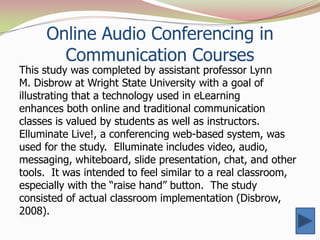
Online Audio Conferencing in
       Communication Courses
This study was completed by assistant professor Lynn
M. Disbrow at Wright State University with a goal of
illustrating that a technology used in eLearning
enhances both online and traditional communication
classes is valued by students as well as instructors.
Elluminate Live!, a conferencing web-based system, was
used for the study. Elluminate includes video, audio,
messaging, whiteboard, slide presentation, chat, and other
tools. It was intended to feel similar to a real classroom,
especially with the “raise hand” button. The study
consisted of actual classroom implementation (Disbrow,
2008).
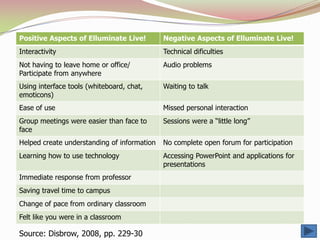
Positive Aspects of Elluminate Live!         Negative Aspects of Elluminate Live!
Interactivity                                Technical dificulties
Not having to leave home or office/          Audio problems
Participate from anywhere
Using interface tools (whiteboard, chat,     Waiting to talk
emoticons)
Ease of use                                  Missed personal interaction
Group meetings were easier than face to      Sessions were a “little long”
face
Helped create understanding of information   No complete open forum for participation
Learning how to use technology               Accessing PowerPoint and applications for
                                             presentations
Immediate response from professor
Saving travel time to campus
Change of pace from ordinary classroom
Felt like you were in a classroom

Source: Disbrow, 2008, pp. 229-30
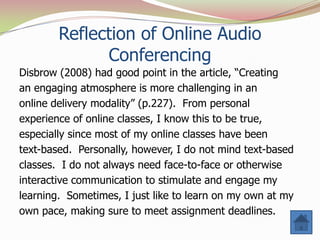
Reflection of Online Audio
              Conferencing
Disbrow (2008) had good point in the article, “Creating
an engaging atmosphere is more challenging in an
online delivery modality” (p.227). From personal
experience of online classes, I know this to be true,
especially since most of my online classes have been
text-based. Personally, however, I do not mind text-based
classes. I do not always need face-to-face or otherwise
interactive communication to stimulate and engage my
learning. Sometimes, I just like to learn on my own at my
own pace, making sure to meet assignment deadlines.
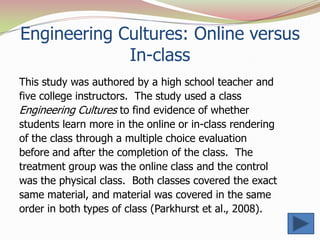
Engineering Cultures: Online versus
             In-class
This study was authored by a high school teacher and
five college instructors. The study used a class
Engineering Cultures to find evidence of whether
students learn more in the online or in-class rendering
of the class through a multiple choice evaluation
before and after the completion of the class. The
treatment group was the online class and the control
was the physical class. Both classes covered the exact
same material, and material was covered in the same
order in both types of class (Parkhurst et al., 2008).
Engineering Cultures: Online versus
          In-class cont.
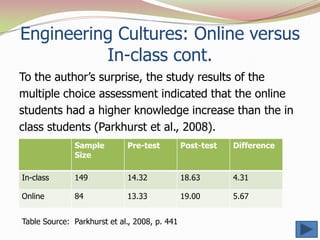
To the author’s surprise, the study results of the
multiple choice assessment indicated that the online
students had a higher knowledge increase than the in
class students (Parkhurst et al., 2008).
              Sample         Pre-test          Post-test   Difference
              Size

In-class      149            14.32             18.63       4.31

Online        84             13.33             19.00       5.67


Table Source: Parkhurst et al., 2008, p. 441
Reflection of Engineering Cultures
While I think this study was mostly well-done, I think
it is very important that the method be repeated in
different classes and across various campuses. Also,
there could be lurking variables to the results of the
assessment. The authors did point out one of my
concerns, “For example, students that are more motivated
and that are confident in their abilities may be more likely
to select to complete online course. These same students
may be more likely than the typical student to acquire
greater learning gains regardless of course structure”
(Parkhurst et al., 2008, p. 442).
The Role of Community in Online
            Learning Success
This study approached the
following questions (Sadera,
Robertson, Song, & Midon,
2009, p. 279):
 Is perceived learning
  affected by participation
  in the online community?
 How does the sense of
  community affect
  perceived learning?
 Does the amount and
  type of online interaction
  affect the feeling of
  membership in the
  learning community?
The Role of Community in Online
      Learning Success cont.
The study found the following positive correlations
(Sadera et al., 2009):
 between students’ knowledge gain and students’ amount
  of time and energy spent on the class
 between students’ knowledge gain and students’ active
  class contribution
 between students’ knowledge gain and the level of
  connectedness to the class
So, the study found that an overall positive relationship is
found between students’ sense of community and learning
achievements (Sadera et al., 2009).
Reflection of the Role of the
               Community
The role of community is important in all aspects of our
lives. We all want to feel as if we belong somewhere and
be able to effectively relate to others. In eLearning, it can
be hard to achieve this personal level of community,
though it is not impossible. The authors agree, further
research needs to be done in order to find out the best
ways to provide a sense of community to online learners
(Sadera et al., 2009). The major drawback of the study
was that it was performed on adult learners. I think the
study needs to be repeated through all levels of education,
K-12 as well as the traditional college student.
Putting it All Together
In conclusion, eLearning is an ever-growing, necessary
component to our education system. It is important
for eLearning to implement convenient user-friendly,
cost effective technologies in classrooms ranging from
elementary to higher education levels. More research
needs to be done to come to more conclusive results as to
what works in eLearning. Students should also be provided
with a sense of community within Internet based learning
experiences, whether implemented as an entire class or
just a classroom component. eLearning is not going away,
so it is important that we adjust to it and try to make it as
effective as possible.
References
 Disbrow, L. M. (2008, June). The overall effect of online
       audio conferencing in communication courses: what do
       students really think? MERLOT Journal of Online
       Learning and Teaching, 4(2). Retrieved from
       http://jolt.merlot.org/vol4no2/disbrow0608.pdf
 Parkhurst, R., Moskal, B. M., Downey, G. L., Lucena, J., Bigley,
       T., & Elberb S. (2008, December). Engineering
       cultures: online versus in-class. MERLOT Journal of
       Online Learning and Teaching 4(4). Retrieved from
       http://jolt.merlot.org/vol4no4/moskal_1208.pdf
 Sadera, W. A., Robertson, J., Song, L., & Midon, M. N. (2009,
       June). The role of community in online learning success.
       MERLOT Journal of Online Learning and Teaching 5(2).
       Retrieved from
       http://jolt.merlot.org/vol5no2/sadera_0609.pdf

A Look at eLearning

  • 1.
  • 2.
    How May IeDirect You? Articles:  The Overall Effect of Online Audio Conferencing in Communication Course: What do Students Really  Title Screen Think  Engineering Cultures:  Putting it All Together Online Versus In-class  The Role of Community  References in Online Learning Success
  • 3.
    Online Audio Conferencingin Communication Courses This study was completed by assistant professor Lynn M. Disbrow at Wright State University with a goal of illustrating that a technology used in eLearning enhances both online and traditional communication classes is valued by students as well as instructors. Elluminate Live!, a conferencing web-based system, was used for the study. Elluminate includes video, audio, messaging, whiteboard, slide presentation, chat, and other tools. It was intended to feel similar to a real classroom, especially with the “raise hand” button. The study consisted of actual classroom implementation (Disbrow, 2008).
  • 4.
    Positive Aspects ofElluminate Live! Negative Aspects of Elluminate Live! Interactivity Technical dificulties Not having to leave home or office/ Audio problems Participate from anywhere Using interface tools (whiteboard, chat, Waiting to talk emoticons) Ease of use Missed personal interaction Group meetings were easier than face to Sessions were a “little long” face Helped create understanding of information No complete open forum for participation Learning how to use technology Accessing PowerPoint and applications for presentations Immediate response from professor Saving travel time to campus Change of pace from ordinary classroom Felt like you were in a classroom Source: Disbrow, 2008, pp. 229-30
  • 5.
    Reflection of OnlineAudio Conferencing Disbrow (2008) had good point in the article, “Creating an engaging atmosphere is more challenging in an online delivery modality” (p.227). From personal experience of online classes, I know this to be true, especially since most of my online classes have been text-based. Personally, however, I do not mind text-based classes. I do not always need face-to-face or otherwise interactive communication to stimulate and engage my learning. Sometimes, I just like to learn on my own at my own pace, making sure to meet assignment deadlines.
  • 6.
    Engineering Cultures: Onlineversus In-class This study was authored by a high school teacher and five college instructors. The study used a class Engineering Cultures to find evidence of whether students learn more in the online or in-class rendering of the class through a multiple choice evaluation before and after the completion of the class. The treatment group was the online class and the control was the physical class. Both classes covered the exact same material, and material was covered in the same order in both types of class (Parkhurst et al., 2008).
  • 7.
    Engineering Cultures: Onlineversus In-class cont. To the author’s surprise, the study results of the multiple choice assessment indicated that the online students had a higher knowledge increase than the in class students (Parkhurst et al., 2008). Sample Pre-test Post-test Difference Size In-class 149 14.32 18.63 4.31 Online 84 13.33 19.00 5.67 Table Source: Parkhurst et al., 2008, p. 441
  • 8.
    Reflection of EngineeringCultures While I think this study was mostly well-done, I think it is very important that the method be repeated in different classes and across various campuses. Also, there could be lurking variables to the results of the assessment. The authors did point out one of my concerns, “For example, students that are more motivated and that are confident in their abilities may be more likely to select to complete online course. These same students may be more likely than the typical student to acquire greater learning gains regardless of course structure” (Parkhurst et al., 2008, p. 442).
  • 9.
    The Role ofCommunity in Online Learning Success This study approached the following questions (Sadera, Robertson, Song, & Midon, 2009, p. 279):  Is perceived learning affected by participation in the online community?  How does the sense of community affect perceived learning?  Does the amount and type of online interaction affect the feeling of membership in the learning community?
  • 10.
    The Role ofCommunity in Online Learning Success cont. The study found the following positive correlations (Sadera et al., 2009):  between students’ knowledge gain and students’ amount of time and energy spent on the class  between students’ knowledge gain and students’ active class contribution  between students’ knowledge gain and the level of connectedness to the class So, the study found that an overall positive relationship is found between students’ sense of community and learning achievements (Sadera et al., 2009).
  • 11.
    Reflection of theRole of the Community The role of community is important in all aspects of our lives. We all want to feel as if we belong somewhere and be able to effectively relate to others. In eLearning, it can be hard to achieve this personal level of community, though it is not impossible. The authors agree, further research needs to be done in order to find out the best ways to provide a sense of community to online learners (Sadera et al., 2009). The major drawback of the study was that it was performed on adult learners. I think the study needs to be repeated through all levels of education, K-12 as well as the traditional college student.
  • 12.
    Putting it AllTogether In conclusion, eLearning is an ever-growing, necessary component to our education system. It is important for eLearning to implement convenient user-friendly, cost effective technologies in classrooms ranging from elementary to higher education levels. More research needs to be done to come to more conclusive results as to what works in eLearning. Students should also be provided with a sense of community within Internet based learning experiences, whether implemented as an entire class or just a classroom component. eLearning is not going away, so it is important that we adjust to it and try to make it as effective as possible.
  • 13.
    References  Disbrow, L.M. (2008, June). The overall effect of online audio conferencing in communication courses: what do students really think? MERLOT Journal of Online Learning and Teaching, 4(2). Retrieved from http://jolt.merlot.org/vol4no2/disbrow0608.pdf  Parkhurst, R., Moskal, B. M., Downey, G. L., Lucena, J., Bigley, T., & Elberb S. (2008, December). Engineering cultures: online versus in-class. MERLOT Journal of Online Learning and Teaching 4(4). Retrieved from http://jolt.merlot.org/vol4no4/moskal_1208.pdf  Sadera, W. A., Robertson, J., Song, L., & Midon, M. N. (2009, June). The role of community in online learning success. MERLOT Journal of Online Learning and Teaching 5(2). Retrieved from http://jolt.merlot.org/vol5no2/sadera_0609.pdf