APP PGR: Workshop 2
Enhancing Skills in Small
and Large Group
Teaching
Morning! Grab a coffee and write your
name on a large post-it note.
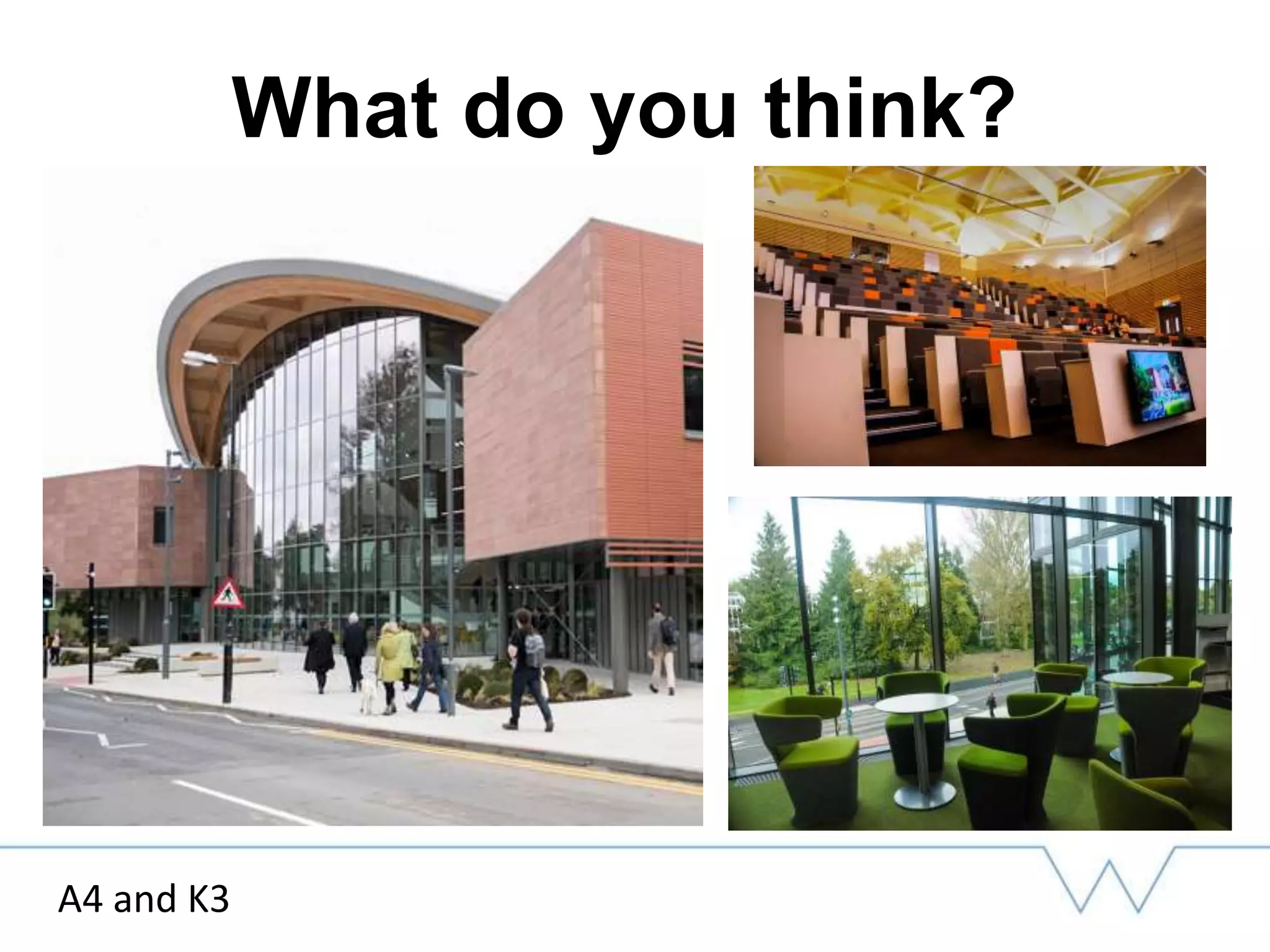
Warm up question: What are your thoughts on the
Oculus?
What do you think?
A4 and K3
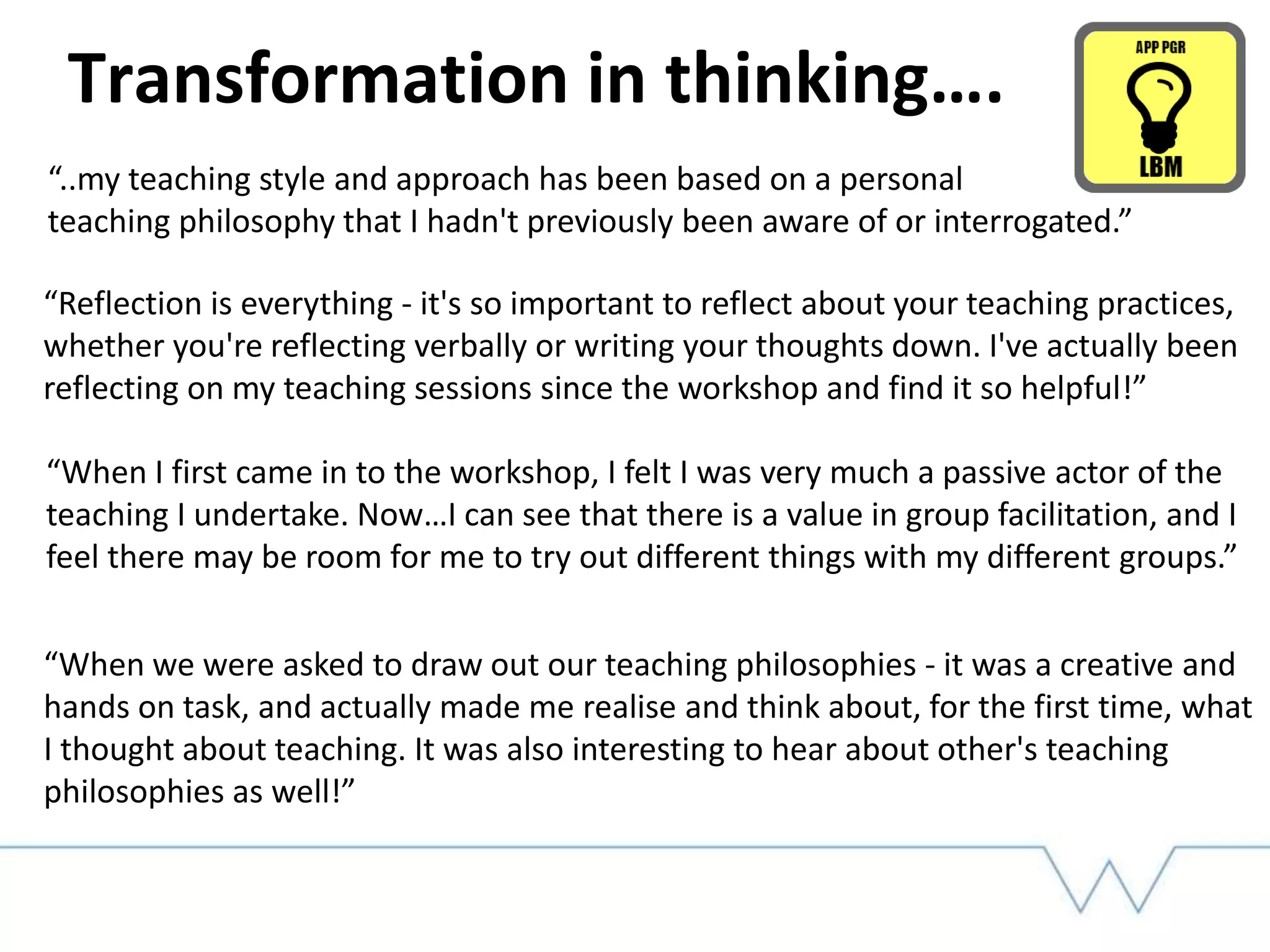
Transformation in thinking….
“..my teaching style and approach has been based on a personal
teaching philosophy that I hadn't previously been aware of or interrogated.”
“Reflection is everything - it's so important to reflect about your teaching practices,
whether you're reflecting verbally or writing your thoughts down. I've actually been
reflecting on my teaching sessions since the workshop and find it so helpful!”
“When I first came in to the workshop, I felt I was very much a passive actor of the
teaching I undertake. Now…I can see that there is a value in group facilitation, and I
feel there may be room for me to try out different things with my different groups.”
“When we were asked to draw out our teaching philosophies - it was a creative and
hands on task, and actually made me realise and think about, for the first time, what
I thought about teaching. It was also interesting to hear about other's teaching
philosophies as well!”
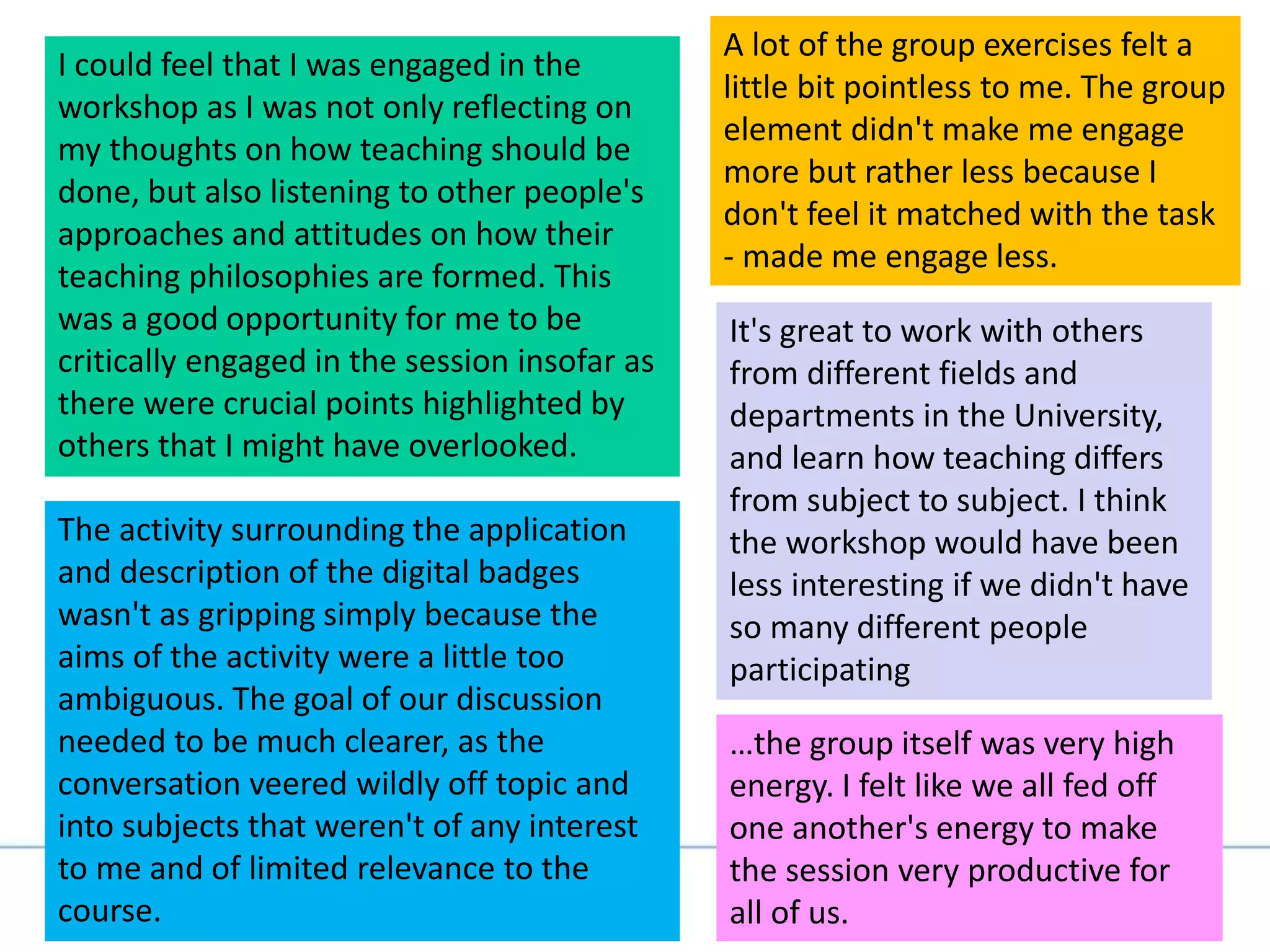
I could feel that I was engaged in the
workshop as I was not only reflecting on
my thoughts on how teaching should be
done, but also listening to other people's
approaches and attitudes on how their
teaching philosophies are formed. This
was a good opportunity for me to be
critically engaged in the session insofar as
there were crucial points highlighted by
others that I might have overlooked.
A lot of the group exercises felt a
little bit pointless to me. The group
element didn't make me engage
more but rather less because I
don't feel it matched with the task
- made me engage less.
The activity surrounding the application
and description of the digital badges
wasn't as gripping simply because the
aims of the activity were a little too
ambiguous. The goal of our discussion
needed to be much clearer, as the
conversation veered wildly off topic and
into subjects that weren't of any interest
to me and of limited relevance to the
course.
It's great to work with others
from different fields and
departments in the University,
and learn how teaching differs
from subject to subject. I think
the workshop would have been
less interesting if we didn't have
so many different people
participating
…the group itself was very high
energy. I felt like we all fed off
one another's energy to make
the session very productive for
all of us.
Learning outcomes
To identify the relationship between subject discipline
and teaching approach (K1, K2, A2).
To consider the benefits and issues, and differences
between small and large group teaching, including the
role of the tutor and students (A2, A4, V2).
To begin to plan for learning, incorporating active
strategies and student-centred approaches (A1, A2, K3)
To experience and evaluate techniques for teaching
groups, critically evaluating them with peers and within
subject-disciplinary contexts (A2, A4, K2, K3).
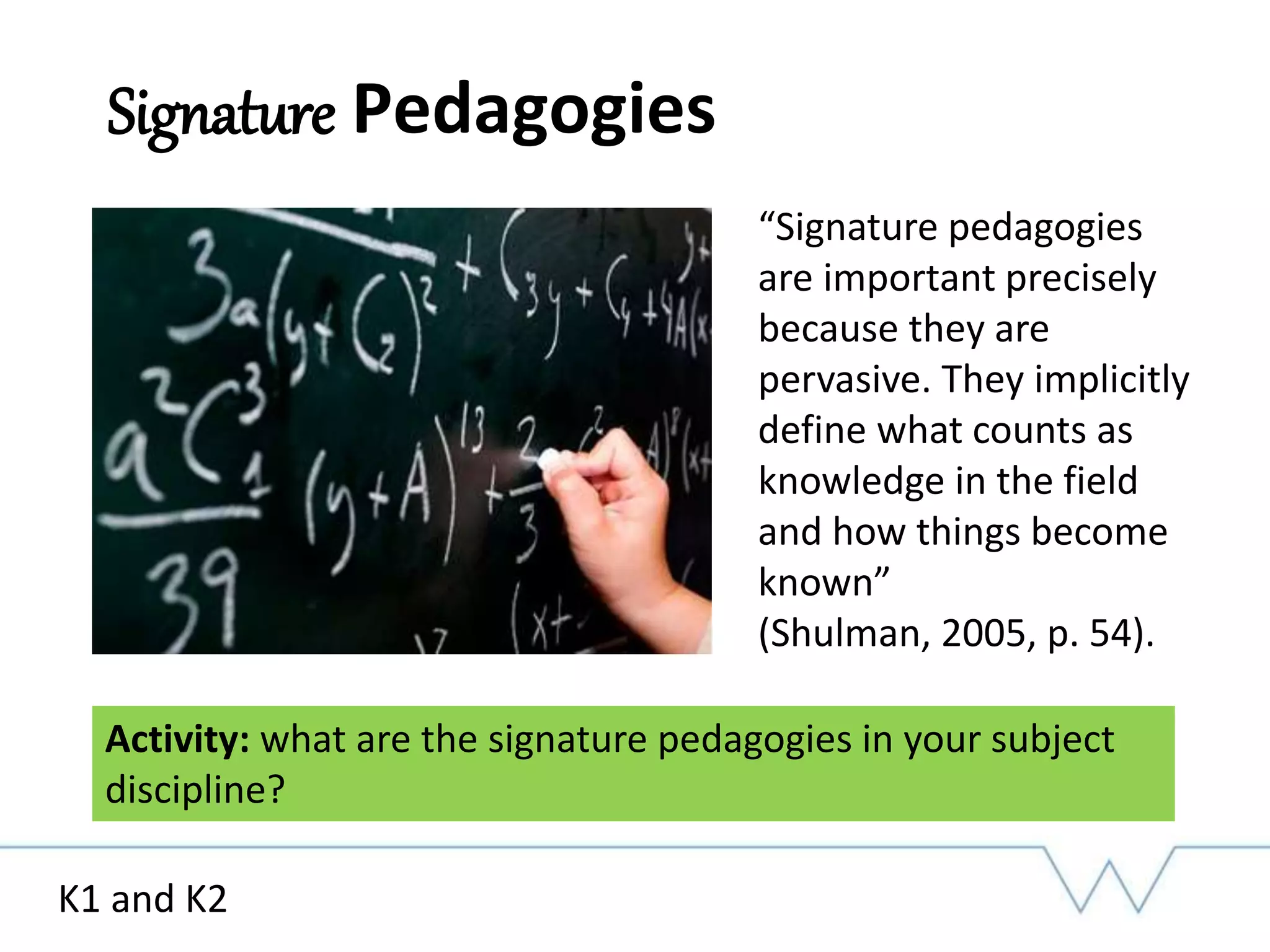
Signature Pedagogies
“Signature pedagogies
are important precisely
because they are
pervasive. They implicitly
define what counts as
knowledge in the field
and how things become
known”
(Shulman, 2005, p. 54).
Activity: what are the signature pedagogies in your subject
discipline?
K1 and K2
Homework tasks*….
10/12 responded to the evaluation form
7/12 are members of the APP PGR MyPortfolio
group
7/15 have shared their e-portfolio with me
7/15 have engaged with Teaching Philosophy
task, Reflective practice and/or UKPSF
37 post-its on the ‘Lectures: Fab or Drab’ wall
(Routes A and B together; 4 are mine, 19 new
posts since Friday)
*At 2.30pm on Wednesday afternoon
1. Most universities now
record their lectures, so
missing the lecture in the
set place and time doesn’t
harm your studies – it
improves it.
2. I graduated with a 2:1 in
history, I never attended
lectures because I believe
most of the learning comes
from outside the class.
3. Students who choose to
watch the video instead of
attending the lecture miss
out on the opportunity to
ask questions then and
there, or participate in
discussion.
Teuta Hoxha, Is Missing Lectures Harming my Studies? The Guardian online, 11/12/15
https://www.theguardian.com/education/2015/dec/11/is-missing-lectures-harming-my-
studies?utm_content=buffer10b7b&utm_medium=social&utm_source=twitter.com&utm_campaign=buffer
In lectures, after what time do
students start to lose their
concentration?
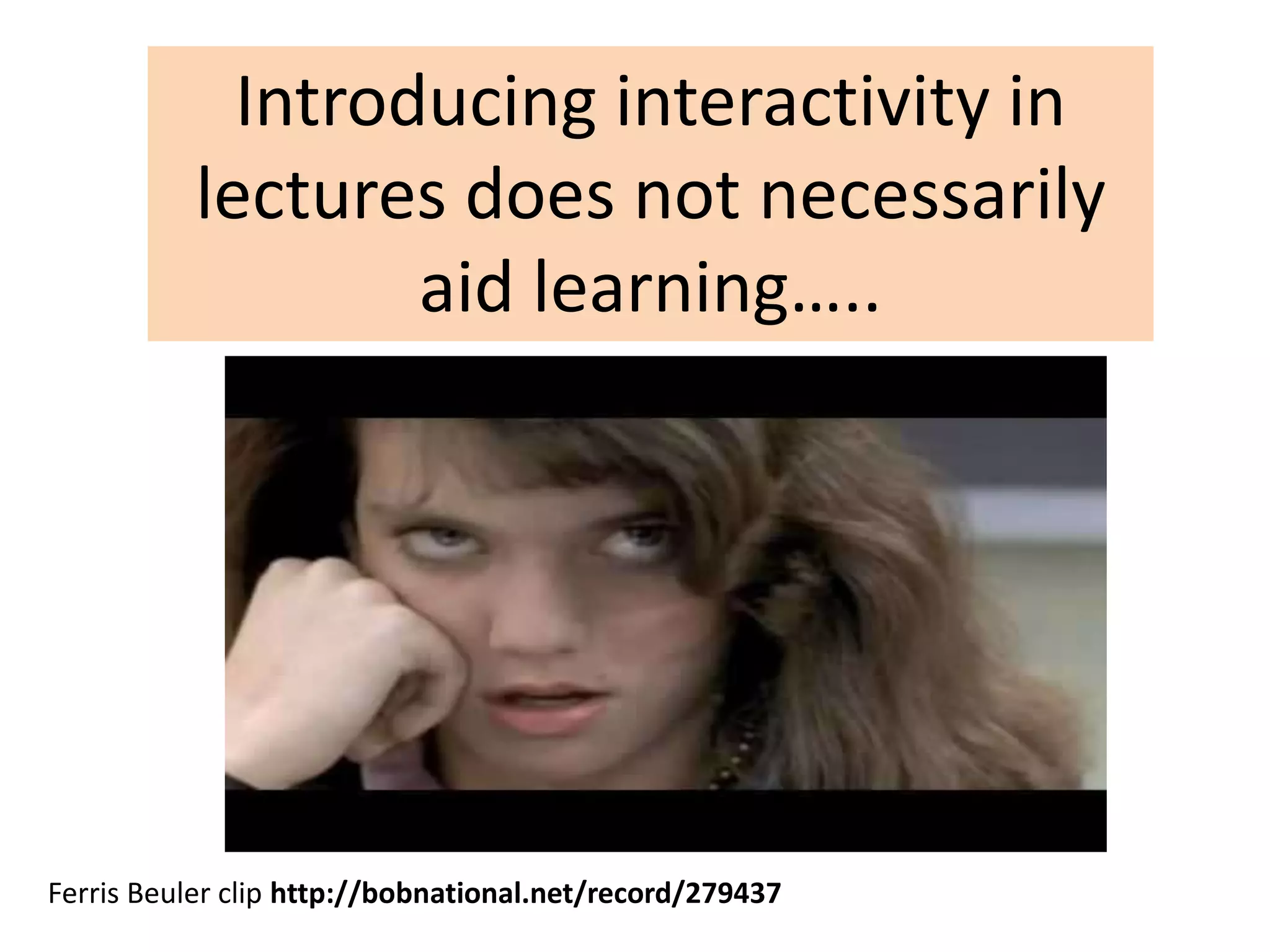
Introducing interactivity in
lectures does not necessarily
aid learning…..
Ferris Beuler clip http://bobnational.net/record/279437
Large Group Teaching Top Trumps
Activity: In small groups, look over the 10 strategies for
interactivity in large groups/lectures. Consider their worth, and
their ‘risks’ and try to rank them in some sort of preferential
order. Use the Teaching Grid to display your cards and additional
post-it notes alongside the cards to offer further explanation or
example.
A basic lecture structure
• Introduction and overview
• purpose and context of lecture
• overview of main points of lecture
• revision of earlier material to provide foundation
• Main points (3-4)
• summary of first main point
• development and explanation of ideas
• examples
• restatement of first point
• Summary and conclusions
• restatement and review of main points
• conclusion or implications
• details of next lecture, preparations, etc.
Context
Content
Closure
A comparative structure
• Introduction and overview
• Theory A
• Theory B
• Criteria for comparing theories
• Comparisons and contrasts between
theories A and B
• Summary and conclusions
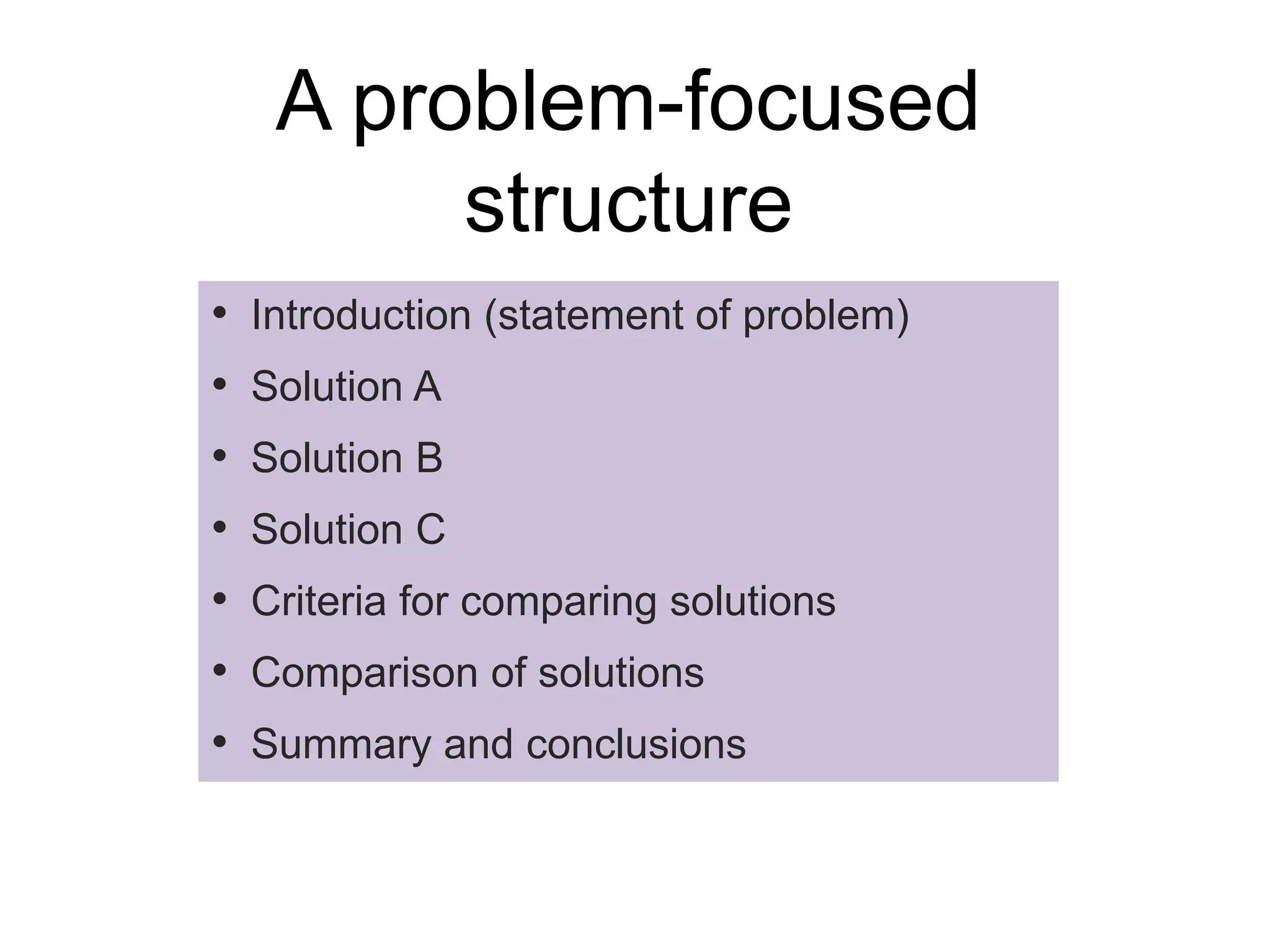
A problem-focused
structure
• Introduction (statement of problem)
• Solution A
• Solution B
• Solution C
• Criteria for comparing solutions
• Comparison of solutions
• Summary and conclusions
Plan a 50 minute lecture
Activity: in small groups, plan a 50 minute lecture with
consideration for:
• Timing, breaks and opportunities for ‘change’
• Learning outcomes
• Relationship of lecture to remainder of the module
• Resources, activities and approaches
• Lecture structure
• Interactivity (use at least one method discussed)
• Assessment and evaluation
A1, A2, K3
The (new and topical*) discipline
of worm taming
*possible exaggeration
Flipped classroom
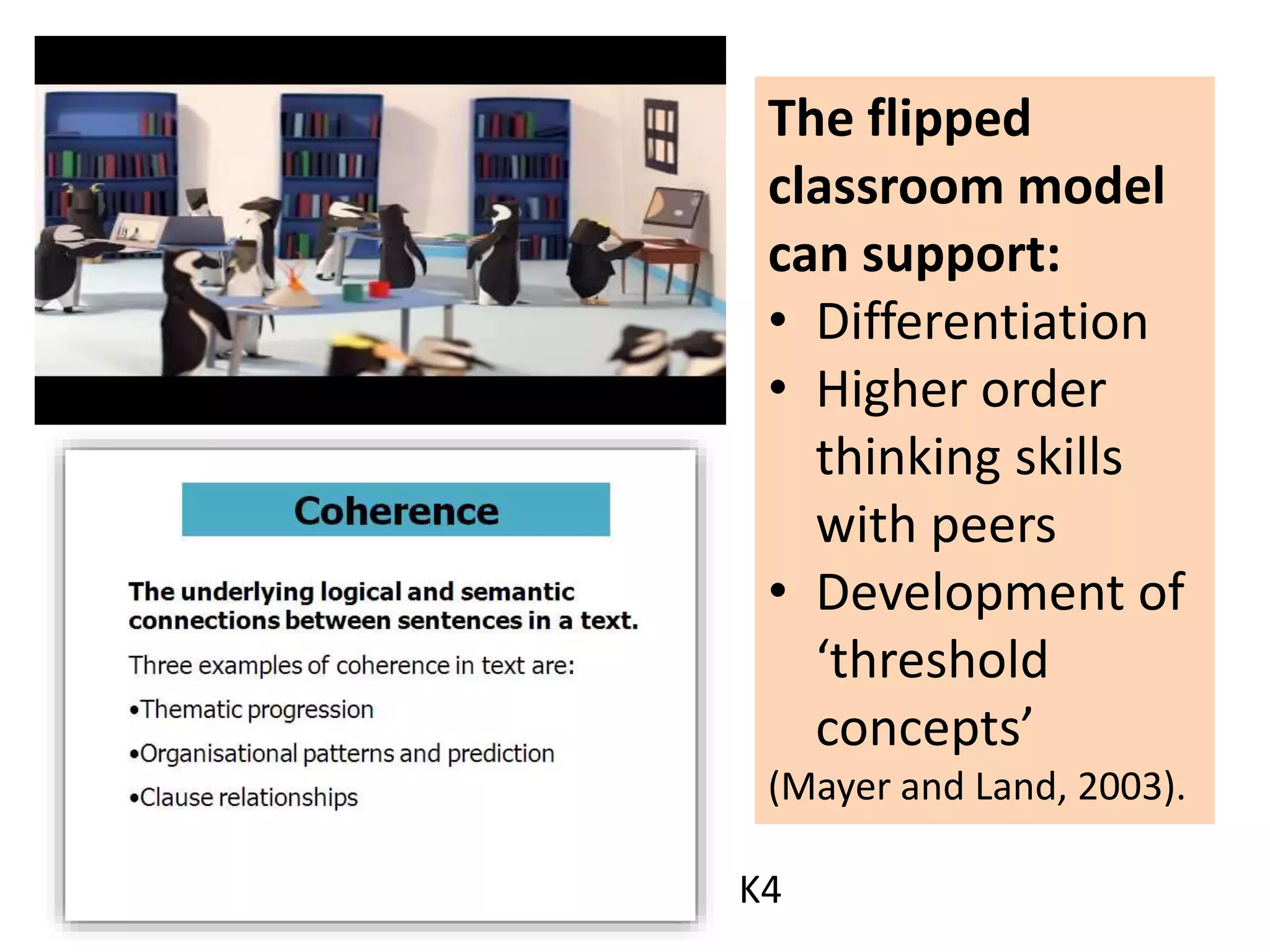
The flipped
classroom model
can support:
• Differentiation
• Higher order
thinking skills
with peers
• Development of
‘threshold
concepts’
(Mayer and Land, 2003).
K4
HEA: Manifesto for Small Group
Teaching
Key strengths of small group teaching:
(Mills, D and Alexander, P. ‘Small Group Teaching: a toolkit for learning’ The Higher Education
Academy, March 2013)
Flexibility Interactivity
Reflexivity Engagement
Philosophies of small group teaching
• Vygotsky – zone of
proximal development
• Dewey – experiential
learning
• Piaget – social
constructivist learning
• Exley and Dennick – both
content and process
• Brookfield – interaction,
democratic education
• Petty – active learning
• Knowles – adult learning
based on experience
The best group approaches are active
and ensure that students are involved
and engaged.
• Active learning is individual but can be
supported and enhanced in groups.
• Active learning roles can be varied
• Group work also needs to be
managed
Active learning strategies
Activity: Consider the 25 methods for active learning presented
by Petty. Work with subject discipline groups to discuss their
potential. Be open minded!
http://www.teacherstoolbox.co.uk/25ways.html
Petty also describes roles which could encourage active learning in a
small group:
Teacher – explains concepts to learners
Checker – verify individual’s understanding
Scribe- summarises key points
Questioner – decides on questions that the activity should ‘answer’
Vocabulary chief – research and explain terms
Leader – manages group in a democratic way
Active learning roles
Quick thinker: What might be the nature of these roles be?
Devil’s advocate Googler Horizon scanner
Divergent thinker Runner Wildcard
Themes in small group teaching
• Game-based learning
• Open-space learning
• Peer learning and reciprocal teaching
• Case-based learning
• Problem-based learning
• Technology-enhanced learning
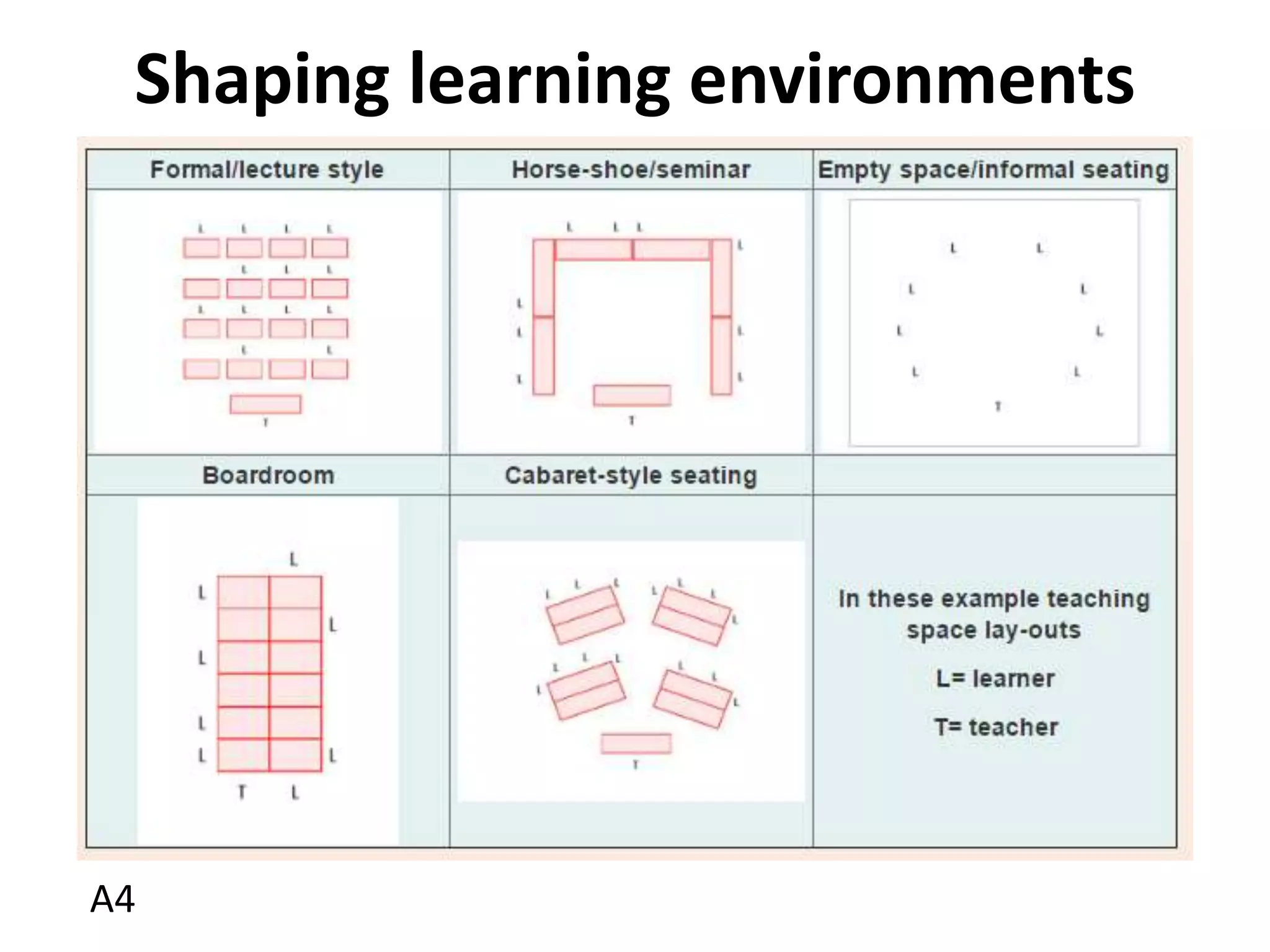
Shaping learning environments
A4
Open space learning
Interdisciplinarity is an
important, current theme
in Warwick Teaching.
Open-space learning often
forms a key part of this
work.
Industrial and creative
partners (e.g. RSC) sees
‘education’ entering spaces
outside of institutions, and
traditionally ‘non-teaching’
approaches being
integrated.
• The application of games-based elements and
approaches to non-games contexts.
• Includes concerns for motivation, awards, competition,
progress through levels, instructions and social elements.
• There are a number of educational technology tools
which can support this approach:
Gamification
K4
The Pedagogy Clinic
Activity: take two common
pedagogical ailments (one
student, one tutor) and
consider the symptoms and
underlying causes. Diagnose
the problem and offer
treatments which could offer
either short term or longer
term relief, support or cure!
Your ideas may be reviewed by
a senior clinician….
• Wheeler et al (2005) discuss the notion of distributed
problem-based learning online and ‘communities of practice’.
• Discursive online dialogue can lead to a ZPD (Vygotsky, 1978)
– an incremental shift of an individual’s cognitive
development, through peer interactions.
• DPBL can be achieved in synchronous and asynchronous
environments.
• Notions of online identity and its relationship to actual,
professional identity.
Wheeler, S (2005) The influence of online problem-based learning on teachers’ professional practice and identity
ALT-J Research in Learning Technology Journal. v. 13. no. 2. 2005. p. 125
Problem-based learning online
Critical closing questions
How far do your students understand ‘how to learn’
in large and small group teaching situations? What
might you need to do to equip them?
Can you identify one (or more) teaching/learning
methods or resources that you have used today that
you could take forward into your own practice? In
particular, what might you use that offers a
different approach from an existing signature
pedagogy?
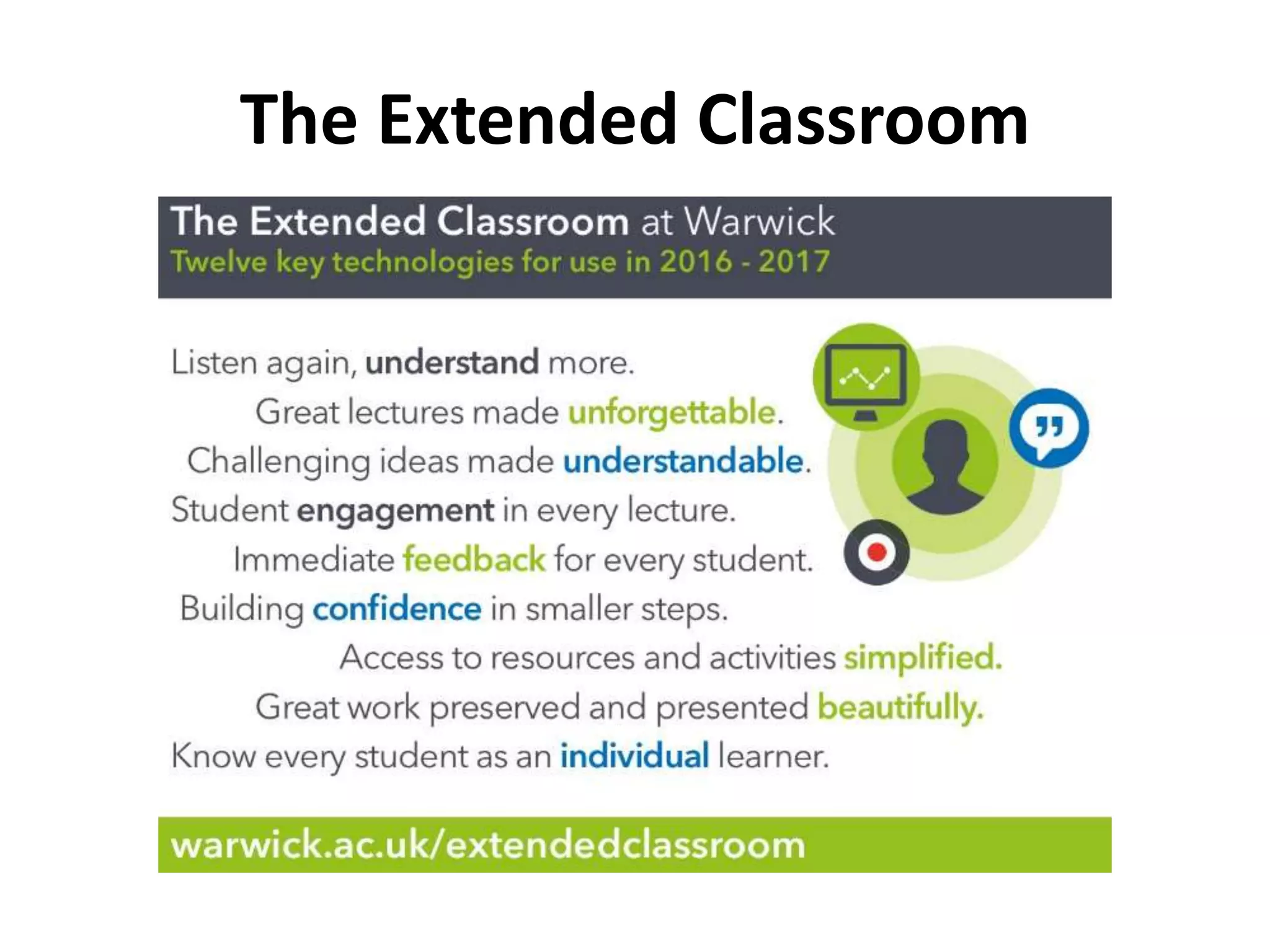
The Extended Classroom

App pgr workshop2 2017-18

  • 1.
    APP PGR: Workshop2 Enhancing Skills in Small and Large Group Teaching
  • 2.
    Morning! Grab acoffee and write your name on a large post-it note. Warm up question: What are your thoughts on the Oculus?
  • 3.
    What do youthink? A4 and K3
  • 4.
    Transformation in thinking…. “..myteaching style and approach has been based on a personal teaching philosophy that I hadn't previously been aware of or interrogated.” “Reflection is everything - it's so important to reflect about your teaching practices, whether you're reflecting verbally or writing your thoughts down. I've actually been reflecting on my teaching sessions since the workshop and find it so helpful!” “When I first came in to the workshop, I felt I was very much a passive actor of the teaching I undertake. Now…I can see that there is a value in group facilitation, and I feel there may be room for me to try out different things with my different groups.” “When we were asked to draw out our teaching philosophies - it was a creative and hands on task, and actually made me realise and think about, for the first time, what I thought about teaching. It was also interesting to hear about other's teaching philosophies as well!”
  • 5.
    I could feelthat I was engaged in the workshop as I was not only reflecting on my thoughts on how teaching should be done, but also listening to other people's approaches and attitudes on how their teaching philosophies are formed. This was a good opportunity for me to be critically engaged in the session insofar as there were crucial points highlighted by others that I might have overlooked. A lot of the group exercises felt a little bit pointless to me. The group element didn't make me engage more but rather less because I don't feel it matched with the task - made me engage less. The activity surrounding the application and description of the digital badges wasn't as gripping simply because the aims of the activity were a little too ambiguous. The goal of our discussion needed to be much clearer, as the conversation veered wildly off topic and into subjects that weren't of any interest to me and of limited relevance to the course. It's great to work with others from different fields and departments in the University, and learn how teaching differs from subject to subject. I think the workshop would have been less interesting if we didn't have so many different people participating …the group itself was very high energy. I felt like we all fed off one another's energy to make the session very productive for all of us.
  • 6.
    Learning outcomes To identifythe relationship between subject discipline and teaching approach (K1, K2, A2). To consider the benefits and issues, and differences between small and large group teaching, including the role of the tutor and students (A2, A4, V2). To begin to plan for learning, incorporating active strategies and student-centred approaches (A1, A2, K3) To experience and evaluate techniques for teaching groups, critically evaluating them with peers and within subject-disciplinary contexts (A2, A4, K2, K3).
  • 7.
    Signature Pedagogies “Signature pedagogies areimportant precisely because they are pervasive. They implicitly define what counts as knowledge in the field and how things become known” (Shulman, 2005, p. 54). Activity: what are the signature pedagogies in your subject discipline? K1 and K2
  • 8.
    Homework tasks*…. 10/12 respondedto the evaluation form 7/12 are members of the APP PGR MyPortfolio group 7/15 have shared their e-portfolio with me 7/15 have engaged with Teaching Philosophy task, Reflective practice and/or UKPSF 37 post-its on the ‘Lectures: Fab or Drab’ wall (Routes A and B together; 4 are mine, 19 new posts since Friday) *At 2.30pm on Wednesday afternoon
  • 9.
    1. Most universitiesnow record their lectures, so missing the lecture in the set place and time doesn’t harm your studies – it improves it. 2. I graduated with a 2:1 in history, I never attended lectures because I believe most of the learning comes from outside the class. 3. Students who choose to watch the video instead of attending the lecture miss out on the opportunity to ask questions then and there, or participate in discussion. Teuta Hoxha, Is Missing Lectures Harming my Studies? The Guardian online, 11/12/15 https://www.theguardian.com/education/2015/dec/11/is-missing-lectures-harming-my- studies?utm_content=buffer10b7b&utm_medium=social&utm_source=twitter.com&utm_campaign=buffer
  • 10.
    In lectures, afterwhat time do students start to lose their concentration?
  • 11.
    Introducing interactivity in lecturesdoes not necessarily aid learning….. Ferris Beuler clip http://bobnational.net/record/279437
  • 12.
    Large Group TeachingTop Trumps Activity: In small groups, look over the 10 strategies for interactivity in large groups/lectures. Consider their worth, and their ‘risks’ and try to rank them in some sort of preferential order. Use the Teaching Grid to display your cards and additional post-it notes alongside the cards to offer further explanation or example.
  • 13.
    A basic lecturestructure • Introduction and overview • purpose and context of lecture • overview of main points of lecture • revision of earlier material to provide foundation • Main points (3-4) • summary of first main point • development and explanation of ideas • examples • restatement of first point • Summary and conclusions • restatement and review of main points • conclusion or implications • details of next lecture, preparations, etc. Context Content Closure
  • 14.
    A comparative structure •Introduction and overview • Theory A • Theory B • Criteria for comparing theories • Comparisons and contrasts between theories A and B • Summary and conclusions
  • 15.
    A problem-focused structure • Introduction(statement of problem) • Solution A • Solution B • Solution C • Criteria for comparing solutions • Comparison of solutions • Summary and conclusions
  • 16.
    Plan a 50minute lecture Activity: in small groups, plan a 50 minute lecture with consideration for: • Timing, breaks and opportunities for ‘change’ • Learning outcomes • Relationship of lecture to remainder of the module • Resources, activities and approaches • Lecture structure • Interactivity (use at least one method discussed) • Assessment and evaluation A1, A2, K3
  • 17.
    The (new andtopical*) discipline of worm taming *possible exaggeration
  • 18.
  • 19.
    The flipped classroom model cansupport: • Differentiation • Higher order thinking skills with peers • Development of ‘threshold concepts’ (Mayer and Land, 2003). K4
  • 20.
    HEA: Manifesto forSmall Group Teaching Key strengths of small group teaching: (Mills, D and Alexander, P. ‘Small Group Teaching: a toolkit for learning’ The Higher Education Academy, March 2013) Flexibility Interactivity Reflexivity Engagement
  • 21.
    Philosophies of smallgroup teaching • Vygotsky – zone of proximal development • Dewey – experiential learning • Piaget – social constructivist learning • Exley and Dennick – both content and process • Brookfield – interaction, democratic education • Petty – active learning • Knowles – adult learning based on experience
  • 22.
    The best groupapproaches are active and ensure that students are involved and engaged. • Active learning is individual but can be supported and enhanced in groups. • Active learning roles can be varied • Group work also needs to be managed Active learning strategies Activity: Consider the 25 methods for active learning presented by Petty. Work with subject discipline groups to discuss their potential. Be open minded! http://www.teacherstoolbox.co.uk/25ways.html
  • 23.
    Petty also describesroles which could encourage active learning in a small group: Teacher – explains concepts to learners Checker – verify individual’s understanding Scribe- summarises key points Questioner – decides on questions that the activity should ‘answer’ Vocabulary chief – research and explain terms Leader – manages group in a democratic way Active learning roles Quick thinker: What might be the nature of these roles be? Devil’s advocate Googler Horizon scanner Divergent thinker Runner Wildcard
  • 24.
    Themes in smallgroup teaching • Game-based learning • Open-space learning • Peer learning and reciprocal teaching • Case-based learning • Problem-based learning • Technology-enhanced learning
  • 25.
  • 26.
    Open space learning Interdisciplinarityis an important, current theme in Warwick Teaching. Open-space learning often forms a key part of this work. Industrial and creative partners (e.g. RSC) sees ‘education’ entering spaces outside of institutions, and traditionally ‘non-teaching’ approaches being integrated.
  • 27.
    • The applicationof games-based elements and approaches to non-games contexts. • Includes concerns for motivation, awards, competition, progress through levels, instructions and social elements. • There are a number of educational technology tools which can support this approach: Gamification K4
  • 28.
    The Pedagogy Clinic Activity:take two common pedagogical ailments (one student, one tutor) and consider the symptoms and underlying causes. Diagnose the problem and offer treatments which could offer either short term or longer term relief, support or cure! Your ideas may be reviewed by a senior clinician….
  • 29.
    • Wheeler etal (2005) discuss the notion of distributed problem-based learning online and ‘communities of practice’. • Discursive online dialogue can lead to a ZPD (Vygotsky, 1978) – an incremental shift of an individual’s cognitive development, through peer interactions. • DPBL can be achieved in synchronous and asynchronous environments. • Notions of online identity and its relationship to actual, professional identity. Wheeler, S (2005) The influence of online problem-based learning on teachers’ professional practice and identity ALT-J Research in Learning Technology Journal. v. 13. no. 2. 2005. p. 125 Problem-based learning online
  • 30.
    Critical closing questions Howfar do your students understand ‘how to learn’ in large and small group teaching situations? What might you need to do to equip them? Can you identify one (or more) teaching/learning methods or resources that you have used today that you could take forward into your own practice? In particular, what might you use that offers a different approach from an existing signature pedagogy?
  • 31.

Editor's Notes

  • #4 Could be a comparison of two arguments, concepts, works, processes, systems, problem solving techniques, etc. Discuss strengths & weaknesses Could be an ideal structure for student involvement with students – get them to vote at end. important to build on their prior learning and to signpost the lecture well so that they don’t get lost
  • #12 Ferris Beuler clip also for discussion http://bobnational.net/record/279437
  • #14 11.15 Briefly run through the 4 lecture structures before reflecting on them in groups. Exley an Dennick provide further examples if you are interested. Purpose and overview of lecture…. Research (Habeshaw) students think all lectures same identical. Student expectations -> What’s your role and theirs in terms of questions, activities etc. / notes Reassurance. Revision of earlier material -> activate prior learning. Constructivist view Main - dev and exp of ideas. signposting… Remind the students of where we are in the lecture, main points and what we are going to do next. Key points they really need to know. Giving examples, make them real and relevant. Chemistry / Sciences Timing. 1 hour lecture slot….. Actually 50 mins Think about practicalities – next session etc. Closure is often missing!
  • #15 Could be a comparison of two arguments, concepts, works, processes, systems, problem solving techniques, etc. Discuss strengths & weaknesses Could be an ideal structure for student involvement with students – get them to vote at end. important to build on their prior learning and to signpost the lecture well so that they don’t get lost
  • #16 This is quite linear brief mention of this. Take this example with a number of solutions. helpful in getting students to think analytically, critically independent learning.(criteria for comparing Common problems is that students often see only one way… Inductive: Figures – hypothesis Deductive: hypothesis – figures