APP PGR: Workshop 1
Course introduction,
Reflective Practice and
Teaching Philosophy
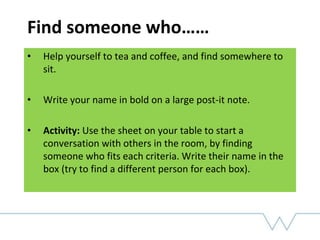
Find someone who……
• Help yourself to tea and coffee, and find somewhere to
sit.
• Write your name in bold on a large post-it note.
• Activity: Use the sheet on your table to start a
conversation with others in the room, by finding
someone who fits each criteria. Write their name in the
box (try to find a different person for each box).
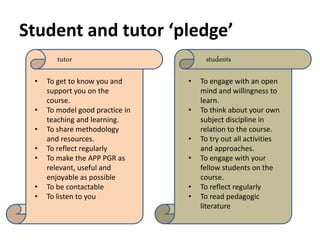
Student and tutor ‘pledge’
• To get to know you and
support you on the
course.
• To model good practice in
teaching and learning.
• To share methodology
and resources.
• To reflect regularly
• To make the APP PGR as
relevant, useful and
enjoyable as possible
• To be contactable
• To listen to you
• To engage with an open
mind and willingness to
learn.
• To think about your own
subject discipline in
relation to the course.
• To try out all activities
and approaches.
• To engage with your
fellow students on the
course.
• To reflect regularly
• To read pedagogic
literature
tutor students
Learning outcomes (workshop 1)
• To clarify the constituent parts of the APP PGR
and understand its position in the Higher
Education teacher training framework.
• To familiarise yourself with the e-portfolio and
begin to edit it.
• To reflect on who you are as a teacher, by
beginning to construct a Teaching Philosophy.
• To examine a range of models and examples of
reflective practice.
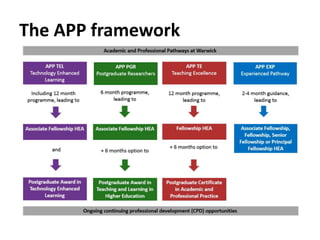
The APP framework
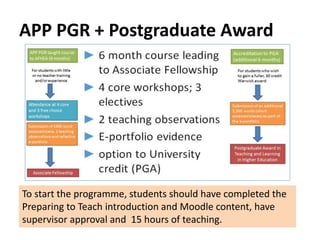
APP PGR + Postgraduate Award
To start the programme, students should have completed the
Preparing to Teach introduction and Moodle content, have
supervisor approval and 15 hours of teaching.
Key tenets of the course
• Core and free choice workshops for experiential learning
• Moodle space for course management, dialogue, resources,
online activities and groups.
• Digital badges for formative, peer assessment
• E-Portfolios for assessed pieces and reflective practice.
• Twitter hashtag for shared endeavours and announcements
#apppgr
• Subject mentor for coaching and teaching observations
• Assessed pieces working towards Associate Fellowship status
• Reflective practice over the duration of the pathway
• Engagement with pedagogic literature – both generic and
discipline-specific
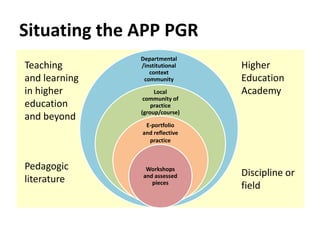
Situating the APP PGR
Departmental
/institutional
context
community
Local
community of
practice
(group/course)
E-portfolio
and reflective
practice
Workshops
and assessed
pieces
Teaching
and learning
in higher
education
and beyond
Higher
Education
Academy
Pedagogic
literature
Discipline or
field
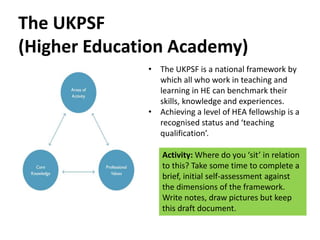
The UKPSF
(Higher Education Academy)
Activity: Where do you ‘sit’ in relation
to this? Take some time to complete a
brief, initial self-assessment against
the dimensions of the framework.
Write notes, draw pictures but keep
this draft document.
• The UKPSF is a national framework by
which all who work in teaching and
learning in HE can benchmark their
skills, knowledge and experiences.
• Achieving a level of HEA fellowship is a
recognised status and ‘teaching
qualification’.
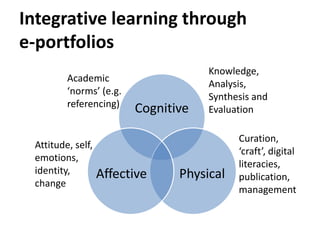
Integrative learning through
e-portfolios
Cognitive
PhysicalAffective
Knowledge,
Analysis,
Synthesis and
Evaluation
Academic
‘norms’ (e.g.
referencing)
Attitude, self,
emotions,
identity,
change
Curation,
‘craft’, digital
literacies,
publication,
management
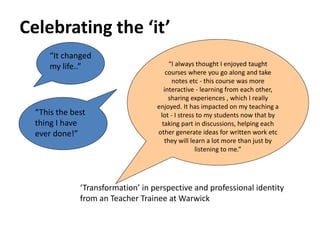
Celebrating the ‘it’
“It changed
my life..”
“This the best
thing I have
ever done!”
“I always thought I enjoyed taught
courses where you go along and take
notes etc - this course was more
interactive - learning from each other,
sharing experiences , which I really
enjoyed. It has impacted on my teaching a
lot - I stress to my students now that by
taking part in discussions, helping each
other generate ideas for written work etc
they will learn a lot more than just by
listening to me.”
‘Transformation’ in perspective and professional identity
from an Teacher Trainee at Warwick
Digital badges
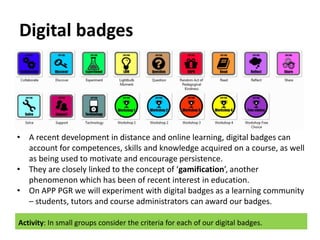
• A recent development in distance and online learning, digital badges can
account for competences, skills and knowledge acquired on a course, as well
as being used to motivate and encourage persistence.
• They are closely linked to the concept of ‘gamification’, another
phenomenon which has been of recent interest in education.
• On APP PGR we will experiment with digital badges as a learning community
– students, tutors and course administrators can award our badges.
Activity: In small groups consider the criteria for each of our digital badges.
Teaching Philosophy
• One of the assessed pieces in the e-portfolio is
a Teaching Philosophy statement.
• This sets a baseline for your practice, but is
also an evolving account of yourself as a
teacher.
• Your teaching philosophy evolves from your
own experiences as a learner, experiences as
you think and teach and the influences of your
peers, institution and literature.
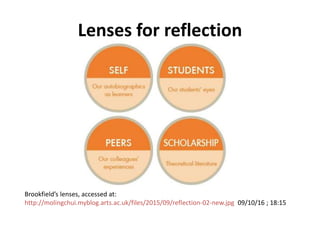
Lenses for reflection
Brookfield’s lenses, accessed at:
http://molingchui.myblog.arts.ac.uk/files/2015/09/reflection-02-new.jpg 09/10/16 ; 18:15
Rich pictures to evolve thinking
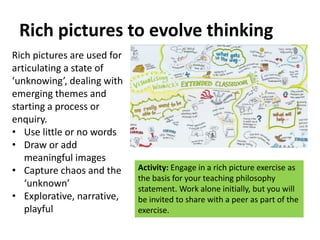
Rich pictures are used for
articulating a state of
‘unknowing’, dealing with
emerging themes and
starting a process or
enquiry.
• Use little or no words
• Draw or add
meaningful images
• Capture chaos and the
‘unknown’
• Explorative, narrative,
playful
Activity: Engage in a rich picture exercise as
the basis for your teaching philosophy
statement. Work alone initially, but you will
be invited to share with a peer as part of the
exercise.
What is reflective practice?
Activity: Work in small groups to discuss what you understand
by reflective practice.
This could include:
• Broadly, what the term might mean.
• Specifically what you might reflect on, when and why.
• How a teacher might reflect
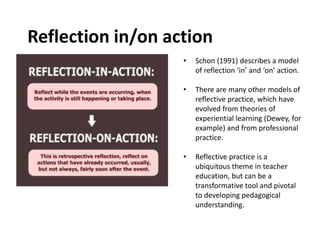
Reflection in/on action
• Schon (1991) describes a model
of reflection ‘in’ and ‘on’ action.
• There are many other models of
reflective practice, which have
evolved from theories of
experiential learning (Dewey, for
example) and from professional
practice.
• Reflective practice is a
ubiquitous theme in teacher
education, but can be a
transformative tool and pivotal
to developing pedagogical
understanding.
Activity: considering different models
• Look over the model you have been presented with
• Make sure the model is clear to everyone in the group.
• Use the Internet to find out a little more about the
model/add some details to your understanding.
• See if you can come up with at least one example of this
model ‘in action’ (this might be based on your own
experiences or an example you find online).
• Be prepared to disseminate your findings to others.
Models of reflective practice
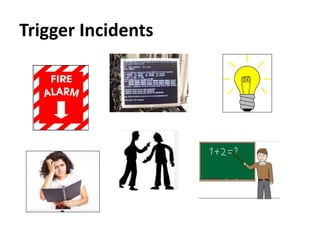
Trigger Incidents
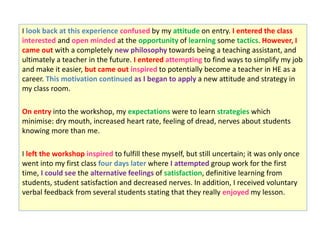
I look back at this experience confused by my attitude on entry. I entered the class
interested and open minded at the opportunity of learning some tactics. However, I
came out with a completely new philosophy towards being a teaching assistant, and
ultimately a teacher in the future. I entered attempting to find ways to simplify my job
and make it easier, but came out inspired to potentially become a teacher in HE as a
career. This motivation continued as I began to apply a new attitude and strategy in
my class room.
On entry into the workshop, my expectations were to learn strategies which
minimise: dry mouth, increased heart rate, feeling of dread, nerves about students
knowing more than me.
I left the workshop inspired to fulfill these myself, but still uncertain; it was only once
went into my first class four days later where I attempted group work for the first
time, I could see the alternative feelings of satisfaction, definitive learning from
students, student satisfaction and decreased nerves. In addition, I received voluntary
verbal feedback from several students stating that they really enjoyed my lesson.
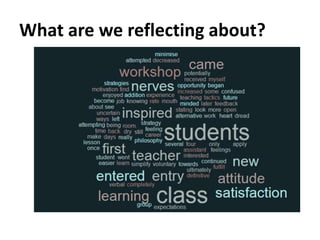
What are we reflecting about?
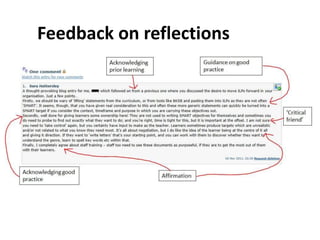
Activity: Look at the examples of reflections from real
students (teacher trainees). Rank these pieces of writing in
terms of their ‘reflectiveness’.
You might like to consider:
• Use of language (which words indicate reflective practice?)
• Tone (formal, informal, professional,other?)
• Content – what they are writing about
Be prepared to share your thoughts with the whole group.
Analysing writing
Reflections on the course
Things you might reflect on:
• The workshops (core and free choice)
• Critical/trigger incidents in your teaching
• Departmental occurrences/meetings/decisions
• Events, conferences and other activities
• Your readings in the literature and/or sector materials,
including news items.
• The assessed pieces in your e-portfolio
• Anything else!
Feedback on reflections
Critical closing questions
Can you identify ways in which your knowledge,
understanding or views have shifted, as a result of
attending Workshop 1?
Can you identify one (or more) teaching/learning
methods or resources that you have used today that
you could take forward into your own practice?
Things to do before the next
session…
• Establish a subject mentor in your department
• Familiarise yourself with your e-portfolio and add some notes to the
UKPSF or Teaching Philosophy sections.
• Write a short reflection on Workshop 1 in your journal (use one of the
reflective models to start you off).
• Use the Group forum or chat facility or take to Twitter to talk about
the first workshop.
• Complete the post-workshop evaluation form in Moodle to
gain your first digital badge!
• Get in touch with the APP PGR team if you have any questions:
apppgr@warwick.ac.uk

App pgr workshop1

  • 1.
    APP PGR: Workshop1 Course introduction, Reflective Practice and Teaching Philosophy
  • 2.
    Find someone who…… •Help yourself to tea and coffee, and find somewhere to sit. • Write your name in bold on a large post-it note. • Activity: Use the sheet on your table to start a conversation with others in the room, by finding someone who fits each criteria. Write their name in the box (try to find a different person for each box).
  • 4.
    Student and tutor‘pledge’ • To get to know you and support you on the course. • To model good practice in teaching and learning. • To share methodology and resources. • To reflect regularly • To make the APP PGR as relevant, useful and enjoyable as possible • To be contactable • To listen to you • To engage with an open mind and willingness to learn. • To think about your own subject discipline in relation to the course. • To try out all activities and approaches. • To engage with your fellow students on the course. • To reflect regularly • To read pedagogic literature tutor students
  • 5.
    Learning outcomes (workshop1) • To clarify the constituent parts of the APP PGR and understand its position in the Higher Education teacher training framework. • To familiarise yourself with the e-portfolio and begin to edit it. • To reflect on who you are as a teacher, by beginning to construct a Teaching Philosophy. • To examine a range of models and examples of reflective practice.
  • 6.
  • 7.
    APP PGR +Postgraduate Award To start the programme, students should have completed the Preparing to Teach introduction and Moodle content, have supervisor approval and 15 hours of teaching.
  • 8.
    Key tenets ofthe course • Core and free choice workshops for experiential learning • Moodle space for course management, dialogue, resources, online activities and groups. • Digital badges for formative, peer assessment • E-Portfolios for assessed pieces and reflective practice. • Twitter hashtag for shared endeavours and announcements #apppgr • Subject mentor for coaching and teaching observations • Assessed pieces working towards Associate Fellowship status • Reflective practice over the duration of the pathway • Engagement with pedagogic literature – both generic and discipline-specific
  • 9.
    Situating the APPPGR Departmental /institutional context community Local community of practice (group/course) E-portfolio and reflective practice Workshops and assessed pieces Teaching and learning in higher education and beyond Higher Education Academy Pedagogic literature Discipline or field
  • 10.
    The UKPSF (Higher EducationAcademy) Activity: Where do you ‘sit’ in relation to this? Take some time to complete a brief, initial self-assessment against the dimensions of the framework. Write notes, draw pictures but keep this draft document. • The UKPSF is a national framework by which all who work in teaching and learning in HE can benchmark their skills, knowledge and experiences. • Achieving a level of HEA fellowship is a recognised status and ‘teaching qualification’.
  • 11.
    Integrative learning through e-portfolios Cognitive PhysicalAffective Knowledge, Analysis, Synthesisand Evaluation Academic ‘norms’ (e.g. referencing) Attitude, self, emotions, identity, change Curation, ‘craft’, digital literacies, publication, management
  • 12.
    Celebrating the ‘it’ “Itchanged my life..” “This the best thing I have ever done!” “I always thought I enjoyed taught courses where you go along and take notes etc - this course was more interactive - learning from each other, sharing experiences , which I really enjoyed. It has impacted on my teaching a lot - I stress to my students now that by taking part in discussions, helping each other generate ideas for written work etc they will learn a lot more than just by listening to me.” ‘Transformation’ in perspective and professional identity from an Teacher Trainee at Warwick
  • 13.
    Digital badges • Arecent development in distance and online learning, digital badges can account for competences, skills and knowledge acquired on a course, as well as being used to motivate and encourage persistence. • They are closely linked to the concept of ‘gamification’, another phenomenon which has been of recent interest in education. • On APP PGR we will experiment with digital badges as a learning community – students, tutors and course administrators can award our badges. Activity: In small groups consider the criteria for each of our digital badges.
  • 14.
    Teaching Philosophy • Oneof the assessed pieces in the e-portfolio is a Teaching Philosophy statement. • This sets a baseline for your practice, but is also an evolving account of yourself as a teacher. • Your teaching philosophy evolves from your own experiences as a learner, experiences as you think and teach and the influences of your peers, institution and literature.
  • 15.
    Lenses for reflection Brookfield’slenses, accessed at: http://molingchui.myblog.arts.ac.uk/files/2015/09/reflection-02-new.jpg 09/10/16 ; 18:15
  • 16.
    Rich pictures toevolve thinking Rich pictures are used for articulating a state of ‘unknowing’, dealing with emerging themes and starting a process or enquiry. • Use little or no words • Draw or add meaningful images • Capture chaos and the ‘unknown’ • Explorative, narrative, playful Activity: Engage in a rich picture exercise as the basis for your teaching philosophy statement. Work alone initially, but you will be invited to share with a peer as part of the exercise.
  • 17.
    What is reflectivepractice? Activity: Work in small groups to discuss what you understand by reflective practice. This could include: • Broadly, what the term might mean. • Specifically what you might reflect on, when and why. • How a teacher might reflect
  • 18.
    Reflection in/on action •Schon (1991) describes a model of reflection ‘in’ and ‘on’ action. • There are many other models of reflective practice, which have evolved from theories of experiential learning (Dewey, for example) and from professional practice. • Reflective practice is a ubiquitous theme in teacher education, but can be a transformative tool and pivotal to developing pedagogical understanding.
  • 19.
    Activity: considering differentmodels • Look over the model you have been presented with • Make sure the model is clear to everyone in the group. • Use the Internet to find out a little more about the model/add some details to your understanding. • See if you can come up with at least one example of this model ‘in action’ (this might be based on your own experiences or an example you find online). • Be prepared to disseminate your findings to others. Models of reflective practice
  • 20.
  • 21.
    I look backat this experience confused by my attitude on entry. I entered the class interested and open minded at the opportunity of learning some tactics. However, I came out with a completely new philosophy towards being a teaching assistant, and ultimately a teacher in the future. I entered attempting to find ways to simplify my job and make it easier, but came out inspired to potentially become a teacher in HE as a career. This motivation continued as I began to apply a new attitude and strategy in my class room. On entry into the workshop, my expectations were to learn strategies which minimise: dry mouth, increased heart rate, feeling of dread, nerves about students knowing more than me. I left the workshop inspired to fulfill these myself, but still uncertain; it was only once went into my first class four days later where I attempted group work for the first time, I could see the alternative feelings of satisfaction, definitive learning from students, student satisfaction and decreased nerves. In addition, I received voluntary verbal feedback from several students stating that they really enjoyed my lesson.
  • 22.
    What are wereflecting about?
  • 23.
    Activity: Look atthe examples of reflections from real students (teacher trainees). Rank these pieces of writing in terms of their ‘reflectiveness’. You might like to consider: • Use of language (which words indicate reflective practice?) • Tone (formal, informal, professional,other?) • Content – what they are writing about Be prepared to share your thoughts with the whole group. Analysing writing
  • 24.
    Reflections on thecourse Things you might reflect on: • The workshops (core and free choice) • Critical/trigger incidents in your teaching • Departmental occurrences/meetings/decisions • Events, conferences and other activities • Your readings in the literature and/or sector materials, including news items. • The assessed pieces in your e-portfolio • Anything else!
  • 25.
  • 26.
    Critical closing questions Canyou identify ways in which your knowledge, understanding or views have shifted, as a result of attending Workshop 1? Can you identify one (or more) teaching/learning methods or resources that you have used today that you could take forward into your own practice?
  • 27.
    Things to dobefore the next session… • Establish a subject mentor in your department • Familiarise yourself with your e-portfolio and add some notes to the UKPSF or Teaching Philosophy sections. • Write a short reflection on Workshop 1 in your journal (use one of the reflective models to start you off). • Use the Group forum or chat facility or take to Twitter to talk about the first workshop. • Complete the post-workshop evaluation form in Moodle to gain your first digital badge! • Get in touch with the APP PGR team if you have any questions: apppgr@warwick.ac.uk

Editor's Notes

  • #3 09:50 warm up activity – handouts on the table
  • #4 Welcome!
  • #5 Quite a useful way forward on a course is to agree a ‘contract’ with students; outline your expectations – what you will offer too.
  • #10 Important to note any type of study in its context – quite often students have a narrow view of their course.
  • #11 The HEA PSF are a standard which ‘govern’ us
  • #24 10.15 Taking stock – in groups – sharing common concerns What teaching have you done so far? What’s going well? What’s challenging? 5 min + Q+A Or you could ask tables collect questions as a group and then return to see if they’ve answered these after lunch. Some repetition from part 1 covering these all collectively.
  • #25 10.30 – (Prompts only if needed: What is small group teaching and why do we do it? How does it fit in with lectures, assessment, etc.? where does it fit in the student experience and what is your role? Also think about anything that should not be part of your role. Can do this on flipchart and then stick on wall and share.) 10min + 10min Importance of SGT: Develops students understanding Encourages students to take responsibility for their own learning Develops analytical, organisational, communication and collaborative skills What sort of skills can you develop through SGT? Analytical skills Through exposure to a variety of views, ideas and problems Organisational skills Preparing evidence or a case for discussion Leading a group of students Communication skills Participation in discussion, preparation of debates, role play, etc. Presenting a case to other students and listening, questioning and responding Collaborative skills Working together and negotiating with others
  • #26 10.55 Role play about different types of students – write clear instructions and add the observer/critical friend’s role – after the role play give each of them 30seconds to reflect on how they felt Critical friend feeds back from whole group. 5 minutes to prepare individually + 5 minutes for role play + 5/10 min discussion Student types… Silent Know-it-all No preparation Tends to go off topic Shy Talkative Model student Belligerent Distracting Prejudiced Split into small groups and assign roles using cards