17/06/10 Geoffrey Crisp ALTC National Teaching Fellow Director, Centre for Learning and Professional Development  University of Adelaide Why should we change assessment because of Web 2.0?
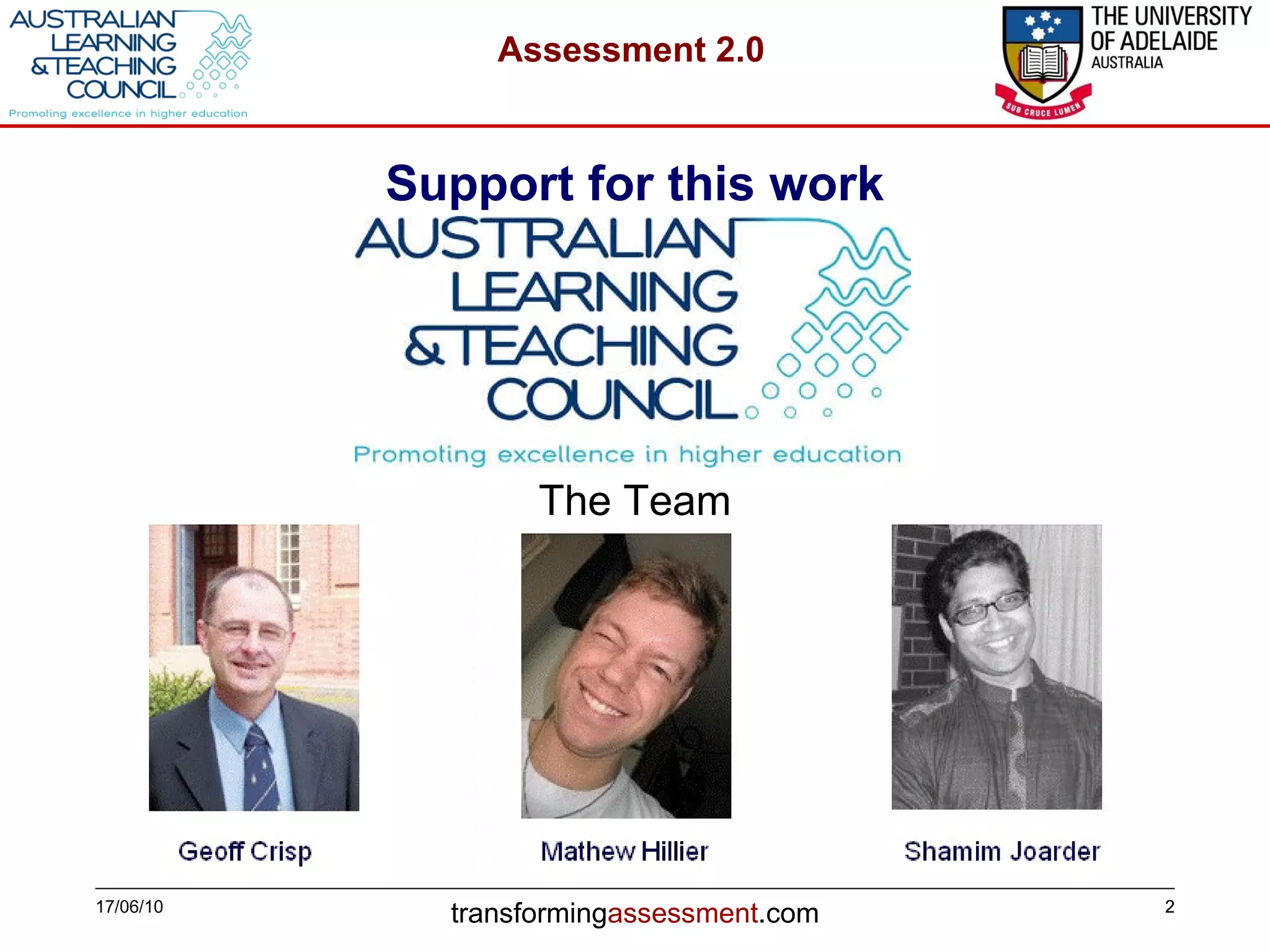
Support for this work 17/06/10 The Team
Outline of presentation introduction - learning and assessment e-assessments examples of interactive e-assessments assessment in virtual environments assessment tasks for the future 17/06/10
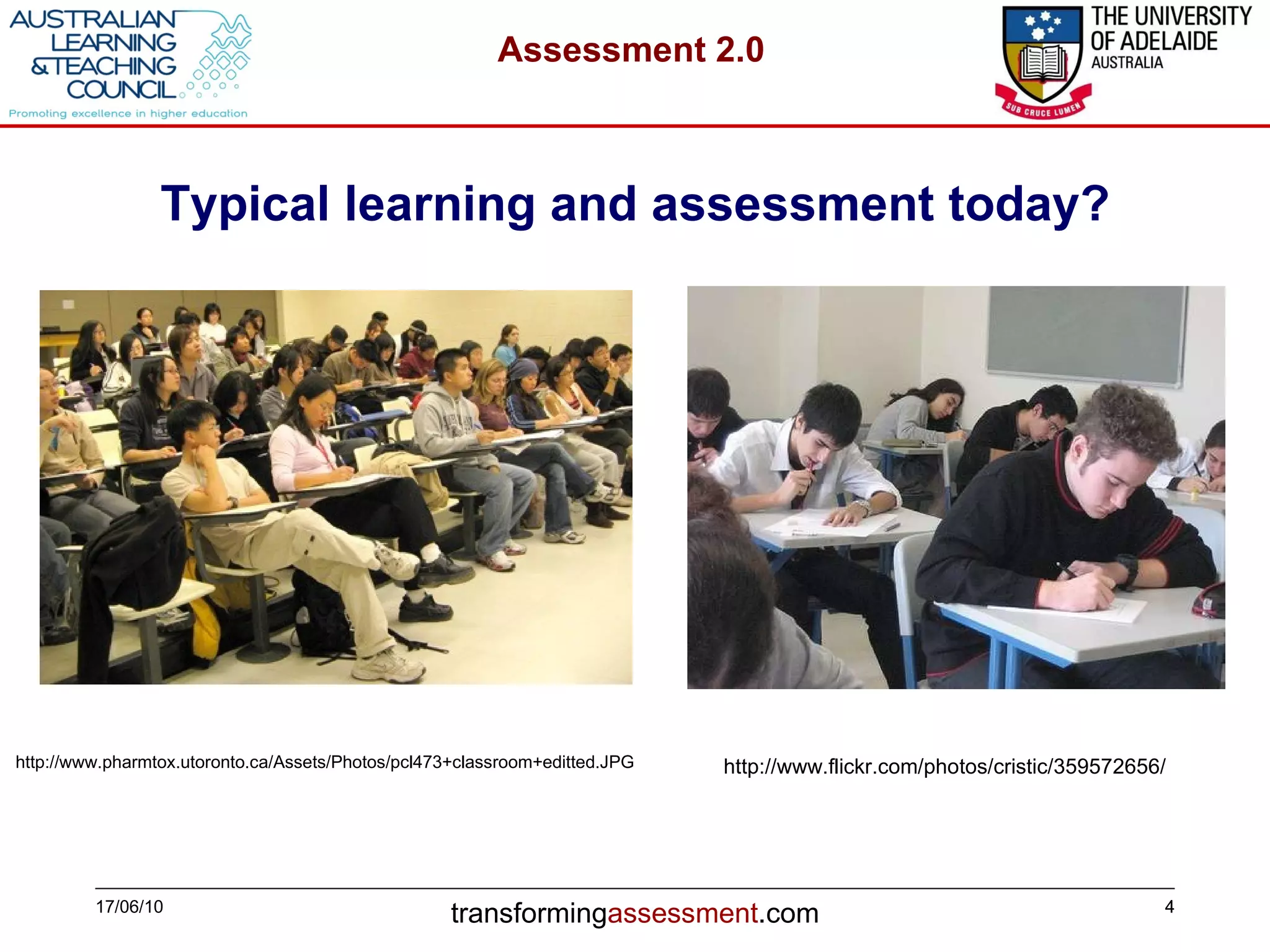
Typical learning and assessment today? 17/06/10 http://www.flickr.com/photos/cristic/359572656/  http://www.pharmtox.utoronto.ca/Assets/Photos/pcl473+classroom+editted.JPG
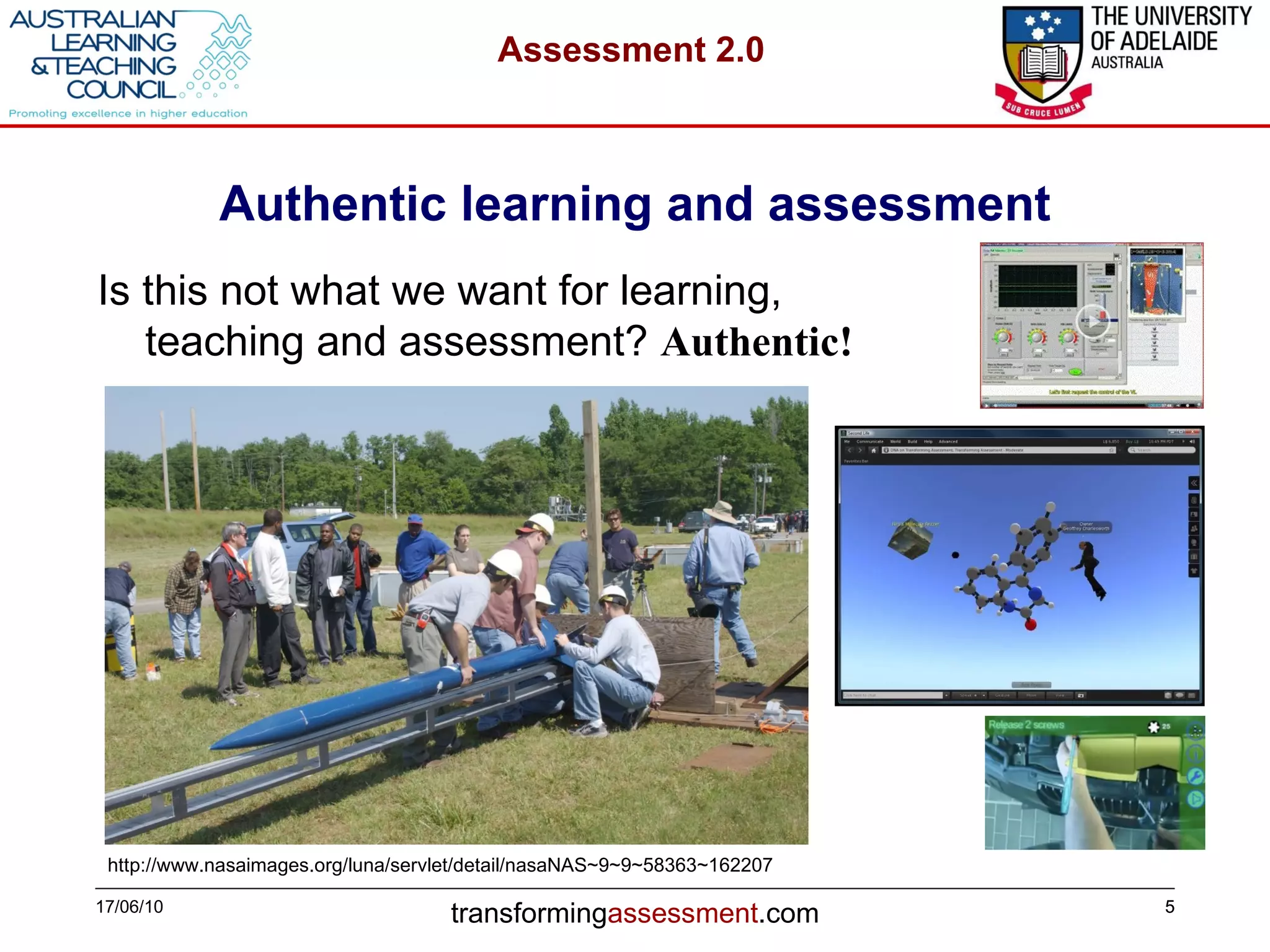
Authentic learning and assessment 17/06/10 http://www.nasaimages.org/luna/servlet/detail/nasaNAS~9~9~58363~162207 Is this not what we want for learning, teaching and assessment?  Authentic!
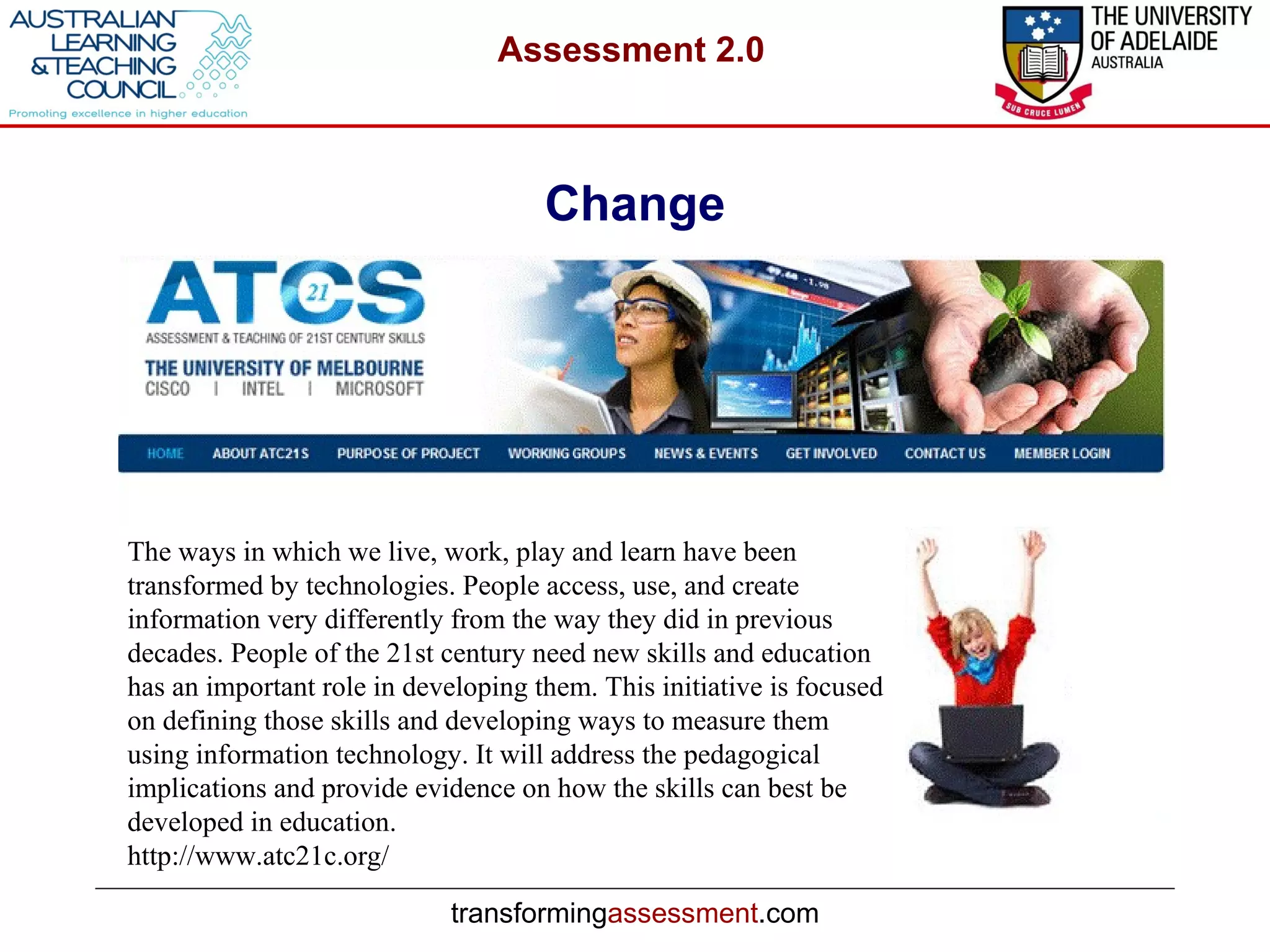
Change The ways in which we live, work, play and learn have been transformed by technologies. People access, use, and create information very differently from the way they did in previous decades. People of the 21st century need new skills and education has an important role in developing them. This initiative is focused on defining those skills and developing ways to measure them using information technology. It will address the pedagogical implications and provide evidence on how the skills can best be developed in education.   http://www.atc21c.org/
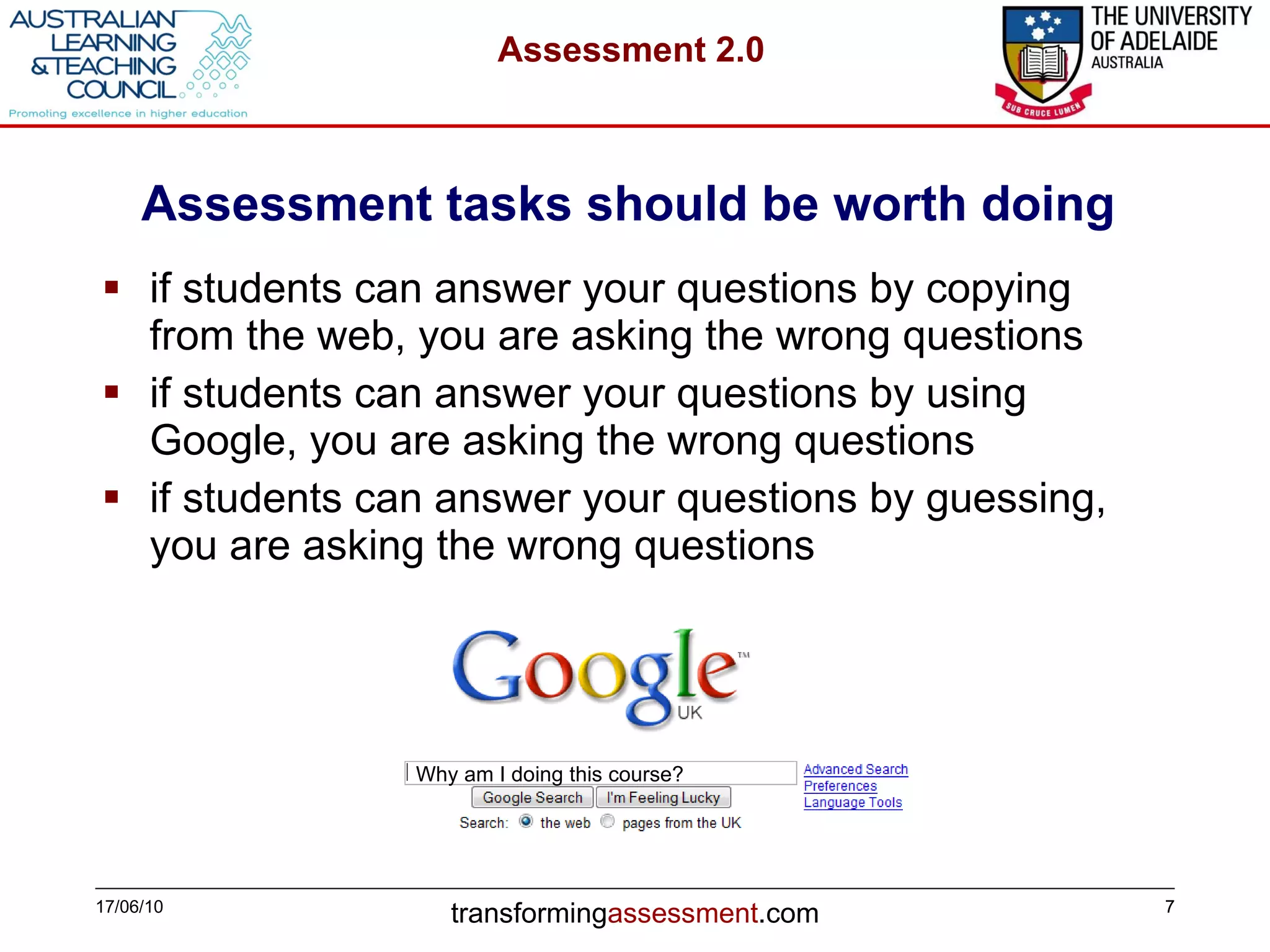
Assessment tasks should be worth doing  if students can answer your questions by copying from the web, you are asking the wrong questions if students can answer your questions by using Google, you are asking the wrong questions if students can answer your questions by guessing, you are asking the wrong questions 17/06/10 Why am I doing this course?
Outline of presentation brief introduction to learning and assessment traditional e-assessments examples of interactive e-assessment assessment in virtual environments assessment tasks for the future 17/06/10
Effective e-Assessment  can offer new possibilities for immersion and interactivity has the potential to facilitate enhanced social interactions  can begin to resemble games and role-playing can facilitate the exposition of advanced skills and capabilities  17/06/10
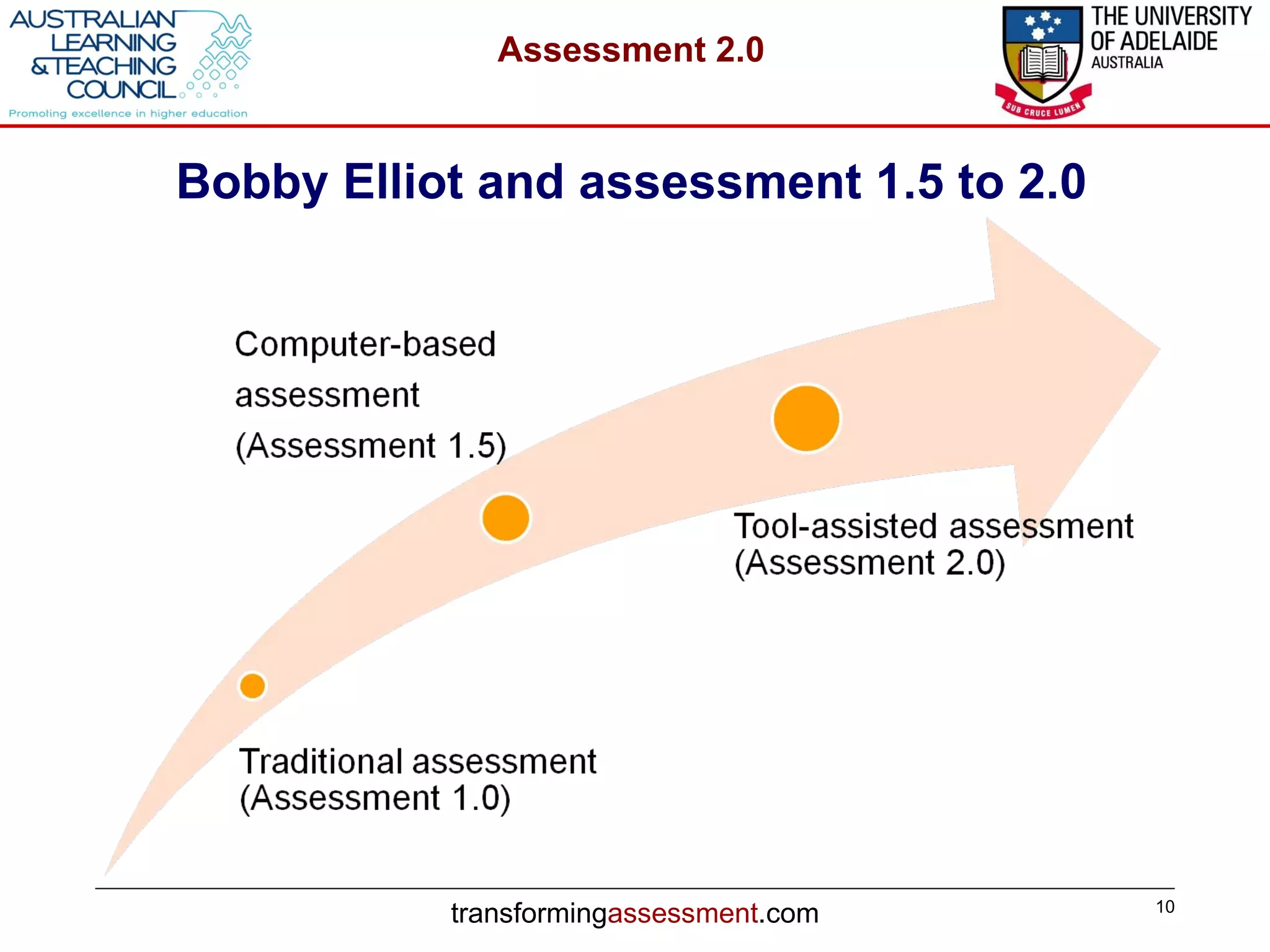
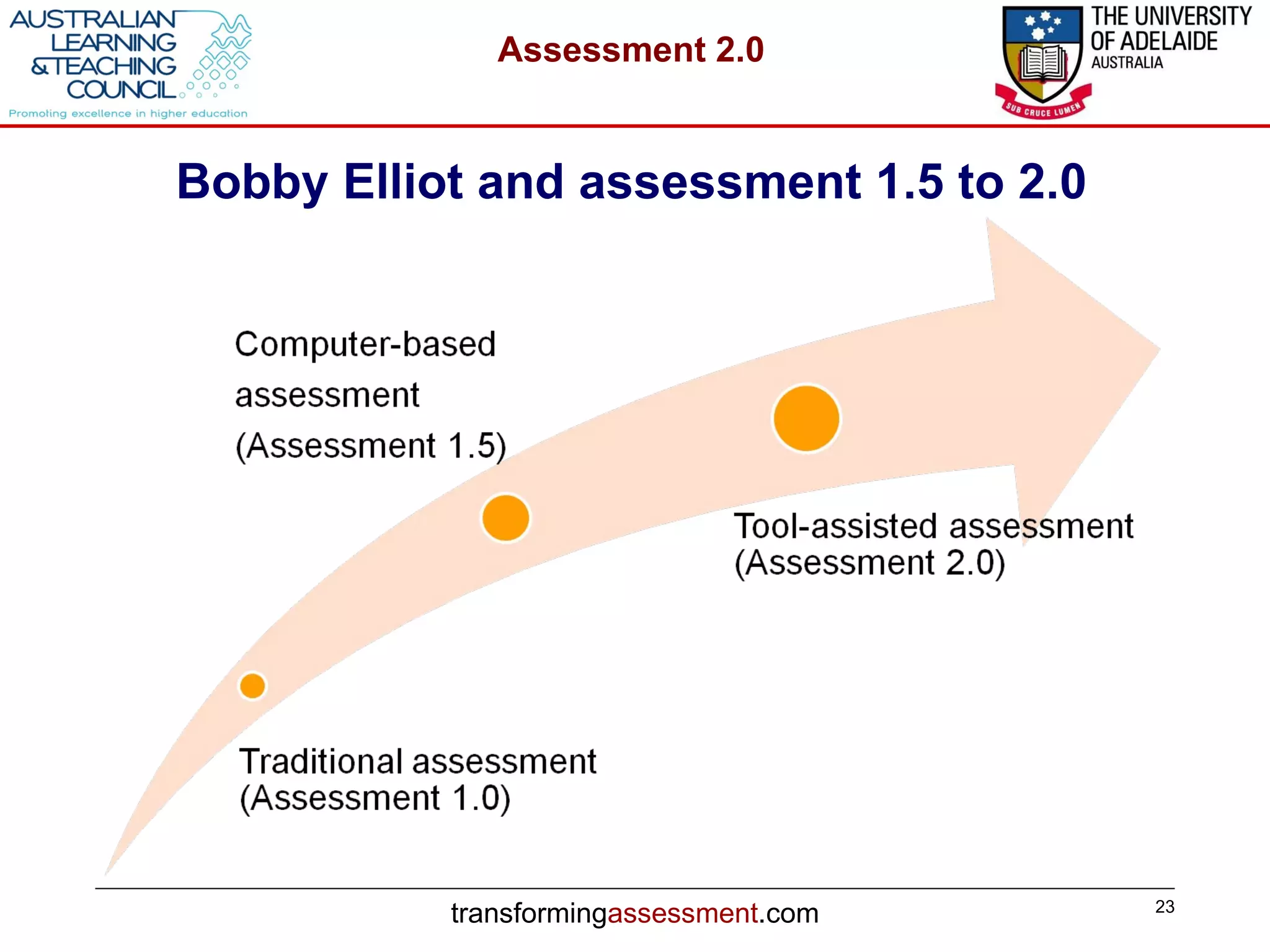
Bobby Elliot and assessment 1.5 to 2.0
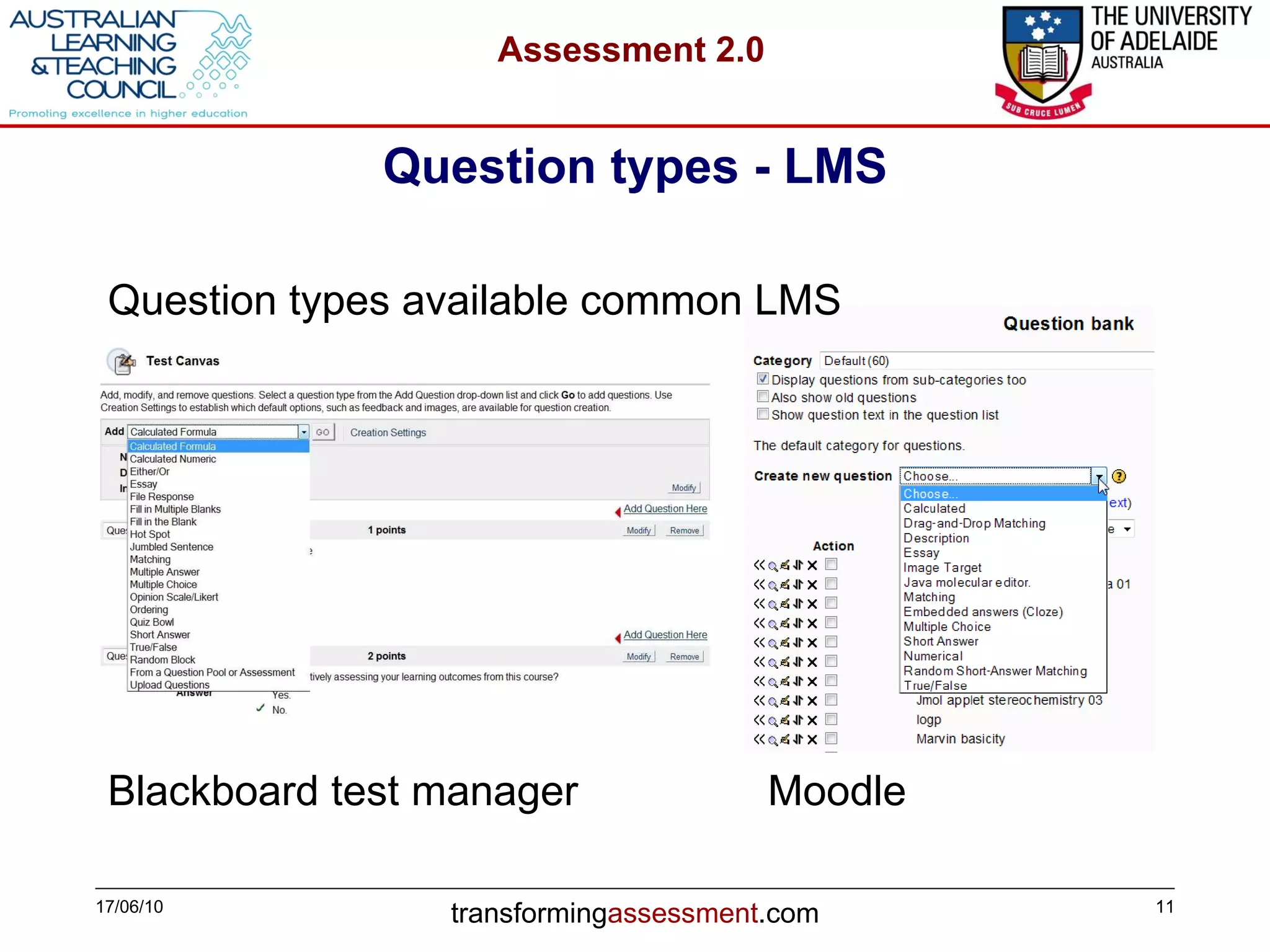
Question types - LMS 17/06/10 Question types available common LMS Blackboard test manager  Moodle
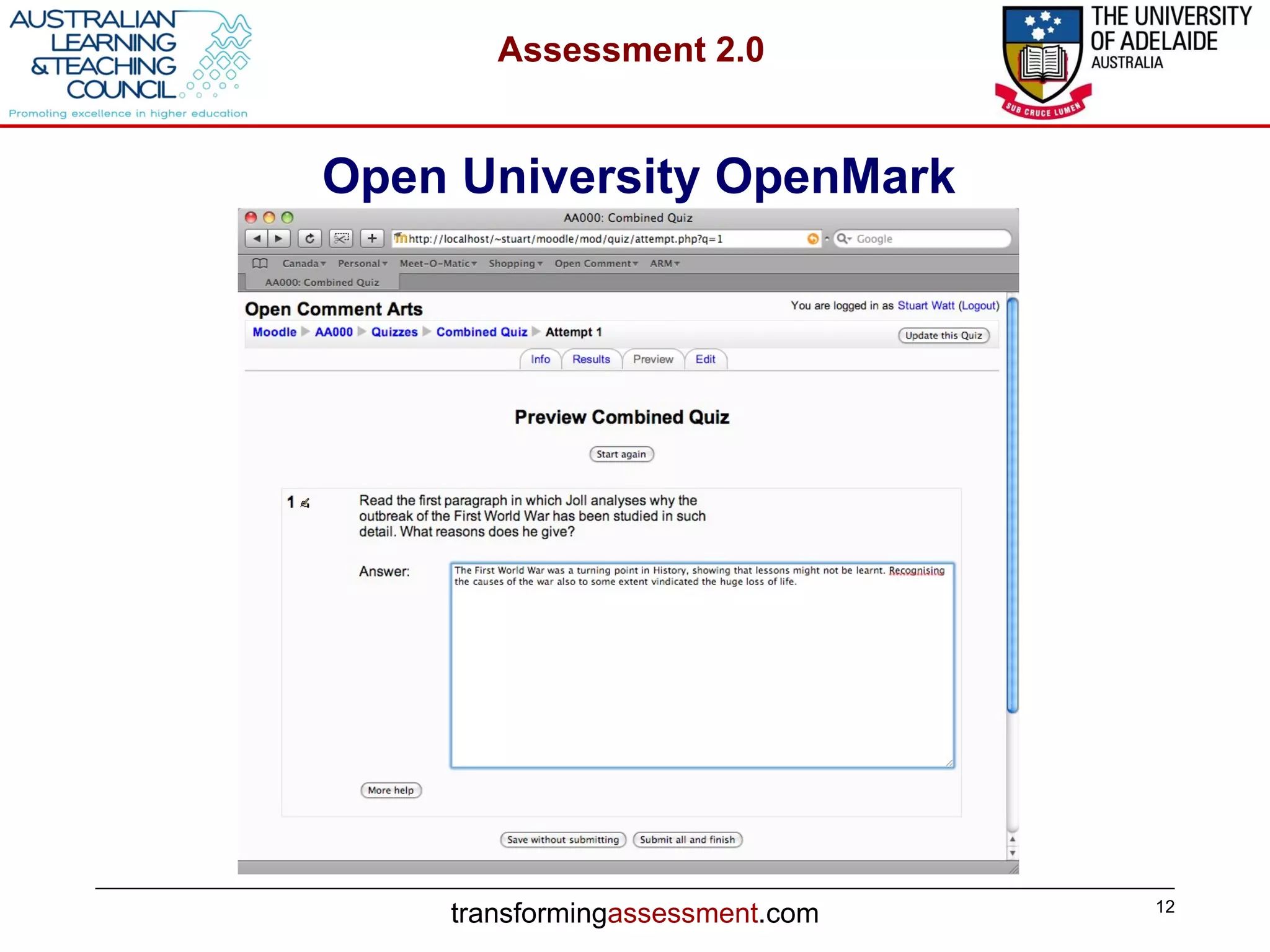
Open University OpenMark
Outline of presentation brief introduction to learning and assessment traditional e-assessments examples of interactive e-assessment assessment in virtual environments assessment tasks for the future 17/06/10
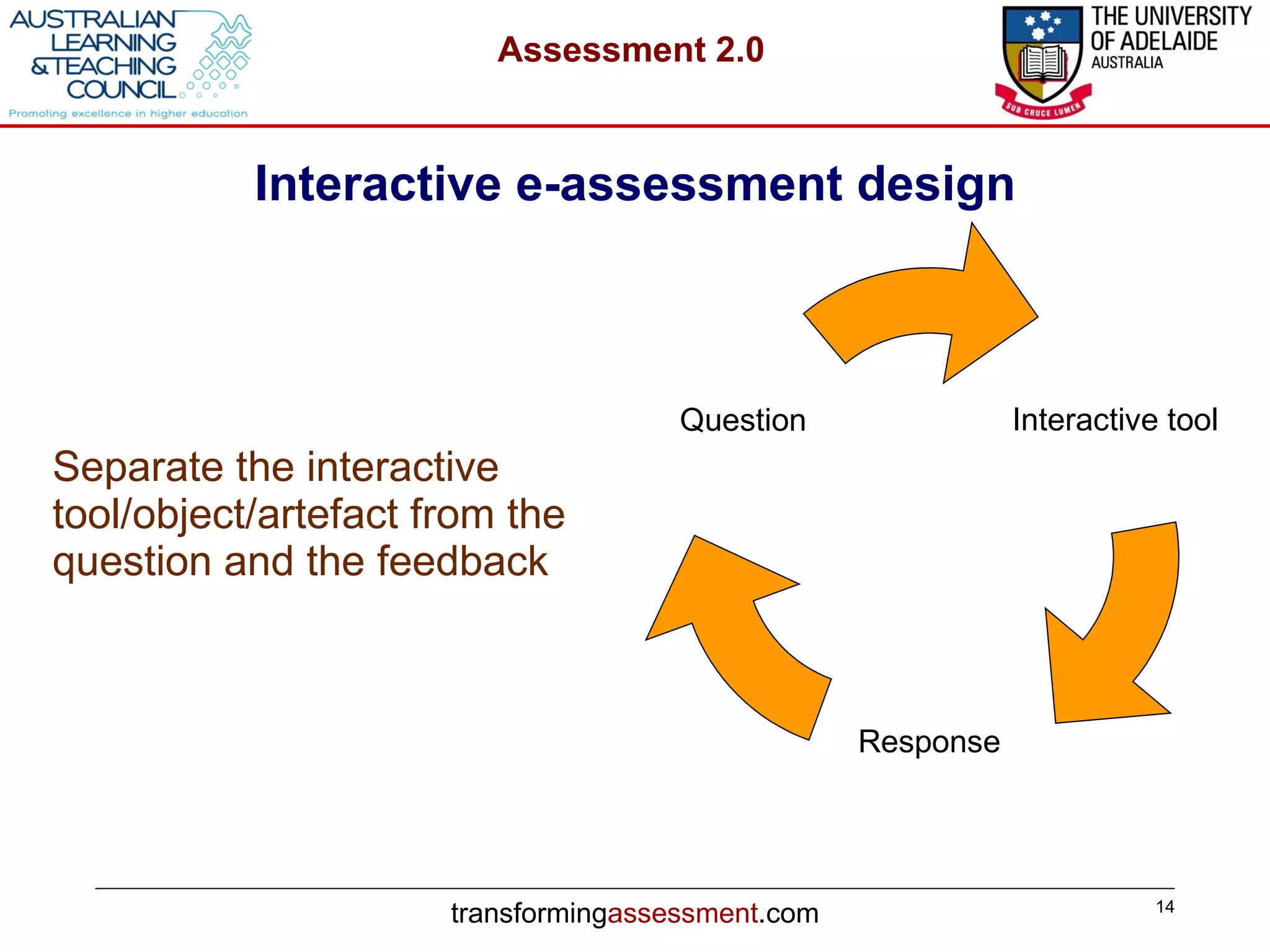
Interactive e-assessment design Separate the interactive tool/object/artefact from the question and the feedback Interactive tool Response Question
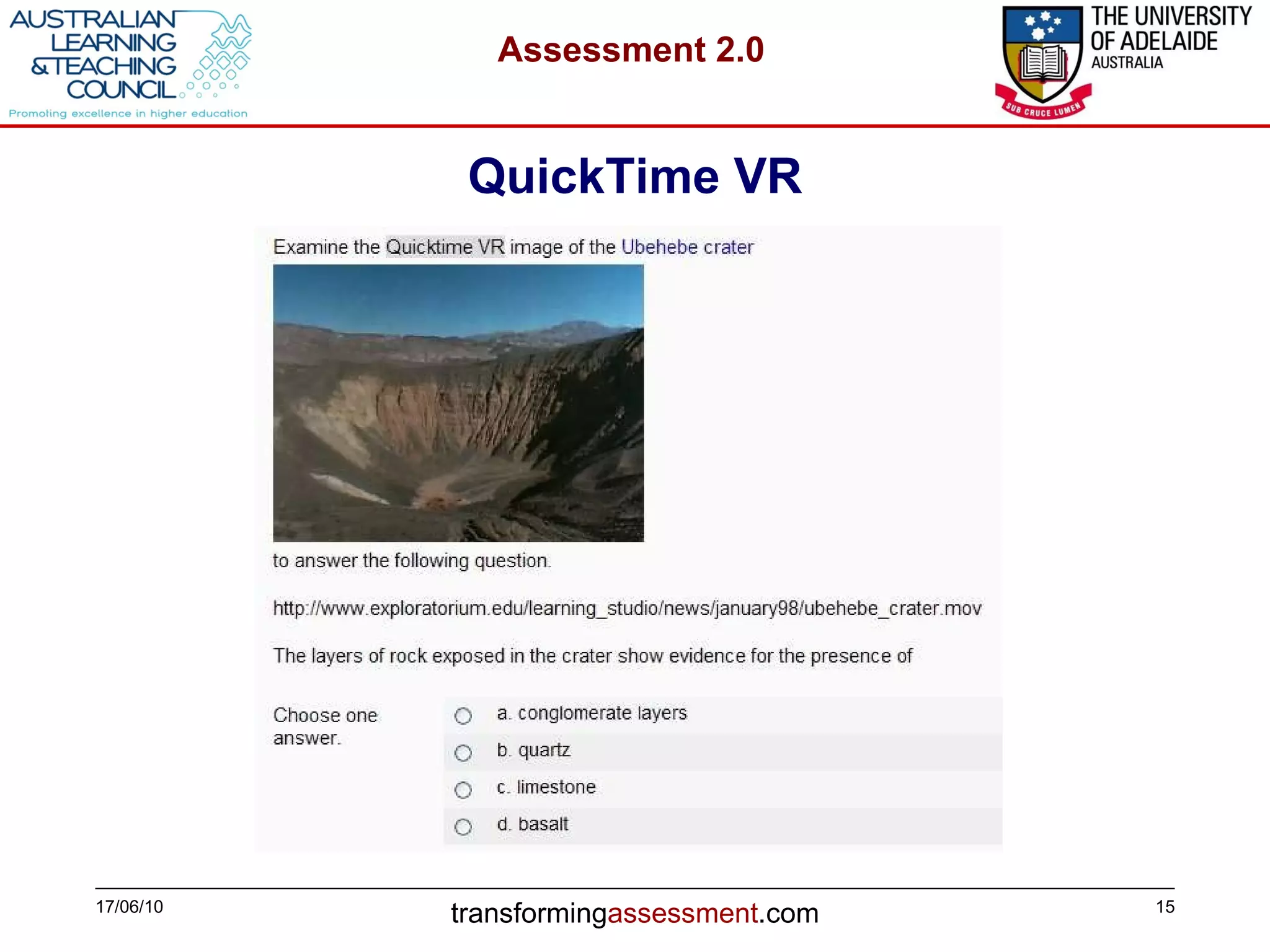
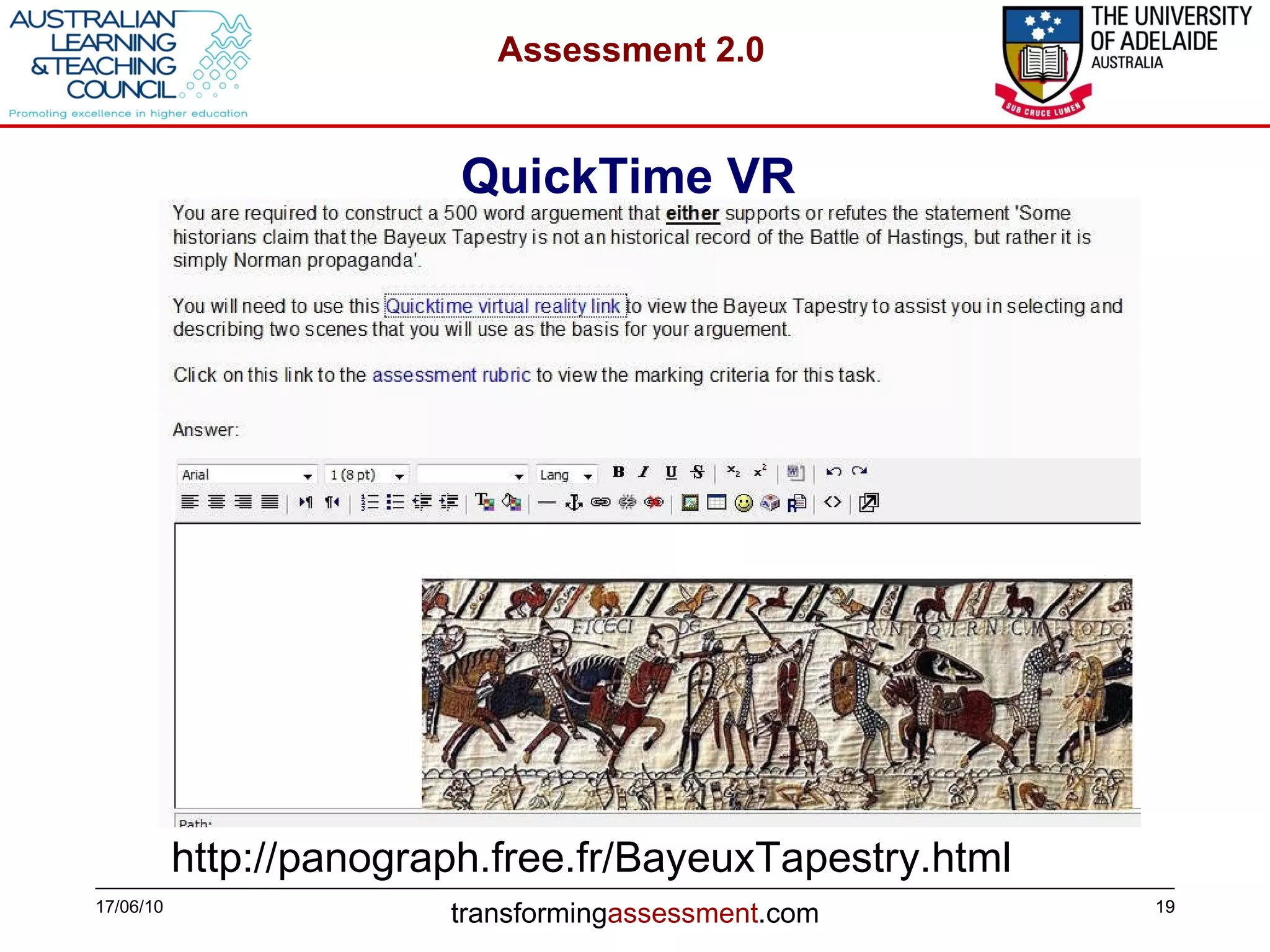
QuickTime VR 17/06/10
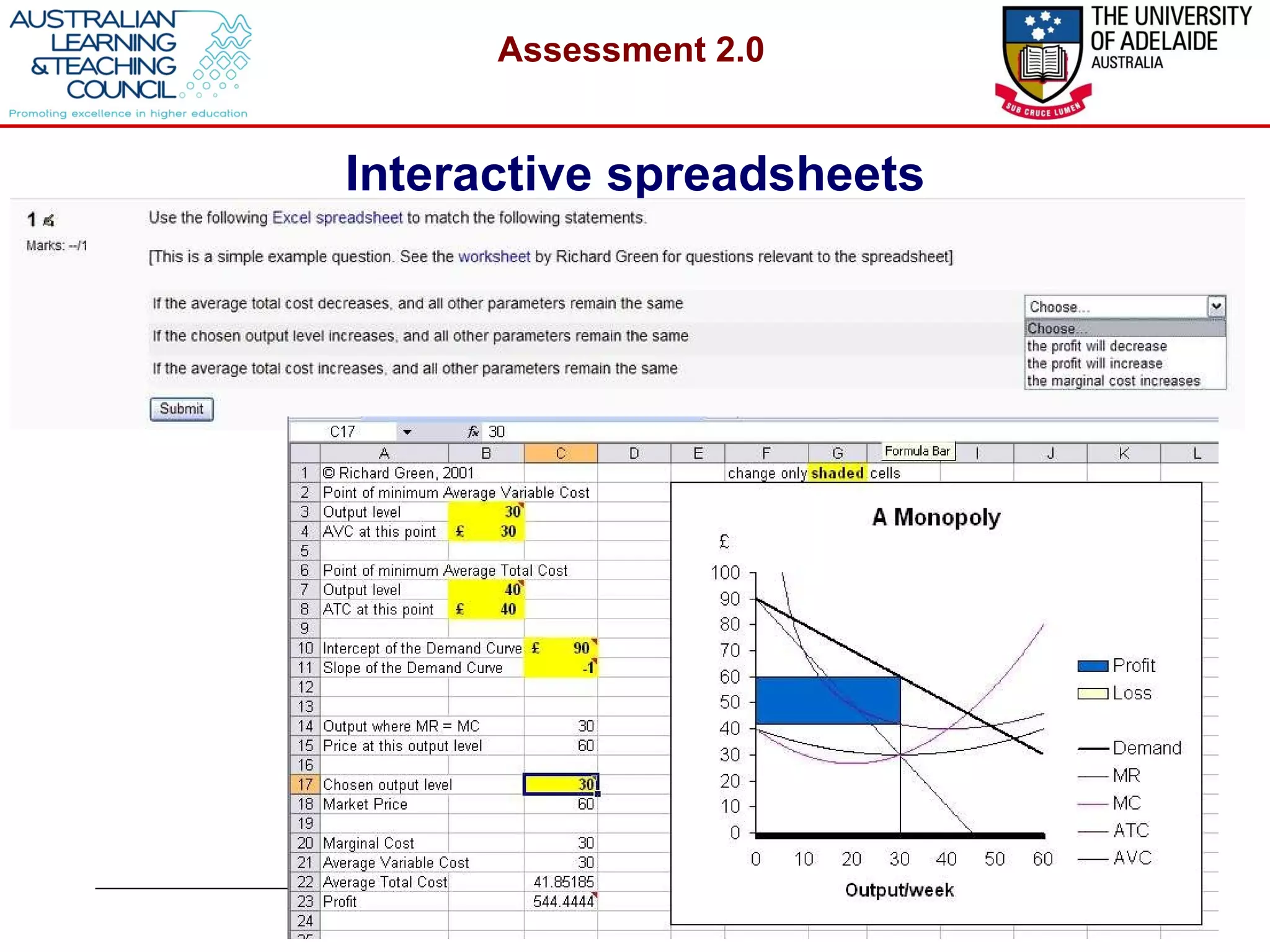
Interactive spreadsheets
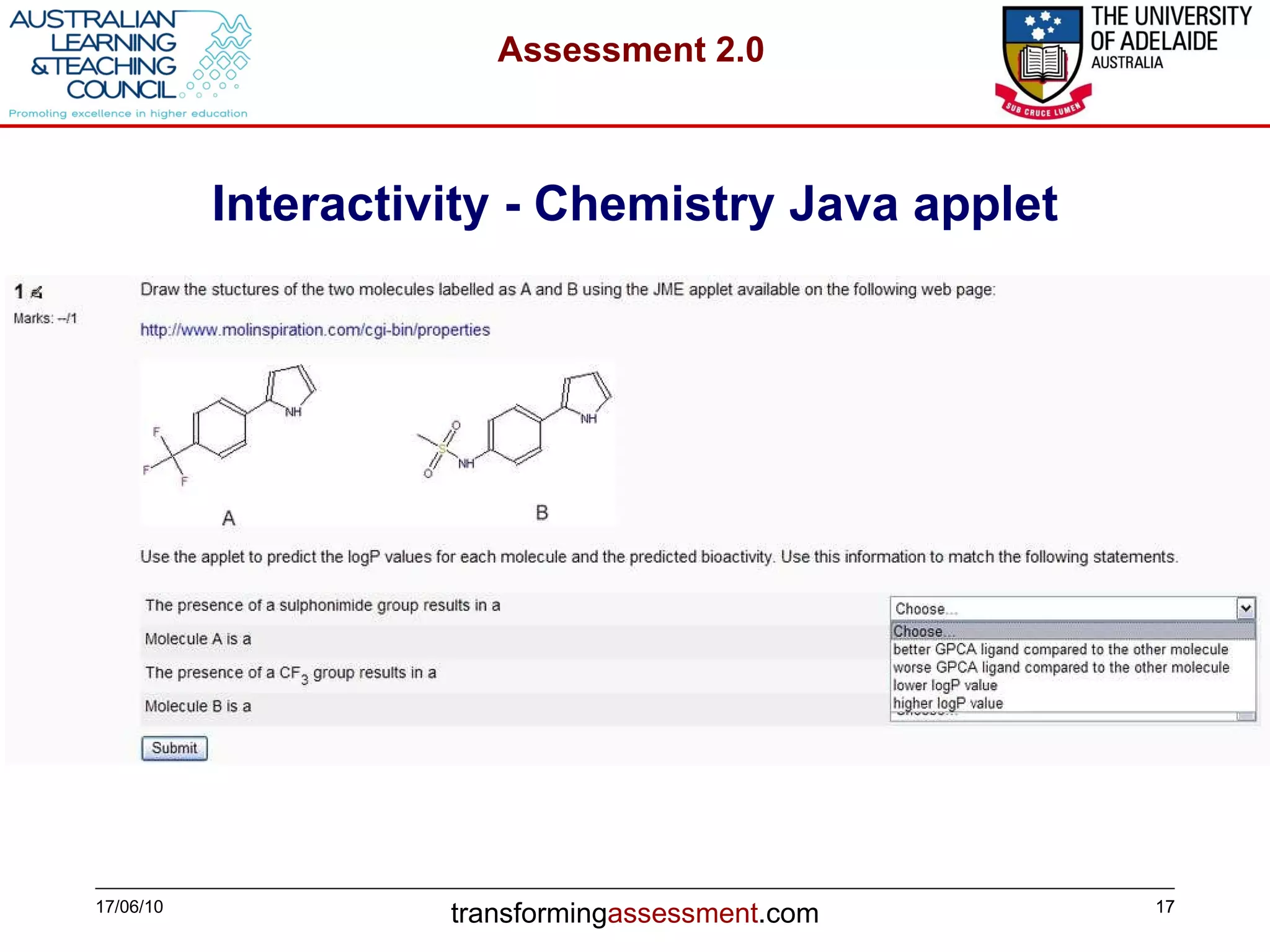
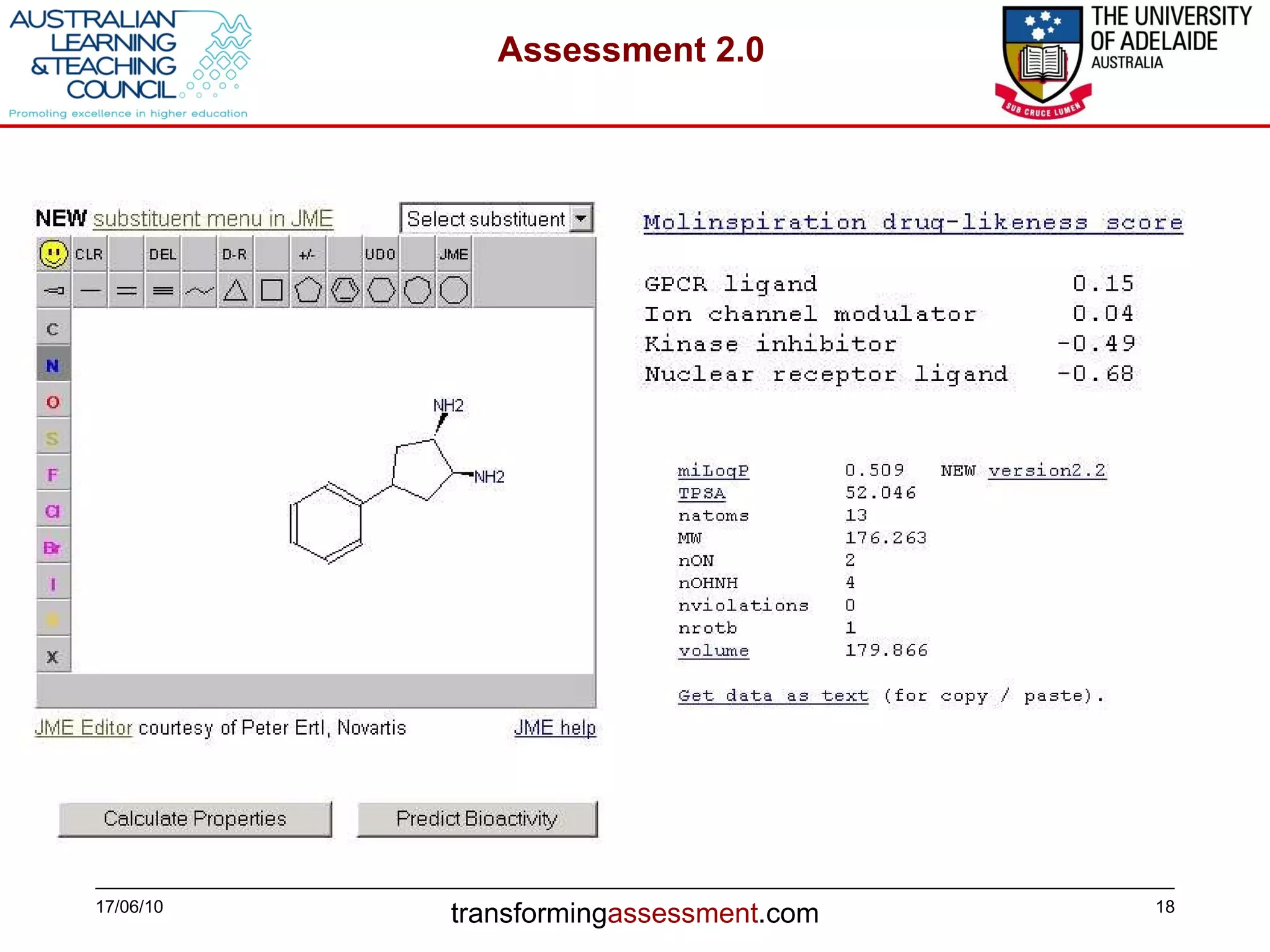
Interactivity - Chemistry Java applet 17/06/10
17/06/10
QuickTime VR  17/06/10 http://panograph.free.fr/BayeuxTapestry.html
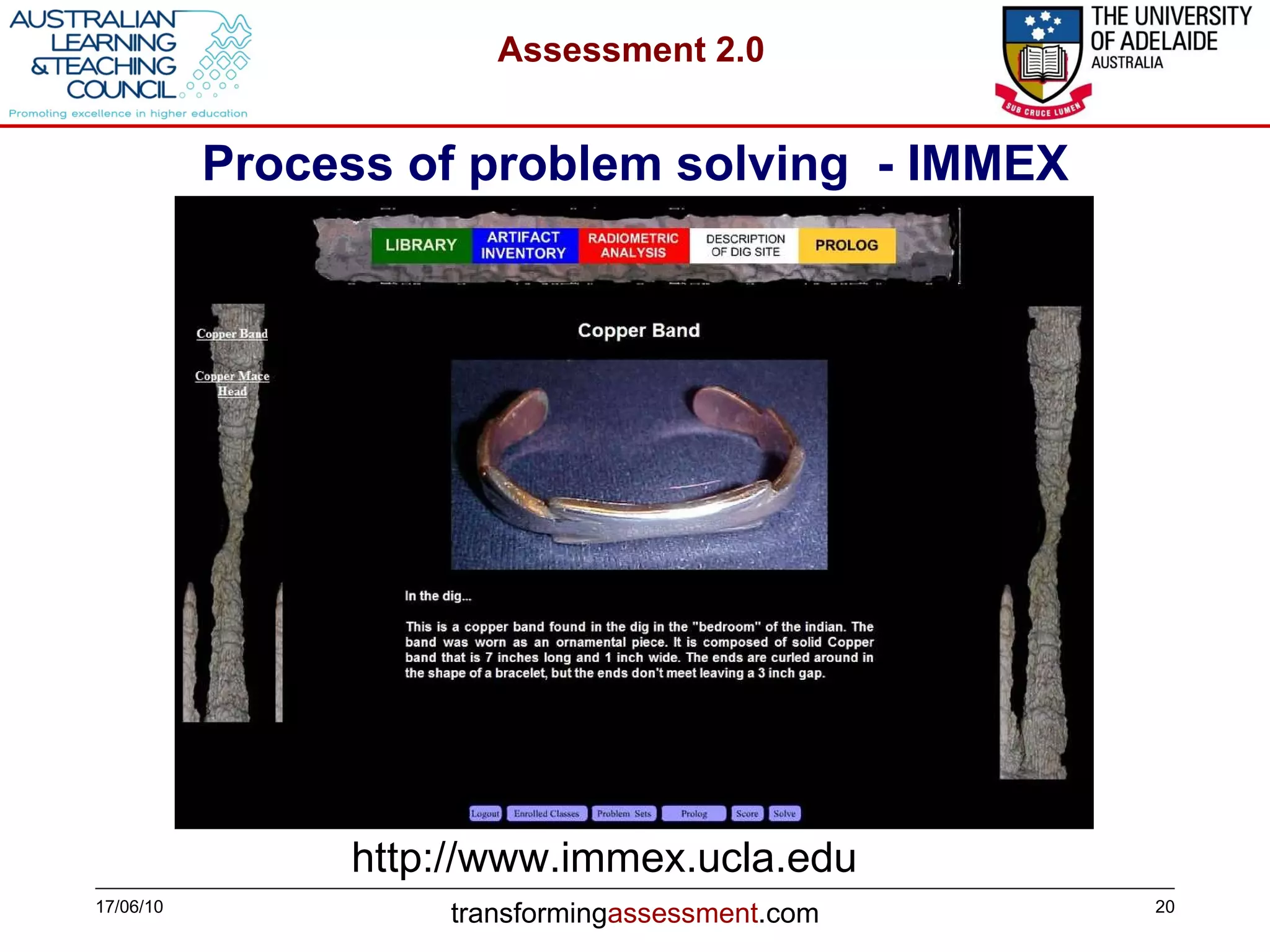
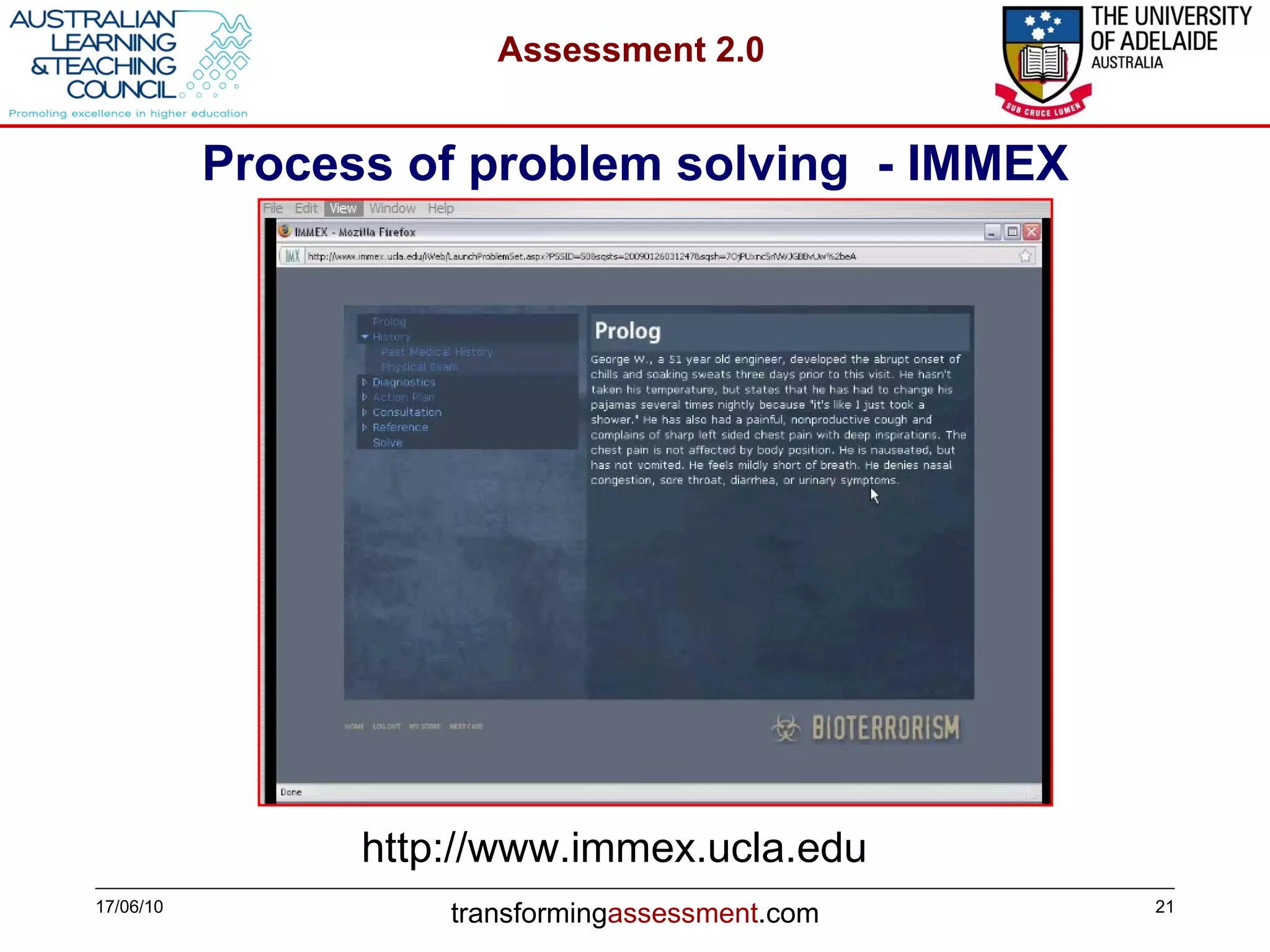
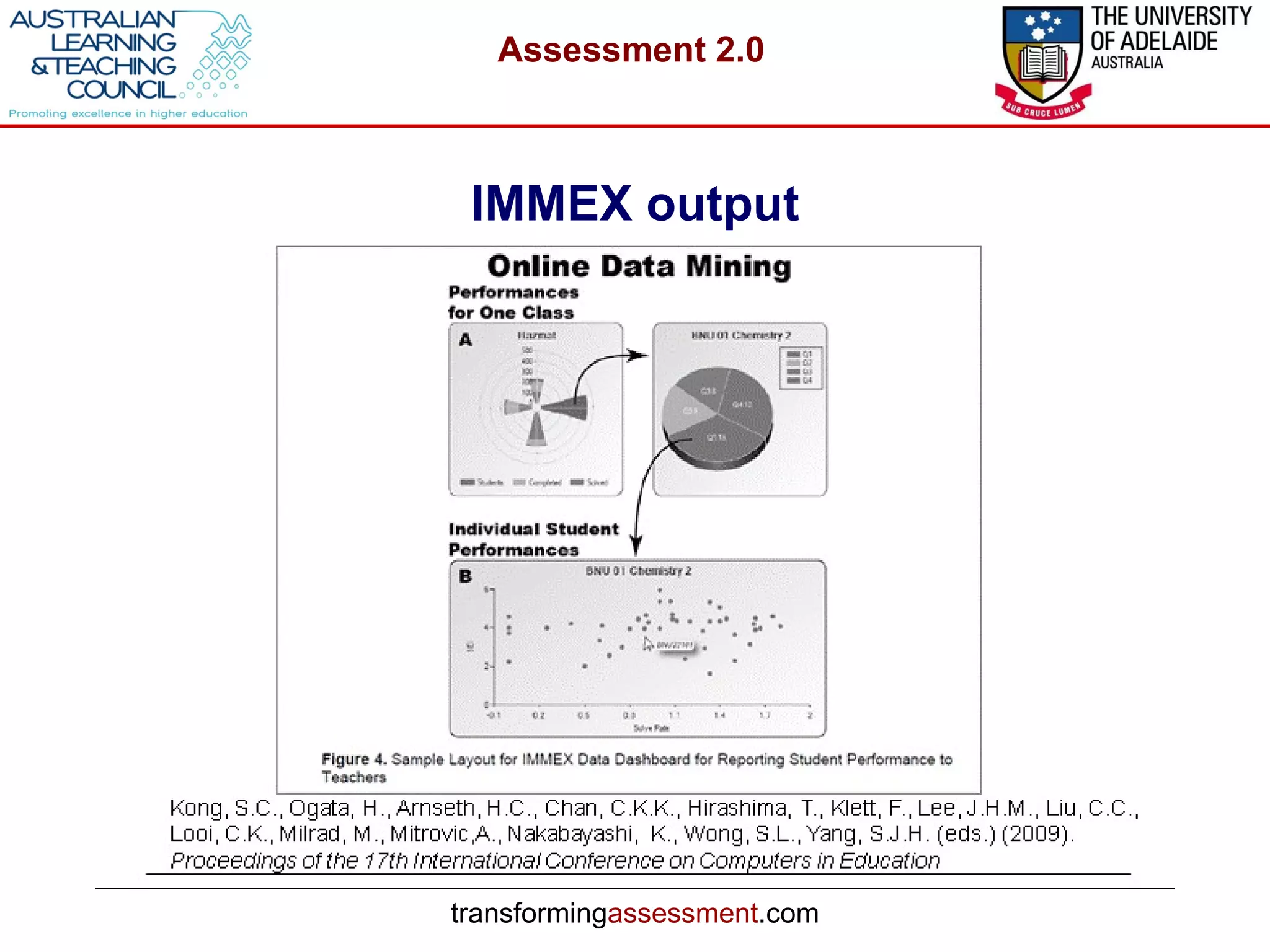
Process of problem solving  - IMMEX 17/06/10 http://www.immex.ucla.edu
Outline of presentation brief introduction to learning and assessment traditional e-assessments examples of interactive e-assessment assessment in virtual environments assessment tasks for the future 17/06/10
Bobby Elliot and assessment 1.5 to 2.0
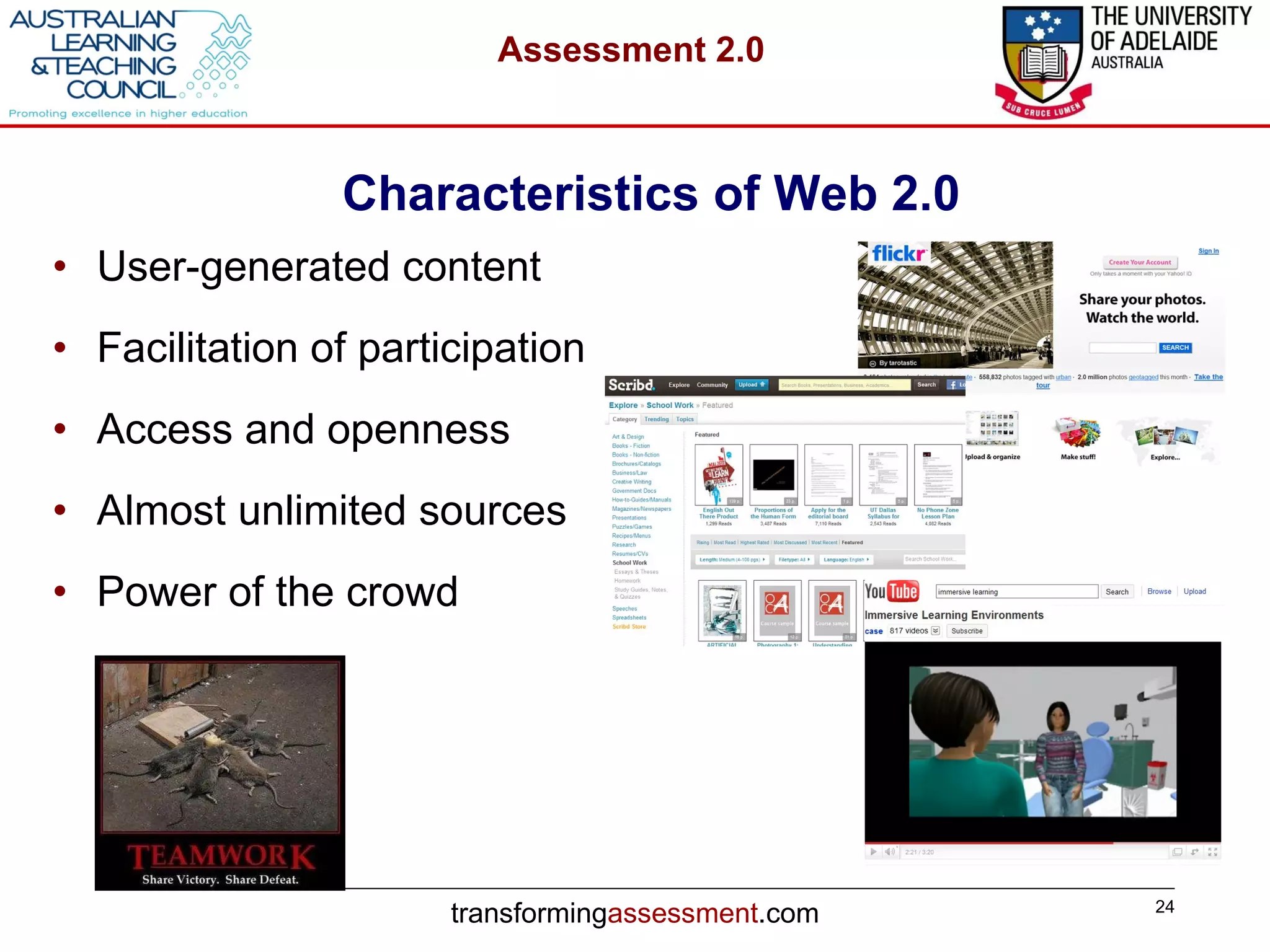
Characteristics of Web 2.0 User-generated content Facilitation of participation Access and openness Almost unlimited sources Power of the crowd
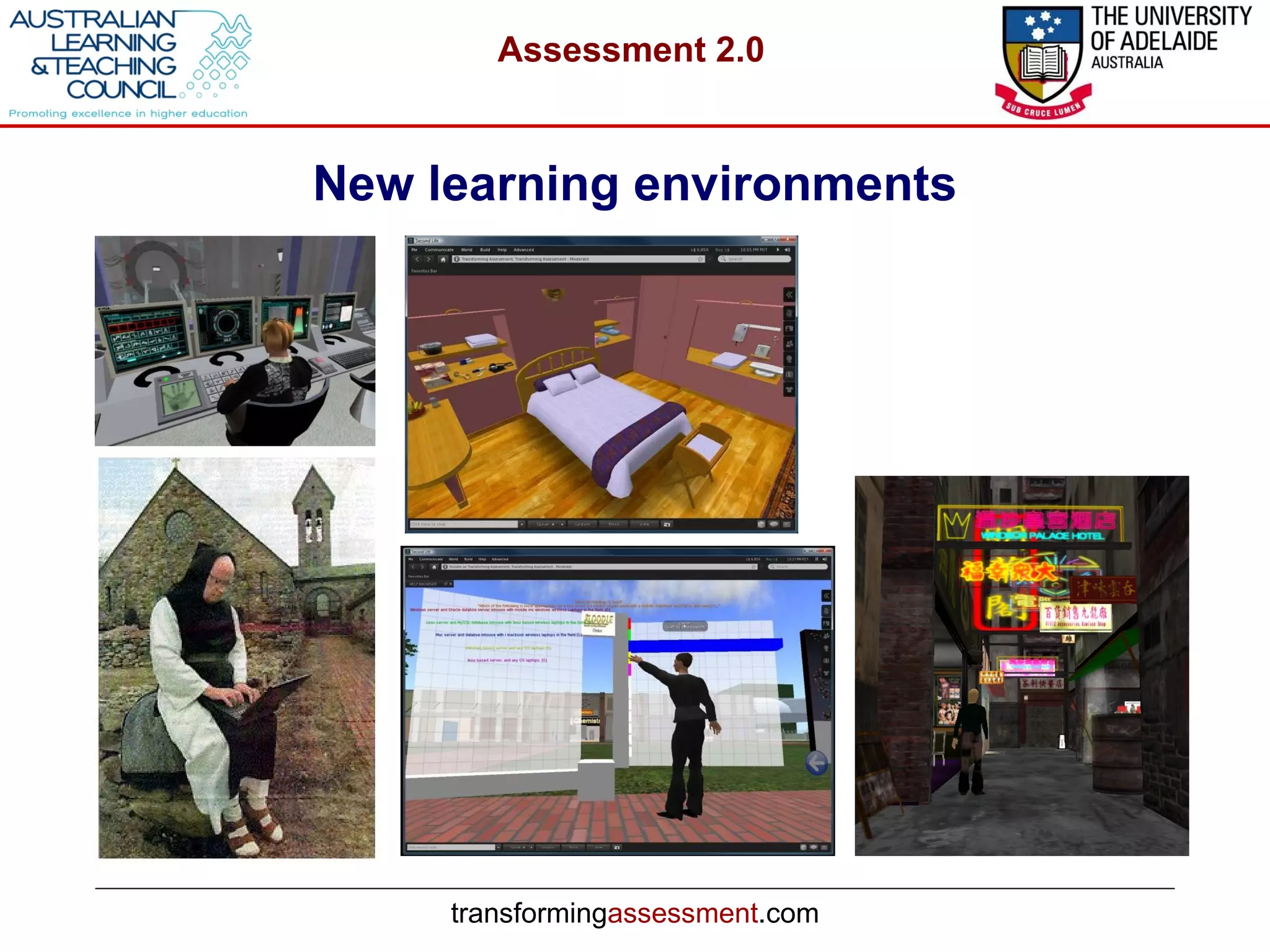
New learning environments
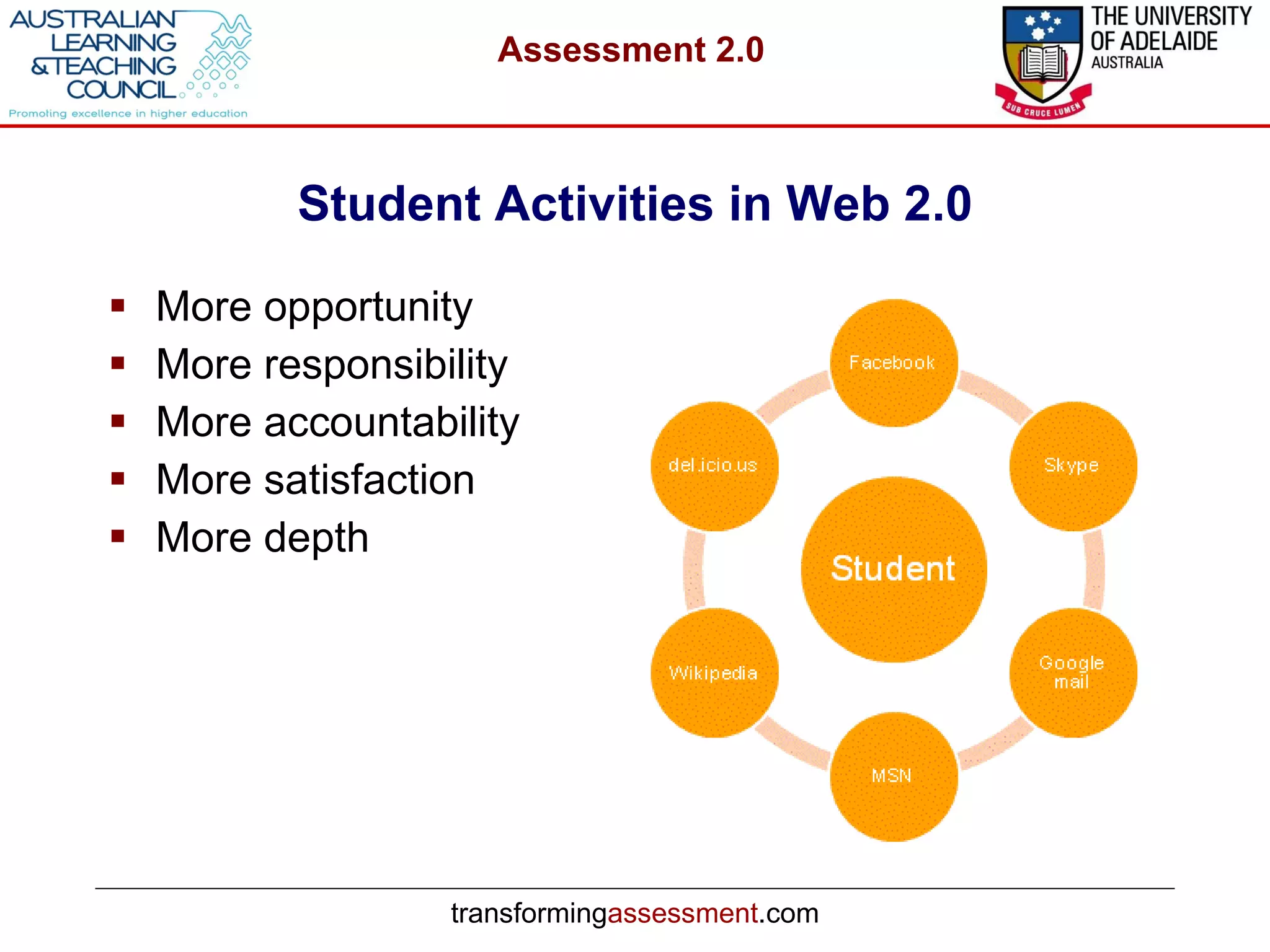
Student Activities in Web 2.0 More opportunity More responsibility More accountability More satisfaction More depth
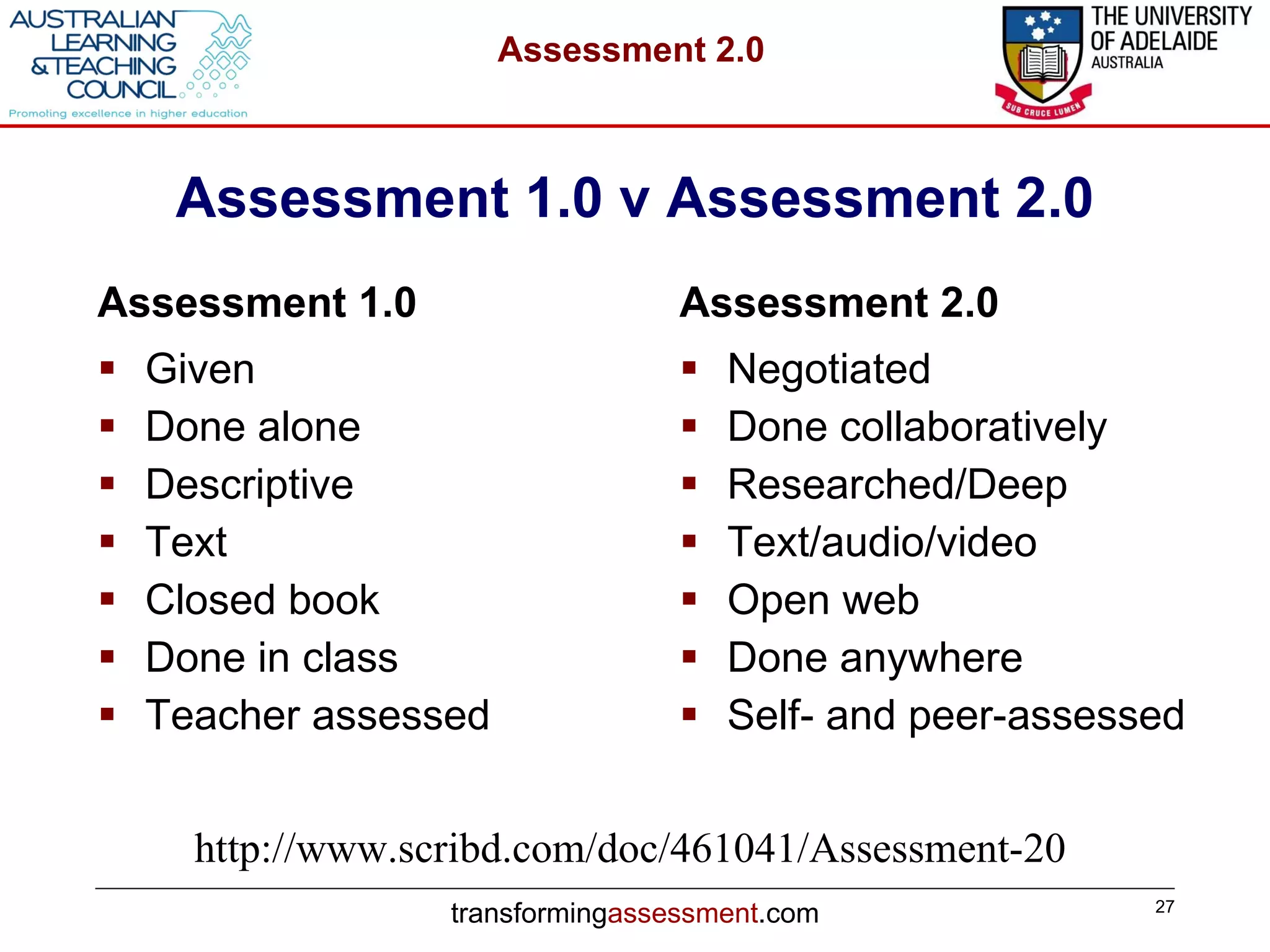
Assessment 1.0 v Assessment 2.0 Given Done alone Descriptive Text Closed book Done in class Teacher assessed Negotiated Done collaboratively Researched/Deep Text/audio/video Open web Done anywhere Self- and peer-assessed Assessment 1.0 Assessment 2.0 http://www.scribd.com/doc/461041/Assessment-20
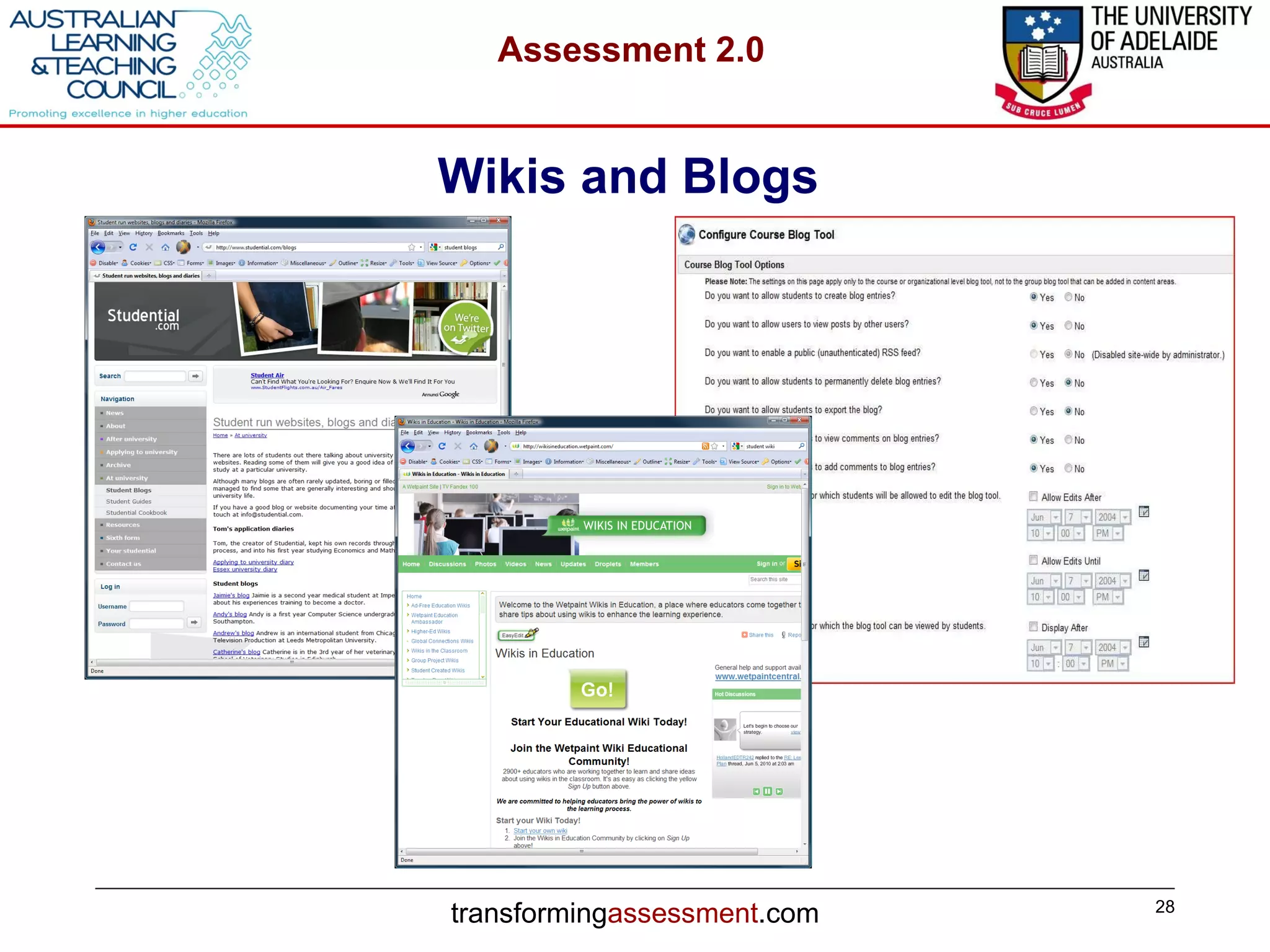
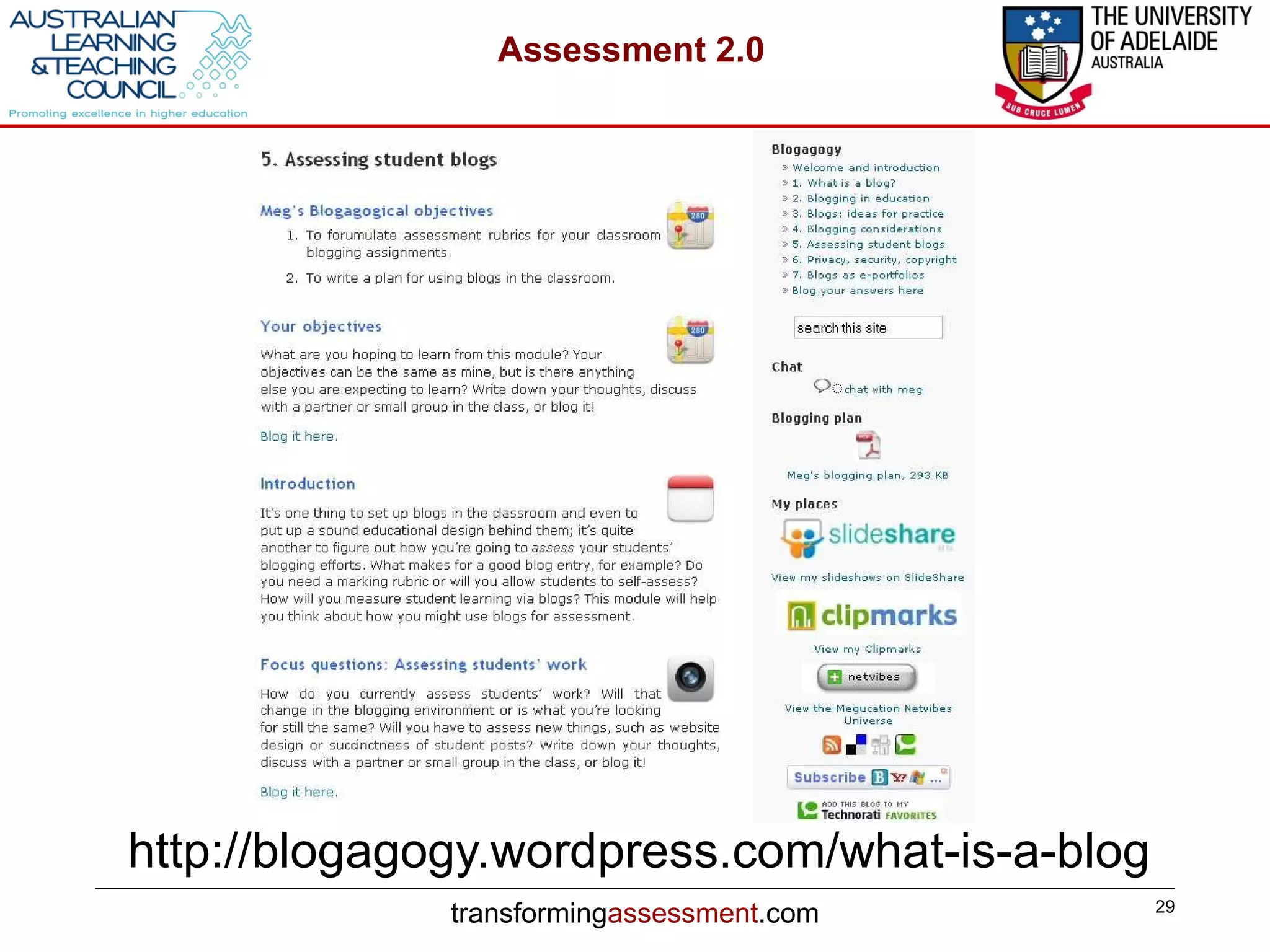
Wikis and Blogs
http://blogagogy.wordpress.com/what-is-a-blog
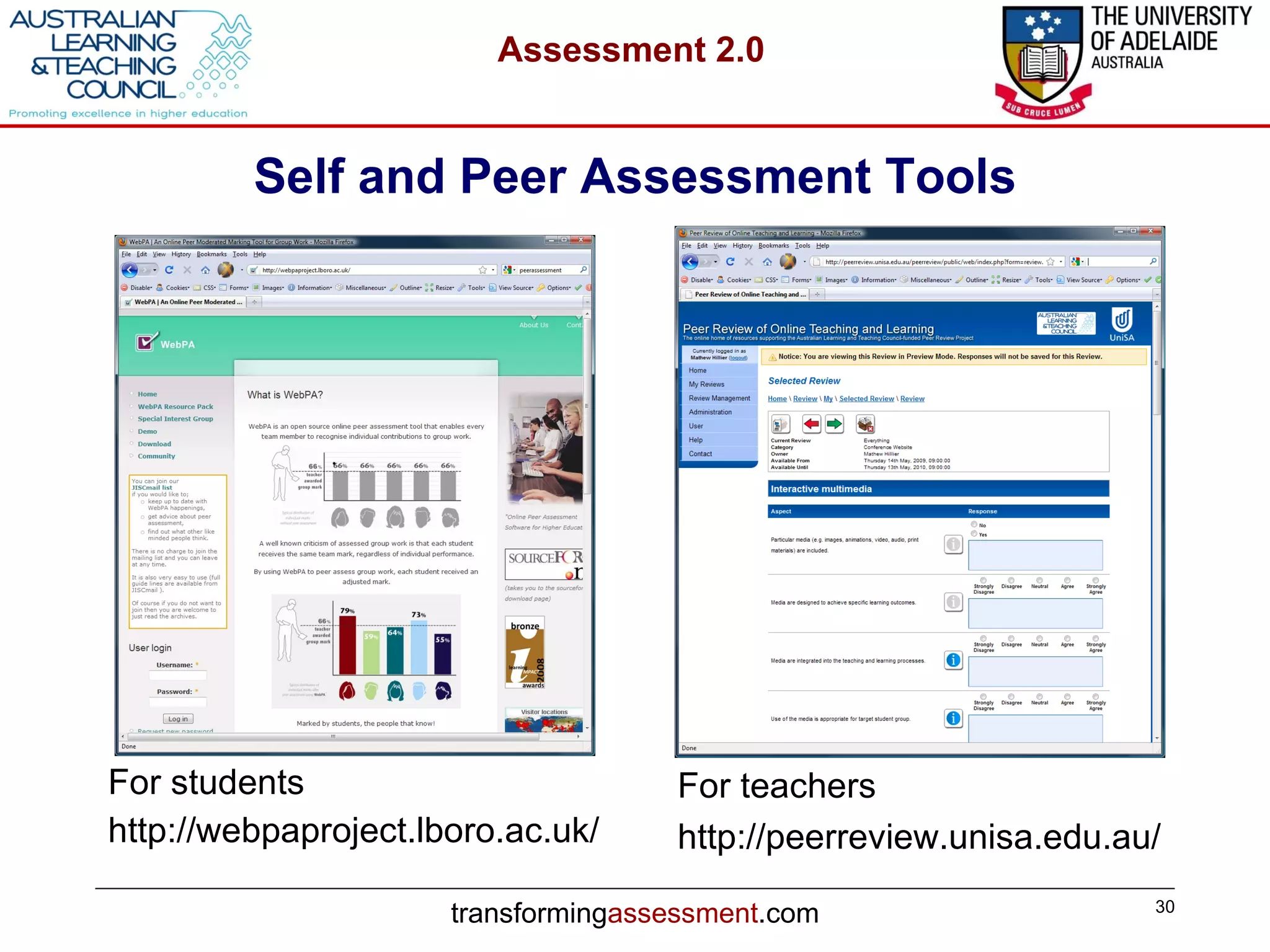
Self and Peer Assessment Tools For students http://webpaproject.lboro.ac.uk/ For teachers http://peerreview.unisa.edu.au/
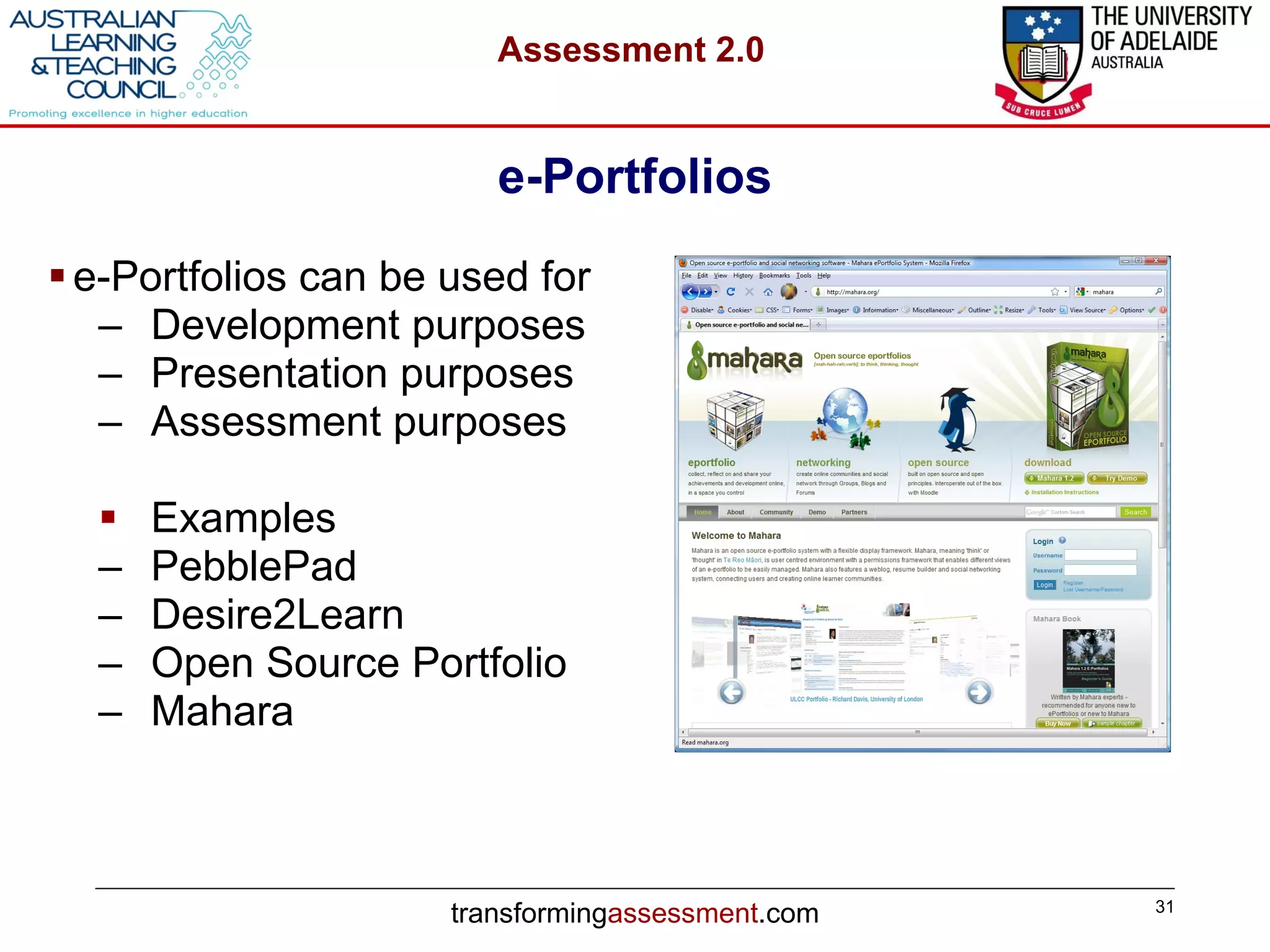
e-Portfolios e-Portfolios can be used for Development purposes Presentation purposes Assessment purposes Examples PebblePad Desire2Learn Open Source Portfolio Mahara
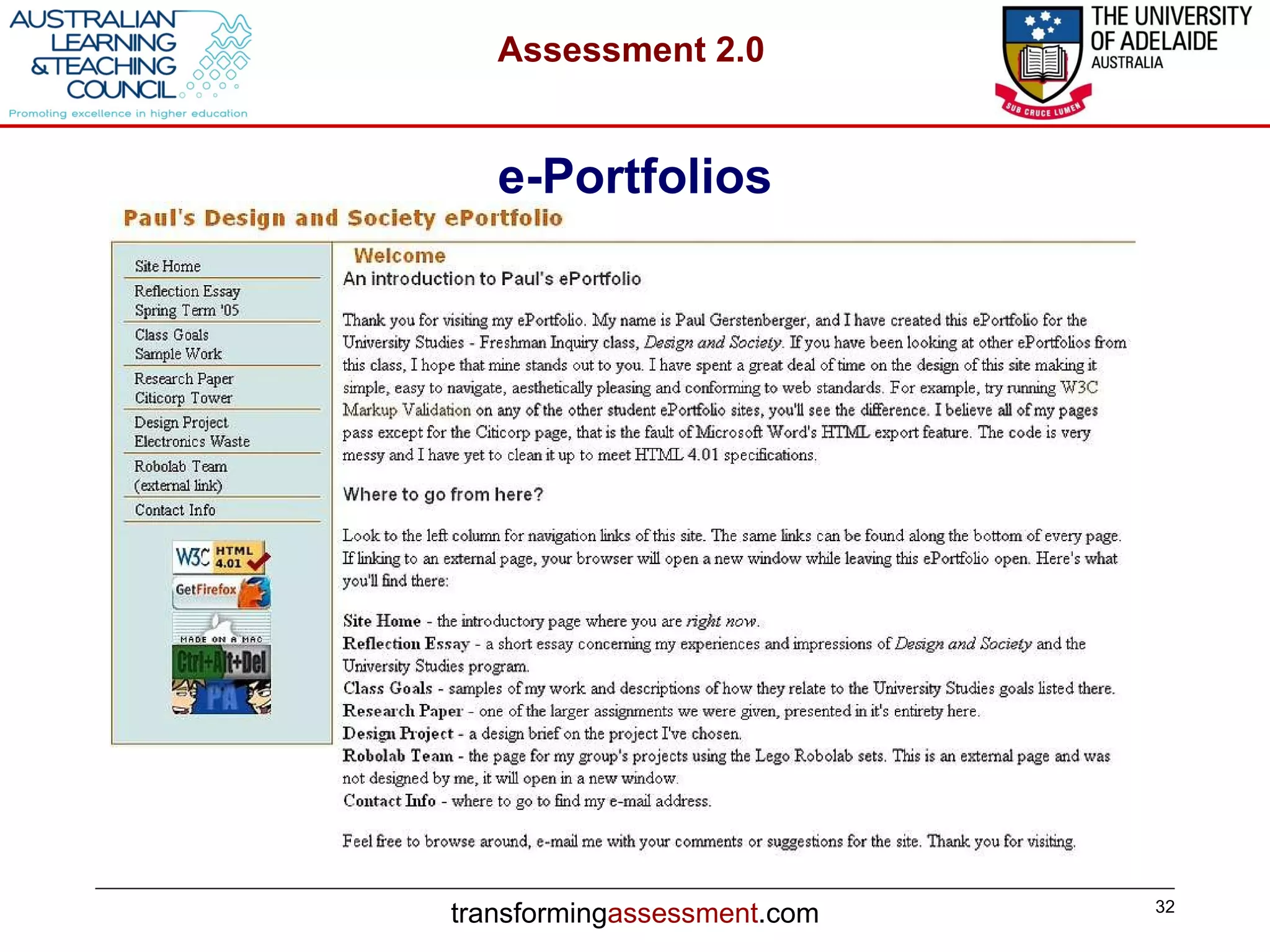
e-Portfolios
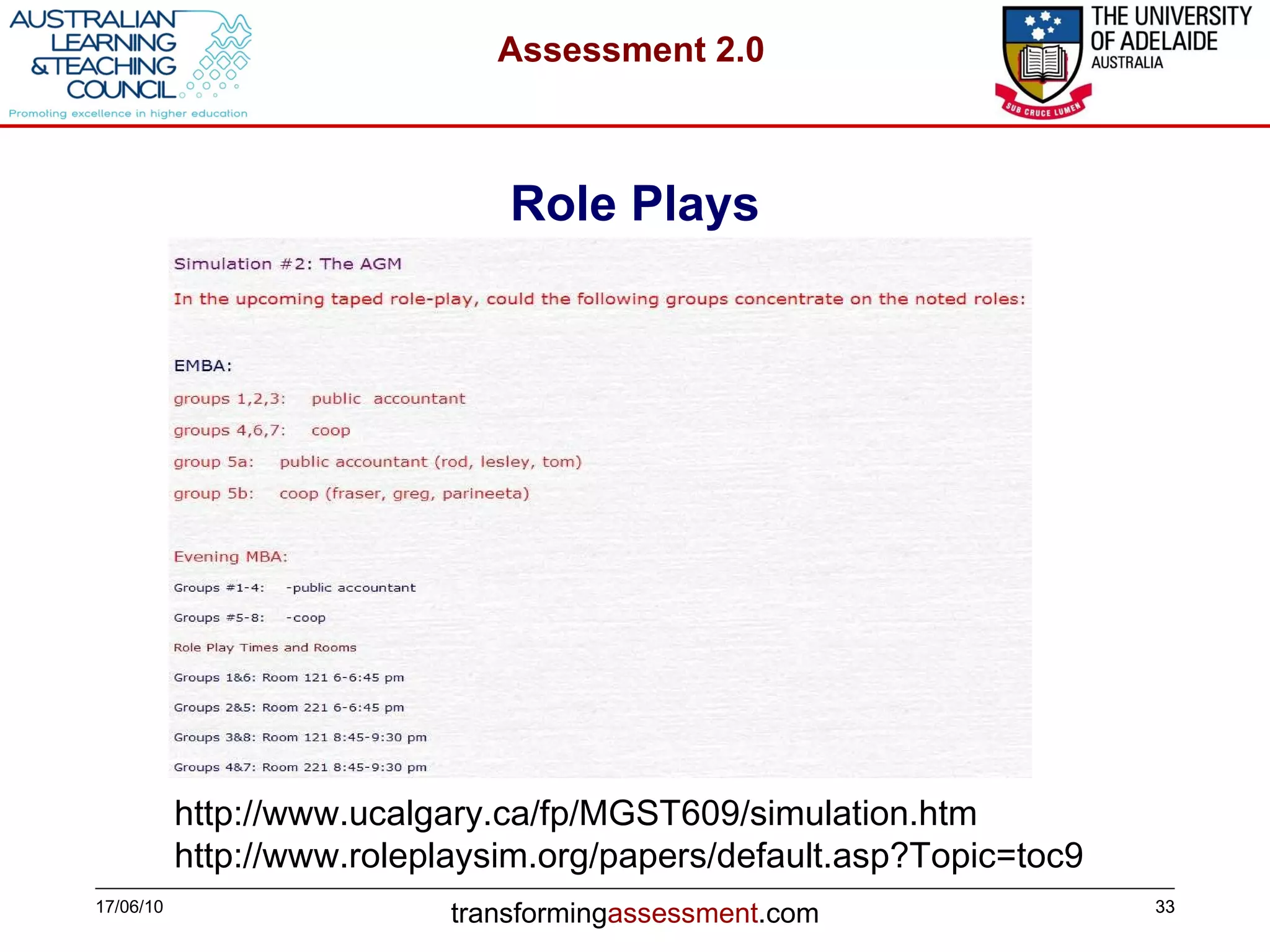
Role Plays 17/06/10 http://www.ucalgary.ca/fp/MGST609/simulation.htm http://www.roleplaysim.org/papers/default.asp?Topic=toc9
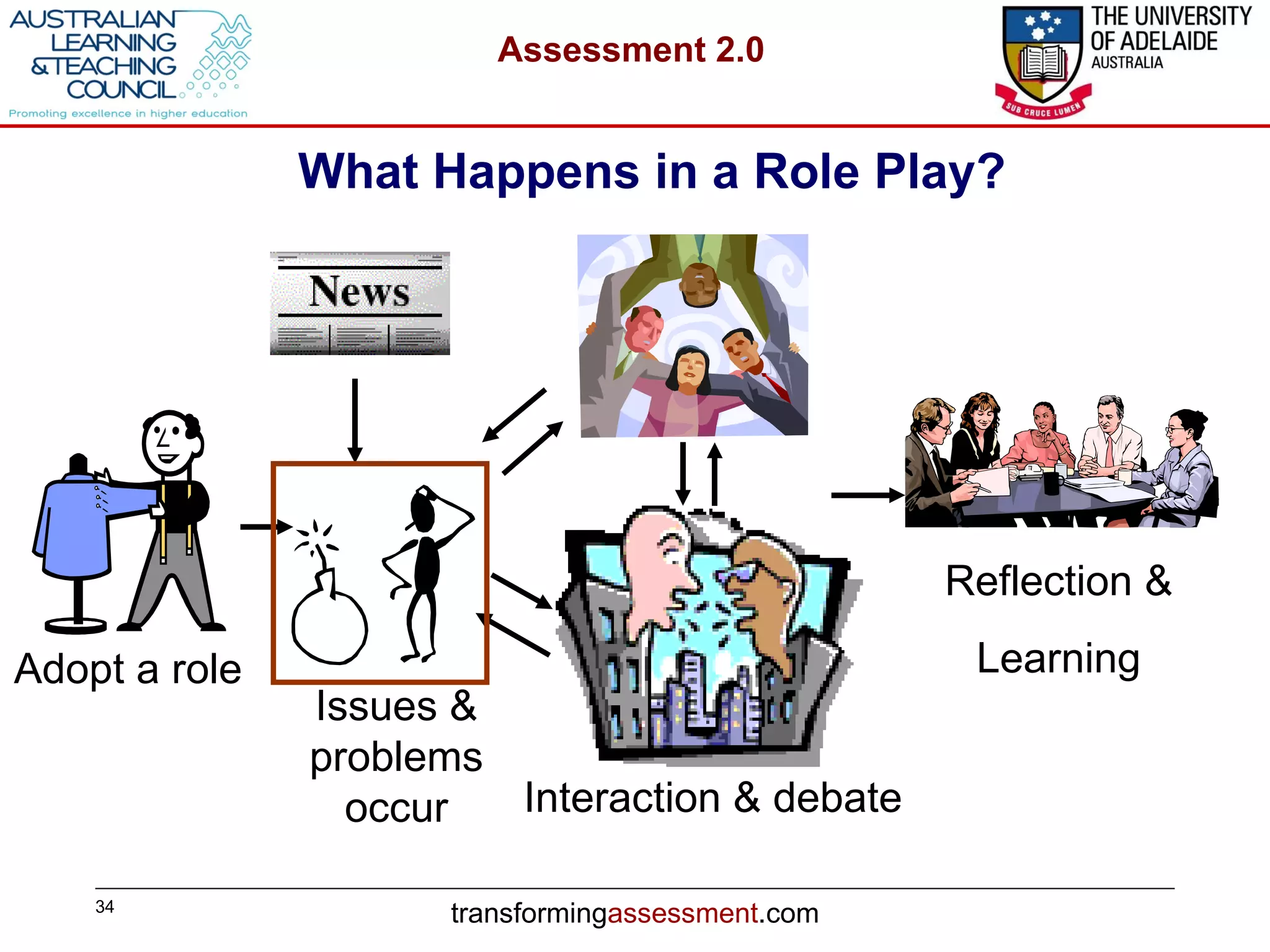
What Happens in a Role Play? Adopt a role Issues & problems occur Reflection & Learning Interaction & debate
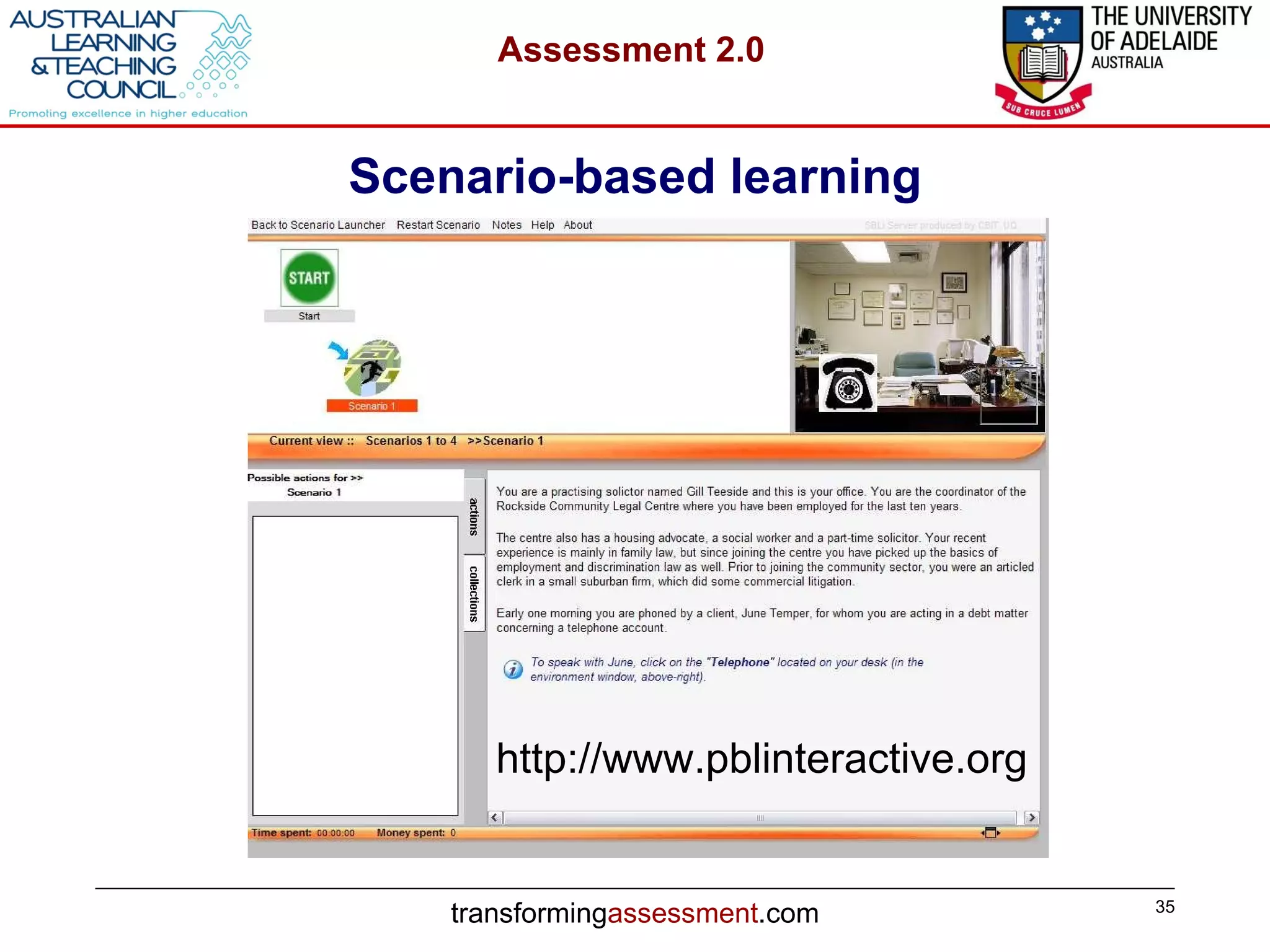
Scenario-based learning http://www.pblinteractive.org
IMMEX output
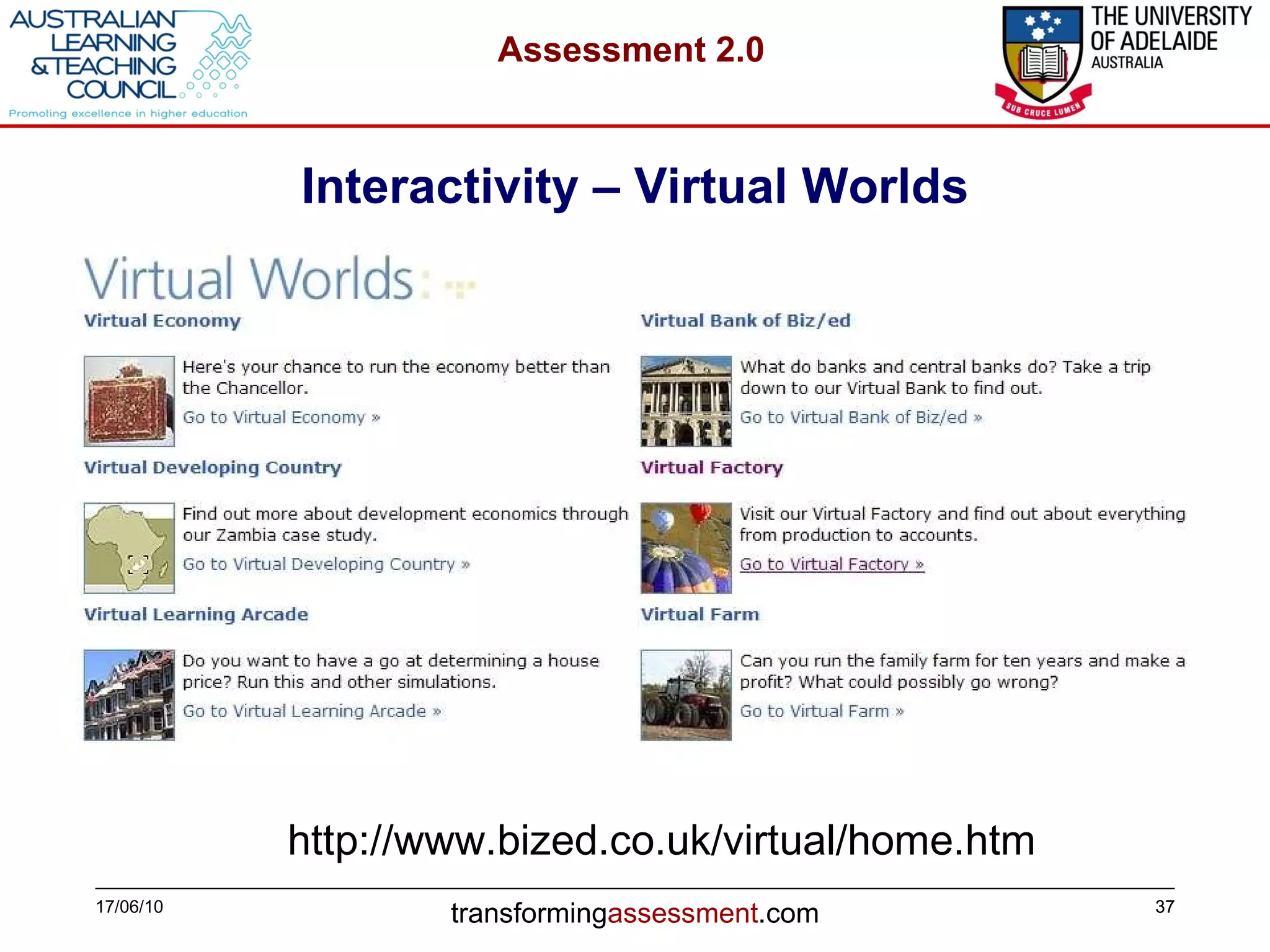
Interactivity – Virtual Worlds 17/06/10 http://www.bized.co.uk/virtual/home.htm
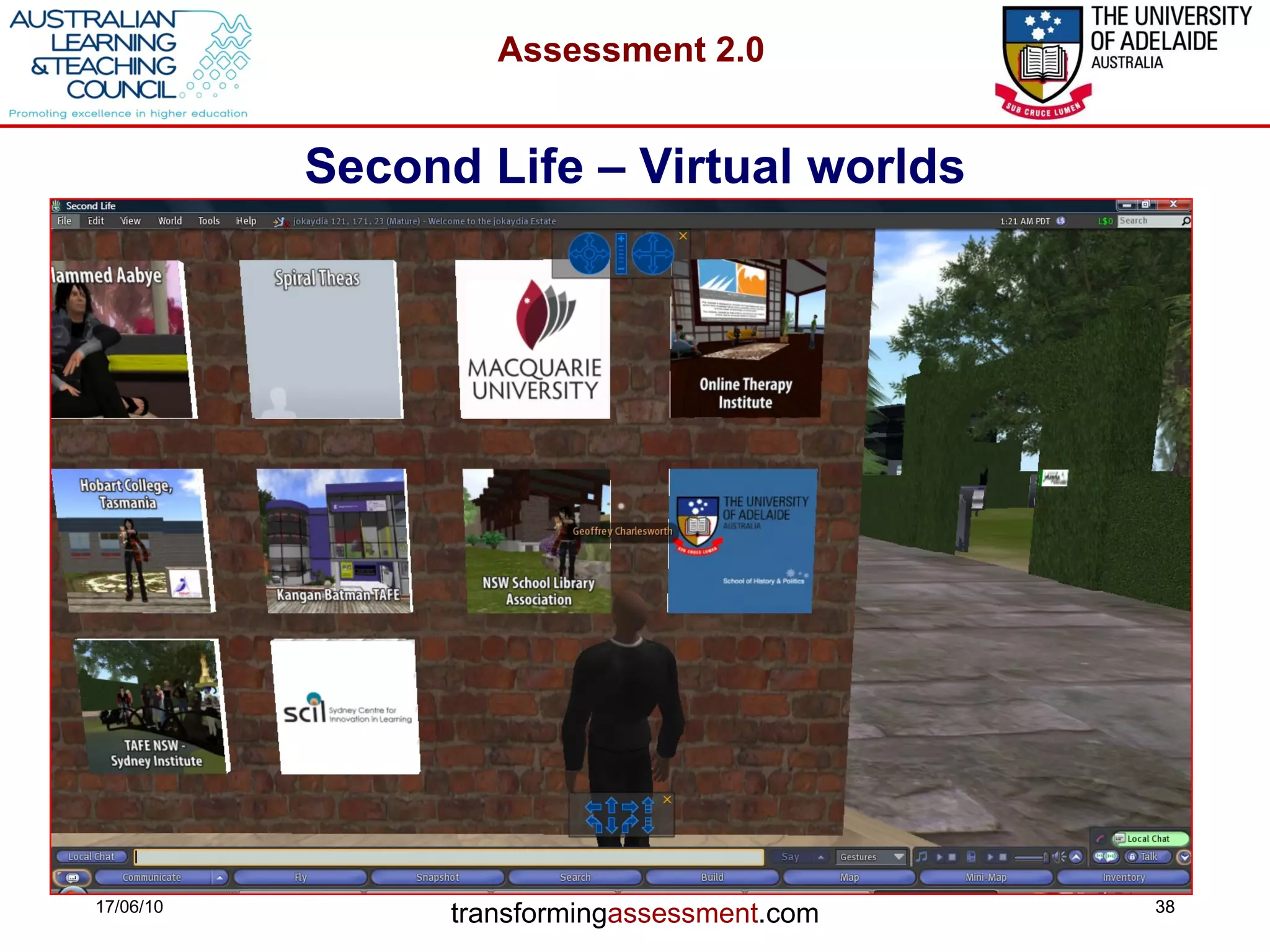
Second Life – Virtual worlds 17/06/10
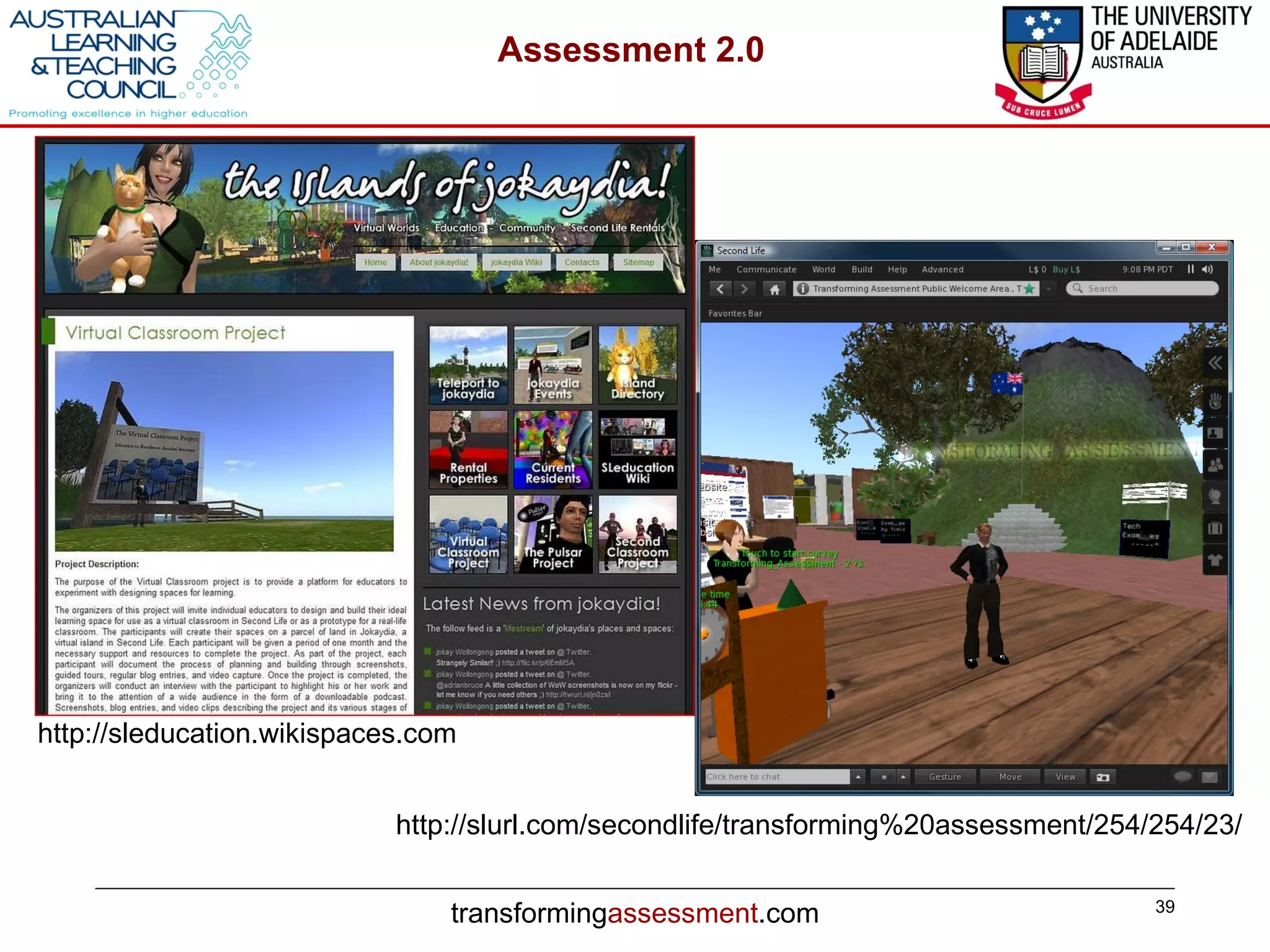
http://sleducation.wikispaces.com http://slurl.com/secondlife/transforming%20assessment/254/254/23/
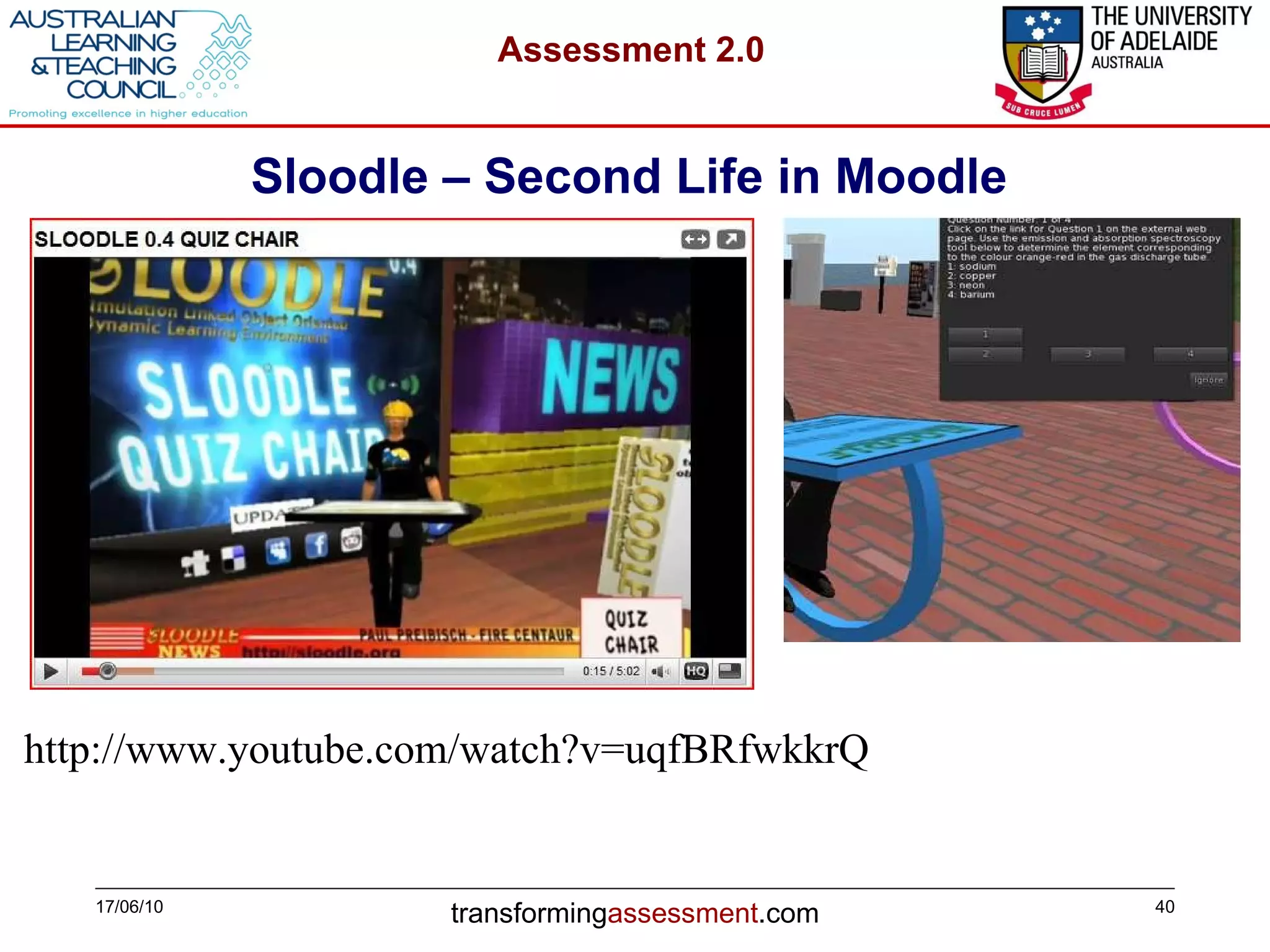
Sloodle – Second Life in Moodle 17/06/10 http://www.youtube.com/watch?v=uqfBRfwkkrQ
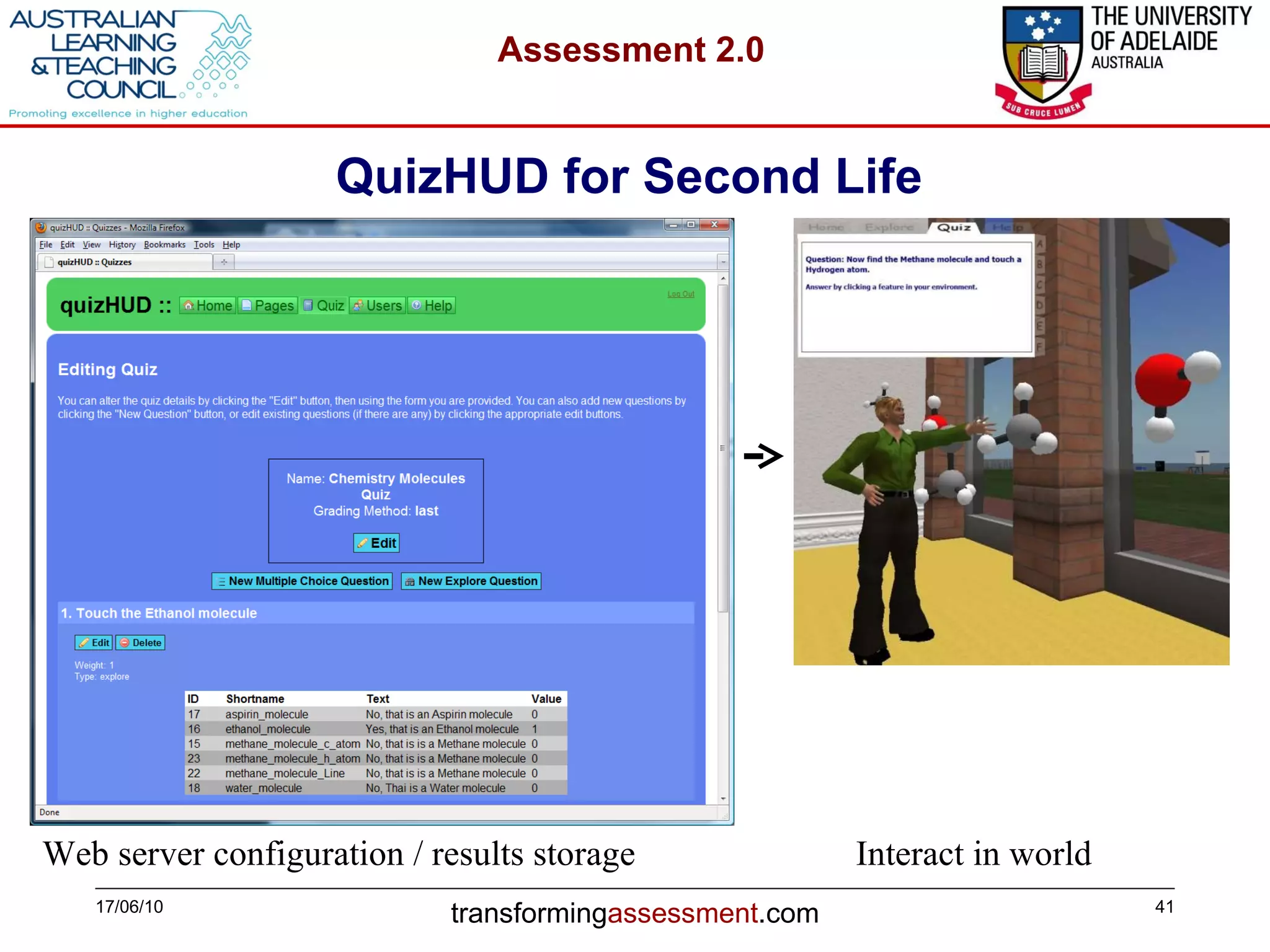
QuizHUD for Second Life 17/06/10 Web server configuration / results storage  Interact in world
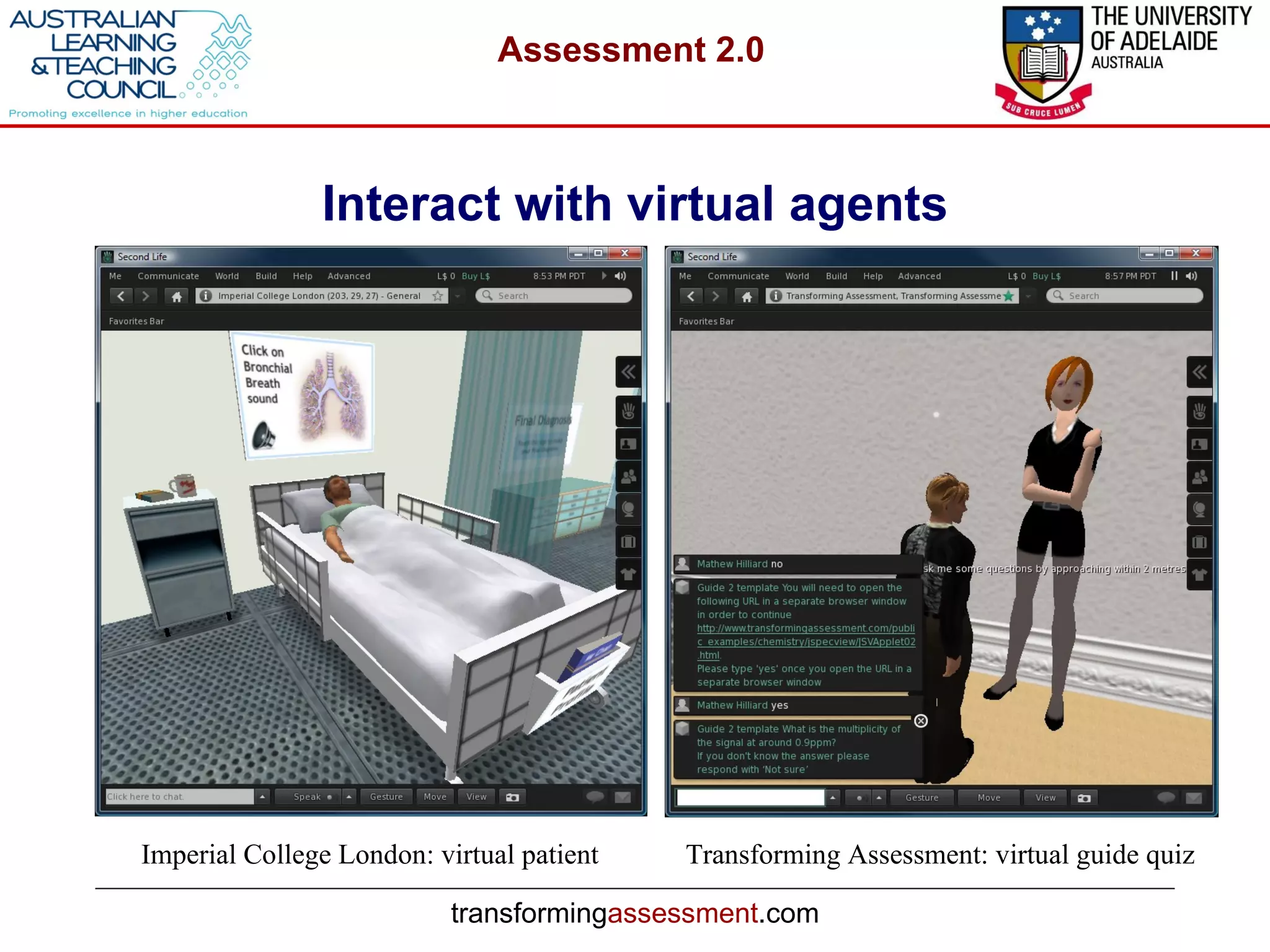
Interact with virtual agents Imperial College London: virtual patient Transforming Assessment: virtual guide quiz
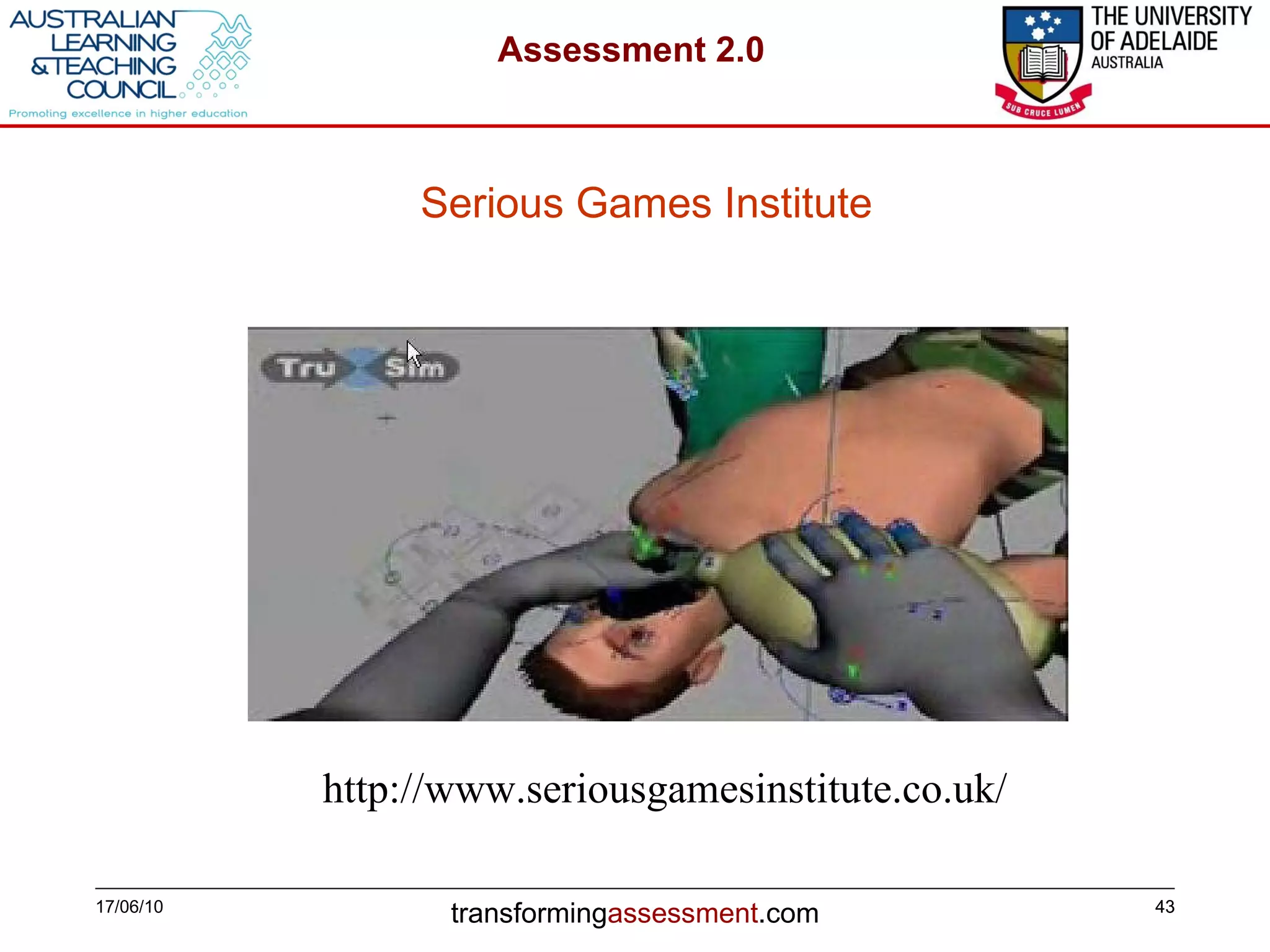
17/06/10 Serious Games Institute http://www.seriousgamesinstitute.co.uk/
17/06/10
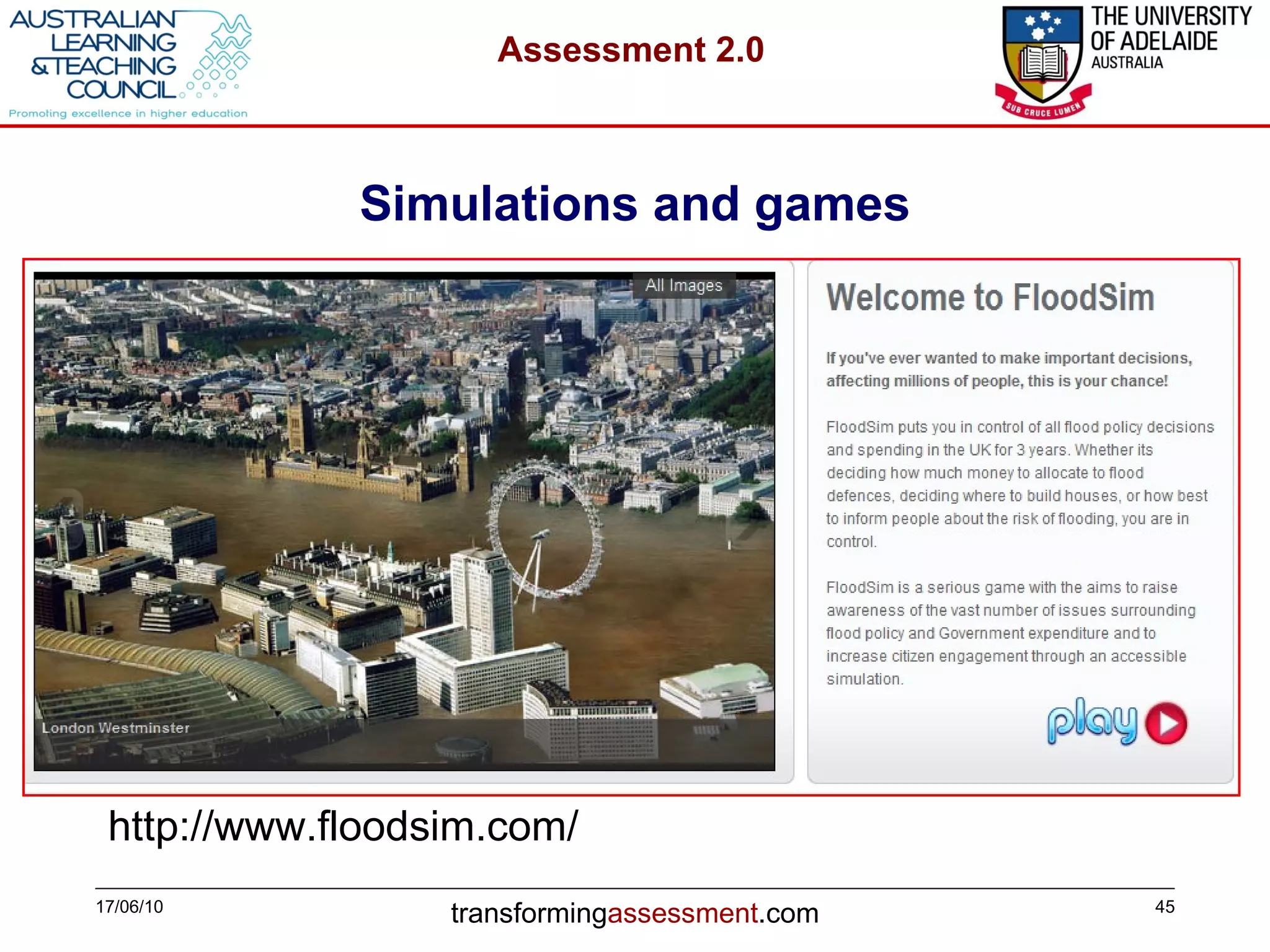
Simulations and games http://www.floodsim.com/ 17/06/10
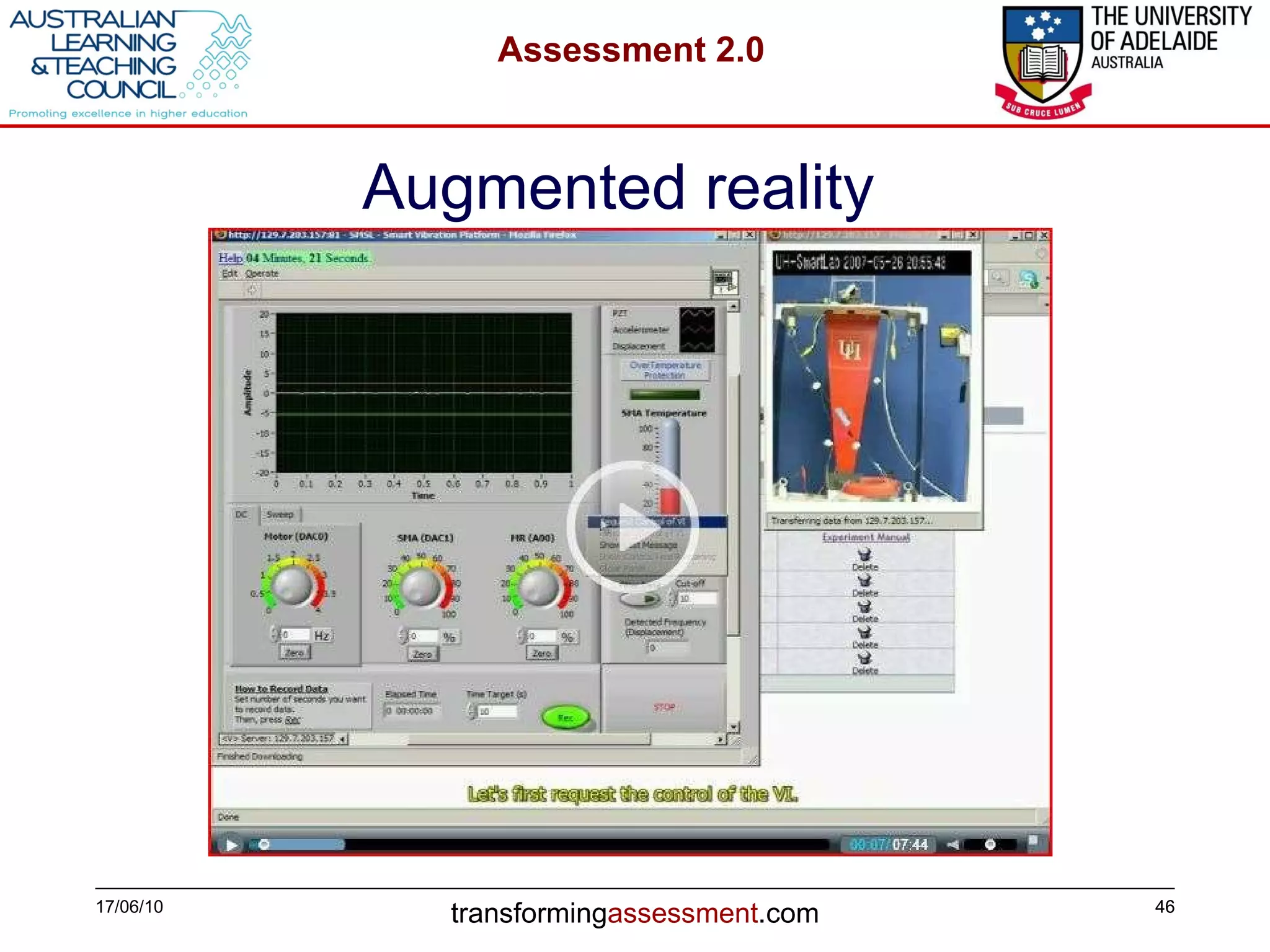
17/06/10 Augmented reality
Outline of presentation brief introduction to learning and assessment traditional e-assessments examples of interactive e-assessment assessment in virtual environments assessment tasks for the future 17/06/10
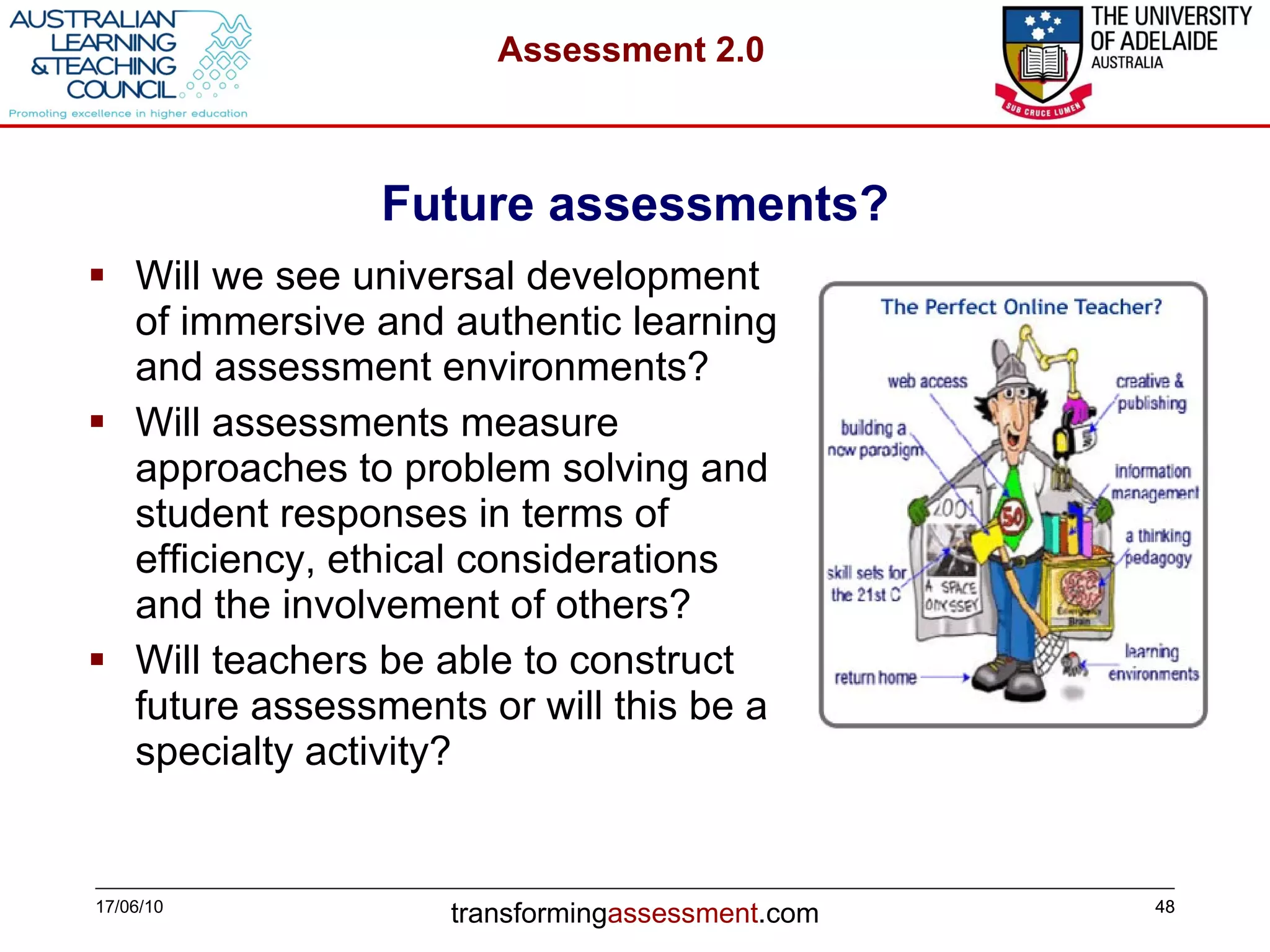
Future assessments? Will we see universal development of immersive and authentic learning and assessment environments ? Will assessments measure approaches to problem solving and student responses in terms of efficiency, ethical considerations and the involvement of others? Will teachers be able to construct future assessments or will this be a specialty activity?   17/06/10
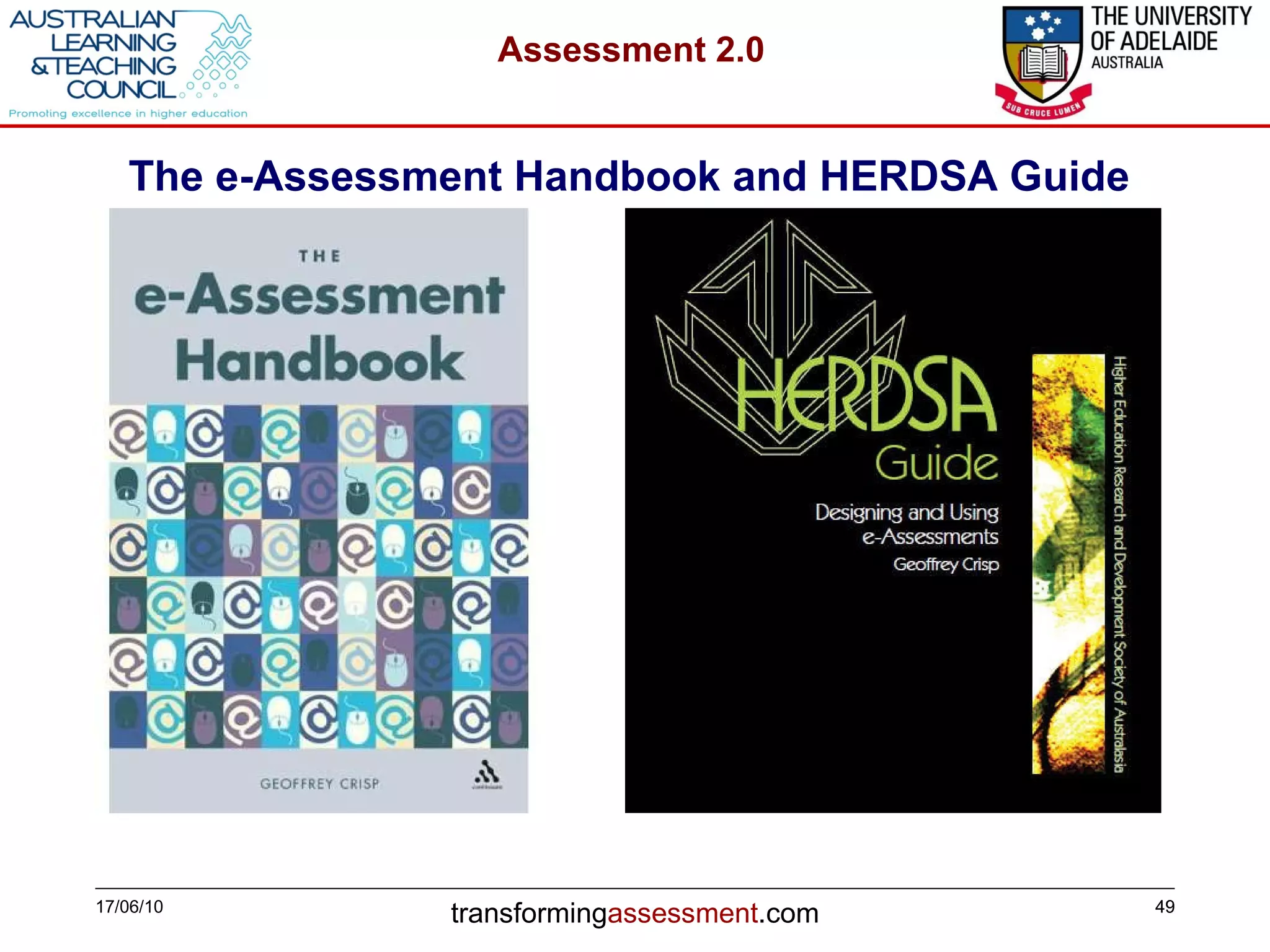
The e-Assessment Handbook and HERDSA Guide 17/06/10
For more information see

e-Assessment: Why should we change assessment for web 2.0?

  • 1.
    17/06/10 Geoffrey CrispALTC National Teaching Fellow Director, Centre for Learning and Professional Development University of Adelaide Why should we change assessment because of Web 2.0?
  • 2.
    Support for thiswork 17/06/10 The Team
  • 3.
    Outline of presentationintroduction - learning and assessment e-assessments examples of interactive e-assessments assessment in virtual environments assessment tasks for the future 17/06/10
  • 4.
    Typical learning andassessment today? 17/06/10 http://www.flickr.com/photos/cristic/359572656/ http://www.pharmtox.utoronto.ca/Assets/Photos/pcl473+classroom+editted.JPG
  • 5.
    Authentic learning andassessment 17/06/10 http://www.nasaimages.org/luna/servlet/detail/nasaNAS~9~9~58363~162207 Is this not what we want for learning, teaching and assessment? Authentic!
  • 6.
    Change The waysin which we live, work, play and learn have been transformed by technologies. People access, use, and create information very differently from the way they did in previous decades. People of the 21st century need new skills and education has an important role in developing them. This initiative is focused on defining those skills and developing ways to measure them using information technology. It will address the pedagogical implications and provide evidence on how the skills can best be developed in education.  http://www.atc21c.org/
  • 7.
    Assessment tasks shouldbe worth doing if students can answer your questions by copying from the web, you are asking the wrong questions if students can answer your questions by using Google, you are asking the wrong questions if students can answer your questions by guessing, you are asking the wrong questions 17/06/10 Why am I doing this course?
  • 8.
    Outline of presentationbrief introduction to learning and assessment traditional e-assessments examples of interactive e-assessment assessment in virtual environments assessment tasks for the future 17/06/10
  • 9.
    Effective e-Assessment can offer new possibilities for immersion and interactivity has the potential to facilitate enhanced social interactions can begin to resemble games and role-playing can facilitate the exposition of advanced skills and capabilities 17/06/10
  • 10.
    Bobby Elliot andassessment 1.5 to 2.0
  • 11.
    Question types -LMS 17/06/10 Question types available common LMS Blackboard test manager Moodle
  • 12.
  • 13.
    Outline of presentationbrief introduction to learning and assessment traditional e-assessments examples of interactive e-assessment assessment in virtual environments assessment tasks for the future 17/06/10
  • 14.
    Interactive e-assessment designSeparate the interactive tool/object/artefact from the question and the feedback Interactive tool Response Question
  • 15.
  • 16.
  • 17.
    Interactivity - ChemistryJava applet 17/06/10
  • 18.
  • 19.
    QuickTime VR 17/06/10 http://panograph.free.fr/BayeuxTapestry.html
  • 20.
    Process of problemsolving - IMMEX 17/06/10 http://www.immex.ucla.edu
  • 21.
    Process of problemsolving - IMMEX 17/06/10 http://www.immex.ucla.edu
  • 22.
    Outline of presentationbrief introduction to learning and assessment traditional e-assessments examples of interactive e-assessment assessment in virtual environments assessment tasks for the future 17/06/10
  • 23.
    Bobby Elliot andassessment 1.5 to 2.0
  • 24.
    Characteristics of Web2.0 User-generated content Facilitation of participation Access and openness Almost unlimited sources Power of the crowd
  • 25.
  • 26.
    Student Activities inWeb 2.0 More opportunity More responsibility More accountability More satisfaction More depth
  • 27.
    Assessment 1.0 vAssessment 2.0 Given Done alone Descriptive Text Closed book Done in class Teacher assessed Negotiated Done collaboratively Researched/Deep Text/audio/video Open web Done anywhere Self- and peer-assessed Assessment 1.0 Assessment 2.0 http://www.scribd.com/doc/461041/Assessment-20
  • 28.
  • 29.
  • 30.
    Self and PeerAssessment Tools For students http://webpaproject.lboro.ac.uk/ For teachers http://peerreview.unisa.edu.au/
  • 31.
    e-Portfolios e-Portfolios canbe used for Development purposes Presentation purposes Assessment purposes Examples PebblePad Desire2Learn Open Source Portfolio Mahara
  • 32.
  • 33.
    Role Plays 17/06/10http://www.ucalgary.ca/fp/MGST609/simulation.htm http://www.roleplaysim.org/papers/default.asp?Topic=toc9
  • 34.
    What Happens ina Role Play? Adopt a role Issues & problems occur Reflection & Learning Interaction & debate
  • 35.
  • 36.
  • 37.
    Interactivity – VirtualWorlds 17/06/10 http://www.bized.co.uk/virtual/home.htm
  • 38.
    Second Life –Virtual worlds 17/06/10
  • 39.
  • 40.
    Sloodle – SecondLife in Moodle 17/06/10 http://www.youtube.com/watch?v=uqfBRfwkkrQ
  • 41.
    QuizHUD for SecondLife 17/06/10 Web server configuration / results storage Interact in world
  • 42.
    Interact with virtualagents Imperial College London: virtual patient Transforming Assessment: virtual guide quiz
  • 43.
    17/06/10 Serious GamesInstitute http://www.seriousgamesinstitute.co.uk/
  • 44.
  • 45.
    Simulations and gameshttp://www.floodsim.com/ 17/06/10
  • 46.
  • 47.
    Outline of presentationbrief introduction to learning and assessment traditional e-assessments examples of interactive e-assessment assessment in virtual environments assessment tasks for the future 17/06/10
  • 48.
    Future assessments? Willwe see universal development of immersive and authentic learning and assessment environments ? Will assessments measure approaches to problem solving and student responses in terms of efficiency, ethical considerations and the involvement of others? Will teachers be able to construct future assessments or will this be a specialty activity? 17/06/10
  • 49.
    The e-Assessment Handbookand HERDSA Guide 17/06/10
  • 50.

Editor's Notes

  • #2 ATN Assessment Conference 2009
  • #3 ATN Assessment Conference 2009
  • #4 ATN Assessment Conference 2009
  • #8 ATN Assessment Conference 2009
  • #9 ATN Assessment Conference 2009
  • #10 ATN Assessment Conference 2009
  • #12 ATN Assessment Conference 2009
  • #14 ATN Assessment Conference 2009
  • #18 ATN Assessment Conference 2009
  • #20 ATN Assessment Conference 2009
  • #21 ATN Assessment Conference 2009
  • #22 ATN Assessment Conference 2009
  • #23 ATN Assessment Conference 2009
  • #38 ATN Assessment Conference 2009
  • #48 ATN Assessment Conference 2009
  • #49 ATN Assessment Conference 2009
  • #50 ATN Assessment Conference 2009