Student Learning Objectives:
Textbook #1:
Chapter 1, Learning
  Standards
  Students will be able to:
  Recognize what Learning
  Standards are
  Explain National Standards
  Examine why there is a
  need for standards
  Identify how Standards can
  be used
Chapter 1: Student Learning
        Standards


ED 450 Assessment & Evaluation
What are Student Learning
       Standards
Standards is the same as objectives
Standards are parallel to
traditional goals and objectives as
well as outcomes.
It has an implication of high levels
of expectations and monitoring
that were not commonly connected
to the widely used educational
objectives
National Standards
Some are very general
Other standards are more specific
Format of Standards
Lack of uniformity in national
standards makes it difficult for
school districts to adopt the subject-
specific national documents
(Standards & Benchmarks)
Some standards deal with content,
while others address curriculum,
performance or lifelong learning
skills
Management Issues
If teachers attempt to teach ALL
the standards now in place, the
average student would need to add
FIVE more years to his/her school
career.
Types of Standards
***There are 4 types of Standards, they are:
1.Content Standards
2.Performance Standards
3.Lifelong Learning Standards
4.Opportunity to learn

In your group, discuss, and be ready to
  explain your standard(s)
Why Do We Need
       Standards?
Standards can be a blueprint to
ensure that all students are
learning the necessary knowledge
and skills.
Effective instructional practices
can be designed to teach the
standards, and appropriate
multiple measures can be
developed which is reliable, valid,
Four reasons that standards
represent the most powerful options
          for school reform
1. Erosion of the Carnegie unit and
   the common curriculum
2. Variation in current grading
   practices
3. Lack of attention to educational
   outputs
4. Competing countries do it
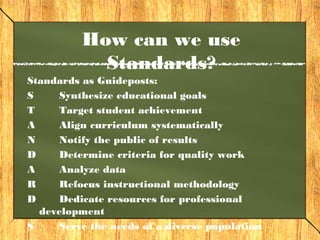
How can we use
            Standards?
Standards as Guideposts:
S     Synthesize educational goals
T     Target student achievement
A     Align curriculum systematically
N     Notify the public of results
D     Determine criteria for quality work
A     Analyze data
R     Refocus instructional methodology
D     Dedicate resources for professional
  development
S     Serve the needs of a diverse population

Chapter 1 learning standards

  • 1.
    Student Learning Objectives: Textbook#1: Chapter 1, Learning Standards Students will be able to: Recognize what Learning Standards are Explain National Standards Examine why there is a need for standards Identify how Standards can be used
  • 2.
    Chapter 1: StudentLearning Standards ED 450 Assessment & Evaluation
  • 3.
    What are StudentLearning Standards Standards is the same as objectives Standards are parallel to traditional goals and objectives as well as outcomes. It has an implication of high levels of expectations and monitoring that were not commonly connected to the widely used educational objectives
  • 4.
    National Standards Some arevery general Other standards are more specific
  • 5.
    Format of Standards Lackof uniformity in national standards makes it difficult for school districts to adopt the subject- specific national documents (Standards & Benchmarks) Some standards deal with content, while others address curriculum, performance or lifelong learning skills
  • 6.
    Management Issues If teachersattempt to teach ALL the standards now in place, the average student would need to add FIVE more years to his/her school career.
  • 7.
    Types of Standards ***Thereare 4 types of Standards, they are: 1.Content Standards 2.Performance Standards 3.Lifelong Learning Standards 4.Opportunity to learn In your group, discuss, and be ready to explain your standard(s)
  • 8.
    Why Do WeNeed Standards? Standards can be a blueprint to ensure that all students are learning the necessary knowledge and skills. Effective instructional practices can be designed to teach the standards, and appropriate multiple measures can be developed which is reliable, valid,
  • 9.
    Four reasons thatstandards represent the most powerful options for school reform 1. Erosion of the Carnegie unit and the common curriculum 2. Variation in current grading practices 3. Lack of attention to educational outputs 4. Competing countries do it
  • 10.
    How can weuse Standards? Standards as Guideposts: S Synthesize educational goals T Target student achievement A Align curriculum systematically N Notify the public of results D Determine criteria for quality work A Analyze data R Refocus instructional methodology D Dedicate resources for professional development S Serve the needs of a diverse population