10/12/2014 | slide 1 
Transforming assessment for learning in a digital age 
David Boud, facilitated by Mark Russell 
Joint Information Systems Committee 
Supporting education and research
Joint Information Systems Committee 
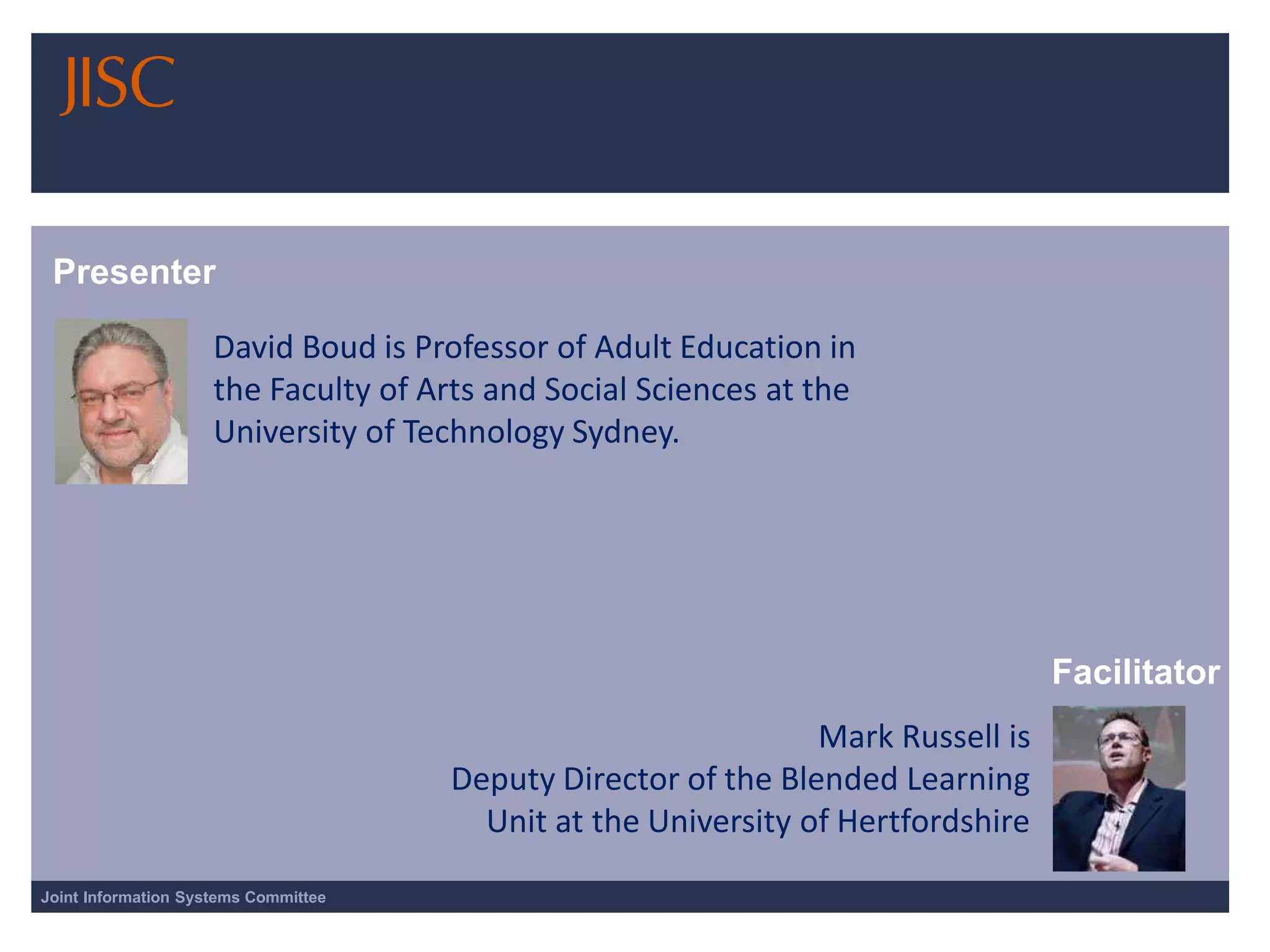
David Boud is Professor of Adult Education in the Faculty of Arts and Social Sciences at the University of Technology Sydney. 
Presenter 
Facilitator 
Mark Russell is 
Deputy Director of the Blended Learning Unit at the University of Hertfordshire
Session practice 
Joint Information Systems Committee 
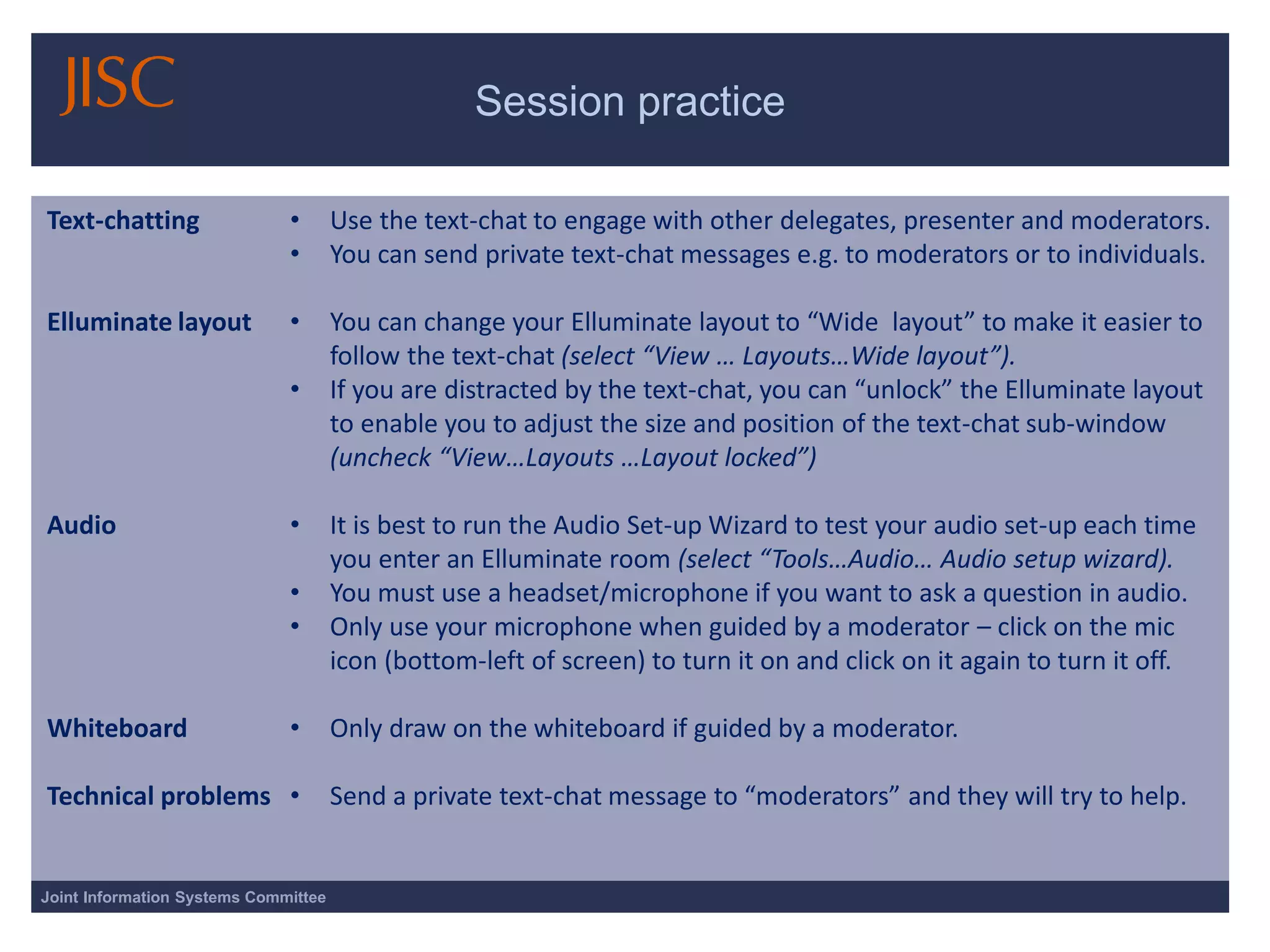
Text-chatting 
Elluminate layout 
Audio 
Whiteboard 
Technical problems 
•Use the text-chat to engage with other delegates, presenter and moderators. 
•You can send private text-chat messages e.g. to moderators or to individuals. 
•You can change your Elluminate layout to “Wide layout” to make it easier to follow the text-chat (select “View … Layouts…Wide layout”). 
•If you are distracted by the text-chat, you can “unlock” the Elluminate layout to enable you to adjust the size and position of the text-chat sub-window (uncheck “View…Layouts …Layout locked”) 
•It is best to run the Audio Set-up Wizard to test your audio set-up each time you enter an Elluminate room (select “Tools…Audio… Audio setup wizard). 
•You must use a headset/microphone if you want to ask a question in audio. 
•Only use your microphone when guided by a moderator –click on the mic icon (bottom-left of screen) to turn it on and click on it again to turn it off. 
•Only draw on the whiteboard if guided by a moderator. 
•Send a private text-chat message to “moderators” and they will try to help.
Transforming assessment for learning in a digital age 
David Boud 
University of Technology, Sydney 
http://www.davidboud.com 
http://tinyurl.com/jiscdavidboud 
http://www.assessmentfutures.com 
Other picture
Pre-conference activities and reading 
Activities 
1.Drawing from the JISC Guide, what is the most strategic form of digitally enabled assessment needed to foster learning? Why this one? 
2.Drawing on the Assessment 2020 propositions, what is the single greatest contribution that digital technology can make to this reform agenda? How can it best be made? 
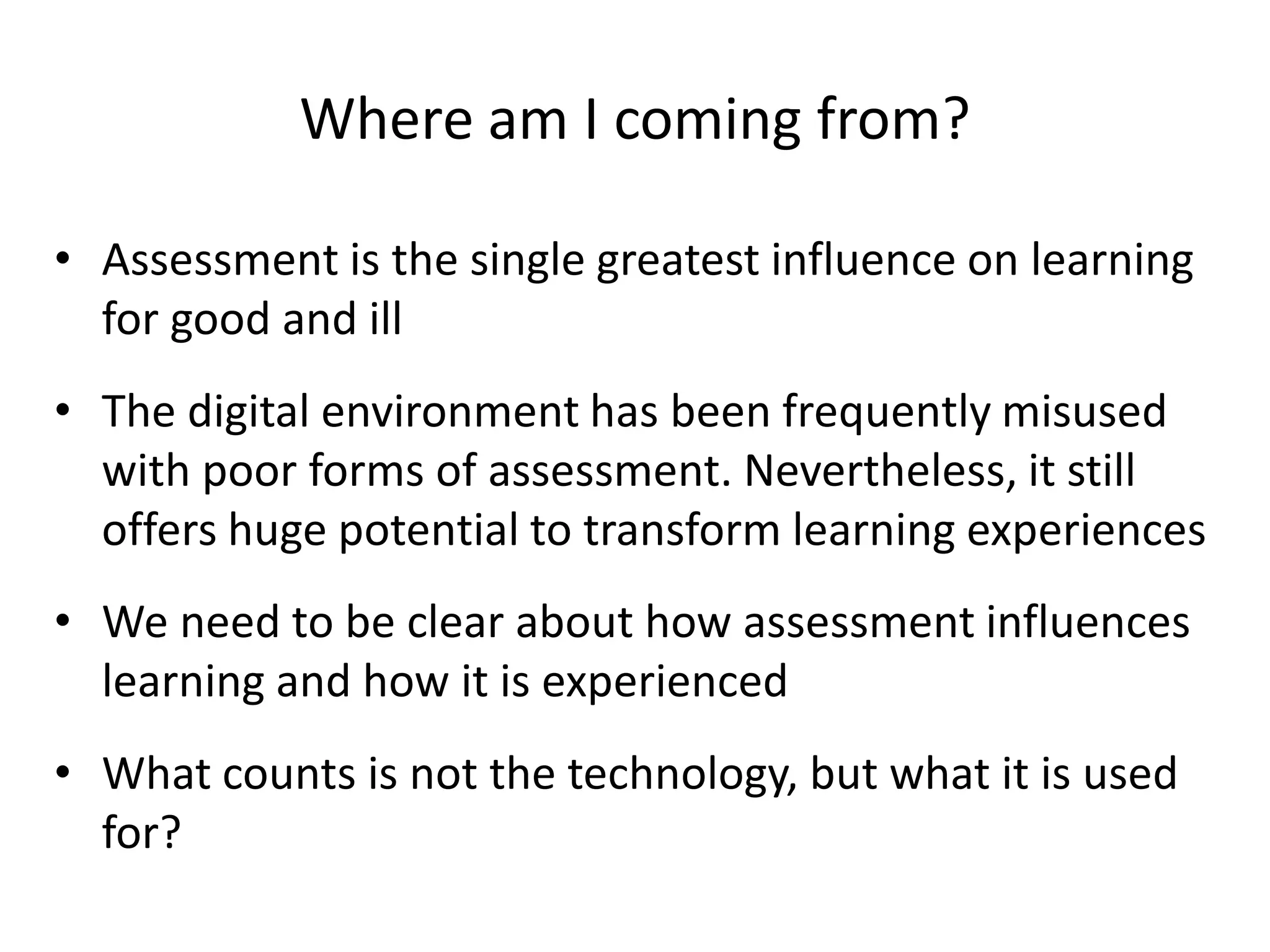
http://tinyurl.com/assessment2020 
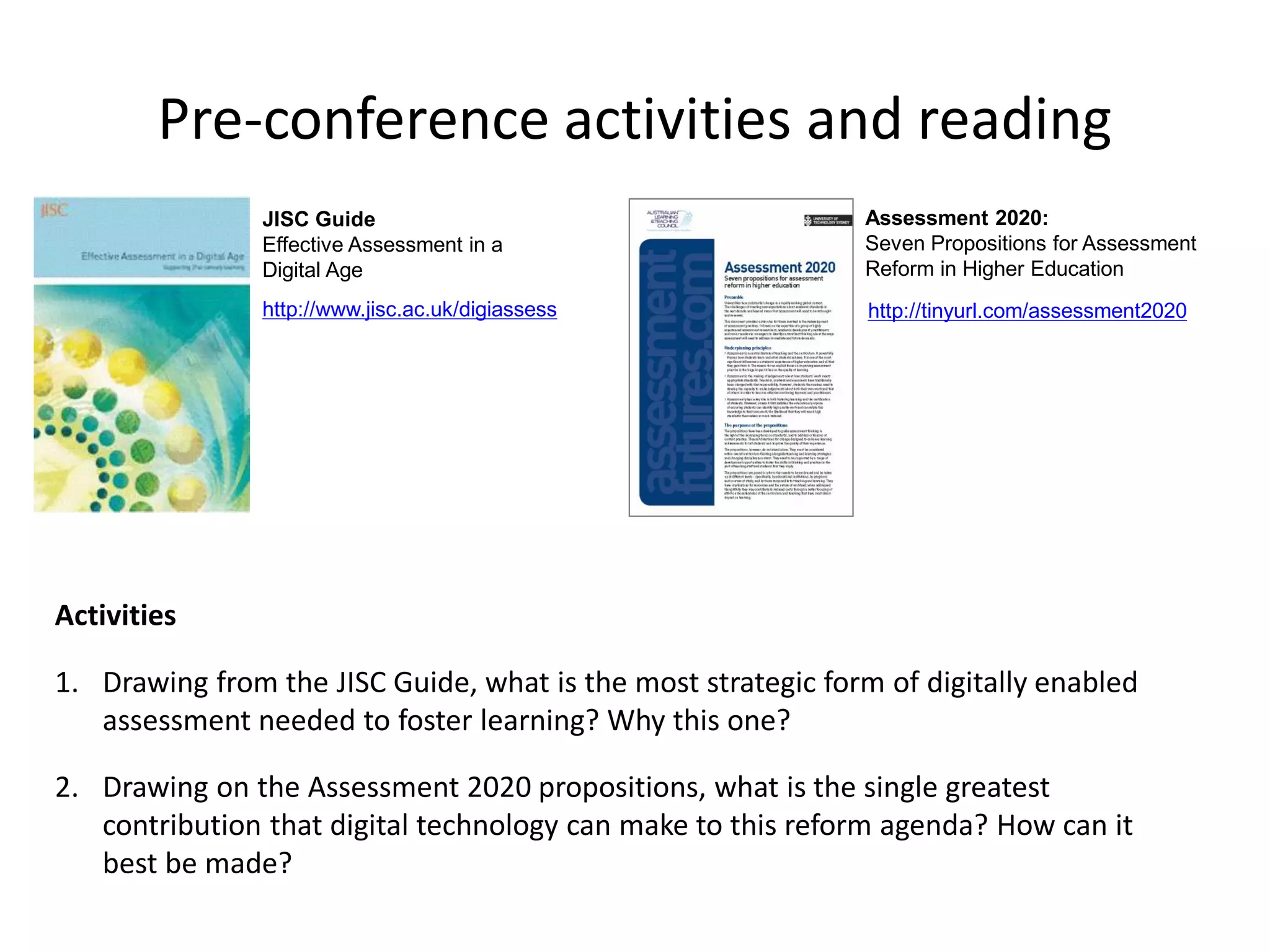
http://www.jisc.ac.uk/digiassess 
JISC Guide 
Effective Assessment in a Digital Age 
Assessment 2020: 
Seven Propositions for Assessment Reform in Higher Education
Where am I coming from? 
•Assessment is the single greatest influence on learning for good and ill 
•The digital environment has been frequently misused with poor forms of assessment. Nevertheless, it still offers huge potential to transform learning experiences 
•We need to be clear about how assessment influences learning and how it is experienced 
•What counts is not the technology, but what it is used for?
Overview of presentation 
I.We haven’t yet transformed assessment for a pre-digital age 
II.The trap is to use the digital environment to lock in a primitive view of assessment 
III.Reclaiming learning as a key purpose of assessment, but in a new way 
IV.Assessment for longer term learning 
V.Positive and negative affordances of digital technology for assessment for learning 
VI.Some key sites for development: feedback, self-assessment, collaboration
I. We haven’t yet transformed assessment for a pre-digital age 
•Let us not pretend that assessment in everyday situations is satisfactory 
•Often messy compromises between assessment for certification and learning
I. We haven’t yet transformed assessment for a pre-digital age 
•Let us not pretend that assessment in everyday situations is satisfactory 
•Often messy compromises between assessment for certification and learning 
Changing thinking about assessment is needed: 
1.Assessment isn’t just about formal structured assessment activities, it is about everything that enables us (teachers and learners) to make judgements about learning 
2.Whatever else it does, assessment should fundamentally be about building learners’ capacity to make informed judgements about their work. It always needs to do double duty—for immediate purposes and for the longer-term
What is the worst feature of e-assessment we need to avoid? 
A Excessive use of close-ended questions 
B Easy to over-assess with relentless testing 
C Students work in isolation from each other 
D Easy to remove tutor involvement 
E Lack of personal explanations 
•Select your response from the buttons (A B C D E) at the bottom-right of the list of participants 
•Type any additional comments into the text-chat
II. The digital environment can lock in a primitive view of assessment 
•Need to avoid reverting to primitive ideas about assessment when faced with an unfamiliar environment 
•Assessment in general may be traped in an earlier era of measurement, norms, testing, etc. 
•eAssessment is sometimes discussed as if it were a different beast, many papers on the topic ignore basic assessment and learning issues and non-e literature 
•Need to consider the human dimension—how assessment shapes students’ actions—not just more efficient testing 
•Students must have an active role. This become more important on the web as it is so easy to remove this.
Question 
What is the greatest untapped potential of the digital environment for assessment? 
•Type your responses into the text-chat
III. Reclaiming learning as a key purpose of assessment, but in a new way 
•Need to shift conceptions of assessment towards longer term learning 
•Assessment isn’t just about formal assessment for certification purposes 
•Greatest potential of digital technology is for assessment and feedback to be easily be embedded in all learning activities 
–eg. use of clickers in lectures and new cheaper technology for this purpose
Key feature of quality assessment 
•Addresses need for information to guide learning when needed and in a way needed 
–need to distinguish guidance from simply what students want and when they want it 
•Always promotes high quality study activities 
–and discourages cramming for tests 
•Assessment completely aligned with pedagogy and purpose 
–constructive alignment but with a long-term learning view
IV. Assessment for longer term learning 
1.Sustainable 
2.Develops informed judgement 
3.Constructs reflexive learners 
4.Forms the becoming practitioner 
Key features: 
(in each of the following slides you can vote for which topic you would like to explore in more depth)
Feature 1. Sustainable 
A.Looks beyond the immediate content 
–To what is required beyond the end of the course 
B.Avoids creating dependency 
–e.g. through pleasing the lecturer, or looking to them for judgement 
C.Focuses on higher-order knowledge and skills in context 
–Memorising as such is not tested because doing so fosters bad habits 
•Select which topic you would like to explore in more depth –using the buttons (A B C)
Feature 2. Develops informed judgement 
A.Students must develop the capacity to make judgments about their own learning 
–Otherwise they cannot be effective learners now or in the future 
B.Assessment is about informing students’ own judgements as well as making judgements on their work 
–Summative assessment alone is to risky and does not equip students for new challenges. Assessment is more important than grading 
C.Opportunities for developing informed judgement need to be staged across a program 
–Working across subjects/modules is essential 
•Select which topic you would like to explore in more depth –using the buttons (A B C)
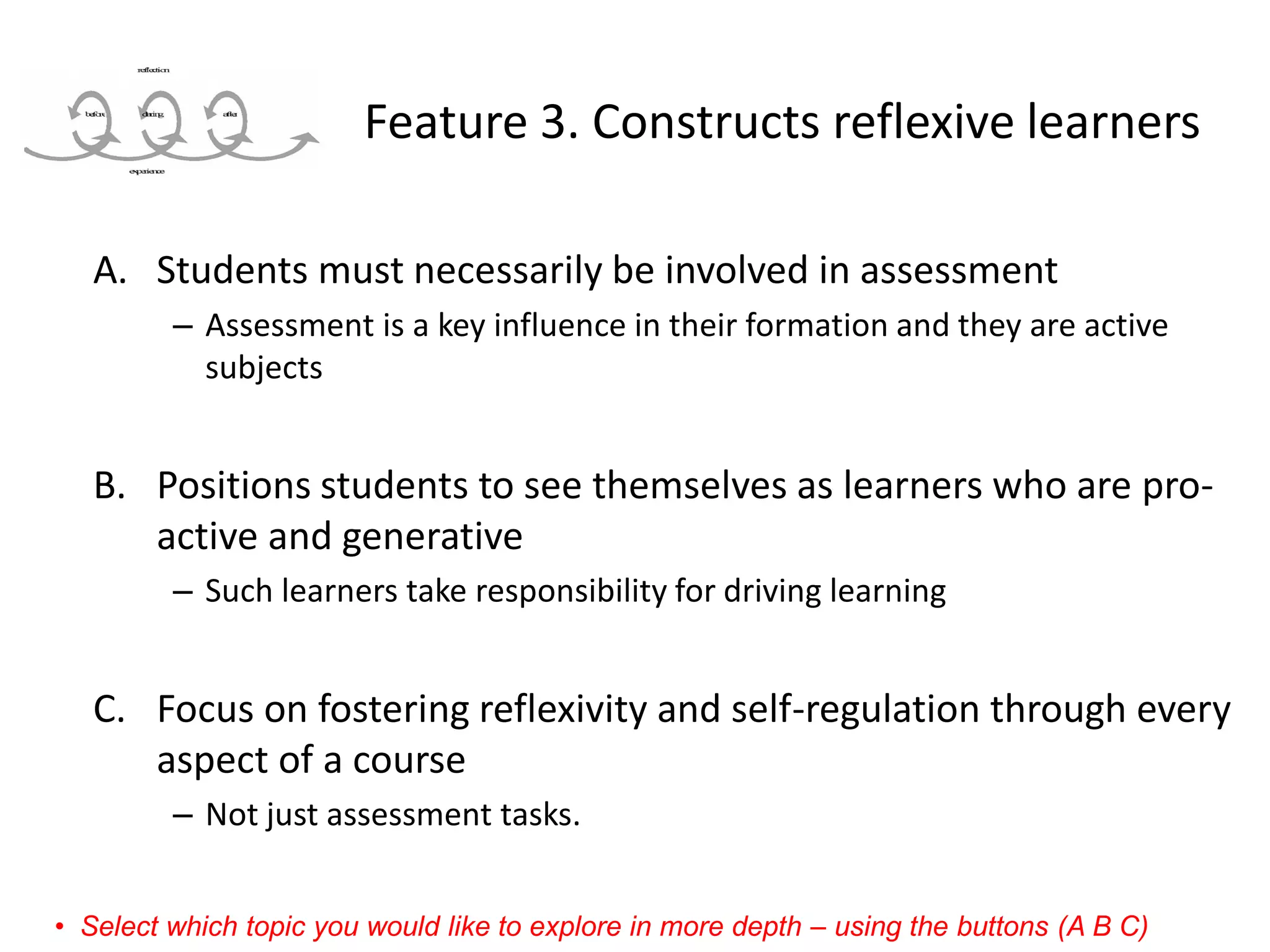
Feature 3. Constructs reflexive learners 
A.Students must necessarily be involved in assessment 
–Assessment is a key influence in their formation and they are active subjects 
B.Positions students to see themselves as learners who are pro- active and generative 
–Such learners take responsibility for driving learning 
C.Focus on fostering reflexivity and self-regulation through every aspect of a course 
–Not just assessment tasks. 
•Select which topic you would like to explore in more depth –using the buttons (A B C)
Feature 4. Forms the becoming practitioner 
A.Assessment to help calibrate judgement 
–Learners act on their belief in their own judgements; if these are flawed it is more serious than particular knowledge gaps 
B.Develops confidence and skills to manage their own learning and assessment 
–Understanding is not enough 
C.Develops the capacity to work effectively with others to assist learning and mutually develop informed judgement 
–Assessment in work settings occurs with and for others 
•Select which topic you would like to explore in more depth –using the buttons (A B C)
Exploring these ideas further 
Examples of different kinds of assessment practice to foster learning in the longer term: 
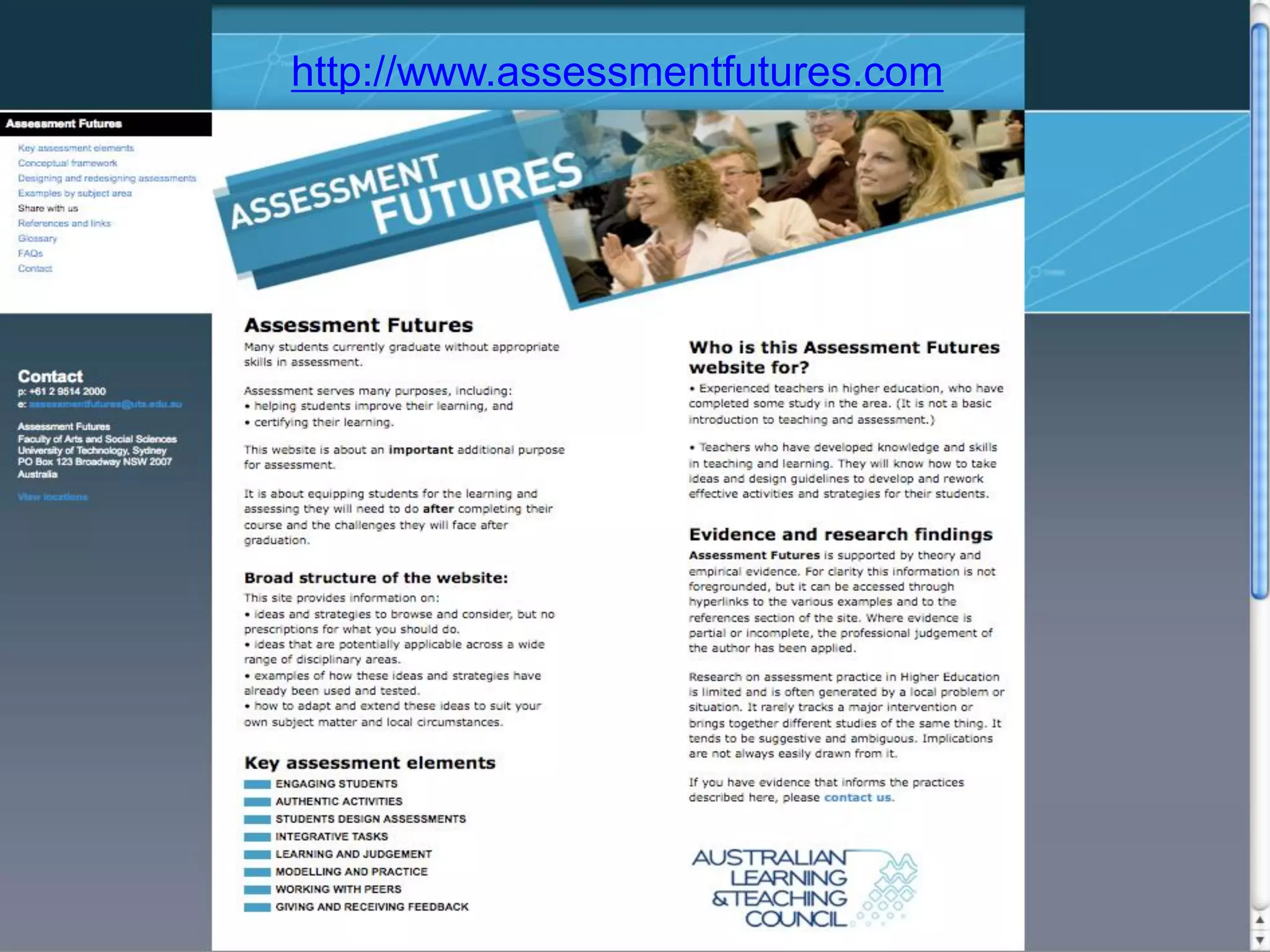
http://www.assessmentfutures.com
Assessmentfutures splash 
http://www.assessmentfutures.com
Question 
What are the most challenging aspects of this view of assessment for your practice? 
•Type your responses into the text-chat
V. Affordances of digital technology for assessment for learning 
Learning involves students being pro-active and doingrather than listening/reading 
–responsiveness 
•extends repertoire of ways of responding to variety of students and variety of student needs 
–user-control 
•purpose, timing, involvement 
–collaboration 
•working with others doesn’t need a particular physical environment 
–multi-media and multi-modal
Negative affordances 
What do we need to avoid? 
•Lots of things are easy to do, but don’t transform assessment and don’t support learning 
•More testing or self-testing 
•More compliance and control 
•More dependency
Positive affordances 
•Always there, never tired 
•Databases can be used to support assessment tasks 
•Can involve others easily—they don’t have to be physically present 
•Keeps good records (for students as well as teachers)
Traps 
•Teachers dominate because everything can be pre- coded 
•Over-predetermined standards/criteria/approaches 
•Students not involved in key steps in the assessment process 
In short, we need to resist the temptations of a behaviourist technology
Question 
•What is the area in the use of digital technologies for assessment in which we need to invest effort to get the greatest payoff for learning with very little investment of resources? 
•Type your responses into the text-chat
VI. Key areas for development 
1.Feedback 
2.Self-judgements 
3.Collaboration in assessment
1. Feedback 
•Feedback in non-digital environments suffers from the misconception that the process is complete when useful information is provided for students 
•For feedback to be effective, the effect of information on students’ work must be identified and adjusted to maximise the effect 
•Digital applications need to enable us to do this and for students to access and track feedback
2. Self-judgements 
•Self-testing with immediate guidance on all answers is easy to do and is worthwhile especially in technical areas 
•Self-assessment involves much more than this, particularly identifying suitable criteria and making judgements about students’ own work 
•Examples: e-portfolios, Re:View
An example—Re:View 
•ReView provides a step in the direction of full self- assessment 
•It is a web application developed to aid marking, feedback and graduate attribute development. 
•Student self-assessment is an option that academics can select for each task 
http://reviewsecure.com
Self Assessment Process (video) 
http://www.youtube.com/watch?v=6dgFSbkswks 
http://reviewsecure.com/
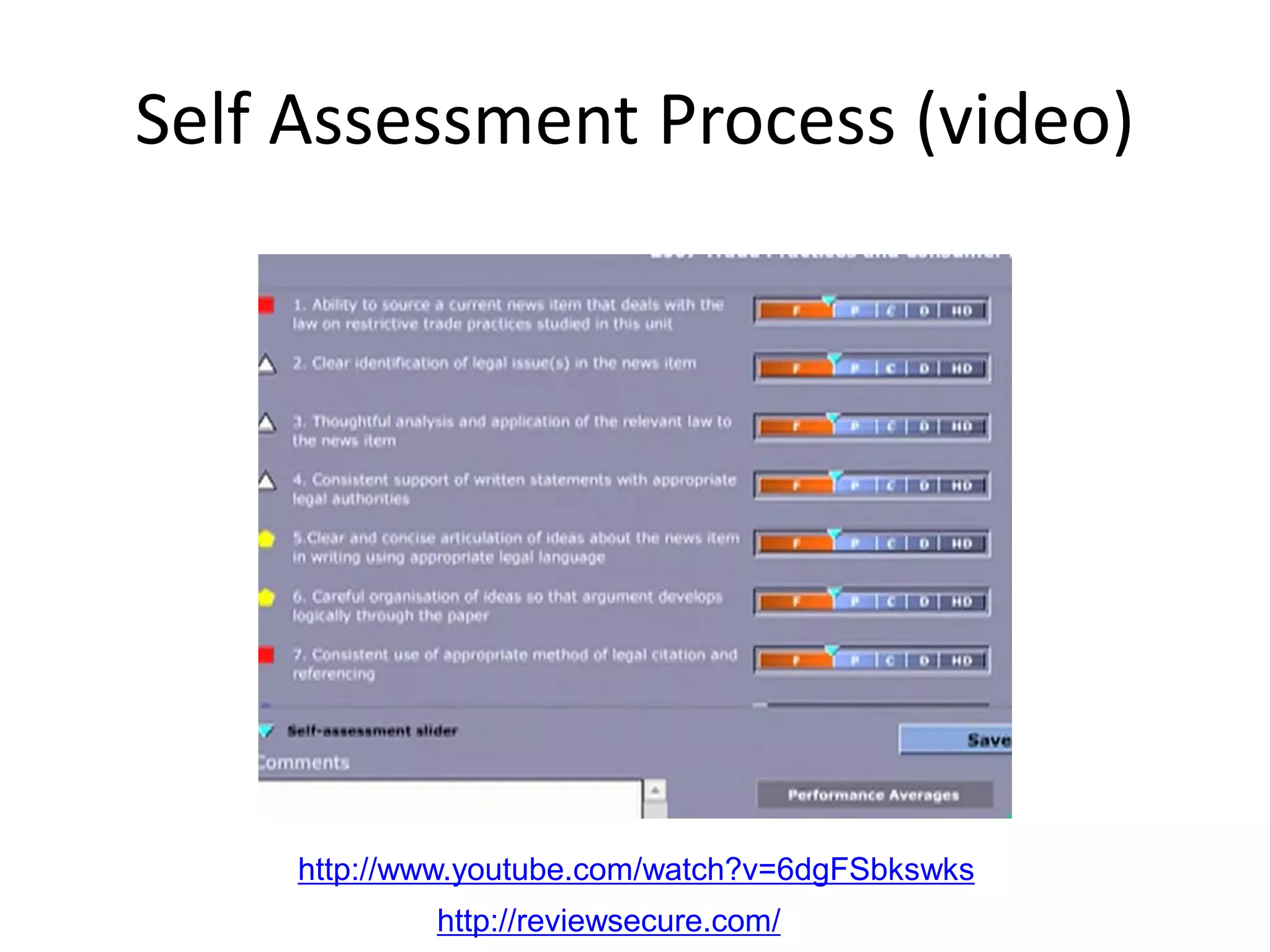
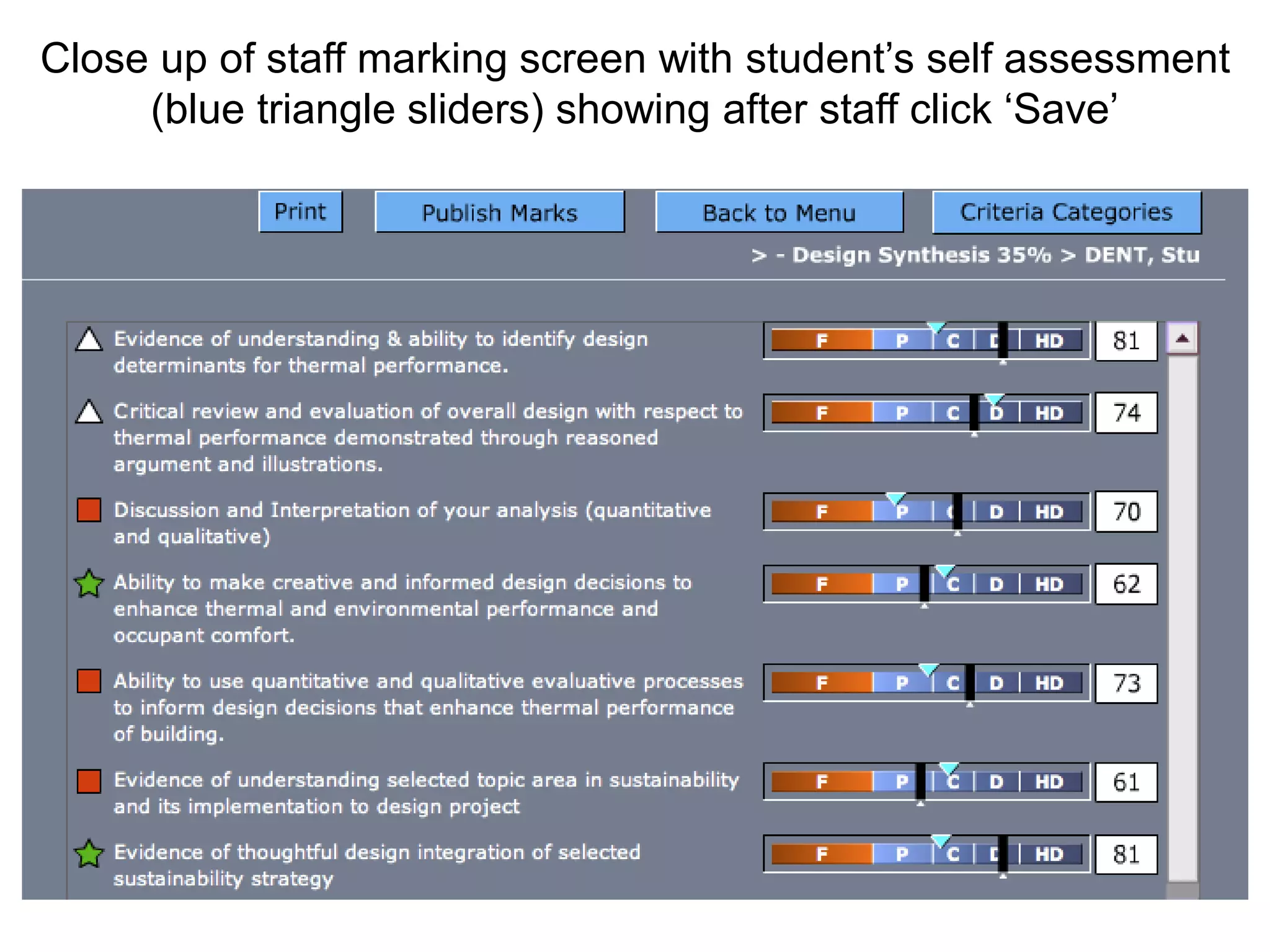
Close up of staff marking screen with student’s self assessment 
(blue triangle sliders) showing after staff click ‘Save’
3. Collaboration in assessment 
Collaboration is already a strong feature of digital environments, so what needs to be involved for assessment: 
•Group tasks 
•Consideration of standards and criteria 
•Peer feedback 
•Moderation of marks by other students, eg. 
http://spark.uts.edu.au
VII. What is the transformation needed? 
•Not about technology 
–We will use whatever is available and user-friendly 
•Not about techniques and methods 
–More are available that we can sensible use at present 
•It is about our disposition 
–Towards learning and whatever it takes 
–Towards seeing assessment as a central tool in promoting learning, that should also be in the hands of students
Discussionto be continued in the conference discussion forum 
•How will digital technology otherwise change our views of assessment? 
•What will students expect as a normal part of any educational interaction? What expectations should we foster?
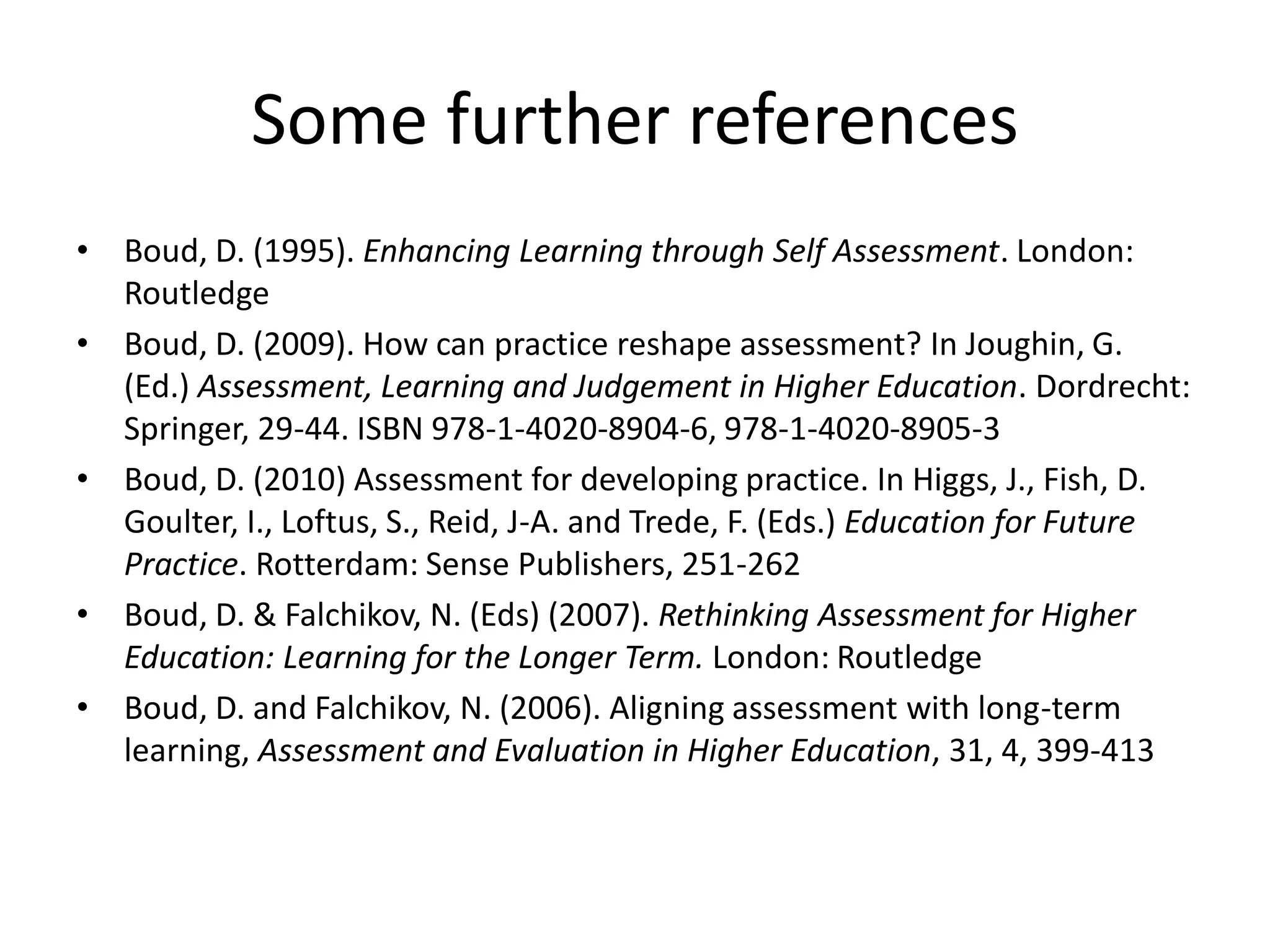
Some further references 
•Boud, D. (1995). Enhancing Learning through Self Assessment. London: Routledge 
•Boud, D. (2009). How can practice reshape assessment? In Joughin, G. (Ed.) Assessment, Learning and Judgement in Higher Education. Dordrecht: Springer, 29-44. ISBN 978-1-4020-8904-6, 978-1-4020-8905-3 
•Boud, D. (2010) Assessment for developing practice. In Higgs, J., Fish, D. Goulter, I., Loftus, S., Reid, J-A. and Trede, F. (Eds.) Education for Future Practice. Rotterdam: Sense Publishers, 251-262 
•Boud, D. & Falchikov, N. (Eds) (2007). Rethinking Assessment for Higher Education: Learning for the Longer Term.London: Routledge 
•Boud, D. and Falchikov, N. (2006). Aligning assessment with long-term learning, Assessment and Evaluation in Higher Education, 31, 4, 399-413

Transforming assessment for learning in a digital age

  • 1.
    10/12/2014 | slide1 Transforming assessment for learning in a digital age David Boud, facilitated by Mark Russell Joint Information Systems Committee Supporting education and research
  • 2.
    Joint Information SystemsCommittee David Boud is Professor of Adult Education in the Faculty of Arts and Social Sciences at the University of Technology Sydney. Presenter Facilitator Mark Russell is Deputy Director of the Blended Learning Unit at the University of Hertfordshire
  • 3.
    Session practice JointInformation Systems Committee Text-chatting Elluminate layout Audio Whiteboard Technical problems •Use the text-chat to engage with other delegates, presenter and moderators. •You can send private text-chat messages e.g. to moderators or to individuals. •You can change your Elluminate layout to “Wide layout” to make it easier to follow the text-chat (select “View … Layouts…Wide layout”). •If you are distracted by the text-chat, you can “unlock” the Elluminate layout to enable you to adjust the size and position of the text-chat sub-window (uncheck “View…Layouts …Layout locked”) •It is best to run the Audio Set-up Wizard to test your audio set-up each time you enter an Elluminate room (select “Tools…Audio… Audio setup wizard). •You must use a headset/microphone if you want to ask a question in audio. •Only use your microphone when guided by a moderator –click on the mic icon (bottom-left of screen) to turn it on and click on it again to turn it off. •Only draw on the whiteboard if guided by a moderator. •Send a private text-chat message to “moderators” and they will try to help.
  • 4.
    Transforming assessment forlearning in a digital age David Boud University of Technology, Sydney http://www.davidboud.com http://tinyurl.com/jiscdavidboud http://www.assessmentfutures.com Other picture
  • 5.
    Pre-conference activities andreading Activities 1.Drawing from the JISC Guide, what is the most strategic form of digitally enabled assessment needed to foster learning? Why this one? 2.Drawing on the Assessment 2020 propositions, what is the single greatest contribution that digital technology can make to this reform agenda? How can it best be made? http://tinyurl.com/assessment2020 http://www.jisc.ac.uk/digiassess JISC Guide Effective Assessment in a Digital Age Assessment 2020: Seven Propositions for Assessment Reform in Higher Education
  • 6.
    Where am Icoming from? •Assessment is the single greatest influence on learning for good and ill •The digital environment has been frequently misused with poor forms of assessment. Nevertheless, it still offers huge potential to transform learning experiences •We need to be clear about how assessment influences learning and how it is experienced •What counts is not the technology, but what it is used for?
  • 7.
    Overview of presentation I.We haven’t yet transformed assessment for a pre-digital age II.The trap is to use the digital environment to lock in a primitive view of assessment III.Reclaiming learning as a key purpose of assessment, but in a new way IV.Assessment for longer term learning V.Positive and negative affordances of digital technology for assessment for learning VI.Some key sites for development: feedback, self-assessment, collaboration
  • 8.
    I. We haven’tyet transformed assessment for a pre-digital age •Let us not pretend that assessment in everyday situations is satisfactory •Often messy compromises between assessment for certification and learning
  • 9.
    I. We haven’tyet transformed assessment for a pre-digital age •Let us not pretend that assessment in everyday situations is satisfactory •Often messy compromises between assessment for certification and learning Changing thinking about assessment is needed: 1.Assessment isn’t just about formal structured assessment activities, it is about everything that enables us (teachers and learners) to make judgements about learning 2.Whatever else it does, assessment should fundamentally be about building learners’ capacity to make informed judgements about their work. It always needs to do double duty—for immediate purposes and for the longer-term
  • 10.
    What is theworst feature of e-assessment we need to avoid? A Excessive use of close-ended questions B Easy to over-assess with relentless testing C Students work in isolation from each other D Easy to remove tutor involvement E Lack of personal explanations •Select your response from the buttons (A B C D E) at the bottom-right of the list of participants •Type any additional comments into the text-chat
  • 11.
    II. The digitalenvironment can lock in a primitive view of assessment •Need to avoid reverting to primitive ideas about assessment when faced with an unfamiliar environment •Assessment in general may be traped in an earlier era of measurement, norms, testing, etc. •eAssessment is sometimes discussed as if it were a different beast, many papers on the topic ignore basic assessment and learning issues and non-e literature •Need to consider the human dimension—how assessment shapes students’ actions—not just more efficient testing •Students must have an active role. This become more important on the web as it is so easy to remove this.
  • 12.
    Question What isthe greatest untapped potential of the digital environment for assessment? •Type your responses into the text-chat
  • 13.
    III. Reclaiming learningas a key purpose of assessment, but in a new way •Need to shift conceptions of assessment towards longer term learning •Assessment isn’t just about formal assessment for certification purposes •Greatest potential of digital technology is for assessment and feedback to be easily be embedded in all learning activities –eg. use of clickers in lectures and new cheaper technology for this purpose
  • 14.
    Key feature ofquality assessment •Addresses need for information to guide learning when needed and in a way needed –need to distinguish guidance from simply what students want and when they want it •Always promotes high quality study activities –and discourages cramming for tests •Assessment completely aligned with pedagogy and purpose –constructive alignment but with a long-term learning view
  • 15.
    IV. Assessment forlonger term learning 1.Sustainable 2.Develops informed judgement 3.Constructs reflexive learners 4.Forms the becoming practitioner Key features: (in each of the following slides you can vote for which topic you would like to explore in more depth)
  • 16.
    Feature 1. Sustainable A.Looks beyond the immediate content –To what is required beyond the end of the course B.Avoids creating dependency –e.g. through pleasing the lecturer, or looking to them for judgement C.Focuses on higher-order knowledge and skills in context –Memorising as such is not tested because doing so fosters bad habits •Select which topic you would like to explore in more depth –using the buttons (A B C)
  • 17.
    Feature 2. Developsinformed judgement A.Students must develop the capacity to make judgments about their own learning –Otherwise they cannot be effective learners now or in the future B.Assessment is about informing students’ own judgements as well as making judgements on their work –Summative assessment alone is to risky and does not equip students for new challenges. Assessment is more important than grading C.Opportunities for developing informed judgement need to be staged across a program –Working across subjects/modules is essential •Select which topic you would like to explore in more depth –using the buttons (A B C)
  • 18.
    Feature 3. Constructsreflexive learners A.Students must necessarily be involved in assessment –Assessment is a key influence in their formation and they are active subjects B.Positions students to see themselves as learners who are pro- active and generative –Such learners take responsibility for driving learning C.Focus on fostering reflexivity and self-regulation through every aspect of a course –Not just assessment tasks. •Select which topic you would like to explore in more depth –using the buttons (A B C)
  • 19.
    Feature 4. Formsthe becoming practitioner A.Assessment to help calibrate judgement –Learners act on their belief in their own judgements; if these are flawed it is more serious than particular knowledge gaps B.Develops confidence and skills to manage their own learning and assessment –Understanding is not enough C.Develops the capacity to work effectively with others to assist learning and mutually develop informed judgement –Assessment in work settings occurs with and for others •Select which topic you would like to explore in more depth –using the buttons (A B C)
  • 20.
    Exploring these ideasfurther Examples of different kinds of assessment practice to foster learning in the longer term: http://www.assessmentfutures.com
  • 21.
  • 22.
    Question What arethe most challenging aspects of this view of assessment for your practice? •Type your responses into the text-chat
  • 23.
    V. Affordances ofdigital technology for assessment for learning Learning involves students being pro-active and doingrather than listening/reading –responsiveness •extends repertoire of ways of responding to variety of students and variety of student needs –user-control •purpose, timing, involvement –collaboration •working with others doesn’t need a particular physical environment –multi-media and multi-modal
  • 24.
    Negative affordances Whatdo we need to avoid? •Lots of things are easy to do, but don’t transform assessment and don’t support learning •More testing or self-testing •More compliance and control •More dependency
  • 25.
    Positive affordances •Alwaysthere, never tired •Databases can be used to support assessment tasks •Can involve others easily—they don’t have to be physically present •Keeps good records (for students as well as teachers)
  • 26.
    Traps •Teachers dominatebecause everything can be pre- coded •Over-predetermined standards/criteria/approaches •Students not involved in key steps in the assessment process In short, we need to resist the temptations of a behaviourist technology
  • 27.
    Question •What isthe area in the use of digital technologies for assessment in which we need to invest effort to get the greatest payoff for learning with very little investment of resources? •Type your responses into the text-chat
  • 28.
    VI. Key areasfor development 1.Feedback 2.Self-judgements 3.Collaboration in assessment
  • 29.
    1. Feedback •Feedbackin non-digital environments suffers from the misconception that the process is complete when useful information is provided for students •For feedback to be effective, the effect of information on students’ work must be identified and adjusted to maximise the effect •Digital applications need to enable us to do this and for students to access and track feedback
  • 30.
    2. Self-judgements •Self-testingwith immediate guidance on all answers is easy to do and is worthwhile especially in technical areas •Self-assessment involves much more than this, particularly identifying suitable criteria and making judgements about students’ own work •Examples: e-portfolios, Re:View
  • 31.
    An example—Re:View •ReViewprovides a step in the direction of full self- assessment •It is a web application developed to aid marking, feedback and graduate attribute development. •Student self-assessment is an option that academics can select for each task http://reviewsecure.com
  • 32.
    Self Assessment Process(video) http://www.youtube.com/watch?v=6dgFSbkswks http://reviewsecure.com/
  • 33.
    Close up ofstaff marking screen with student’s self assessment (blue triangle sliders) showing after staff click ‘Save’
  • 34.
    3. Collaboration inassessment Collaboration is already a strong feature of digital environments, so what needs to be involved for assessment: •Group tasks •Consideration of standards and criteria •Peer feedback •Moderation of marks by other students, eg. http://spark.uts.edu.au
  • 35.
    VII. What isthe transformation needed? •Not about technology –We will use whatever is available and user-friendly •Not about techniques and methods –More are available that we can sensible use at present •It is about our disposition –Towards learning and whatever it takes –Towards seeing assessment as a central tool in promoting learning, that should also be in the hands of students
  • 36.
    Discussionto be continuedin the conference discussion forum •How will digital technology otherwise change our views of assessment? •What will students expect as a normal part of any educational interaction? What expectations should we foster?
  • 37.
    Some further references •Boud, D. (1995). Enhancing Learning through Self Assessment. London: Routledge •Boud, D. (2009). How can practice reshape assessment? In Joughin, G. (Ed.) Assessment, Learning and Judgement in Higher Education. Dordrecht: Springer, 29-44. ISBN 978-1-4020-8904-6, 978-1-4020-8905-3 •Boud, D. (2010) Assessment for developing practice. In Higgs, J., Fish, D. Goulter, I., Loftus, S., Reid, J-A. and Trede, F. (Eds.) Education for Future Practice. Rotterdam: Sense Publishers, 251-262 •Boud, D. & Falchikov, N. (Eds) (2007). Rethinking Assessment for Higher Education: Learning for the Longer Term.London: Routledge •Boud, D. and Falchikov, N. (2006). Aligning assessment with long-term learning, Assessment and Evaluation in Higher Education, 31, 4, 399-413