Dr. Eloise Tan
National Forum for the Enhancement of Teaching and
Learning
Twitter: @t_Eloise
Eloise.tan@teachingandlearning.ie
www.Teachingandlearning.ie
• Experiences with online assessment
• Digital Roadmap – focus on assessment
• Examining (possible) assumptions around
online assumptions
• Practical example of programme development
from Elaine
Questions throughout please!
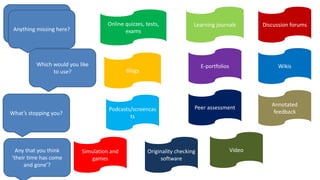
Discussion forumsLearning journals
Wikis
Online quizzes, tests,
exams
Blogs
E-portfolios
Peer assessment
Simulation and
games
Podcasts/screencas
ts
Video
Annotated
feedback
Originality checking
software
Which have you used?
Which would you like
to use?
Any that you think
‘their time has come
and gone’?
What’s stopping you?
Anything missing here?
• H. A focus on assessment and feedback as key
routes to digital-capacity development and
innovation
• http://teachingandlearning.ie/wp-
content/uploads/2014/05/Digital-Roadmap-
PHASE1MAY282014.pdf
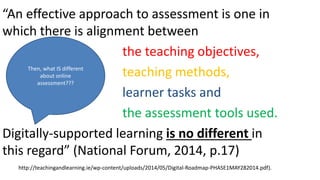
“An effective approach to assessment is one in
which there is alignment between
the teaching objectives,
teaching methods,
learner tasks and
the assessment tools used.
Digitally-supported learning is no different in
this regard” (National Forum, 2014, p.17)
http://teachingandlearning.ie/wp-content/uploads/2014/05/Digital-Roadmap-PHASE1MAY282014.pdf).
Then, what IS different
about online
assessment???
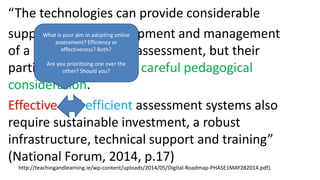
“The technologies can provide considerable
support for the development and management
of a range of forms of assessment, but their
particular use requires careful pedagogical
consideration.
Effective and efficient assessment systems also
require sustainable investment, a robust
infrastructure, technical support and training”
(National Forum, 2014, p.17)
http://teachingandlearning.ie/wp-content/uploads/2014/05/Digital-Roadmap-PHASE1MAY282014.pdf).
What is your aim in adopting online
assessment? Efficiency or
effectiveness? Both?
Are you prioritising one over the
other? Should you?
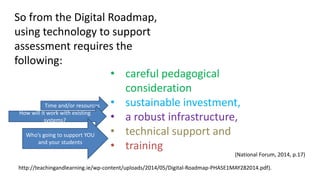
• careful pedagogical
consideration
• sustainable investment,
• a robust infrastructure,
• technical support and
• training
So from the Digital Roadmap,
using technology to support
assessment requires the
following:
http://teachingandlearning.ie/wp-content/uploads/2014/05/Digital-Roadmap-PHASE1MAY282014.pdf).
(National Forum, 2014, p.17)
Time and/or resources
How will it work with existing
systems?
Who’s going to support YOU
and your students
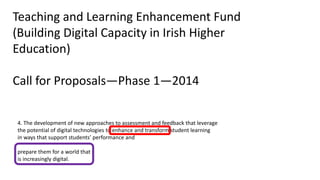
4. The development of new approaches to assessment and feedback that leverage
the potential of digital technologies to enhance and transform student learning
in ways that support students’ performance and
prepare them for a world that
is increasingly digital.
Teaching and Learning Enhancement Fund
(Building Digital Capacity in Irish Higher
Education)
Call for Proposals—Phase 1—2014
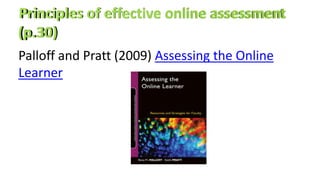
Palloff and Pratt (2009) Assessing the Online
Learner
• Learner-centred
• Encourage self reflection
• Include rubrics for discussion / assignments /
collaboration
• Encourage self and peer assessment
• Contextual and aligned to learning outcomes
• Include learner input
1. Classes are composed of ‘21st century learners /
educators’
2. Educators should strive for a learner-centred
process / students want a learner-centred process
3. Online assessment / feedback tools are reusable
and efficient
4. Student input into assessment design is helpful
• "Many of today's students are entering online classroom with a
higher level of technical skill than their instructors possess“ (p.44)
• Marc Prensky’s ‘Digital immigrants and natives’
http://www.marcprensky.com/writing/prensky%20-
%20digital%20natives,%20digital%20immigrants%20-%20part1.pdf
Michael Wesch’s video ‘A vision of Student’s Today’ based on his
undergraduate class of 200 cultural anthropology students
http://www.youtube.com/watch?v=dGCJ46vyR9o
However…
• “Involvement in social networking is different from participating in
an online course” (p.29)
• “teachers should not assume that because many children are
adept at using new and emerging technology, that they are able to
apply them freely in formalised learning contexts…children may
have skills in the use of technology, but teachers have the skills
and the knowledge to create engaging and exciting learning
opportunities and environments”
http://steve-wheeler.blogspot.com/2011/05/natives-are-
revolting.html
• ILTA’s Multi Institutional Survey of usage of
Virtual Learning Environments (VLE)
• Over 20,000 students
http://www.slideshare.net/CTLatUL/ed-
tech2013-25914828
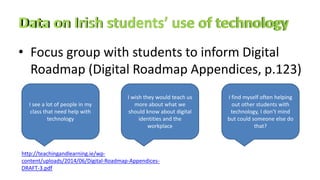
• Focus group with students to inform Digital
Roadmap (Digital Roadmap Appendices, p.123)
http://teachingandlearning.ie/wp-
content/uploads/2014/06/Digital-Roadmap-Appendices-
DRAFT-3.pdf
I see a lot of people in my
class that need help with
technology
I wish they would teach us
more about what we
should know about digital
identities and the
workplace
I find myself often helping
out other students with
technology, I don’t mind
but could someone else do
that?
• Assumptions about the technical abilities /
needs / wants of learners should not lead the
design of online education
• Technology should be a vehicle for the
pedagogy, not drive the pedagogy.
• 21st century learner concept assumes a
homogeneity for our students abilities / needs
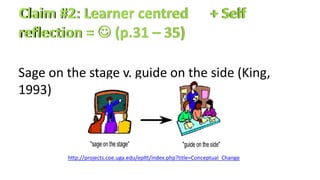
Sage on the stage v. guide on the side (King,
1993)
http://projects.coe.uga.edu/epltt/index.php?title=Conceptual_Change
Gibbs (1992): “learner-centred learning gives learners greater autonomy and control over
choice of subject matter, learning methods and pace of study ”
Gibbs, G. (1992). Assessing More Students. Oxford: Oxford Centre for Staff Development.
“student responsibility and activity in learning” (Cannon and Newble in Lea et al, 2003:
321).
Lea, S.J., Stephenson, D. & Troy, J. (2003) Higher Education Students’ Attitudes to Student-centred Learning: Beyond ‘educational bulimia’? Studies in Higher
Education, 28(3), 321-334
Other definitions of Learner-centred pedagogy
• http://www.intime.uni.edu/model/center_of_learning_files/definition.html.
• http://www.aishe.org/readings/2005-1/oneill-mcmahon-Tues_19th_Oct_SCL.html
Teachers in higher education “need to stimulate
active, not passive learning, and to encourage
students to be critical, creative thinkers, with the
capacity to go on learning after their college days
are over” (DES, 52-53, 2011).
• http://www.irishtimes.com/focus/2011/hunt-report/index.pdf
A learner centred assessment must be designed
within the context of learning outcomes designed
with self reflection and learner-centredness in mind.
Students (and educators) need to be scaffolded in the
move towards learner centredness.
A programmatic approach would help here.
Students encountering learner centred approaches in one module
might find it difficult to adjust/grasp what the expectations are.
Open Educational Resources (OERs)
- Digitised, online teaching and learning resources
available to the public
- Open licensing
Video explaining Creative Commons
http://www.youtube.com/watch?v=1DKm96Ftfko
FAQs on OERsfrom the HEA UK
http://www.engsc.ac.uk/oer/faq
Image credit:
http://cnx.org/content/m35664/latest/
• http://www.jorum.ac.uk/
– Search: Learning theories higher education
• http://www.open.edu
• http://www.open.edu/itunes//openlearn/
• https://dspace.ndlr.ie/
– Previous Irish repository
• Reusable resource does not equal appropriate
resource
• New area of intellectual property, must be
informed
• http://theedublogger.com/2012/02/09/the-educators-guide-to-copyright-fair-use-and-creative-commons/
• If reusability is a factor in design then tools can
save time / energy (ex. General feedback)
http://pearsonewa.pbworks.com/w/file/47125124/Student%20Choice%20Assessment%20Sta
ndard%20PDF.pdf
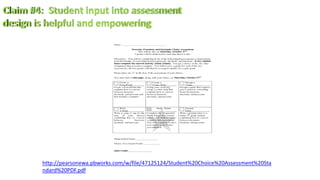
O’Neill, G (Ed) (2011) A Practitioner’s Guide to
Choice of Assessment Methods within a
Module, Dublin: UCD Teaching and Learning,
http://www.ucd.ie/teaching/resources/assessm
ent/howdoyouassessstudentlearning/
• Move towards learner input must be
scaffolded
• Students may not choose what you think they
should
• The ‘choices’ must each be aligned with the
learning outcomes, choice for choice’s sake is
meaningless
1. Classes are composed of ‘21st century learners /
educators’
2. Educators should strive for a learner-centred
process / students want a learner-centred process
3. Online assessment / feedback tools are reusable
and efficient
4. Student input into assessment design is helpful
• Learner-centred
• Encourage self reflection
• Include rubrics for discussion / assignments /
collaboration
• Encourage self and peer assessment
• Contextual and aligned to learning outcomes
• Include learner input
These may not suit all
teaching contexts.
Some might be
aspirations rather than
principles.
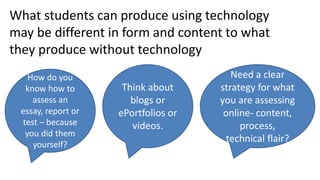
What students can produce using technology
may be different in form and content to what
they produce without technology
Think about
blogs or
ePortfolios or
videos.
How do you
know how to
assess an
essay, report or
test – because
you did them
yourself?
Need a clear
strategy for what
you are assessing
online- content,
process,
technical flair?
eLearning Summer School: Exploring assumptions about online assessment

eLearning Summer School: Exploring assumptions about online assessment

  • 1.
    Dr. Eloise Tan NationalForum for the Enhancement of Teaching and Learning Twitter: @t_Eloise Eloise.tan@teachingandlearning.ie www.Teachingandlearning.ie
  • 2.
    • Experiences withonline assessment • Digital Roadmap – focus on assessment • Examining (possible) assumptions around online assumptions • Practical example of programme development from Elaine Questions throughout please!
  • 3.
    Discussion forumsLearning journals Wikis Onlinequizzes, tests, exams Blogs E-portfolios Peer assessment Simulation and games Podcasts/screencas ts Video Annotated feedback Originality checking software Which have you used? Which would you like to use? Any that you think ‘their time has come and gone’? What’s stopping you? Anything missing here?
  • 4.
    • H. Afocus on assessment and feedback as key routes to digital-capacity development and innovation • http://teachingandlearning.ie/wp- content/uploads/2014/05/Digital-Roadmap- PHASE1MAY282014.pdf
  • 5.
    “An effective approachto assessment is one in which there is alignment between the teaching objectives, teaching methods, learner tasks and the assessment tools used. Digitally-supported learning is no different in this regard” (National Forum, 2014, p.17) http://teachingandlearning.ie/wp-content/uploads/2014/05/Digital-Roadmap-PHASE1MAY282014.pdf). Then, what IS different about online assessment???
  • 6.
    “The technologies canprovide considerable support for the development and management of a range of forms of assessment, but their particular use requires careful pedagogical consideration. Effective and efficient assessment systems also require sustainable investment, a robust infrastructure, technical support and training” (National Forum, 2014, p.17) http://teachingandlearning.ie/wp-content/uploads/2014/05/Digital-Roadmap-PHASE1MAY282014.pdf). What is your aim in adopting online assessment? Efficiency or effectiveness? Both? Are you prioritising one over the other? Should you?
  • 7.
    • careful pedagogical consideration •sustainable investment, • a robust infrastructure, • technical support and • training So from the Digital Roadmap, using technology to support assessment requires the following: http://teachingandlearning.ie/wp-content/uploads/2014/05/Digital-Roadmap-PHASE1MAY282014.pdf). (National Forum, 2014, p.17) Time and/or resources How will it work with existing systems? Who’s going to support YOU and your students
  • 8.
    4. The developmentof new approaches to assessment and feedback that leverage the potential of digital technologies to enhance and transform student learning in ways that support students’ performance and prepare them for a world that is increasingly digital. Teaching and Learning Enhancement Fund (Building Digital Capacity in Irish Higher Education) Call for Proposals—Phase 1—2014
  • 9.
    Palloff and Pratt(2009) Assessing the Online Learner
  • 10.
    • Learner-centred • Encourageself reflection • Include rubrics for discussion / assignments / collaboration • Encourage self and peer assessment • Contextual and aligned to learning outcomes • Include learner input
  • 11.
    1. Classes arecomposed of ‘21st century learners / educators’ 2. Educators should strive for a learner-centred process / students want a learner-centred process 3. Online assessment / feedback tools are reusable and efficient 4. Student input into assessment design is helpful
  • 12.
    • "Many oftoday's students are entering online classroom with a higher level of technical skill than their instructors possess“ (p.44) • Marc Prensky’s ‘Digital immigrants and natives’ http://www.marcprensky.com/writing/prensky%20- %20digital%20natives,%20digital%20immigrants%20-%20part1.pdf Michael Wesch’s video ‘A vision of Student’s Today’ based on his undergraduate class of 200 cultural anthropology students http://www.youtube.com/watch?v=dGCJ46vyR9o
  • 13.
    However… • “Involvement insocial networking is different from participating in an online course” (p.29) • “teachers should not assume that because many children are adept at using new and emerging technology, that they are able to apply them freely in formalised learning contexts…children may have skills in the use of technology, but teachers have the skills and the knowledge to create engaging and exciting learning opportunities and environments” http://steve-wheeler.blogspot.com/2011/05/natives-are- revolting.html
  • 14.
    • ILTA’s MultiInstitutional Survey of usage of Virtual Learning Environments (VLE) • Over 20,000 students http://www.slideshare.net/CTLatUL/ed- tech2013-25914828
  • 15.
    • Focus groupwith students to inform Digital Roadmap (Digital Roadmap Appendices, p.123) http://teachingandlearning.ie/wp- content/uploads/2014/06/Digital-Roadmap-Appendices- DRAFT-3.pdf I see a lot of people in my class that need help with technology I wish they would teach us more about what we should know about digital identities and the workplace I find myself often helping out other students with technology, I don’t mind but could someone else do that?
  • 16.
    • Assumptions aboutthe technical abilities / needs / wants of learners should not lead the design of online education • Technology should be a vehicle for the pedagogy, not drive the pedagogy. • 21st century learner concept assumes a homogeneity for our students abilities / needs
  • 17.
    Sage on thestage v. guide on the side (King, 1993) http://projects.coe.uga.edu/epltt/index.php?title=Conceptual_Change
  • 18.
    Gibbs (1992): “learner-centredlearning gives learners greater autonomy and control over choice of subject matter, learning methods and pace of study ” Gibbs, G. (1992). Assessing More Students. Oxford: Oxford Centre for Staff Development. “student responsibility and activity in learning” (Cannon and Newble in Lea et al, 2003: 321). Lea, S.J., Stephenson, D. & Troy, J. (2003) Higher Education Students’ Attitudes to Student-centred Learning: Beyond ‘educational bulimia’? Studies in Higher Education, 28(3), 321-334 Other definitions of Learner-centred pedagogy • http://www.intime.uni.edu/model/center_of_learning_files/definition.html. • http://www.aishe.org/readings/2005-1/oneill-mcmahon-Tues_19th_Oct_SCL.html
  • 19.
    Teachers in highereducation “need to stimulate active, not passive learning, and to encourage students to be critical, creative thinkers, with the capacity to go on learning after their college days are over” (DES, 52-53, 2011). • http://www.irishtimes.com/focus/2011/hunt-report/index.pdf
  • 20.
    A learner centredassessment must be designed within the context of learning outcomes designed with self reflection and learner-centredness in mind. Students (and educators) need to be scaffolded in the move towards learner centredness. A programmatic approach would help here. Students encountering learner centred approaches in one module might find it difficult to adjust/grasp what the expectations are.
  • 21.
    Open Educational Resources(OERs) - Digitised, online teaching and learning resources available to the public - Open licensing Video explaining Creative Commons http://www.youtube.com/watch?v=1DKm96Ftfko FAQs on OERsfrom the HEA UK http://www.engsc.ac.uk/oer/faq Image credit: http://cnx.org/content/m35664/latest/
  • 22.
    • http://www.jorum.ac.uk/ – Search:Learning theories higher education • http://www.open.edu • http://www.open.edu/itunes//openlearn/ • https://dspace.ndlr.ie/ – Previous Irish repository
  • 23.
    • Reusable resourcedoes not equal appropriate resource • New area of intellectual property, must be informed • http://theedublogger.com/2012/02/09/the-educators-guide-to-copyright-fair-use-and-creative-commons/ • If reusability is a factor in design then tools can save time / energy (ex. General feedback)
  • 24.
  • 25.
    O’Neill, G (Ed)(2011) A Practitioner’s Guide to Choice of Assessment Methods within a Module, Dublin: UCD Teaching and Learning, http://www.ucd.ie/teaching/resources/assessm ent/howdoyouassessstudentlearning/
  • 26.
    • Move towardslearner input must be scaffolded • Students may not choose what you think they should • The ‘choices’ must each be aligned with the learning outcomes, choice for choice’s sake is meaningless
  • 27.
    1. Classes arecomposed of ‘21st century learners / educators’ 2. Educators should strive for a learner-centred process / students want a learner-centred process 3. Online assessment / feedback tools are reusable and efficient 4. Student input into assessment design is helpful
  • 28.
    • Learner-centred • Encourageself reflection • Include rubrics for discussion / assignments / collaboration • Encourage self and peer assessment • Contextual and aligned to learning outcomes • Include learner input These may not suit all teaching contexts. Some might be aspirations rather than principles.
  • 29.
    What students canproduce using technology may be different in form and content to what they produce without technology Think about blogs or ePortfolios or videos. How do you know how to assess an essay, report or test – because you did them yourself? Need a clear strategy for what you are assessing online- content, process, technical flair?