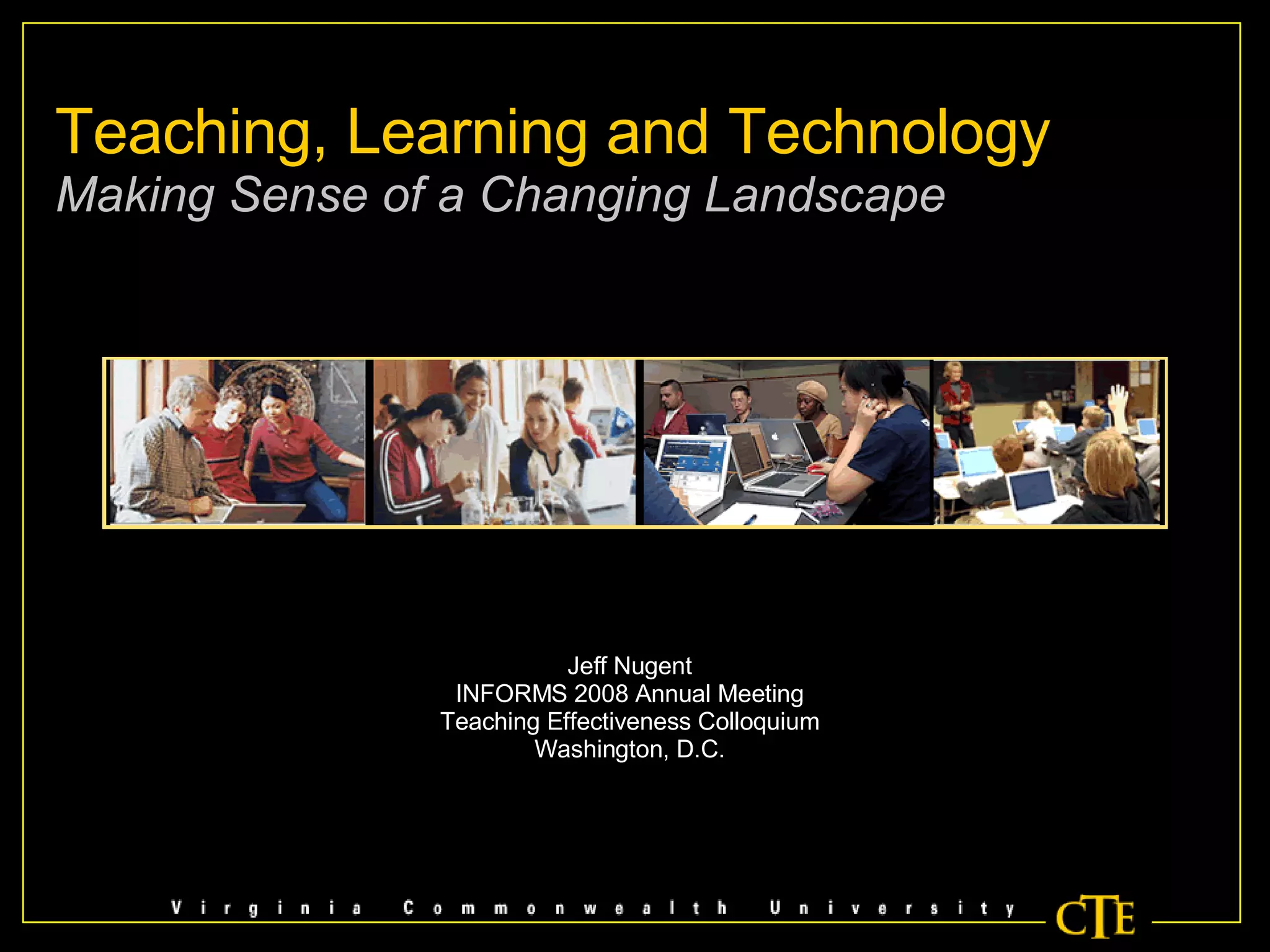
Teaching, Learning and Technology Making Sense of a Changing Landscape Jeff Nugent INFORMS 2008 Annual Meeting Teaching Effectiveness Colloquium Washington, D.C.
Session Overview Your perspective… Changing nature of the web Consider student perspectives on technology use Research-based framework for supporting good instructional practice
Some initial thoughts on instructional technology…
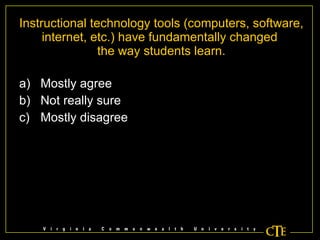
Instructional technology tools (computers, software, internet, etc.) have fundamentally changed  the way students learn. Mostly agree Not really sure Mostly disagree
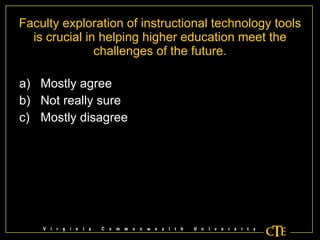
Faculty exploration of instructional technology tools is crucial in helping higher education meet the challenges of the future. Mostly agree Not really sure Mostly disagree
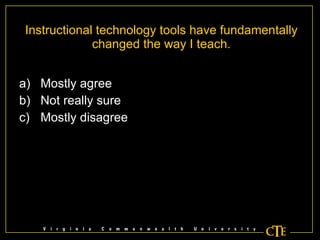
Instructional technology tools have fundamentally changed the way I teach. Mostly agree Not really sure Mostly disagree
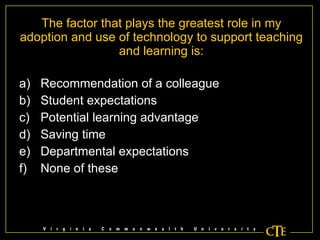
The factor that plays the greatest role in my adoption and use of technology to support teaching and learning is: Recommendation of a colleague Student expectations Potential learning advantage Saving time Departmental expectations None of these
Instructional technology tools have fundamentally changed the way instruction is delivered in colleges and universities. Mostly agree Not really sure Mostly disagree
 
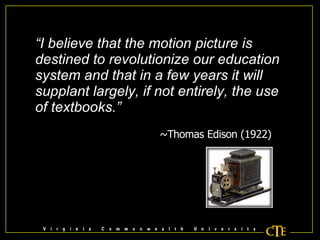
“ I believe that the motion picture is destined to revolutionize our education system and that in a few years it will supplant largely, if not entirely, the use of textbooks.” ~Thomas Edison (1922)
 
" New technologies are always used to do old tasks--until some driving force causes them to be used in new ways."   ~Marshall McLuhan
How is the  web  changing where and how learning is taking place?
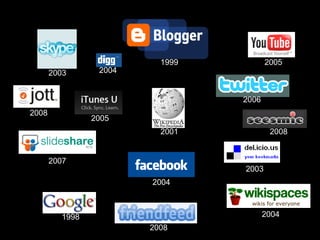
2004 2004 2008 1998 2007 2005 2003 2001 2003 2005 2008 2004 2006 2008 1999
Today’s Web Unprecedented access to information Freely available web-based tools New publishing opportunities User generated filtering, organization & distribution  Web experience dominated by creation, interaction and participation…the  social web
Why teach with technology? Technology has the potential to transform learning. Access to rich learning resources New learning environments Real world problem solving Immediate feedback to students / instructors
Why teach with technology? Mounting evidence that the effective use of technology can support and enrich student learning. North Central Regional Educational Laboratory (NCREL) Center for Research on Information Technology and Organizations (CRITO) National Study of the Effectiveness of Educational Technology Interventions
Why teach with technology? “ Net Generation” ??? A world without email, the internet, instant messaging, cell phones… Anytime -  anywhere access to electronic media and information… Technology is a normal part of their learning landscape
“ In the midst of other priorities, schools can choose to view this emerging pressure for change from their student body in either a positive or negative light. On the positive side, through the growing use of the Internet outside of school, educators have the opportunity to expand their reach and to engage students in new and thoughtful ways. On the negative side, the sanctity and tradition of the four walls of the classroom quite literally is melting away. Students are likely to be increasingly dissatisfied with conventional approaches to teaching and learning…” The Digital Disconnect: The widening gap between Internet-savvy students and their schools , Pew Internet and American Life Project
What do we know about  Today’s  students ?
ECAR Study of  Undergraduate Students and Information Technology, 2007 Fourth consecutive year of study 27,846 Freshmen, seniors and community college students 103 Higher education institutions Educause Center for Applied Research
Key Findings from the   2007 ECAR Study
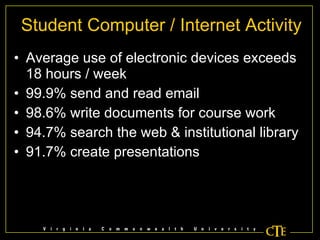
Student Computer / Internet Activity Average use of electronic devices exceeds 18 hours / week 99.9% send and read email 98.6% write documents for course work 94.7% search the web & institutional library  91.7% create presentations
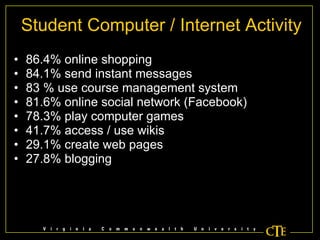
Student Computer / Internet Activity 86.4% online shopping 84.1% send instant messages 83 % use course management system 81.6% online social network (Facebook) 78.3% play computer games  41.7% access / use wikis 29.1% create web pages  27.8% blogging
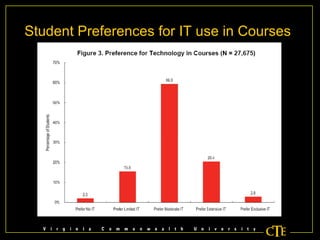
Student Preferences for IT use in Courses
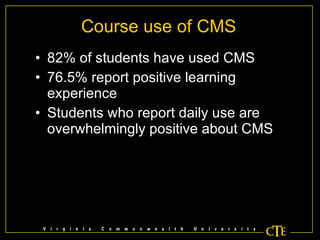
Course use of CMS 82% of students have used CMS 76.5% report positive learning experience Students who report daily use are overwhelmingly positive about CMS
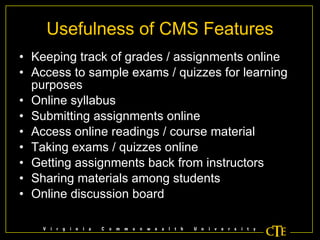
Usefulness of CMS Features Keeping track of grades / assignments online Access to sample exams / quizzes for learning purposes Online syllabus Submitting assignments online Access online readings / course material Taking exams / quizzes online Getting assignments back from instructors Sharing materials among students Online discussion board
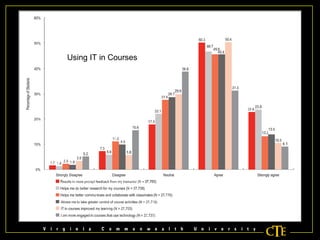
Perceptions of IT in Courses Using IT in Courses
Bottom Lines? Undergrads like IT  Net Gen characterization does not apply to all undergrads University is a place where students mature as IT users Respondents agree with series of positive outcome statements about IT
How can technology be used to promote meaningful learning?
What teaching practices can support effective use of technology?
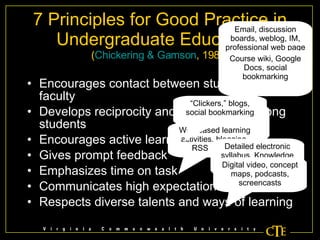
7 Principles for Good Practice in Undergraduate Education  ( Chickering & Gamson , 1987)   Encourages contact between students and faculty  Develops reciprocity and cooperation among students  Encourages active learning Gives prompt feedback  Emphasizes time on task  Communicates high expectations  Respects diverse talents and ways of learning  Email, discussion boards, weblog, IM, professional web page Course wiki, Google Docs, social bookmarking “ Clickers”, online tests / quizzes, posting student grades Web-based learning activities, blogging, RSS readers Detailed electronic syllabus, Knowledge surveys via Bb Digital video, concept maps, podcasts, screencasts “ Clickers,” blogs, social bookmarking
Consider this advice… Use technology to support your own learning Be willing to take risks in your teaching You don’t have to play without a net…build informal learning networks with your colleagues
questions & next steps
 

Tech Changing Landscape(Informs Tec2008)

  • 1.
    Teaching, Learning andTechnology Making Sense of a Changing Landscape Jeff Nugent INFORMS 2008 Annual Meeting Teaching Effectiveness Colloquium Washington, D.C.
  • 2.
    Session Overview Yourperspective… Changing nature of the web Consider student perspectives on technology use Research-based framework for supporting good instructional practice
  • 3.
    Some initial thoughtson instructional technology…
  • 4.
    Instructional technology tools(computers, software, internet, etc.) have fundamentally changed the way students learn. Mostly agree Not really sure Mostly disagree
  • 5.
    Faculty exploration ofinstructional technology tools is crucial in helping higher education meet the challenges of the future. Mostly agree Not really sure Mostly disagree
  • 6.
    Instructional technology toolshave fundamentally changed the way I teach. Mostly agree Not really sure Mostly disagree
  • 7.
    The factor thatplays the greatest role in my adoption and use of technology to support teaching and learning is: Recommendation of a colleague Student expectations Potential learning advantage Saving time Departmental expectations None of these
  • 8.
    Instructional technology toolshave fundamentally changed the way instruction is delivered in colleges and universities. Mostly agree Not really sure Mostly disagree
  • 9.
  • 10.
    “ I believethat the motion picture is destined to revolutionize our education system and that in a few years it will supplant largely, if not entirely, the use of textbooks.” ~Thomas Edison (1922)
  • 11.
  • 12.
    " New technologiesare always used to do old tasks--until some driving force causes them to be used in new ways." ~Marshall McLuhan
  • 13.
    How is the web changing where and how learning is taking place?
  • 14.
    2004 2004 20081998 2007 2005 2003 2001 2003 2005 2008 2004 2006 2008 1999
  • 15.
    Today’s Web Unprecedentedaccess to information Freely available web-based tools New publishing opportunities User generated filtering, organization & distribution Web experience dominated by creation, interaction and participation…the social web
  • 16.
    Why teach withtechnology? Technology has the potential to transform learning. Access to rich learning resources New learning environments Real world problem solving Immediate feedback to students / instructors
  • 17.
    Why teach withtechnology? Mounting evidence that the effective use of technology can support and enrich student learning. North Central Regional Educational Laboratory (NCREL) Center for Research on Information Technology and Organizations (CRITO) National Study of the Effectiveness of Educational Technology Interventions
  • 18.
    Why teach withtechnology? “ Net Generation” ??? A world without email, the internet, instant messaging, cell phones… Anytime - anywhere access to electronic media and information… Technology is a normal part of their learning landscape
  • 19.
    “ In themidst of other priorities, schools can choose to view this emerging pressure for change from their student body in either a positive or negative light. On the positive side, through the growing use of the Internet outside of school, educators have the opportunity to expand their reach and to engage students in new and thoughtful ways. On the negative side, the sanctity and tradition of the four walls of the classroom quite literally is melting away. Students are likely to be increasingly dissatisfied with conventional approaches to teaching and learning…” The Digital Disconnect: The widening gap between Internet-savvy students and their schools , Pew Internet and American Life Project
  • 20.
    What do weknow about Today’s students ?
  • 21.
    ECAR Study of Undergraduate Students and Information Technology, 2007 Fourth consecutive year of study 27,846 Freshmen, seniors and community college students 103 Higher education institutions Educause Center for Applied Research
  • 22.
    Key Findings fromthe 2007 ECAR Study
  • 23.
    Student Computer /Internet Activity Average use of electronic devices exceeds 18 hours / week 99.9% send and read email 98.6% write documents for course work 94.7% search the web & institutional library 91.7% create presentations
  • 24.
    Student Computer /Internet Activity 86.4% online shopping 84.1% send instant messages 83 % use course management system 81.6% online social network (Facebook) 78.3% play computer games 41.7% access / use wikis 29.1% create web pages 27.8% blogging
  • 25.
    Student Preferences forIT use in Courses
  • 26.
    Course use ofCMS 82% of students have used CMS 76.5% report positive learning experience Students who report daily use are overwhelmingly positive about CMS
  • 27.
    Usefulness of CMSFeatures Keeping track of grades / assignments online Access to sample exams / quizzes for learning purposes Online syllabus Submitting assignments online Access online readings / course material Taking exams / quizzes online Getting assignments back from instructors Sharing materials among students Online discussion board
  • 28.
    Perceptions of ITin Courses Using IT in Courses
  • 29.
    Bottom Lines? Undergradslike IT Net Gen characterization does not apply to all undergrads University is a place where students mature as IT users Respondents agree with series of positive outcome statements about IT
  • 30.
    How can technologybe used to promote meaningful learning?
  • 31.
    What teaching practicescan support effective use of technology?
  • 32.
    7 Principles forGood Practice in Undergraduate Education ( Chickering & Gamson , 1987) Encourages contact between students and faculty Develops reciprocity and cooperation among students Encourages active learning Gives prompt feedback Emphasizes time on task Communicates high expectations Respects diverse talents and ways of learning Email, discussion boards, weblog, IM, professional web page Course wiki, Google Docs, social bookmarking “ Clickers”, online tests / quizzes, posting student grades Web-based learning activities, blogging, RSS readers Detailed electronic syllabus, Knowledge surveys via Bb Digital video, concept maps, podcasts, screencasts “ Clickers,” blogs, social bookmarking
  • 33.
    Consider this advice…Use technology to support your own learning Be willing to take risks in your teaching You don’t have to play without a net…build informal learning networks with your colleagues
  • 34.
  • 35.