TRAMADOL HYDROCHLORIDE
TRANSFEROSOMAL GEL
Presented By
Miss. S.S.SHIVANI
TABLE OF CONTENTS
• INTRODUCTION
• REVIEW OF LITERATURE
• AIM AND OBJECTIVE
• PLAN OF WORK
• DRUG AND EXCIEPIENT PROFILE
• METHODOLOGY
• RESULTS AND DISCUSSION
• BIBILOGRAPHY
INTRODUCTION
• The concept of Transfersome were introduced in 1991 by Gregor Cevc and
co-workers.
• Transfersome is a term registered as a trademark by the German company
IDEAAG, and used by its proprietary drug delivery technology.
• The name means “ carrying body”, and is derived from the Latin word
‘transferre’ , meaning ‘to carry across’, and the Greek word ‘soma’, for a
‘body’.
• A Transfersome carrier is an artificial vesicle designed to be like a cell
vesicle or a cell engaged in exocytosis, and thus suitable for controlled and,
potentially targeted, drug delivery.
• Transfersomes are highly efficient edge activator (EA) – based ultra
flexible vesicles capable of, non-invasively, trespassing skin by virtue of
their high, self- optimizing deformability.
INTRODUCTION
• Transfersomes are self regulatory, mixed lipid aggregates containing edge
activators with in a phospholipid matrix so as to drastically reduce the
value of its module.
 ADVANTAGES:
• Transfersomes hold an infrastructure consisting of hydrophobic and
hydrophilic moieties together and as a result can accomidate drug
molecules with wide range of solubility.
• They have high entrapment efficiency, in case of lipophilic drug near to
90%.
• This high deformability gives better penetration of intact vesicles.
• Transfersomes are biocompatible, biodegradable and are capable of
protecting the encapsulated drug from metabolic degradation.
• They can be used for both systemic as well as topical delivery of drug.
• In addition to a non-invasive means of drug-delivery, they also offer a
novel approach for investigating skin histology.
• Delivery of proteins and nutraceuticals.
• Ease of scale up compared to other vesicular systems.
 LIMITATIONS:
• Transfersomes are chemically unstable because of their predisposition to
oxidative degradation.
• The Lack of Purity of natural phospholipids is another criteria that
influences acceptance of Transfersomes as drug delivery vehicles.
• Transfersomes formulations are expensive to prepare.
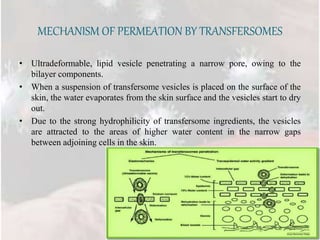
MECHANISM OF PERMEATION BY TRANSFERSOMES
• Ultradeformable, lipid vesicle penetrating a narrow pore, owing to the
bilayer components.
• When a suspension of transfersome vesicles is placed on the surface of the
skin, the water evaporates from the skin surface and the vesicles start to dry
out.
• Due to the strong hydrophilicity of transfersome ingredients, the vesicles
are attracted to the areas of higher water content in the narrow gaps
between adjoining cells in the skin.
REVIEW OF LITERATURE
• Sheo Datta Maurya et,al (2010): The aim of the present study was to investigate
the potential of transfersomal formulations for transdermal delivery of indinavir
sulfate and to evaluate Span 80, Tween 80, Sodium cholate and Sodium
deoxycholate as edge activators. Vesicles containing phosphatidylcholine (PC)
mixed with edge activators and indinavir sulfate were prepared by conventional
rotary evaporation method.
• Swarnlata Saraf et,al (2011): Our aim was to develop a stable nano-transfersomes
loaded cream which could correct the morphological defects and penetrate deeper
to the cellular level of dermis to produce anti-wrinkle effect. Soxhlet extraction of
C. longa was carried out with two solvents viz. absolute ethanol and 85% ethanol.
• Geeta Aggarwal et,al (2012): The aim of the present study was to investigate
transfersomes as a transdermal delivery system for the poorly soluble drug,
sertraline, in order to overcome the troubles associated with its oral delivery.
Different transfersomal formulations were prepared with non-ionic surfactant (span
80), soya lecithin, and carbopol 940 by the rotary evaporation sonication method.
AIM AND OBJECTIVE
• To prepare and evaluate Tramadol HCl loaded transferosome gel.
• The drug delivery technology is extended to transdermal route apart from
oral.
• The ability to increase the transdermal permeation can be valuable aid
when oral administration of drug is associated with problems.
 OBJECTIVE OF STUDY:
• The main objective of the study is to formulate and evaluate Tramadol HCl
transferosome gel formulation for effective topical delivery of drug.
• That commercial topical formulations of Tramadol HCl are available which
have limited drug loading and requires frequent application.
• To overcome this problem Transferosome gel is prepared which helps in
more penetration of drug and producing a sustain release effect at the site
of administration.
PLAN OF WORK
 To develop analytical method for the estimation of drug in the formulations.
 To carry out pre-formulation studies for possible drug-excipient interactions by
FTIR.
 Preparation of transferosomes containing Tramadol HCl using different ratios of
lipid and surfactant using thin film hydration technique.
 Characterization of transferosomes with respect to
 Vesicle size, size distribution and zeta potential analysis
 Vesicle shape and type
 Formulation of transferosome gel and studying its
 In-vitro drug release using diffusion cell
 Entrapment efficiency
 Drug content
 Studies on formulated topical transferosome gel and comparison of that with
marketed Tramadol HCl gel.
 In vitro drug release studies using diffusion membrane (Cellophane membrane).
DRUG PROFILE:
• Name of Drug : Tramadol hydrochloride
• IUPAC name: (1R,2R)-rel-2-[(Dimethylamino)methyl]-1-(3-
methoxyphenyl)cyclohexanol
• Category: Opioid analgesic
• Chemical formula: C16H25NO2.HCl
• Molecular weight: 299.84 g/mol
• Structure:
• Solubility: Freely soluble in water, methanol, ethanol and slightly soluble
in acetone
• Dosage form: Tablets, SR tablets, capsules, Transfersomalgel, injections.
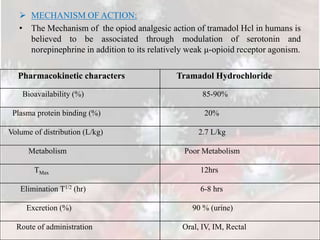
 MECHANISM OF ACTION:
• The Mechanism of the opiod analgesic action of tramadol Hcl in humans is
believed to be associated through modulation of serotonin and
norepinephrine in addition to its relatively weak μ-opioid receptor agonism.
Pharmacokinetic characters Tramadol Hydrochloride
Bioavailability (%) 85-90%
Plasma protein binding (%) 20%
Volume of distribution (L/kg) 2.7 L/kg
Metabolism Poor Metabolism
TMax 12hrs
Elimination T1/2 (hr) 6-8 hrs
Excretion (%) 90 % (urine)
Route of administration Oral, IV, IM, Rectal
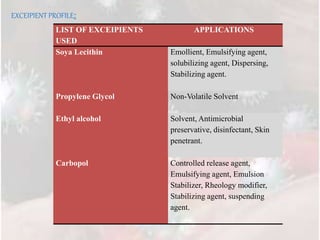
LIST OF EXCEIPIENTS
USED
APPLICATIONS
Soya Lecithin Emollient, Emulsifying agent,
solubilizing agent, Dispersing,
Stabilizing agent.
Propylene Glycol Non-Volatile Solvent
Ethyl alcohol Solvent, Antimicrobial
preservative, disinfectant, Skin
penetrant.
Carbopol Controlled release agent,
Emulsifying agent, Emulsion
Stabilizer, Rheology modifier,
Stabilizing agent, suspending
agent.
EXCEIPIENT PROFILE:
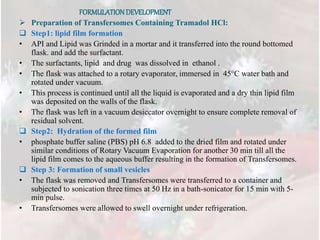
FORMULATIONDEVELOPMENT
 Preparation of Transfersomes Containing Tramadol HCl:
 Step1: lipid film formation
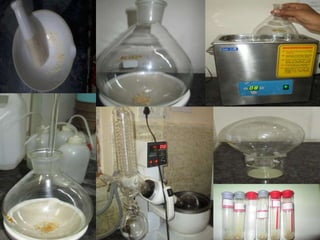
• API and Lipid was Grinded in a mortar and it transferred into the round bottomed
flask. and add the surfactant.
• The surfactants, lipid and drug was dissolved in ethanol .
• The flask was attached to a rotary evaporator, immersed in 45°C water bath and
rotated under vacuum.
• This process is continued until all the liquid is evaporated and a dry thin lipid film
was deposited on the walls of the flask.
• The flask was left in a vacuum desiccator overnight to ensure complete removal of
residual solvent.
 Step2: Hydration of the formed film
• phosphate buffer saline (PBS) pH 6.8 added to the dried film and rotated under
similar conditions of Rotary Vacuum Evaporation for another 30 min till all the
lipid film comes to the aqueous buffer resulting in the formation of Transfersomes.
 Step 3: Formation of small vesicles
• The flask was removed and Transfersomes were transferred to a container and
subjected to sonication three times at 50 Hz in a bath-sonicator for 15 min with 5-
min pulse.
• Transfersomes were allowed to swell overnight under refrigeration.
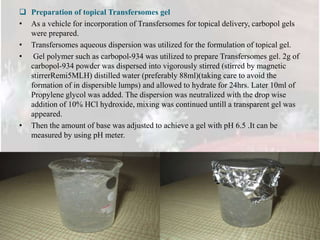
 Preparation of topical Transfersomes gel
• As a vehicle for incorporation of Transfersomes for topical delivery, carbopol gels
were prepared.
• Transfersomes aqueous dispersion was utilized for the formulation of topical gel.
• Gel polymer such as carbopol-934 was utilized to prepare Transfersomes gel. 2g of
carbopol-934 powder was dispersed into vigorously stirred (stirred by magnetic
stirrerRemi5MLH) distilled water (preferably 88ml)(taking care to avoid the
formation of in dispersible lumps) and allowed to hydrate for 24hrs. Later 10ml of
Propylene glycol was added. The dispersion was neutralized with the drop wise
addition of 10% HCl hydroxide, mixing was continued untill a transparent gel was
appeared.
• Then the amount of base was adjusted to achieve a gel with pH 6.5 .It can be
measured by using pH meter.
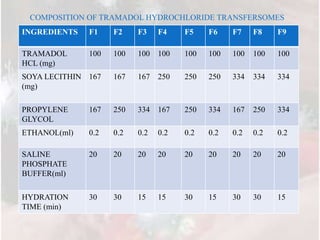
INGREDIENTS F1 F2 F3 F4 F5 F6 F7 F8 F9
TRAMADOL
HCL (mg)
100 100 100 100 100 100 100 100 100
SOYA LECITHIN
(mg)
167 167 167 250 250 250 334 334 334
PROPYLENE
GLYCOL
167 250 334 167 250 334 167 250 334
ETHANOL(ml) 0.2 0.2 0.2 0.2 0.2 0.2 0.2 0.2 0.2
SALINE
PHOSPHATE
BUFFER(ml)
20 20 20 20 20 20 20 20 20
HYDRATION
TIME (min)
30 30 15 15 30 15 30 30 15
COMPOSITION OF TRAMADOL HYDROCHLORIDE TRANSFERSOMES
EVALUATION PARAMETERS
Transfersome Suspension:
 Vesicle Shape & type by TEM
 Vesicle Size analysis by SEM
 Vesicle size, size distribution and zeta potential analysis.
 Entrapment Efficiency
Transfersome gel:
 Determination of PH
 % Drug Content
 In-vitro drug release studies through cellophane membrane
 Stability Studies of Transfersomes
RESULTS AND DISCUSSION
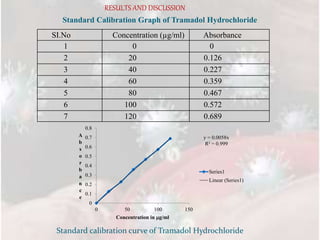
Standard Calibration Graph of Tramadol Hydrochloride
SI.No Concentration (µg/ml) Absorbance
1 0 0
2 20 0.126
3 40 0.227
4 60 0.359
5 80 0.467
6 100 0.572
7 120 0.689
y = 0.0058x
R² = 0.999
0
0.1
0.2
0.3
0.4
0.5
0.6
0.7
0.8
0 50 100 150
A
b
s
o
r
b
a
n
c
e
Concentration in g/ml
Series1
Linear (Series1)
Standard calibration curve of Tramadol Hydrochloride
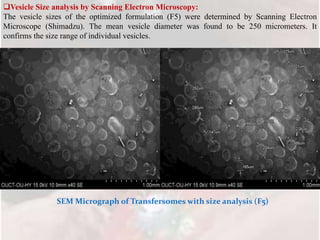
Vesicle Size analysis by Scanning Electron Microscopy:
The vesicle sizes of the optimized formulation (F5) were determined by Scanning Electron
Microscope (Shimadzu). The mean vesicle diameter was found to be 250 micrometers. It
confirms the size range of individual vesicles.
SEM Micrograph of Transfersomes with size analysis (F5)
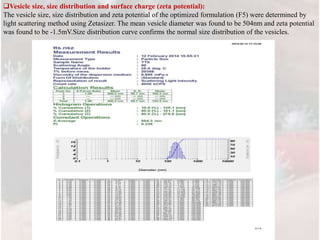
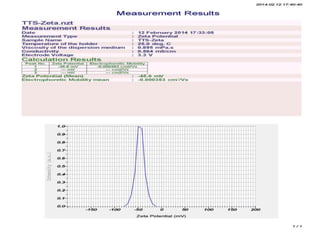
Vesicle size, size distribution and surface charge (zeta potential):
The vesicle size, size distribution and zeta potential of the optimized formulation (F5) were determined by
light scattering method using Zetasizer. The mean vesicle diameter was found to be 504nm and zeta potential
was found to be -1.5mV.Size distribution curve confirms the normal size distribution of the vesicles.
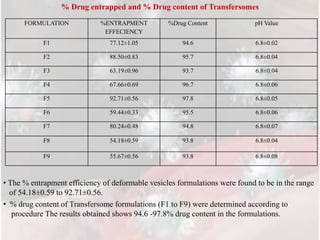
% Drug entrapped and % Drug content of Transfersomes
FORMULATION %ENTRAPMENT
EFFECIENCY
%Drug Content pH Value
F1 77.12±1.05 94.6 6.8±0.02
F2 88.50±0.83 95.7 6.8±0.04
F3 63.19±0.96 93.7 6.8±0.04
F4 67.66±0.69 96.7 6.8±0.06
F5 92.71±0.56 97.8 6.8±0.05
F6 59.44±0.33 95.5 6.8±0.06
F7 80.24±0.48 94.8 6.8±0.07
F8 54.18±0.59 93.8 6.8±0.04
F9 55.67±0.56 93.8 6.8±0.08
• The % entrapment efficiency of deformable vesicles formulations were found to be in the range
of 54.18±0.59 to 92.71±0.56.
• % drug content of Transfersome formulations (F1 to F9) were determined according to
procedure The results obtained shows 94.6 -97.8% drug content in the formulations.
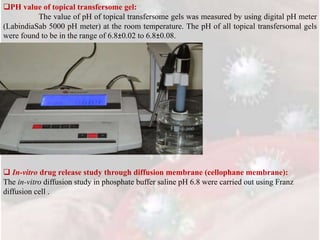
PH value of topical transfersome gel:
The value of pH of topical transfersome gels was measured by using digital pH meter
(LabindiaSab 5000 pH meter) at the room temperature. The pH of all topical transfersomal gels
were found to be in the range of 6.8±0.02 to 6.8±0.08.
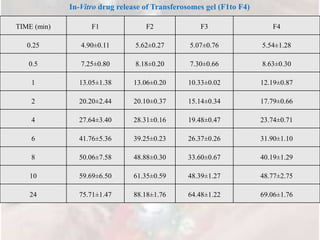
 In-vitro drug release study through diffusion membrane (cellophane membrane):
The in-vitro diffusion study in phosphate buffer saline pH 6.8 were carried out using Franz
diffusion cell .
TIME (min) F1 F2 F3 F4
0.25 4.90±0.11 5.62±0.27 5.07±0.76 5.54±1.28
0.5 7.25±0.80 8.18±0.20 7.30±0.66 8.63±0.30
1 13.05±1.38 13.06±0.20 10.33±0.02 12.19±0.87
2 20.20±2.44 20.10±0.37 15.14±0.34 17.79±0.66
4 27.64±3.40 28.31±0.16 19.48±0.47 23.74±0.71
6 41.76±5.36 39.25±0.23 26.37±0.26 31.90±1.10
8 50.06±7.58 48.88±0.30 33.60±0.67 40.19±1.29
10 59.69±6.50 61.35±0.59 48.39±1.27 48.77±2.75
24 75.71±1.47 88.18±1.76 64.48±1.22 69.06±1.76
In-Vitro drug release of Transferosomes gel (F1to F4)
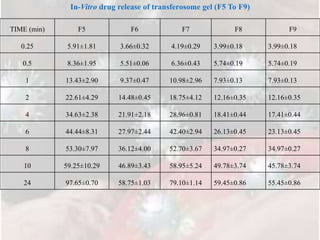
TIME (min) F5 F6 F7 F8 F9
0.25 5.91±1.81 3.66±0.32 4.19±0.29 3.99±0.18 3.99±0.18
0.5 8.36±1.95 5.51±0.06 6.36±0.43 5.74±0.19 5.74±0.19
1 13.43±2.90 9.37±0.47 10.98±2.96 7.93±0.13 7.93±0.13
2 22.61±4.29 14.48±0.45 18.75±4.12 12.16±0.35 12.16±0.35
4 34.63±2.38 21.91±2.18 28.96±0.81 18.41±0.44 17.41±0.44
6 44.44±8.31 27.97±2.44 42.40±2.94 26.13±0.45 23.13±0.45
8 53.30±7.97 36.12±4.00 52.70±3.67 34.97±0.27 34.97±0.27
10 59.25±10.29 46.89±3.43 58.95±5.24 49.78±3.74 45.78±3.74
24 97.65±0.70 58.75±1.03 79.10±1.14 59.45±0.86 55.45±0.86
In-Vitro drug release of transferosome gel (F5 To F9)
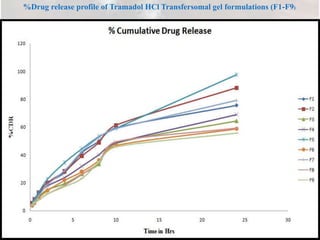
%Drug release profile of Tramadol HCl Transfersomal gel formulations (F1-F9)
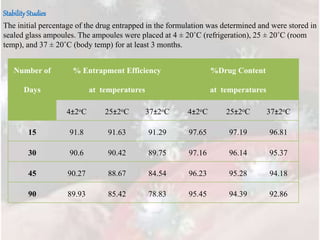
The initial percentage of the drug entrapped in the formulation was determined and were stored in
sealed glass ampoules. The ampoules were placed at 4 ± 20˚C (refrigeration), 25 ± 20˚C (room
temp), and 37 ± 20˚C (body temp) for at least 3 months.
StabilityStudies
Number of
Days
% Entrapment Efficiency
at temperatures
%Drug Content
at temperatures
4±2oC 25±2oC 37±2oC 4±2oC 25±2oC 37±2oC
15 91.8 91.63 91.29 97.65 97.19 96.81
30 90.6 90.42 89.75 97.16 96.14 95.37
45 90.27 88.67 84.54 96.23 95.28 94.18
90 89.93 85.42 78.83 95.45 94.39 92.86
SUMMARY AND CONCLUSION
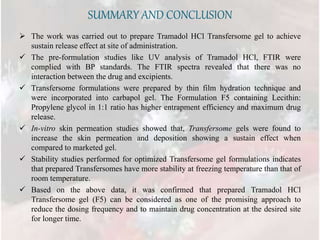
 The work was carried out to prepare Tramadol HCl Transfersome gel to achieve
sustain release effect at site of administration.
 The pre-formulation studies like UV analysis of Tramadol HCl, FTIR were
complied with BP standards. The FTIR spectra revealed that there was no
interaction between the drug and excipients.
 Transfersome formulations were prepared by thin film hydration technique and
were incorporated into carbapol gel. The Formulation F5 containing Lecithin:
Propylene glycol in 1:1 ratio has higher entrapment efficiency and maximum drug
release.
 In-vitro skin permeation studies showed that, Transfersome gels were found to
increase the skin permeation and deposition showing a sustain effect when
compared to marketed gel.
 Stability studies performed for optimized Transfersome gel formulations indicates
that prepared Transfersomes have more stability at freezing temperature than that of
room temperature.
 Based on the above data, it was confirmed that prepared Tramadol HCl
Transfersome gel (F5) can be considered as one of the promising approach to
reduce the dosing frequency and to maintain drug concentration at the desired site
for longer time.
 Tramadol HCl is used to reduce the pain, inflammation, and stiffness caused by
osteoarthritis and rheumatoid arthritis. It is well absorbed following oral
administration however; its use has been associated with a number of undesirable
side effects on the stomach and kidneys in addition to gastric mucosal damage.
These side effects can be avoided by topical administration of the drug.
 To alleviate this problem, vesicular drug delivery system Transfersomes is
formulated to deliver Tramadol HCl across skin and target drug to synovium or
specific tissues which in turn increase drug efficacy with minimum extra synovial
toxicity.
 Finally, it can be concluded from the results of present study that transfersomal gel
improves the transdermal delivery, prolong the release, and improve the site
specificity of the drug Tramadol HCl. Transfersomes creates a new opportunity for
the well-controlled transdermal delivery of a number of drugs that have a problem
of administration by other routes.
BIBILOGRAPHY
• Shaw,J.E; Chandrasekaran,S.K. In: pharmacology of the skin, Greaves, M.W.;
Shuster S.(Eds.) Springer- Verlag, Berlin,1999, 115-122.
• Modi CD, Bharadia PD, “Transfersomes: New Dominants for Transdermal Drug
Delivery”, Am. J.PharmTech Res., 2012, 2 (3), 71-91.
• Swarnlata S, Gunjan J, Chanchal DK, Shailendra S,“Development of novel herbal
cosmetic cream with Curcuma longa extract loaded transfersomes for anti-wrinkle
effect”, African J Pharm Pharmacol,2011, 5 (8), 1054-1062
• Cevc G, Gebauer D, Stieber J, Schatzlein A and Blume G: Ultraflexible vesicles,
Transfersomes, have an extremely low pore penetration resistance and transport
therapeutic amounts of insulin across the intact mammalian skin. Biochimica et
Biophysica Acta 1998; 1368: 201–215.
• Benson HA, “Transfersomes for transdermal drug delivery”, Expert Opin. Drug
Deliv., 2006, 3 (6),727-37.
• Patel R, Singh SK, Singh S, Sheth NR, Gendle R, “Development and
Characterization of Curcumin Loaded Transfersome for Transdermal Delivery” J.
Pharm Sci. Res., 2009, 1 (4), 71-81.
• Cevc G, Schatlein A and Blume G. J.Control Release, 1995; 36:3.
Transfersomes by S Shivani Shastrulagari

Transfersomes by S Shivani Shastrulagari

  • 1.
  • 2.
    TABLE OF CONTENTS •INTRODUCTION • REVIEW OF LITERATURE • AIM AND OBJECTIVE • PLAN OF WORK • DRUG AND EXCIEPIENT PROFILE • METHODOLOGY • RESULTS AND DISCUSSION • BIBILOGRAPHY
  • 3.
    INTRODUCTION • The conceptof Transfersome were introduced in 1991 by Gregor Cevc and co-workers. • Transfersome is a term registered as a trademark by the German company IDEAAG, and used by its proprietary drug delivery technology. • The name means “ carrying body”, and is derived from the Latin word ‘transferre’ , meaning ‘to carry across’, and the Greek word ‘soma’, for a ‘body’. • A Transfersome carrier is an artificial vesicle designed to be like a cell vesicle or a cell engaged in exocytosis, and thus suitable for controlled and, potentially targeted, drug delivery. • Transfersomes are highly efficient edge activator (EA) – based ultra flexible vesicles capable of, non-invasively, trespassing skin by virtue of their high, self- optimizing deformability.
  • 4.
    INTRODUCTION • Transfersomes areself regulatory, mixed lipid aggregates containing edge activators with in a phospholipid matrix so as to drastically reduce the value of its module.  ADVANTAGES: • Transfersomes hold an infrastructure consisting of hydrophobic and hydrophilic moieties together and as a result can accomidate drug molecules with wide range of solubility. • They have high entrapment efficiency, in case of lipophilic drug near to 90%. • This high deformability gives better penetration of intact vesicles. • Transfersomes are biocompatible, biodegradable and are capable of protecting the encapsulated drug from metabolic degradation.
  • 5.
    • They canbe used for both systemic as well as topical delivery of drug. • In addition to a non-invasive means of drug-delivery, they also offer a novel approach for investigating skin histology. • Delivery of proteins and nutraceuticals. • Ease of scale up compared to other vesicular systems.  LIMITATIONS: • Transfersomes are chemically unstable because of their predisposition to oxidative degradation. • The Lack of Purity of natural phospholipids is another criteria that influences acceptance of Transfersomes as drug delivery vehicles. • Transfersomes formulations are expensive to prepare.
  • 6.
    MECHANISM OF PERMEATIONBY TRANSFERSOMES • Ultradeformable, lipid vesicle penetrating a narrow pore, owing to the bilayer components. • When a suspension of transfersome vesicles is placed on the surface of the skin, the water evaporates from the skin surface and the vesicles start to dry out. • Due to the strong hydrophilicity of transfersome ingredients, the vesicles are attracted to the areas of higher water content in the narrow gaps between adjoining cells in the skin.
  • 7.
    REVIEW OF LITERATURE •Sheo Datta Maurya et,al (2010): The aim of the present study was to investigate the potential of transfersomal formulations for transdermal delivery of indinavir sulfate and to evaluate Span 80, Tween 80, Sodium cholate and Sodium deoxycholate as edge activators. Vesicles containing phosphatidylcholine (PC) mixed with edge activators and indinavir sulfate were prepared by conventional rotary evaporation method. • Swarnlata Saraf et,al (2011): Our aim was to develop a stable nano-transfersomes loaded cream which could correct the morphological defects and penetrate deeper to the cellular level of dermis to produce anti-wrinkle effect. Soxhlet extraction of C. longa was carried out with two solvents viz. absolute ethanol and 85% ethanol. • Geeta Aggarwal et,al (2012): The aim of the present study was to investigate transfersomes as a transdermal delivery system for the poorly soluble drug, sertraline, in order to overcome the troubles associated with its oral delivery. Different transfersomal formulations were prepared with non-ionic surfactant (span 80), soya lecithin, and carbopol 940 by the rotary evaporation sonication method.
  • 8.
    AIM AND OBJECTIVE •To prepare and evaluate Tramadol HCl loaded transferosome gel. • The drug delivery technology is extended to transdermal route apart from oral. • The ability to increase the transdermal permeation can be valuable aid when oral administration of drug is associated with problems.  OBJECTIVE OF STUDY: • The main objective of the study is to formulate and evaluate Tramadol HCl transferosome gel formulation for effective topical delivery of drug. • That commercial topical formulations of Tramadol HCl are available which have limited drug loading and requires frequent application. • To overcome this problem Transferosome gel is prepared which helps in more penetration of drug and producing a sustain release effect at the site of administration.
  • 9.
    PLAN OF WORK To develop analytical method for the estimation of drug in the formulations.  To carry out pre-formulation studies for possible drug-excipient interactions by FTIR.  Preparation of transferosomes containing Tramadol HCl using different ratios of lipid and surfactant using thin film hydration technique.  Characterization of transferosomes with respect to  Vesicle size, size distribution and zeta potential analysis  Vesicle shape and type  Formulation of transferosome gel and studying its  In-vitro drug release using diffusion cell  Entrapment efficiency  Drug content  Studies on formulated topical transferosome gel and comparison of that with marketed Tramadol HCl gel.  In vitro drug release studies using diffusion membrane (Cellophane membrane).
  • 10.
    DRUG PROFILE: • Nameof Drug : Tramadol hydrochloride • IUPAC name: (1R,2R)-rel-2-[(Dimethylamino)methyl]-1-(3- methoxyphenyl)cyclohexanol • Category: Opioid analgesic • Chemical formula: C16H25NO2.HCl • Molecular weight: 299.84 g/mol • Structure: • Solubility: Freely soluble in water, methanol, ethanol and slightly soluble in acetone • Dosage form: Tablets, SR tablets, capsules, Transfersomalgel, injections.
  • 11.
     MECHANISM OFACTION: • The Mechanism of the opiod analgesic action of tramadol Hcl in humans is believed to be associated through modulation of serotonin and norepinephrine in addition to its relatively weak μ-opioid receptor agonism. Pharmacokinetic characters Tramadol Hydrochloride Bioavailability (%) 85-90% Plasma protein binding (%) 20% Volume of distribution (L/kg) 2.7 L/kg Metabolism Poor Metabolism TMax 12hrs Elimination T1/2 (hr) 6-8 hrs Excretion (%) 90 % (urine) Route of administration Oral, IV, IM, Rectal
  • 12.
    LIST OF EXCEIPIENTS USED APPLICATIONS SoyaLecithin Emollient, Emulsifying agent, solubilizing agent, Dispersing, Stabilizing agent. Propylene Glycol Non-Volatile Solvent Ethyl alcohol Solvent, Antimicrobial preservative, disinfectant, Skin penetrant. Carbopol Controlled release agent, Emulsifying agent, Emulsion Stabilizer, Rheology modifier, Stabilizing agent, suspending agent. EXCEIPIENT PROFILE:
  • 13.
    FORMULATIONDEVELOPMENT  Preparation ofTransfersomes Containing Tramadol HCl:  Step1: lipid film formation • API and Lipid was Grinded in a mortar and it transferred into the round bottomed flask. and add the surfactant. • The surfactants, lipid and drug was dissolved in ethanol . • The flask was attached to a rotary evaporator, immersed in 45°C water bath and rotated under vacuum. • This process is continued until all the liquid is evaporated and a dry thin lipid film was deposited on the walls of the flask. • The flask was left in a vacuum desiccator overnight to ensure complete removal of residual solvent.  Step2: Hydration of the formed film • phosphate buffer saline (PBS) pH 6.8 added to the dried film and rotated under similar conditions of Rotary Vacuum Evaporation for another 30 min till all the lipid film comes to the aqueous buffer resulting in the formation of Transfersomes.  Step 3: Formation of small vesicles • The flask was removed and Transfersomes were transferred to a container and subjected to sonication three times at 50 Hz in a bath-sonicator for 15 min with 5- min pulse. • Transfersomes were allowed to swell overnight under refrigeration.
  • 15.
     Preparation oftopical Transfersomes gel • As a vehicle for incorporation of Transfersomes for topical delivery, carbopol gels were prepared. • Transfersomes aqueous dispersion was utilized for the formulation of topical gel. • Gel polymer such as carbopol-934 was utilized to prepare Transfersomes gel. 2g of carbopol-934 powder was dispersed into vigorously stirred (stirred by magnetic stirrerRemi5MLH) distilled water (preferably 88ml)(taking care to avoid the formation of in dispersible lumps) and allowed to hydrate for 24hrs. Later 10ml of Propylene glycol was added. The dispersion was neutralized with the drop wise addition of 10% HCl hydroxide, mixing was continued untill a transparent gel was appeared. • Then the amount of base was adjusted to achieve a gel with pH 6.5 .It can be measured by using pH meter.
  • 16.
    INGREDIENTS F1 F2F3 F4 F5 F6 F7 F8 F9 TRAMADOL HCL (mg) 100 100 100 100 100 100 100 100 100 SOYA LECITHIN (mg) 167 167 167 250 250 250 334 334 334 PROPYLENE GLYCOL 167 250 334 167 250 334 167 250 334 ETHANOL(ml) 0.2 0.2 0.2 0.2 0.2 0.2 0.2 0.2 0.2 SALINE PHOSPHATE BUFFER(ml) 20 20 20 20 20 20 20 20 20 HYDRATION TIME (min) 30 30 15 15 30 15 30 30 15 COMPOSITION OF TRAMADOL HYDROCHLORIDE TRANSFERSOMES
  • 17.
    EVALUATION PARAMETERS Transfersome Suspension: Vesicle Shape & type by TEM  Vesicle Size analysis by SEM  Vesicle size, size distribution and zeta potential analysis.  Entrapment Efficiency Transfersome gel:  Determination of PH  % Drug Content  In-vitro drug release studies through cellophane membrane  Stability Studies of Transfersomes
  • 18.
    RESULTS AND DISCUSSION StandardCalibration Graph of Tramadol Hydrochloride SI.No Concentration (µg/ml) Absorbance 1 0 0 2 20 0.126 3 40 0.227 4 60 0.359 5 80 0.467 6 100 0.572 7 120 0.689 y = 0.0058x R² = 0.999 0 0.1 0.2 0.3 0.4 0.5 0.6 0.7 0.8 0 50 100 150 A b s o r b a n c e Concentration in g/ml Series1 Linear (Series1) Standard calibration curve of Tramadol Hydrochloride
  • 19.
    Vesicle Size analysisby Scanning Electron Microscopy: The vesicle sizes of the optimized formulation (F5) were determined by Scanning Electron Microscope (Shimadzu). The mean vesicle diameter was found to be 250 micrometers. It confirms the size range of individual vesicles. SEM Micrograph of Transfersomes with size analysis (F5)
  • 20.
    Vesicle size, sizedistribution and surface charge (zeta potential): The vesicle size, size distribution and zeta potential of the optimized formulation (F5) were determined by light scattering method using Zetasizer. The mean vesicle diameter was found to be 504nm and zeta potential was found to be -1.5mV.Size distribution curve confirms the normal size distribution of the vesicles.
  • 22.
    % Drug entrappedand % Drug content of Transfersomes FORMULATION %ENTRAPMENT EFFECIENCY %Drug Content pH Value F1 77.12±1.05 94.6 6.8±0.02 F2 88.50±0.83 95.7 6.8±0.04 F3 63.19±0.96 93.7 6.8±0.04 F4 67.66±0.69 96.7 6.8±0.06 F5 92.71±0.56 97.8 6.8±0.05 F6 59.44±0.33 95.5 6.8±0.06 F7 80.24±0.48 94.8 6.8±0.07 F8 54.18±0.59 93.8 6.8±0.04 F9 55.67±0.56 93.8 6.8±0.08 • The % entrapment efficiency of deformable vesicles formulations were found to be in the range of 54.18±0.59 to 92.71±0.56. • % drug content of Transfersome formulations (F1 to F9) were determined according to procedure The results obtained shows 94.6 -97.8% drug content in the formulations.
  • 23.
    PH value oftopical transfersome gel: The value of pH of topical transfersome gels was measured by using digital pH meter (LabindiaSab 5000 pH meter) at the room temperature. The pH of all topical transfersomal gels were found to be in the range of 6.8±0.02 to 6.8±0.08.  In-vitro drug release study through diffusion membrane (cellophane membrane): The in-vitro diffusion study in phosphate buffer saline pH 6.8 were carried out using Franz diffusion cell .
  • 24.
    TIME (min) F1F2 F3 F4 0.25 4.90±0.11 5.62±0.27 5.07±0.76 5.54±1.28 0.5 7.25±0.80 8.18±0.20 7.30±0.66 8.63±0.30 1 13.05±1.38 13.06±0.20 10.33±0.02 12.19±0.87 2 20.20±2.44 20.10±0.37 15.14±0.34 17.79±0.66 4 27.64±3.40 28.31±0.16 19.48±0.47 23.74±0.71 6 41.76±5.36 39.25±0.23 26.37±0.26 31.90±1.10 8 50.06±7.58 48.88±0.30 33.60±0.67 40.19±1.29 10 59.69±6.50 61.35±0.59 48.39±1.27 48.77±2.75 24 75.71±1.47 88.18±1.76 64.48±1.22 69.06±1.76 In-Vitro drug release of Transferosomes gel (F1to F4)
  • 25.
    TIME (min) F5F6 F7 F8 F9 0.25 5.91±1.81 3.66±0.32 4.19±0.29 3.99±0.18 3.99±0.18 0.5 8.36±1.95 5.51±0.06 6.36±0.43 5.74±0.19 5.74±0.19 1 13.43±2.90 9.37±0.47 10.98±2.96 7.93±0.13 7.93±0.13 2 22.61±4.29 14.48±0.45 18.75±4.12 12.16±0.35 12.16±0.35 4 34.63±2.38 21.91±2.18 28.96±0.81 18.41±0.44 17.41±0.44 6 44.44±8.31 27.97±2.44 42.40±2.94 26.13±0.45 23.13±0.45 8 53.30±7.97 36.12±4.00 52.70±3.67 34.97±0.27 34.97±0.27 10 59.25±10.29 46.89±3.43 58.95±5.24 49.78±3.74 45.78±3.74 24 97.65±0.70 58.75±1.03 79.10±1.14 59.45±0.86 55.45±0.86 In-Vitro drug release of transferosome gel (F5 To F9)
  • 26.
    %Drug release profileof Tramadol HCl Transfersomal gel formulations (F1-F9)
  • 27.
    The initial percentageof the drug entrapped in the formulation was determined and were stored in sealed glass ampoules. The ampoules were placed at 4 ± 20˚C (refrigeration), 25 ± 20˚C (room temp), and 37 ± 20˚C (body temp) for at least 3 months. StabilityStudies Number of Days % Entrapment Efficiency at temperatures %Drug Content at temperatures 4±2oC 25±2oC 37±2oC 4±2oC 25±2oC 37±2oC 15 91.8 91.63 91.29 97.65 97.19 96.81 30 90.6 90.42 89.75 97.16 96.14 95.37 45 90.27 88.67 84.54 96.23 95.28 94.18 90 89.93 85.42 78.83 95.45 94.39 92.86
  • 28.
    SUMMARY AND CONCLUSION The work was carried out to prepare Tramadol HCl Transfersome gel to achieve sustain release effect at site of administration.  The pre-formulation studies like UV analysis of Tramadol HCl, FTIR were complied with BP standards. The FTIR spectra revealed that there was no interaction between the drug and excipients.  Transfersome formulations were prepared by thin film hydration technique and were incorporated into carbapol gel. The Formulation F5 containing Lecithin: Propylene glycol in 1:1 ratio has higher entrapment efficiency and maximum drug release.  In-vitro skin permeation studies showed that, Transfersome gels were found to increase the skin permeation and deposition showing a sustain effect when compared to marketed gel.  Stability studies performed for optimized Transfersome gel formulations indicates that prepared Transfersomes have more stability at freezing temperature than that of room temperature.  Based on the above data, it was confirmed that prepared Tramadol HCl Transfersome gel (F5) can be considered as one of the promising approach to reduce the dosing frequency and to maintain drug concentration at the desired site for longer time.
  • 29.
     Tramadol HClis used to reduce the pain, inflammation, and stiffness caused by osteoarthritis and rheumatoid arthritis. It is well absorbed following oral administration however; its use has been associated with a number of undesirable side effects on the stomach and kidneys in addition to gastric mucosal damage. These side effects can be avoided by topical administration of the drug.  To alleviate this problem, vesicular drug delivery system Transfersomes is formulated to deliver Tramadol HCl across skin and target drug to synovium or specific tissues which in turn increase drug efficacy with minimum extra synovial toxicity.  Finally, it can be concluded from the results of present study that transfersomal gel improves the transdermal delivery, prolong the release, and improve the site specificity of the drug Tramadol HCl. Transfersomes creates a new opportunity for the well-controlled transdermal delivery of a number of drugs that have a problem of administration by other routes.
  • 30.
    BIBILOGRAPHY • Shaw,J.E; Chandrasekaran,S.K.In: pharmacology of the skin, Greaves, M.W.; Shuster S.(Eds.) Springer- Verlag, Berlin,1999, 115-122. • Modi CD, Bharadia PD, “Transfersomes: New Dominants for Transdermal Drug Delivery”, Am. J.PharmTech Res., 2012, 2 (3), 71-91. • Swarnlata S, Gunjan J, Chanchal DK, Shailendra S,“Development of novel herbal cosmetic cream with Curcuma longa extract loaded transfersomes for anti-wrinkle effect”, African J Pharm Pharmacol,2011, 5 (8), 1054-1062 • Cevc G, Gebauer D, Stieber J, Schatzlein A and Blume G: Ultraflexible vesicles, Transfersomes, have an extremely low pore penetration resistance and transport therapeutic amounts of insulin across the intact mammalian skin. Biochimica et Biophysica Acta 1998; 1368: 201–215. • Benson HA, “Transfersomes for transdermal drug delivery”, Expert Opin. Drug Deliv., 2006, 3 (6),727-37. • Patel R, Singh SK, Singh S, Sheth NR, Gendle R, “Development and Characterization of Curcumin Loaded Transfersome for Transdermal Delivery” J. Pharm Sci. Res., 2009, 1 (4), 71-81. • Cevc G, Schatlein A and Blume G. J.Control Release, 1995; 36:3.