Presented By 
S.Shiva Shivani 
12y71so330 
M.Pharm(Pharmaceutics) 
Samskruthi College Of Pharmacy
 Since 150 years needle based injections have ruled the parenterals . 
Even now they form the major part of parenteral dosage form. 
 To overcome the problem related to needle based injections there is 
one technology that has received constant attention during the past 
few years that has all of the sought after benefits..Needle less injection 
technology (NLIT) was discovered in 1940’s in FRANCE. 
 Needle-less injection systems are novel ways to introduce various 
medicines into patients without piercing the skin with a conventional 
needle. 
 This is mainly useful for the patients who are suffering from chronic 
diseases who requires injectable products 2-3 a day. 
For Ex:-Diabetes patient
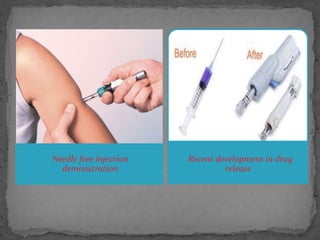
Needle free injection 
demonstration 
Recent development in drug 
release
 Needle free injection technology works by forcing liquid medications 
at high speed through a tiny orifice that is held against the skin . 
 This creates an ultra stream of high pressure fluid that penetrates the 
skin without the use of needle. 
 The design of this device has a major influence on the accuracy of 
subcutaneous delivery and the stresses improved on the product to be 
delivered. 
 The design must ensure that a sufficient high pressure is generated to 
puncture the skin, while the subsequent pressure is reduced to ensure 
that the molecule is deposited at a level that doe’s not reach the 
muscle tissue
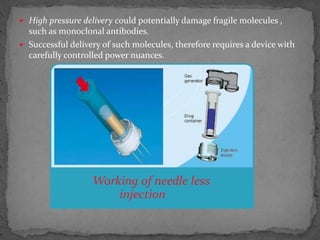
 High pressure delivery could potentially damage fragile molecules , 
such as monoclonal antibodies. 
 Successful delivery of such molecules, therefore requires a device with 
carefully controlled power nuances. 
Working of needle less 
injection
Every commercial device has in common three main components they 
are:- 
 The injection Device 
 The needle less syringe 
 The power source 
 The injection device is the one which is operated in order to propel the 
power source to inturn move the drug. 
 The needle less syringe is the one containing the drug substance and 
the nozzle through which the drug moves into the skin. 
 In between the propeller of the injection device and the drug reservoir 
of the syringe lies the power source.
 There are many different types of power sources available in the 
market each having its own PROS and CONS. 
 The common power sources include: 
Compressed gas cartridges 
Spring system 
Piezoelectric crystals 
Lorentz force actuator using current 
 Since a few decades gas powder systems and spring systems have been 
used but they had their own disadvantages of improper control over 
the velocity of the drug. 
 These are now replaced by the newer technologies like Lorentz force 
actuators that can control the velocity and pressure of the drug 
released .
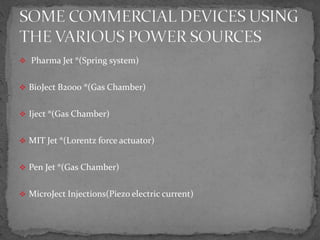
 Pharma Jet ®(Spring system) 
 BioJect B2000 ®(Gas Chamber) 
 Iject ®(Gas Chamber) 
 MIT Jet ®(Lorentz force actuator) 
 Pen Jet ®(Gas Chamber) 
 MicroJect Injections(Piezo electric current)
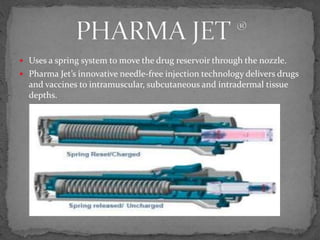
 Uses a spring system to move the drug reservoir through the nozzle. 
 Pharma Jet’s innovative needle-free injection technology delivers drugs 
and vaccines to intramuscular, subcutaneous and intradermal tissue 
depths.
 This injection technology works by forcing liquid medication at high 
speed through a tiny orifice that is held against the skin. 
 The diameter of the orifice is smaller than the diameter of human hair. 
 This creates an ultra fine stream of high pressure fluid that penetrates 
the skin without single needle. 
 This is unique because it delivers injections to a number of injection 
depth.
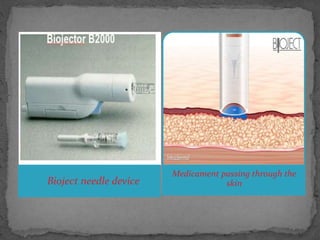
Bioject needle device 
Medicament passing through the 
skin
 It is prefilled single used disposable device configured to administered 
0.5-1ml subcutaneous or intramuscular injections.
 Utilizes current and magnetism Lorentz force to propel the liquid 
forward and so it is adjustable by fluctuating the currents.
 A gas powered system similar to Bioject but uses Nitrogen as Gas.
 Uses Piezo electric current from the crystals present in the system
 Patient compliance, as there is no pain. 
 Easy administration. Often favouring self administration and 
administration by untrained people. 
 Worker safety, as it prevents accidental pricking with used needles 
 Re-usability of major portion of the needle less injections, rather than 
complete removal of the syringe. 
 Cost effective. 
 Administration of drug at required rate for required time to required 
region below the skin, thus favouring administration of proper dosage 
regimen.
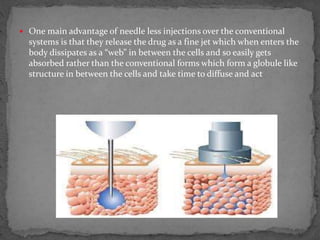
 One main advantage of needle less injections over the conventional 
systems is that they release the drug as a fine jet which when enters the 
body dissipates as a “web” in between the cells and so easily gets 
absorbed rather than the conventional forms which form a globule like 
structure in between the cells and take time to diffuse and act
 If a needle syringe is not sterilized, reusing it can lead to the spread of 
diseases. 
 Risk of cross-contamination from needle-stick injury 
 Under or overdosing resulting in poor injection technique of patients 
 Costs of sharps disposal 
 Needle phobia 
 Injection site pain 
 Poor compliance leading to long term worsening of conditions.
 Needle free technology offers the very obvious benefits of reducing 
patient concern about conventional needles and no needle disposable 
issues. 
 Not only it can benefit pharmaceutical industry in increasing product 
sales, it has the added potential to increase compliance with dosage 
regimens and improved outcomes 
 In the developing world, there are major challenges of disease 
transmission through re use of needles. 
 Organizations such as WHO and CDC(center for disease control) and 
groups like gate foundation have supported the development of needle 
free alternatives for drug delivery.
Needle Less Injection Technology by S Shivani Shastrulagari.

Needle Less Injection Technology by S Shivani Shastrulagari.

  • 1.
    Presented By S.ShivaShivani 12y71so330 M.Pharm(Pharmaceutics) Samskruthi College Of Pharmacy
  • 2.
     Since 150years needle based injections have ruled the parenterals . Even now they form the major part of parenteral dosage form.  To overcome the problem related to needle based injections there is one technology that has received constant attention during the past few years that has all of the sought after benefits..Needle less injection technology (NLIT) was discovered in 1940’s in FRANCE.  Needle-less injection systems are novel ways to introduce various medicines into patients without piercing the skin with a conventional needle.  This is mainly useful for the patients who are suffering from chronic diseases who requires injectable products 2-3 a day. For Ex:-Diabetes patient
  • 3.
    Needle free injection demonstration Recent development in drug release
  • 4.
     Needle freeinjection technology works by forcing liquid medications at high speed through a tiny orifice that is held against the skin .  This creates an ultra stream of high pressure fluid that penetrates the skin without the use of needle.  The design of this device has a major influence on the accuracy of subcutaneous delivery and the stresses improved on the product to be delivered.  The design must ensure that a sufficient high pressure is generated to puncture the skin, while the subsequent pressure is reduced to ensure that the molecule is deposited at a level that doe’s not reach the muscle tissue
  • 5.
     High pressuredelivery could potentially damage fragile molecules , such as monoclonal antibodies.  Successful delivery of such molecules, therefore requires a device with carefully controlled power nuances. Working of needle less injection
  • 6.
    Every commercial devicehas in common three main components they are:-  The injection Device  The needle less syringe  The power source  The injection device is the one which is operated in order to propel the power source to inturn move the drug.  The needle less syringe is the one containing the drug substance and the nozzle through which the drug moves into the skin.  In between the propeller of the injection device and the drug reservoir of the syringe lies the power source.
  • 8.
     There aremany different types of power sources available in the market each having its own PROS and CONS.  The common power sources include: Compressed gas cartridges Spring system Piezoelectric crystals Lorentz force actuator using current  Since a few decades gas powder systems and spring systems have been used but they had their own disadvantages of improper control over the velocity of the drug.  These are now replaced by the newer technologies like Lorentz force actuators that can control the velocity and pressure of the drug released .
  • 9.
     Pharma Jet®(Spring system)  BioJect B2000 ®(Gas Chamber)  Iject ®(Gas Chamber)  MIT Jet ®(Lorentz force actuator)  Pen Jet ®(Gas Chamber)  MicroJect Injections(Piezo electric current)
  • 10.
     Uses aspring system to move the drug reservoir through the nozzle.  Pharma Jet’s innovative needle-free injection technology delivers drugs and vaccines to intramuscular, subcutaneous and intradermal tissue depths.
  • 11.
     This injectiontechnology works by forcing liquid medication at high speed through a tiny orifice that is held against the skin.  The diameter of the orifice is smaller than the diameter of human hair.  This creates an ultra fine stream of high pressure fluid that penetrates the skin without single needle.  This is unique because it delivers injections to a number of injection depth.
  • 12.
    Bioject needle device Medicament passing through the skin
  • 13.
     It isprefilled single used disposable device configured to administered 0.5-1ml subcutaneous or intramuscular injections.
  • 14.
     Utilizes currentand magnetism Lorentz force to propel the liquid forward and so it is adjustable by fluctuating the currents.
  • 15.
     A gaspowered system similar to Bioject but uses Nitrogen as Gas.
  • 16.
     Uses Piezoelectric current from the crystals present in the system
  • 17.
     Patient compliance,as there is no pain.  Easy administration. Often favouring self administration and administration by untrained people.  Worker safety, as it prevents accidental pricking with used needles  Re-usability of major portion of the needle less injections, rather than complete removal of the syringe.  Cost effective.  Administration of drug at required rate for required time to required region below the skin, thus favouring administration of proper dosage regimen.
  • 18.
     One mainadvantage of needle less injections over the conventional systems is that they release the drug as a fine jet which when enters the body dissipates as a “web” in between the cells and so easily gets absorbed rather than the conventional forms which form a globule like structure in between the cells and take time to diffuse and act
  • 19.
     If aneedle syringe is not sterilized, reusing it can lead to the spread of diseases.  Risk of cross-contamination from needle-stick injury  Under or overdosing resulting in poor injection technique of patients  Costs of sharps disposal  Needle phobia  Injection site pain  Poor compliance leading to long term worsening of conditions.
  • 20.
     Needle freetechnology offers the very obvious benefits of reducing patient concern about conventional needles and no needle disposable issues.  Not only it can benefit pharmaceutical industry in increasing product sales, it has the added potential to increase compliance with dosage regimens and improved outcomes  In the developing world, there are major challenges of disease transmission through re use of needles.  Organizations such as WHO and CDC(center for disease control) and groups like gate foundation have supported the development of needle free alternatives for drug delivery.