Transdermal Drug Delivery System
[TDDS]
06/04/16SAGAR KISHOR SAVALE1
Contents:-
 Introduction to TDDS’s
 Basic Components of TDDS’s
Factors of TDDS
 Penetration Enhancements
 Percutaneous Absorption
 Approaches used in TDDS’s
 Production of TDDS’s
 Model Drug Selection Criteria
Evaluation of TDDS
06/04/16SAGAR KISHOR SAVALE2
A] Introduction to TDDS’s-
Management of illness through medication has entered an era of rapid
growth. A variety of means by which drugs are delivered to the human body
for the therapy such as tablets, capsules, injections, aerosols, creams,
ointments, suppositories, liquids etc. are referred as a conventional drug
formulations.
Among many pharmaceutical dosage forms, continuous intravenous
infusion at preprogrammed rate has been recognized as a superior mode of
drug delivery.
At present, the most common form of delivery of drugs is the oral route.
It has the notable advantage of easy administration.
Contd...
06/04/16SAGAR KISHOR SAVALE3
But these delivery systems having some Drawbacks-
Oral- poor bioavailability
hepatic metabolism (first pass)
tendency to produce rapid blood level spikes
need of high and/or frequent dosing
Intravenous- These mode of drug delivery entails certain risks
and therefore necessities hospitalization of the patients and close
medical supervision of the medication.
To overcome these difficulties there is a need for the
development of new drug delivery system which will improve the
therapeutic efficacy and safety of drugs by more precisely.
Contd...
06/04/16SAGAR KISHOR SAVALE4
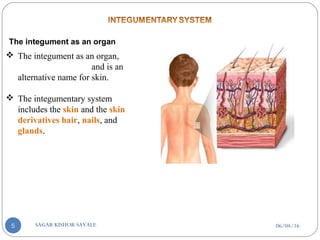
The integument as an organ
 The integument as an organ,
and is an
alternative name for skin.
 The integumentary system
includes the skin and the skin
derivatives hair, nails, and
glands.
06/04/16SAGAR KISHOR SAVALE5
The Integument
Is the largest system of the body
 16% of body weight,
 1.5 to 2m2
in area,
 The integument is made up of two parts:
1. Cutaneous membrane
a. Epidermis– Superficial epithelium
b. Dermis – underlying CT with blood supply
2. Accessory structures
a. Hair
b. Nails
c. Exocrine Glands
06/04/16SAGAR KISHOR SAVALE6
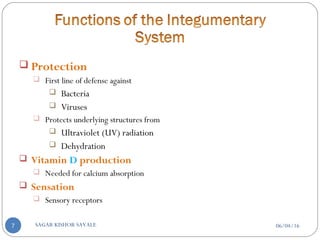
 Protection
 First line of defense against
 Bacteria
 Viruses
 Protects underlying structures from
 Ultraviolet (UV) radiation
 Dehydration
 Vitamin D production
 Needed for calcium absorption
 Sensation
 Sensory receptors
06/04/16SAGAR KISHOR SAVALE7
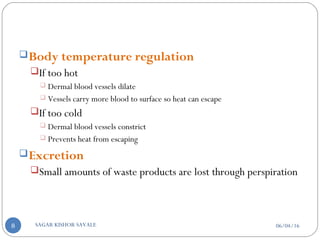
Body temperature regulation
If too hot
 Dermal blood vessels dilate
 Vessels carry more blood to surface so heat can escape
If too cold
 Dermal blood vessels constrict
 Prevents heat from escaping
Excretion
Small amounts of waste products are lost through perspiration
06/04/16SAGAR KISHOR SAVALE8
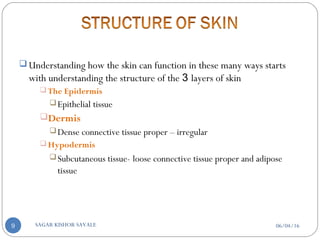
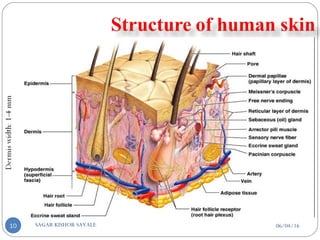
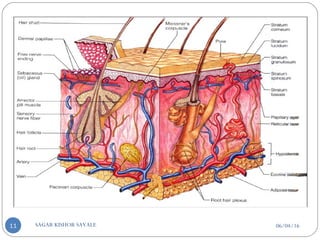
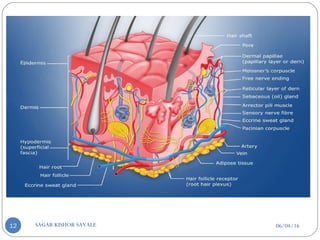
 Understanding how the skin can function in these many ways starts
with understanding the structure of the 3 layers of skin
 The Epidermis
Epithelial tissue
Dermis
Dense connective tissue proper – irregular
 Hypodermis
Subcutaneous tissue- loose connective tissue proper and adipose
tissue
06/04/16SAGAR KISHOR SAVALE9
06/04/16SAGAR KISHOR SAVALE10
06/04/16SAGAR KISHOR SAVALE11
06/04/16SAGAR KISHOR SAVALE12
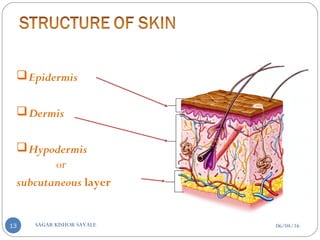
Epidermis
Dermis
Hypodermis
or
subcutaneous layer
06/04/16SAGAR KISHOR SAVALE13
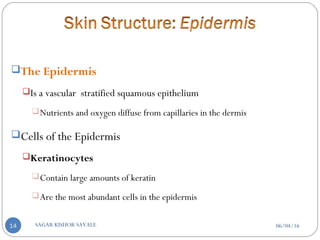
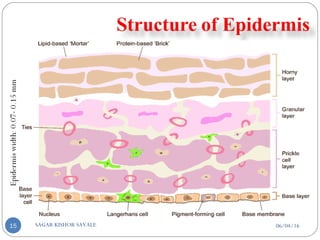
The Epidermis
Is a vascular stratified squamous epithelium
Nutrients and oxygen diffuse from capillaries in the dermis
Cells of the Epidermis
Keratinocytes
Contain large amounts of keratin
Are the most abundant cells in the epidermis
06/04/16SAGAR KISHOR SAVALE14
06/04/16SAGAR KISHOR SAVALE15
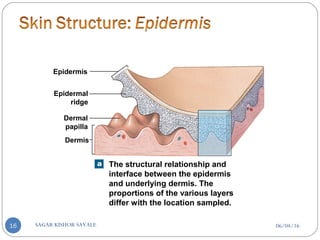
The structural relationship and
interface between the epidermis
and underlying dermis. The
proportions of the various layers
differ with the location sampled.
Dermis
Epidermis
Epidermal
ridge
Dermal
papilla
06/04/16SAGAR KISHOR SAVALE16
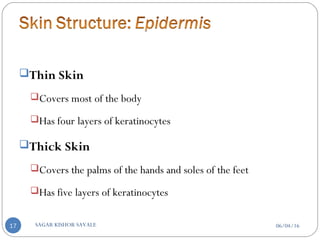
Thin Skin
Covers most of the body
Has four layers of keratinocytes
Thick Skin
Covers the palms of the hands and soles of the feet
Has five layers of keratinocytes
06/04/16SAGAR KISHOR SAVALE17
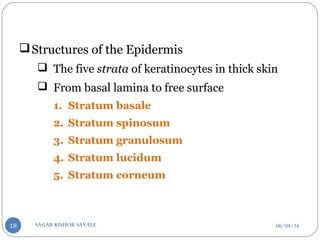
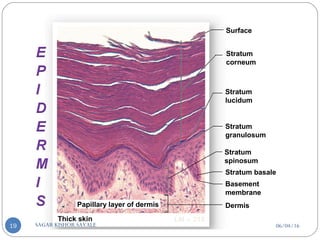
Structures of the Epidermis
 The five strata of keratinocytes in thick skin
 From basal lamina to free surface
1. Stratum basale
2. Stratum spinosum
3. Stratum granulosum
4. Stratum lucidum
5. Stratum corneum
06/04/16SAGAR KISHOR SAVALE18
Thick skin LM × 210
Surface
Stratum
corneum
Stratum
lucidum
Stratum
granulosum
Stratum
spinosum
Stratum basale
Basement
membrane
DermisPapillary layer of dermis
06/04/16SAGAR KISHOR SAVALE19
Stratum Basale
Is attached to basement membrane by hemidesmosomes
Forms a strong bond between epidermis and dermis
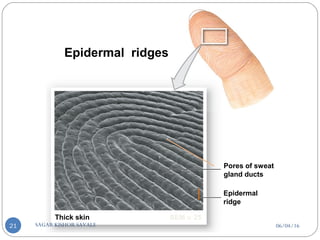
Forms epidermal ridges (e.g., fingerprints)
Dermal papillae (tiny mounds)
 Increase the area of basement membrane
 Strengthen attachment between epidermis and dermis
Has many basal cells or germinative cells
06/04/16SAGAR KISHOR SAVALE20
Thick skin SEM × 25
Epidermal
ridge
Pores of sweat
gland ducts
Epidermal ridges
06/04/16SAGAR KISHOR SAVALE21
Stratum Spinosum — the “spiny layer”
Produced by division of stratum basale
Eight to ten layers of keratinocytes bound by desmosomes
Cells shrink until cytoskeletons stick out (spiny)
Continue to divide, increasing thickness of epithelium
Contain dendritic (Langerhans) cells, active in immune response
06/04/16SAGAR KISHOR SAVALE22
Stratum Granulosum — the “grainy layer”
Stops dividing, starts producing
 Keratin
A tough, fibrous protein
Makes up hair and nails
 Keratohyalin
Dense granules
Cross-link keratin fibers
06/04/16SAGAR KISHOR SAVALE23
Stratum Lucidum — the “clear layer”
 Found only in thick skin
 Covers stratum granulosum
Stratum Corneum — the “horn layer”
 Exposed surface of skin
 15 to 30 layers of keratinized cells
 Water resistant
 Shed and replaced every 2 weeks
06/04/16SAGAR KISHOR SAVALE24
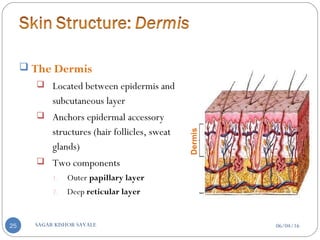
 The Dermis
 Located between epidermis and
subcutaneous layer
 Anchors epidermal accessory
structures (hair follicles, sweat
glands)
 Two components
1. Outer papillary layer
2. Deep reticular layer Dermis
06/04/16SAGAR KISHOR SAVALE25
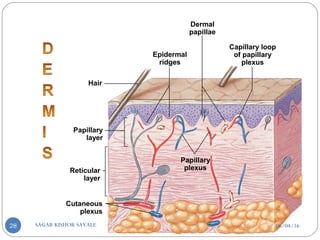
The Papillary Layer
Consists of areolar tissue
Contains smaller capillaries, lymphatics, and sensory neurons
Has dermal papillae projecting between epidermal ridges
The Reticular Layer
Consists of dense irregular connective tissue
Contains larger blood vessels, lymphatic vessels, and nerve fibers
Contains collagen and elastic fibers
Contains connective tissue proper
06/04/16SAGAR KISHOR SAVALE26
An inflammation of the papillary layer
Caused by
 infection, radiation, mechanical irritation, or chemicals (e.g., poison
ivy)
Characterized by
itch or pain
Characteristics
Strong, due to collagen fibers
Elastic, due to elastic fibers
Flexible
06/04/16SAGAR KISHOR SAVALE27
Hair
Papillary
layer
Reticular
layer
Cutaneous
plexus
Papillary
plexus
Epidermal
ridges
Dermal
papillae
Capillary loop
of papillary
plexus
06/04/16SAGAR KISHOR SAVALE28
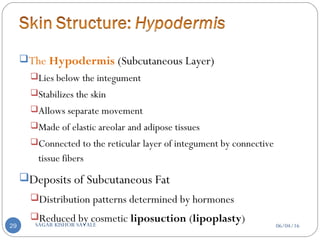
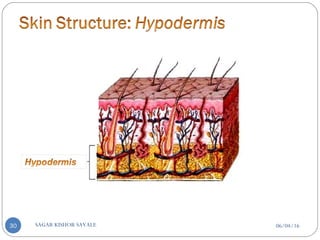
The Hypodermis (Subcutaneous Layer)
Lies below the integument
Stabilizes the skin
Allows separate movement
Made of elastic areolar and adipose tissues
Connected to the reticular layer of integument by connective
tissue fibers
Deposits of Subcutaneous Fat
Distribution patterns determined by hormones
Reduced by cosmetic liposuction (lipoplasty)
06/04/16SAGAR KISHOR SAVALE29
06/04/16SAGAR KISHOR SAVALE30
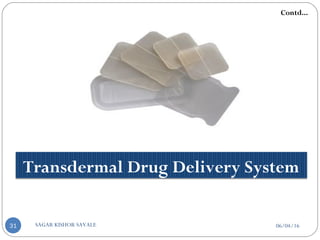
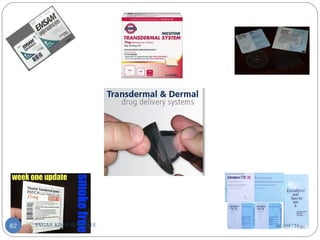
Transdermal Drug Delivery System
Contd...
06/04/16SAGAR KISHOR SAVALE31
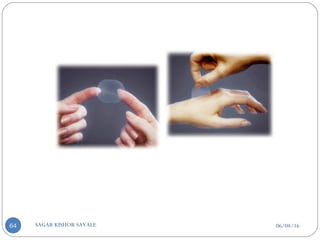
One of the methods most often utilized has been transdermal
delivery - meaning transport of therapeutic substances through
the skin for systemic effect in the form of patches that deliver
drugs for systemic effects at a predetermined and controlled rate.
Definition- When the aim is to deliver drugs through skin in
a predetermined & controlled release fashion, it is known
transdermal drug delivery system.
It is a polymeric drug delivery system which contains drug
either in a reservoir with a rate – controlling membrane or
dispersed in polymer matrix.
Contd...
06/04/16SAGAR KISHOR SAVALE32
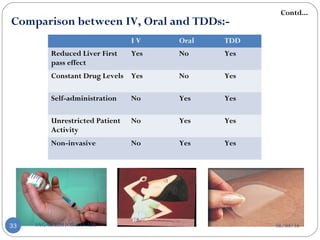
Comparison between IV, Oral and TDDs:-
I V Oral TDD
Reduced Liver First
pass effect
Yes No Yes
Constant Drug Levels Yes No Yes
Self-administration No Yes Yes
Unrestricted Patient
Activity
No Yes Yes
Non-invasive No Yes Yes
Contd...
06/04/16SAGAR KISHOR SAVALE33
Advantages of Transdermal system:-
Dosage intervals not limited by gastric transit time.
Avoid the first- pass effect.
Noninvasive.
Allows effective use of drug with short biological half- life.
Drugs with narrow therapeutic indices can be safely administered.
Drug therapy may be terminated rapidly by removal of the application from the
surface of the skin.
Self administration is possible.
Single application has capacity for multi-day therapy, thereby improving patient
compliance.
Easy to prepare and easy to transport.
Contd...
06/04/16SAGAR KISHOR SAVALE34
Disadvantages of Transdermal system:-
Only potent drugs are suitable Candidate.
Unsuitable for drugs that irritate or sensitize the skin.
These systems include variation in absorption efficiency at different
sites of skin
Maintaining contact between device & skin can be problem.
Barrier function of skin changes from one site to another on same
person, from person to person & with age.
Some Patients develop contact dermatitis at the site of application.
Contd...
06/04/16SAGAR KISHOR SAVALE35
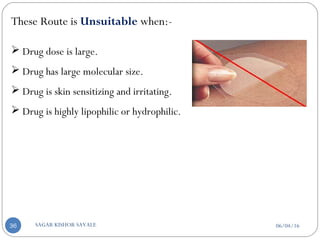
These Route is Unsuitable when:-
 Drug dose is large.
 Drug has large molecular size.
 Drug is skin sensitizing and irritating.
 Drug is highly lipophilic or hydrophilic.
06/04/16SAGAR KISHOR SAVALE36
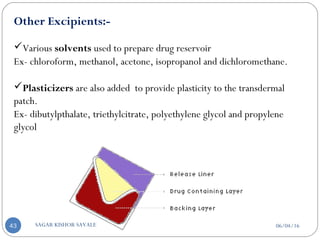
B] Basic Components Of Transdermal System:-
Polymer matrix / Drug reservoir
Drug
Penetration enhancers
Pressure sensitive adhesive (PSA)
Backing laminates
Release liner
Other excipients like plasticizers and solvents
06/04/16SAGAR KISHOR SAVALE37
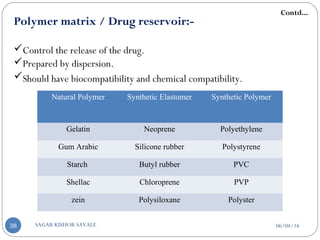
Polymer matrix / Drug reservoir:-
Control the release of the drug.
Prepared by dispersion.
Should have biocompatibility and chemical compatibility.
Natural Polymer Synthetic Elastomer Synthetic Polymer
Gelatin Neoprene Polyethylene
Gum Arabic Silicone rubber Polystyrene
Starch Butyl rubber PVC
Shellac Chloroprene PVP
zein Polysiloxane Polyster
Contd...
06/04/16SAGAR KISHOR SAVALE38
Drug:-
The foremost requirement of TDDS is that the drug possesses the right mix
of physicochemical and biological properties.
Biological properties-
Therapeutic Index
Biological half life
Skin toxicity
Physicochemical properties-
Mol. Wt
Partition coefficient
Drug stability
Melting point
Contd...
06/04/16SAGAR KISHOR SAVALE39
Penetration Enhancers:-
Two types of principles have been employed to increase drug permeation (and
drug absorption) through skin: chemical and physical.
Chemical enhancers-
Substance exist which temporarily diminish the impermeability of the
skin, known also as accelerants or sorption promoters.
Examples-Sulphoxides and similar chemicals, Azone, Pyrrolidones, Fatty acids,
Essential oils, terpenes, terpenoids, Oxazolidodienes and Urea.
Physical enhancers-
Physical enhancement technologies have taken off where the limitations
of chemical enhancement have been reached.
Methodologies involved in the physical transdermal delivery including:
•Electrically-based techniques: iontophoresis, electroporation, ultrasound,
photomechanical wave,
•Structure-based techniques: microneedles, and
•Velocity-based techniques: jet-propulsion
Contd...
06/04/16SAGAR KISHOR SAVALE40
Pressure Sensitive Adhesives (PSA):-
A PSA is a material that helps in maintaining an intimate contact between
transdermal system and the skin surface.
It can be positioned on the face of the device
Some widely used pressure sensitive adhesives are-
Polyisobutylene
Polyacrylates
Silicones
Contd...
1506/04/16SAGAR KISHOR SAVALE41
Backing Laminate:-
Hold and protect the drug reservoir from exposure to atmosphere.
Avoid loss of drug
Accept printing
High flexibility
Good oxygen transmission and a high moisture vapor transmission rate
Examples- vinyl, polyethylene and polyester films.
Release Liner:-
During storage the patch is covered by a protective liner that is removed and
discharged immediately before the application of the patch to skin.
Part of primary packaging
Base layer -Non-occlusive (e.g. paper fabric) or occlusive (e.g. polyethylene,
polyvinylchloride).
Release coating layer- silicon or Teflon.
Contd...
06/04/16SAGAR KISHOR SAVALE42
Other Excipients:-
Various solvents used to prepare drug reservoir
Ex- chloroform, methanol, acetone, isopropanol and dichloromethane.
Plasticizers are also added to provide plasticity to the transdermal
patch.
Ex- dibutylpthalate, triethylcitrate, polyethylene glycol and propylene
glycol
06/04/16SAGAR KISHOR SAVALE43
06/04/16SAGAR KISHOR SAVALE44
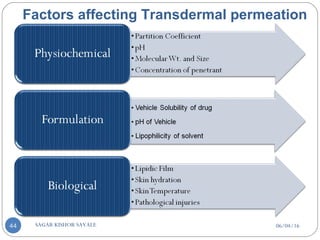
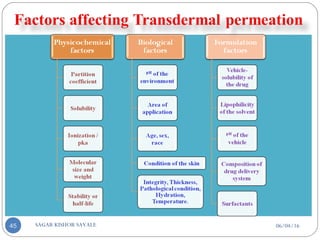
Factors affecting Transdermal permeation
06/04/16SAGAR KISHOR SAVALE45
C] Penetration Enhancement:-
Skin structure as it relates to drug penetration:-
The skin is a multilayered organ, complex in structure and function. It is
composed of-
Outer epidermis (outermost layered called STRATUM CORNEUM)
Viable epidermis (stratum lucidum, stratum granulosum, stratum spinosum and
stratum germinotive)
Dermis
Contd...
06/04/16SAGAR KISHOR SAVALE46
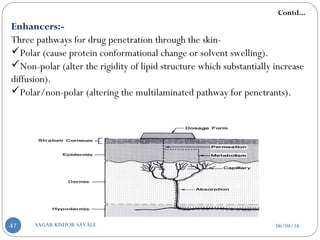
Enhancers:-
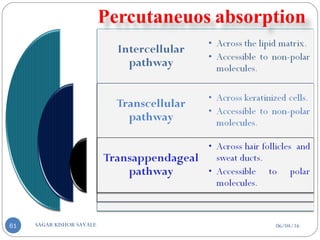
Three pathways for drug penetration through the skin-
Polar (cause protein conformational change or solvent swelling).
Non-polar (alter the rigidity of lipid structure which substantially increase
diffusion).
Polar/non-polar (altering the multilaminated pathway for penetrants).
Contd...
06/04/16SAGAR KISHOR SAVALE47
06/04/16SAGAR KISHOR SAVALE48
Classification Of Penetration Enhancement
Chemical Physical
1. Sulphoxides and similar
chemicals
2. Azone
3. Pyrrolidones
4. Fatty acids
5. Essential oils, terpenes
and terpenoids
6. Oxazolidodienes
7. Urea
A] Electrically based techniques-
1. Iontophoresis
2. Electroporation
3. Ultrasound (sonophoresis)
4. Photochemical waves
5. Laser Ablation
6. Combination of electrically based physical
enhancement technique and chemical enhancers.
 
B] Structured based technique-
1. Micro needles
 
C] Velocity based technique-
1. Jet-propelled particles
Contd...
06/04/16SAGAR KISHOR SAVALE49
Chemical Penetration Enhancement:-
Ideal characteristics of chemical penetration enhancers
Non-toxic, non-irritating and non-allergenic
The activity and duration of effect should be both predictable and
reproducible.
No pharmacological activity within the body.
Unidirectional
Barrier properties should return to normal.
Cosmetically acceptable with an appropriate skin feel.
Mechanism of chemical penetration enhancement:-
 
Disruption of the highly ordered structure of stratum corneum lipid.
Interaction with intercellular protein.
Improved partition of the drug, co enhancer or solvent into the stratum
corneum.
06/04/16SAGAR KISHOR SAVALE50
1. Sulphoxides and similar chemicals:-
 Aprotic solvent, colourless, odourless and hydroscopic
 It is known as ‘Universal Solvent’ for TDDs.
 The effect is concentration-dependant (›60% )
 Cause erythema, denaturing of skin, burning sensation.
 Ex- showing a 12-fold increase in the flux of caffeine permeating across a
DMF-treated human skin, but it also shows irreversible damage to skin.
2. Azone:-
 Azone (1-dodecylazacycloheptan-2-one or laurocapran)
 Colourless, odourless liquid with a melting point of -7 ºC
 Smooth, oily but yet non-greasyfeel.
 Soluble in most of organic solvent.
 Effect showing in 0.1-5% (more often between 1-3%)
Contd...
06/04/16SAGAR KISHOR SAVALE51
3. Pyrrolidones:-
Used as permeation enhancers for numerous molecules including hydrophilic (e.g.
mannitol and 5-flurouracil) and lipophilic (progesterone and hydrocortisone) permeants.
Ex-N-methyl-2 pyrolidone was employed with limited success as a penetration enhancer
for captopril when formulated in a matrix-type transdermal patch.
4. Fatty acids:-
Percutaneous absorption can be increased by long-chain fatty acids such as oleic acid.
Ex- Oleic acid increase the flux 28 fold of salicylic acid and 56 of 5-flourouracil.
5. Essential oils, terpenes and terpenoids:-
It is used as medicinal use as well as flavoring agent and fragrance agent.
Ex- Chenopodium found to be effective penetration enhancers for
5-flouorouracil transversing human skin.
Contd...
06/04/16SAGAR KISHOR SAVALE52
6. Oxazolidinones:-
Potential for use in many cosmetic and personal care product
formulations.
It having ability to localize co-administered drug in skin layers, resulting
in low systemic permeation.
Ex- 4-decyloxazolidin-2-one -localize the delivery of retinoic acid and
diclofenac sodium in skin layers.
7. Urea
Cyclic urea permeation enhancers are biodegradable and non-toxic
molecules.
Enhancement mechanism by lipid disruption mechanism.
06/04/16SAGAR KISHOR SAVALE53
Physical Penetration Enhancement:-
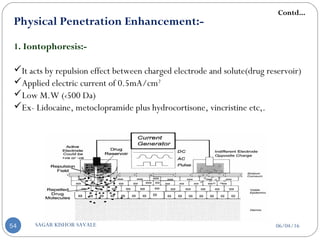
1. Iontophoresis:-
It acts by repulsion effect between charged electrode and solute(drug reservoir)
Applied electric current of 0.5mA/cm2
Low M.W (‹500 Da)
Ex- Lidocaine, metoclopramide plus hydrocortisone, vincristine etc,.
Contd...
06/04/16SAGAR KISHOR SAVALE54
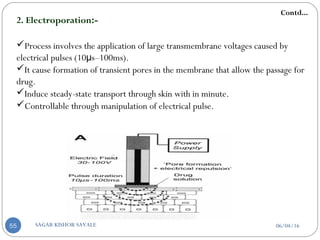
2. Electroporation:-
Process involves the application of large transmembrane voltages caused by
electrical pulses (10 s–100ms).μ
It cause formation of transient pores in the membrane that allow the passage for
drug.
Induce steady-state transport through skin with in minute.
Controllable through manipulation of electrical pulse.
Contd...
06/04/16SAGAR KISHOR SAVALE55
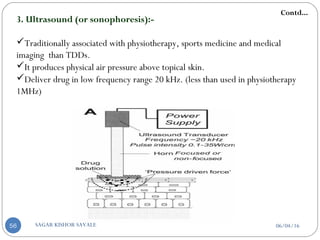
3. Ultrasound (or sonophoresis):-
Traditionally associated with physiotherapy, sports medicine and medical
imaging than TDDs.
It produces physical air pressure above topical skin.
Deliver drug in low frequency range 20 kHz. (less than used in physiotherapy
1MHz)
Contd...
06/04/16SAGAR KISHOR SAVALE56
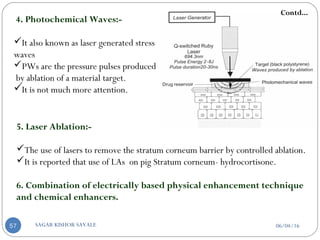
4. Photochemical Waves:-
It also known as laser generated stress
waves
PWs are the pressure pulses produced
by ablation of a material target.
It is not much more attention.
5. Laser Ablation:-
The use of lasers to remove the stratum corneum barrier by controlled ablation.
It is reported that use of LAs on pig Stratum corneum- hydrocortisone.
6. Combination of electrically based physical enhancement technique
and chemical enhancers.
Contd...
06/04/16SAGAR KISHOR SAVALE57
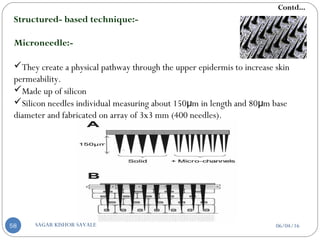
Structured- based technique:-
Microneedle:-
They create a physical pathway through the upper epidermis to increase skin
permeability.
Made up of silicon
Silicon needles individual measuring about 150 m in length and 80 m baseμ μ
diameter and fabricated on array of 3x3 mm (400 needles).
Contd...
06/04/16SAGAR KISHOR SAVALE58
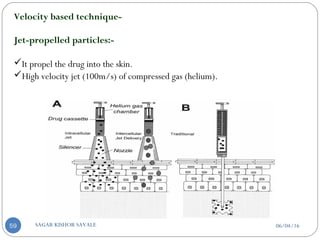
Velocity based technique-
Jet-propelled particles:-
It propel the drug into the skin.
High velocity jet (100m/s) of compressed gas (helium).
06/04/16SAGAR KISHOR SAVALE59
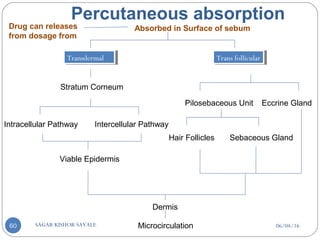
06/04/16SAGAR KISHOR SAVALE60
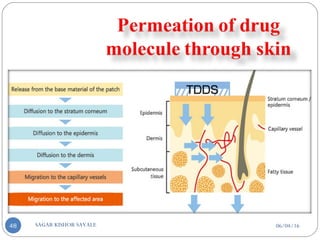
Absorbed in Surface of sebum
TransdermalTransdermal Trans follicularTrans follicular
Intracellular Pathway Intercellular Pathway
Stratum Corneum
Pilosebaceous Unit Eccrine Gland
Sebaceous GlandHair Follicles
Dermis
Microcirculation
Viable Epidermis
Percutaneous absorption
Drug can releases
from dosage from
06/04/16SAGAR KISHOR SAVALE61
06/04/16SAGAR KISHOR SAVALE62
Generally, drug absorption into the skin occurs by passive diffusion.
The rate of drug transport across the stratum corneum follows fick’s
first law of diffusion.
dm/dt = J = d a k/h
Where,
dm / dt = J = rate of diffusion / study state flux.
d = diffusion coefficient.
a = surface area of membrane.
k = partial coefficient between the stratum corneum and the vehicle.
h = diffusional path length / membrane thickness.
06/04/16SAGAR KISHOR SAVALE63
In other words, the rate of drug transport depends not only on its
aqueous solubility,
But is also directly proportional to its oil/water partition
coefficient, its concentration in the formulation vehicle, and the
surface area of the skin to which it is exposed;
It is inversely proportional to the thickness of the stratum
corneum.
06/04/16SAGAR KISHOR SAVALE64
D] Approaches Used in TDDs:-
Approaches
A) According to drug release
mechanisms:-
1. Matrix-diffusion controlled TDDS’s
2. Membrane-permeation controlled
TDDS’s
3. Microreservoir type or Micro sealed
dissolution controlled TDDS’s
4. Adhesive dispersion type TDDS’s
B) According to rate
controlling step:-
1. Those control the rate
of drug delivery to skin.
2. Those allow the skin to
control the rate of drug
absorption.
C) According to
polymer:-
1. Hydrophilic or
hydro gel system
2. Hydrophobic or
occlusion system
Contd...
06/04/16SAGAR KISHOR SAVALE65
a] According to drug release mechanisms:-
1. Matrix-diffusion controlled TDDS’s:-
 Drug Reservoir- Dispersing drug particles in a hydrophilic or lipophilic
polymer matrix which is accomplished by:
Homogeneously mixing of grounded particles
Liquid
polymer
Highly viscous
base polymer
Blending of particle with
rubbery polymer
Molded in medicated disc
Also by dissolving Drug and Polymer in common solvent solvent
evaporation method
Pasted on occlusive base plate
Impermeable plastic membrane
Contd...
06/04/16SAGAR KISHOR SAVALE66
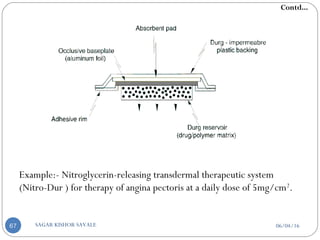
Example:- Nitroglycerin-releasing transdermal therapeutic system
(Nitro-Dur ) for therapy of angina pectoris at a daily dose of 5mg/cm2
.
Contd...
06/04/16SAGAR KISHOR SAVALE67
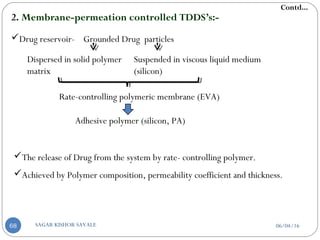
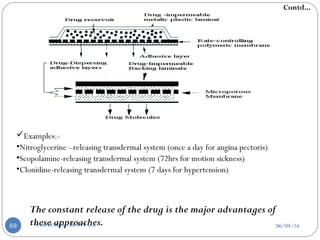
2. Membrane-permeation controlled TDDS’s:-
Drug reservoir- Grounded Drug particles
Dispersed in solid polymer
matrix
Suspended in viscous liquid medium
(silicon)
Rate-controlling polymeric membrane (EVA)
Adhesive polymer (silicon, PA)
The release of Drug from the system by rate- controlling polymer.
Achieved by Polymer composition, permeability coefficient and thickness.
Contd...
06/04/16SAGAR KISHOR SAVALE68
Examples:-
•Nitroglycerine –releasing transdermal system (once a day for angina pectoris)
•Scopolamine-releasing transdermal system (72hrs for motion sickness)
•Clonidine-releasing transdermal system (7 days for hypertension)
The constant release of the drug is the major advantages of
these approaches.
Contd...
06/04/16SAGAR KISHOR SAVALE69
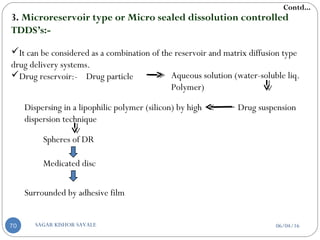
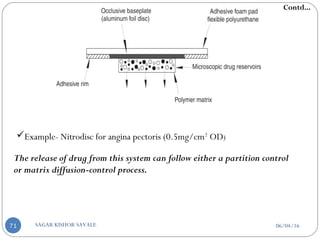
3. Microreservoir type or Micro sealed dissolution controlled
TDDS’s:-
It can be considered as a combination of the reservoir and matrix diffusion type
drug delivery systems.
Drug reservoir:- Drug particle
Drug suspensionDispersing in a lipophilic polymer (silicon) by high
dispersion technique
Spheres of DR
Medicated disc
Surrounded by adhesive film
Aqueous solution (water-soluble liq.
Polymer)
Contd...
06/04/16SAGAR KISHOR SAVALE70
Example- Nitrodisc for angina pectoris (0.5mg/cm2
OD)
The release of drug from this system can follow either a partition control
or matrix diffusion-control process.
Contd...
06/04/16SAGAR KISHOR SAVALE71
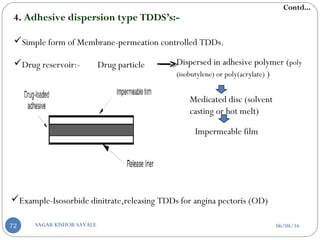
4. Adhesive dispersion type TDDS’s:-
Simple form of Membrane-permeation controlled TDDs.
Drug reservoir:- Drug particle Dispersed in adhesive polymer (poly
(isobutylene) or poly(acrylate) )
Medicated disc (solvent
casting or hot melt)
Impermeable film
Example-Isosorbide dinitrate,releasing TDDs for angina pectoris (OD)
Contd...
06/04/16SAGAR KISHOR SAVALE72
b] According to rate controlling step:-
Those they control the rate of drug delivery to the skin.
Potent, for maintaining MEC
Those that allow the skin to control the rate of drug absorption.
Having wide range of plasma drug concentration.
c] According to polymer:-
Hydrophilic or hydro gel system:-
Drug release by swelling mechanism.
Patch of these type absorb water from the skin.
Causes skin irritation & burning sensation.
Contd...
06/04/16SAGAR KISHOR SAVALE73
Hydrophobic or occlusion system:-
Prevent losing of water from the skin.
Swelling of Horny layer at skin surface.
Increases the temperature and resulting in increase in molecular motion &
skin permeation & decrease in protein network density.
Causes sweat retention syndrome, irritation reaction.
06/04/16SAGAR KISHOR SAVALE74
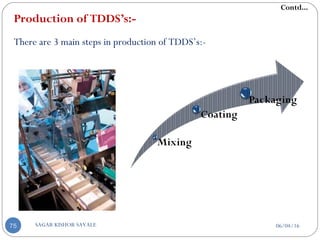
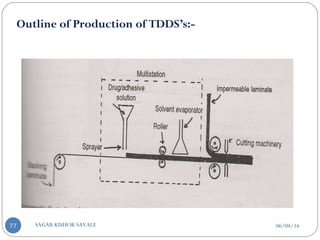
Production of TDDS’s:-
There are 3 main steps in production of TDDS’s:-
Contd...
06/04/16SAGAR KISHOR SAVALE75
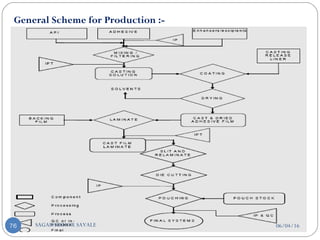
General Scheme for Production :-
06/04/16SAGAR KISHOR SAVALE76
Outline of Production of TDDS’s:-
06/04/16SAGAR KISHOR SAVALE77
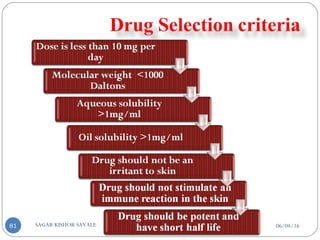
E] Model Drug Selection Criteria:-
Most drugs are not suitable candidate for Transdermal drug delivery for one or
more reason-
‘Easy to deliver’ drugs have already been commercialized into TDDs.
To date 10 drugs out of 100 have been commercialized into TDDs.
More than 35 patches spanning 13 molecules present in market.
For successfully developing a transdermal drug delivery system, the drug should
be chosen with great care.
The drug possesses the right mix of physicochemical and biological properties
for transdermal drug delivery.
Contd...
06/04/16SAGAR KISHOR SAVALE78
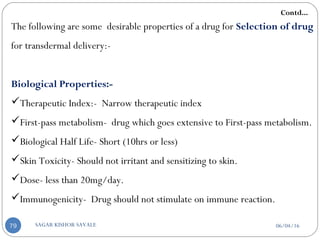
The following are some desirable properties of a drug for Selection of drug
for transdermal delivery:-
Biological Properties:-
Therapeutic Index:- Narrow therapeutic index
First-pass metabolism- drug which goes extensive to First-pass metabolism.
Biological Half Life- Short (10hrs or less)
Skin Toxicity- Should not irritant and sensitizing to skin.
Dose- less than 20mg/day.
Immunogenicity- Drug should not stimulate on immune reaction.
Contd...
06/04/16SAGAR KISHOR SAVALE79
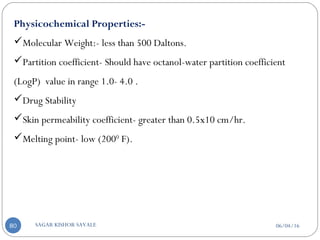
Physicochemical Properties:-
Molecular Weight:- less than 500 Daltons.
Partition coefficient- Should have octanol-water partition coefficient
(LogP) value in range 1.0- 4.0 .
Drug Stability
Skin permeability coefficient- greater than 0.5x10 cm/hr.
Melting point- low (2000
F).
06/04/16SAGAR KISHOR SAVALE80
06/04/16SAGAR KISHOR SAVALE81
06/04/16SAGAR KISHOR SAVALE82
06/04/16SAGAR KISHOR SAVALE83
06/04/16SAGAR KISHOR SAVALE84
06/04/16SAGAR KISHOR SAVALE85
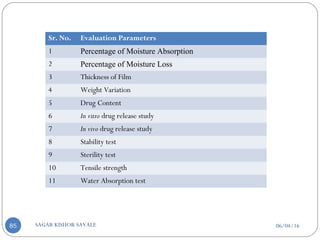
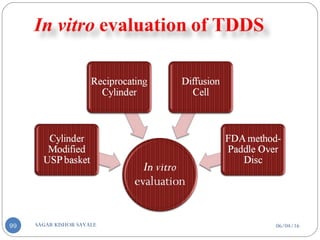
Sr. No. Evaluation Parameters
1 Percentage of Moisture Absorption
2 Percentage of Moisture Loss
3 Thickness of Film
4 Weight Variation
5 Drug Content
6 In vitro drug release study
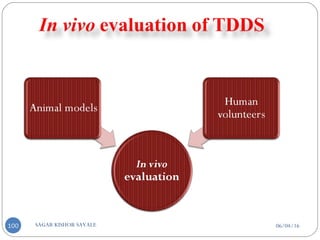
7 In vivo drug release study
8 Stability test
9 Sterility test
10 Tensile strength
11 Water Absorption test
06/04/16SAGAR KISHOR SAVALE86
Physicochemical Evaluation of Transdermal Patches
Thickness - travelling microscope, dial/screw gauge,
micrometer
Weight variation – weigh 10 patches
Drug content – by suitable validated analytical method
 Folding endurance – repeatedly folding at same point
until it break . The number of times it could be folded is
its folding endurance value.
06/04/16SAGAR KISHOR SAVALE87
 Content uniformity- 10 patches are selected and
content is determined for individual patches. If 9 out of
10 patches have content between 85% to 115% of the
specified value and one has content not less than 75% to
125% of the specified value, then Transdermal patches
pass the test of content uniformity. But if 3 patches have
content in the range of 75% to 125%, then additional 20
patches are tested for drug content. If these 20 patches
have range from 85% to 115%, then the Transdermal
patches pass the test.
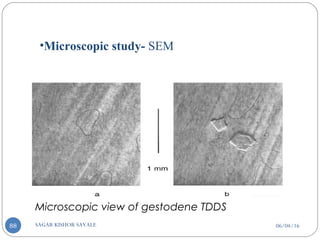
Microscopic study- SEM
06/04/16SAGAR KISHOR SAVALE88
•Microscopic study- SEM
88
Microscopic view of gestodene TDDS
06/04/16SAGAR KISHOR SAVALE89
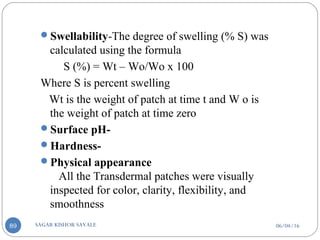
Swellability-The degree of swelling (% S) was
calculated using the formula
S (%) = Wt – Wo/Wo x 100
Where S is percent swelling
Wt is the weight of patch at time t and W o is
the weight of patch at time zero
Surface pH-
Hardness-
Physical appearance
All the Transdermal patches were visually
inspected for color, clarity, flexibility, and
smoothness
06/04/16SAGAR KISHOR SAVALE90
 Flatness one strip is cut from the centre and two from
each side of patches. The length of each strip is
measured and variation in length is measured by
determining percent constriction. Zero percent
constriction is equivalent to 100 percent flatness.
% constriction =[(I1-I2)/I1]X100
I2 = Final length of each strip
I1 = Initial length of each strip
 Percentage of moisture content
% Moisture content = Initial weight – Final weight X
100
Final weight
06/04/16SAGAR KISHOR SAVALE91
Percentage of moisture uptake-
% moisture uptake = Final weight – Initial weight X 100
Initial weight
Water Vapor Transmission study-
WVT = W/ ST
W is the increase in weight in 24 h; S is area of
film exposed (cm2
); T is exposure time .
Tensile strength-
Tensile strength= F/a.b (1+L/l)
F is the force required to break; a is width of film; b is
thickness of film; L is length of film; l is elongation of film
at break point
06/04/16SAGAR KISHOR SAVALE92
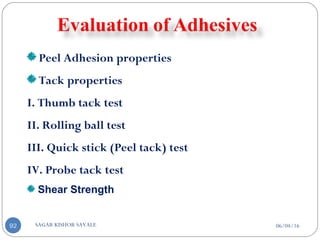
Peel Adhesion properties
Tack properties
I. Thumb tack test
II. Rolling ball test
III. Quick stick (Peel tack) test
IV. Probe tack test
Shear Strength
06/04/16SAGAR KISHOR SAVALE93
Figure: 1 Peel Adhesion Test
In this test, the force required to remove an adhesive coating form a
test substrate is referred to as peel adhesion.
Molecular weight of adhesive polymer, the type and amount of
additives are the variables that determined the peel adhesion properties.
A single tape is applied to a stainless steel plate or a backing membrane
of choice and then tape is pulled from the substrate at a 180°C angle, and
the force required for tape removed is measured.
06/04/16SAGAR KISHOR SAVALE94
It is the ability of the polymer to adhere to substrate with little contact
pressure. Tack is dependent on molecular weight and composition of
polymer as well as on the use of tackifying resins in polymer
The force required to remove thumb from adhesive is a measure
of tack.
This test measures the softness of a polymer.
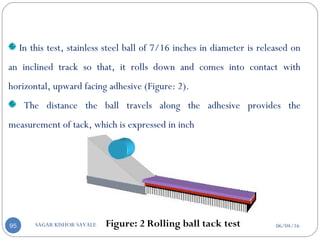
06/04/16SAGAR KISHOR SAVALE95 Figure: 2 Rolling ball tack test
In this test, stainless steel ball of 7/16 inches in diameter is released on
an inclined track so that, it rolls down and comes into contact with
horizontal, upward facing adhesive (Figure: 2).
The distance the ball travels along the adhesive provides the
measurement of tack, which is expressed in inch
06/04/16SAGAR KISHOR SAVALE96
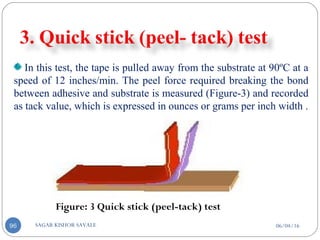
Figure: 3 Quick stick (peel-tack) test
In this test, the tape is pulled away from the substrate at 90ºC at a
speed of 12 inches/min. The peel force required breaking the bond
between adhesive and substrate is measured (Figure-3) and recorded
as tack value, which is expressed in ounces or grams per inch width .
06/04/16SAGAR KISHOR SAVALE97
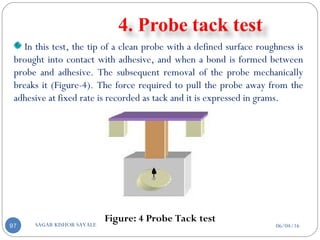
Figure: 4 Probe Tack test
In this test, the tip of a clean probe with a defined surface roughness is
brought into contact with adhesive, and when a bond is formed between
probe and adhesive. The subsequent removal of the probe mechanically
breaks it (Figure-4). The force required to pull the probe away from the
adhesive at fixed rate is recorded as tack and it is expressed in grams.
06/04/16SAGAR KISHOR SAVALE98
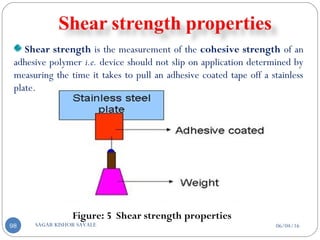
Figure: 5 Shear strength properties
Shear strength is the measurement of the cohesive strength of an
adhesive polymer i.e. device should not slip on application determined by
measuring the time it takes to pull an adhesive coated tape off a stainless
plate.
06/04/16SAGAR KISHOR SAVALE99
06/04/16SAGAR KISHOR SAVALE100
06/04/16SAGAR KISHOR SAVALE101
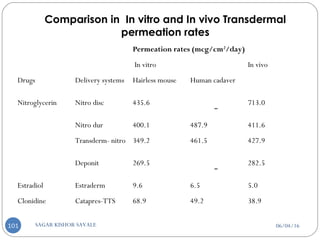
Comparison in In vitro and In vivo Transdermal
permeation rates
Permeation rates (mcg/cm2
/day)
In vitro In vivo
Drugs Delivery systems Hairless mouse Human cadaver
Nitroglycerin Nitro disc 435.6
- 713.0
Nitro dur 400.1 487.9 411.6
Transderm- nitro 349.2 461.5 427.9
Deponit 269.5
- 282.5
Estradiol Estraderm 9.6 6.5 5.0
Clonidine Catapres-TTS 68.9 49.2 38.9
06/04/16SAGAR KISHOR SAVALE102
According to the International Conference on Harmonization (ICH)
guidelines by storing the TDDS samples at 40± 2°C and 75 ± 5% RH
for 6 months. The samples were withdrawn at 0, 30, 60, 90 and 180
days and analyzed for drug content by suitable analytical technique.
06/04/16SAGAR KISHOR SAVALE103
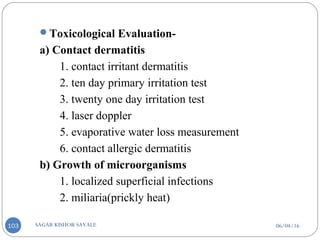
Toxicological Evaluation-
a) Contact dermatitis
1. contact irritant dermatitis
2. ten day primary irritation test
3. twenty one day irritation test
4. laser doppler
5. evaporative water loss measurement
6. contact allergic dermatitis
b) Growth of microorganisms
1. localized superficial infections
2. miliaria(prickly heat)
06/04/16SAGAR KISHOR SAVALE104
 REGULATORY STRATEGY FOR INVESTIGATIONAL NEW DRUG
(IND) APPLICATION AND NEW DRUG APPLICATION SUBMISSIONS
FOR TDDS
 Standard irritation and sensitization studies
should be performed with the patch itself in animals/humans.
 Negotiate the timing and implementation of the
toxicology requirements.
 The dermatology division at FDA should review
dermal aspects of the IND and New drug Application(NDA).
 Primary review should occur at the division that
handles the indication under study.
 Dose ranging studies be required in Phase 2.
 Single Phase 3 study could be negotiated.
06/04/16SAGAR KISHOR SAVALE105
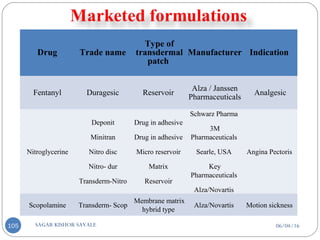
Drug Trade name
Type of
transdermal
patch
Manufacturer Indication
Fentanyl Duragesic Reservoir
Alza / Janssen
Pharmaceuticals
Analgesic
Nitroglycerine
Deponit
Minitran
Nitro disc
Nitro- dur
Transderm-Nitro
Drug in adhesive
Drug in adhesive
Micro reservoir
Matrix
Reservoir
Schwarz Pharma
3M
Pharmaceuticals
Searle, USA
Key
Pharmaceuticals
Alza/Novartis
Angina Pectoris
Scopolamine Transderm- Scop
Membrane matrix
hybrid type
Alza/Novartis Motion sickness
References:-
Chein, Y W, 1992, Novel Drug Delivery System, 2nd
edition, vol-14, Marcel Dekker
Inc, New York, pp- 301-314.
Banker, G S, & Rhodes, C T, 2002, Modern Pharmaceutics, 4th
edition, vol-121, Marcel
Dekker Inc, New York, pp. 187-192.
Hsieh, D S, 1994, Drug Permeation Enhancement, theory and application, vol-62, Marcel
Dekker Inc, New York, pp. 3-23.
Roberts, M S, & Walters, K A, 1998, Dermal Absorption and Toxicity Assessment, vol-91,
Marcel Dekker Inc, New York, pp 297-309 371-375.
Walters, K A, 2002, Dermatological and Transdermal Formulation,vol-119, Marcel Dekker
Inc, New York, pp 1-14 337-339.
Brahmankar, D M & Jaiswal, S B, 2005, Biopharmaceutics and Pharmacokinetics A Treatise,
Vallabh prakashan, Delhi, pp-365-369.
06/04/16SAGAR KISHOR SAVALE106
Sachan, N.K, et al, 2009, Transdermal Approaches in drug delivery, Der Pharmacia
Lettre, pp 4-47.
Heather, A E, 2005, Transdermal Drug Delivery: Penetration Enhancement
Techniques, Current Drug delivery, vol-2, pp 23-33.
Kandavilli, S, et al, 2002, Polymers used in Transdermal Drug delivery System,
Pharmaceutical Technologies, pp 62-80.
Pathan, B I, et al, 2009, Chemical Penetration Enhancers for Transdermal Drug delivery
System, Tropical Journal of Pharmaceutical Research, pp 173-179.
Cross, S E, et al, 2004, Physical Enhancement of Transdermal Drug Application: Is
Delivery Technology Keeping up with Pharmaceutical Development?, Current Drug
Delivery, pp 81-92.
Aggarwal, G, 2009, Development, Fabrication and Evaluation of Transdermal Drug
Delivery System - A Review, Pharmainfo, Vol. 7 Issue 5.
06/04/16SAGAR KISHOR SAVALE107

Transdermal Drug Delivery System [TDDS]

  • 1.
    Transdermal Drug DeliverySystem [TDDS] 06/04/16SAGAR KISHOR SAVALE1
  • 2.
    Contents:-  Introduction toTDDS’s  Basic Components of TDDS’s Factors of TDDS  Penetration Enhancements  Percutaneous Absorption  Approaches used in TDDS’s  Production of TDDS’s  Model Drug Selection Criteria Evaluation of TDDS 06/04/16SAGAR KISHOR SAVALE2
  • 3.
    A] Introduction toTDDS’s- Management of illness through medication has entered an era of rapid growth. A variety of means by which drugs are delivered to the human body for the therapy such as tablets, capsules, injections, aerosols, creams, ointments, suppositories, liquids etc. are referred as a conventional drug formulations. Among many pharmaceutical dosage forms, continuous intravenous infusion at preprogrammed rate has been recognized as a superior mode of drug delivery. At present, the most common form of delivery of drugs is the oral route. It has the notable advantage of easy administration. Contd... 06/04/16SAGAR KISHOR SAVALE3
  • 4.
    But these deliverysystems having some Drawbacks- Oral- poor bioavailability hepatic metabolism (first pass) tendency to produce rapid blood level spikes need of high and/or frequent dosing Intravenous- These mode of drug delivery entails certain risks and therefore necessities hospitalization of the patients and close medical supervision of the medication. To overcome these difficulties there is a need for the development of new drug delivery system which will improve the therapeutic efficacy and safety of drugs by more precisely. Contd... 06/04/16SAGAR KISHOR SAVALE4
  • 5.
    The integument asan organ  The integument as an organ, and is an alternative name for skin.  The integumentary system includes the skin and the skin derivatives hair, nails, and glands. 06/04/16SAGAR KISHOR SAVALE5
  • 6.
    The Integument Is thelargest system of the body  16% of body weight,  1.5 to 2m2 in area,  The integument is made up of two parts: 1. Cutaneous membrane a. Epidermis– Superficial epithelium b. Dermis – underlying CT with blood supply 2. Accessory structures a. Hair b. Nails c. Exocrine Glands 06/04/16SAGAR KISHOR SAVALE6
  • 7.
     Protection  Firstline of defense against  Bacteria  Viruses  Protects underlying structures from  Ultraviolet (UV) radiation  Dehydration  Vitamin D production  Needed for calcium absorption  Sensation  Sensory receptors 06/04/16SAGAR KISHOR SAVALE7
  • 8.
    Body temperature regulation Iftoo hot  Dermal blood vessels dilate  Vessels carry more blood to surface so heat can escape If too cold  Dermal blood vessels constrict  Prevents heat from escaping Excretion Small amounts of waste products are lost through perspiration 06/04/16SAGAR KISHOR SAVALE8
  • 9.
     Understanding howthe skin can function in these many ways starts with understanding the structure of the 3 layers of skin  The Epidermis Epithelial tissue Dermis Dense connective tissue proper – irregular  Hypodermis Subcutaneous tissue- loose connective tissue proper and adipose tissue 06/04/16SAGAR KISHOR SAVALE9
  • 10.
  • 11.
  • 12.
  • 13.
  • 14.
    The Epidermis Is avascular stratified squamous epithelium Nutrients and oxygen diffuse from capillaries in the dermis Cells of the Epidermis Keratinocytes Contain large amounts of keratin Are the most abundant cells in the epidermis 06/04/16SAGAR KISHOR SAVALE14
  • 15.
  • 16.
    The structural relationshipand interface between the epidermis and underlying dermis. The proportions of the various layers differ with the location sampled. Dermis Epidermis Epidermal ridge Dermal papilla 06/04/16SAGAR KISHOR SAVALE16
  • 17.
    Thin Skin Covers mostof the body Has four layers of keratinocytes Thick Skin Covers the palms of the hands and soles of the feet Has five layers of keratinocytes 06/04/16SAGAR KISHOR SAVALE17
  • 18.
    Structures of theEpidermis  The five strata of keratinocytes in thick skin  From basal lamina to free surface 1. Stratum basale 2. Stratum spinosum 3. Stratum granulosum 4. Stratum lucidum 5. Stratum corneum 06/04/16SAGAR KISHOR SAVALE18
  • 19.
    Thick skin LM× 210 Surface Stratum corneum Stratum lucidum Stratum granulosum Stratum spinosum Stratum basale Basement membrane DermisPapillary layer of dermis 06/04/16SAGAR KISHOR SAVALE19
  • 20.
    Stratum Basale Is attachedto basement membrane by hemidesmosomes Forms a strong bond between epidermis and dermis Forms epidermal ridges (e.g., fingerprints) Dermal papillae (tiny mounds)  Increase the area of basement membrane  Strengthen attachment between epidermis and dermis Has many basal cells or germinative cells 06/04/16SAGAR KISHOR SAVALE20
  • 21.
    Thick skin SEM× 25 Epidermal ridge Pores of sweat gland ducts Epidermal ridges 06/04/16SAGAR KISHOR SAVALE21
  • 22.
    Stratum Spinosum —the “spiny layer” Produced by division of stratum basale Eight to ten layers of keratinocytes bound by desmosomes Cells shrink until cytoskeletons stick out (spiny) Continue to divide, increasing thickness of epithelium Contain dendritic (Langerhans) cells, active in immune response 06/04/16SAGAR KISHOR SAVALE22
  • 23.
    Stratum Granulosum —the “grainy layer” Stops dividing, starts producing  Keratin A tough, fibrous protein Makes up hair and nails  Keratohyalin Dense granules Cross-link keratin fibers 06/04/16SAGAR KISHOR SAVALE23
  • 24.
    Stratum Lucidum —the “clear layer”  Found only in thick skin  Covers stratum granulosum Stratum Corneum — the “horn layer”  Exposed surface of skin  15 to 30 layers of keratinized cells  Water resistant  Shed and replaced every 2 weeks 06/04/16SAGAR KISHOR SAVALE24
  • 25.
     The Dermis Located between epidermis and subcutaneous layer  Anchors epidermal accessory structures (hair follicles, sweat glands)  Two components 1. Outer papillary layer 2. Deep reticular layer Dermis 06/04/16SAGAR KISHOR SAVALE25
  • 26.
    The Papillary Layer Consistsof areolar tissue Contains smaller capillaries, lymphatics, and sensory neurons Has dermal papillae projecting between epidermal ridges The Reticular Layer Consists of dense irregular connective tissue Contains larger blood vessels, lymphatic vessels, and nerve fibers Contains collagen and elastic fibers Contains connective tissue proper 06/04/16SAGAR KISHOR SAVALE26
  • 27.
    An inflammation ofthe papillary layer Caused by  infection, radiation, mechanical irritation, or chemicals (e.g., poison ivy) Characterized by itch or pain Characteristics Strong, due to collagen fibers Elastic, due to elastic fibers Flexible 06/04/16SAGAR KISHOR SAVALE27
  • 28.
  • 29.
    The Hypodermis (SubcutaneousLayer) Lies below the integument Stabilizes the skin Allows separate movement Made of elastic areolar and adipose tissues Connected to the reticular layer of integument by connective tissue fibers Deposits of Subcutaneous Fat Distribution patterns determined by hormones Reduced by cosmetic liposuction (lipoplasty) 06/04/16SAGAR KISHOR SAVALE29
  • 30.
  • 31.
    Transdermal Drug DeliverySystem Contd... 06/04/16SAGAR KISHOR SAVALE31
  • 32.
    One of themethods most often utilized has been transdermal delivery - meaning transport of therapeutic substances through the skin for systemic effect in the form of patches that deliver drugs for systemic effects at a predetermined and controlled rate. Definition- When the aim is to deliver drugs through skin in a predetermined & controlled release fashion, it is known transdermal drug delivery system. It is a polymeric drug delivery system which contains drug either in a reservoir with a rate – controlling membrane or dispersed in polymer matrix. Contd... 06/04/16SAGAR KISHOR SAVALE32
  • 33.
    Comparison between IV,Oral and TDDs:- I V Oral TDD Reduced Liver First pass effect Yes No Yes Constant Drug Levels Yes No Yes Self-administration No Yes Yes Unrestricted Patient Activity No Yes Yes Non-invasive No Yes Yes Contd... 06/04/16SAGAR KISHOR SAVALE33
  • 34.
    Advantages of Transdermalsystem:- Dosage intervals not limited by gastric transit time. Avoid the first- pass effect. Noninvasive. Allows effective use of drug with short biological half- life. Drugs with narrow therapeutic indices can be safely administered. Drug therapy may be terminated rapidly by removal of the application from the surface of the skin. Self administration is possible. Single application has capacity for multi-day therapy, thereby improving patient compliance. Easy to prepare and easy to transport. Contd... 06/04/16SAGAR KISHOR SAVALE34
  • 35.
    Disadvantages of Transdermalsystem:- Only potent drugs are suitable Candidate. Unsuitable for drugs that irritate or sensitize the skin. These systems include variation in absorption efficiency at different sites of skin Maintaining contact between device & skin can be problem. Barrier function of skin changes from one site to another on same person, from person to person & with age. Some Patients develop contact dermatitis at the site of application. Contd... 06/04/16SAGAR KISHOR SAVALE35
  • 36.
    These Route isUnsuitable when:-  Drug dose is large.  Drug has large molecular size.  Drug is skin sensitizing and irritating.  Drug is highly lipophilic or hydrophilic. 06/04/16SAGAR KISHOR SAVALE36
  • 37.
    B] Basic ComponentsOf Transdermal System:- Polymer matrix / Drug reservoir Drug Penetration enhancers Pressure sensitive adhesive (PSA) Backing laminates Release liner Other excipients like plasticizers and solvents 06/04/16SAGAR KISHOR SAVALE37
  • 38.
    Polymer matrix /Drug reservoir:- Control the release of the drug. Prepared by dispersion. Should have biocompatibility and chemical compatibility. Natural Polymer Synthetic Elastomer Synthetic Polymer Gelatin Neoprene Polyethylene Gum Arabic Silicone rubber Polystyrene Starch Butyl rubber PVC Shellac Chloroprene PVP zein Polysiloxane Polyster Contd... 06/04/16SAGAR KISHOR SAVALE38
  • 39.
    Drug:- The foremost requirementof TDDS is that the drug possesses the right mix of physicochemical and biological properties. Biological properties- Therapeutic Index Biological half life Skin toxicity Physicochemical properties- Mol. Wt Partition coefficient Drug stability Melting point Contd... 06/04/16SAGAR KISHOR SAVALE39
  • 40.
    Penetration Enhancers:- Two typesof principles have been employed to increase drug permeation (and drug absorption) through skin: chemical and physical. Chemical enhancers- Substance exist which temporarily diminish the impermeability of the skin, known also as accelerants or sorption promoters. Examples-Sulphoxides and similar chemicals, Azone, Pyrrolidones, Fatty acids, Essential oils, terpenes, terpenoids, Oxazolidodienes and Urea. Physical enhancers- Physical enhancement technologies have taken off where the limitations of chemical enhancement have been reached. Methodologies involved in the physical transdermal delivery including: •Electrically-based techniques: iontophoresis, electroporation, ultrasound, photomechanical wave, •Structure-based techniques: microneedles, and •Velocity-based techniques: jet-propulsion Contd... 06/04/16SAGAR KISHOR SAVALE40
  • 41.
    Pressure Sensitive Adhesives(PSA):- A PSA is a material that helps in maintaining an intimate contact between transdermal system and the skin surface. It can be positioned on the face of the device Some widely used pressure sensitive adhesives are- Polyisobutylene Polyacrylates Silicones Contd... 1506/04/16SAGAR KISHOR SAVALE41
  • 42.
    Backing Laminate:- Hold andprotect the drug reservoir from exposure to atmosphere. Avoid loss of drug Accept printing High flexibility Good oxygen transmission and a high moisture vapor transmission rate Examples- vinyl, polyethylene and polyester films. Release Liner:- During storage the patch is covered by a protective liner that is removed and discharged immediately before the application of the patch to skin. Part of primary packaging Base layer -Non-occlusive (e.g. paper fabric) or occlusive (e.g. polyethylene, polyvinylchloride). Release coating layer- silicon or Teflon. Contd... 06/04/16SAGAR KISHOR SAVALE42
  • 43.
    Other Excipients:- Various solventsused to prepare drug reservoir Ex- chloroform, methanol, acetone, isopropanol and dichloromethane. Plasticizers are also added to provide plasticity to the transdermal patch. Ex- dibutylpthalate, triethylcitrate, polyethylene glycol and propylene glycol 06/04/16SAGAR KISHOR SAVALE43
  • 44.
    06/04/16SAGAR KISHOR SAVALE44 Factorsaffecting Transdermal permeation
  • 45.
  • 46.
    C] Penetration Enhancement:- Skinstructure as it relates to drug penetration:- The skin is a multilayered organ, complex in structure and function. It is composed of- Outer epidermis (outermost layered called STRATUM CORNEUM) Viable epidermis (stratum lucidum, stratum granulosum, stratum spinosum and stratum germinotive) Dermis Contd... 06/04/16SAGAR KISHOR SAVALE46
  • 47.
    Enhancers:- Three pathways fordrug penetration through the skin- Polar (cause protein conformational change or solvent swelling). Non-polar (alter the rigidity of lipid structure which substantially increase diffusion). Polar/non-polar (altering the multilaminated pathway for penetrants). Contd... 06/04/16SAGAR KISHOR SAVALE47
  • 48.
  • 49.
    Classification Of PenetrationEnhancement Chemical Physical 1. Sulphoxides and similar chemicals 2. Azone 3. Pyrrolidones 4. Fatty acids 5. Essential oils, terpenes and terpenoids 6. Oxazolidodienes 7. Urea A] Electrically based techniques- 1. Iontophoresis 2. Electroporation 3. Ultrasound (sonophoresis) 4. Photochemical waves 5. Laser Ablation 6. Combination of electrically based physical enhancement technique and chemical enhancers.   B] Structured based technique- 1. Micro needles   C] Velocity based technique- 1. Jet-propelled particles Contd... 06/04/16SAGAR KISHOR SAVALE49
  • 50.
    Chemical Penetration Enhancement:- Idealcharacteristics of chemical penetration enhancers Non-toxic, non-irritating and non-allergenic The activity and duration of effect should be both predictable and reproducible. No pharmacological activity within the body. Unidirectional Barrier properties should return to normal. Cosmetically acceptable with an appropriate skin feel. Mechanism of chemical penetration enhancement:-   Disruption of the highly ordered structure of stratum corneum lipid. Interaction with intercellular protein. Improved partition of the drug, co enhancer or solvent into the stratum corneum. 06/04/16SAGAR KISHOR SAVALE50
  • 51.
    1. Sulphoxides andsimilar chemicals:-  Aprotic solvent, colourless, odourless and hydroscopic  It is known as ‘Universal Solvent’ for TDDs.  The effect is concentration-dependant (›60% )  Cause erythema, denaturing of skin, burning sensation.  Ex- showing a 12-fold increase in the flux of caffeine permeating across a DMF-treated human skin, but it also shows irreversible damage to skin. 2. Azone:-  Azone (1-dodecylazacycloheptan-2-one or laurocapran)  Colourless, odourless liquid with a melting point of -7 ºC  Smooth, oily but yet non-greasyfeel.  Soluble in most of organic solvent.  Effect showing in 0.1-5% (more often between 1-3%) Contd... 06/04/16SAGAR KISHOR SAVALE51
  • 52.
    3. Pyrrolidones:- Used aspermeation enhancers for numerous molecules including hydrophilic (e.g. mannitol and 5-flurouracil) and lipophilic (progesterone and hydrocortisone) permeants. Ex-N-methyl-2 pyrolidone was employed with limited success as a penetration enhancer for captopril when formulated in a matrix-type transdermal patch. 4. Fatty acids:- Percutaneous absorption can be increased by long-chain fatty acids such as oleic acid. Ex- Oleic acid increase the flux 28 fold of salicylic acid and 56 of 5-flourouracil. 5. Essential oils, terpenes and terpenoids:- It is used as medicinal use as well as flavoring agent and fragrance agent. Ex- Chenopodium found to be effective penetration enhancers for 5-flouorouracil transversing human skin. Contd... 06/04/16SAGAR KISHOR SAVALE52
  • 53.
    6. Oxazolidinones:- Potential foruse in many cosmetic and personal care product formulations. It having ability to localize co-administered drug in skin layers, resulting in low systemic permeation. Ex- 4-decyloxazolidin-2-one -localize the delivery of retinoic acid and diclofenac sodium in skin layers. 7. Urea Cyclic urea permeation enhancers are biodegradable and non-toxic molecules. Enhancement mechanism by lipid disruption mechanism. 06/04/16SAGAR KISHOR SAVALE53
  • 54.
    Physical Penetration Enhancement:- 1.Iontophoresis:- It acts by repulsion effect between charged electrode and solute(drug reservoir) Applied electric current of 0.5mA/cm2 Low M.W (‹500 Da) Ex- Lidocaine, metoclopramide plus hydrocortisone, vincristine etc,. Contd... 06/04/16SAGAR KISHOR SAVALE54
  • 55.
    2. Electroporation:- Process involvesthe application of large transmembrane voltages caused by electrical pulses (10 s–100ms).μ It cause formation of transient pores in the membrane that allow the passage for drug. Induce steady-state transport through skin with in minute. Controllable through manipulation of electrical pulse. Contd... 06/04/16SAGAR KISHOR SAVALE55
  • 56.
    3. Ultrasound (orsonophoresis):- Traditionally associated with physiotherapy, sports medicine and medical imaging than TDDs. It produces physical air pressure above topical skin. Deliver drug in low frequency range 20 kHz. (less than used in physiotherapy 1MHz) Contd... 06/04/16SAGAR KISHOR SAVALE56
  • 57.
    4. Photochemical Waves:- Italso known as laser generated stress waves PWs are the pressure pulses produced by ablation of a material target. It is not much more attention. 5. Laser Ablation:- The use of lasers to remove the stratum corneum barrier by controlled ablation. It is reported that use of LAs on pig Stratum corneum- hydrocortisone. 6. Combination of electrically based physical enhancement technique and chemical enhancers. Contd... 06/04/16SAGAR KISHOR SAVALE57
  • 58.
    Structured- based technique:- Microneedle:- Theycreate a physical pathway through the upper epidermis to increase skin permeability. Made up of silicon Silicon needles individual measuring about 150 m in length and 80 m baseμ μ diameter and fabricated on array of 3x3 mm (400 needles). Contd... 06/04/16SAGAR KISHOR SAVALE58
  • 59.
    Velocity based technique- Jet-propelledparticles:- It propel the drug into the skin. High velocity jet (100m/s) of compressed gas (helium). 06/04/16SAGAR KISHOR SAVALE59
  • 60.
    06/04/16SAGAR KISHOR SAVALE60 Absorbedin Surface of sebum TransdermalTransdermal Trans follicularTrans follicular Intracellular Pathway Intercellular Pathway Stratum Corneum Pilosebaceous Unit Eccrine Gland Sebaceous GlandHair Follicles Dermis Microcirculation Viable Epidermis Percutaneous absorption Drug can releases from dosage from
  • 61.
  • 62.
    06/04/16SAGAR KISHOR SAVALE62 Generally,drug absorption into the skin occurs by passive diffusion. The rate of drug transport across the stratum corneum follows fick’s first law of diffusion. dm/dt = J = d a k/h Where, dm / dt = J = rate of diffusion / study state flux. d = diffusion coefficient. a = surface area of membrane. k = partial coefficient between the stratum corneum and the vehicle. h = diffusional path length / membrane thickness.
  • 63.
    06/04/16SAGAR KISHOR SAVALE63 Inother words, the rate of drug transport depends not only on its aqueous solubility, But is also directly proportional to its oil/water partition coefficient, its concentration in the formulation vehicle, and the surface area of the skin to which it is exposed; It is inversely proportional to the thickness of the stratum corneum.
  • 64.
  • 65.
    D] Approaches Usedin TDDs:- Approaches A) According to drug release mechanisms:- 1. Matrix-diffusion controlled TDDS’s 2. Membrane-permeation controlled TDDS’s 3. Microreservoir type or Micro sealed dissolution controlled TDDS’s 4. Adhesive dispersion type TDDS’s B) According to rate controlling step:- 1. Those control the rate of drug delivery to skin. 2. Those allow the skin to control the rate of drug absorption. C) According to polymer:- 1. Hydrophilic or hydro gel system 2. Hydrophobic or occlusion system Contd... 06/04/16SAGAR KISHOR SAVALE65
  • 66.
    a] According todrug release mechanisms:- 1. Matrix-diffusion controlled TDDS’s:-  Drug Reservoir- Dispersing drug particles in a hydrophilic or lipophilic polymer matrix which is accomplished by: Homogeneously mixing of grounded particles Liquid polymer Highly viscous base polymer Blending of particle with rubbery polymer Molded in medicated disc Also by dissolving Drug and Polymer in common solvent solvent evaporation method Pasted on occlusive base plate Impermeable plastic membrane Contd... 06/04/16SAGAR KISHOR SAVALE66
  • 67.
    Example:- Nitroglycerin-releasing transdermaltherapeutic system (Nitro-Dur ) for therapy of angina pectoris at a daily dose of 5mg/cm2 . Contd... 06/04/16SAGAR KISHOR SAVALE67
  • 68.
    2. Membrane-permeation controlledTDDS’s:- Drug reservoir- Grounded Drug particles Dispersed in solid polymer matrix Suspended in viscous liquid medium (silicon) Rate-controlling polymeric membrane (EVA) Adhesive polymer (silicon, PA) The release of Drug from the system by rate- controlling polymer. Achieved by Polymer composition, permeability coefficient and thickness. Contd... 06/04/16SAGAR KISHOR SAVALE68
  • 69.
    Examples:- •Nitroglycerine –releasing transdermalsystem (once a day for angina pectoris) •Scopolamine-releasing transdermal system (72hrs for motion sickness) •Clonidine-releasing transdermal system (7 days for hypertension) The constant release of the drug is the major advantages of these approaches. Contd... 06/04/16SAGAR KISHOR SAVALE69
  • 70.
    3. Microreservoir typeor Micro sealed dissolution controlled TDDS’s:- It can be considered as a combination of the reservoir and matrix diffusion type drug delivery systems. Drug reservoir:- Drug particle Drug suspensionDispersing in a lipophilic polymer (silicon) by high dispersion technique Spheres of DR Medicated disc Surrounded by adhesive film Aqueous solution (water-soluble liq. Polymer) Contd... 06/04/16SAGAR KISHOR SAVALE70
  • 71.
    Example- Nitrodisc forangina pectoris (0.5mg/cm2 OD) The release of drug from this system can follow either a partition control or matrix diffusion-control process. Contd... 06/04/16SAGAR KISHOR SAVALE71
  • 72.
    4. Adhesive dispersiontype TDDS’s:- Simple form of Membrane-permeation controlled TDDs. Drug reservoir:- Drug particle Dispersed in adhesive polymer (poly (isobutylene) or poly(acrylate) ) Medicated disc (solvent casting or hot melt) Impermeable film Example-Isosorbide dinitrate,releasing TDDs for angina pectoris (OD) Contd... 06/04/16SAGAR KISHOR SAVALE72
  • 73.
    b] According torate controlling step:- Those they control the rate of drug delivery to the skin. Potent, for maintaining MEC Those that allow the skin to control the rate of drug absorption. Having wide range of plasma drug concentration. c] According to polymer:- Hydrophilic or hydro gel system:- Drug release by swelling mechanism. Patch of these type absorb water from the skin. Causes skin irritation & burning sensation. Contd... 06/04/16SAGAR KISHOR SAVALE73
  • 74.
    Hydrophobic or occlusionsystem:- Prevent losing of water from the skin. Swelling of Horny layer at skin surface. Increases the temperature and resulting in increase in molecular motion & skin permeation & decrease in protein network density. Causes sweat retention syndrome, irritation reaction. 06/04/16SAGAR KISHOR SAVALE74
  • 75.
    Production of TDDS’s:- Thereare 3 main steps in production of TDDS’s:- Contd... 06/04/16SAGAR KISHOR SAVALE75
  • 76.
    General Scheme forProduction :- 06/04/16SAGAR KISHOR SAVALE76
  • 77.
    Outline of Productionof TDDS’s:- 06/04/16SAGAR KISHOR SAVALE77
  • 78.
    E] Model DrugSelection Criteria:- Most drugs are not suitable candidate for Transdermal drug delivery for one or more reason- ‘Easy to deliver’ drugs have already been commercialized into TDDs. To date 10 drugs out of 100 have been commercialized into TDDs. More than 35 patches spanning 13 molecules present in market. For successfully developing a transdermal drug delivery system, the drug should be chosen with great care. The drug possesses the right mix of physicochemical and biological properties for transdermal drug delivery. Contd... 06/04/16SAGAR KISHOR SAVALE78
  • 79.
    The following aresome desirable properties of a drug for Selection of drug for transdermal delivery:- Biological Properties:- Therapeutic Index:- Narrow therapeutic index First-pass metabolism- drug which goes extensive to First-pass metabolism. Biological Half Life- Short (10hrs or less) Skin Toxicity- Should not irritant and sensitizing to skin. Dose- less than 20mg/day. Immunogenicity- Drug should not stimulate on immune reaction. Contd... 06/04/16SAGAR KISHOR SAVALE79
  • 80.
    Physicochemical Properties:- Molecular Weight:-less than 500 Daltons. Partition coefficient- Should have octanol-water partition coefficient (LogP) value in range 1.0- 4.0 . Drug Stability Skin permeability coefficient- greater than 0.5x10 cm/hr. Melting point- low (2000 F). 06/04/16SAGAR KISHOR SAVALE80
  • 81.
  • 82.
  • 83.
  • 84.
  • 85.
    06/04/16SAGAR KISHOR SAVALE85 Sr.No. Evaluation Parameters 1 Percentage of Moisture Absorption 2 Percentage of Moisture Loss 3 Thickness of Film 4 Weight Variation 5 Drug Content 6 In vitro drug release study 7 In vivo drug release study 8 Stability test 9 Sterility test 10 Tensile strength 11 Water Absorption test
  • 86.
    06/04/16SAGAR KISHOR SAVALE86 PhysicochemicalEvaluation of Transdermal Patches Thickness - travelling microscope, dial/screw gauge, micrometer Weight variation – weigh 10 patches Drug content – by suitable validated analytical method  Folding endurance – repeatedly folding at same point until it break . The number of times it could be folded is its folding endurance value.
  • 87.
    06/04/16SAGAR KISHOR SAVALE87 Content uniformity- 10 patches are selected and content is determined for individual patches. If 9 out of 10 patches have content between 85% to 115% of the specified value and one has content not less than 75% to 125% of the specified value, then Transdermal patches pass the test of content uniformity. But if 3 patches have content in the range of 75% to 125%, then additional 20 patches are tested for drug content. If these 20 patches have range from 85% to 115%, then the Transdermal patches pass the test. Microscopic study- SEM
  • 88.
    06/04/16SAGAR KISHOR SAVALE88 •Microscopicstudy- SEM 88 Microscopic view of gestodene TDDS
  • 89.
    06/04/16SAGAR KISHOR SAVALE89 Swellability-Thedegree of swelling (% S) was calculated using the formula S (%) = Wt – Wo/Wo x 100 Where S is percent swelling Wt is the weight of patch at time t and W o is the weight of patch at time zero Surface pH- Hardness- Physical appearance All the Transdermal patches were visually inspected for color, clarity, flexibility, and smoothness
  • 90.
    06/04/16SAGAR KISHOR SAVALE90 Flatness one strip is cut from the centre and two from each side of patches. The length of each strip is measured and variation in length is measured by determining percent constriction. Zero percent constriction is equivalent to 100 percent flatness. % constriction =[(I1-I2)/I1]X100 I2 = Final length of each strip I1 = Initial length of each strip  Percentage of moisture content % Moisture content = Initial weight – Final weight X 100 Final weight
  • 91.
    06/04/16SAGAR KISHOR SAVALE91 Percentageof moisture uptake- % moisture uptake = Final weight – Initial weight X 100 Initial weight Water Vapor Transmission study- WVT = W/ ST W is the increase in weight in 24 h; S is area of film exposed (cm2 ); T is exposure time . Tensile strength- Tensile strength= F/a.b (1+L/l) F is the force required to break; a is width of film; b is thickness of film; L is length of film; l is elongation of film at break point
  • 92.
    06/04/16SAGAR KISHOR SAVALE92 PeelAdhesion properties Tack properties I. Thumb tack test II. Rolling ball test III. Quick stick (Peel tack) test IV. Probe tack test Shear Strength
  • 93.
    06/04/16SAGAR KISHOR SAVALE93 Figure:1 Peel Adhesion Test In this test, the force required to remove an adhesive coating form a test substrate is referred to as peel adhesion. Molecular weight of adhesive polymer, the type and amount of additives are the variables that determined the peel adhesion properties. A single tape is applied to a stainless steel plate or a backing membrane of choice and then tape is pulled from the substrate at a 180°C angle, and the force required for tape removed is measured.
  • 94.
    06/04/16SAGAR KISHOR SAVALE94 Itis the ability of the polymer to adhere to substrate with little contact pressure. Tack is dependent on molecular weight and composition of polymer as well as on the use of tackifying resins in polymer The force required to remove thumb from adhesive is a measure of tack. This test measures the softness of a polymer.
  • 95.
    06/04/16SAGAR KISHOR SAVALE95Figure: 2 Rolling ball tack test In this test, stainless steel ball of 7/16 inches in diameter is released on an inclined track so that, it rolls down and comes into contact with horizontal, upward facing adhesive (Figure: 2). The distance the ball travels along the adhesive provides the measurement of tack, which is expressed in inch
  • 96.
    06/04/16SAGAR KISHOR SAVALE96 Figure:3 Quick stick (peel-tack) test In this test, the tape is pulled away from the substrate at 90ºC at a speed of 12 inches/min. The peel force required breaking the bond between adhesive and substrate is measured (Figure-3) and recorded as tack value, which is expressed in ounces or grams per inch width .
  • 97.
    06/04/16SAGAR KISHOR SAVALE97 Figure:4 Probe Tack test In this test, the tip of a clean probe with a defined surface roughness is brought into contact with adhesive, and when a bond is formed between probe and adhesive. The subsequent removal of the probe mechanically breaks it (Figure-4). The force required to pull the probe away from the adhesive at fixed rate is recorded as tack and it is expressed in grams.
  • 98.
    06/04/16SAGAR KISHOR SAVALE98 Figure:5 Shear strength properties Shear strength is the measurement of the cohesive strength of an adhesive polymer i.e. device should not slip on application determined by measuring the time it takes to pull an adhesive coated tape off a stainless plate.
  • 99.
  • 100.
  • 101.
    06/04/16SAGAR KISHOR SAVALE101 Comparisonin In vitro and In vivo Transdermal permeation rates Permeation rates (mcg/cm2 /day) In vitro In vivo Drugs Delivery systems Hairless mouse Human cadaver Nitroglycerin Nitro disc 435.6 - 713.0 Nitro dur 400.1 487.9 411.6 Transderm- nitro 349.2 461.5 427.9 Deponit 269.5 - 282.5 Estradiol Estraderm 9.6 6.5 5.0 Clonidine Catapres-TTS 68.9 49.2 38.9
  • 102.
    06/04/16SAGAR KISHOR SAVALE102 Accordingto the International Conference on Harmonization (ICH) guidelines by storing the TDDS samples at 40± 2°C and 75 ± 5% RH for 6 months. The samples were withdrawn at 0, 30, 60, 90 and 180 days and analyzed for drug content by suitable analytical technique.
  • 103.
    06/04/16SAGAR KISHOR SAVALE103 ToxicologicalEvaluation- a) Contact dermatitis 1. contact irritant dermatitis 2. ten day primary irritation test 3. twenty one day irritation test 4. laser doppler 5. evaporative water loss measurement 6. contact allergic dermatitis b) Growth of microorganisms 1. localized superficial infections 2. miliaria(prickly heat)
  • 104.
    06/04/16SAGAR KISHOR SAVALE104 REGULATORY STRATEGY FOR INVESTIGATIONAL NEW DRUG (IND) APPLICATION AND NEW DRUG APPLICATION SUBMISSIONS FOR TDDS  Standard irritation and sensitization studies should be performed with the patch itself in animals/humans.  Negotiate the timing and implementation of the toxicology requirements.  The dermatology division at FDA should review dermal aspects of the IND and New drug Application(NDA).  Primary review should occur at the division that handles the indication under study.  Dose ranging studies be required in Phase 2.  Single Phase 3 study could be negotiated.
  • 105.
    06/04/16SAGAR KISHOR SAVALE105 DrugTrade name Type of transdermal patch Manufacturer Indication Fentanyl Duragesic Reservoir Alza / Janssen Pharmaceuticals Analgesic Nitroglycerine Deponit Minitran Nitro disc Nitro- dur Transderm-Nitro Drug in adhesive Drug in adhesive Micro reservoir Matrix Reservoir Schwarz Pharma 3M Pharmaceuticals Searle, USA Key Pharmaceuticals Alza/Novartis Angina Pectoris Scopolamine Transderm- Scop Membrane matrix hybrid type Alza/Novartis Motion sickness
  • 106.
    References:- Chein, Y W,1992, Novel Drug Delivery System, 2nd edition, vol-14, Marcel Dekker Inc, New York, pp- 301-314. Banker, G S, & Rhodes, C T, 2002, Modern Pharmaceutics, 4th edition, vol-121, Marcel Dekker Inc, New York, pp. 187-192. Hsieh, D S, 1994, Drug Permeation Enhancement, theory and application, vol-62, Marcel Dekker Inc, New York, pp. 3-23. Roberts, M S, & Walters, K A, 1998, Dermal Absorption and Toxicity Assessment, vol-91, Marcel Dekker Inc, New York, pp 297-309 371-375. Walters, K A, 2002, Dermatological and Transdermal Formulation,vol-119, Marcel Dekker Inc, New York, pp 1-14 337-339. Brahmankar, D M & Jaiswal, S B, 2005, Biopharmaceutics and Pharmacokinetics A Treatise, Vallabh prakashan, Delhi, pp-365-369. 06/04/16SAGAR KISHOR SAVALE106
  • 107.
    Sachan, N.K, etal, 2009, Transdermal Approaches in drug delivery, Der Pharmacia Lettre, pp 4-47. Heather, A E, 2005, Transdermal Drug Delivery: Penetration Enhancement Techniques, Current Drug delivery, vol-2, pp 23-33. Kandavilli, S, et al, 2002, Polymers used in Transdermal Drug delivery System, Pharmaceutical Technologies, pp 62-80. Pathan, B I, et al, 2009, Chemical Penetration Enhancers for Transdermal Drug delivery System, Tropical Journal of Pharmaceutical Research, pp 173-179. Cross, S E, et al, 2004, Physical Enhancement of Transdermal Drug Application: Is Delivery Technology Keeping up with Pharmaceutical Development?, Current Drug Delivery, pp 81-92. Aggarwal, G, 2009, Development, Fabrication and Evaluation of Transdermal Drug Delivery System - A Review, Pharmainfo, Vol. 7 Issue 5. 06/04/16SAGAR KISHOR SAVALE107