SURAJ C. 
A review on hydrodynamically balanced DDS, Osmotic DDS & pH based DDS. 
ADDS 
Dept. of Pharmaceutics 
RATE CONTROLLED DRUG DELIVERY SYSTEM
SURAJ C. (ADDS) 
Activation modulated drug delivery system 
(HYDRO DYNAMICALLY BALANCED SYSTEM) 
INTRODUCTION: 
• The floating sustained release dosage forms present most of the characteristics of hydrophilic matrices and are known as ‘hydrodynamically balanced systems’ (‘HBS’) 
 This system is developed to extend the GI transit time by prolonging the residence time in the stomach. 
 The control of gastrointestinal transit of orally administered dosage forms using hydrodynamically balanced system can improve the bioavailability of drugs. 
 These forms are expected to remain buoyant (3- 4 hours) on the gastric contents without affecting the intrinsic rate of emptying because their bulk density is lower than that of the gastric contents. 
 Among the different hydrocolloids recommended for floating form formulations, cellulose ether polymers are most popular, especially hydroxypropylmethylcellulose (HPMC). 
 Various grades of low density polymers were used for formulation of this system. 
ADVANTAGES: 
 The principle of HBS can be used for any particular medicament or class of medicament which are principally absorbed from the stomach. 
 The HBS are advantageous for drugs absorbed through the stomach e.g. ferrous salts and for drugs meant for local action in the stomach and treatment of peptic ulcer disease. 
 Effective in delivery of sparingly soluble & insoluble drugs or drugs having low solubility at intestinal pH. Eg:Diazepam 
 Suitable for drugs having absorption window in stomach or upper part of intestine. Eg: gabapentin,metformin,levodopa,riboflavin. 
 Suitable for drugs unstable in intestine or colon. Eg:captopril 
PREPARATION: 
• It is prepared by incorporating a high level (20-75%) of one or more gel forming hydrocolloids like (hydroxy ethylcellulose,HPMC,HPC) into the fomulation. 
Page 1 of 10
SURAJ C. (ADDS) 
• Then compressing the granules into a tablet. 
• On contact with gastric fluid, hydro colloid in the floating device becomes hydrated and forms a colloid gel-barrier around its surface. 
• This gel barrier controls the rate of solvent penetration into the device. 
• It maintains the density less than one so that it remains in the GI fluid in the stomach up to 6hrs. 
Ex: 
 An example is the product Valrelease, a slow- release dosage form of Valium (diazepam) val release has been formulated as a unique Hydro dynamically balanced drug delivery system (HBS). – Val release tablets, prepared by granulation of homogenous dispersion of Valium in hydrocolloid and excipients. 
 The granules are compressed to form tablets. 
 After oral intake the hydrocolloid in tablet absorbs GI fluid and forms a colloidal gel that starts from the tablet surface and grows inwards. 
 The release of Valium molecules is then controlled by matrix diffusion through this gel barrier surface and grows inwards. 
 The release of Valium molecules then controlled by matrix diffusion through this gel barrier. 
(OSMOTIC PRESSURE CONTROLLED SYSTEM) 
INTRODUCTION: 
• Belongs to Activation modulated drug delivery systems. 
• Osmosis: It is the movement of solvent through a semipermeable membrane from low solute to high solute concentration. 
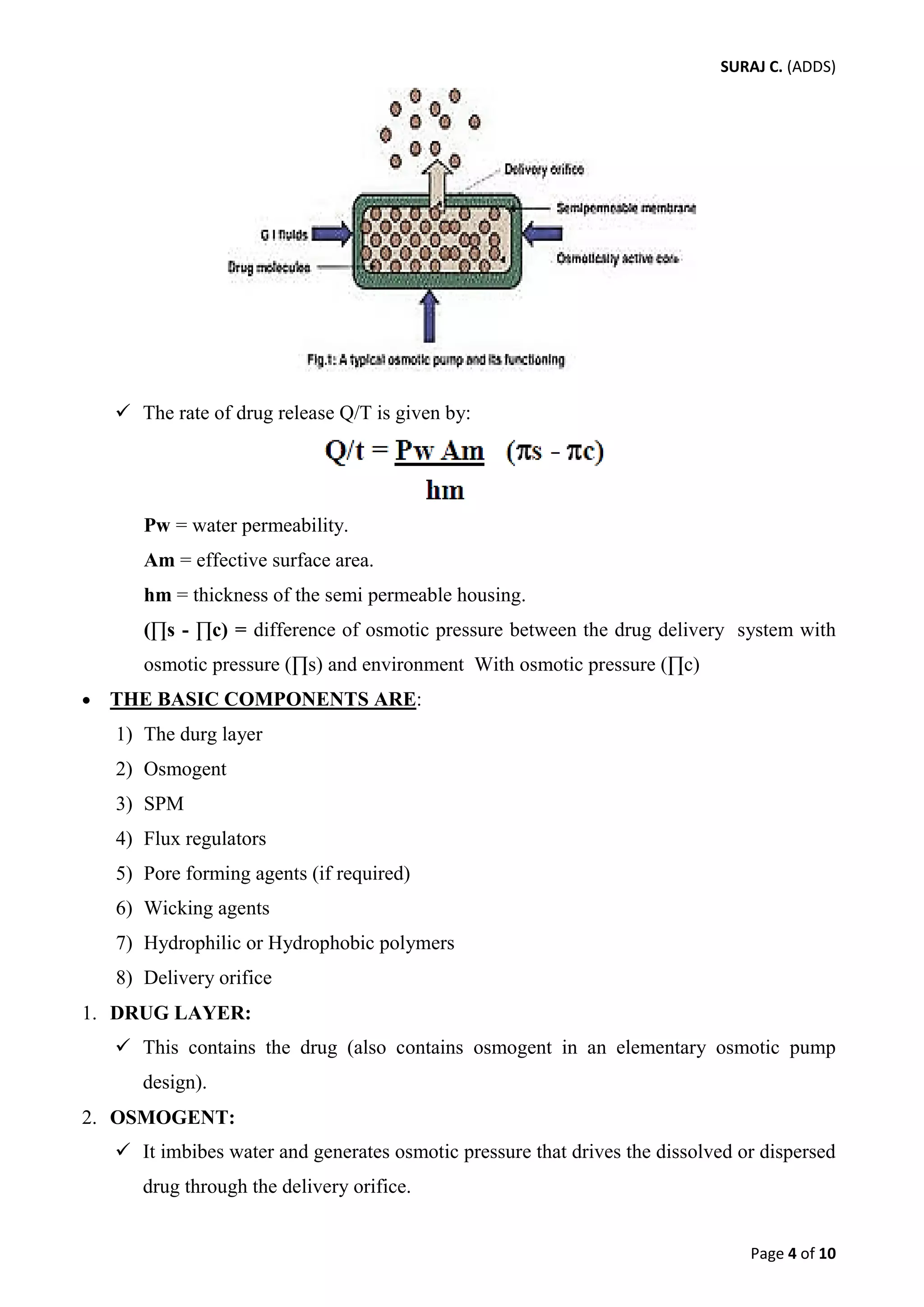
• Osmotic system, imbibe water from the body through semipermeable membrane into an osmotic materials which dissolves in it and increase in volume and generate osmotic pressure that results in slow and even delivery of drug through an orifice. 
• Osmotic pressure is used as driving force for release of drug at constant zero order release. 
ADVANTAGES: 
 It follows zero order release kinetics. 
 Reduced dosing frequency. 
Page 2 of 10
SURAJ C. (ADDS) 
 Prolonged therapeutic effect. 
 Delivery rate is independent of pH and outside agitation (advantages over normal enteric coated tablet). 
 Drug release rate is predictable, programmable and reproducible. 
 High degree of IVIVC is available. 
DISADVANTAGES: 
 Costly 
 Dose dumping (If coating process is not well controlled then there is a risk of film defects which results in dose dumping). 
 size hole is critical 
 It may cause irritation or ulcer due to release of saturated solution of drug 
 Stability problems 
 Additional patient education and counseling is required. 
DRUGS THAT ARE SUITABLE FOR OCDDS: 
 Short biological half life(2-6hrs) 
 Highly potent drugs. 
 Required for prolonged treatment. 
o Eg: Nifedipine, Glipizide, Verapamil etc 
 Mostly suitable for hydrophilic drugs. 
• PRINCIPLE: 
 It involves osmosis of gastrointestinal fluid across the semipermeable membrane (SPM) at a controlled rate. 
 Dissolution of drug and osmotic agent to produce a saturated drug solution with in a tablet core 
 As the number of molecules increases, the osmotic pressure within a tablet core increases. 
 SPM is rigid. 
 Therefore to reduce the osmotic pressure within the tablet, saturated drug solution is emitted from the tablet core through orifice. 
Page 3 of 10
SURAJ C. (ADDS) 
 The rate of drug release Q/T is given by: 
Pw = water permeability. 
Am = effective surface area. 
hm = thickness of the semi permeable housing. 
(Πs - Πc) = difference of osmotic pressure between the drug delivery system with osmotic pressure (Πs) and environment With osmotic pressure (Πc) 
• THE BASIC COMPONENTS ARE: 
1) The durg layer 
2) Osmogent 
3) SPM 
4) Flux regulators 
5) Pore forming agents (if required) 
6) Wicking agents 
7) Hydrophilic or Hydrophobic polymers 
8) Delivery orifice 
1. DRUG LAYER: 
 This contains the drug (also contains osmogent in an elementary osmotic pump design). 
2. OSMOGENT: 
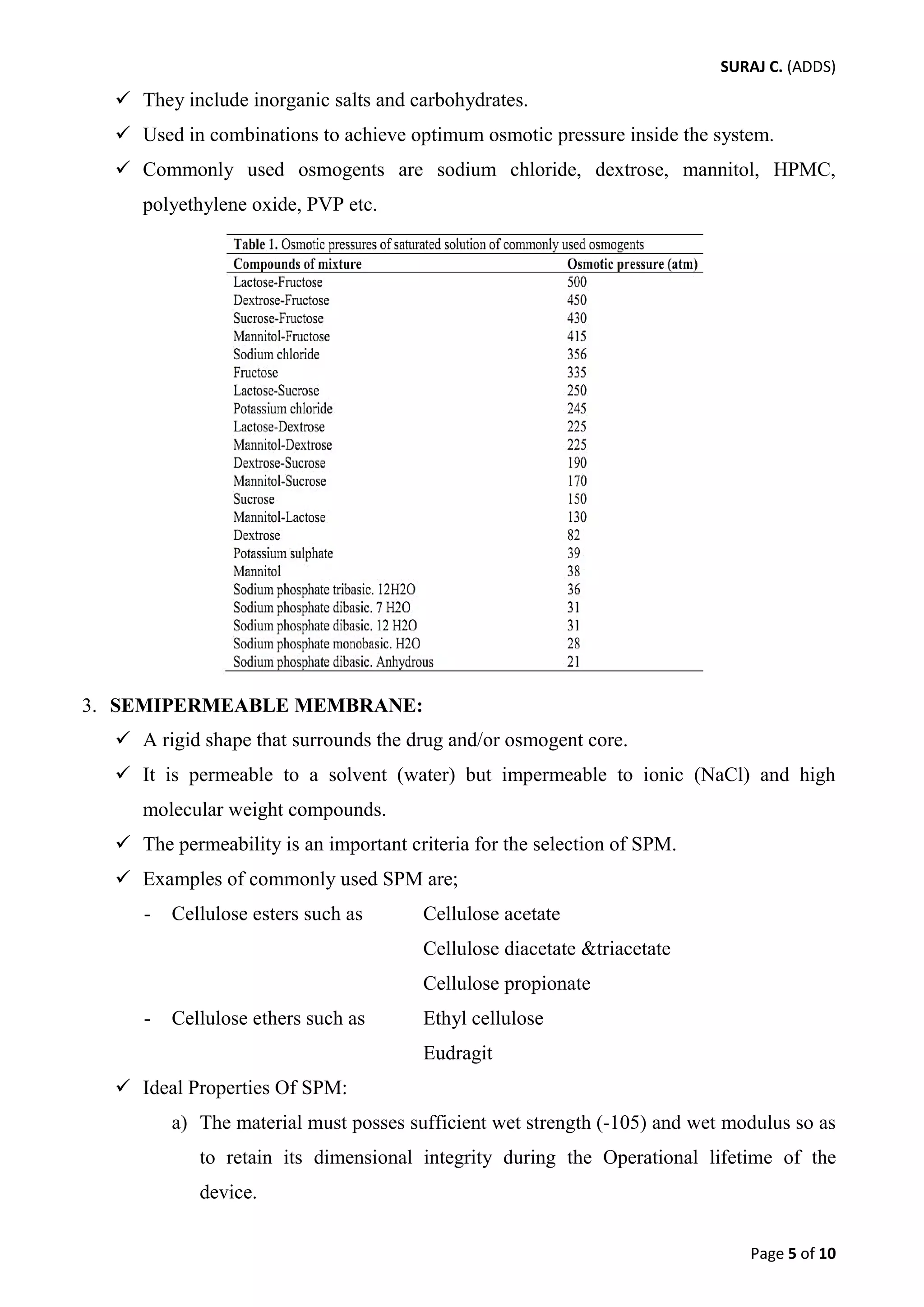
 It imbibes water and generates osmotic pressure that drives the dissolved or dispersed drug through the delivery orifice. 
Page 4 of 10
SURAJ C. (ADDS) 
 They include inorganic salts and carbohydrates. 
 Used in combinations to achieve optimum osmotic pressure inside the system. 
 Commonly used osmogents are sodium chloride, dextrose, mannitol, HPMC, polyethylene oxide, PVP etc. 
3. SEMIPERMEABLE MEMBRANE: 
 A rigid shape that surrounds the drug and/or osmogent core. 
 It is permeable to a solvent (water) but impermeable to ionic (NaCl) and high molecular weight compounds. 
 The permeability is an important criteria for the selection of SPM. 
 Examples of commonly used SPM are; 
- Cellulose esters such as Cellulose acetate 
Cellulose diacetate &triacetate 
Cellulose propionate 
- Cellulose ethers such as Ethyl cellulose 
Eudragit 
 Ideal Properties Of SPM: 
a) The material must posses sufficient wet strength (-105) and wet modulus so as to retain its dimensional integrity during the Operational lifetime of the device. 
Page 5 of 10
SURAJ C. (ADDS) 
b) The membrane exhibit sufficient water permeability so as to retain Water flux rate in the desired range. 
c) The reflection coefficient (leakage of solute through membrane) should approach the limiting value of unity. 
d) The membrane should be biocompatible. 
e) The SPM usually contains a plasticizer and in some cases surfactants, flux regulators, pore forming agents. 
4. PLASTICIZERS: 
 Increases the flexibility and permeability of the fluids. 
Eg: polyethylene glycols 300,400,600, 1500, 4000, 6000. 
5. FLUX REGULATORS: 
 Flux regulating agent or flux enhancing agent or flux decreasing agents are added to the wall forming material, it assists in regulating the fluid permeability of flux through wall. 
 This agent can be pre-selected to increase or decrease the liquid flux. 
Eg: poly propylene, poly butylene & poly amylene. 
6. PORE FORMING AGENTS: 
 Used for poorly water soluble drug. 
 They cause the formation of microporous membrane by its leaching during the operation. 
OR 
 By volatilization of components in a polymer solution or by chemical reactions in a polymer solution which evolves gas results in voids & pores in the wall. 
Eg: Nacl, NaBr, KCl, potassium sulphate, potassium phosphate, calcium chloride. 
7. SURFACTANTS: 
 Act by regulating the surface energy of materials to improve their blending & maintain their integrity during the drug release period. 
Eg: polyoxyethylenated glyceryl recinoleate, Sodium oleate, Potassium oleate, Triethanolamine oleate. 
8. WICKING AGENTS: 
 A material with have the ability to draw water into porous network of a delivery device. 
Page 6 of 10
SURAJ C. (ADDS) 
 Characterized by having the ability to undergo physisorption with water. 
 Physisorption is a form of absorption in which the solvent molecules loosely adhere to surfaces of the wicking agent via vander waals interaction between surface of the wicking agent and the adsorbed molecule. 
 Its function is to carry water to the surfaces inside the core of the tablet, thereby creating channels or a network of increased surface area. 
Eg: colloidal silicon dioxide, kaolin, titanium dioxide, bentonite etc. 
9. HYDROPHILIC or HYDROPHOBIC POLYMERS: 
 Used for making drug containing matrix core. 
 Hydrophobic matrices - entrap high water soluble compounds. 
 Hydrophilic matrices - entrap moderately water soluble compounds. 
10.DELIVERY ORIFICE: 
 It is laser drilled or formed in-situ. 
 Optimum size of the delivery orifice is calculated by the equation 
As = (L V/t) 8Π (η/p)1/2 
As : cross sectional area of the orifice 
V/t : volume released per unit time 
L : diameter of orifice 
η : viscosity of the solution moving from inside to outside 
p : hydrostatic pressure difference 
APPROACHES FOR PROLONGING GI RESIDENCE TIME 
 PHARMACOLOGICAL APPROACH: 
Eg: Antimuscarinic agents (propantheline) or drug that retards gastric motility(Loperamide) 
 PHYSIOLOGICAL APPROACH: 
By stimulating the duodenal receptors (Eg:triethanolamine myristate) or by use of large amounts of volume filling polymer (Polycarbophil) which slows gastric emptying 
The above approaches are not used due to toxicity problems 
Page 7 of 10
SURAJ C. (ADDS) 
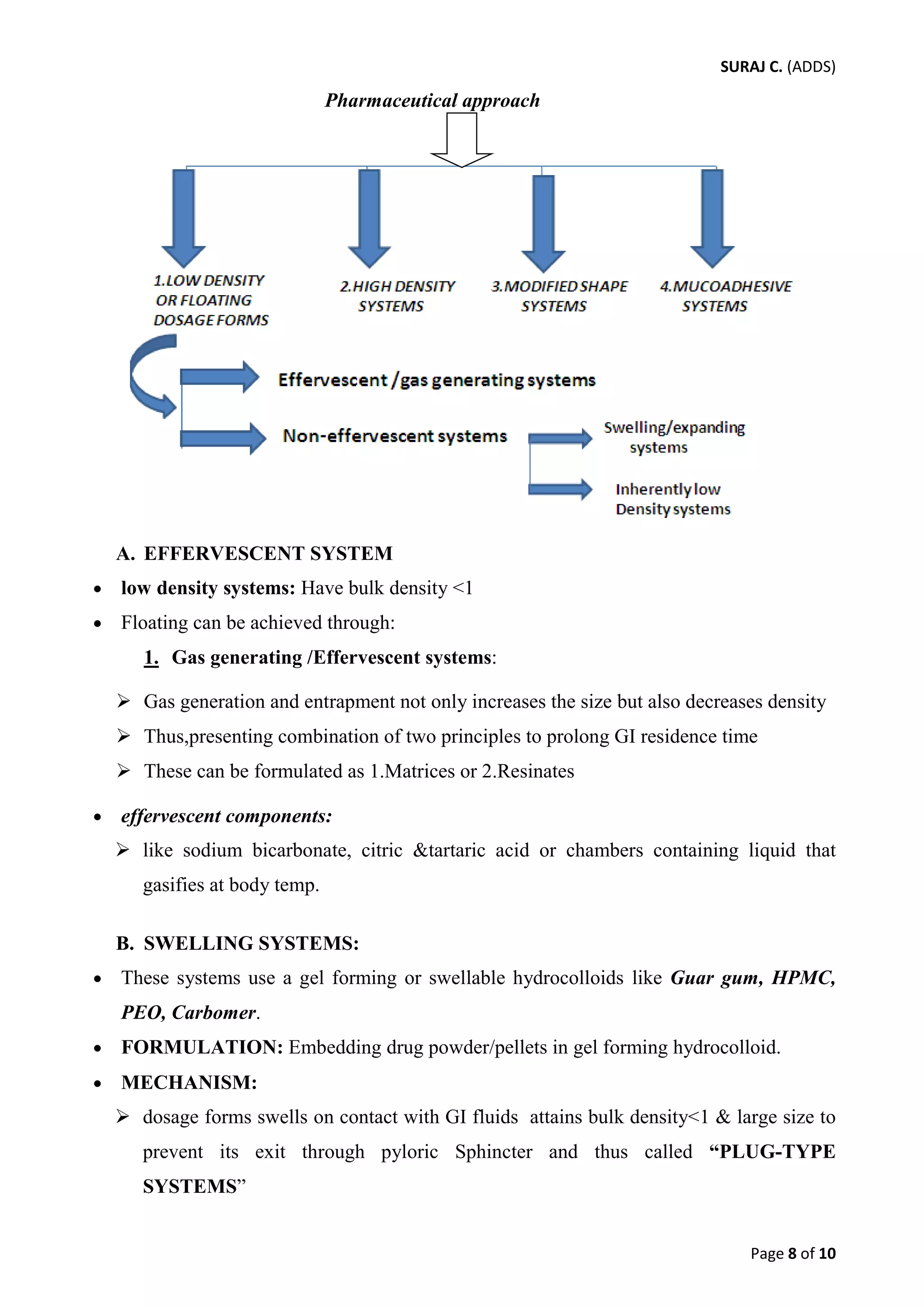
Pharmaceutical approach 
A. EFFERVESCENT SYSTEM 
• low density systems: Have bulk density <1 
• Floating can be achieved through: 
1. Gas generating /Effervescent systems: 
 Gas generation and entrapment not only increases the size but also decreases density 
 Thus,presenting combination of two principles to prolong GI residence time 
 These can be formulated as 1.Matrices or 2.Resinates 
• effervescent components: 
 like sodium bicarbonate, citric &tartaric acid or chambers containing liquid that gasifies at body temp. 
B. SWELLING SYSTEMS: 
• These systems use a gel forming or swellable hydrocolloids like Guar gum, HPMC, PEO, Carbomer. 
• FORMULATION: Embedding drug powder/pellets in gel forming hydrocolloid. 
• MECHANISM: 
 dosage forms swells on contact with GI fluids attains bulk density<1 & large size to prevent its exit through pyloric Sphincter and thus called “PLUG-TYPE SYSTEMS” Page 8 of 10
SURAJ C. (ADDS) 
C. INHERENTLY LOW DENSITY SYSTEMS: 
• It is achieved through 
i. Entrapment of air (hollow microspheres or microballoons) : 
 These are prepared by 
a. Emulsion –solvent diffusion method 
b. Modified solvent evaporation method 
c. Dehydration of swollen hydrogel 
d. Hollow chamber systems 
ii. Low density materials: 
 Inherently low density materials such as “FATS / LOW DENSITY POLYMERS” can be used to prepare floating drug matrices. 
Eg : polypropylene foam powder,matrix forming polymers,drug and an optional filler. 
 Highly porous foam powder provides a low density. 
 Floating drug particles can also be prepared by soaking the microporous foam particles in an organic solution of the drug and polymer (Eudragit RS100) and subsequent drying. 
(pH-INDEPENDENT FORMLATIONS) 
• Oral drug delivery system passes through GIT and encounters with a wide spectrum of pH . 
Mouth – 7 
Stomach – 1-3 
Duodenum – 5- 6 
Jejunum – 6-7 
ileum – 8-9. 
• Since most of the drugs are weak acids and bases, their release from sustained release formulation is pH dependent. 
E.g. 
 Papaverine HCl is released in the stomach and not in the intestine. 
Page 9 of 10
SURAJ C. (ADDS) 
 This type of G.I delivery system is designed for the controlled release of acidic or basic drugs in G.I tract at a rate independent of the variation in the G.I pH 
FORMULATION: 
• Acidic or basic drug is mixed with one or more buffering agents (E.g: salt of citric acid, salt of acetic acid, salt of tartaric acid ) 
• Granulating with appropriate excipients to form granules. 
• Coating with GI fluid permeable film forming polymer. 
PRINCIPLE: 
• When the GI fluid permeates through the membrane, the buffering agent adjusts the fluid inside to a suitable constant pH. 
• Thereby rendering a constant rate of drug release. 
(pH-DEPENDENT FORMULATIONS) 
• Permits targeting the delivery of a drug only in the region with a selected pH range. 
• Coated with pH sensitive polymer combination 
• Gastric fluid-labile drug is protected by encapsuling it inside the polymer that resists the degradative action of gastric pH. 
E.g.: combination of ethyl cellulose and hydroxymethyl cellulose phthalate 
Page 10 of 10

Activation Controlled drug Delivery System

  • 1.
    SURAJ C. Areview on hydrodynamically balanced DDS, Osmotic DDS & pH based DDS. ADDS Dept. of Pharmaceutics RATE CONTROLLED DRUG DELIVERY SYSTEM
  • 2.
    SURAJ C. (ADDS) Activation modulated drug delivery system (HYDRO DYNAMICALLY BALANCED SYSTEM) INTRODUCTION: • The floating sustained release dosage forms present most of the characteristics of hydrophilic matrices and are known as ‘hydrodynamically balanced systems’ (‘HBS’)  This system is developed to extend the GI transit time by prolonging the residence time in the stomach.  The control of gastrointestinal transit of orally administered dosage forms using hydrodynamically balanced system can improve the bioavailability of drugs.  These forms are expected to remain buoyant (3- 4 hours) on the gastric contents without affecting the intrinsic rate of emptying because their bulk density is lower than that of the gastric contents.  Among the different hydrocolloids recommended for floating form formulations, cellulose ether polymers are most popular, especially hydroxypropylmethylcellulose (HPMC).  Various grades of low density polymers were used for formulation of this system. ADVANTAGES:  The principle of HBS can be used for any particular medicament or class of medicament which are principally absorbed from the stomach.  The HBS are advantageous for drugs absorbed through the stomach e.g. ferrous salts and for drugs meant for local action in the stomach and treatment of peptic ulcer disease.  Effective in delivery of sparingly soluble & insoluble drugs or drugs having low solubility at intestinal pH. Eg:Diazepam  Suitable for drugs having absorption window in stomach or upper part of intestine. Eg: gabapentin,metformin,levodopa,riboflavin.  Suitable for drugs unstable in intestine or colon. Eg:captopril PREPARATION: • It is prepared by incorporating a high level (20-75%) of one or more gel forming hydrocolloids like (hydroxy ethylcellulose,HPMC,HPC) into the fomulation. Page 1 of 10
  • 3.
    SURAJ C. (ADDS) • Then compressing the granules into a tablet. • On contact with gastric fluid, hydro colloid in the floating device becomes hydrated and forms a colloid gel-barrier around its surface. • This gel barrier controls the rate of solvent penetration into the device. • It maintains the density less than one so that it remains in the GI fluid in the stomach up to 6hrs. Ex:  An example is the product Valrelease, a slow- release dosage form of Valium (diazepam) val release has been formulated as a unique Hydro dynamically balanced drug delivery system (HBS). – Val release tablets, prepared by granulation of homogenous dispersion of Valium in hydrocolloid and excipients.  The granules are compressed to form tablets.  After oral intake the hydrocolloid in tablet absorbs GI fluid and forms a colloidal gel that starts from the tablet surface and grows inwards.  The release of Valium molecules is then controlled by matrix diffusion through this gel barrier surface and grows inwards.  The release of Valium molecules then controlled by matrix diffusion through this gel barrier. (OSMOTIC PRESSURE CONTROLLED SYSTEM) INTRODUCTION: • Belongs to Activation modulated drug delivery systems. • Osmosis: It is the movement of solvent through a semipermeable membrane from low solute to high solute concentration. • Osmotic system, imbibe water from the body through semipermeable membrane into an osmotic materials which dissolves in it and increase in volume and generate osmotic pressure that results in slow and even delivery of drug through an orifice. • Osmotic pressure is used as driving force for release of drug at constant zero order release. ADVANTAGES:  It follows zero order release kinetics.  Reduced dosing frequency. Page 2 of 10
  • 4.
    SURAJ C. (ADDS)  Prolonged therapeutic effect.  Delivery rate is independent of pH and outside agitation (advantages over normal enteric coated tablet).  Drug release rate is predictable, programmable and reproducible.  High degree of IVIVC is available. DISADVANTAGES:  Costly  Dose dumping (If coating process is not well controlled then there is a risk of film defects which results in dose dumping).  size hole is critical  It may cause irritation or ulcer due to release of saturated solution of drug  Stability problems  Additional patient education and counseling is required. DRUGS THAT ARE SUITABLE FOR OCDDS:  Short biological half life(2-6hrs)  Highly potent drugs.  Required for prolonged treatment. o Eg: Nifedipine, Glipizide, Verapamil etc  Mostly suitable for hydrophilic drugs. • PRINCIPLE:  It involves osmosis of gastrointestinal fluid across the semipermeable membrane (SPM) at a controlled rate.  Dissolution of drug and osmotic agent to produce a saturated drug solution with in a tablet core  As the number of molecules increases, the osmotic pressure within a tablet core increases.  SPM is rigid.  Therefore to reduce the osmotic pressure within the tablet, saturated drug solution is emitted from the tablet core through orifice. Page 3 of 10
  • 5.
    SURAJ C. (ADDS)  The rate of drug release Q/T is given by: Pw = water permeability. Am = effective surface area. hm = thickness of the semi permeable housing. (Πs - Πc) = difference of osmotic pressure between the drug delivery system with osmotic pressure (Πs) and environment With osmotic pressure (Πc) • THE BASIC COMPONENTS ARE: 1) The durg layer 2) Osmogent 3) SPM 4) Flux regulators 5) Pore forming agents (if required) 6) Wicking agents 7) Hydrophilic or Hydrophobic polymers 8) Delivery orifice 1. DRUG LAYER:  This contains the drug (also contains osmogent in an elementary osmotic pump design). 2. OSMOGENT:  It imbibes water and generates osmotic pressure that drives the dissolved or dispersed drug through the delivery orifice. Page 4 of 10
  • 6.
    SURAJ C. (ADDS)  They include inorganic salts and carbohydrates.  Used in combinations to achieve optimum osmotic pressure inside the system.  Commonly used osmogents are sodium chloride, dextrose, mannitol, HPMC, polyethylene oxide, PVP etc. 3. SEMIPERMEABLE MEMBRANE:  A rigid shape that surrounds the drug and/or osmogent core.  It is permeable to a solvent (water) but impermeable to ionic (NaCl) and high molecular weight compounds.  The permeability is an important criteria for the selection of SPM.  Examples of commonly used SPM are; - Cellulose esters such as Cellulose acetate Cellulose diacetate &triacetate Cellulose propionate - Cellulose ethers such as Ethyl cellulose Eudragit  Ideal Properties Of SPM: a) The material must posses sufficient wet strength (-105) and wet modulus so as to retain its dimensional integrity during the Operational lifetime of the device. Page 5 of 10
  • 7.
    SURAJ C. (ADDS) b) The membrane exhibit sufficient water permeability so as to retain Water flux rate in the desired range. c) The reflection coefficient (leakage of solute through membrane) should approach the limiting value of unity. d) The membrane should be biocompatible. e) The SPM usually contains a plasticizer and in some cases surfactants, flux regulators, pore forming agents. 4. PLASTICIZERS:  Increases the flexibility and permeability of the fluids. Eg: polyethylene glycols 300,400,600, 1500, 4000, 6000. 5. FLUX REGULATORS:  Flux regulating agent or flux enhancing agent or flux decreasing agents are added to the wall forming material, it assists in regulating the fluid permeability of flux through wall.  This agent can be pre-selected to increase or decrease the liquid flux. Eg: poly propylene, poly butylene & poly amylene. 6. PORE FORMING AGENTS:  Used for poorly water soluble drug.  They cause the formation of microporous membrane by its leaching during the operation. OR  By volatilization of components in a polymer solution or by chemical reactions in a polymer solution which evolves gas results in voids & pores in the wall. Eg: Nacl, NaBr, KCl, potassium sulphate, potassium phosphate, calcium chloride. 7. SURFACTANTS:  Act by regulating the surface energy of materials to improve their blending & maintain their integrity during the drug release period. Eg: polyoxyethylenated glyceryl recinoleate, Sodium oleate, Potassium oleate, Triethanolamine oleate. 8. WICKING AGENTS:  A material with have the ability to draw water into porous network of a delivery device. Page 6 of 10
  • 8.
    SURAJ C. (ADDS)  Characterized by having the ability to undergo physisorption with water.  Physisorption is a form of absorption in which the solvent molecules loosely adhere to surfaces of the wicking agent via vander waals interaction between surface of the wicking agent and the adsorbed molecule.  Its function is to carry water to the surfaces inside the core of the tablet, thereby creating channels or a network of increased surface area. Eg: colloidal silicon dioxide, kaolin, titanium dioxide, bentonite etc. 9. HYDROPHILIC or HYDROPHOBIC POLYMERS:  Used for making drug containing matrix core.  Hydrophobic matrices - entrap high water soluble compounds.  Hydrophilic matrices - entrap moderately water soluble compounds. 10.DELIVERY ORIFICE:  It is laser drilled or formed in-situ.  Optimum size of the delivery orifice is calculated by the equation As = (L V/t) 8Π (η/p)1/2 As : cross sectional area of the orifice V/t : volume released per unit time L : diameter of orifice η : viscosity of the solution moving from inside to outside p : hydrostatic pressure difference APPROACHES FOR PROLONGING GI RESIDENCE TIME  PHARMACOLOGICAL APPROACH: Eg: Antimuscarinic agents (propantheline) or drug that retards gastric motility(Loperamide)  PHYSIOLOGICAL APPROACH: By stimulating the duodenal receptors (Eg:triethanolamine myristate) or by use of large amounts of volume filling polymer (Polycarbophil) which slows gastric emptying The above approaches are not used due to toxicity problems Page 7 of 10
  • 9.
    SURAJ C. (ADDS) Pharmaceutical approach A. EFFERVESCENT SYSTEM • low density systems: Have bulk density <1 • Floating can be achieved through: 1. Gas generating /Effervescent systems:  Gas generation and entrapment not only increases the size but also decreases density  Thus,presenting combination of two principles to prolong GI residence time  These can be formulated as 1.Matrices or 2.Resinates • effervescent components:  like sodium bicarbonate, citric &tartaric acid or chambers containing liquid that gasifies at body temp. B. SWELLING SYSTEMS: • These systems use a gel forming or swellable hydrocolloids like Guar gum, HPMC, PEO, Carbomer. • FORMULATION: Embedding drug powder/pellets in gel forming hydrocolloid. • MECHANISM:  dosage forms swells on contact with GI fluids attains bulk density<1 & large size to prevent its exit through pyloric Sphincter and thus called “PLUG-TYPE SYSTEMS” Page 8 of 10
  • 10.
    SURAJ C. (ADDS) C. INHERENTLY LOW DENSITY SYSTEMS: • It is achieved through i. Entrapment of air (hollow microspheres or microballoons) :  These are prepared by a. Emulsion –solvent diffusion method b. Modified solvent evaporation method c. Dehydration of swollen hydrogel d. Hollow chamber systems ii. Low density materials:  Inherently low density materials such as “FATS / LOW DENSITY POLYMERS” can be used to prepare floating drug matrices. Eg : polypropylene foam powder,matrix forming polymers,drug and an optional filler.  Highly porous foam powder provides a low density.  Floating drug particles can also be prepared by soaking the microporous foam particles in an organic solution of the drug and polymer (Eudragit RS100) and subsequent drying. (pH-INDEPENDENT FORMLATIONS) • Oral drug delivery system passes through GIT and encounters with a wide spectrum of pH . Mouth – 7 Stomach – 1-3 Duodenum – 5- 6 Jejunum – 6-7 ileum – 8-9. • Since most of the drugs are weak acids and bases, their release from sustained release formulation is pH dependent. E.g.  Papaverine HCl is released in the stomach and not in the intestine. Page 9 of 10
  • 11.
    SURAJ C. (ADDS)  This type of G.I delivery system is designed for the controlled release of acidic or basic drugs in G.I tract at a rate independent of the variation in the G.I pH FORMULATION: • Acidic or basic drug is mixed with one or more buffering agents (E.g: salt of citric acid, salt of acetic acid, salt of tartaric acid ) • Granulating with appropriate excipients to form granules. • Coating with GI fluid permeable film forming polymer. PRINCIPLE: • When the GI fluid permeates through the membrane, the buffering agent adjusts the fluid inside to a suitable constant pH. • Thereby rendering a constant rate of drug release. (pH-DEPENDENT FORMULATIONS) • Permits targeting the delivery of a drug only in the region with a selected pH range. • Coated with pH sensitive polymer combination • Gastric fluid-labile drug is protected by encapsuling it inside the polymer that resists the degradative action of gastric pH. E.g.: combination of ethyl cellulose and hydroxymethyl cellulose phthalate Page 10 of 10