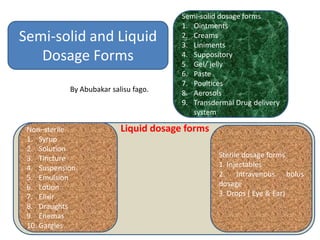
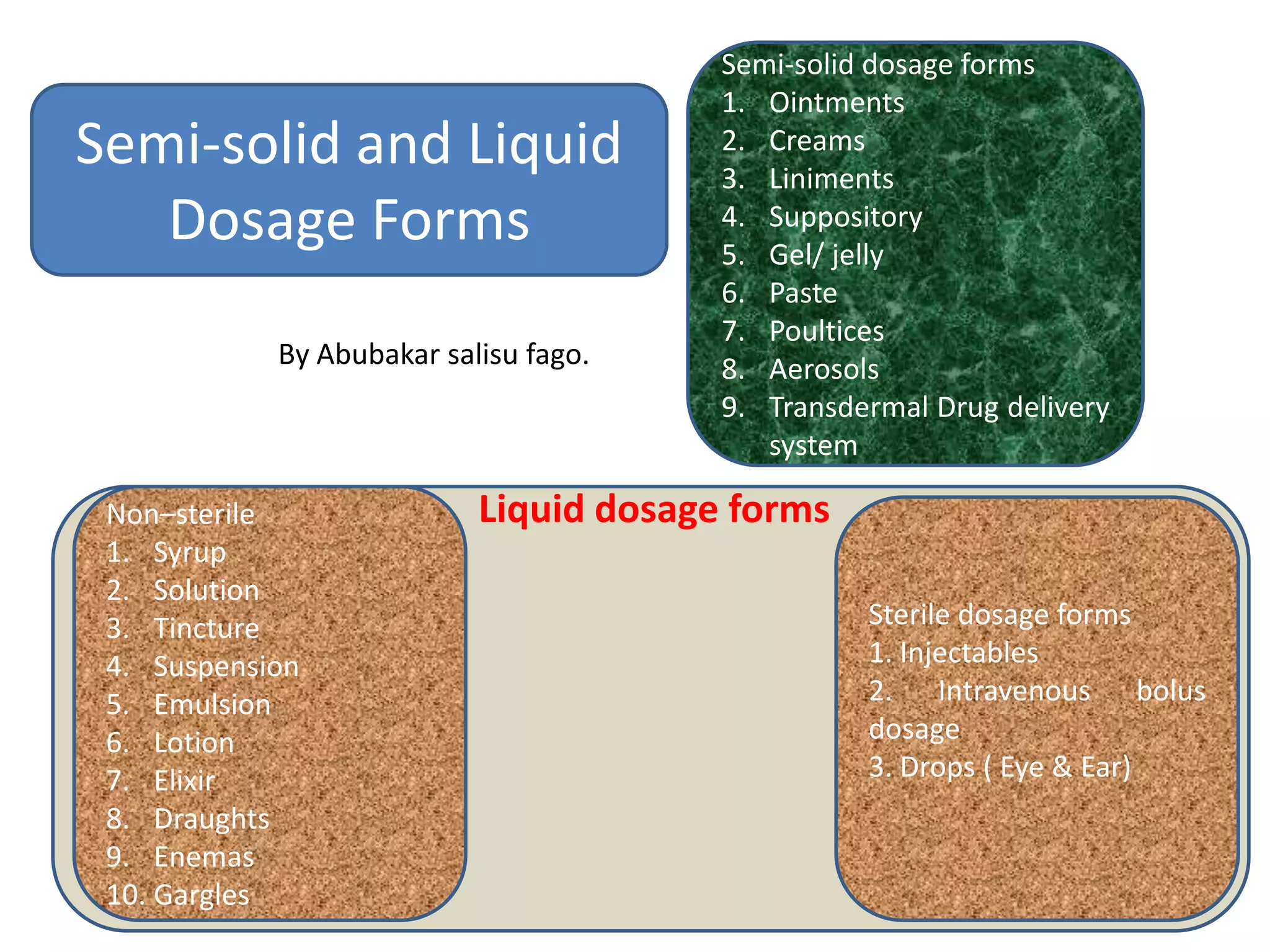
Semi-solid dosage forms
1. Ointments
2. Creams
3. Liniments
4. Suppository
5. Gel/ jelly
6. Paste
7. Poultices
8. Aerosols
9. Transdermal Drug delivery
system
Non–sterile
1. Syrup
2. Solution
3. Tincture
4. Suspension
5. Emulsion
6. Lotion
7. Elixir
8. Draughts
9. Enemas
10. Gargles
Sterile dosage forms
1. Injectables
2. Intravenous bolus
dosage
3. Drops ( Eye & Ear)
Liquid dosage forms
Semi-solid and Liquid
Dosage Forms
By Abubakar salisu fago.
Semisolid Dosage forms
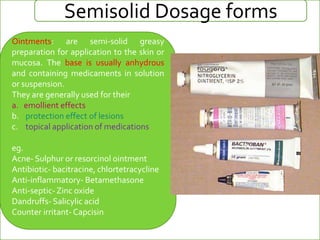
Ointments: are semi-solid greasy
preparation for application to the skin or
mucosa. The base is usually anhydrous
and containing medicaments in solution
or suspension.
They are generally used for their
a. emollient effects
b. protection effect of lesions
c. topical application of medications
eg.
Acne- Sulphur or resorcinol ointment
Antibiotic- bacitracine, chlortetracycline
Anti-inflammatory- Betamethasone
Anti-septic-Zinc oxide
Dandruffs- Salicylic acid
Counter irritant- Capcisin
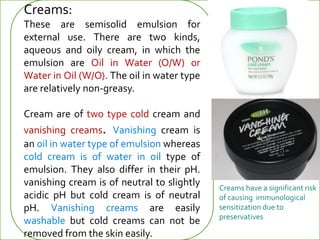
Creams have a significant risk of causing immunological sensitization due to preservatives
Creams:
These are semisolid emulsion for
external use. There are two kinds,
aqueous and oily cream, in which the
emulsion are Oil in Water (O/W) or
Water in Oil (W/O). The oil in water type
are relatively non-greasy.
Cream are of two type cold cream and
vanishing creams. Vanishing cream is
an oil in water type of emulsion whereas
cold cream is of water in oil type of
emulsion. They also differ in their pH.
vanishing cream is of neutral to slightly
acidic pH but cold cream is of neutral
pH. Vanishing creams are easily
washable but cold creams can not be
removed from the skin easily.
Creams have a significant risk
of causing immunological
sensitization due to
preservatives
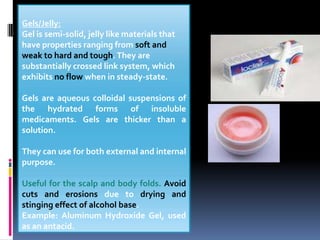
Gels/Jelly:
Gel is semi-solid, jelly like materials that
have properties ranging from soft and
weak to hard and tough.They are
substantially crossed link system, which
exhibits no flow when in steady-state.
Gels are aqueous colloidal suspensions of
the hydrated forms of insoluble
medicaments. Gels are thicker than a
solution.
They can use for both external and internal
purpose.
Useful for the scalp and body folds. Avoid
cuts and erosions due to drying and
stinging effect of alcohol base.
Example: Aluminum Hydroxide Gel, used
as an antacid.
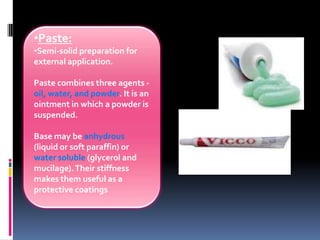
•Paste:
•Semi-solid preparation for
external application.
Paste combines three agents -
oil, water, and powder. It is an
ointment in which a powder is
suspended.
Base may be anhydrous
(liquid or soft paraffin) or
water soluble (glycerol and
mucilage).Their stiffness
makes them useful as a
protective coatings
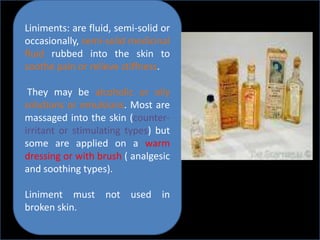
Liniments: are fluid, semi-solid or
occasionally, semi-solid medicinal
fluid rubbed into the skin to
soothe pain or relieve stiffness.
They may be alcoholic or oily
solutions or emulsions. Most are
massaged into the skin (counter-
irritant or stimulating types) but
some are applied on a warm
dressing or with brush ( analgesic
and soothing types).
Liniment must not used in
broken skin.
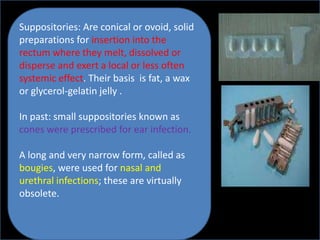
Suppositories: Are conical or ovoid, solid
preparations for insertion into the
rectum where they melt, dissolved or
disperse and exert a local or less often
systemic effect. Their basis is fat, a wax
or glycerol-gelatin jelly .
In past: small suppositories known as
cones were prescribed for ear infection.
A long and very narrow form, called as
bougies, were used for nasal and
urethral infections; these are virtually
obsolete.
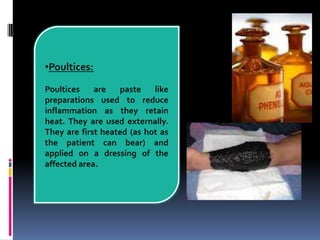
•Poultices:
Poultices are paste like
preparations used to reduce
inflammation as they retain
heat. They are used externally.
They are first heated (as hot as
the patient can bear) and
applied on a dressing of the
affected area.
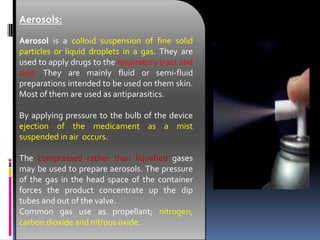
Aerosols:
Aerosol is a colloid suspension of fine solid
particles or liquid droplets in a gas. They are
used to apply drugs to the respiratory tract and
skin. They are mainly fluid or semi-fluid
preparations intended to be used on them skin.
Most of them are used as antiparasitics.
By applying pressure to the bulb of the device
ejection of the medicament as a mist
suspended in air occurs.
The compressed rather than liquefied gases
may be used to prepare aerosols. The pressure
of the gas in the head space of the container
forces the product concentrate up the dip
tubes and out of the valve.
Common gas use as propellant; nitrogen,
carbon dioxide and nitrous oxide.
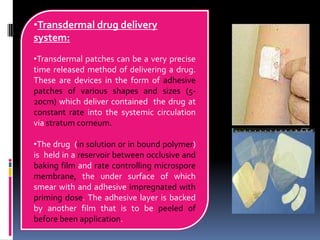
•Transdermal drug delivery
system:
•Transdermal patches can be a very precise
time released method of delivering a drug.
These are devices in the form of adhesive
patches of various shapes and sizes (5-
20cm) which deliver contained the drug at
constant rate into the systemic circulation
via stratum corneum.
•The drug (in solution or in bound polymer)
is held in a reservoir between occlusive and
baking film and rate controlling microspore
membrane, the under surface of which
smear with and adhesive impregnated with
priming dose. The adhesive layer is backed
by another film that is to be peeled of
before been application.
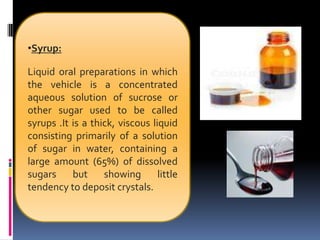
•Syrup:
Liquid oral preparations in which
the vehicle is a concentrated
aqueous solution of sucrose or
other sugar used to be called
syrups .It is a thick, viscous liquid
consisting primarily of a solution
of sugar in water, containing a
large amount (65%) of dissolved
sugars but showing little
tendency to deposit crystals.
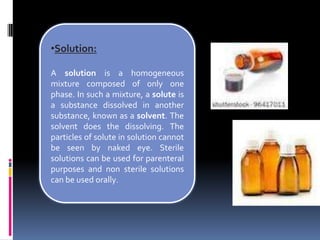
•Solution:
A solution is a homogeneous
mixture composed of only one
phase. In such a mixture, a solute is
a substance dissolved in another
substance, known as a solvent. The
solvent does the dissolving. The
particles of solute in solution cannot
be seen by naked eye. Sterile
solutions can be used for parenteral
purposes and non sterile solutions
can be used orally.
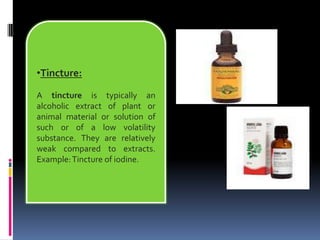
•Tincture:
A tincture is typically an
alcoholic extract of plant or
animal material or solution of
such or of a low volatility
substance. They are relatively
weak compared to extracts.
Example:Tincture of iodine.
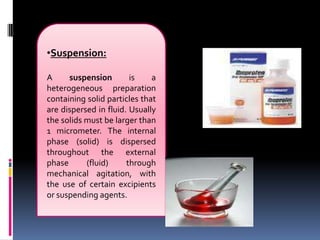
•Suspension:
A suspension is a
heterogeneous preparation
containing solid particles that
are dispersed in fluid. Usually
the solids must be larger than
1 micrometer. The internal
phase (solid) is dispersed
throughout the external
phase (fluid) through
mechanical agitation, with
the use of certain excipients
or suspending agents.
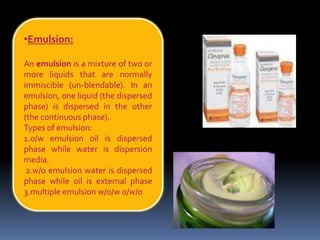
•Emulsion:
An emulsion is a mixture of two or
more liquids that are normally
immiscible (un-blendable). In an
emulsion, one liquid (the dispersed
phase) is dispersed in the other
(the continuous phase).
Types of emulsion:
1.o/w emulsion oil is dispersed
phase while water is dispersion
media.
2.w/o emulsion water is dispersed
phase while oil is external phase
3.multiple emulsion w/o/w o/w/o
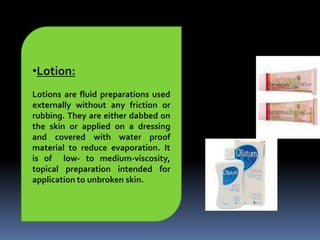
•Lotion:
Lotions are fluid preparations used
externally without any friction or
rubbing. They are either dabbed on
the skin or applied on a dressing
and covered with water proof
material to reduce evaporation. It
is of low- to medium-viscosity,
topical preparation intended for
application to unbroken skin.
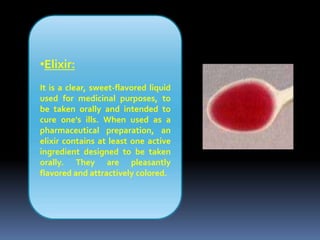
•Elixir:
It is a clear, sweet-flavored liquid
used for medicinal purposes, to
be taken orally and intended to
cure one's ills. When used as a
pharmaceutical preparation, an
elixir contains at least one active
ingredient designed to be taken
orally. They are pleasantly
flavored and attractively colored.
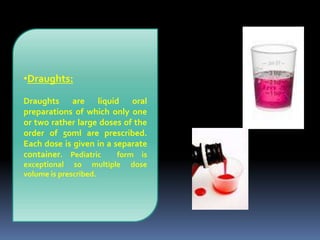
•Draughts:
Draughts are liquid oral
preparations of which only one
or two rather large doses of the
order of 50ml are prescribed.
Each dose is given in a separate
container. Pediatric form is
exceptional so multiple dose
volume is prescribed.
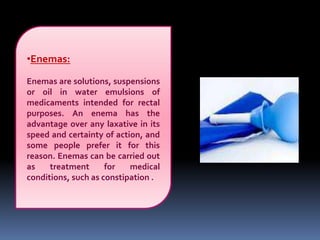
•Enemas:
Enemas are solutions, suspensions
or oil in water emulsions of
medicaments intended for rectal
purposes. An enema has the
advantage over any laxative in its
speed and certainty of action, and
some people prefer it for this
reason. Enemas can be carried out
as treatment for medical
conditions, such as constipation .
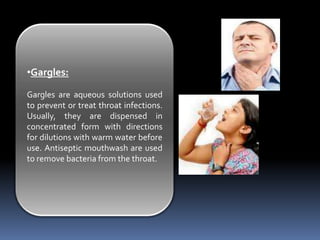
•Gargles:
Gargles are aqueous solutions used
to prevent or treat throat infections.
Usually, they are dispensed in
concentrated form with directions
for dilutions with warm water before
use. Antiseptic mouthwash are used
to remove bacteria from the throat.
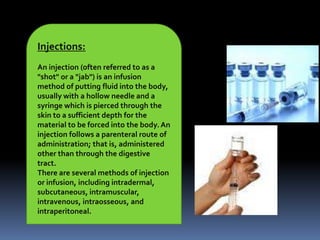
Injections:
An injection (often referred to as a
"shot" or a "jab") is an infusion
method of putting fluid into the body,
usually with a hollow needle and a
syringe which is pierced through the
skin to a sufficient depth for the
material to be forced into the body. An
injection follows a parenteral route of
administration; that is, administered
other than through the digestive
tract.
There are several methods of injection
or infusion, including intradermal,
subcutaneous, intramuscular,
intravenous, intraosseous, and
intraperitoneal.
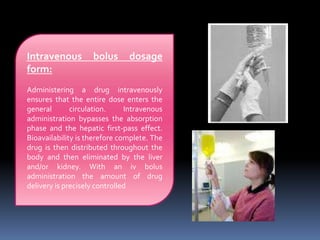
Intravenous bolus dosage
form:
Administering a drug intravenously
ensures that the entire dose enters the
general circulation. Intravenous
administration bypasses the absorption
phase and the hepatic first-pass effect.
Bioavailability is therefore complete. The
drug is then distributed throughout the
body and then eliminated by the liver
and/or kidney. With an iv bolus
administration the amount of drug
delivery is precisely controlled
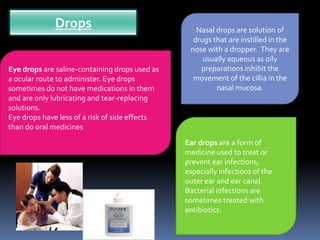
Eye drops are saline-containing drops used as
a ocular route to administer. Eye drops
sometimes do not have medications in them
and are only lubricating and tear-replacing
solutions.
Eye drops have less of a risk of side effects
than do oral medicines
Ear drops are a form of
medicine used to treat or
prevent ear infections,
especially infections of the
outer ear and ear canal.
Bacterial infections are
sometimes treated with
antibiotics.
Nasal drops are solution of
drugs that are instilled in the
nose with a dropper. They are
usually aqueous as oily
preparations inhibit the
movement of the cillia in the
nasal mucosa.
Drops

semi solid and liquid dosage form

  • 1.
    Semi-solid dosage forms 1.Ointments 2. Creams 3. Liniments 4. Suppository 5. Gel/ jelly 6. Paste 7. Poultices 8. Aerosols 9. Transdermal Drug delivery system Non–sterile 1. Syrup 2. Solution 3. Tincture 4. Suspension 5. Emulsion 6. Lotion 7. Elixir 8. Draughts 9. Enemas 10. Gargles Sterile dosage forms 1. Injectables 2. Intravenous bolus dosage 3. Drops ( Eye & Ear) Liquid dosage forms Semi-solid and Liquid Dosage Forms By Abubakar salisu fago.
  • 2.
    Semisolid Dosage forms Ointments:are semi-solid greasy preparation for application to the skin or mucosa. The base is usually anhydrous and containing medicaments in solution or suspension. They are generally used for their a. emollient effects b. protection effect of lesions c. topical application of medications eg. Acne- Sulphur or resorcinol ointment Antibiotic- bacitracine, chlortetracycline Anti-inflammatory- Betamethasone Anti-septic-Zinc oxide Dandruffs- Salicylic acid Counter irritant- Capcisin
  • 3.
    Creams have asignificant risk of causing immunological sensitization due to preservatives Creams: These are semisolid emulsion for external use. There are two kinds, aqueous and oily cream, in which the emulsion are Oil in Water (O/W) or Water in Oil (W/O). The oil in water type are relatively non-greasy. Cream are of two type cold cream and vanishing creams. Vanishing cream is an oil in water type of emulsion whereas cold cream is of water in oil type of emulsion. They also differ in their pH. vanishing cream is of neutral to slightly acidic pH but cold cream is of neutral pH. Vanishing creams are easily washable but cold creams can not be removed from the skin easily. Creams have a significant risk of causing immunological sensitization due to preservatives
  • 4.
    Gels/Jelly: Gel is semi-solid,jelly like materials that have properties ranging from soft and weak to hard and tough.They are substantially crossed link system, which exhibits no flow when in steady-state. Gels are aqueous colloidal suspensions of the hydrated forms of insoluble medicaments. Gels are thicker than a solution. They can use for both external and internal purpose. Useful for the scalp and body folds. Avoid cuts and erosions due to drying and stinging effect of alcohol base. Example: Aluminum Hydroxide Gel, used as an antacid.
  • 5.
    •Paste: •Semi-solid preparation for externalapplication. Paste combines three agents - oil, water, and powder. It is an ointment in which a powder is suspended. Base may be anhydrous (liquid or soft paraffin) or water soluble (glycerol and mucilage).Their stiffness makes them useful as a protective coatings
  • 6.
    Liniments: are fluid,semi-solid or occasionally, semi-solid medicinal fluid rubbed into the skin to soothe pain or relieve stiffness. They may be alcoholic or oily solutions or emulsions. Most are massaged into the skin (counter- irritant or stimulating types) but some are applied on a warm dressing or with brush ( analgesic and soothing types). Liniment must not used in broken skin.
  • 7.
    Suppositories: Are conicalor ovoid, solid preparations for insertion into the rectum where they melt, dissolved or disperse and exert a local or less often systemic effect. Their basis is fat, a wax or glycerol-gelatin jelly . In past: small suppositories known as cones were prescribed for ear infection. A long and very narrow form, called as bougies, were used for nasal and urethral infections; these are virtually obsolete.
  • 8.
    •Poultices: Poultices are pastelike preparations used to reduce inflammation as they retain heat. They are used externally. They are first heated (as hot as the patient can bear) and applied on a dressing of the affected area.
  • 9.
    Aerosols: Aerosol is acolloid suspension of fine solid particles or liquid droplets in a gas. They are used to apply drugs to the respiratory tract and skin. They are mainly fluid or semi-fluid preparations intended to be used on them skin. Most of them are used as antiparasitics. By applying pressure to the bulb of the device ejection of the medicament as a mist suspended in air occurs. The compressed rather than liquefied gases may be used to prepare aerosols. The pressure of the gas in the head space of the container forces the product concentrate up the dip tubes and out of the valve. Common gas use as propellant; nitrogen, carbon dioxide and nitrous oxide.
  • 10.
    •Transdermal drug delivery system: •Transdermalpatches can be a very precise time released method of delivering a drug. These are devices in the form of adhesive patches of various shapes and sizes (5- 20cm) which deliver contained the drug at constant rate into the systemic circulation via stratum corneum. •The drug (in solution or in bound polymer) is held in a reservoir between occlusive and baking film and rate controlling microspore membrane, the under surface of which smear with and adhesive impregnated with priming dose. The adhesive layer is backed by another film that is to be peeled of before been application.
  • 11.
    •Syrup: Liquid oral preparationsin which the vehicle is a concentrated aqueous solution of sucrose or other sugar used to be called syrups .It is a thick, viscous liquid consisting primarily of a solution of sugar in water, containing a large amount (65%) of dissolved sugars but showing little tendency to deposit crystals.
  • 12.
    •Solution: A solution isa homogeneous mixture composed of only one phase. In such a mixture, a solute is a substance dissolved in another substance, known as a solvent. The solvent does the dissolving. The particles of solute in solution cannot be seen by naked eye. Sterile solutions can be used for parenteral purposes and non sterile solutions can be used orally.
  • 13.
    •Tincture: A tincture istypically an alcoholic extract of plant or animal material or solution of such or of a low volatility substance. They are relatively weak compared to extracts. Example:Tincture of iodine.
  • 14.
    •Suspension: A suspension isa heterogeneous preparation containing solid particles that are dispersed in fluid. Usually the solids must be larger than 1 micrometer. The internal phase (solid) is dispersed throughout the external phase (fluid) through mechanical agitation, with the use of certain excipients or suspending agents.
  • 15.
    •Emulsion: An emulsion isa mixture of two or more liquids that are normally immiscible (un-blendable). In an emulsion, one liquid (the dispersed phase) is dispersed in the other (the continuous phase). Types of emulsion: 1.o/w emulsion oil is dispersed phase while water is dispersion media. 2.w/o emulsion water is dispersed phase while oil is external phase 3.multiple emulsion w/o/w o/w/o
  • 16.
    •Lotion: Lotions are fluidpreparations used externally without any friction or rubbing. They are either dabbed on the skin or applied on a dressing and covered with water proof material to reduce evaporation. It is of low- to medium-viscosity, topical preparation intended for application to unbroken skin.
  • 17.
    •Elixir: It is aclear, sweet-flavored liquid used for medicinal purposes, to be taken orally and intended to cure one's ills. When used as a pharmaceutical preparation, an elixir contains at least one active ingredient designed to be taken orally. They are pleasantly flavored and attractively colored.
  • 18.
    •Draughts: Draughts are liquidoral preparations of which only one or two rather large doses of the order of 50ml are prescribed. Each dose is given in a separate container. Pediatric form is exceptional so multiple dose volume is prescribed.
  • 19.
    •Enemas: Enemas are solutions,suspensions or oil in water emulsions of medicaments intended for rectal purposes. An enema has the advantage over any laxative in its speed and certainty of action, and some people prefer it for this reason. Enemas can be carried out as treatment for medical conditions, such as constipation .
  • 20.
    •Gargles: Gargles are aqueoussolutions used to prevent or treat throat infections. Usually, they are dispensed in concentrated form with directions for dilutions with warm water before use. Antiseptic mouthwash are used to remove bacteria from the throat.
  • 21.
    Injections: An injection (oftenreferred to as a "shot" or a "jab") is an infusion method of putting fluid into the body, usually with a hollow needle and a syringe which is pierced through the skin to a sufficient depth for the material to be forced into the body. An injection follows a parenteral route of administration; that is, administered other than through the digestive tract. There are several methods of injection or infusion, including intradermal, subcutaneous, intramuscular, intravenous, intraosseous, and intraperitoneal.
  • 22.
    Intravenous bolus dosage form: Administeringa drug intravenously ensures that the entire dose enters the general circulation. Intravenous administration bypasses the absorption phase and the hepatic first-pass effect. Bioavailability is therefore complete. The drug is then distributed throughout the body and then eliminated by the liver and/or kidney. With an iv bolus administration the amount of drug delivery is precisely controlled
  • 23.
    Eye drops aresaline-containing drops used as a ocular route to administer. Eye drops sometimes do not have medications in them and are only lubricating and tear-replacing solutions. Eye drops have less of a risk of side effects than do oral medicines Ear drops are a form of medicine used to treat or prevent ear infections, especially infections of the outer ear and ear canal. Bacterial infections are sometimes treated with antibiotics. Nasal drops are solution of drugs that are instilled in the nose with a dropper. They are usually aqueous as oily preparations inhibit the movement of the cillia in the nasal mucosa. Drops