•Dr.Zeenat Iqbal          ABDUL MUHEEM
     •Dr.sushama Talegaonkar   M.PHARM (PHARMACEUTICS)
     •Dr.Yasmin Sultana           JAMIA HAMDARD
      FACULTY OF PHARMACY
      JAMIA HAMDARD
      NEW DELHI

2/24/2013         Seminar                                1
What is Mucoadhesive drug delivery system?

 •Mucoadhesive drug delivery system interact
 with the mucus layer covering the mucosal
 epithelial surface, & mucin molecules & increase
 the residence time of the dosage form at the
 site of the absorption.
 •Mucoadhesive drug delivery system is a part of
 controlled delivery system.


2/24/2013     Seminar                               2
 INTRODUCTION
  Since the early 1980,the concept of Mucoadhesion has
   gained considerable interest in pharmaceutical
   technology.
  The strategies studied to overcome such obstacles
   include the employment of the materials
   that,possibly, combine      mucoadhesive , enzyme
   inhibitory & penetration enhancer properties &
   improve the patient complaince.
  MDDS have been devloped for buccal ,nasal,rectal
   &vaginal routes for both systemic & local effects.
  Hydrophilic high mol. wt. such as peptides that cannot
   be administered & poor absorption ,then MDDS is
   best choice.
2/24/2013      Seminar                                      3
Why are we using Mucoadhesive drug delivery
   system(MDDS)?
  MDDS prolng the residence time of the dosage form
   at the site of application or absorption.
  Intimate contact of the dosage form with the
   underlying absorption .
  Improve the therapeutic performance of drug.
  Should not cause cause irritation.
  High drug loading capacity.
  Controlled drug release(preferably unidirectional
   release).

2/24/2013     Seminar                                  4
Types of Drug delivery systems:
Depending upon the route of administration of the mucoadhesive drugs
                 they are different types .They are

                      1)Buccal delivery system

                     2)Sub lingual delivery system

                     3)Vaginal delivery system

                     4)Rectal delivery system

                     5)Nasal delivery system

                     6)Ocular delivery system

                     7)Gastro intestinal delivery system
ADVANTAGES-
  MDDS offer several advantages over other controlled oral
   controlled release systems by virtue of prolongation of
   residence of drug in GIT.
  Targeting & localization of the dosage form at a specific
   site.
  High drug flux at the absorbing tissue.
  MDDS will serve both the purposes of sustain release &
   presense of dosage form at the site of absorption.
  Excellent accessibility.
  Painless administration.
  Low enzymatic activity & avoid of first pass metabolism.

2/24/2013       Seminar                                        6
DISADVANNTAGES-
  If MDDS are adhere too tightlgy because it is undesirable
   to exert too much force to remove the formulation after
   use,otherwise the mucosa could be injured.
  Some patient suffers unpleasent feeling.
  Unfortunately ,the lack of standardized techniques often
   leads to unclear results.
  costly drug delivery system.
  Medications administered orally do not enter the blood
   stream immediately after passage through the buccal
   mucosa.


2/24/2013       Seminar                                        7
Oral cavity: anatomic and physiologic features
  The oral mucosa presents a surface area of about 100
    cm2.
  Three different types of oral mucosa-
  1-Masticatory mucosa-25% of the total oral mucosa &
    covers the gingiva and the hard palate.
 2-Lining mucosa- (60% of the total oral mucosa) &
    covers the lips, cheeks, soft palate, lower surface of the
    tongue and the floor of the oral cavity.
 3-The specialized mucosa-(15% of the total oral
    mucosa) is found on the dorsum of the tongue


2/24/2013        Seminar                                         8
Buccal epithelium-
   The buccal epithelium is non-keratinized and composed of
    multiple layers of cells which show different patterns of
    maturation between the deepest cells and the surface.
   An intracellular lipid portion is packaged in small
    organelles called membrane coating granules or lamellar
    granules.
   Granules migrate to the apical surface of the cell where
    their membrane fuse with the cell membrane,&lipid
    content is extruded in the extracellular space.
   The    buccal     epithelium     is    lacking  in    tight
    junctions, common to intestinal and nasal mucosae, and it
    is endowed with gap junctions, desmosomes and
    hemidesmosomes , which are loose intercellular links.
2/24/2013        Seminar                                      9
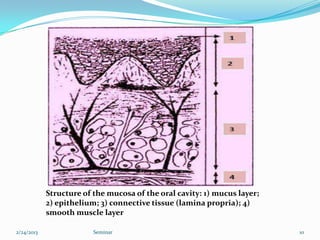
Structure of the mucosa of the oral cavity: 1) mucus layer;
            2) epithelium; 3) connective tissue (lamina propria); 4)
            smooth muscle layer

2/24/2013                Seminar                                          10
COMPOSITION OF MUCUS
LAYER:
        ‘Mucus is translucent and viscid secretion which
    forms a thin continuous gel adherent to mucosal
    epithelial surface.’
      Water                     - 95%
      Glycoprotein and lipids - 0.5-5%
      Mineral salts            - 1%
      Free proteins            - 0.5-1%
MUCOADHESION THEORY
Electronic theory
 Electronic theory is based on the premise that both
  mucoadhesive and biological materials possess
  opposing electrical charges. Thus, when both
  materials come into contact, they transfer electrons
  leading to the building of a double electronic layer at
  the interface, where the within this electronic double
  layer determines the mucoadhesive strength.
Drug transport mechanism
  Two major routes-(1) Transcellular (Intracellular)
                     (2) Paracellular (intercellular)
  The transcellular route involves the crossing of the cellular
   membranes with a polar and a lipid domain.
  The paracellular essentially implicates the passive diffusion
   through the extracellular lipid domain.
  To reach the systemic circulation ,drugs must also
   overcome an enzymatic barrier represented by the enzymes
   that are present on the mucosal surface & mucosa.
  Aminopeptidase,carboxypeptidase & estrase were found in
   homogenates of human epithelial cell culture.


2/24/2013        Seminar                                       13
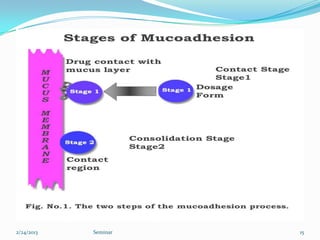
Mechanism of Mucoadhesion-
  Generally divided into two steps-(a)contact stage
                                   (b)consolidation stage
  first is characterized by the contact b/w the
  mucoadhesive &the mucus membrane ,with
  spreading & swelling of the formulation, initiating
  its deep contact with mucus layer.
  In step (b)the mucoadhesive material are
  activated by the presence of moisture


2/24/2013      Seminar                                  14
2/24/2013   Seminar   15
Formulation design-
  In case of both mucosal(local) & transmucosal
    (systemic) adm., conventional dosage are not able to
    assure therapeutic level.
  In MDDS contain the following functional agents-
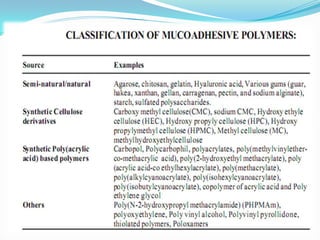
 (1) Mucoadhesive agents
 (2) Penetration enhencers
 (3) Enzyme inhibitors
  Mucoadhesive agents-the polymer hydration &
      consequently the mucus cohesive properties that
      promote mucoadhesion .
  Swelling should favour polymer chain flexibility &
      interpenetration b/w polymer & mucin chains.

2/24/2013      Seminar                                 16
 Ex-Polyacrylic acid (PAA)
      Polyvinyl alcholal(PVA)
      Sodium carboxymethylcelluose(NaCMC)
      Sodium alginate
      HPMC
      HEC
      HPC
  Various copolymer of acrylic acid suchas acrylic acid –
   polyethylene glycol monomethyl ether copolymer have also
   been studied.
 Penetration enhancers(PE)-
  PE are also required when a drug has to reach the systemic
   circulation to exert its action .
  Must be non-irritant &have a reversible effect.


2/24/2013         Seminar                                       17
 Recently chitosan & its derivatives, polymers
   already known for MA properties.chitosan help
   transportion of drug throw paracellular pathway.
 List of Permeation Enhancer :-
  Benzalkonium chloride
  Dextran sulfate
  Fatty acid
  Propyleneglycol
  Menthol
  Phosphatidylcholine
  Polysorbate 80
  Sodium EDTA
2/24/2013       Seminar                               18
Enzyme inhibitors-
  Drug +enzyme inhibitors---->improving the
   buccal absorption of drugs,particulary peptides.
   Ex-1-Aprotinin
      2-Bestatin
      3-Puromycin
       bile salts stabilise protein drugs by different
   mechanism(effecting the activity of the
   enzymes,altering the conformation of the
   protein.
  Chemical modification of chitosan with EDTA
   produces polymer conjugate chitosan –EDTA
   that is a very potent inhibitor of
   metallopeptidases (carboxypeptidase)
2/24/2013       Seminar                                  19
FACTORS AFFECTING MUCOADHESION-
    1-Mol. Wt.-Mucoadhesive is increase with mol wt above
      100,000.
    2-Flexibility-Mucoadhesive starts with the diffusion of the
      polymer chains in the interfacial region.
     Polymer chains contain a substantial degree of flexibility in
      order to achieve the desried entanglement with mucus.
    3-cross linked density-increse the density of cross
      linkedinsufficient of swellingdecrease rate of
      interpenetration b/w polymer & mucin.
    4-hydrogen bonding capacity-desired polymer must have
      functional grps that are able to form hydrogen bonds &
      flexibility of the polymer is improve this hydrogen bonding
      potential.

2/24/2013          Seminar                                        21
4-Hydration-polymer swelling permits a mechanical
   entanglement by exposing the bioadhesive sites for
   hyrogen bonding/ electrostatic interaction b/w
   polymer &mucus network.eg-HMA,PVA.
 5-Concentration-when conc.of the polymer is low ,the
   number of penetrating polymer chains per unit
   volume of mucus is small & interaction b/w polymer
   &mucus is unstable.
  In general the more concentrated polymer would
   result in longer penetrating chain length & better
   adhesion.


2/24/2013     Seminar                               22
 Higher conc.of polymer do not necessarily improve &
   ,in some cases, actually diminshed mucoadhesive
   properties.
 eg-high conc.of the flexible polymeric films based on
   polyvinyl pyrrolidone as film forming polymer did not
   further enhance the muco adhesive properties of the
   polymer.


2/24/2013      Seminar                                 23
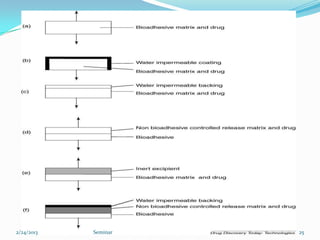
Dosage form-
  most common formulation in MDDS are tablets &
   patches.various dosage which are given in below-
 (1)Matrix tablets
 (2)Patches
 (3)Films
 (4)Gels &ointments
 Matrix tablets-(a)Monolithic
                (b)two layered tablets
  In      monolithicmixture     of   drug+swelling
    bioadhesive polymer
                     |
   bidirectional release & outer side coated with
    impermeable hyrophobic substances.

2/24/2013       Seminar                                24
2/24/2013   Seminar   25
In two layered matrix tablets-
  Comprises an inner layer based on bioadhesive
   polymer &an outer non-bioadhesive layer
   containing the drug for a bi-directional release
   but only local action .
  In case of systemic action outer layer is inert &
   act as a protective layer.

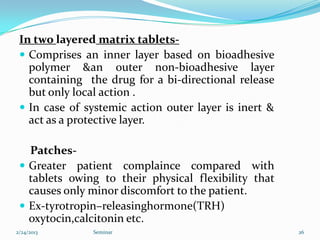
   Patches-
  Greater patient complaince compared with
   tablets owing to their physical flexibility that
   causes only minor discomfort to the patient.
  Ex-tyrotropin–releasinghormone(TRH)
   oxytocin,calcitonin etc.
2/24/2013      Seminar                                 26
Films-may be preferred over adhesive tablets in terms
   of flexibility &comfort.
  An ideal film should be flexible,elastic &soft, without
   breaking due to stress from mouth movements.

 Gels & ointments- adv.over other dosage form is that
   they are easily dispersion throughtout the mucosa.
  But accuracy of drug dosing may not be as accurate.
  Certain      polymer      are    used      such     as
   NaCMC, xanthan,carbopol,hyaluronic acid .
  They change from liquid to semisolid.
  HPMC has been used as an adhesive ointment
   ingredients.
2/24/2013        Seminar                                     27
Dosage    structures     Release      Effect       Active
  form                                               ingredient

  Matrix    Monolithic     Sustained/   Local/       Local-
  tablets   matrix         bidire.      systemic     metronidazo
                                                     le;systemic-
                                                     propanolol,
                                                     timolol


            Two-layer      Bi direct.   Local        As above
            matrix                                   mention

            Two-layer   Monodirect.     Local/system As above
            matrix                      ic
            coated with
            impermeable
            layer


2/24/2013        Seminar                                            28
Evaluation tests of muco-adhesive
tablets
 Weight variation
 Friability
 Hardness
 Content uniformity
 Drug release study of Mucoadhesive tablets
 Swelling index
 Water sorption studies
 Mucoadhesive strength
CASE STUDY IN EUDRAGIT BASED MUCOADHESIVE
   BUCCAL PATCHES OF SALBUTAMOL SULFATE
  Salbutamol(B2 adrenergic receptor agonist) is used for
   relief of bronchospasm in case of asthma & COPD.
  oral bioavailability is 40%(due to 1st pass effect) ,so
   salbutamol patches were prepared using Eudragit L-
   100,HPMC,PVA,& Carbopol934 in various proportions with
   PEG-400/PG as plasticizers.
  SS is usually is adm. via inhaled route for direct effect on
   bronchial smooth muscle,but also have some
   disadvantages like inaccuracy of dosing,patient complaince
   due to CFC,cost of the prepration &frequency of
   administration

2/24/2013        Seminar                                      30
 SS Patches were prepared by solvent casting techniques.
  In which eudragit in ethanol,HPMC in ethanol:acetone
     mixture (3:1) & PVA in water
    5ml of eudragit ,5ml of ethanol & 0.05% of tween 80 mixed
     well on magnetic stirrer at low rpm.
    In above mixture added 2ml of PG or PEG was added &
     mixed low rpm,drug soln must be bubble free.
    The soln was poured in teflon coated circular dish &hen
     dried in room temp.for 2hrs & further dried for 18hrs at
     4O0C in hot air oven.
    The patches were laminated on one side with water
     permeable backing layer.


2/24/2013         Seminar                                    31
EVALUATION TESTS OF PATCHES
1.    Mass uniformity & thickness
2.   Drug content
3.   Swelling index
4.   Measurment of surface PH
5.   Residence time
6.    Bioadhesion test: By tensile strength, shear strength,
     Fluorescent probe method, Atomic force microscopy
     (AFM), falling liquid film method,
7.    Permeability study: Using different diffusion cells
8.   Release rate study: Using USP dissolution test using
     rotating paddle dissolution test apparatus.
CONCLUSION-
  The mucoadhesive drug delivery offers several advantages
   for controlled drug delivery. The mucosa is well supplied
   with both vascular and lymphatic drainage.
  Mucoadhesive drug delivery is a promising area for
   systemic delivery of orally inefficient drugs as well as an
   attractive alternative for noninvasive delivery of potent
   peptide and perhaps protein drug molecules.
  A rational approach to dosage form design requires a
   complete understanding of the physicochemical and
   biopharmaceutical properties of the drug and excipients.


2/24/2013        Seminar                                     33
Mucoadhesive drug delivery system