TRANSDUCTION
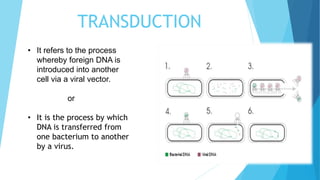
• It refers to the process
whereby foreign DNA is
introduced into another
cell via a viral vector.
or
• It is the process by which
DNA is transferred from
one bacterium to another
by a virus.
The experiments implicated a bacteriophage as the vector or
transducing agent.
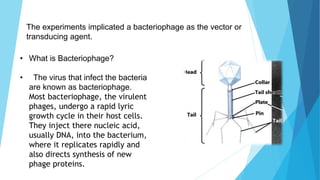
• What is Bacteriophage?
• The virus that infect the bacteria
are known as bacteriophage.
Most bacteriophage, the virulent
phages, undergo a rapid lyric
growth cycle in their host cells.
They inject there nucleic acid,
usually DNA, into the bacterium,
where it replicates rapidly and
also directs synthesis of new
phage proteins.
• Transduction occurs by either the lytic or lysogenic cycles.
•In a lytic infection, the host cells fills with virions and bursts.
•The result is cell death.
•Lysogenic infections are also known as latent infections.
•The viral genome becomes incorporated into the host cell’s DNA.
•It can remain this way for an extended period.
•The host cell lives.
Types of transduction
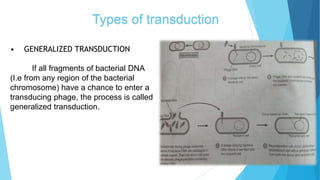
• GENERALIZED TRANSDUCTION
If all fragments of bacterial DNA
(I.e from any region of the bacterial
chromosome) have a chance to enter a
transducing phage, the process is called
generalized transduction.
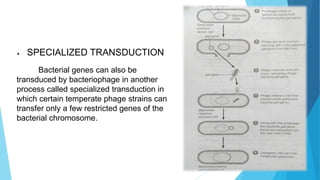
• SPECIALIZED TRANSDUCTION
Bacterial genes can also be
transduced by bacteriophage in another
process called specialized transduction in
which certain temperate phage strains can
transfer only a few restricted genes of the
bacterial chromosome.
GENERAL USES OF THE TERM AND APPLICATIONS
• More generally, transduction is the process by which genetic material e.g:
DNA or siRNA, is inserted into a cell by a virus.
• Common techniques in molecular biology are the use of viral
vectors(including bacteriophages).
• Some medical applications are:-
• It provide resistance to anti-biotic drugs.
• Helps in the correction of genetic diseases by direct modification of genetic
errors.
• It is a common tool used by molecular biologists to stably introduce a
foreign gene into a host cell’s genome.
Bacterial Transduction (microbiology)

Bacterial Transduction (microbiology)

  • 2.
    TRANSDUCTION • It refersto the process whereby foreign DNA is introduced into another cell via a viral vector. or • It is the process by which DNA is transferred from one bacterium to another by a virus.
  • 3.
    The experiments implicateda bacteriophage as the vector or transducing agent. • What is Bacteriophage? • The virus that infect the bacteria are known as bacteriophage. Most bacteriophage, the virulent phages, undergo a rapid lyric growth cycle in their host cells. They inject there nucleic acid, usually DNA, into the bacterium, where it replicates rapidly and also directs synthesis of new phage proteins.
  • 4.
    • Transduction occursby either the lytic or lysogenic cycles. •In a lytic infection, the host cells fills with virions and bursts. •The result is cell death. •Lysogenic infections are also known as latent infections. •The viral genome becomes incorporated into the host cell’s DNA. •It can remain this way for an extended period. •The host cell lives.
  • 5.
    Types of transduction •GENERALIZED TRANSDUCTION If all fragments of bacterial DNA (I.e from any region of the bacterial chromosome) have a chance to enter a transducing phage, the process is called generalized transduction.
  • 6.
    • SPECIALIZED TRANSDUCTION Bacterialgenes can also be transduced by bacteriophage in another process called specialized transduction in which certain temperate phage strains can transfer only a few restricted genes of the bacterial chromosome.
  • 7.
    GENERAL USES OFTHE TERM AND APPLICATIONS • More generally, transduction is the process by which genetic material e.g: DNA or siRNA, is inserted into a cell by a virus. • Common techniques in molecular biology are the use of viral vectors(including bacteriophages). • Some medical applications are:- • It provide resistance to anti-biotic drugs. • Helps in the correction of genetic diseases by direct modification of genetic errors. • It is a common tool used by molecular biologists to stably introduce a foreign gene into a host cell’s genome.