Beverages :- Wine,
Beer & Ethanol
HEENA KAUSAR
DEPARTMENT OF MICROBIOLOGY
What is beverages
Any potable liquid which is alcoholic and non
alcoholic is known as “beverages” . It is a liquid
intended for human consumption.
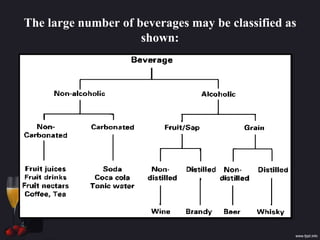
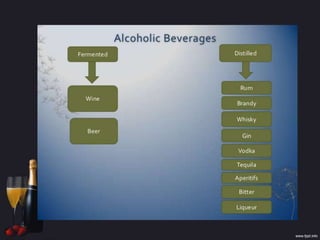
The large number of beverages may be classified as
shown:
Alcoholic beverages
• An alcoholic beverages is a drink that typically contains 30 -
60% ethanol commonly known as alcohol.
• Alcoholic beverages are divided into 3 classes:
 Beer
 Wine
 Spirit (distilled beverages)
• They are legally consumed in most countries around the
world. More than 100 countries have laws regulating their
production , sale and consumption.
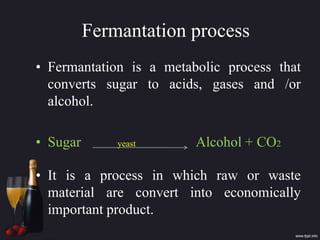
Fermantation process
• Fermantation is a metabolic process that
converts sugar to acids, gases and /or
alcohol.
• Sugar yeast Alcohol + CO2
• It is a process in which raw or waste
material are convert into economically
important product.
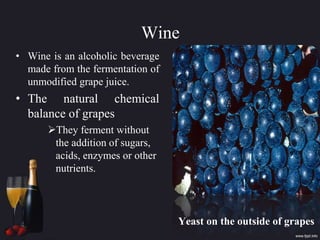
Wine
• Wine is an alcoholic beverage
made from the fermentation of
unmodified grape juice.
• The natural chemical
balance of grapes
They ferment without
the addition of sugars,
acids, enzymes or other
nutrients.
Yeast on the outside of grapes
• Temperature is the most important factor in
storing wine
– Optimum temperature: 50 to 55°F
– Acceptable temperature: 40 to 65°F
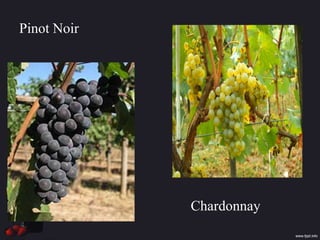
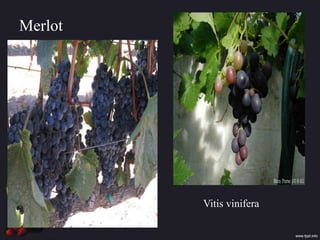
Grape Varieties
Wine is usually made from one or more varieties of
the European species.
Pinot Noir
Chardonnay
Merlot
Vitis vinifera
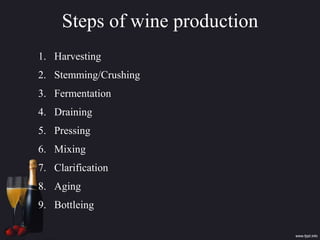
Steps of wine production
1. Harvesting
2. Stemming/Crushing
3. Fermentation
4. Draining
5. Pressing
6. Mixing
7. Clarification
8. Aging
9. Bottleing
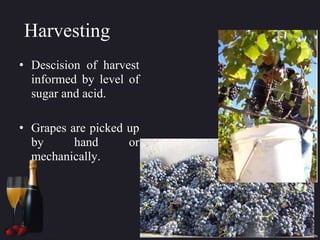
Harvesting
• Descision of harvest
informed by level of
sugar and acid.
• Grapes are picked up
by hand or
mechanically.
Stemming/Crushing
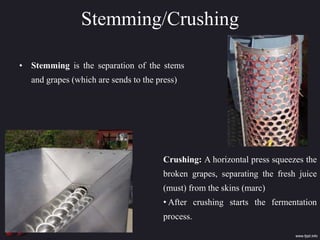
• Stemming is the separation of the stems
and grapes (which are sends to the press)
Crushing: A horizontal press squeezes the
broken grapes, separating the fresh juice
(must) from the skins (marc)
• After crushing starts the fermentation
process.
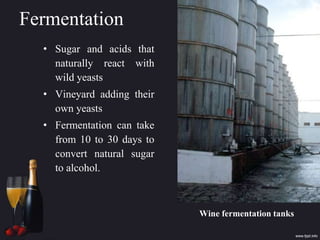
Fermentation
• Sugar and acids that
naturally react with
wild yeasts
• Vineyard adding their
own yeasts
• Fermentation can take
from 10 to 30 days to
convert natural sugar
to alcohol.
Wine fermentation tanks
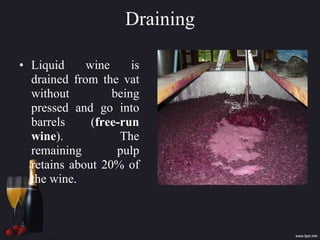
Draining
• Liquid wine is
drained from the vat
without being
pressed and go into
barrels (free-run
wine). The
remaining pulp
retains about 20% of
the wine.
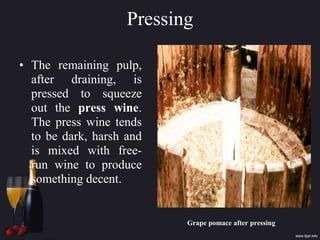
Pressing
• The remaining pulp,
after draining, is
pressed to squeeze
out the press wine.
The press wine tends
to be dark, harsh and
is mixed with free-
run wine to produce
something decent.
Grape pomace after pressing
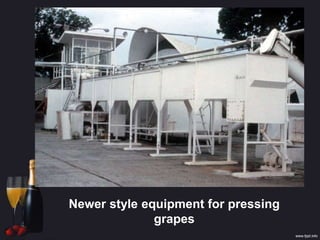
Newer style equipment for pressing
grapes
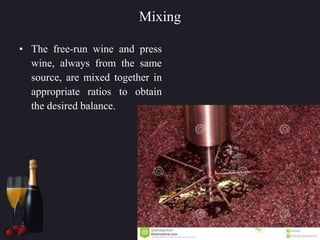
Mixing
• The free-run wine and press
wine, always from the same
source, are mixed together in
appropriate ratios to obtain
the desired balance.
• Clarification
• Clarification is the step of stabilisation of fermentation.
• During clarification all remaining solids are removed from the
fermented liquid.
• Clarification done in numerous ways:
 Running the liquid through coarse and fine filters
 Siphoning the liquid off the top of the fermenting vats after the
solids have settled to the bottom
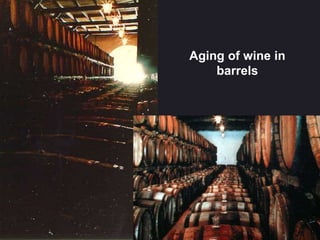
Aging
• The final stage in vinification is aging the wine. At this
point, the clarified wine is transferred into either wooden
barrels or metal vats in which the wine is allowed to
further mature and develop flavors. If a winemaker
chooses to age the wine in wooden casks, he will be
allowing the wine to pick up flavors from the wood,
adding greater depth to its flavors. While this can add
body to some wines, keep in mind that the “woody”
flavor isn’t suited to all types of wine, hence the use of
metal vats.
Aging of wine in
barrels
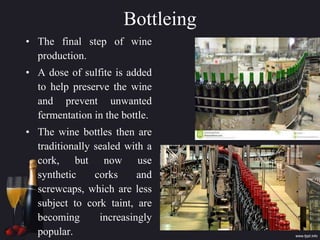
Bottleing
• The final step of wine
production.
• A dose of sulfite is added
to help preserve the wine
and prevent unwanted
fermentation in the bottle.
• The wine bottles then are
traditionally sealed with a
cork, but now use
synthetic corks and
screwcaps, which are less
subject to cork taint, are
becoming increasingly
popular.
Different Kinds of Wine
• Red or white wine
• Rosé wine
• Table wine
• Sparkling wines
• Dessert wine
• Fortified wine
• Cooking wine
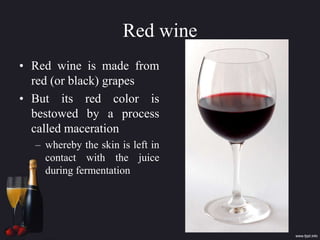
Red wine
• Red wine is made from
red (or black) grapes
• But its red color is
bestowed by a process
called maceration
– whereby the skin is left in
contact with the juice
during fermentation
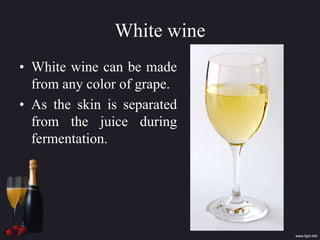
White wine
• White wine can be made
from any color of grape.
• As the skin is separated
from the juice during
fermentation.
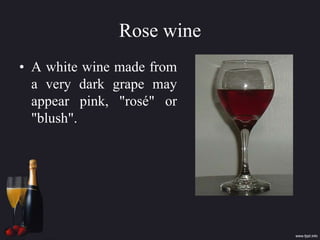
Rose wine
• A white wine made from
a very dark grape may
appear pink, "rosé" or
"blush".
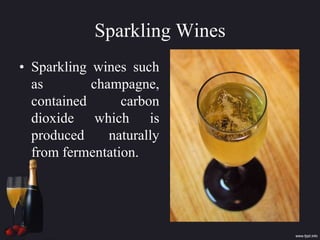
Sparkling Wines
• Sparkling wines such
as champagne,
contained carbon
dioxide which is
produced naturally
from fermentation.
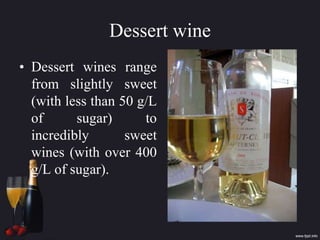
Dessert wine
• Dessert wines range
from slightly sweet
(with less than 50 g/L
of sugar) to
incredibly sweet
wines (with over 400
g/L of sugar).
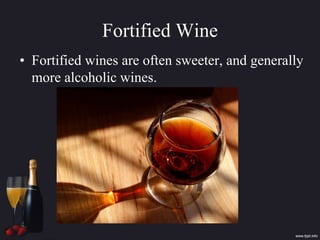
Fortified Wine
• Fortified wines are often sweeter, and generally
more alcoholic wines.
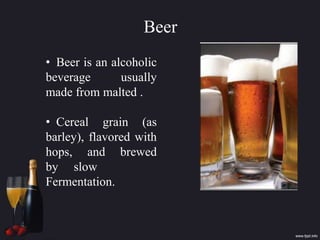
Beer
• Beer is an alcoholic
beverage usually
made from malted .
• Cereal grain (as
barley), flavored with
hops, and brewed
by slow
Fermentation.
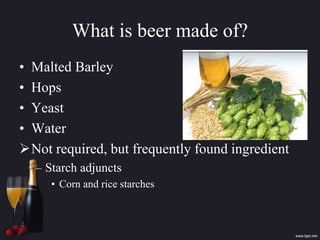
What is beer made of?
• Malted Barley
• Hops
• Yeast
• Water
Not required, but frequently found ingredient
– Starch adjuncts
• Corn and rice starches
Making Beer:
a three step process
• Malting
• Brewing
• Fermentation
Malting
• In the preparation of malt , barley grains are
soaked at 10 to 15.6 C , and germinated at 16
to 21 C for 5 to 7 days.
• Most of the sprout or germs are removed, and
the malt remains.
Brewing process
1. Mashing
2. Fermenting
3. Conditioning
4. Filtering
5. Packaging
Mashing
• Main ingredients such as water, malted barley
and hops are put in a kettle and mix at 38 to 50 C.
• The mash is then boiled with hops in order to
obtain wort.
• Hot wort is cooled down to fermenting
temperature and then fermented using beer yeast.
Fermentation
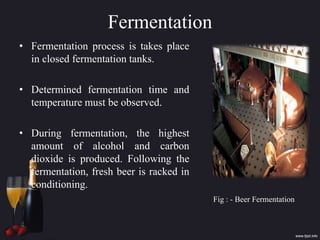
• Fermentation process is takes place
in closed fermentation tanks.
• Determined fermentation time and
temperature must be observed.
• During fermentation, the highest
amount of alcohol and carbon
dioxide is produced. Following the
fermentation, fresh beer is racked in
conditioning.
Fig : - Beer Fermentation
Conditioning
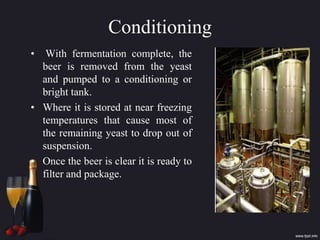
• With fermentation complete, the
beer is removed from the yeast
and pumped to a conditioning or
bright tank.
• Where it is stored at near freezing
temperatures that cause most of
the remaining yeast to drop out of
suspension.
• Once the beer is clear it is ready to
filter and package.
Filtering and packaging
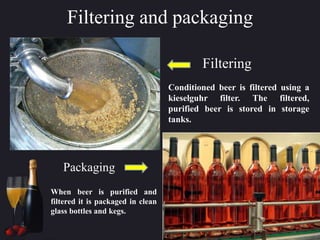
Conditioned beer is filtered using a
kieselguhr filter. The filtered,
purified beer is stored in storage
tanks.
Filtering
When beer is purified and
filtered it is packaged in clean
glass bottles and kegs.
Packaging
Alcoholic fermentation (ethanol)
• Ethanol fermentation also called alcoholic
fermentation, is a biological process which convert
sugar such as glucose, fructose and sucrose into
cellular energy, producing ethanol and CO2.
yeast
Sugar Alcohol + CO2
• Because yeasts perform this conversion in the
absence of oxygen.
• Alcoholic fermentation is considered an anaerobic
process.
• Usually the strain of yeast, Sacchromyces cerevisiae
are employed for commercial production of ethyl
alcohol.
• Generally, strains of S. cerevisiae are selected when
starchy material, as well as saccharide material like
mollasses are use as raw material.
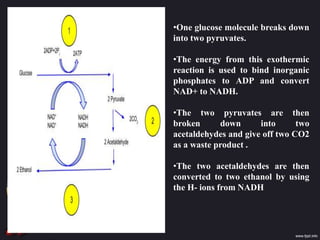
•One glucose molecule breaks down
into two pyruvates.
•The energy from this exothermic
reaction is used to bind inorganic
phosphates to ADP and convert
NAD+ to NADH.
•The two pyruvates are then
broken down into two
acetaldehydes and give off two CO2
as a waste product .
•The two acetaldehydes are then
converted to two ethanol by using
the H- ions from NADH
Raw materials
• A variety of corbohydrates available as waste product
of agricultural industries are used for preparation of
fermentation medium.
• On the basis of their chemical nature they may be
group as-
 Saccharide material – molasses , whey, fruit juices
 Starchy material – potato starch, corn starch wheat
flour.
 Cellulosic material – sulphite waste material and
liquor
Fermentation condition
• Carbon source - Sugar concentration in the range of
10 to 18 % is found satisfactory.
 Ex- Cane molasses contains sucrose as a carbon
source.
• Nitrogen source – Ammonium sulphate (0.15 gms /
2.5 gallons of molasses)is generally used.
• pH – pH of the fermentation medium is adjusted to
4.8 – 5 . The higher value of pH increase the chance
of contaimination, whereas the lower pH values
inhibit the yield of ethyl alcohol.
• Temperature – Usually, the temp. range of 70-80 ͦ F
is preferred.
• Time – Fermentation starts within a few hours after
the addition of yeast, the process complete after 30-72
hrs in this stage it contains 6-8% of ethyl alcohol.
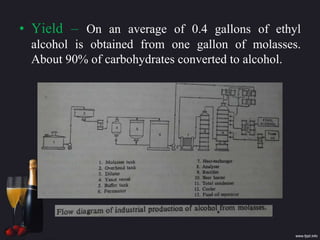
• Yield – On an average of 0.4 gallons of ethyl
alcohol is obtained from one gallon of molasses.
About 90% of carbohydrates converted to alcohol.
• Recovery – The fermented liquid is allowed to
settle for a few hours and then distilled in
analyser and rectifier columns to obtain
rectifier spirit ethyl alcohol.
• The highest concentration that can be secured
by fractional distillation is the constant boilling
mixture which contains 95.6% ethyl alcohol
and remaining 4.4% is water.
References
• Industrial microbiology by A. H. patel Pg. no. 146-148.
• Industrial microbiology by L. E. Casida , JR , chapter 18
anaerobic fermentation pg. no. 299- 303.
• Food microbiology 4th edition by W. C. Frazier and D. C.
Westhoff chapter 22 , food fermentations pg. no. 339-
341.
Thank you

Beverages :- Wine, Beer & Ethanol

  • 1.
    Beverages :- Wine, Beer& Ethanol HEENA KAUSAR DEPARTMENT OF MICROBIOLOGY
  • 2.
    What is beverages Anypotable liquid which is alcoholic and non alcoholic is known as “beverages” . It is a liquid intended for human consumption.
  • 3.
    The large numberof beverages may be classified as shown:
  • 4.
    Alcoholic beverages • Analcoholic beverages is a drink that typically contains 30 - 60% ethanol commonly known as alcohol. • Alcoholic beverages are divided into 3 classes:  Beer  Wine  Spirit (distilled beverages) • They are legally consumed in most countries around the world. More than 100 countries have laws regulating their production , sale and consumption.
  • 6.
    Fermantation process • Fermantationis a metabolic process that converts sugar to acids, gases and /or alcohol. • Sugar yeast Alcohol + CO2 • It is a process in which raw or waste material are convert into economically important product.
  • 7.
    Wine • Wine isan alcoholic beverage made from the fermentation of unmodified grape juice. • The natural chemical balance of grapes They ferment without the addition of sugars, acids, enzymes or other nutrients. Yeast on the outside of grapes
  • 8.
    • Temperature isthe most important factor in storing wine – Optimum temperature: 50 to 55°F – Acceptable temperature: 40 to 65°F Grape Varieties Wine is usually made from one or more varieties of the European species.
  • 9.
  • 10.
  • 11.
    Steps of wineproduction 1. Harvesting 2. Stemming/Crushing 3. Fermentation 4. Draining 5. Pressing 6. Mixing 7. Clarification 8. Aging 9. Bottleing
  • 12.
    Harvesting • Descision ofharvest informed by level of sugar and acid. • Grapes are picked up by hand or mechanically.
  • 13.
    Stemming/Crushing • Stemming isthe separation of the stems and grapes (which are sends to the press) Crushing: A horizontal press squeezes the broken grapes, separating the fresh juice (must) from the skins (marc) • After crushing starts the fermentation process.
  • 14.
    Fermentation • Sugar andacids that naturally react with wild yeasts • Vineyard adding their own yeasts • Fermentation can take from 10 to 30 days to convert natural sugar to alcohol. Wine fermentation tanks
  • 15.
    Draining • Liquid wineis drained from the vat without being pressed and go into barrels (free-run wine). The remaining pulp retains about 20% of the wine.
  • 16.
    Pressing • The remainingpulp, after draining, is pressed to squeeze out the press wine. The press wine tends to be dark, harsh and is mixed with free- run wine to produce something decent. Grape pomace after pressing
  • 17.
    Newer style equipmentfor pressing grapes
  • 18.
    Mixing • The free-runwine and press wine, always from the same source, are mixed together in appropriate ratios to obtain the desired balance.
  • 19.
    • Clarification • Clarificationis the step of stabilisation of fermentation. • During clarification all remaining solids are removed from the fermented liquid. • Clarification done in numerous ways:  Running the liquid through coarse and fine filters  Siphoning the liquid off the top of the fermenting vats after the solids have settled to the bottom
  • 20.
    Aging • The finalstage in vinification is aging the wine. At this point, the clarified wine is transferred into either wooden barrels or metal vats in which the wine is allowed to further mature and develop flavors. If a winemaker chooses to age the wine in wooden casks, he will be allowing the wine to pick up flavors from the wood, adding greater depth to its flavors. While this can add body to some wines, keep in mind that the “woody” flavor isn’t suited to all types of wine, hence the use of metal vats.
  • 21.
    Aging of winein barrels
  • 22.
    Bottleing • The finalstep of wine production. • A dose of sulfite is added to help preserve the wine and prevent unwanted fermentation in the bottle. • The wine bottles then are traditionally sealed with a cork, but now use synthetic corks and screwcaps, which are less subject to cork taint, are becoming increasingly popular.
  • 23.
    Different Kinds ofWine • Red or white wine • Rosé wine • Table wine • Sparkling wines • Dessert wine • Fortified wine • Cooking wine
  • 24.
    Red wine • Redwine is made from red (or black) grapes • But its red color is bestowed by a process called maceration – whereby the skin is left in contact with the juice during fermentation
  • 25.
    White wine • Whitewine can be made from any color of grape. • As the skin is separated from the juice during fermentation.
  • 26.
    Rose wine • Awhite wine made from a very dark grape may appear pink, "rosé" or "blush".
  • 27.
    Sparkling Wines • Sparklingwines such as champagne, contained carbon dioxide which is produced naturally from fermentation.
  • 28.
    Dessert wine • Dessertwines range from slightly sweet (with less than 50 g/L of sugar) to incredibly sweet wines (with over 400 g/L of sugar).
  • 29.
    Fortified Wine • Fortifiedwines are often sweeter, and generally more alcoholic wines.
  • 30.
    Beer • Beer isan alcoholic beverage usually made from malted . • Cereal grain (as barley), flavored with hops, and brewed by slow Fermentation.
  • 31.
    What is beermade of? • Malted Barley • Hops • Yeast • Water Not required, but frequently found ingredient – Starch adjuncts • Corn and rice starches
  • 32.
    Making Beer: a threestep process • Malting • Brewing • Fermentation
  • 33.
    Malting • In thepreparation of malt , barley grains are soaked at 10 to 15.6 C , and germinated at 16 to 21 C for 5 to 7 days. • Most of the sprout or germs are removed, and the malt remains.
  • 34.
    Brewing process 1. Mashing 2.Fermenting 3. Conditioning 4. Filtering 5. Packaging
  • 35.
    Mashing • Main ingredientssuch as water, malted barley and hops are put in a kettle and mix at 38 to 50 C. • The mash is then boiled with hops in order to obtain wort. • Hot wort is cooled down to fermenting temperature and then fermented using beer yeast.
  • 36.
    Fermentation • Fermentation processis takes place in closed fermentation tanks. • Determined fermentation time and temperature must be observed. • During fermentation, the highest amount of alcohol and carbon dioxide is produced. Following the fermentation, fresh beer is racked in conditioning. Fig : - Beer Fermentation
  • 37.
    Conditioning • With fermentationcomplete, the beer is removed from the yeast and pumped to a conditioning or bright tank. • Where it is stored at near freezing temperatures that cause most of the remaining yeast to drop out of suspension. • Once the beer is clear it is ready to filter and package.
  • 38.
    Filtering and packaging Conditionedbeer is filtered using a kieselguhr filter. The filtered, purified beer is stored in storage tanks. Filtering When beer is purified and filtered it is packaged in clean glass bottles and kegs. Packaging
  • 39.
    Alcoholic fermentation (ethanol) •Ethanol fermentation also called alcoholic fermentation, is a biological process which convert sugar such as glucose, fructose and sucrose into cellular energy, producing ethanol and CO2. yeast Sugar Alcohol + CO2 • Because yeasts perform this conversion in the absence of oxygen. • Alcoholic fermentation is considered an anaerobic process.
  • 40.
    • Usually thestrain of yeast, Sacchromyces cerevisiae are employed for commercial production of ethyl alcohol. • Generally, strains of S. cerevisiae are selected when starchy material, as well as saccharide material like mollasses are use as raw material.
  • 41.
    •One glucose moleculebreaks down into two pyruvates. •The energy from this exothermic reaction is used to bind inorganic phosphates to ADP and convert NAD+ to NADH. •The two pyruvates are then broken down into two acetaldehydes and give off two CO2 as a waste product . •The two acetaldehydes are then converted to two ethanol by using the H- ions from NADH
  • 42.
    Raw materials • Avariety of corbohydrates available as waste product of agricultural industries are used for preparation of fermentation medium. • On the basis of their chemical nature they may be group as-  Saccharide material – molasses , whey, fruit juices  Starchy material – potato starch, corn starch wheat flour.  Cellulosic material – sulphite waste material and liquor
  • 43.
    Fermentation condition • Carbonsource - Sugar concentration in the range of 10 to 18 % is found satisfactory.  Ex- Cane molasses contains sucrose as a carbon source. • Nitrogen source – Ammonium sulphate (0.15 gms / 2.5 gallons of molasses)is generally used.
  • 44.
    • pH –pH of the fermentation medium is adjusted to 4.8 – 5 . The higher value of pH increase the chance of contaimination, whereas the lower pH values inhibit the yield of ethyl alcohol. • Temperature – Usually, the temp. range of 70-80 ͦ F is preferred. • Time – Fermentation starts within a few hours after the addition of yeast, the process complete after 30-72 hrs in this stage it contains 6-8% of ethyl alcohol.
  • 45.
    • Yield –On an average of 0.4 gallons of ethyl alcohol is obtained from one gallon of molasses. About 90% of carbohydrates converted to alcohol.
  • 46.
    • Recovery –The fermented liquid is allowed to settle for a few hours and then distilled in analyser and rectifier columns to obtain rectifier spirit ethyl alcohol. • The highest concentration that can be secured by fractional distillation is the constant boilling mixture which contains 95.6% ethyl alcohol and remaining 4.4% is water.
  • 47.
    References • Industrial microbiologyby A. H. patel Pg. no. 146-148. • Industrial microbiology by L. E. Casida , JR , chapter 18 anaerobic fermentation pg. no. 299- 303. • Food microbiology 4th edition by W. C. Frazier and D. C. Westhoff chapter 22 , food fermentations pg. no. 339- 341.
  • 48.