TERM PAPER PRESENTATION
GP-508
TRANSCRIPTION
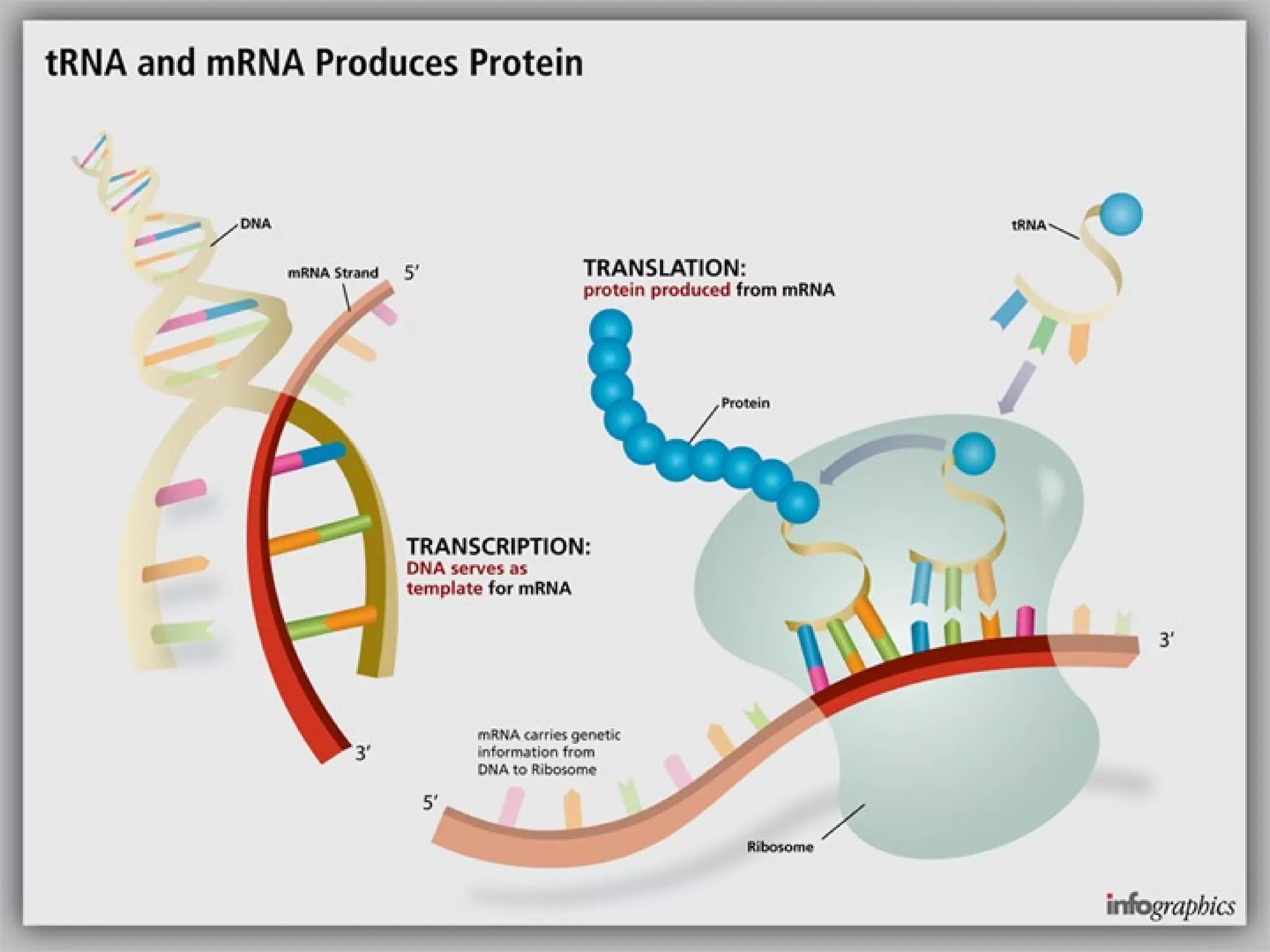
The synthesis of RNA molecules using DNA
strands as the templates so that the genetic
information can be transferred from DNA to
RNA.
TRANSCRIPTION
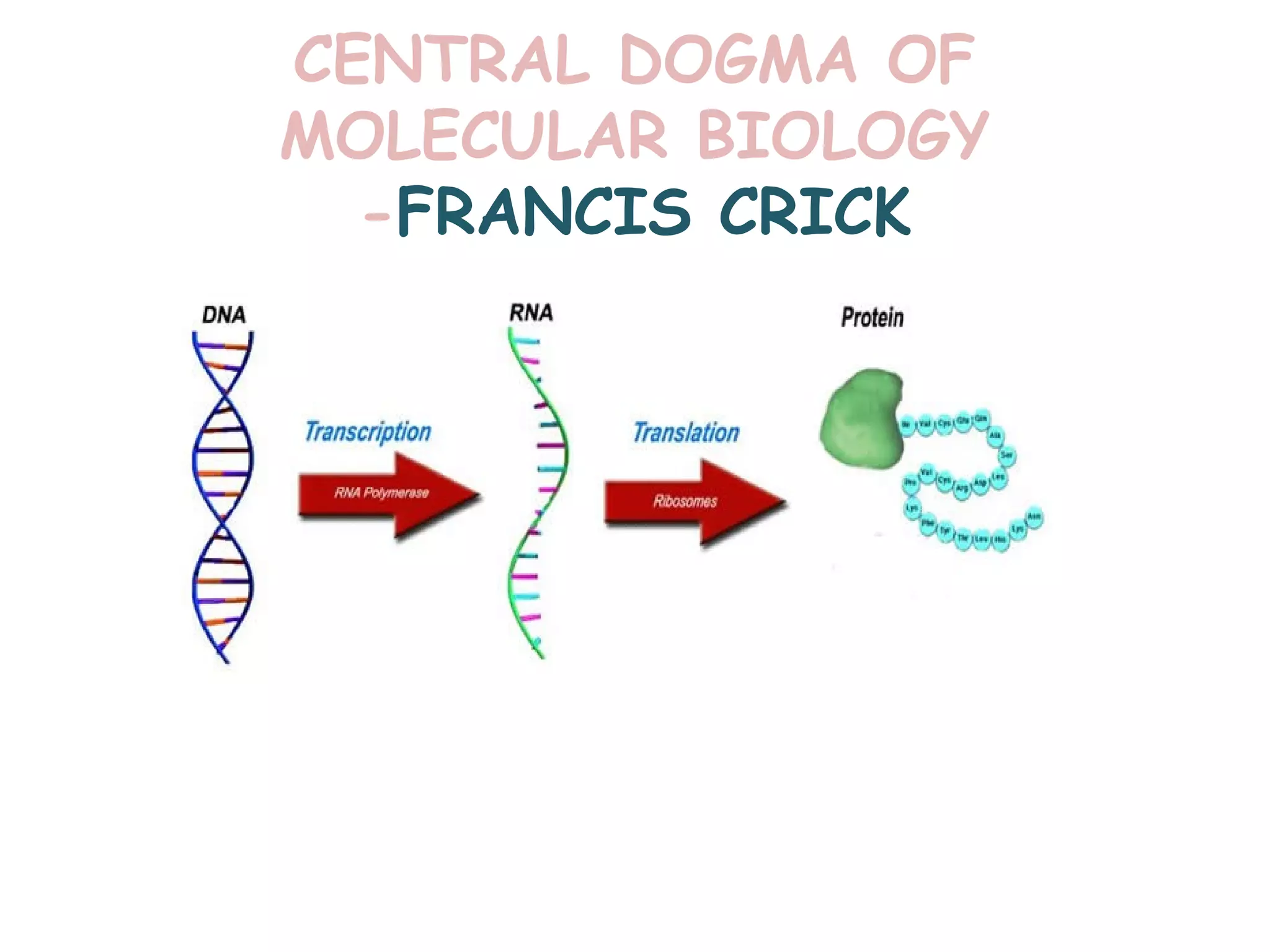
CENTRAL DOGMA OF
MOLECULAR BIOLOGY
-FRANCIS CRICK
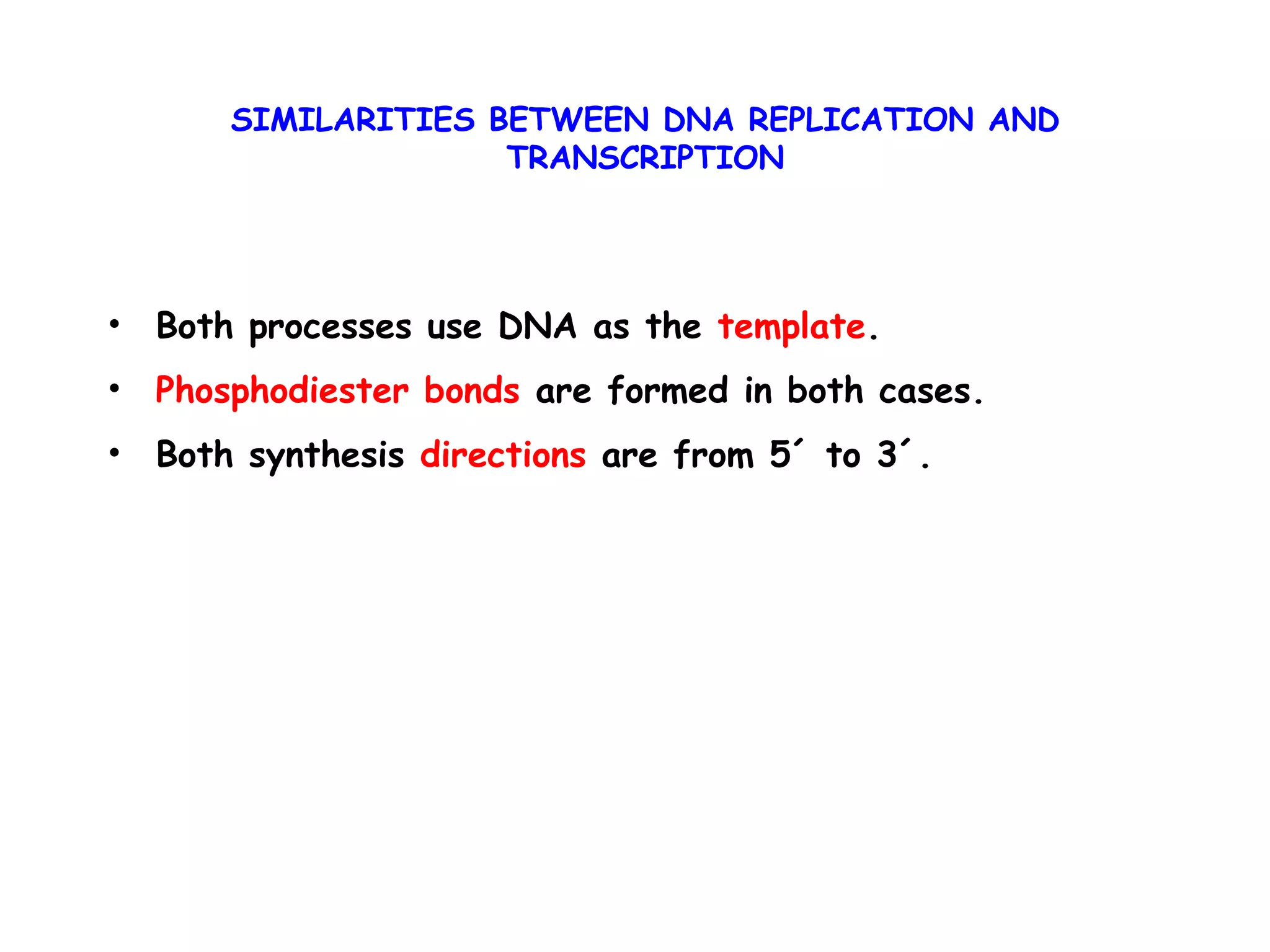
SIMILARITIES BETWEEN DNA REPLICATION AND
TRANSCRIPTION
• Both processes use DNA as the template.
• Phosphodiester bonds are formed in both cases.
• Both synthesis directions are from 5´ to 3´.
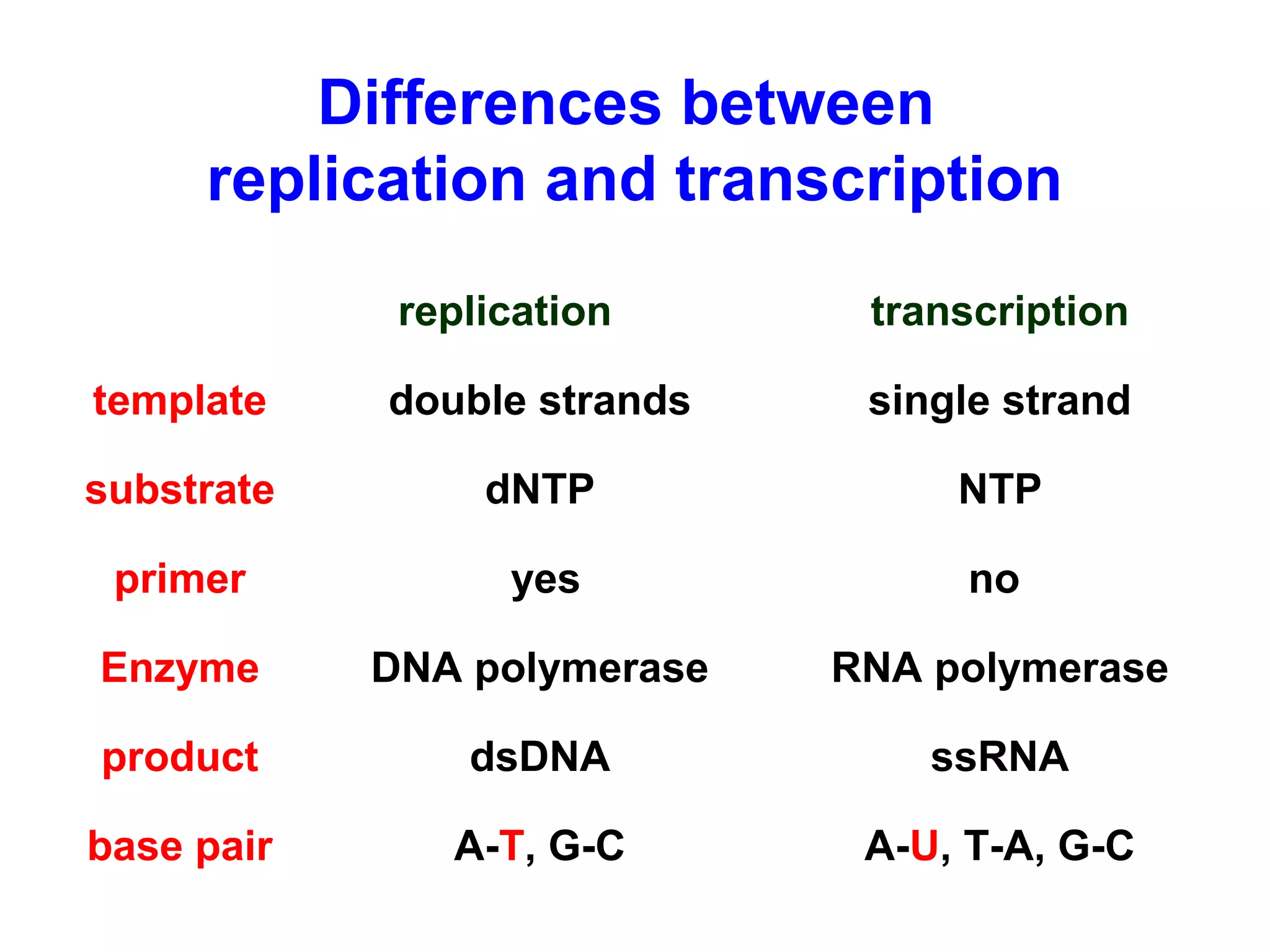
replication transcription
template double strands single strand
substrate dNTP NTP
primer yes no
Enzyme DNA polymerase RNA polymerase
product dsDNA ssRNA
base pair A-T, G-C A-U, T-A, G-C
Differences between
replication and transcription
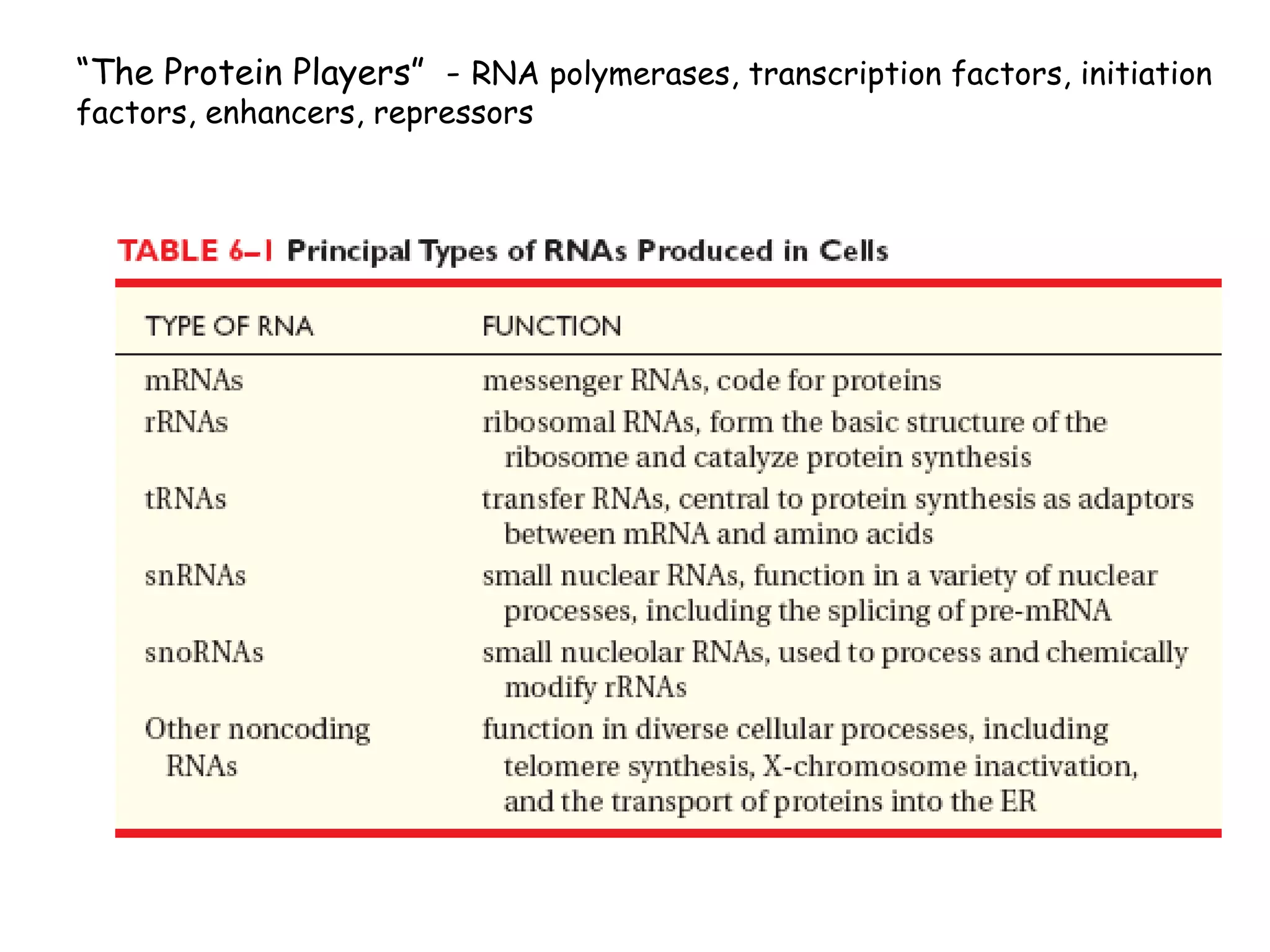
“The Protein Players” - RNA polymerases, transcription factors, initiation
factors, enhancers, repressors
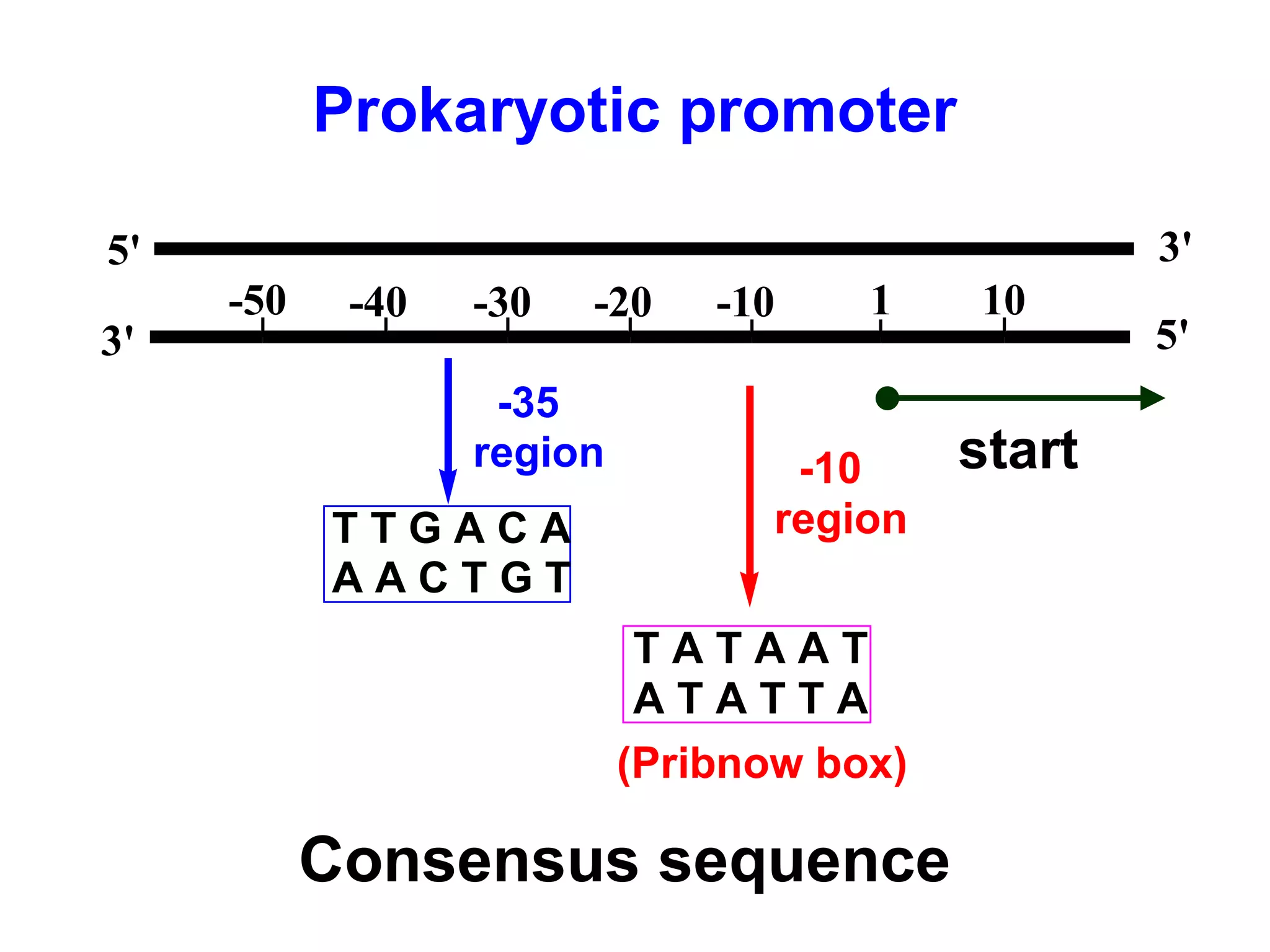
5'
3'
3'
5'
-50 -40 -30 -20 -10 1 10
start-10
region
T A T A A T
A T A T T A
(Pribnow box)
-35
region
T T G A C A
A A C T G T
Prokaryotic promoter
Consensus sequence
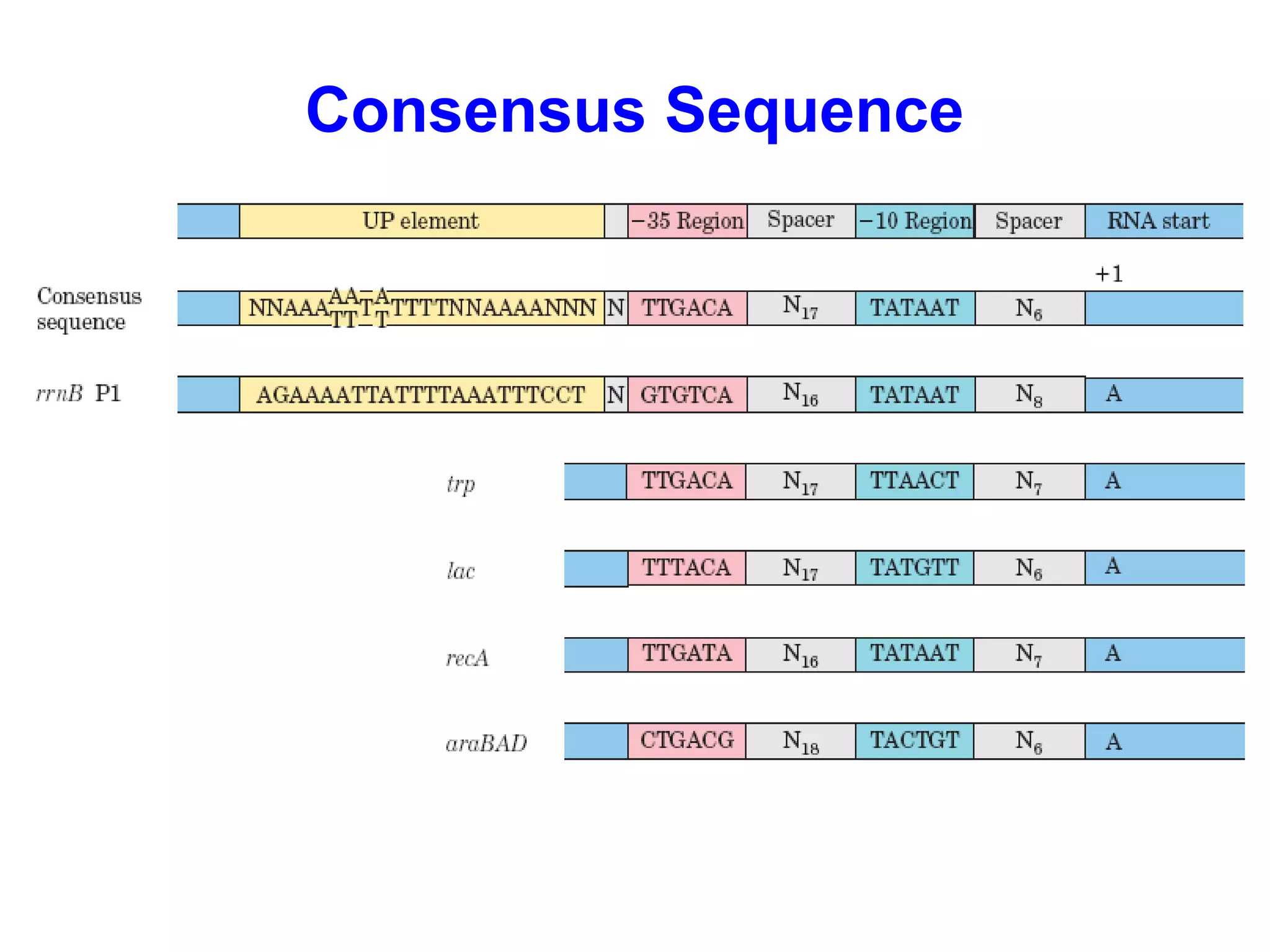
Consensus Sequence
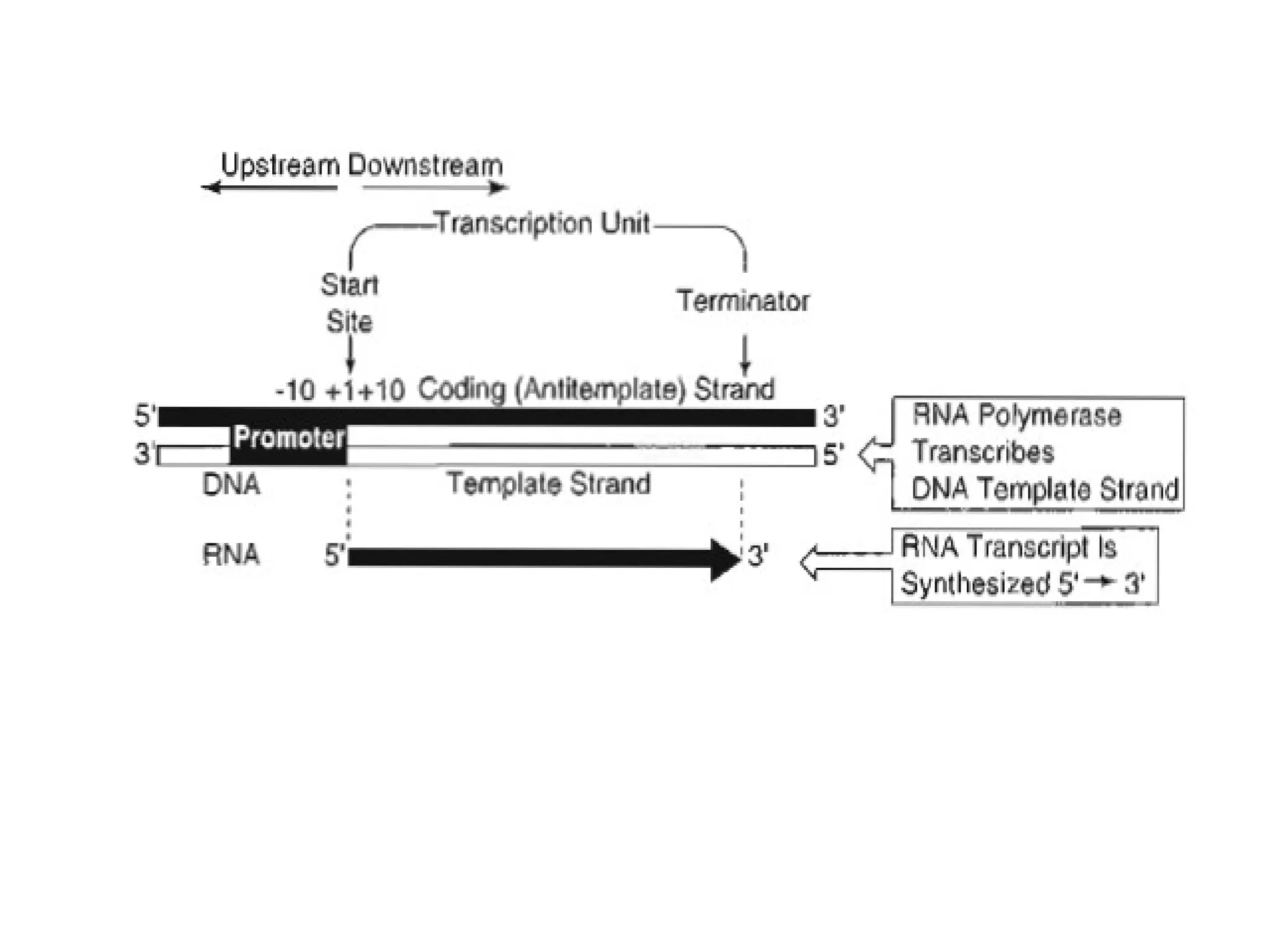
Figure 1-3-2. Transcription of DNA
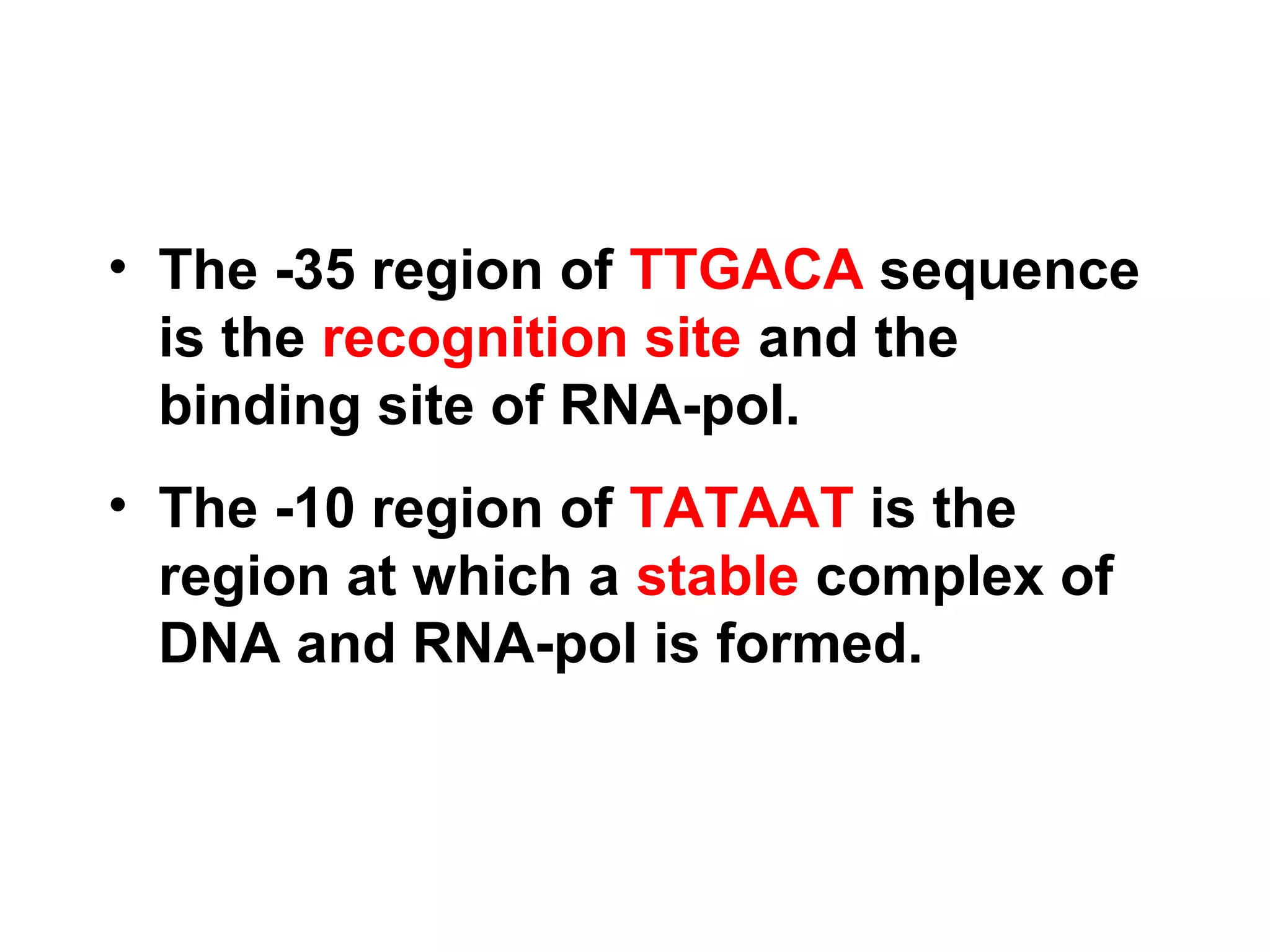
• The -35 region of TTGACA sequence
is the recognition site and the
binding site of RNA-pol.
• The -10 region of TATAAT is the
region at which a stable complex of
DNA and RNA-pol is formed.
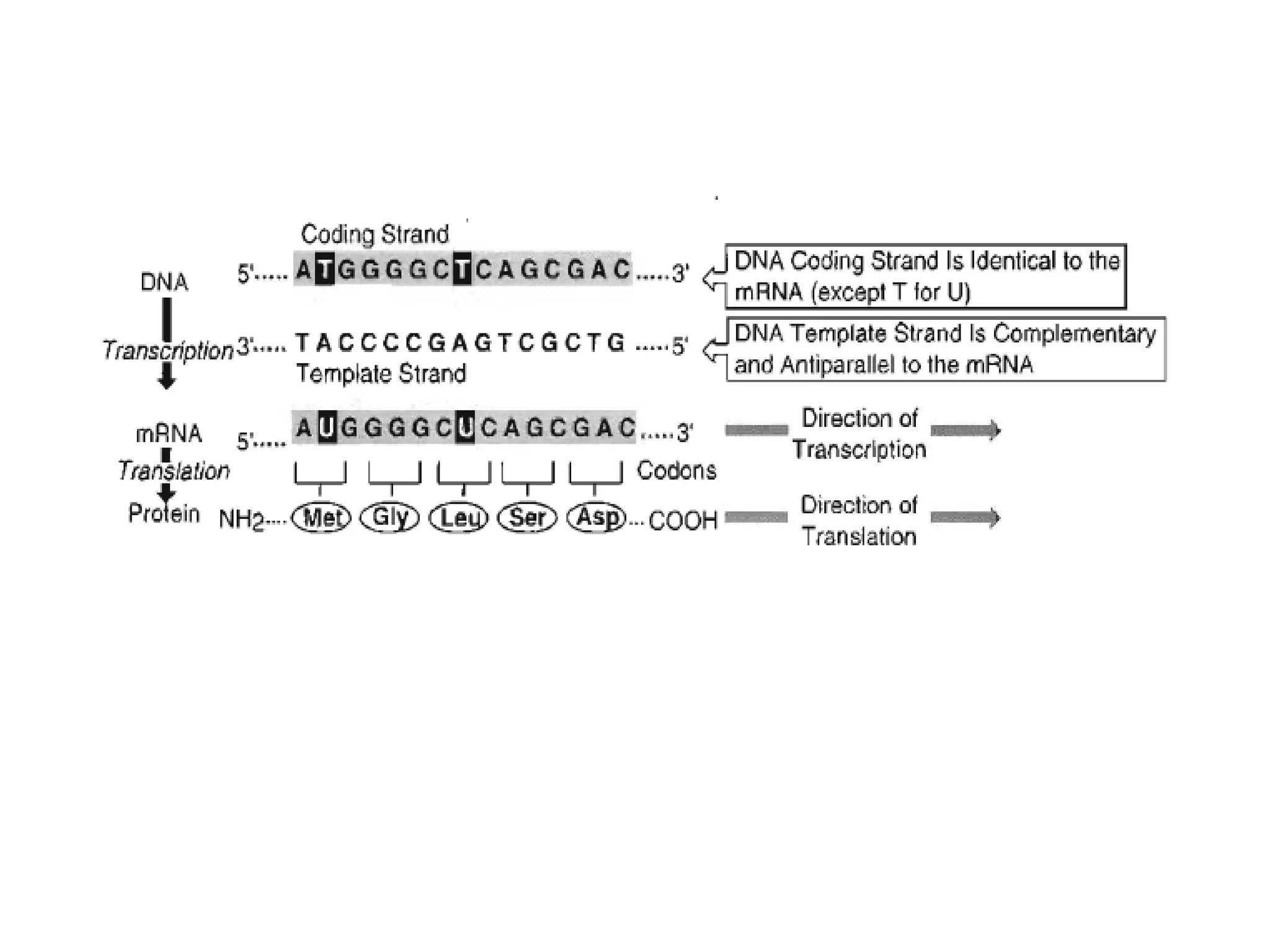
Figure 1-3-3. Flow of Genetic Information From DNA to Protein
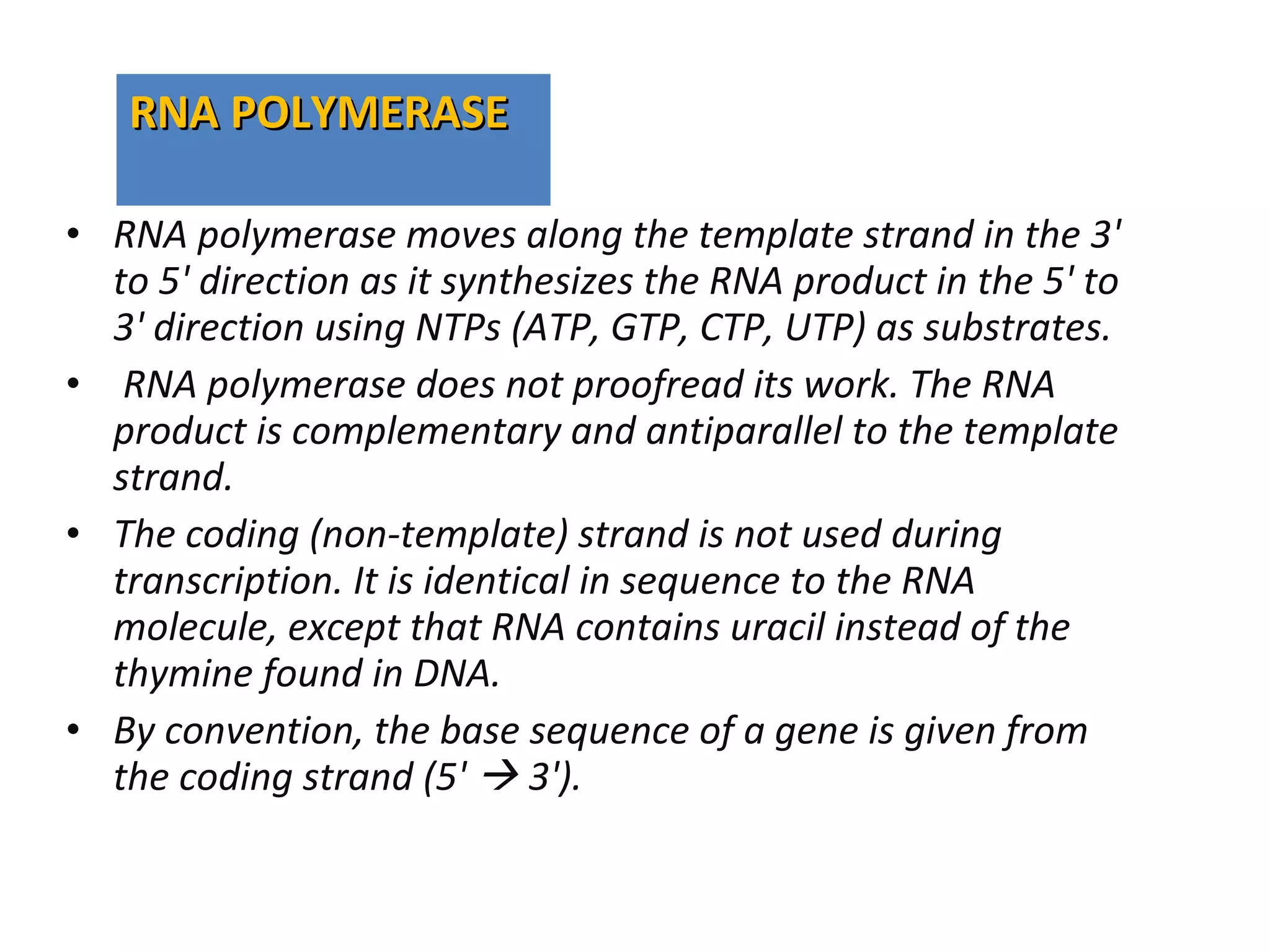
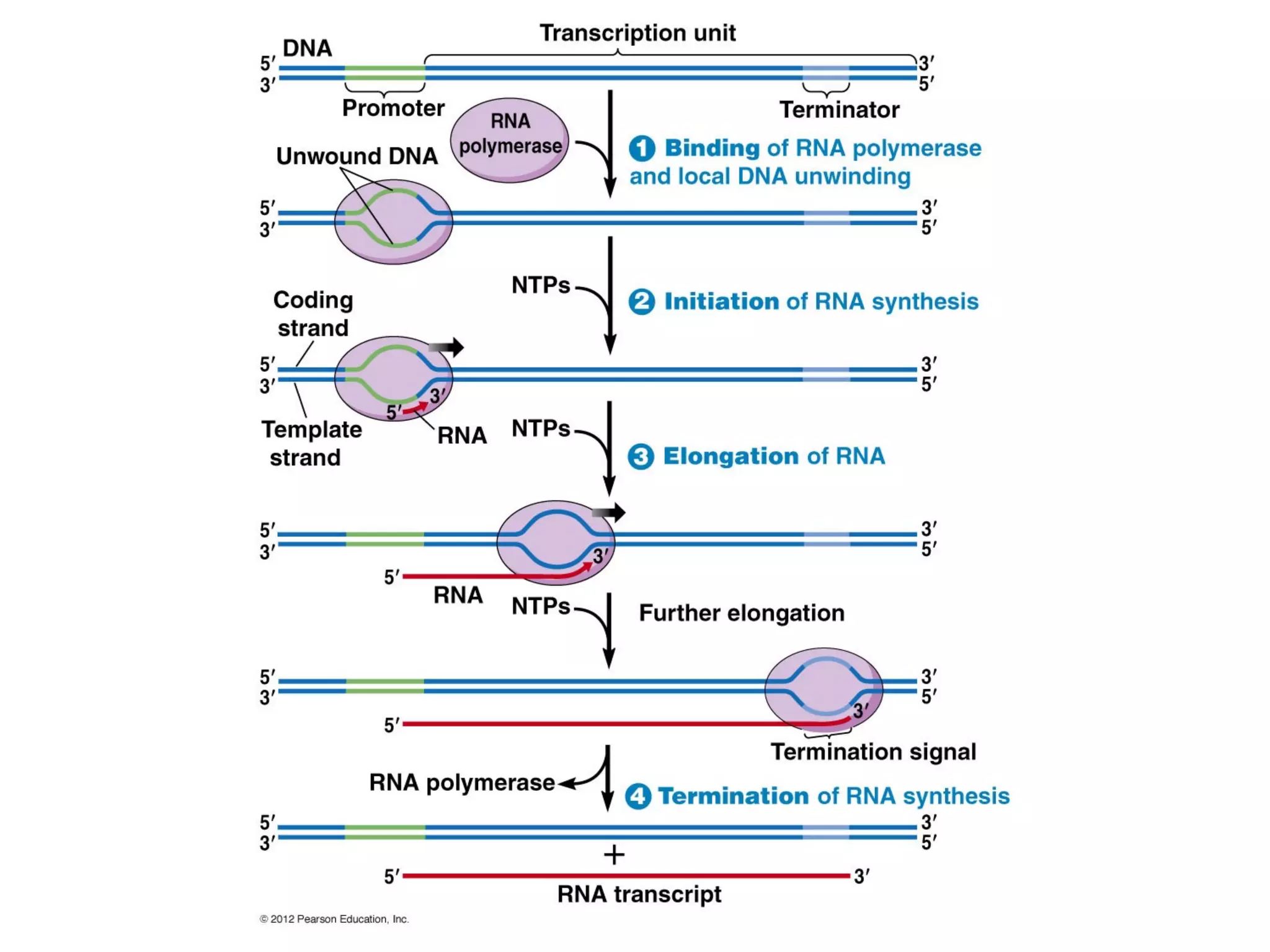
• RNA polymerase moves along the template strand in the 3'
to 5' direction as it synthesizes the RNA product in the 5' to
3' direction using NTPs (ATP, GTP, CTP, UTP) as substrates.
• RNA polymerase does not proofread its work. The RNA
product is complementary and antiparallel to the template
strand.
• The coding (non-template) strand is not used during
transcription. It is identical in sequence to the RNA
molecule, except that RNA contains uracil instead of the
thymine found in DNA.
• By convention, the base sequence of a gene is given from
the coding strand (5'  3').
RNA POLYMERASERNA POLYMERASE
core enzymeholoenzyme
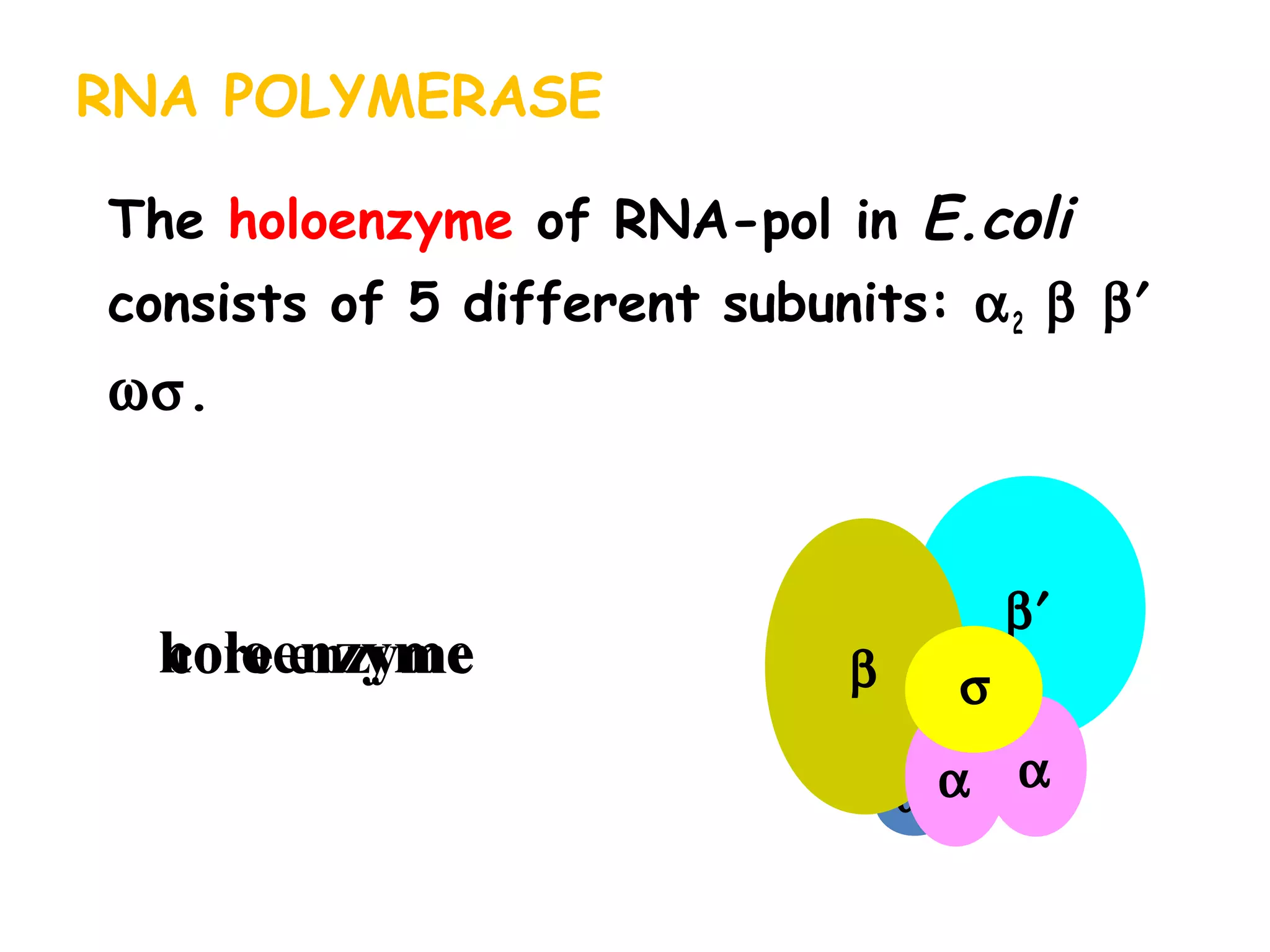
The holoenzyme of RNA-pol in E.coli
consists of 5 different subunits: α2 β β′
ωσ.
ω
β′
β
αα
σ
RNA POLYMERASE
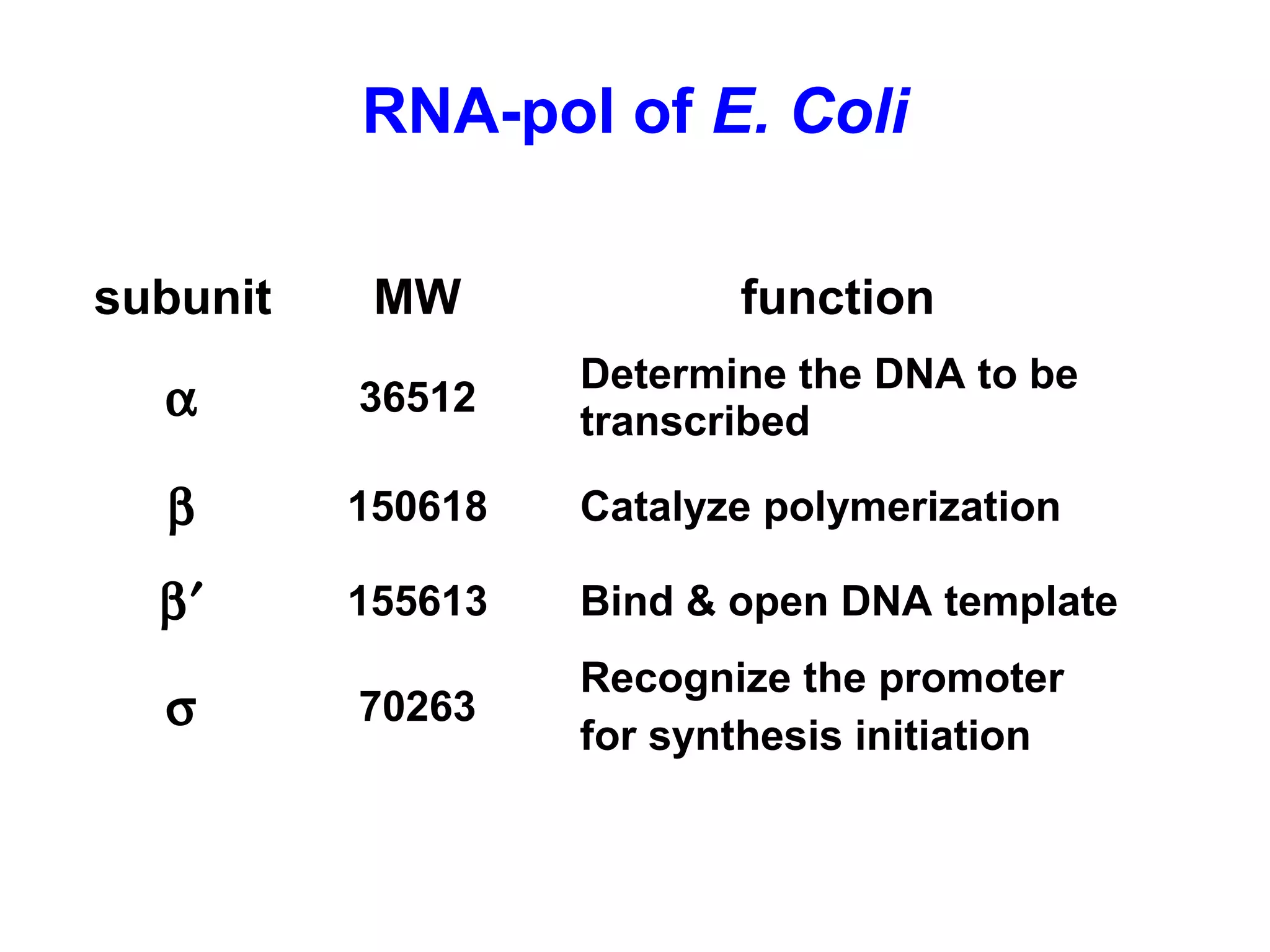
subunit MW function
α 36512
Determine the DNA to be
transcribed
β 150618 Catalyze polymerization
β′ 155613 Bind & open DNA template
σ 70263
Recognize the promoter
for synthesis initiation
RNA-pol of E. Coli
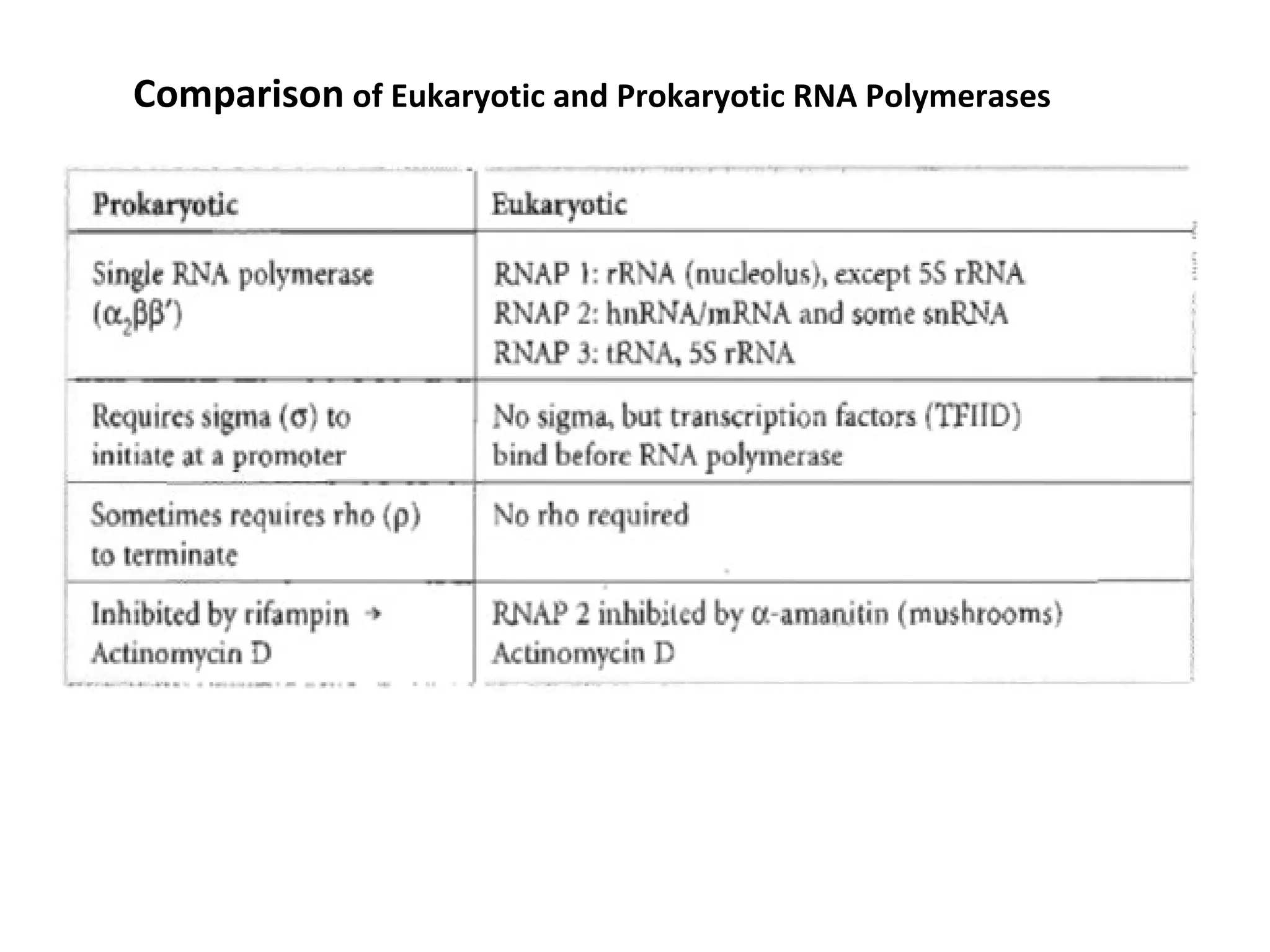
Comparison of Eukaryotic and Prokaryotic RNA Polymerases
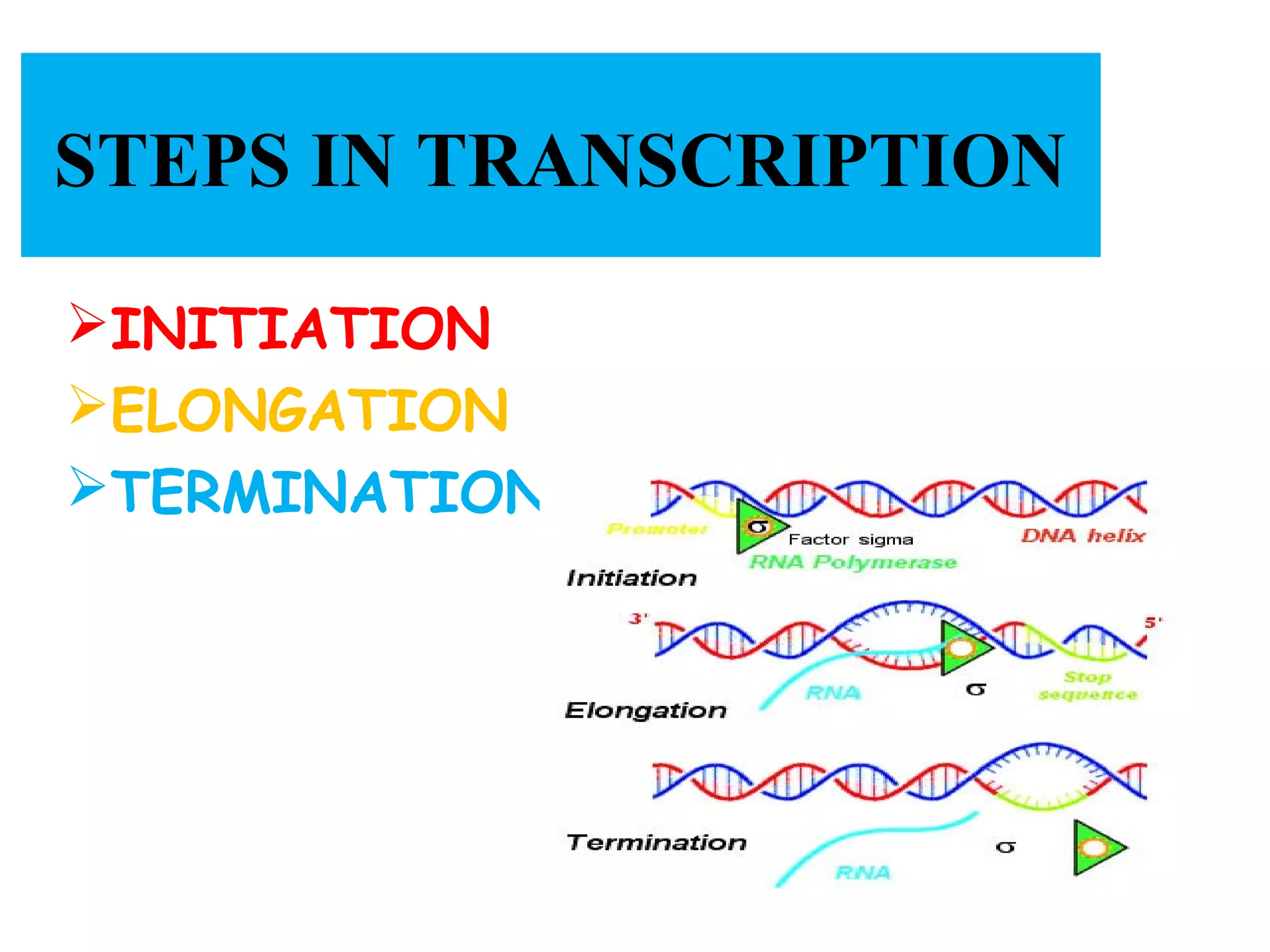
STEPS IN TRANSCRIPTION
INITIATION
ELONGATION
TERMINATION
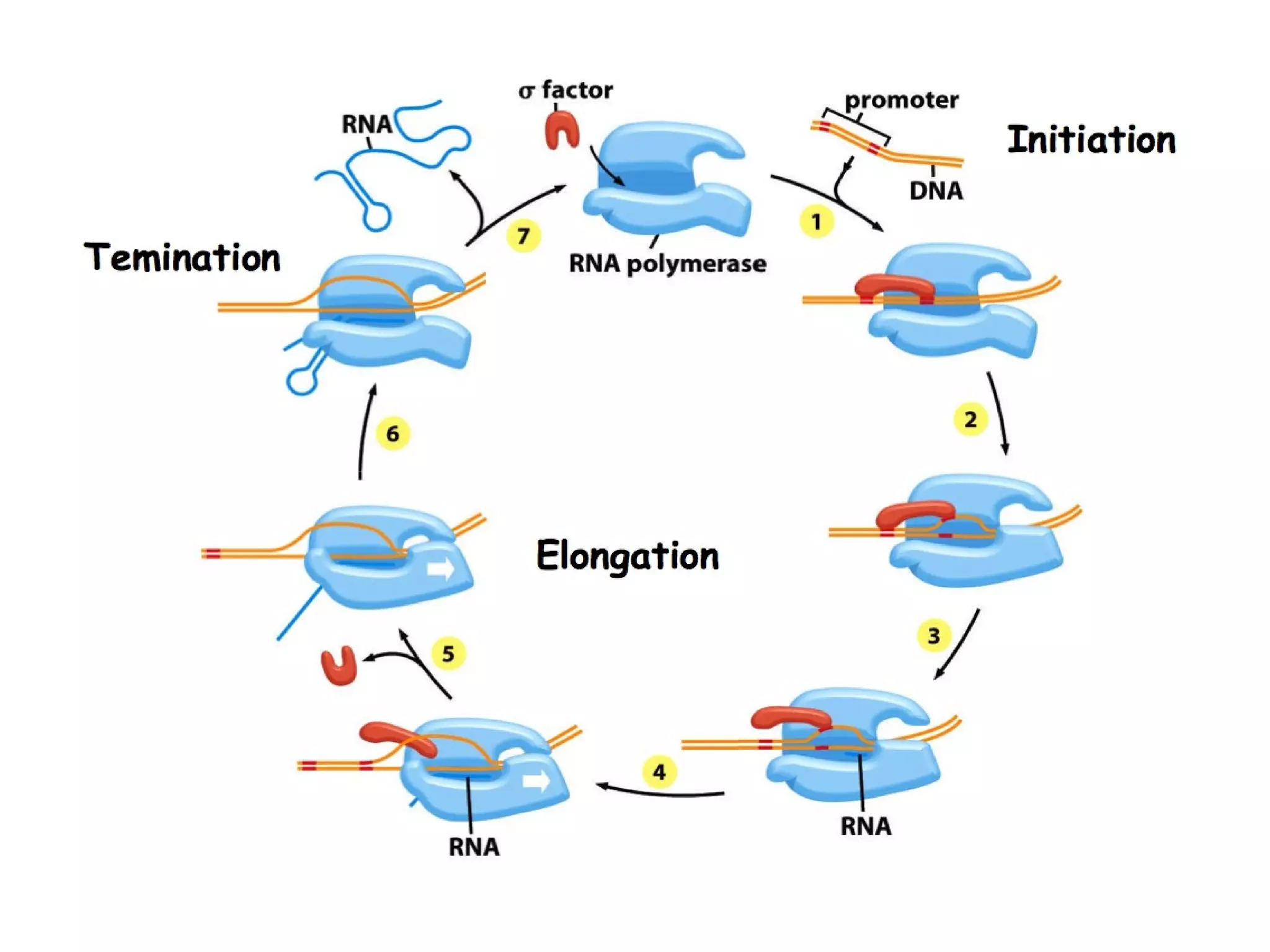
• Three phases: initiation, elongation,
and termination.
• The prokaryotic RNA-pol can bind to
the DNA template directly in the
transcription process.
• The eukaryotic RNA-pol requires co-
factors to bind to the DNA template
together in the transcription process.
General concepts
• Initiation phase: RNA-pol recognizes
the promoter and starts the
transcription.
• Elongation phase: the RNA strand is
continuously growing.
• Termination phase: the RNA-pol stops
synthesis and the nascent RNA is
separated from the DNA template.
Transcription of Prokaryotes
a. Initiation
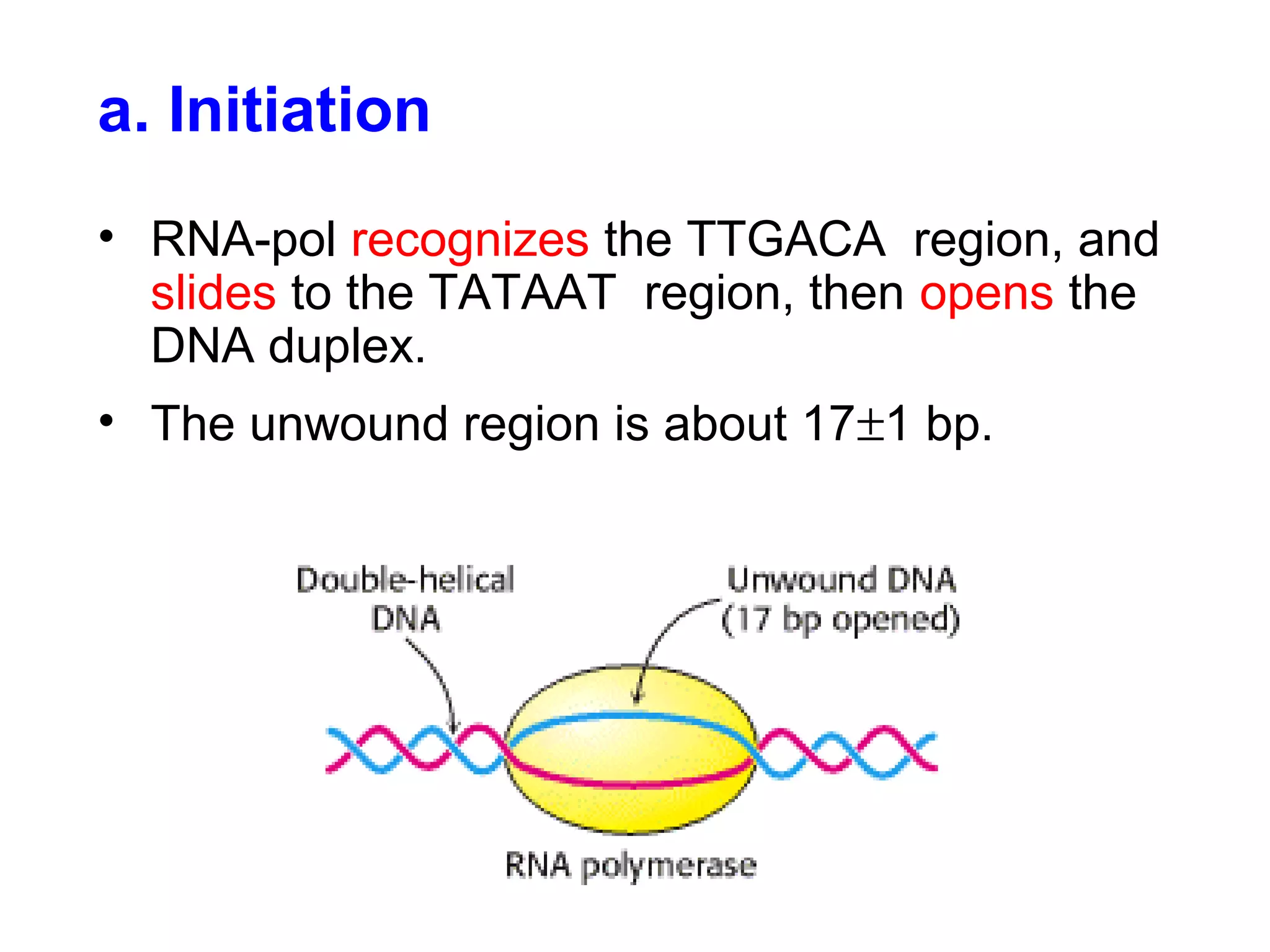
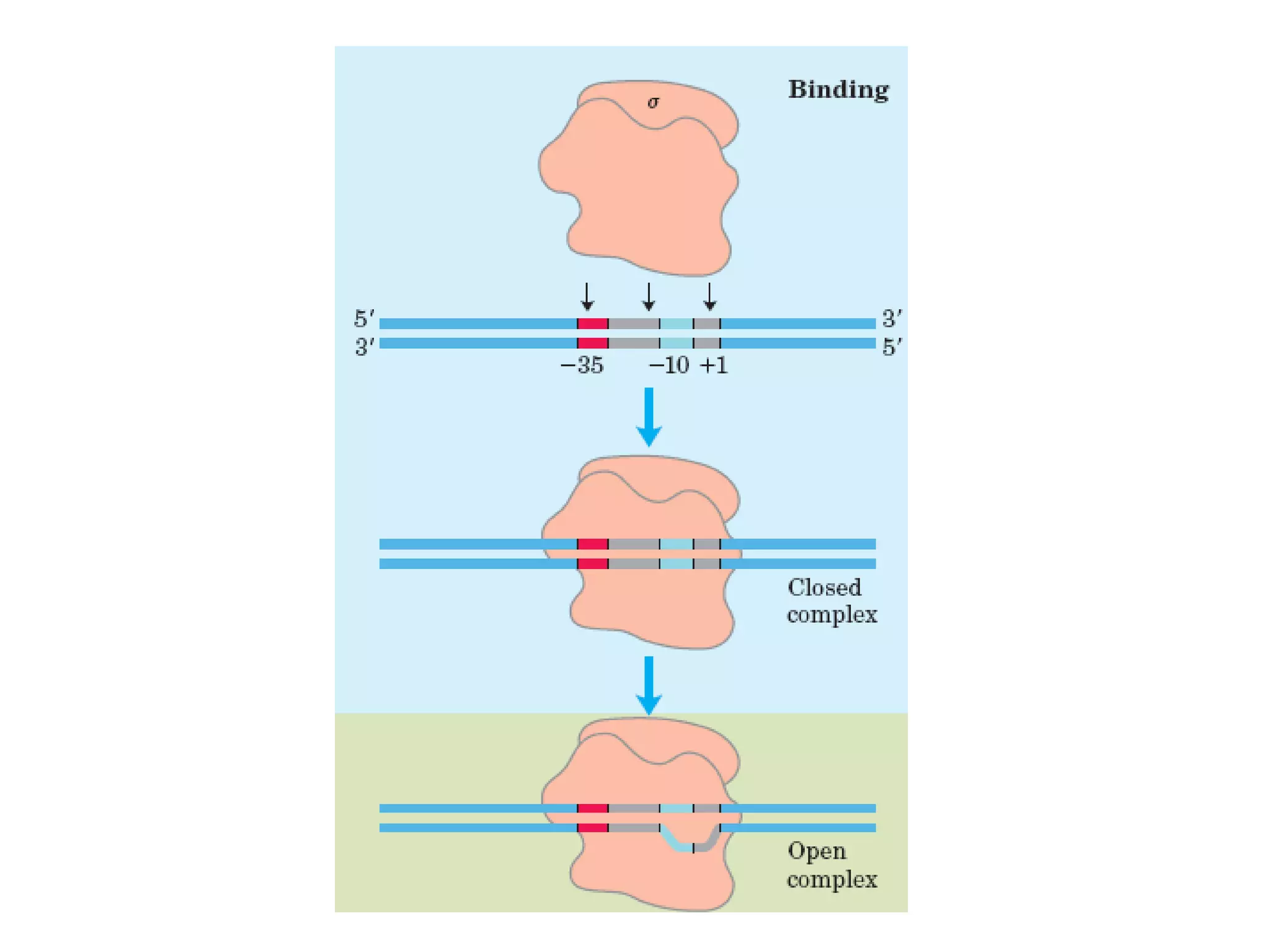
• RNA-pol recognizes the TTGACA region, and
slides to the TATAAT region, then opens the
DNA duplex.
• The unwound region is about 17±1 bp.
• The first nucleotide on RNA transcript is
always purine triphosphate. GTP is more often
than ATP.
• The pppGpN-OH structure remains on the RNA
transcript until the RNA synthesis is
completed.
• The three molecules form a transcription
initiation complex.
RNA-pol (α2ββ′σ) - DNA - pppGpN- OH 3′
• No primer is needed for RNA synthesis.
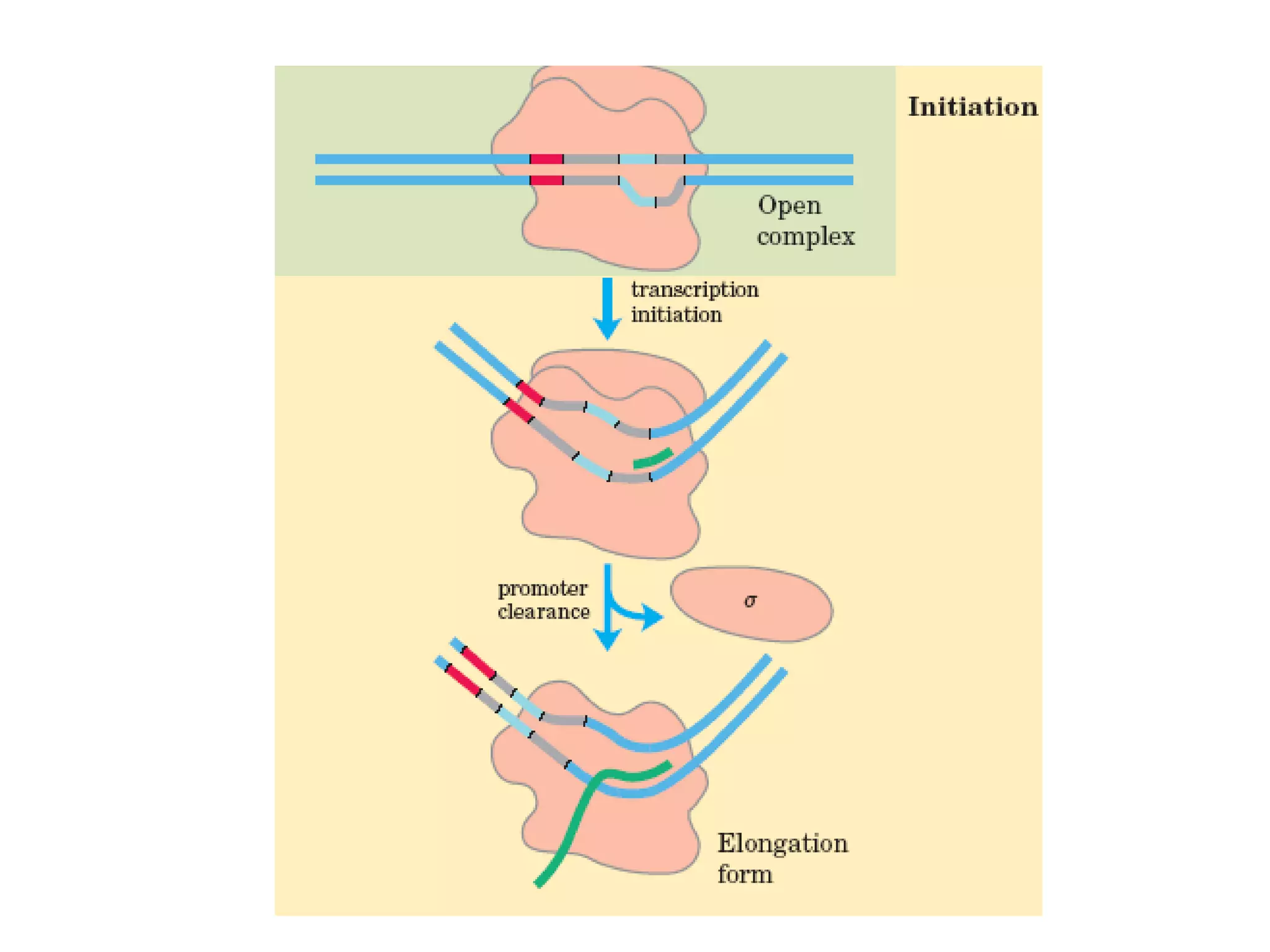
• The σ subunit falls off from the RNA-pol once
the first 3′,5′ phosphodiester bond is formed.
• The core enzyme moves along the DNA
template to enter the elongation phase.
b. Elongation
• The release of the σ subunit causes the
conformational change of the core enzyme.
The core enzyme slides on the DNA template
toward the 3′ end.
• Free NTPs are added sequentially to the 3′
-OH of the nascent RNA strand.
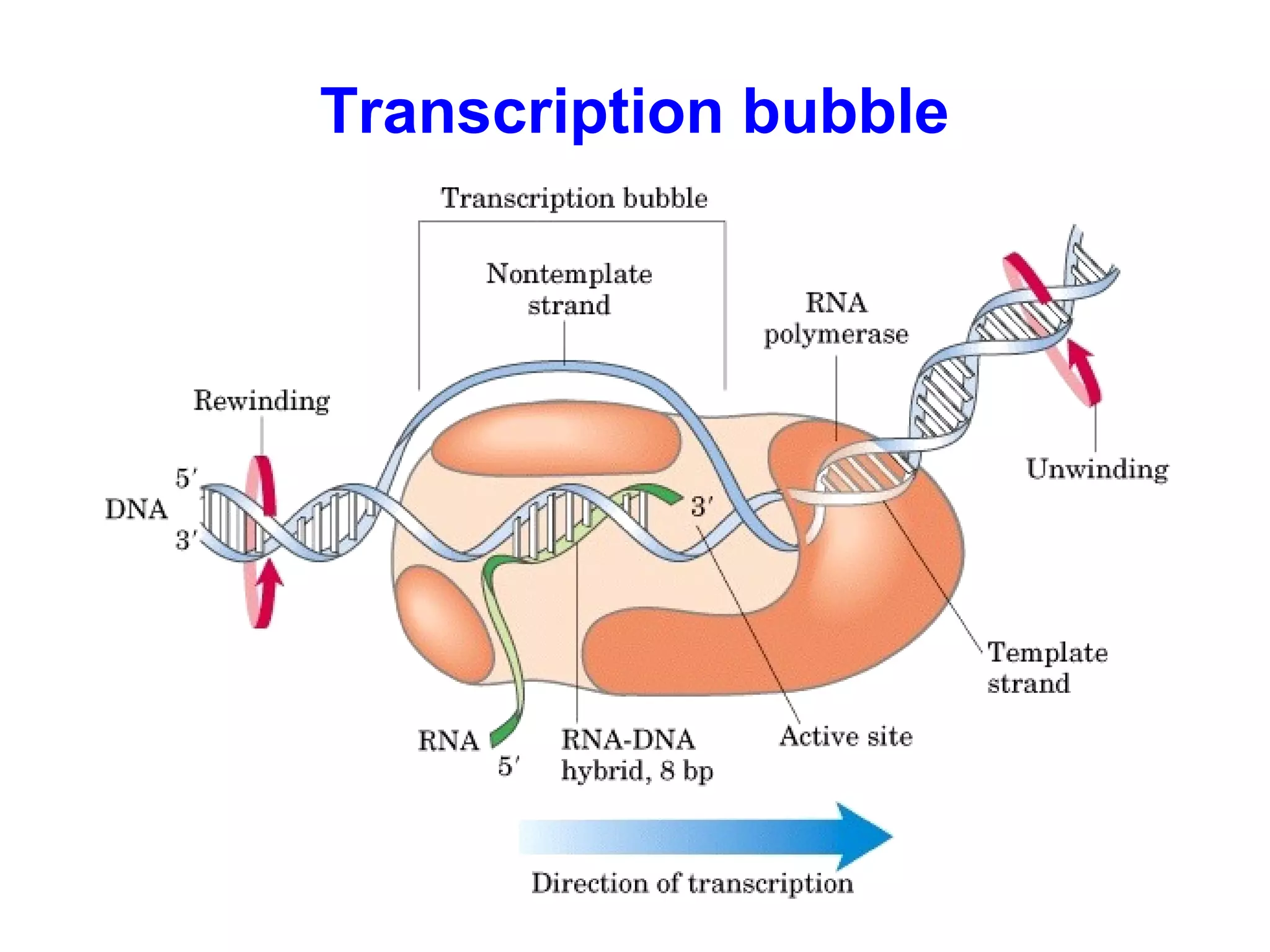
• RNA-pol, DNA segment of ~40nt and the
nascent RNA form a complex called the
transcription bubble.
• The 3′ segment of the nascent RNA
hybridizes with the DNA template, and its
5′ end extends out the transcription bubble
as the synthesis is processing.
Transcription bubble
c. Termination
• The RNA-pol stops moving on the
DNA template. The RNA transcript
falls off from the transcription
complex.
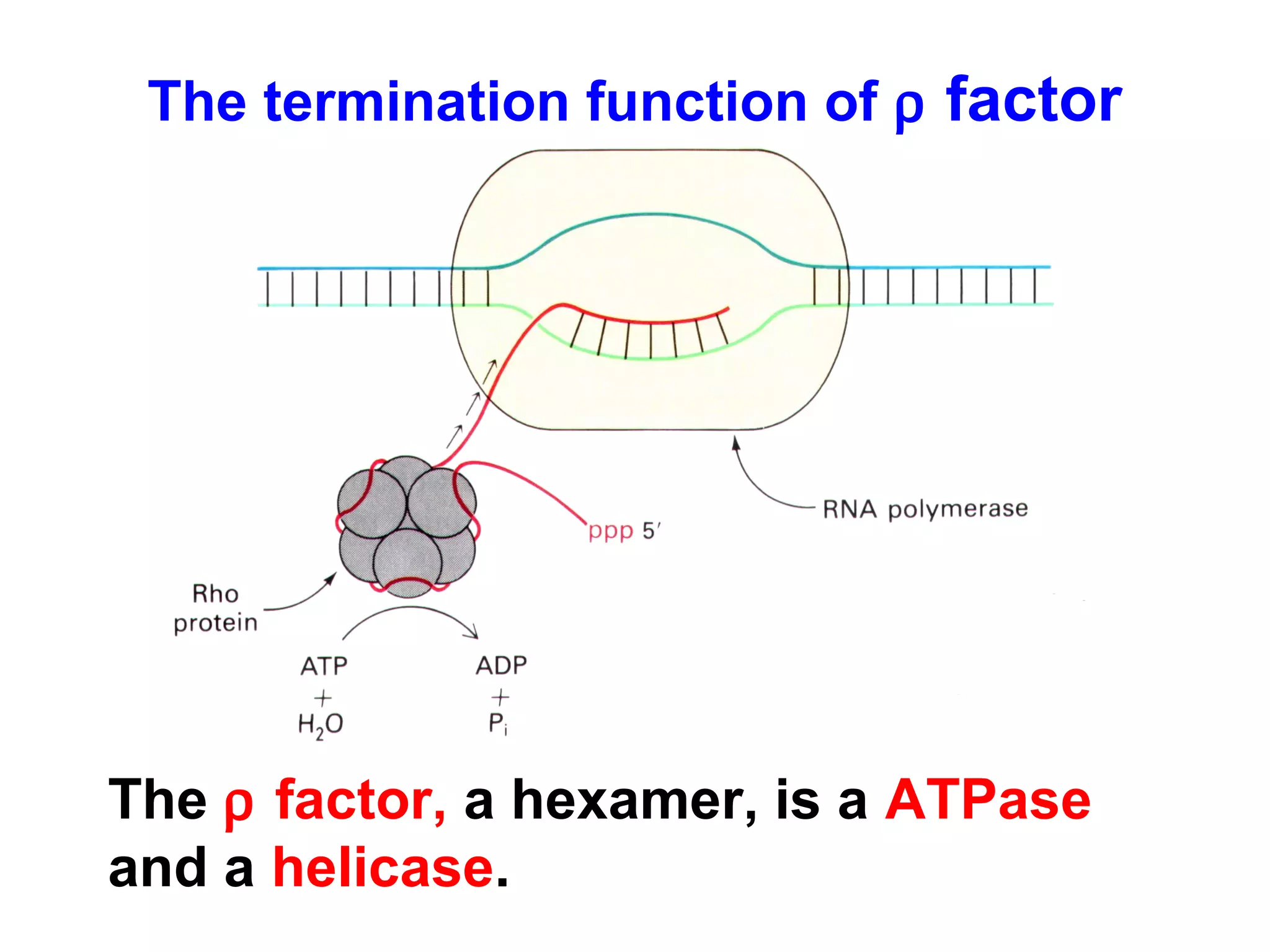
• The termination occurs in either ρ
-dependent or ρ -independent
manner.
The termination function of ρ factor
The ρ factor, a hexamer, is a ATPase
and a helicase.
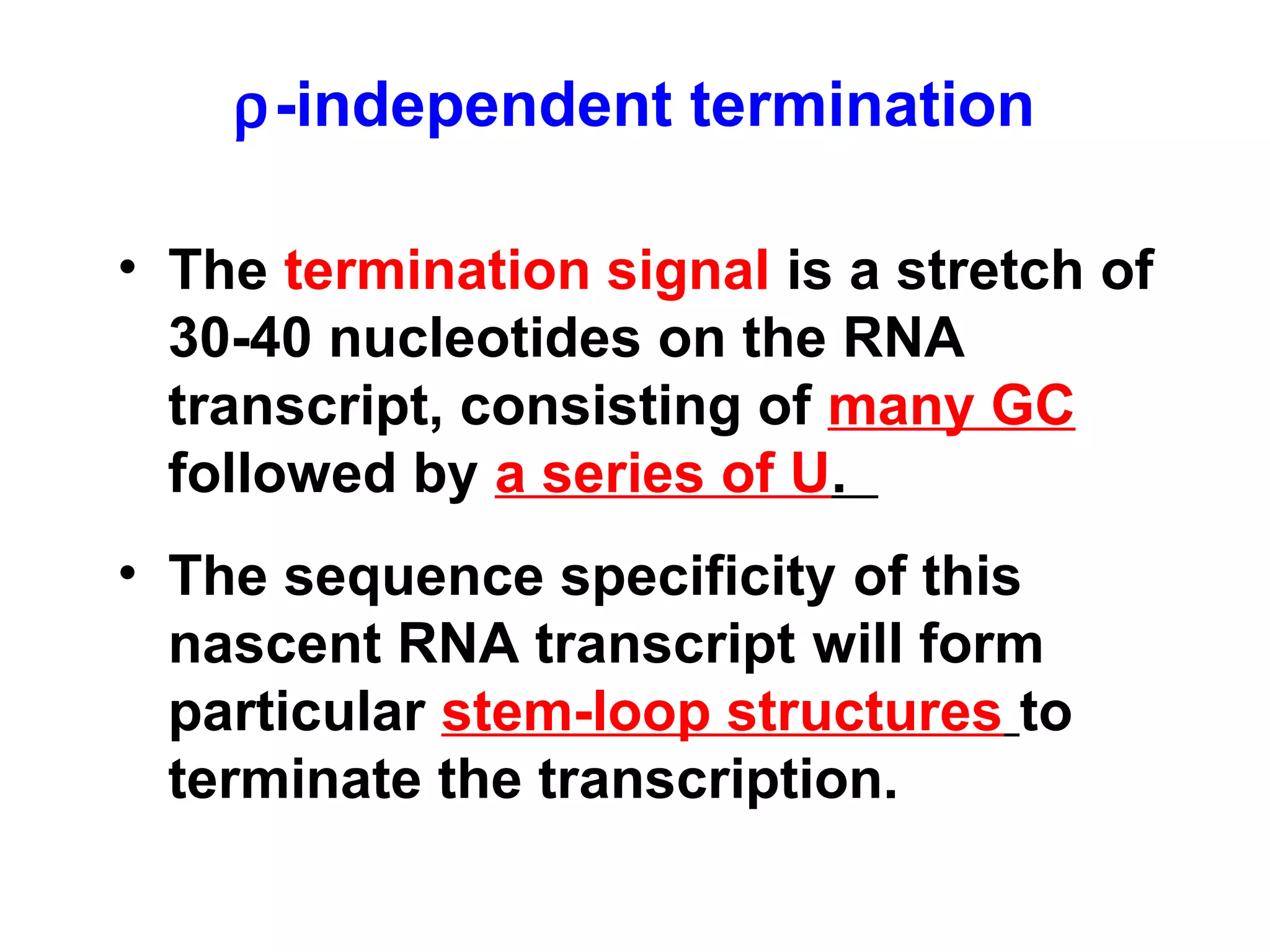
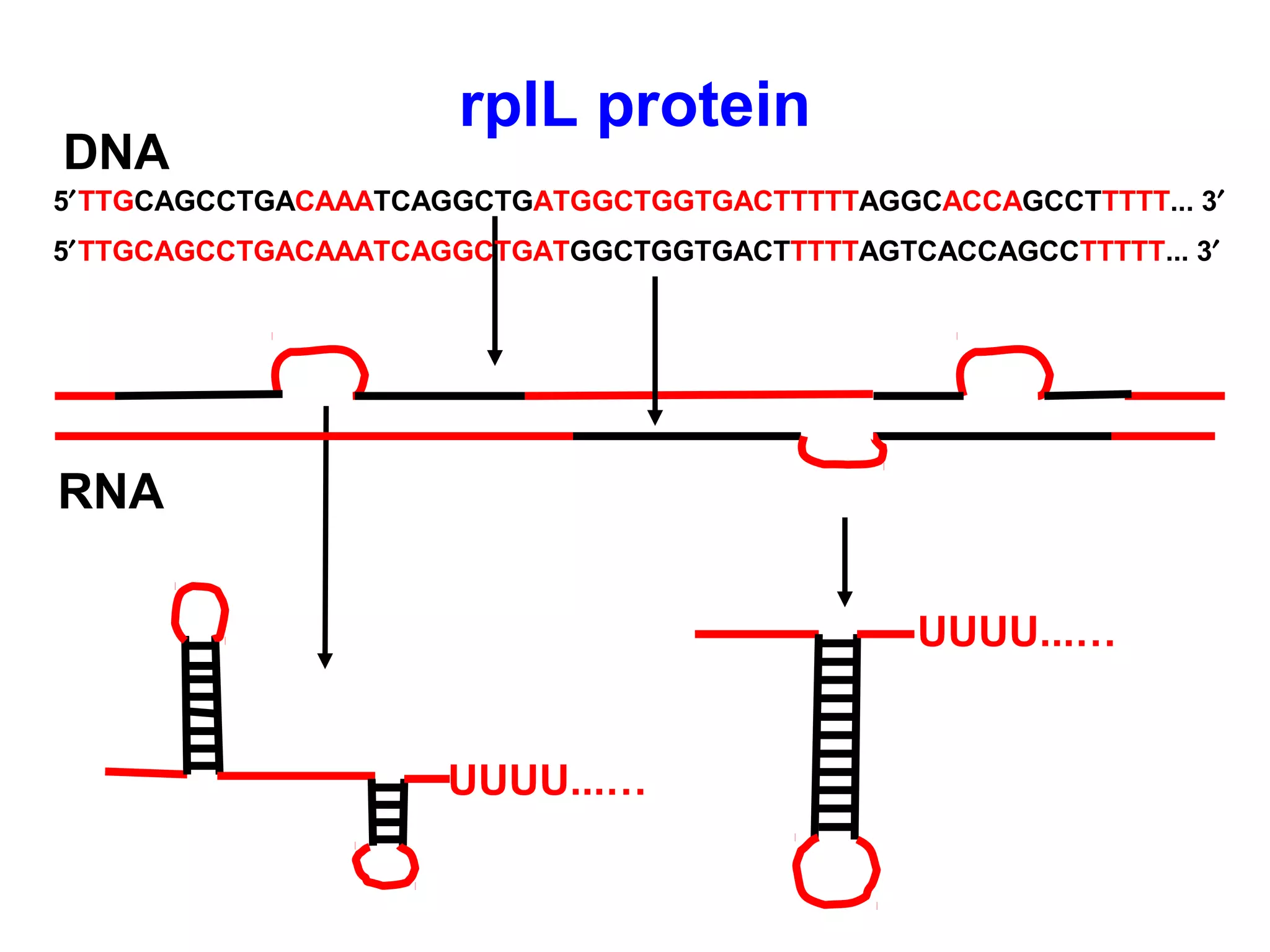
ρ-independent termination
• The termination signal is a stretch of
30-40 nucleotides on the RNA
transcript, consisting of many GC
followed by a series of U.
• The sequence specificity of this
nascent RNA transcript will form
particular stem-loop structures to
terminate the transcription.
RNA
5′TTGCAGCCTGACAAATCAGGCTGATGGCTGGTGACTTTTTAGGCACCAGCCTTTTT... 3′
DNA
UUUU...…
rplL protein
UUUU...…
5′TTGCAGCCTGACAAATCAGGCTGATGGCTGGTGACTTTTTAGTCACCAGCCTTTTT... 3′
TRANSCRIPTION IN
EUKARYOTES
CHARACTERISTICS OF THE THREE RNA POLYMERASES
OF EUKARYOTES
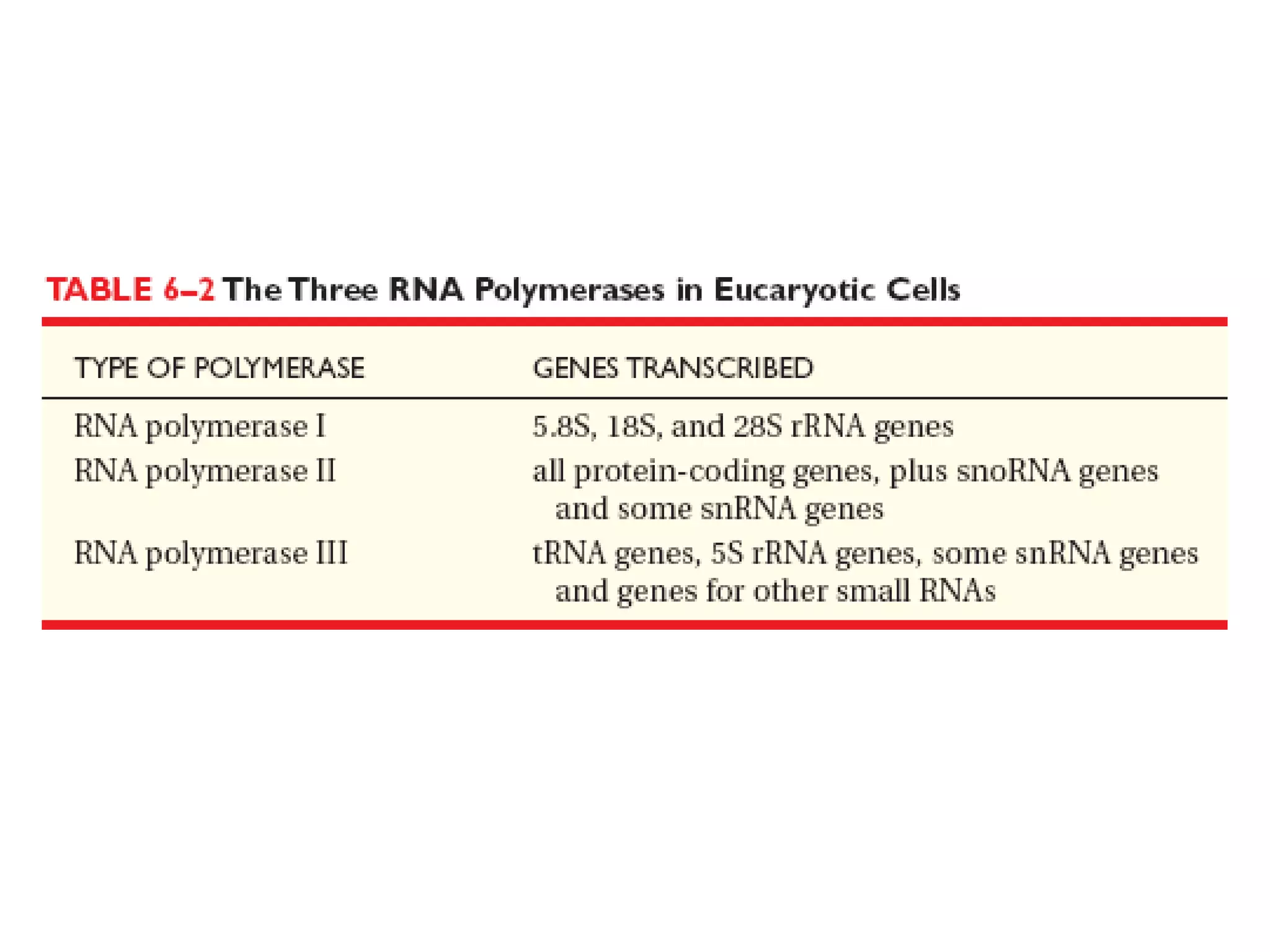
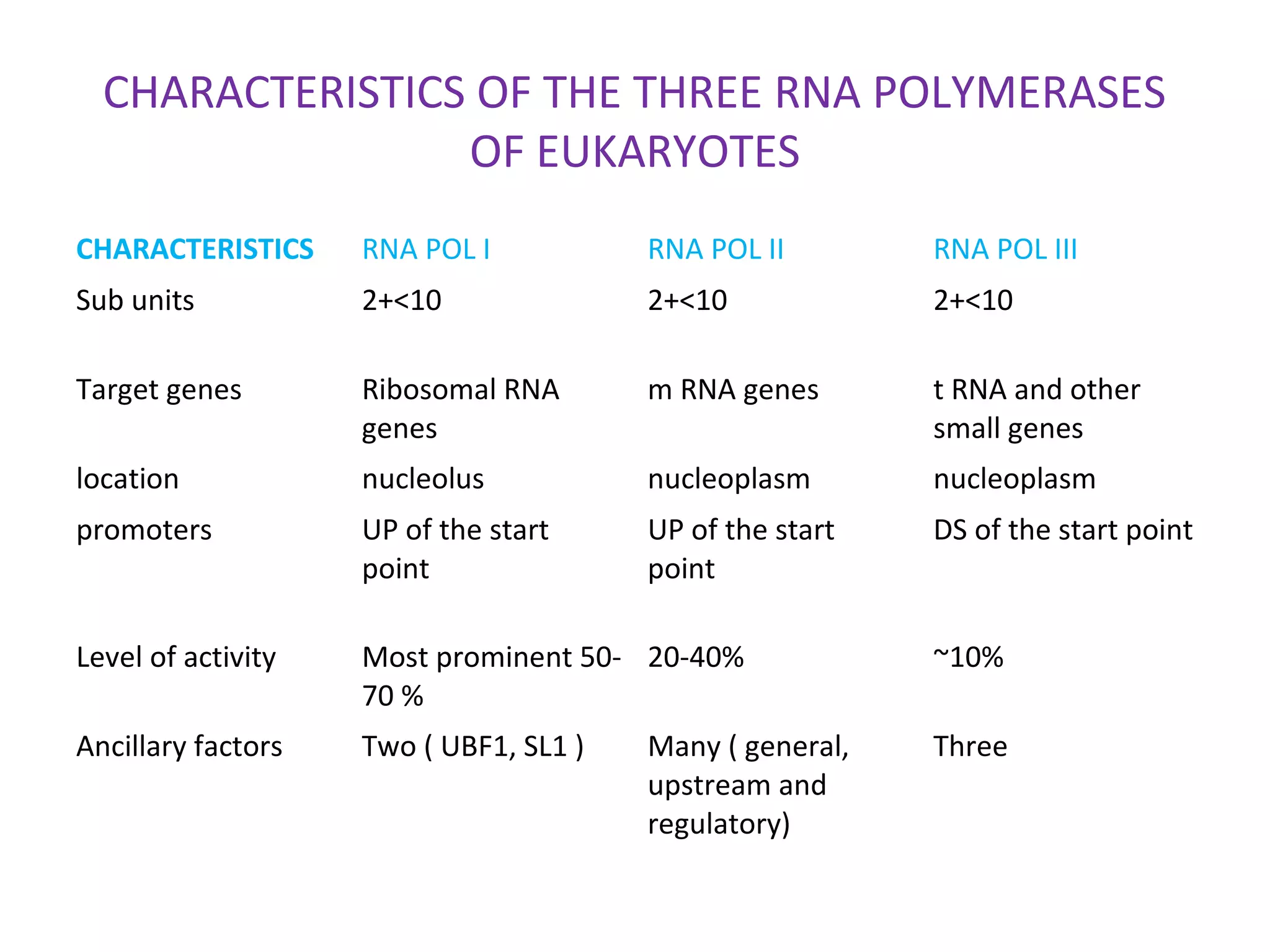
CHARACTERISTICS RNA POL I RNA POL II RNA POL III
Sub units 2+<10 2+<10 2+<10
Target genes Ribosomal RNA
genes
m RNA genes t RNA and other
small genes
location nucleolus nucleoplasm nucleoplasm
promoters UP of the start
point
UP of the start
point
DS of the start point
Level of activity Most prominent 50-
70 %
20-40% ~10%
Ancillary factors Two ( UBF1, SL1 ) Many ( general,
upstream and
regulatory)
Three
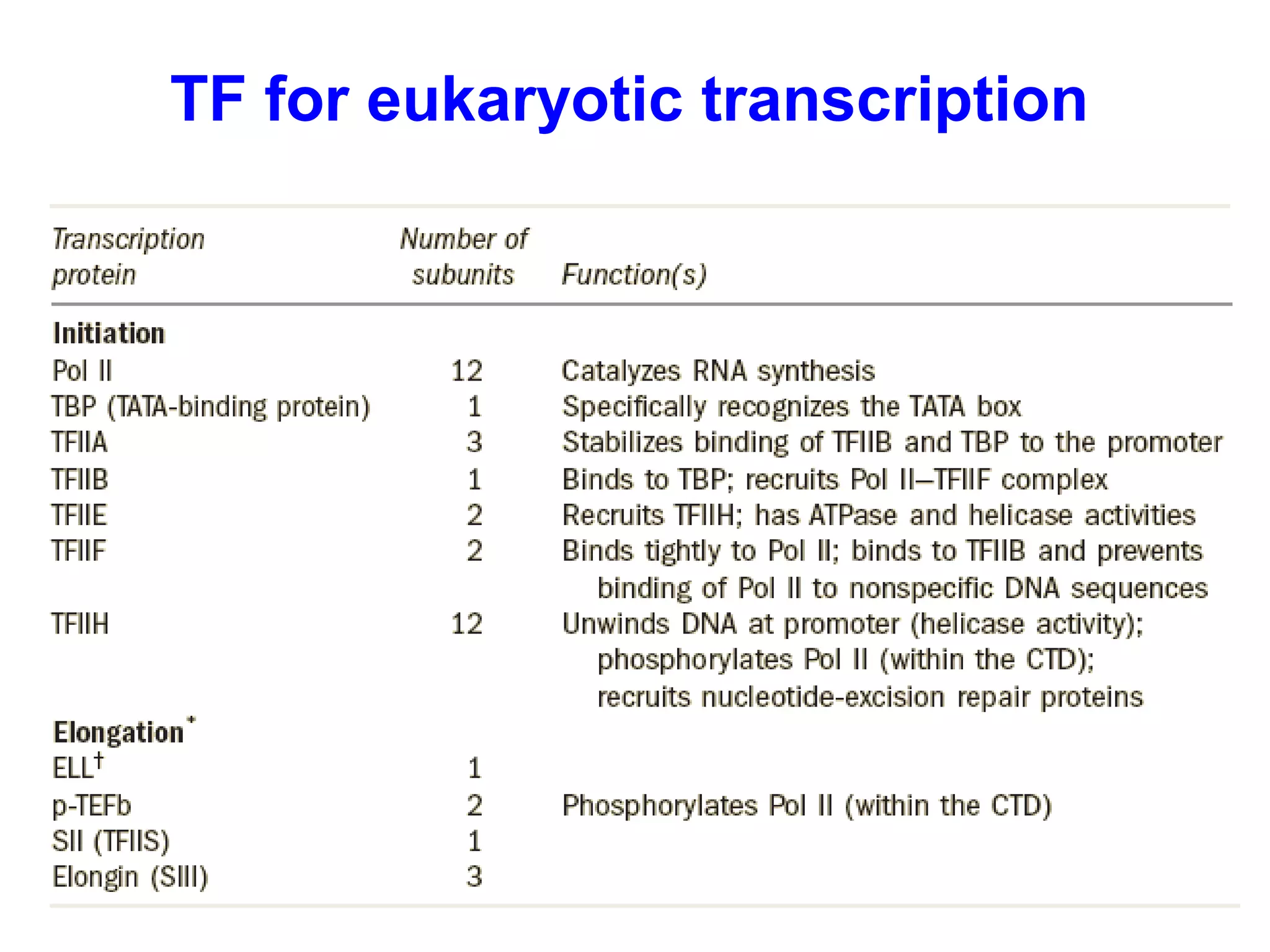
TF for eukaryotic transcription
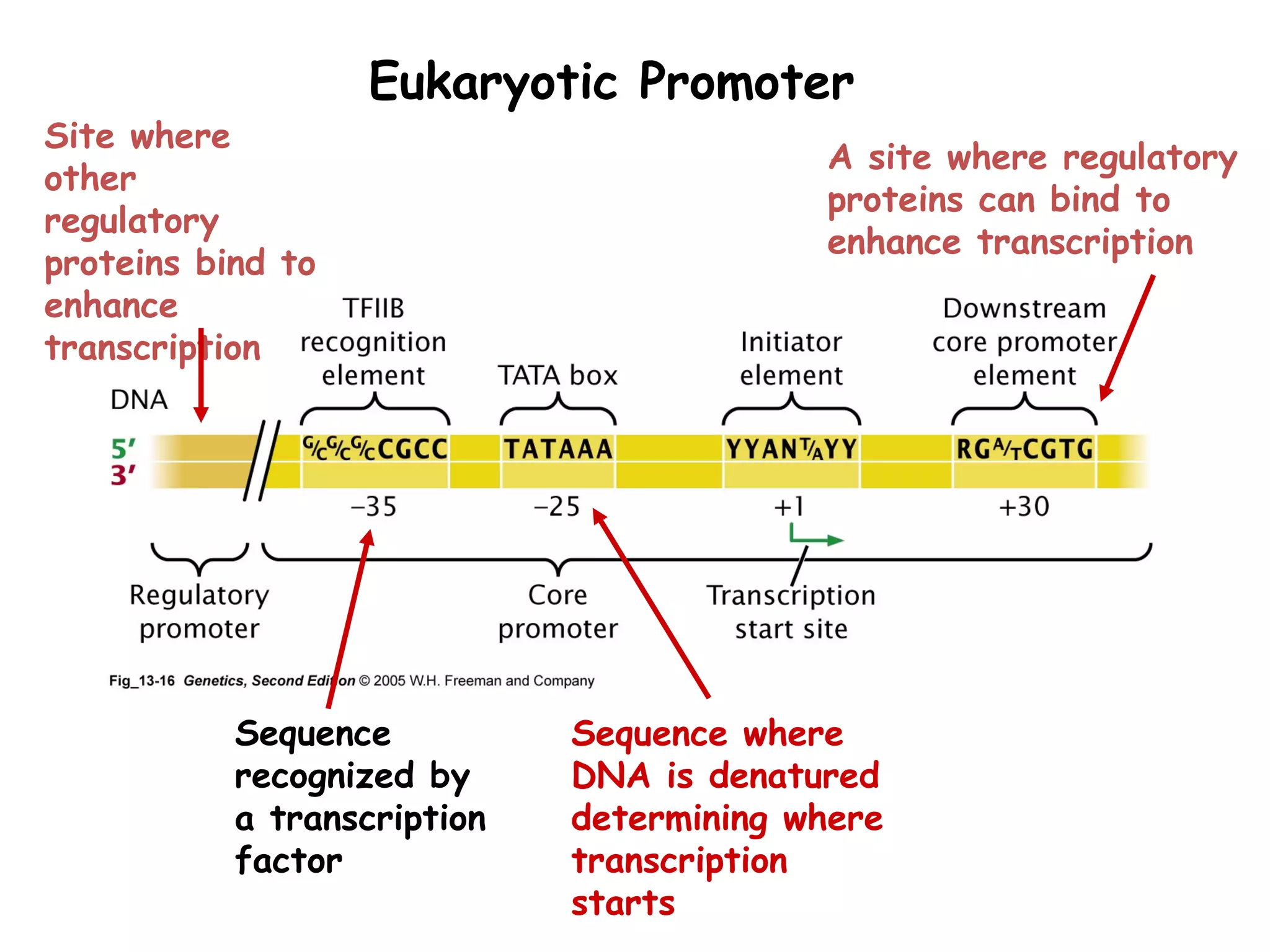
Eukaryotic Promoter
Sequence
recognized by
a transcription
factor
Sequence where
DNA is denatured
determining where
transcription
starts
Site where
other
regulatory
proteins bind to
enhance
transcription
A site where regulatory
proteins can bind to
enhance transcription
TranscripTion EnhancErs and
silEncErs
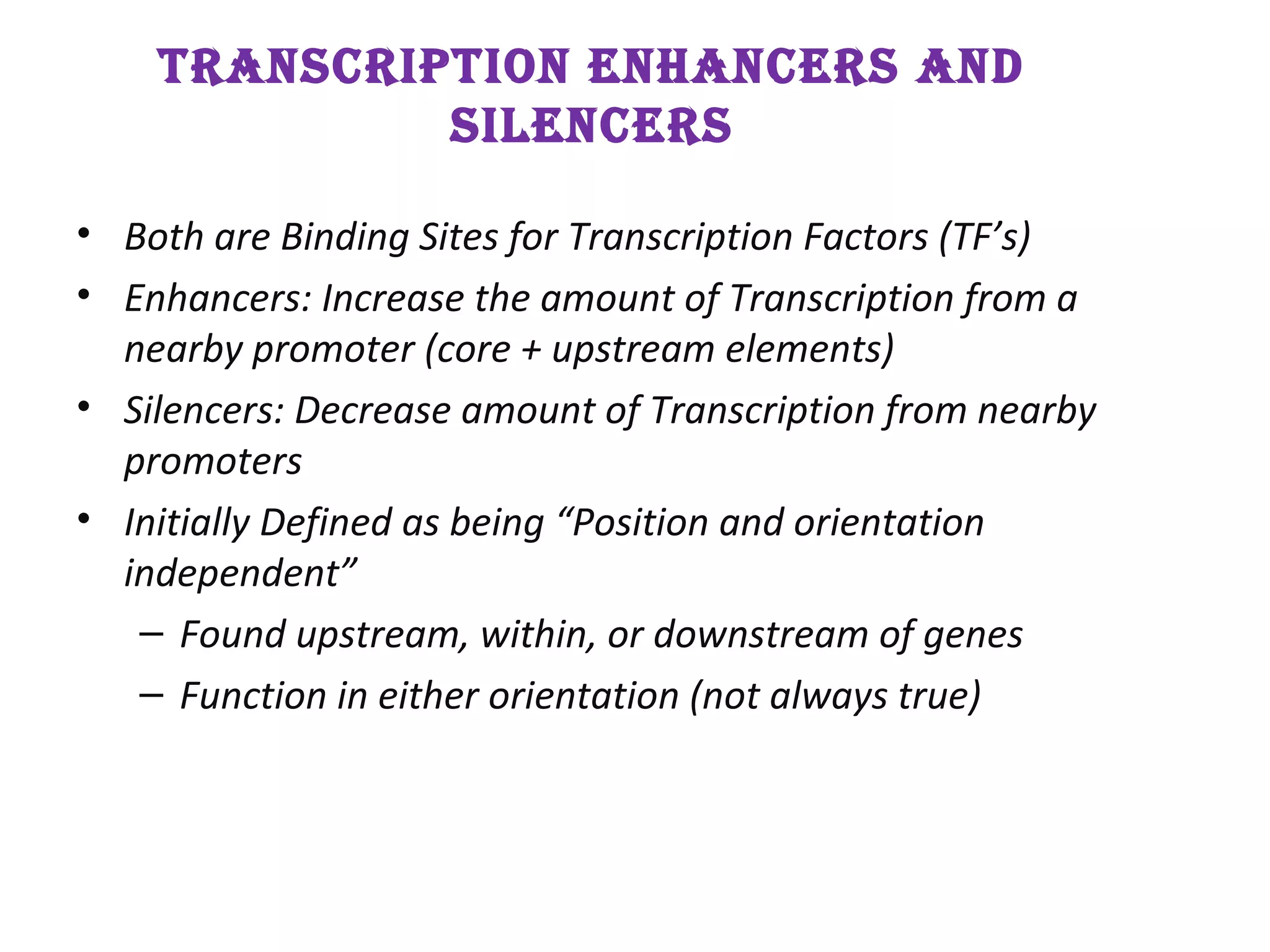
• Both are Binding Sites for Transcription Factors (TF’s)
• Enhancers: Increase the amount of Transcription from a
nearby promoter (core + upstream elements)
• Silencers: Decrease amount of Transcription from nearby
promoters
• Initially Defined as being “Position and orientation
independent”
– Found upstream, within, or downstream of genes
– Function in either orientation (not always true)
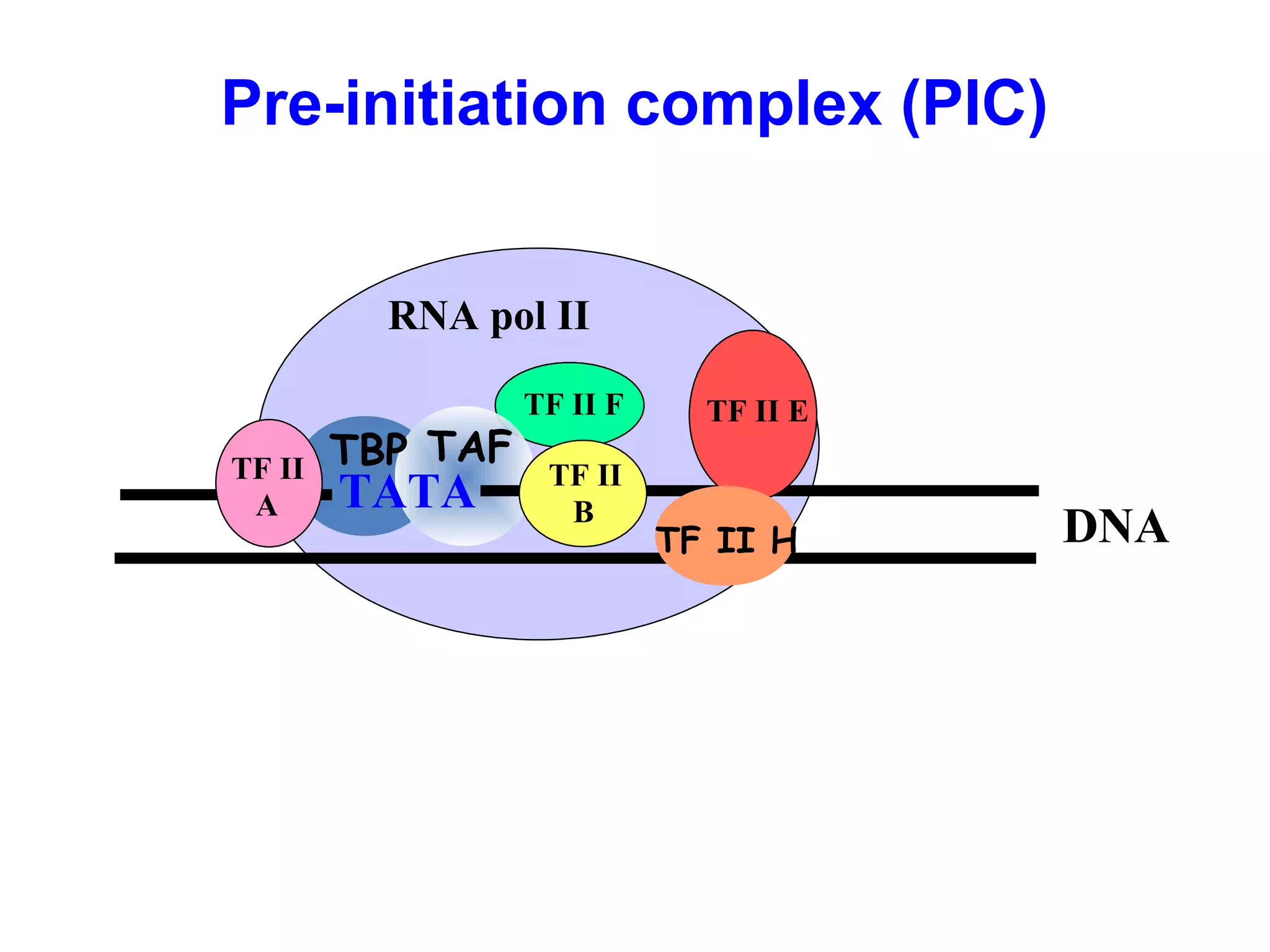
Pre-initiation complex (PIC)
RNA pol II
TF II F
TBP TAF
TATA
DNA
TF II
A
TF II
B
TF II E
TF II H
• Mechanism of transcription: Involves
• Initiation
• Elongation
• Termination.
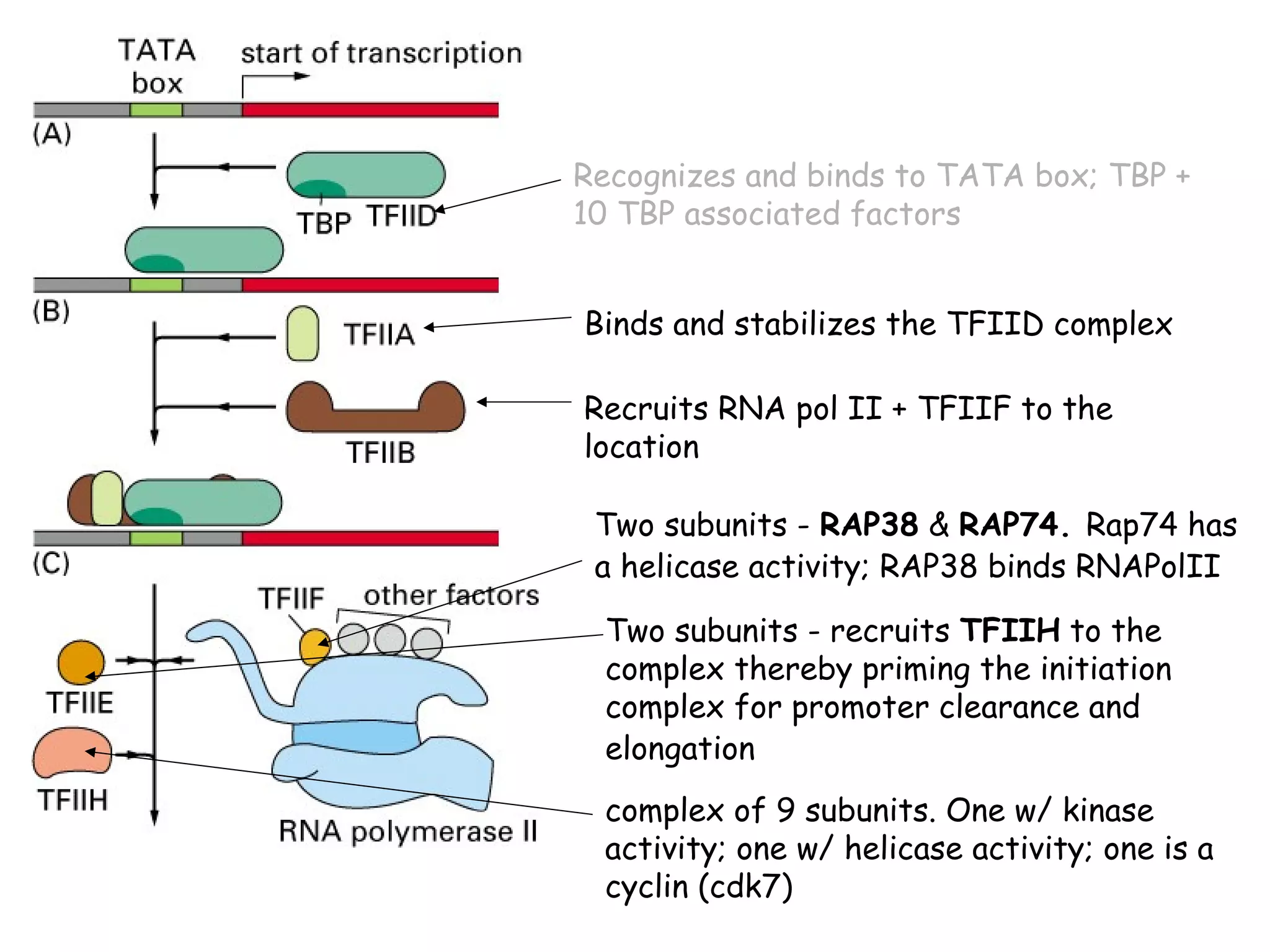
Recognizes and binds to TATA box; TBP +
10 TBP associated factors
Binds and stabilizes the TFIID complex
Recruits RNA pol II + TFIIF to the
location
Two subunits - RAP38 & RAP74. Rap74 has
a helicase activity; RAP38 binds RNAPolII
Two subunits - recruits TFIIH to the
complex thereby priming the initiation
complex for promoter clearance and
elongation
complex of 9 subunits. One w/ kinase
activity; one w/ helicase activity; one is a
cyclin (cdk7)
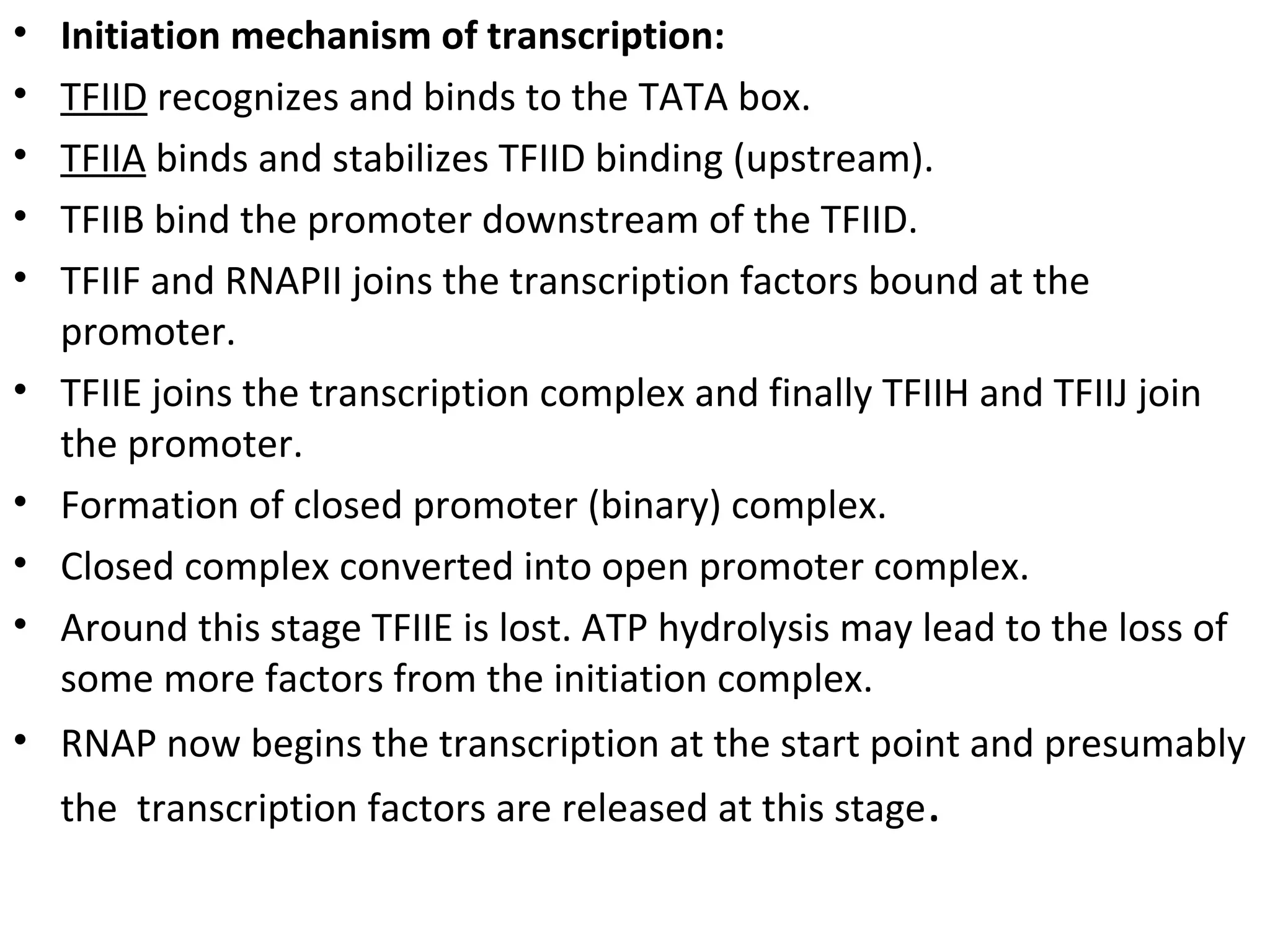
• Initiation mechanism of transcription:
• TFIID recognizes and binds to the TATA box.
• TFIIA binds and stabilizes TFIID binding (upstream).
• TFІІB bind the promoter downstream of the TFІІD.
• TFІІF and RNAPІІ joins the transcription factors bound at the
promoter.
• TFІІE joins the transcription complex and finally TFІІH and TFІІJ join
the promoter.
• Formation of closed promoter (binary) complex.
• Closed complex converted into open promoter complex.
• Around this stage TFІІE is lost. ATP hydrolysis may lead to the loss of
some more factors from the initiation complex.
• RNAP now begins the transcription at the start point and presumably
the transcription factors are released at this stage.
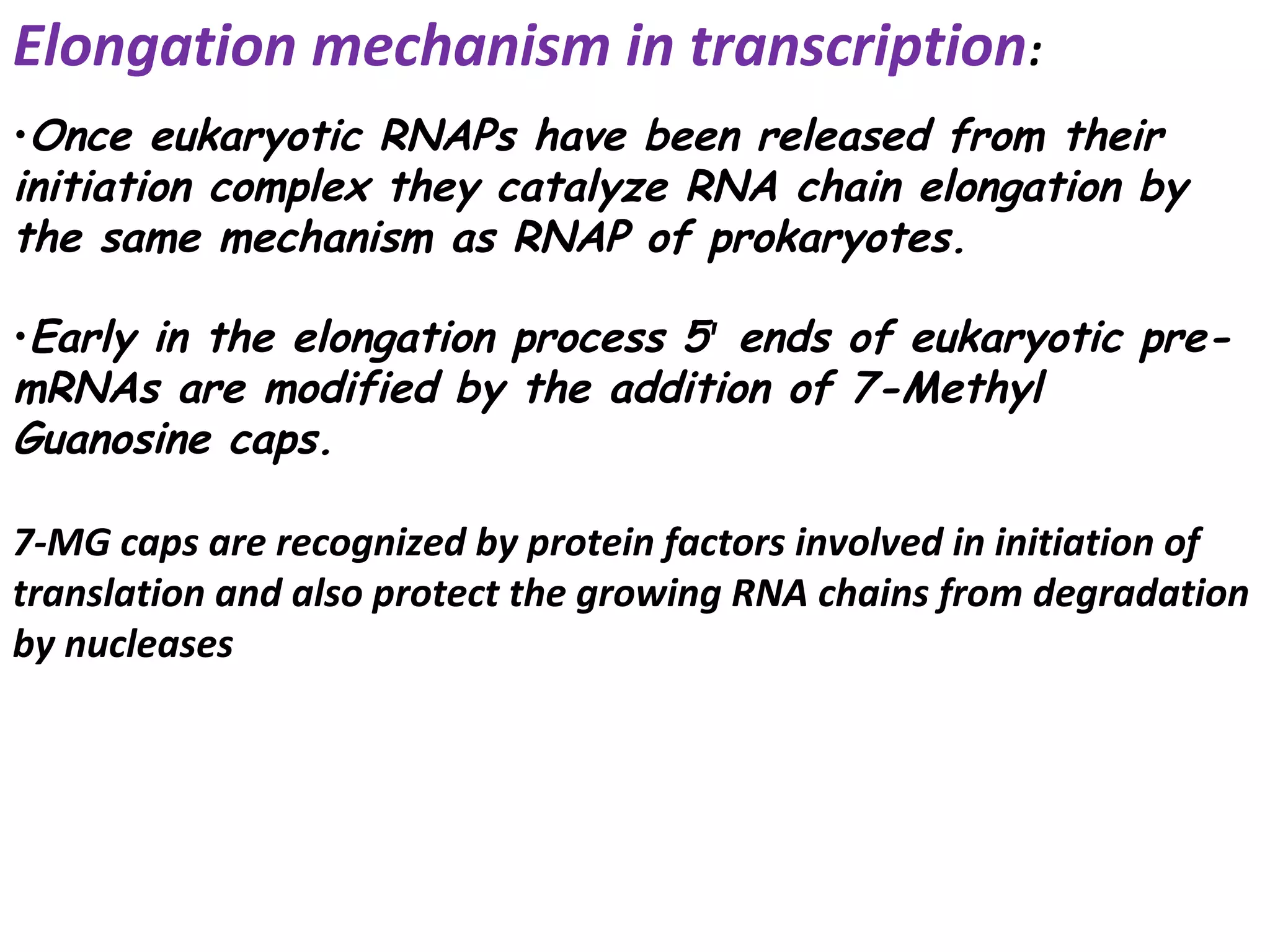
Elongation mechanism in transcription:
•Once eukaryotic RNAPs have been released from their
initiation complex they catalyze RNA chain elongation by
the same mechanism as RNAP of prokaryotes.
•Early in the elongation process 5' ends of eukaryotic pre-
mRNAs are modified by the addition of 7-Methyl
Guanosine caps.
7-MG caps are recognized by protein factors involved in initiation of
translation and also protect the growing RNA chains from degradation
by nucleases
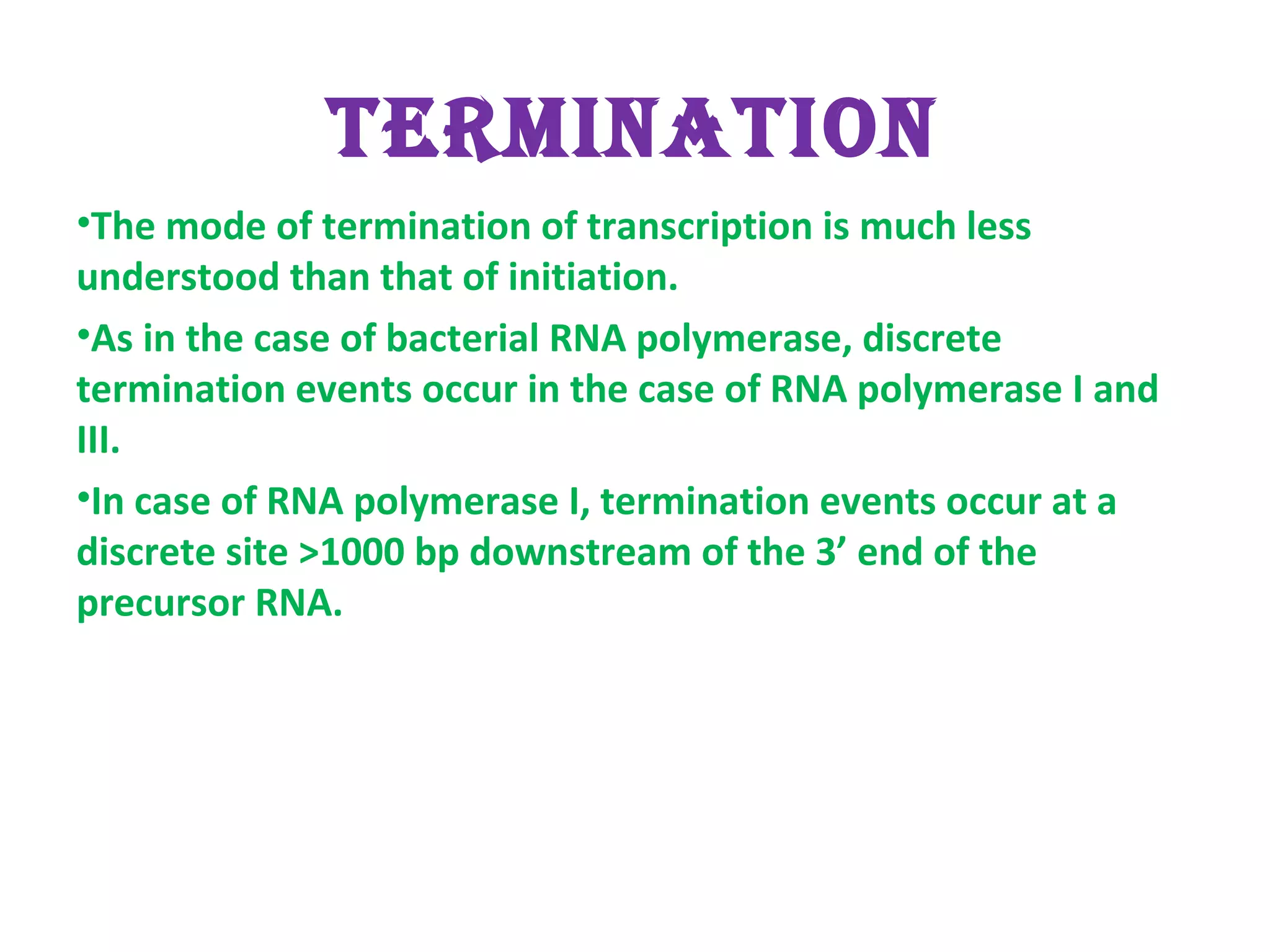
3 RNA polymerase II ends transcription
when it reaches a termination signal.
These signals are not well understood
in eukaryotes.
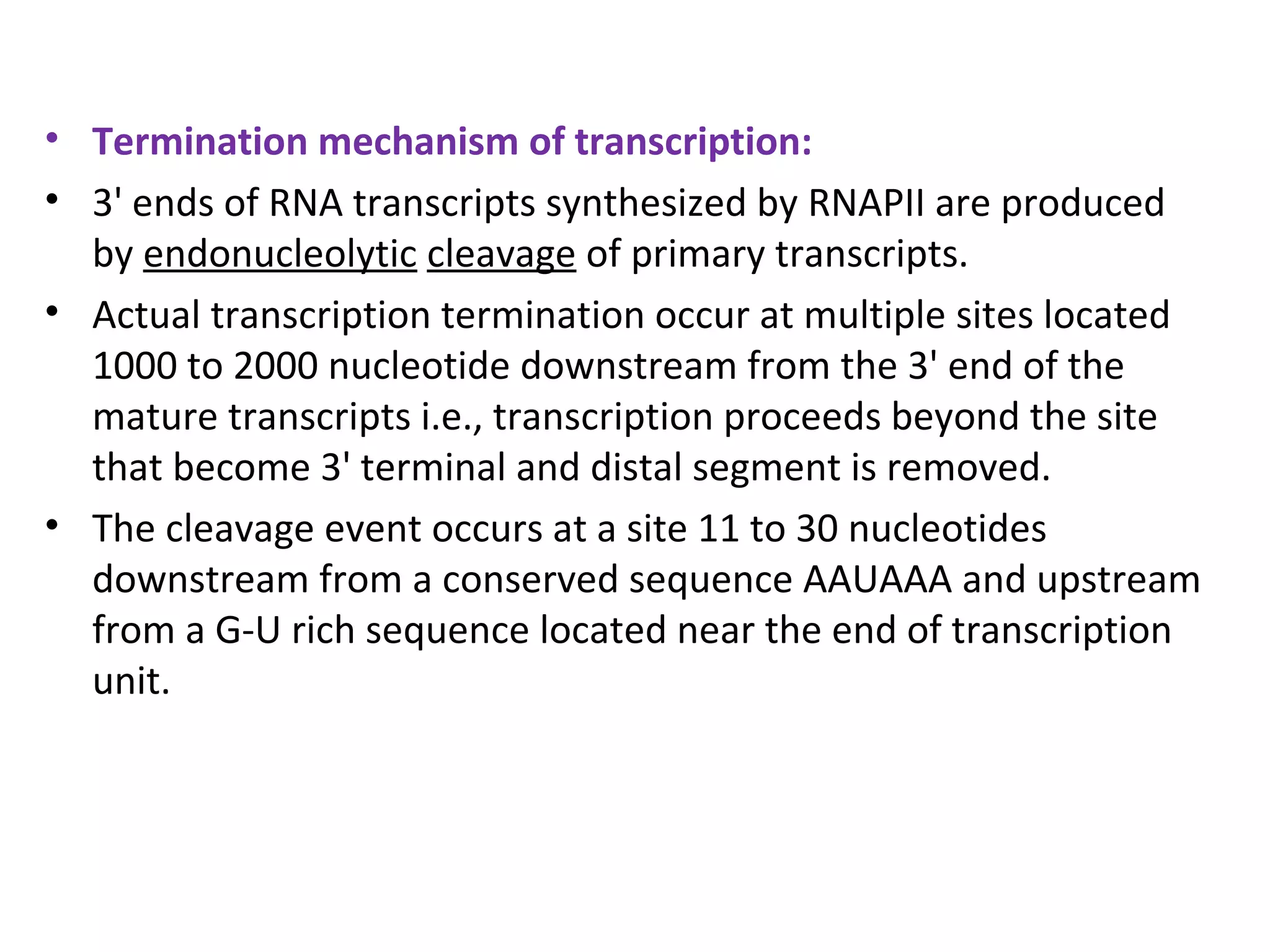
TERMINATION
•The mode of termination of transcription is much less
understood than that of initiation.
•As in the case of bacterial RNA polymerase, discrete
termination events occur in the case of RNA polymerase I and
III.
•In case of RNA polymerase I, termination events occur at a
discrete site >1000 bp downstream of the 3’ end of the
precursor RNA.
• Termination mechanism of transcription:
• 3' ends of RNA transcripts synthesized by RNAPІІ are produced
by endonucleolytic cleavage of primary transcripts.
• Actual transcription termination occur at multiple sites located
1000 to 2000 nucleotide downstream from the 3' end of the
mature transcripts i.e., transcription proceeds beyond the site
that become 3' terminal and distal segment is removed.
• The cleavage event occurs at a site 11 to 30 nucleotides
downstream from a conserved sequence AAUAAA and upstream
from a G-U rich sequence located near the end of transcription
unit.
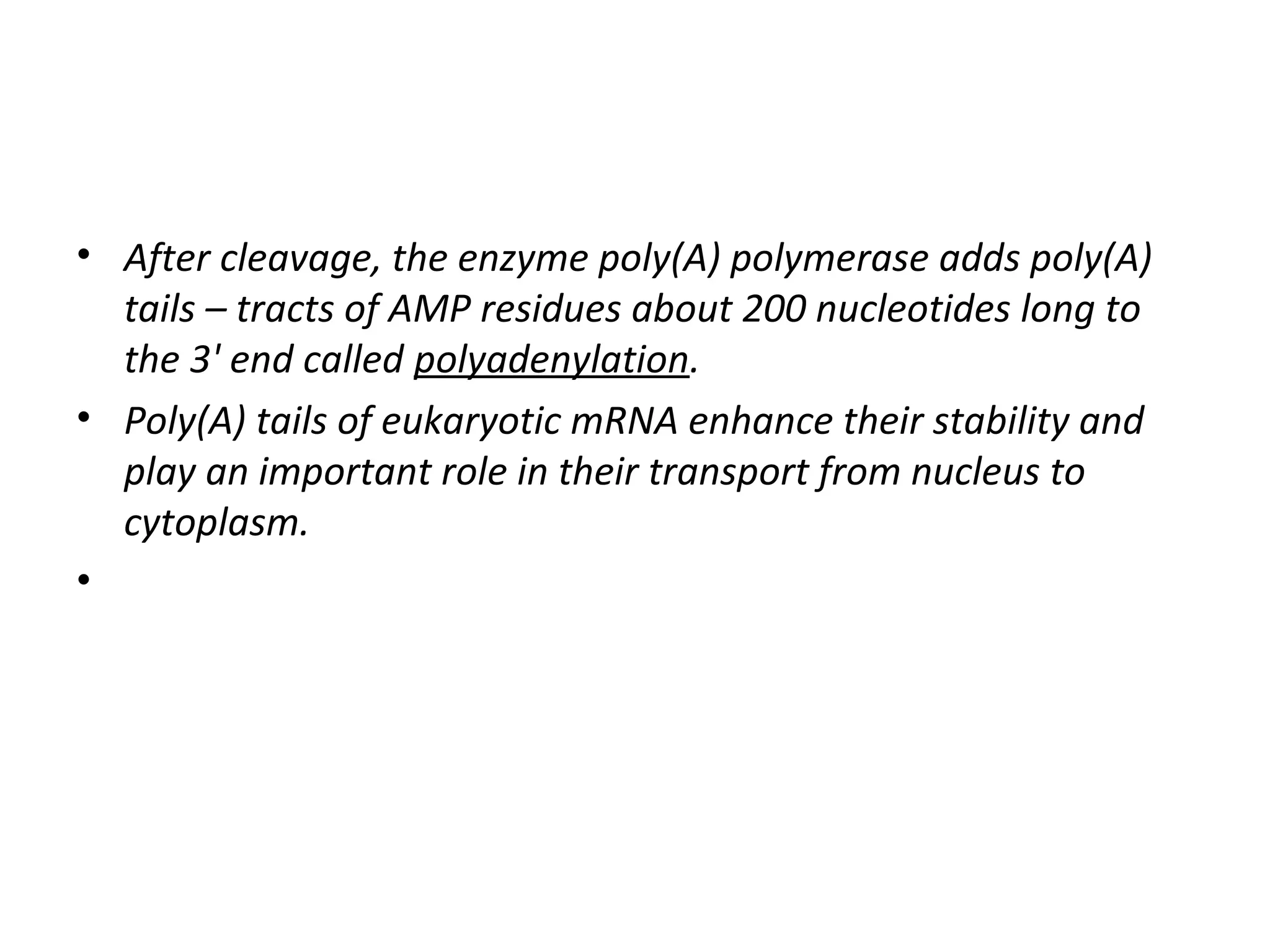
• After cleavage, the enzyme poly(A) polymerase adds poly(A)
tails – tracts of AMP residues about 200 nucleotides long to
the 3' end called polyadenylation.
• Poly(A) tails of eukaryotic mRNA enhance their stability and
play an important role in their transport from nucleus to
cytoplasm.
•
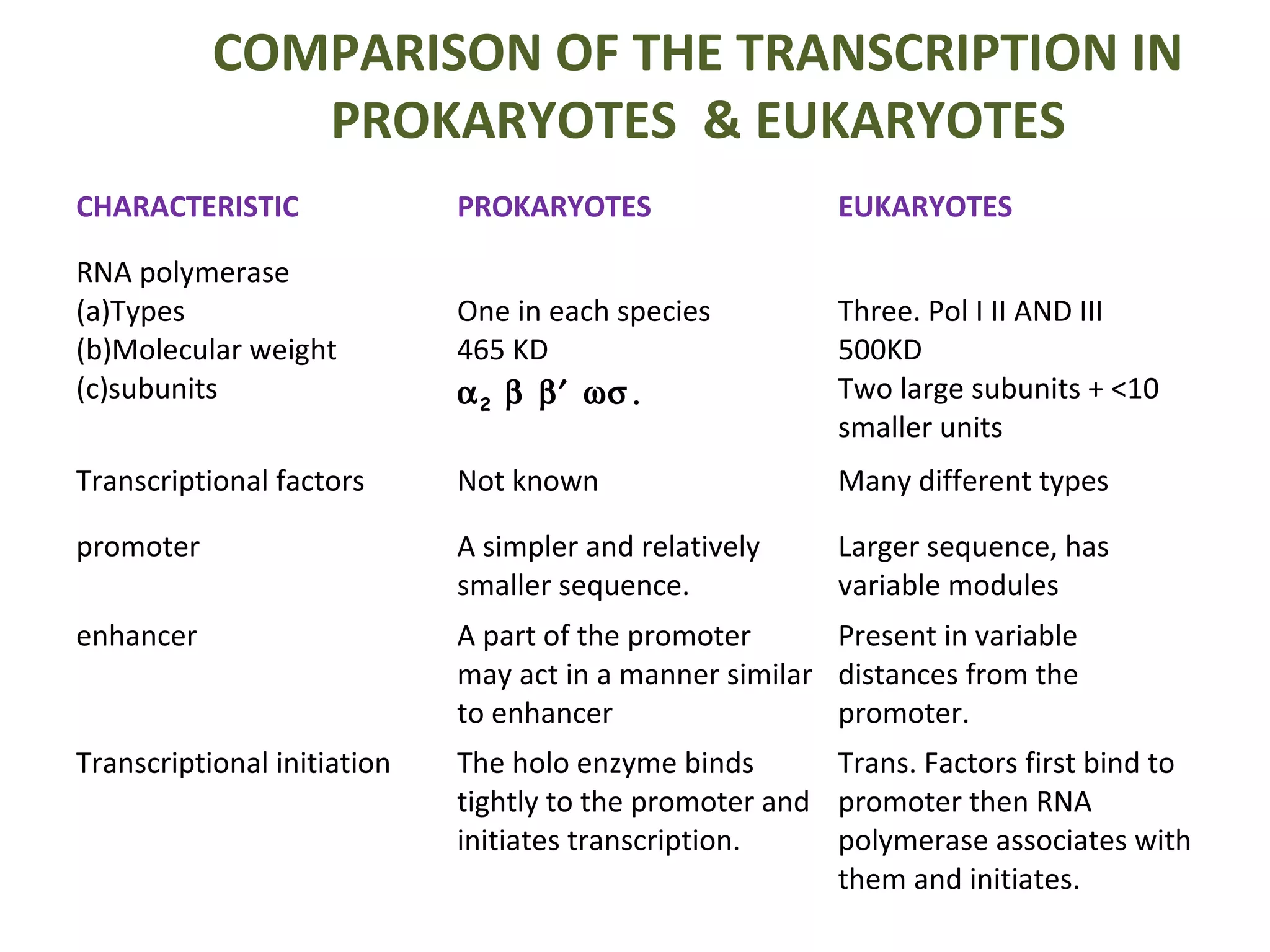
COMPARISON OF THE TRANSCRIPTION IN
PROKARYOTES & EUKARYOTES
CHARACTERISTIC PROKARYOTES EUKARYOTES
RNA polymerase
(a)Types
(b)Molecular weight
(c)subunits
One in each species
465 KD
α2 β β′ ωσ.
Three. Pol I II AND III
500KD
Two large subunits + <10
smaller units
Transcriptional factors Not known Many different types
promoter A simpler and relatively
smaller sequence.
Larger sequence, has
variable modules
enhancer A part of the promoter
may act in a manner similar
to enhancer
Present in variable
distances from the
promoter.
Transcriptional initiation The holo enzyme binds
tightly to the promoter and
initiates transcription.
Trans. Factors first bind to
promoter then RNA
polymerase associates with
them and initiates.
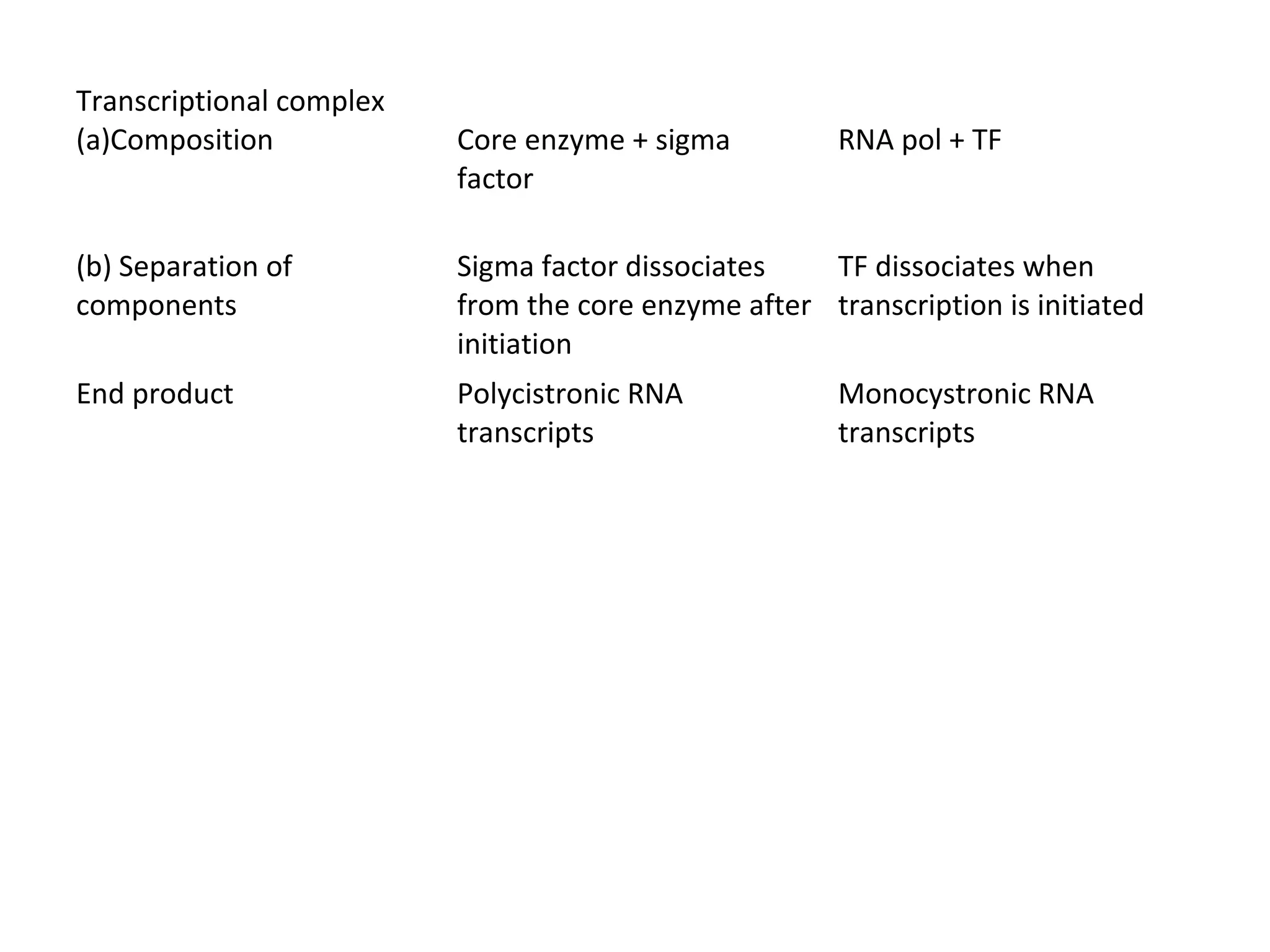
Transcriptional complex
(a)Composition Core enzyme + sigma
factor
RNA pol + TF
(b) Separation of
components
Sigma factor dissociates
from the core enzyme after
initiation
TF dissociates when
transcription is initiated
End product Polycistronic RNA
transcripts
Monocystronic RNA
transcripts
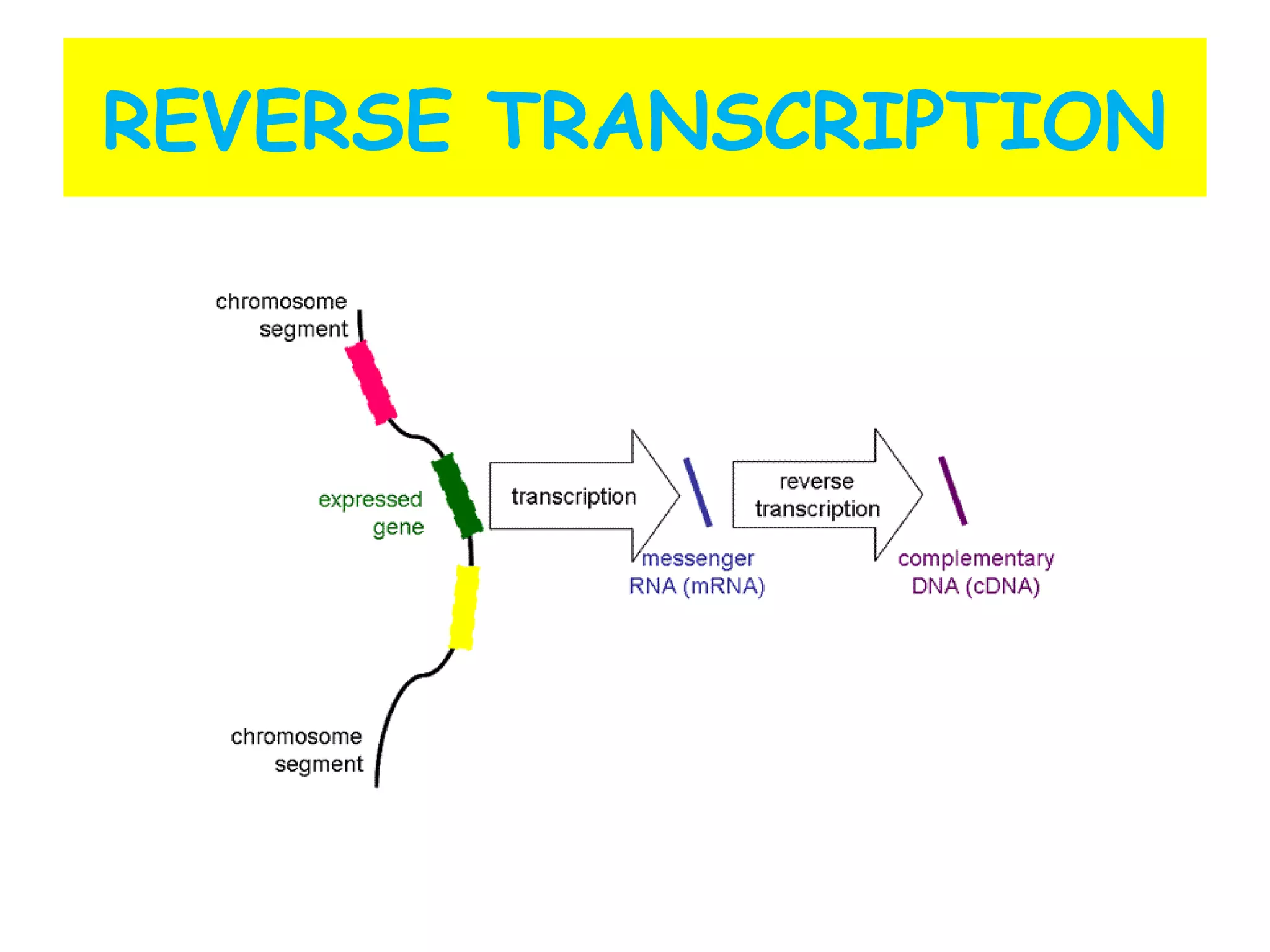
REVERSE TRANSCRIPTION
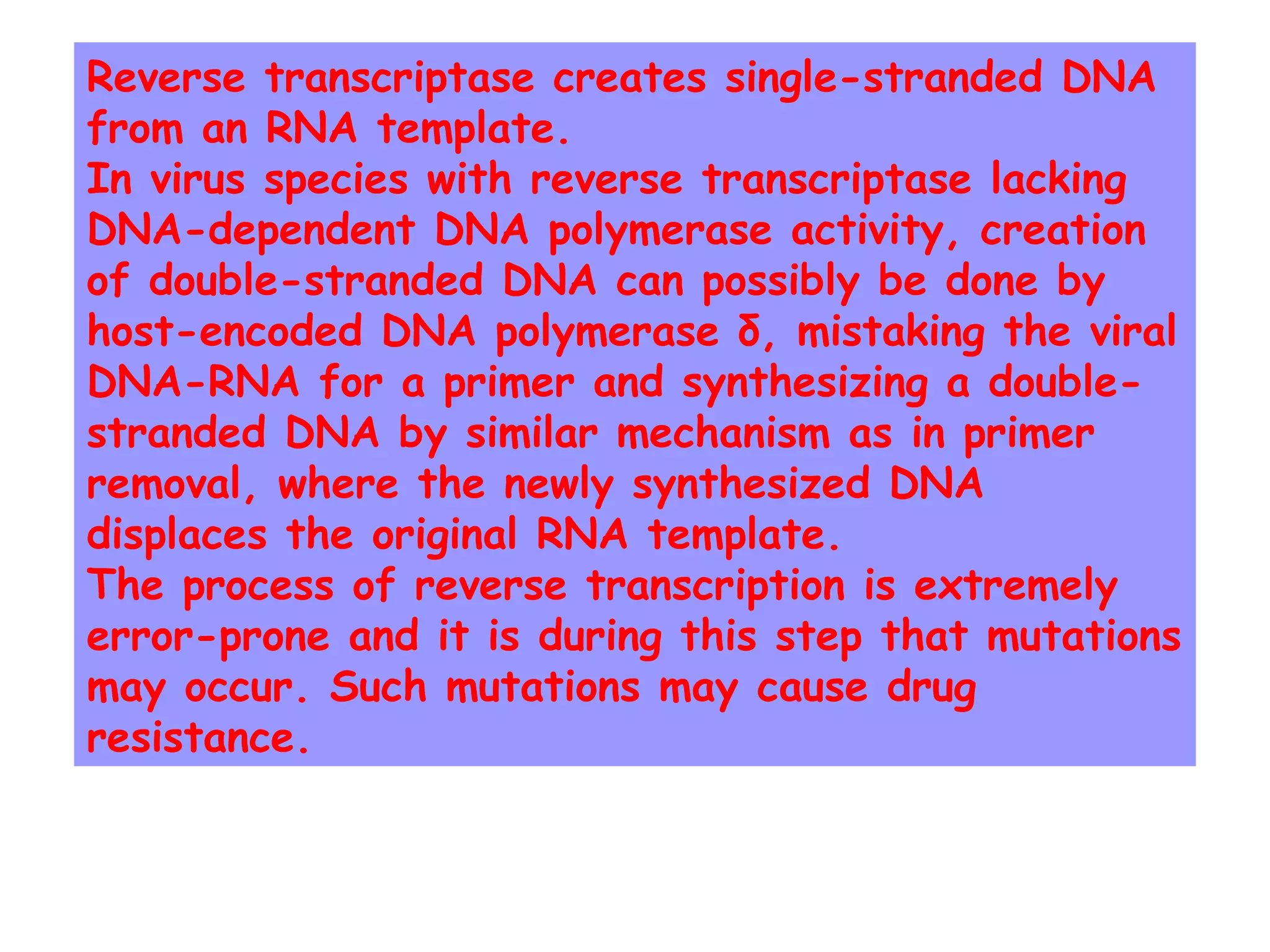
Reverse transcriptase creates single-stranded DNA
from an RNA template.
In virus species with reverse transcriptase lacking
DNA-dependent DNA polymerase activity, creation
of double-stranded DNA can possibly be done by
host-encoded DNA polymerase δ, mistaking the viral
DNA-RNA for a primer and synthesizing a double-
stranded DNA by similar mechanism as in primer
removal, where the newly synthesized DNA
displaces the original RNA template.
The process of reverse transcription is extremely
error-prone and it is during this step that mutations
may occur. Such mutations may cause drug
resistance.
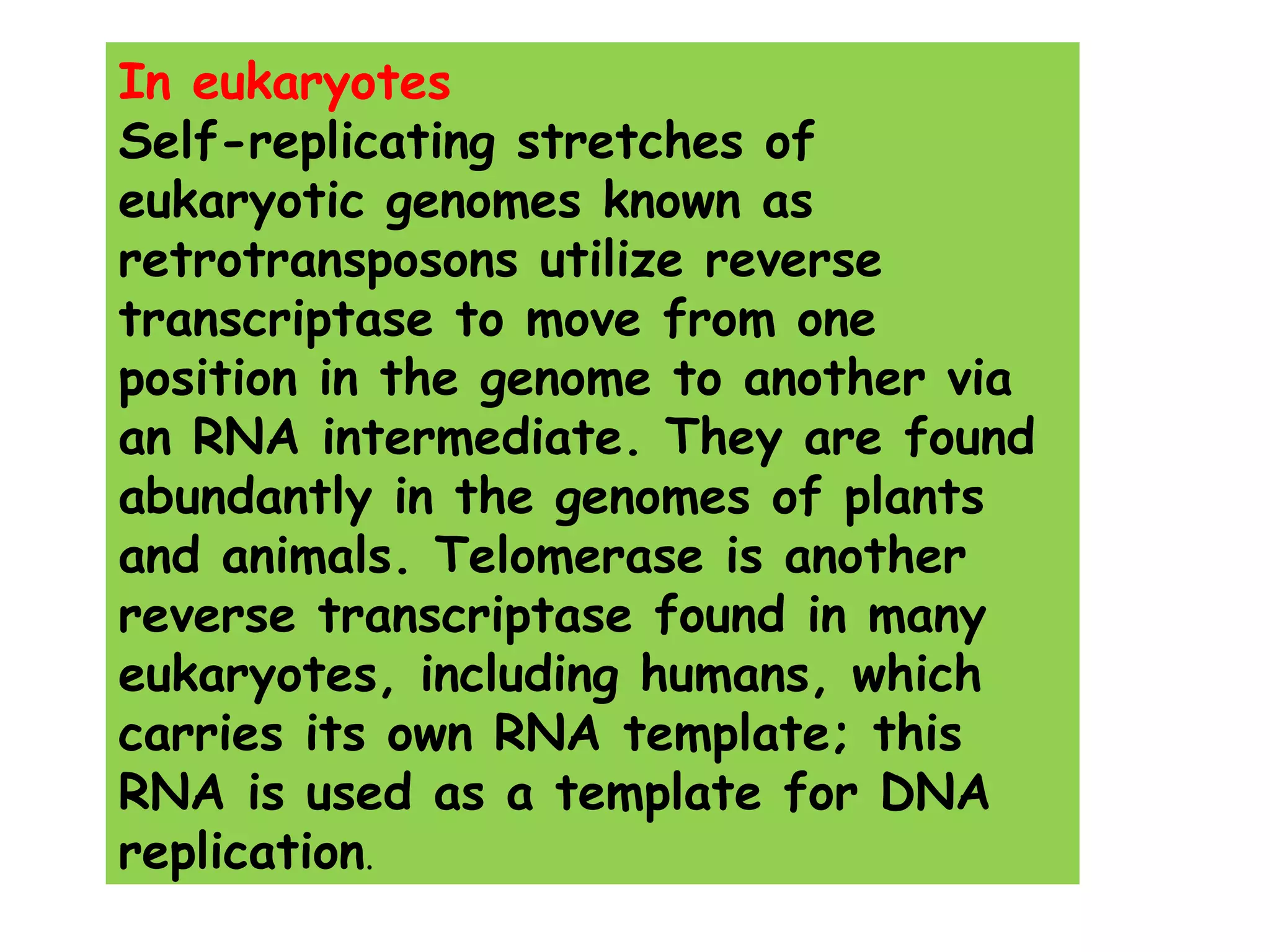
In eukaryotes
Self-replicating stretches of
eukaryotic genomes known as
retrotransposons utilize reverse
transcriptase to move from one
position in the genome to another via
an RNA intermediate. They are found
abundantly in the genomes of plants
and animals. Telomerase is another
reverse transcriptase found in many
eukaryotes, including humans, which
carries its own RNA template; this
RNA is used as a template for DNA
replication.
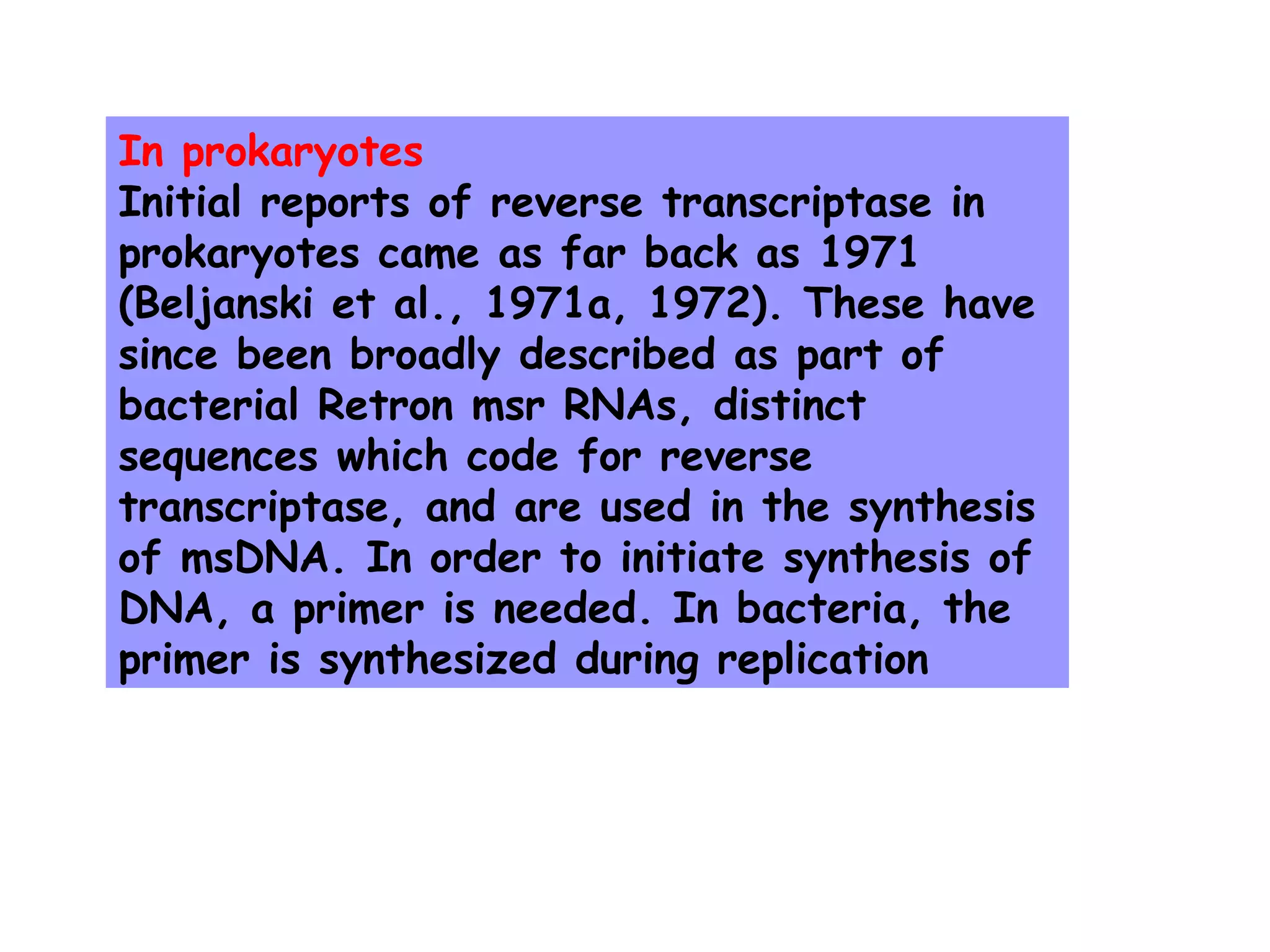
In prokaryotes
Initial reports of reverse transcriptase in
prokaryotes came as far back as 1971
(Beljanski et al., 1971a, 1972). These have
since been broadly described as part of
bacterial Retron msr RNAs, distinct
sequences which code for reverse
transcriptase, and are used in the synthesis
of msDNA. In order to initiate synthesis of
DNA, a primer is needed. In bacteria, the
primer is synthesized during replication
 GENETICS VERMA AND AGARWAL.
GENETICS SNUSTARD AND SIMMONS.
WEB.
SOURCE-
Transcription (term paper) by Ganesh M

Transcription (term paper) by Ganesh M

  • 1.
  • 2.
    The synthesis ofRNA molecules using DNA strands as the templates so that the genetic information can be transferred from DNA to RNA. TRANSCRIPTION
  • 4.
    CENTRAL DOGMA OF MOLECULARBIOLOGY -FRANCIS CRICK
  • 5.
    SIMILARITIES BETWEEN DNAREPLICATION AND TRANSCRIPTION • Both processes use DNA as the template. • Phosphodiester bonds are formed in both cases. • Both synthesis directions are from 5´ to 3´.
  • 6.
    replication transcription template doublestrands single strand substrate dNTP NTP primer yes no Enzyme DNA polymerase RNA polymerase product dsDNA ssRNA base pair A-T, G-C A-U, T-A, G-C Differences between replication and transcription
  • 7.
    “The Protein Players”- RNA polymerases, transcription factors, initiation factors, enhancers, repressors
  • 8.
    5' 3' 3' 5' -50 -40 -30-20 -10 1 10 start-10 region T A T A A T A T A T T A (Pribnow box) -35 region T T G A C A A A C T G T Prokaryotic promoter Consensus sequence
  • 9.
  • 10.
  • 11.
    • The -35region of TTGACA sequence is the recognition site and the binding site of RNA-pol. • The -10 region of TATAAT is the region at which a stable complex of DNA and RNA-pol is formed.
  • 12.
    Figure 1-3-3. Flowof Genetic Information From DNA to Protein
  • 13.
    • RNA polymerasemoves along the template strand in the 3' to 5' direction as it synthesizes the RNA product in the 5' to 3' direction using NTPs (ATP, GTP, CTP, UTP) as substrates. • RNA polymerase does not proofread its work. The RNA product is complementary and antiparallel to the template strand. • The coding (non-template) strand is not used during transcription. It is identical in sequence to the RNA molecule, except that RNA contains uracil instead of the thymine found in DNA. • By convention, the base sequence of a gene is given from the coding strand (5'  3'). RNA POLYMERASERNA POLYMERASE
  • 14.
    core enzymeholoenzyme The holoenzymeof RNA-pol in E.coli consists of 5 different subunits: α2 β β′ ωσ. ω β′ β αα σ RNA POLYMERASE
  • 15.
    subunit MW function α36512 Determine the DNA to be transcribed β 150618 Catalyze polymerization β′ 155613 Bind & open DNA template σ 70263 Recognize the promoter for synthesis initiation RNA-pol of E. Coli
  • 16.
    Comparison of Eukaryoticand Prokaryotic RNA Polymerases
  • 17.
  • 18.
    • Three phases:initiation, elongation, and termination. • The prokaryotic RNA-pol can bind to the DNA template directly in the transcription process. • The eukaryotic RNA-pol requires co- factors to bind to the DNA template together in the transcription process. General concepts
  • 19.
    • Initiation phase:RNA-pol recognizes the promoter and starts the transcription. • Elongation phase: the RNA strand is continuously growing. • Termination phase: the RNA-pol stops synthesis and the nascent RNA is separated from the DNA template. Transcription of Prokaryotes
  • 20.
    a. Initiation • RNA-polrecognizes the TTGACA region, and slides to the TATAAT region, then opens the DNA duplex. • The unwound region is about 17±1 bp.
  • 21.
    • The firstnucleotide on RNA transcript is always purine triphosphate. GTP is more often than ATP. • The pppGpN-OH structure remains on the RNA transcript until the RNA synthesis is completed. • The three molecules form a transcription initiation complex. RNA-pol (α2ββ′σ) - DNA - pppGpN- OH 3′
  • 22.
    • No primeris needed for RNA synthesis. • The σ subunit falls off from the RNA-pol once the first 3′,5′ phosphodiester bond is formed. • The core enzyme moves along the DNA template to enter the elongation phase.
  • 23.
    b. Elongation • Therelease of the σ subunit causes the conformational change of the core enzyme. The core enzyme slides on the DNA template toward the 3′ end. • Free NTPs are added sequentially to the 3′ -OH of the nascent RNA strand.
  • 24.
    • RNA-pol, DNAsegment of ~40nt and the nascent RNA form a complex called the transcription bubble. • The 3′ segment of the nascent RNA hybridizes with the DNA template, and its 5′ end extends out the transcription bubble as the synthesis is processing.
  • 25.
  • 28.
    c. Termination • TheRNA-pol stops moving on the DNA template. The RNA transcript falls off from the transcription complex. • The termination occurs in either ρ -dependent or ρ -independent manner.
  • 29.
    The termination functionof ρ factor The ρ factor, a hexamer, is a ATPase and a helicase.
  • 30.
    ρ-independent termination • Thetermination signal is a stretch of 30-40 nucleotides on the RNA transcript, consisting of many GC followed by a series of U. • The sequence specificity of this nascent RNA transcript will form particular stem-loop structures to terminate the transcription.
  • 31.
  • 33.
  • 35.
    CHARACTERISTICS OF THETHREE RNA POLYMERASES OF EUKARYOTES CHARACTERISTICS RNA POL I RNA POL II RNA POL III Sub units 2+<10 2+<10 2+<10 Target genes Ribosomal RNA genes m RNA genes t RNA and other small genes location nucleolus nucleoplasm nucleoplasm promoters UP of the start point UP of the start point DS of the start point Level of activity Most prominent 50- 70 % 20-40% ~10% Ancillary factors Two ( UBF1, SL1 ) Many ( general, upstream and regulatory) Three
  • 36.
    TF for eukaryotictranscription
  • 37.
    Eukaryotic Promoter Sequence recognized by atranscription factor Sequence where DNA is denatured determining where transcription starts Site where other regulatory proteins bind to enhance transcription A site where regulatory proteins can bind to enhance transcription
  • 38.
    TranscripTion EnhancErs and silEncErs •Both are Binding Sites for Transcription Factors (TF’s) • Enhancers: Increase the amount of Transcription from a nearby promoter (core + upstream elements) • Silencers: Decrease amount of Transcription from nearby promoters • Initially Defined as being “Position and orientation independent” – Found upstream, within, or downstream of genes – Function in either orientation (not always true)
  • 39.
    Pre-initiation complex (PIC) RNApol II TF II F TBP TAF TATA DNA TF II A TF II B TF II E TF II H
  • 40.
    • Mechanism oftranscription: Involves • Initiation • Elongation • Termination.
  • 41.
    Recognizes and bindsto TATA box; TBP + 10 TBP associated factors Binds and stabilizes the TFIID complex Recruits RNA pol II + TFIIF to the location Two subunits - RAP38 & RAP74. Rap74 has a helicase activity; RAP38 binds RNAPolII Two subunits - recruits TFIIH to the complex thereby priming the initiation complex for promoter clearance and elongation complex of 9 subunits. One w/ kinase activity; one w/ helicase activity; one is a cyclin (cdk7)
  • 42.
    • Initiation mechanismof transcription: • TFIID recognizes and binds to the TATA box. • TFIIA binds and stabilizes TFIID binding (upstream). • TFІІB bind the promoter downstream of the TFІІD. • TFІІF and RNAPІІ joins the transcription factors bound at the promoter. • TFІІE joins the transcription complex and finally TFІІH and TFІІJ join the promoter. • Formation of closed promoter (binary) complex. • Closed complex converted into open promoter complex. • Around this stage TFІІE is lost. ATP hydrolysis may lead to the loss of some more factors from the initiation complex. • RNAP now begins the transcription at the start point and presumably the transcription factors are released at this stage.
  • 43.
    Elongation mechanism intranscription: •Once eukaryotic RNAPs have been released from their initiation complex they catalyze RNA chain elongation by the same mechanism as RNAP of prokaryotes. •Early in the elongation process 5' ends of eukaryotic pre- mRNAs are modified by the addition of 7-Methyl Guanosine caps. 7-MG caps are recognized by protein factors involved in initiation of translation and also protect the growing RNA chains from degradation by nucleases
  • 45.
    3 RNA polymeraseII ends transcription when it reaches a termination signal. These signals are not well understood in eukaryotes.
  • 46.
    TERMINATION •The mode oftermination of transcription is much less understood than that of initiation. •As in the case of bacterial RNA polymerase, discrete termination events occur in the case of RNA polymerase I and III. •In case of RNA polymerase I, termination events occur at a discrete site >1000 bp downstream of the 3’ end of the precursor RNA.
  • 47.
    • Termination mechanismof transcription: • 3' ends of RNA transcripts synthesized by RNAPІІ are produced by endonucleolytic cleavage of primary transcripts. • Actual transcription termination occur at multiple sites located 1000 to 2000 nucleotide downstream from the 3' end of the mature transcripts i.e., transcription proceeds beyond the site that become 3' terminal and distal segment is removed. • The cleavage event occurs at a site 11 to 30 nucleotides downstream from a conserved sequence AAUAAA and upstream from a G-U rich sequence located near the end of transcription unit.
  • 48.
    • After cleavage,the enzyme poly(A) polymerase adds poly(A) tails – tracts of AMP residues about 200 nucleotides long to the 3' end called polyadenylation. • Poly(A) tails of eukaryotic mRNA enhance their stability and play an important role in their transport from nucleus to cytoplasm. •
  • 49.
    COMPARISON OF THETRANSCRIPTION IN PROKARYOTES & EUKARYOTES CHARACTERISTIC PROKARYOTES EUKARYOTES RNA polymerase (a)Types (b)Molecular weight (c)subunits One in each species 465 KD α2 β β′ ωσ. Three. Pol I II AND III 500KD Two large subunits + <10 smaller units Transcriptional factors Not known Many different types promoter A simpler and relatively smaller sequence. Larger sequence, has variable modules enhancer A part of the promoter may act in a manner similar to enhancer Present in variable distances from the promoter. Transcriptional initiation The holo enzyme binds tightly to the promoter and initiates transcription. Trans. Factors first bind to promoter then RNA polymerase associates with them and initiates.
  • 50.
    Transcriptional complex (a)Composition Coreenzyme + sigma factor RNA pol + TF (b) Separation of components Sigma factor dissociates from the core enzyme after initiation TF dissociates when transcription is initiated End product Polycistronic RNA transcripts Monocystronic RNA transcripts
  • 51.
  • 52.
    Reverse transcriptase createssingle-stranded DNA from an RNA template. In virus species with reverse transcriptase lacking DNA-dependent DNA polymerase activity, creation of double-stranded DNA can possibly be done by host-encoded DNA polymerase δ, mistaking the viral DNA-RNA for a primer and synthesizing a double- stranded DNA by similar mechanism as in primer removal, where the newly synthesized DNA displaces the original RNA template. The process of reverse transcription is extremely error-prone and it is during this step that mutations may occur. Such mutations may cause drug resistance.
  • 53.
    In eukaryotes Self-replicating stretchesof eukaryotic genomes known as retrotransposons utilize reverse transcriptase to move from one position in the genome to another via an RNA intermediate. They are found abundantly in the genomes of plants and animals. Telomerase is another reverse transcriptase found in many eukaryotes, including humans, which carries its own RNA template; this RNA is used as a template for DNA replication.
  • 54.
    In prokaryotes Initial reportsof reverse transcriptase in prokaryotes came as far back as 1971 (Beljanski et al., 1971a, 1972). These have since been broadly described as part of bacterial Retron msr RNAs, distinct sequences which code for reverse transcriptase, and are used in the synthesis of msDNA. In order to initiate synthesis of DNA, a primer is needed. In bacteria, the primer is synthesized during replication
  • 55.
     GENETICS VERMAAND AGARWAL. GENETICS SNUSTARD AND SIMMONS. WEB. SOURCE-

Editor's Notes

  • #35 Assembly of the pre-initiation complex (PIC).  TBP first binds to the promoter and then recruits TFIIB to join TFIID (and TFIIA if present).  Before entering PIC, RNA Pol II and TFIIF are bound together, which are recruited by TFIIB.  Finally, RNA Pol II recruits TFIIE, which further recruits TFIIH to complete the PIC assembly.