Transcription
D.INDRAJA
• Transcription is the first step in gene expression
• Transcription is a process of formation of transcript (RNA)
• All RNA molecules except the RNA genomes of certain viruses are derived
from information permanently stored in DNA
• During transcription, an enzyme system converts the genetic information in
a segment of double-stranded DNA in to an RNA strand with a base
sequence complementary to one of the DNA strands
• Transcription is a highly regulated process for specific gene expression
• Specific regulatory sequences mark the beginning and end of the DNA
segment to be transcribed and designate which strand in duplex DNA is to
be used as the template
• Some portions of the DNA genome are never transcribed
Coding or sense strand
Template or antisense strand
ds DNA
RNA
Differences between DNA Replication
and Transcription
Transcription DNA Replication
Copies only certain part of genome Copies whole genome
RNA pol doesn’t need primer DNA pol needs primer
Product doesn’t remain base paired with
template
Product remain paired with the template
Less accurate More accurate
1 mistake per 10,000 nu added 1 mistake per 10,000,000 nu added
Transcription generates three kinds of RNA
 Messenger RNA (mRNA) bears the message for protein synthesis
 Transfer RNA(tRNA) carries amino acids during protein synthesis
 Ribosomal RNA (rRNA) molecules are components of ribosomes
• mRNA in prokaryotes is polycistronic it means it carries several open
reading frames (ORFs), each of which is translated into a polypeptide
• There is a non translated leader sequence of 25-150 bases at the 5’ end
preceding the initiation codon
Transcription in Prokaryotes
Important Machinery Components
• RNA polymerase
• Promoter sequences
• Termination sequences
DNA dependent RNA
polymerase• DNA dependent RNA Synthesis is catalyzed by the enzyme DNA
dependent RNA Polymerase (simply called RNA Polymerase)
• It was discovered by Samuel B. Weiss and Jerard Hurwitz in 1960.
• In Prokaryotes, single type of RNA polymerase appears to be
responsible for the synthesis of all different types of RNA such as,
mRNA, rRNA, tRNA.
• It requires all four ribonucleosides (ATP, GTP, UTP, CTP) as
precursors of the nucleotide units of RNA, as well as Mg2+ (Zn2+)
• It doesn’t need a primer to initiate synthesis
• RNA Polymerase elongates an RNA strand by adding ribonucleotide
units to the 3’-hydroxyl end, building RNA in the 5’  3’ direction
• each nucleotide in the newly formed RNA is selected by watson-
crick base pairing interaction
• 5’-triphosphate group of the first residue in a nascent (newly
formed) RNA molecule is not cleaved to release PPi but instead
remains intact through out the trancsription process
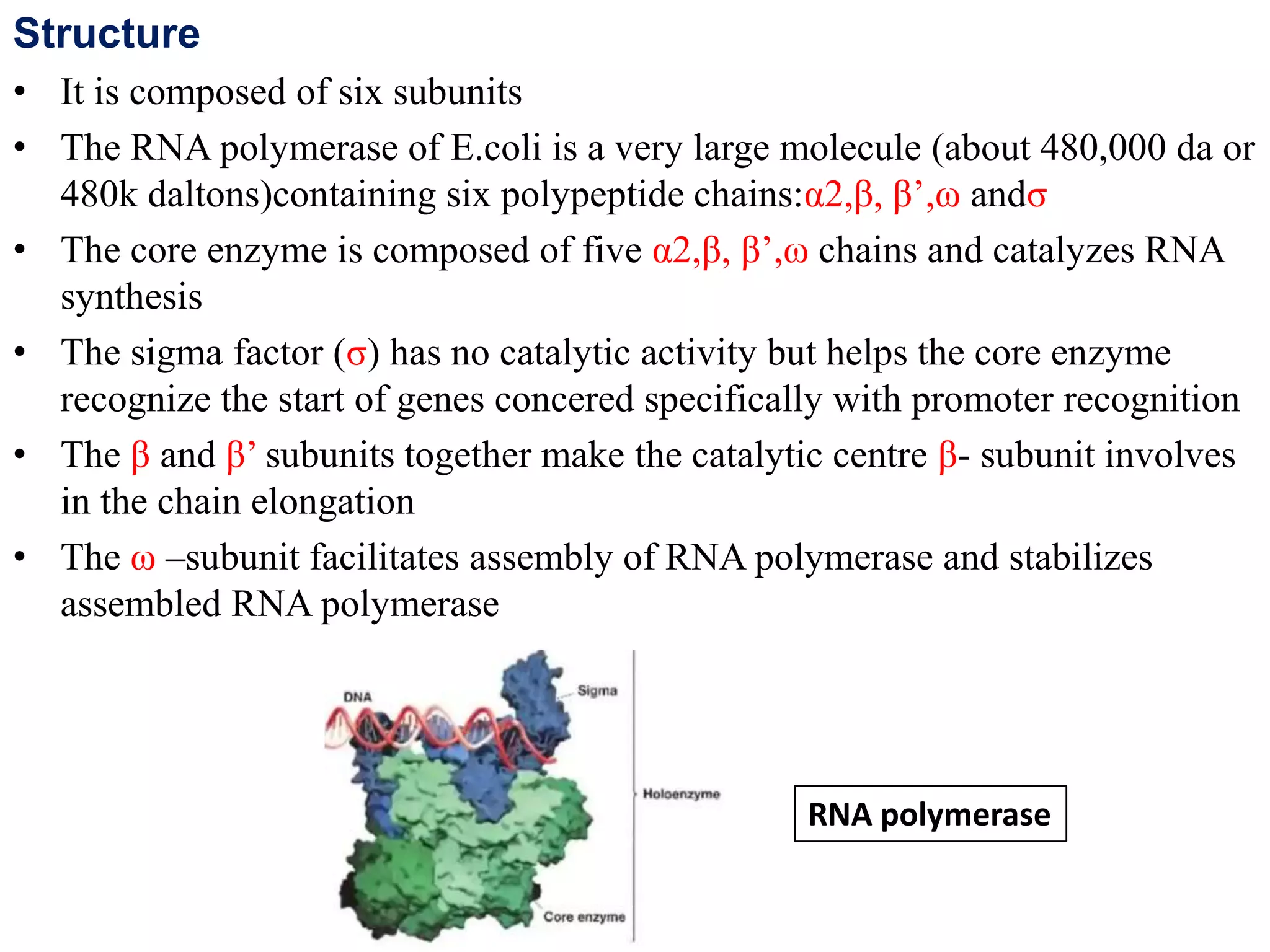
Structure
• It is composed of six subunits
• The RNA polymerase of E.coli is a very large molecule (about 480,000 da or
480k daltons)containing six polypeptide chains:α2,β, β’,ω andσ
• The core enzyme is composed of five α2,β, β’,ω chains and catalyzes RNA
synthesis
• The sigma factor (σ) has no catalytic activity but helps the core enzyme
recognize the start of genes concered specifically with promoter recognition
• The β and β’ subunits together make the catalytic centre β- subunit involves
in the chain elongation
• The ω –subunit facilitates assembly of RNA polymerase and stabilizes
assembled RNA polymerase
RNA polymerase
• Once RNA synthesis begins, the sigma factor dissociates from the core
enzyme –DNA complex and is available to aid another core enzyme
Subunits Gene Function
α rpoA Assembly of the core enzyme
and promoter recognition
β rpoB Catalytic center
β' rpoC Catalytic center
ω rpoZ Assembly of RNA polymerase
σ rpoD Promoter recognition and
transcription initiation
RNA polymerase subunits and their function
Sigma(σ)fa
ctor
• The σ 70 (superscript indicates molecular mass 70kda )factor can be divided
in to four regions called σ region 1 , σ region 2, σ region 3, σ region4
• The regions that recognize the -10 and -35 elements of the promoter are
regions 2 and 4 respectively
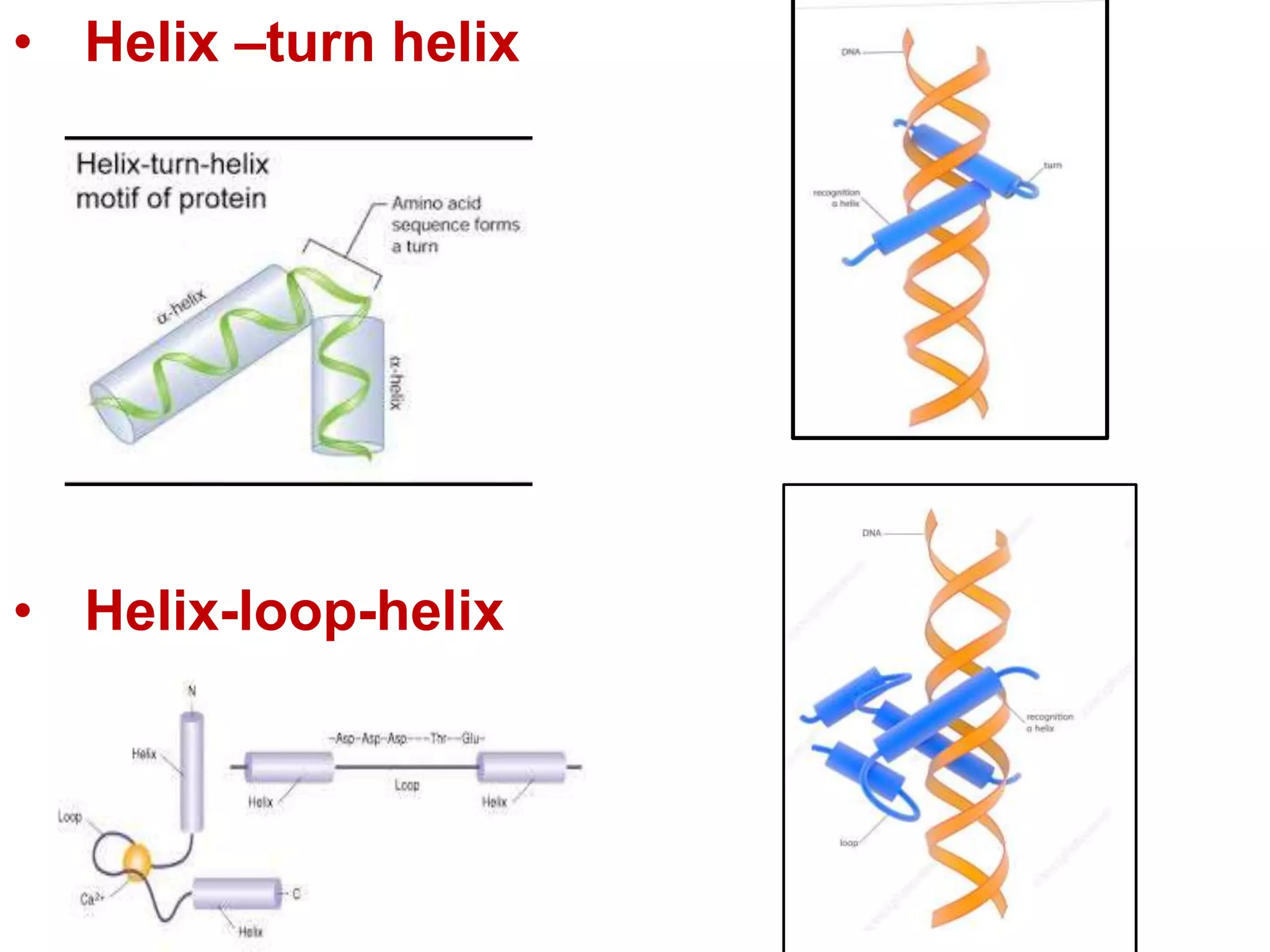
• Two helices within region 4 form a common DNA-binding motif called a
helix-turn-helix
• One of these helices inserts into the major groove and interacts with bases in
the -35 region
• Region 2 has α helix and has aromatic amino acid which interactswith the
bases on non template region
RNA dependent RNA
polymerase
• Some viruses like f2 and R17 contain RNA genomes. The
single stranded RNA in these viruses are replicated in the host
cell by the action of enzymes called RNA dependent RNA
polymerases or RNA replicases
• RNA replicase requires RNA as a template and will not
function with DNA
• Synthesis of the new strand proceeds in the 5’3’ direction,
and the chemical mechanism is similar to that of DNA
dependent transcription
• RNA replicases are specific for the RNA of their own virus,the
RNA’s of the host cell are not replicated
Prokaryotic
promoter
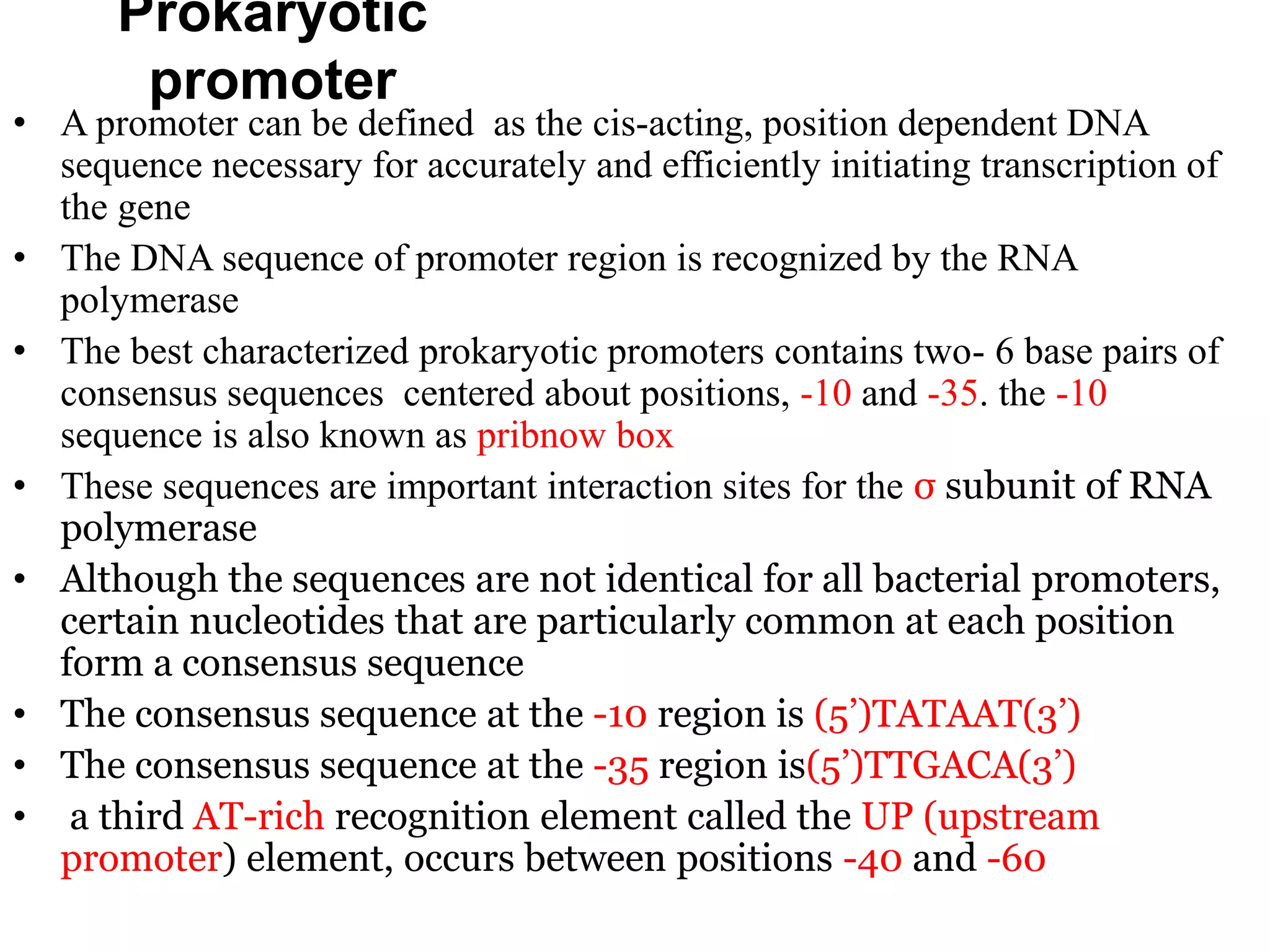
• A promoter can be defined as the cis-acting, position dependent DNA
sequence necessary for accurately and efficiently initiating transcription of
the gene
• The DNA sequence of promoter region is recognized by the RNA
polymerase
• The best characterized prokaryotic promoters contains two- 6 base pairs of
consensus sequences centered about positions, -10 and -35. the -10
sequence is also known as pribnow box
• These sequences are important interaction sites for the σ subunit of RNA
polymerase
• Although the sequences are not identical for all bacterial promoters,
certain nucleotides that are particularly common at each position
form a consensus sequence
• The consensus sequence at the -10 region is (5’)TATAAT(3’)
• The consensus sequence at the -35 region is(5’)TTGACA(3’)
• a third AT-rich recognition element called the UP (upstream
promoter) element, occurs between positions -40 and -60
-10 region
• Contains sequences for melting
-35 region
• Provides binding energy to secure pol to promoter
UP element
• Not found in all promoters
• Increases polymerase binding
• Bound by αCTD of polymerase
Types of
promoter
• Variations in the consensus sequence also affect the efficiency of RNA
polymerase binding and transcription initiation
• A change in only one base pair can decrease the rate of binding by several
orders of magnitude
Strong promoters
• Promoters with sequences closer to the consensus
Weak promoters
• Promoters with sequences which match less with the consensus
The σ subunit enables the RNA polymerase to recognize promoter sites.
• Most E.coli promoters interact with the major form of RNA polymerase,
which contains σ70. transcription of certain groups of genes, however is
carried out by E.coli RNA polymerase containing one of several alternative
sigma factors. These alternative sigma factors σ28, σ32, σ38, and σ54 recognize
different consensus promoter sequences than σ70
Alternative σ factors and their
consensus sequences
Name Upstream(-35)
consensus
Function
σ54 TTGGCACA Nitrogen assimilation
σ38 CCGGCG Major sigma factor during
stationary phase, also for genes
involved in oxidative and
osmotic responses
σ32 TNTCNCCTTGAA Heat shock response
σ28 TAAA For genes involved in flagella
synthesis
Stages in
Transcription
Recognition and binding
Initiation
Elongation
Termination and release
Recognition and binding
• RNA polymerase binds to its initiation sites through base sequences known
as promoters that are recognized by the corresponding σ factor
• The holoenzyme forms tight complexes with promoters (dissociation
constant K =10-14M) and there by protects the bound DNA segments from
digestion by DNase I
• The region from about -20 to+20 is protected against exhaustive DNase I
degradation
• The region extending upstream to about -60 is also protected but to a lesser
extent, pressumbly because it binds holoenzyme less tightly.
• 5’-triphosphate group of the first residue in a nascent (newly formed) RNA
molecule is not cleaved to release PPi but instead remains intact through out
the trancsription process
• E.coli RNA polymerase generally keeps about 17 bp unwound
• The 8 bp RNA-DNA hybrid occurs in this unwound region
• Elongation of a transcript by E.coli RNA polymerase proceeds at a rate of
50-90 nucleotides/s
• It has complete processivity
Initiation
1.Binding of RNAp:
• It involves the initial binding of RNA polymerase
to the promoter present in the DNA
2.Closed complex formation:
• The next stage in initiation requires
the enzyme become more intimately engaged
with the promoter by forming a
closed complex/closed binary complex
• When RNA polymerase holoenzyme
initially binds to DNA it covers
some 75-80 bp, by extending from -55 to+20
3.Open complex formation:
• The transition from the closed to the open complex involves structural
changes in the enzyme and the opening of the DNA double helix to reveal
the template and non template strands
• This transition often called isomerization , does not require energy derived
from ATP hydrolysis and is instead the result of a spontaneous
conformational change in the DNA-enzyme complex to a more energetically
favorable form
• Isomerization is essentially irreversible and, once complete, typically
guarantees that transcription will subsequently initiate
Formation of transcription bubble
• The binding of holoenzyme melts out the promoter in aregion of 14bp
extending from the middle of the -10 region to just pass the initiation site,
there by forming a so called transcription bubble
Chain initiation
• The next step is to incorporate the first two nucleotides; then a
phosphodiester bond is forms between them. This generates a ternary
complex that contains RNA, DNA, and enzyme.
• The 5’-terminal base of prokaryotic RNAs is almost always a purine with A
occuring more often than G
PPPA+ PPPN PPPAPN + Ppi
• RNAP has a curious behaviour : it frequently releases its newly synthesized
RNA after only 10nt have been polymerized, a process known as abortive
initiation.
• The RNAP fails to escape the promoter and instead relieves the
conformational tension by releasing the newly synthesized RNA fragment,
there by letting the transcription bubble relax to its normal size
• Successful initiation, eventually provides sufficient energy to strip the
promoter from the RNAP, which then commences the processive
(continuous) transcription of the template
• This process requires the dissociation of the σ factor from the core DNA-
RNA complex to form the elongation complex
Chain elongation
• Catalytic mechanism of RNA synthesis by RNA polymerase. Note that this
is essentially the same mechanism used by DNA polymerases
• The reaction involves two Mg2+ ions,
coordinated to the phosphate
groups of the incoming NTP
and to three Asp residues
(Asp460, Asp462, Asp 464
in the Subunit of the E. coli).
• One Mg2+ ion facilitates
attack by the 3 hydroxyl
group on the a phosphate of
the NTP.
• And the other Mg2+ ion facilitates displacement of the pyrophosphate
(During each nucleotide addition the β and γ phosphates are removed from
the incoming nucleotide)
• The in vivo rate of transcription is 20-70
nucleotides per second
• Once an RNAP molecule has initiated
transcription and moved away from the
promoter, another RNAP can follow suit.
The RNAP itself apparently functions as
a sliding clamp by binding tightly but
flexibly to the DNA RNA complex
• A moving RNA polymerase generates
waves of positive supercoils ahead of the
transcription bubble and negative
supercoils behind.
• In the cell, the topological problems
caused by transcription are relieved
through the action of topoisomerases and
gyrases
• Gyrase removes positive supercoil and
introduces negative super coils where as
topoisomerase I removes negative
supercoils that develop behind
• Cordycepin an adenosine analog that lacks a 3’-OH group, inhibits
elongation.its addition to the 3’ end of RNA prevents the RNA chains further
elongation. It is readily phosphorylated to its mono, di and triphosphate
intracellularly. Triphosphate cordycepin can be incorporated in to RNA and
inhibits transcription elongation
Termination
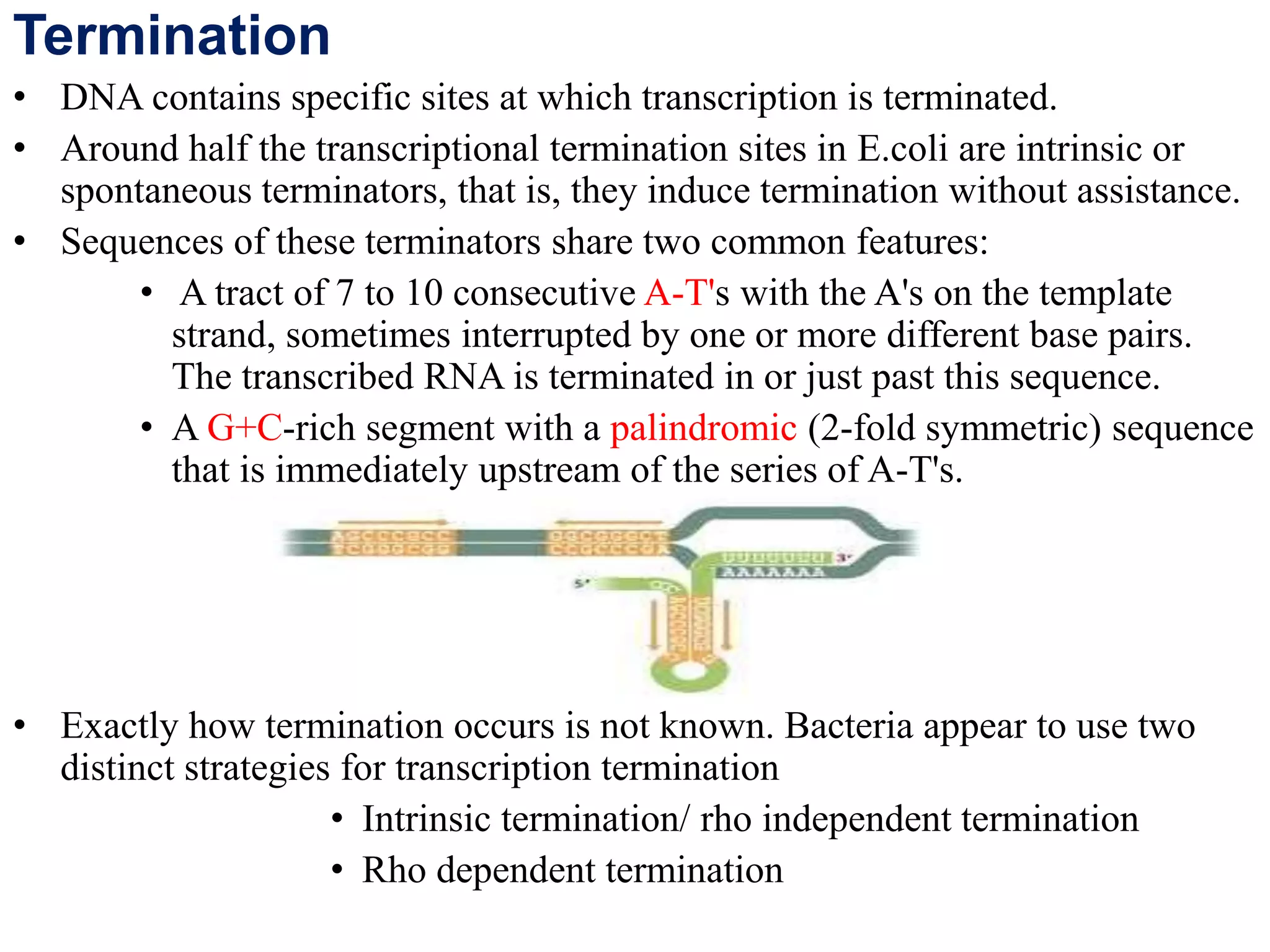
• DNA contains specific sites at which transcription is terminated.
• Around half the transcriptional termination sites in E.coli are intrinsic or
spontaneous terminators, that is, they induce termination without assistance.
• Sequences of these terminators share two common features:
• A tract of 7 to 10 consecutive A-T's with the A's on the template
strand, sometimes interrupted by one or more different base pairs.
The transcribed RNA is terminated in or just past this sequence.
• A G+C-rich segment with a palindromic (2-fold symmetric) sequence
that is immediately upstream of the series of A-T's.
• Exactly how termination occurs is not known. Bacteria appear to use two
distinct strategies for transcription termination
• Intrinsic termination/ rho independent termination
• Rho dependent termination
Rho-independent termination
Rho- dependent termination
• Around half the termination sites in E.coli lack any obvious similarities and
are unable to form strong hairpins; they require the participation of a protein
known as Rho factor to terminate transcription (nonspontaneously
terminating transcripts).
• Rho factor, a RecA family hexameric helicase of identical 419 residue
subunits.
• Rho unwinds RNA-DNA and RNA-RNA double helices by translocating
along a single strand of RNA in its 5'to 3' direction. This process is powered
by the hydrolysis of NTPs to NDPs + Pi with little preference for the
identity of the base.
• Rho attaches to nascent RNA at its recognition sequence [named rut (for
Rho utilization), a C-rich segment of at least 40 nt]Translocates along the
RNA in the 5' 3' direction until it encounters an RNAP paused at the
termination site
• Rho pushes the RNAP forward in a way that partially rewinds its dsDNA
helix at the transcription bubble while unwinding the RNA-DNA hybrid
helix thus releasing the RNA.
Transcription in eukaryotes
Important machinery components
RNA polymerases
Promoter sequences
Transcription factors
Activators
repressors
RNA polymerases
• A single RNA polymerase is responsible for transcription of all different
types of RNAs in prokaryotes. However, eukaryotes have three different
RNA polymerases:
• RNAP I-transcribes rRNA genes (nucleoli)
• RNAP II -transcribes mRNA genes (nucleoplasm)
• RNAP III - transcribes tRNA, 5S RRNA, and other small RNAgenes
(nucleoplasm)
• All eukaryotic RNA polymerases are large proteins, appearing as aggregates
of >500 kDa Each RNA pol is a multi-subunit protein (8 -12 subunits)
Eukaryotic pol II consists of 12 subunits.
• The two largest subunits are homologous to the bacterial and subunits.
• In addition to the increased number of subunits, eukaryotic pol II differs
from its prokaryotic counterpart in that it has a series of heptad repeats with
the consensus sequence Tyr-Ser-Pro-Thr Ser Pro-Ser at the carboxyl
terminal of the largest pol II subunit. – 52X humans , - 26X yeast
• This Carboxyl Terminal Domain (CTD) s both a substrate for several
kinases, including the kinase component of TFIIH, and a binding site for a
wide array of protein
• An additional RNA polymerase is found in mitochondria as well as in the
chloroplast, which carry a small DNA molecule of their own
• In addition to the three RNA polymerases (Pol I, Pol II and Pol III) shared
by all eukaryotic organisms, plant genomes encode two additional RNA
polymerases
• RNA Polymerase IV- si RNA biogenesis
• RNA Polymerase V - si RNA detected DNA methylation
• RNAPs do not monotonically move forward along the template DNA,
instead, they frequently backtrack.
• Forward movement of the RNA is impeded by damage to the template or by
mispairing, further backtracking becomes favored.
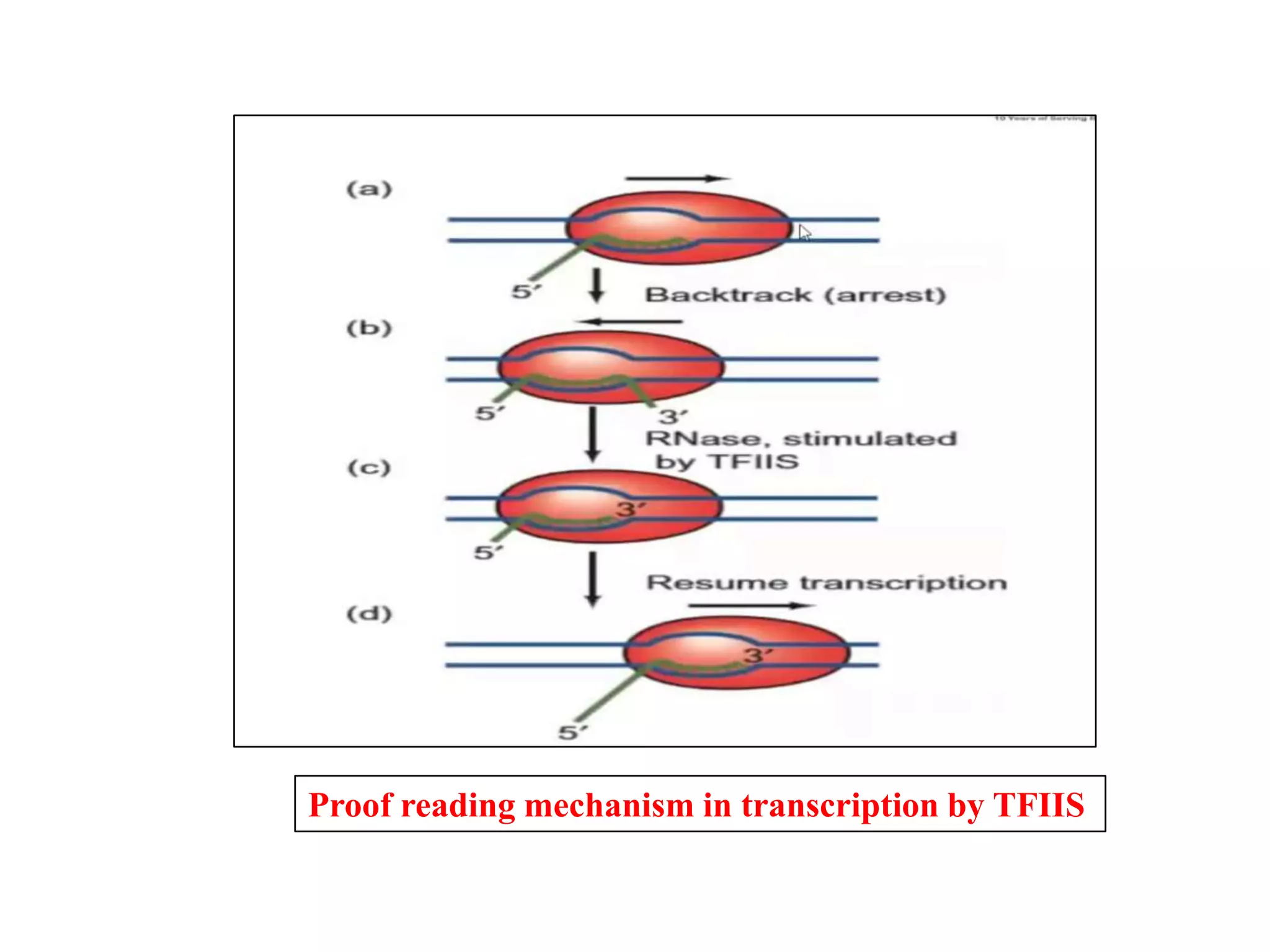
• protein TFIIS - hydrolyze the phosphodiester bond between the
ribonucleotides and corrects the mistake
Class II Promoters
• Class II promoters can be considered as having two parts:
• core promoter (elements lying within about 37 bp of the transcription start
site, on either side)
• proximal promoter (37 bp up to 250 bp upstream of the transcription start
site, upstream promoter elements)
Core Promoter
• TATA box is centered at approximately position -28 (about -31to -26) and
has the consensus sequence TATA(A/T)AA(G/A)
• TFIIB recognition element (BRE) lies just upstream of the TATA box
(position -37 to -32) and has the consensus sequence (G/C/G/C)(G/A)CGCC
• Initiator (Inr) is centered on the transcription start site (position -2 to +4) and
has the consensus sequence GCA(G/T)T(T/C) inDrosophila, or
PyPyAN(T/A)PyPy in mammals
• Downstream promoter element (DPE) is centered on position+30 (+28 to
+32)
• Downstream core element (DCE) has three parts located at approximately
+6 to +12, +17 to +23, and +31 to +33, and these have the consensus
sequences CTTC, CTGT, and AGC, respectively
• Motif ten element (MTE) lies approximately between positions+18 and +27
Proximal Promoter Elements
• GC boxes found in a variety of promoters, usually upstream ofthe TATA box
contain the sequences GGGCGG and CCGCCC, respectively (-47 to -61 and
in the -80 to -105regions).
• CCAAT box ( pronounced "cat box”) another up stream element (-70 and -
90)
• The CAAT box is recognized by the activators NF-1 and NF-γ
• The GC box is recognized by Sp1 activator
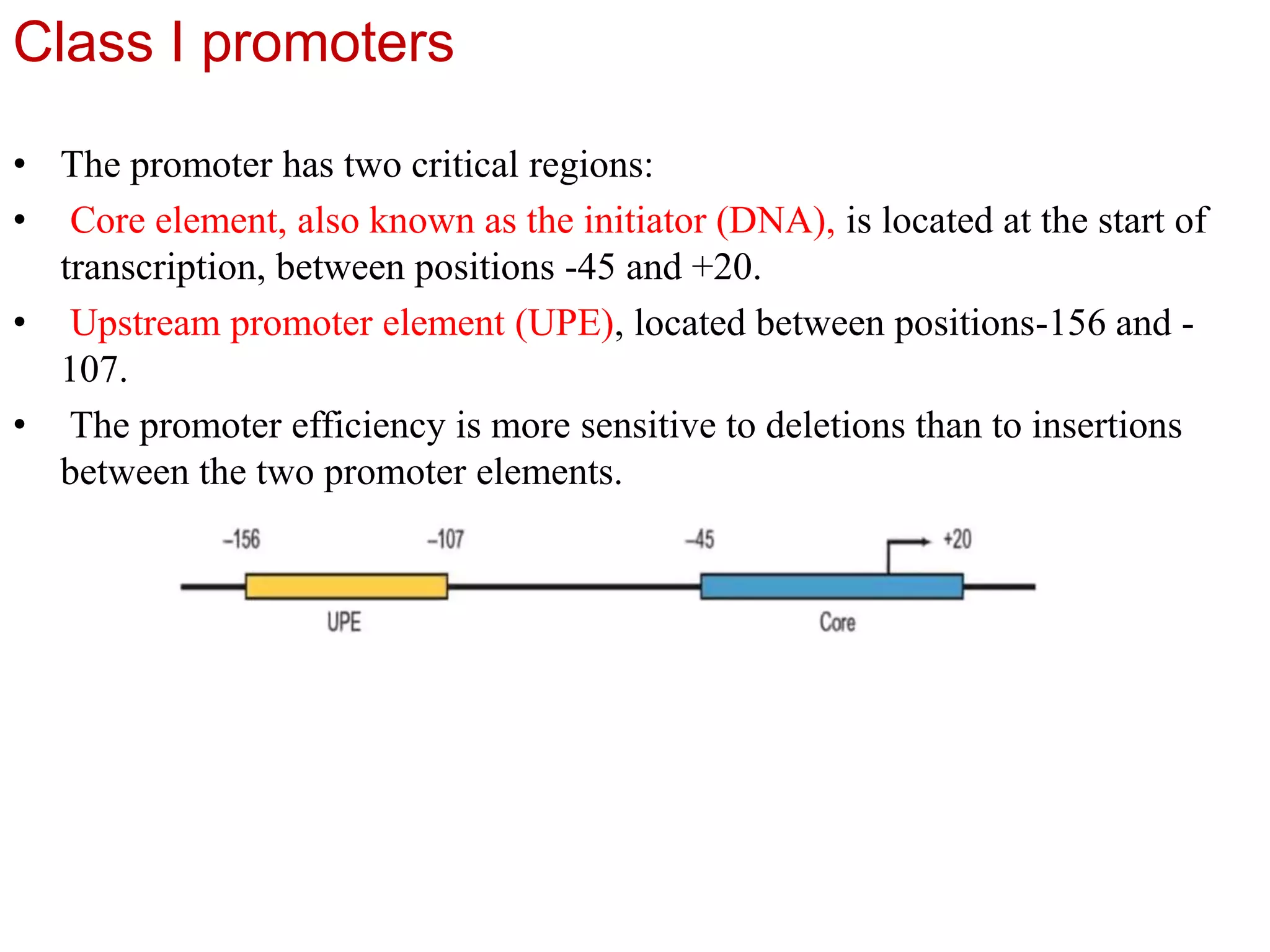
Class I promoters
• The promoter has two critical regions:
• Core element, also known as the initiator (DNA), is located at the start of
transcription, between positions -45 and +20.
• Upstream promoter element (UPE), located between positions-156 and -
107.
• The promoter efficiency is more sensitive to deletions than to insertions
between the two promoter elements.
• Class III promoters
• RNA polymerase III transcribes a set of short genes.
• The classical class III genes (types I and II) have promoters that lie wholly
within the genes.
• The internal promoter (+41 to +87) of the type I class III gene (the 5S rRNA
gene) is split into three regions: box A (+50 to +60), a short intermediate
element (+67 to +72), and box C (+80 to +90).
• The internal promoters of the type II genes (e.g., the tRNA genes) are split
into two parts: box A (+8 to +19) and box B (+52 to +62).
• The promoters of the nonclassical (type III) (eg. U6 snRNA gene) class III
genes resemble those of class II genes. DSC (-215 to -240), PSE, (-65 to -
48) and TATA box (-32 to -25) also may contain A box (+21 to +31), and a B
box (+234 to +244)
Enhancers and Silencers
• Many eukaryotic genes, especially class II genes, are associated with cis-
acting DNA elements that are not strictly part of the promoter, yet strongly
influence transcription.
• Enhancers /activator are elements that stimulate transcription.
• Silencers / repressors , by contrast, depress transcription.
• Position- and orientation- independent DNAelements
• Tissue-specific
• The mediator is a protein complex consisting of about 20 protein subunits
and allow the enhancer proteins to communicate properly with the
polymerase II and with the general transcription factors .
• Mediator is a general coactivator of RNA pol II mediated transcription
Enhancers
• Discovered the first enhancer in the 5'-flanking region of the SV40 early
gene, called as 72-bp repeat
• Enhancers act through proteins that bind to them transcription factors,
enhancer-binding proteins, or activators
• Stimulate transcription by interacting with other proteins called general
transcription factors at the promoter. This interaction promotes formation of
a preinitiation complex
• Enhancers usually allow a gene to be induced Activators frequently require
help from other molecules (e.g., hormones and coactivator proteins) to exert
their effects
Silencers
• The available data indicate that they cause the chromatin to coil up into a
condensed, inaccessible, and therefore inactive form, thereby preventing
transcription of neighbouring genes.
• Yeast chromosome III contains three loci of very similar sequence: MAT,
HML, and HMR. Though MAT is expressed, the other two loci are not, and
silencers located at least 1 kb away seem to be responsible for this genetic
inactivity.
• Sometimes the same DNA element can have both enhancer and silencer
activity, depending on the protein bound to it. For example, the thyroid
hormone response element.
Transcription Factors
• RNA polymerase II requires an array of other proteins, called transcription
factors (TFII), in order to form the active transcription complex.
• The general transcription factors required at every Pol II promoter.
• General transcription factor (TF) vs. promoter-specific
1. General TFs are required by all mRNA genes (absolute requirement).
Transcription can occur alone with these factors and by definition the basal
level of transcription.
2. Promoter-specific TFs are different for each gene. The promoter-specific
TFs are required for maximal level of transcription or for activated
transcription (induction).
General TFs
1. TFIID = TBP+TAFs (approx 14)
• TBP (38 kDa) binds the minor groove of the TATA box and kinks DNA
• TAFs interact with the Inr region
• makes contact with TFIIB and TFIIA
• have up to 14 different TAF proteins bound to TBP
• only TBP is required for basal transcription
2. TFIIA
• helps stabilize TFIIB-TBP interactions on DNA
• required for activation and to counteract repression- not essential in a highly
consensus promoter
3.TFIIB
• is a single polypeptide (35 kDa)
• involved in start site selection (position the active center of the polymerase
about 26–31 bp downstream of the TATA box)
• position of TFIIB between TFIID and TFIIF/RNA polymerase II
4. TFIIF
• originally identified as a RNAP II associated protein (RAP)
• has sigma like activity enhances RNAP II binding to promoter DNA and
reduces its nonspecific binding to DNA
• also important for promoter clearance
5. TFIIE
• heterodimer(34 & 56 kD)
• It is required for recruitment of TFIIH
6. TFIIH
• has both 3'-5' and 5'-3 helicase activity which requires ATP hydrolysis
• the 3'-5' helicase activity is essential for promoter opening
– There is an ATP requirement for promoter opening
– Can circumvent by using super coiled DNA or pre meltedDNA
eliminates the need for TFIIH
• TFIIH is also involved in nucleotide excision repair of DNA
• actively transcribed DNA is more readily repaired
• interaction with TFIIE modulates the ATPase, helicase, and kinase
activity of TFIIH
General transcription factors Function
TFIID(TBP component) Recognition of the TATA box and possibly Inr
sequence, forms a platform for TFIIB binding
TFIID ( TAFs) Recognition of the core promoter, regulation
of TBP binding
TFIIA Stabilizes TBP and TAF binding
TFIIB Influences selection of the start point for
transcription
TFIIF Recruitment of RNA polymerase II
TFIIE Intermediate in the recruitment of TFIIH,
modulates various activities of TFIIH
TFIIH Helicase activity responsible for transition
from closed to open promoter complex,
possibly influences promoter clearence by
phosphorylation of the C-terminal domain of
the largest subunit of RNA polymerase II
Elongation Factors
1. DRB sensitivity-inducing factor (DSIF) and negative elongation factor
(NELF):
 DRB - 5,6-dichloro-1-beta-D-ribofuranosylbenzimidazole
• polymerases paused at specific pause sites lying 20 - 50 bp downstream of
the transcription start site (Promoter Proximal Pausing)
• Two protein factors, DSIF and NELF, are known to help stabilize RNA
polymerase II in the paused state
2. Positive transcription elongation factor-b (P-TEFb):
• Protein kinase (Cdk9) that can phosphorylate polymerase II, DSIF, and
NELF
• NELF leaves but DSIF remains behind to stimulate elongation
3.TFIIS
• TFIIS stimulates proofreading the correction of misincorporated
nucleotides, presumbly by stimulating the RNase activity of the RNA
polymerase
• This factors performs the rescue by inserting in to the active site of RNA
polymerase and stimulating an RNase that cleaves off the extruded 3’ end
of nascent RNA
Proof reading mechanism in transcription by TFIIS
Assembly of RNA Polymerase and
Transcription Factors at a
Promoter/Initation
• Formation of a closed complex begins when the TATA-binding protein
(TBP) binds to the TATA box
• TBP is bound in turn by the transcription factor TFIIB, which also
binds to DNA on either side of TBP
• TFIIA binding, can stabilize the TFIIB-TBP complex on the DNA
• TFIIB-TBP complex is next bound by another complex consisting of
TFIIF and Pol II (- 34 to + 17)
• Finally, TFIIE and TFIIH bind to create the closed complex
• TFIIH has DNA helicase activity that promotes the unwinding of
DNA near the RNA start site, thereby creating an open complex
RNA strand initiation and Promoter
clearance
• TFIIH phosphorylates Pol II at many places in the CTD along with several
other protein kinases, including CDK9.
• This causes a conformational change in the over all complex, initiating
transcription.
• Phosphorylation of the CTD is also important during the subsequent
elongation phase, and it affects the interactions between the transcription
complex and other enzymes
• During synthesis of the initial 60 to 70 nucleotides of RNA, first TFIIE and
then TFIIH is released, and Pol II enters the elongation phase of
transcription.
Elongation
• TFIIF remains associated with Pol II throughout elongation.
• The activity of the polymerase is greatly enhanced by proteins called
elongation factors
• Elongation factors suppress pausing during transcription and also coordinate
interactions between protein complexes involved in the posttranscriptional
processing of mRNAs
Termination, and Release
• In eukaryotes termination of transcription occurs by different processes
depending up on the type of the polymerase utilized
• Pol I  stoped using a transcription factor through a mechanism similar to
rho-dependent termination in bacteria
• Pol III  ends after transcribing a termination sequence that includes a poly
uracil stretch by mechanism resembling to rho-independent prokaryotic
termination
• Pol II  termination of most protein coding genes is functionally coupled
with an RNA processing event in which the 3’ end of the nascent transcript
undergoes clevage and polyadenylation
Assembly of TFs in case of RNAP I promoter
• promoterTranscription factor UBF (97 kDa, single polypeptide) binds to
both promoter elements
• This then helps recruit a second transcription factor called SL1
• SLI contains 4 subunits and one of the subunits is TBP. It is referred to as
specificity factor - species specific.
• Finally Pol I is recruited.
Assembly of TFs in case of RNAP III
promoter
tRNA genes
• TFIIIC (6 subunits, 600 kDa) is bound to both box A and B
• Recruits TFIIIB (TBP) to DNA upstream of start site of transcription
• Finally recruits Pol III
5S rRNA gene
• Box C is bound by TFIIIA (9 zinc fingers, bind to majorgroove)
• TFIIIA helps recruit TFIIIC and in turn TFIIIB
• Finally recruits Pol III
Role of phosphorylation and
dephosphorylation of CTD in
eukaryotes
The CTD of polymerase has consensus sequence Tyr-Ser-Pro-Thr Ser
Pro-Ser of multiple repeats
When all the basal transcription factors are on the promoter after the
addition of TF II H the role of cdk’s comes activated
• Cdk 7 associated with the cyclin H of RNA pol II and regulatory
subunit MAT1 ,these phosphorylate 5th serine of CTD tail
• Cdk8  with cyclin partner c phosphorylate 2nd serine of CTD tail
• Cdk9  with corresponding cyclins T1 &T2 ,elongation factor(P-
TEFb), phosphorylate DSIF,NELF(which prevents the pausing of
pol II once it has been started) --phosphorylating amino acids are
not defined yet
DNA binding motifs
• These are the DNA binding proteins can make specific contacts to dsDNA
molecule without breaking the hydrogen bonds
• DNA-binding proteins such as transcription factors recognize and bind a
short nucleotide sequence usually as a result of extensive complementarity
between the surface of the protein and surface features of the double helix in
the region of binding
• Contacts occur between the DNA binding proteins and the edges of the base
pairs that are exposed in the grooves of the DNA especially the major
groove
• Several conserved structural motifs have been identified which are common
to many different DNA binding proteins with quiet different specificities
,some of them are:
• Helix –turn helix
• Helix-loop-helix
• leucine Zipper mechanism
• Zinc figger motif
Transcription
Transcription

Transcription

  • 1.
  • 3.
    • Transcription isthe first step in gene expression • Transcription is a process of formation of transcript (RNA) • All RNA molecules except the RNA genomes of certain viruses are derived from information permanently stored in DNA • During transcription, an enzyme system converts the genetic information in a segment of double-stranded DNA in to an RNA strand with a base sequence complementary to one of the DNA strands • Transcription is a highly regulated process for specific gene expression • Specific regulatory sequences mark the beginning and end of the DNA segment to be transcribed and designate which strand in duplex DNA is to be used as the template • Some portions of the DNA genome are never transcribed Coding or sense strand Template or antisense strand ds DNA RNA
  • 4.
    Differences between DNAReplication and Transcription Transcription DNA Replication Copies only certain part of genome Copies whole genome RNA pol doesn’t need primer DNA pol needs primer Product doesn’t remain base paired with template Product remain paired with the template Less accurate More accurate 1 mistake per 10,000 nu added 1 mistake per 10,000,000 nu added Transcription generates three kinds of RNA  Messenger RNA (mRNA) bears the message for protein synthesis  Transfer RNA(tRNA) carries amino acids during protein synthesis  Ribosomal RNA (rRNA) molecules are components of ribosomes
  • 5.
    • mRNA inprokaryotes is polycistronic it means it carries several open reading frames (ORFs), each of which is translated into a polypeptide • There is a non translated leader sequence of 25-150 bases at the 5’ end preceding the initiation codon
  • 6.
  • 7.
    Important Machinery Components •RNA polymerase • Promoter sequences • Termination sequences
  • 8.
    DNA dependent RNA polymerase•DNA dependent RNA Synthesis is catalyzed by the enzyme DNA dependent RNA Polymerase (simply called RNA Polymerase) • It was discovered by Samuel B. Weiss and Jerard Hurwitz in 1960. • In Prokaryotes, single type of RNA polymerase appears to be responsible for the synthesis of all different types of RNA such as, mRNA, rRNA, tRNA. • It requires all four ribonucleosides (ATP, GTP, UTP, CTP) as precursors of the nucleotide units of RNA, as well as Mg2+ (Zn2+) • It doesn’t need a primer to initiate synthesis • RNA Polymerase elongates an RNA strand by adding ribonucleotide units to the 3’-hydroxyl end, building RNA in the 5’  3’ direction • each nucleotide in the newly formed RNA is selected by watson- crick base pairing interaction • 5’-triphosphate group of the first residue in a nascent (newly formed) RNA molecule is not cleaved to release PPi but instead remains intact through out the trancsription process
  • 9.
    Structure • It iscomposed of six subunits • The RNA polymerase of E.coli is a very large molecule (about 480,000 da or 480k daltons)containing six polypeptide chains:α2,β, β’,ω andσ • The core enzyme is composed of five α2,β, β’,ω chains and catalyzes RNA synthesis • The sigma factor (σ) has no catalytic activity but helps the core enzyme recognize the start of genes concered specifically with promoter recognition • The β and β’ subunits together make the catalytic centre β- subunit involves in the chain elongation • The ω –subunit facilitates assembly of RNA polymerase and stabilizes assembled RNA polymerase RNA polymerase
  • 10.
    • Once RNAsynthesis begins, the sigma factor dissociates from the core enzyme –DNA complex and is available to aid another core enzyme Subunits Gene Function α rpoA Assembly of the core enzyme and promoter recognition β rpoB Catalytic center β' rpoC Catalytic center ω rpoZ Assembly of RNA polymerase σ rpoD Promoter recognition and transcription initiation RNA polymerase subunits and their function
  • 11.
    Sigma(σ)fa ctor • The σ70 (superscript indicates molecular mass 70kda )factor can be divided in to four regions called σ region 1 , σ region 2, σ region 3, σ region4 • The regions that recognize the -10 and -35 elements of the promoter are regions 2 and 4 respectively • Two helices within region 4 form a common DNA-binding motif called a helix-turn-helix • One of these helices inserts into the major groove and interacts with bases in the -35 region • Region 2 has α helix and has aromatic amino acid which interactswith the bases on non template region
  • 12.
    RNA dependent RNA polymerase •Some viruses like f2 and R17 contain RNA genomes. The single stranded RNA in these viruses are replicated in the host cell by the action of enzymes called RNA dependent RNA polymerases or RNA replicases • RNA replicase requires RNA as a template and will not function with DNA • Synthesis of the new strand proceeds in the 5’3’ direction, and the chemical mechanism is similar to that of DNA dependent transcription • RNA replicases are specific for the RNA of their own virus,the RNA’s of the host cell are not replicated
  • 13.
    Prokaryotic promoter • A promotercan be defined as the cis-acting, position dependent DNA sequence necessary for accurately and efficiently initiating transcription of the gene • The DNA sequence of promoter region is recognized by the RNA polymerase • The best characterized prokaryotic promoters contains two- 6 base pairs of consensus sequences centered about positions, -10 and -35. the -10 sequence is also known as pribnow box • These sequences are important interaction sites for the σ subunit of RNA polymerase • Although the sequences are not identical for all bacterial promoters, certain nucleotides that are particularly common at each position form a consensus sequence • The consensus sequence at the -10 region is (5’)TATAAT(3’) • The consensus sequence at the -35 region is(5’)TTGACA(3’) • a third AT-rich recognition element called the UP (upstream promoter) element, occurs between positions -40 and -60
  • 14.
    -10 region • Containssequences for melting -35 region • Provides binding energy to secure pol to promoter UP element • Not found in all promoters • Increases polymerase binding • Bound by αCTD of polymerase
  • 15.
    Types of promoter • Variationsin the consensus sequence also affect the efficiency of RNA polymerase binding and transcription initiation • A change in only one base pair can decrease the rate of binding by several orders of magnitude Strong promoters • Promoters with sequences closer to the consensus Weak promoters • Promoters with sequences which match less with the consensus The σ subunit enables the RNA polymerase to recognize promoter sites. • Most E.coli promoters interact with the major form of RNA polymerase, which contains σ70. transcription of certain groups of genes, however is carried out by E.coli RNA polymerase containing one of several alternative sigma factors. These alternative sigma factors σ28, σ32, σ38, and σ54 recognize different consensus promoter sequences than σ70
  • 16.
    Alternative σ factorsand their consensus sequences Name Upstream(-35) consensus Function σ54 TTGGCACA Nitrogen assimilation σ38 CCGGCG Major sigma factor during stationary phase, also for genes involved in oxidative and osmotic responses σ32 TNTCNCCTTGAA Heat shock response σ28 TAAA For genes involved in flagella synthesis
  • 17.
    Stages in Transcription Recognition andbinding Initiation Elongation Termination and release
  • 18.
    Recognition and binding •RNA polymerase binds to its initiation sites through base sequences known as promoters that are recognized by the corresponding σ factor • The holoenzyme forms tight complexes with promoters (dissociation constant K =10-14M) and there by protects the bound DNA segments from digestion by DNase I • The region from about -20 to+20 is protected against exhaustive DNase I degradation • The region extending upstream to about -60 is also protected but to a lesser extent, pressumbly because it binds holoenzyme less tightly. • 5’-triphosphate group of the first residue in a nascent (newly formed) RNA molecule is not cleaved to release PPi but instead remains intact through out the trancsription process
  • 19.
    • E.coli RNApolymerase generally keeps about 17 bp unwound • The 8 bp RNA-DNA hybrid occurs in this unwound region • Elongation of a transcript by E.coli RNA polymerase proceeds at a rate of 50-90 nucleotides/s • It has complete processivity
  • 20.
    Initiation 1.Binding of RNAp: •It involves the initial binding of RNA polymerase to the promoter present in the DNA 2.Closed complex formation: • The next stage in initiation requires the enzyme become more intimately engaged with the promoter by forming a closed complex/closed binary complex • When RNA polymerase holoenzyme initially binds to DNA it covers some 75-80 bp, by extending from -55 to+20 3.Open complex formation: • The transition from the closed to the open complex involves structural changes in the enzyme and the opening of the DNA double helix to reveal the template and non template strands
  • 21.
    • This transitionoften called isomerization , does not require energy derived from ATP hydrolysis and is instead the result of a spontaneous conformational change in the DNA-enzyme complex to a more energetically favorable form • Isomerization is essentially irreversible and, once complete, typically guarantees that transcription will subsequently initiate Formation of transcription bubble • The binding of holoenzyme melts out the promoter in aregion of 14bp extending from the middle of the -10 region to just pass the initiation site, there by forming a so called transcription bubble Chain initiation • The next step is to incorporate the first two nucleotides; then a phosphodiester bond is forms between them. This generates a ternary complex that contains RNA, DNA, and enzyme.
  • 22.
    • The 5’-terminalbase of prokaryotic RNAs is almost always a purine with A occuring more often than G PPPA+ PPPN PPPAPN + Ppi • RNAP has a curious behaviour : it frequently releases its newly synthesized RNA after only 10nt have been polymerized, a process known as abortive initiation. • The RNAP fails to escape the promoter and instead relieves the conformational tension by releasing the newly synthesized RNA fragment, there by letting the transcription bubble relax to its normal size • Successful initiation, eventually provides sufficient energy to strip the promoter from the RNAP, which then commences the processive (continuous) transcription of the template • This process requires the dissociation of the σ factor from the core DNA- RNA complex to form the elongation complex
  • 24.
    Chain elongation • Catalyticmechanism of RNA synthesis by RNA polymerase. Note that this is essentially the same mechanism used by DNA polymerases • The reaction involves two Mg2+ ions, coordinated to the phosphate groups of the incoming NTP and to three Asp residues (Asp460, Asp462, Asp 464 in the Subunit of the E. coli). • One Mg2+ ion facilitates attack by the 3 hydroxyl group on the a phosphate of the NTP. • And the other Mg2+ ion facilitates displacement of the pyrophosphate (During each nucleotide addition the β and γ phosphates are removed from the incoming nucleotide)
  • 25.
    • The invivo rate of transcription is 20-70 nucleotides per second • Once an RNAP molecule has initiated transcription and moved away from the promoter, another RNAP can follow suit. The RNAP itself apparently functions as a sliding clamp by binding tightly but flexibly to the DNA RNA complex • A moving RNA polymerase generates waves of positive supercoils ahead of the transcription bubble and negative supercoils behind. • In the cell, the topological problems caused by transcription are relieved through the action of topoisomerases and gyrases • Gyrase removes positive supercoil and introduces negative super coils where as topoisomerase I removes negative supercoils that develop behind
  • 26.
    • Cordycepin anadenosine analog that lacks a 3’-OH group, inhibits elongation.its addition to the 3’ end of RNA prevents the RNA chains further elongation. It is readily phosphorylated to its mono, di and triphosphate intracellularly. Triphosphate cordycepin can be incorporated in to RNA and inhibits transcription elongation
  • 27.
    Termination • DNA containsspecific sites at which transcription is terminated. • Around half the transcriptional termination sites in E.coli are intrinsic or spontaneous terminators, that is, they induce termination without assistance. • Sequences of these terminators share two common features: • A tract of 7 to 10 consecutive A-T's with the A's on the template strand, sometimes interrupted by one or more different base pairs. The transcribed RNA is terminated in or just past this sequence. • A G+C-rich segment with a palindromic (2-fold symmetric) sequence that is immediately upstream of the series of A-T's. • Exactly how termination occurs is not known. Bacteria appear to use two distinct strategies for transcription termination • Intrinsic termination/ rho independent termination • Rho dependent termination
  • 28.
  • 29.
    Rho- dependent termination •Around half the termination sites in E.coli lack any obvious similarities and are unable to form strong hairpins; they require the participation of a protein known as Rho factor to terminate transcription (nonspontaneously terminating transcripts). • Rho factor, a RecA family hexameric helicase of identical 419 residue subunits. • Rho unwinds RNA-DNA and RNA-RNA double helices by translocating along a single strand of RNA in its 5'to 3' direction. This process is powered by the hydrolysis of NTPs to NDPs + Pi with little preference for the identity of the base.
  • 30.
    • Rho attachesto nascent RNA at its recognition sequence [named rut (for Rho utilization), a C-rich segment of at least 40 nt]Translocates along the RNA in the 5' 3' direction until it encounters an RNAP paused at the termination site • Rho pushes the RNAP forward in a way that partially rewinds its dsDNA helix at the transcription bubble while unwinding the RNA-DNA hybrid helix thus releasing the RNA.
  • 31.
  • 32.
    Important machinery components RNApolymerases Promoter sequences Transcription factors Activators repressors
  • 33.
    RNA polymerases • Asingle RNA polymerase is responsible for transcription of all different types of RNAs in prokaryotes. However, eukaryotes have three different RNA polymerases: • RNAP I-transcribes rRNA genes (nucleoli) • RNAP II -transcribes mRNA genes (nucleoplasm) • RNAP III - transcribes tRNA, 5S RRNA, and other small RNAgenes (nucleoplasm) • All eukaryotic RNA polymerases are large proteins, appearing as aggregates of >500 kDa Each RNA pol is a multi-subunit protein (8 -12 subunits) Eukaryotic pol II consists of 12 subunits. • The two largest subunits are homologous to the bacterial and subunits. • In addition to the increased number of subunits, eukaryotic pol II differs from its prokaryotic counterpart in that it has a series of heptad repeats with the consensus sequence Tyr-Ser-Pro-Thr Ser Pro-Ser at the carboxyl terminal of the largest pol II subunit. – 52X humans , - 26X yeast
  • 34.
    • This CarboxylTerminal Domain (CTD) s both a substrate for several kinases, including the kinase component of TFIIH, and a binding site for a wide array of protein • An additional RNA polymerase is found in mitochondria as well as in the chloroplast, which carry a small DNA molecule of their own • In addition to the three RNA polymerases (Pol I, Pol II and Pol III) shared by all eukaryotic organisms, plant genomes encode two additional RNA polymerases • RNA Polymerase IV- si RNA biogenesis • RNA Polymerase V - si RNA detected DNA methylation • RNAPs do not monotonically move forward along the template DNA, instead, they frequently backtrack. • Forward movement of the RNA is impeded by damage to the template or by mispairing, further backtracking becomes favored. • protein TFIIS - hydrolyze the phosphodiester bond between the ribonucleotides and corrects the mistake
  • 35.
    Class II Promoters •Class II promoters can be considered as having two parts: • core promoter (elements lying within about 37 bp of the transcription start site, on either side) • proximal promoter (37 bp up to 250 bp upstream of the transcription start site, upstream promoter elements) Core Promoter • TATA box is centered at approximately position -28 (about -31to -26) and has the consensus sequence TATA(A/T)AA(G/A) • TFIIB recognition element (BRE) lies just upstream of the TATA box (position -37 to -32) and has the consensus sequence (G/C/G/C)(G/A)CGCC
  • 36.
    • Initiator (Inr)is centered on the transcription start site (position -2 to +4) and has the consensus sequence GCA(G/T)T(T/C) inDrosophila, or PyPyAN(T/A)PyPy in mammals • Downstream promoter element (DPE) is centered on position+30 (+28 to +32) • Downstream core element (DCE) has three parts located at approximately +6 to +12, +17 to +23, and +31 to +33, and these have the consensus sequences CTTC, CTGT, and AGC, respectively • Motif ten element (MTE) lies approximately between positions+18 and +27 Proximal Promoter Elements • GC boxes found in a variety of promoters, usually upstream ofthe TATA box contain the sequences GGGCGG and CCGCCC, respectively (-47 to -61 and in the -80 to -105regions). • CCAAT box ( pronounced "cat box”) another up stream element (-70 and - 90) • The CAAT box is recognized by the activators NF-1 and NF-γ • The GC box is recognized by Sp1 activator
  • 37.
    Class I promoters •The promoter has two critical regions: • Core element, also known as the initiator (DNA), is located at the start of transcription, between positions -45 and +20. • Upstream promoter element (UPE), located between positions-156 and - 107. • The promoter efficiency is more sensitive to deletions than to insertions between the two promoter elements.
  • 38.
    • Class IIIpromoters • RNA polymerase III transcribes a set of short genes. • The classical class III genes (types I and II) have promoters that lie wholly within the genes. • The internal promoter (+41 to +87) of the type I class III gene (the 5S rRNA gene) is split into three regions: box A (+50 to +60), a short intermediate element (+67 to +72), and box C (+80 to +90). • The internal promoters of the type II genes (e.g., the tRNA genes) are split into two parts: box A (+8 to +19) and box B (+52 to +62).
  • 39.
    • The promotersof the nonclassical (type III) (eg. U6 snRNA gene) class III genes resemble those of class II genes. DSC (-215 to -240), PSE, (-65 to - 48) and TATA box (-32 to -25) also may contain A box (+21 to +31), and a B box (+234 to +244) Enhancers and Silencers • Many eukaryotic genes, especially class II genes, are associated with cis- acting DNA elements that are not strictly part of the promoter, yet strongly influence transcription. • Enhancers /activator are elements that stimulate transcription. • Silencers / repressors , by contrast, depress transcription. • Position- and orientation- independent DNAelements • Tissue-specific • The mediator is a protein complex consisting of about 20 protein subunits and allow the enhancer proteins to communicate properly with the polymerase II and with the general transcription factors . • Mediator is a general coactivator of RNA pol II mediated transcription
  • 40.
    Enhancers • Discovered thefirst enhancer in the 5'-flanking region of the SV40 early gene, called as 72-bp repeat • Enhancers act through proteins that bind to them transcription factors, enhancer-binding proteins, or activators • Stimulate transcription by interacting with other proteins called general transcription factors at the promoter. This interaction promotes formation of a preinitiation complex • Enhancers usually allow a gene to be induced Activators frequently require help from other molecules (e.g., hormones and coactivator proteins) to exert their effects
  • 41.
    Silencers • The availabledata indicate that they cause the chromatin to coil up into a condensed, inaccessible, and therefore inactive form, thereby preventing transcription of neighbouring genes. • Yeast chromosome III contains three loci of very similar sequence: MAT, HML, and HMR. Though MAT is expressed, the other two loci are not, and silencers located at least 1 kb away seem to be responsible for this genetic inactivity. • Sometimes the same DNA element can have both enhancer and silencer activity, depending on the protein bound to it. For example, the thyroid hormone response element.
  • 42.
    Transcription Factors • RNApolymerase II requires an array of other proteins, called transcription factors (TFII), in order to form the active transcription complex. • The general transcription factors required at every Pol II promoter. • General transcription factor (TF) vs. promoter-specific 1. General TFs are required by all mRNA genes (absolute requirement). Transcription can occur alone with these factors and by definition the basal level of transcription. 2. Promoter-specific TFs are different for each gene. The promoter-specific TFs are required for maximal level of transcription or for activated transcription (induction). General TFs 1. TFIID = TBP+TAFs (approx 14) • TBP (38 kDa) binds the minor groove of the TATA box and kinks DNA • TAFs interact with the Inr region • makes contact with TFIIB and TFIIA • have up to 14 different TAF proteins bound to TBP • only TBP is required for basal transcription
  • 43.
    2. TFIIA • helpsstabilize TFIIB-TBP interactions on DNA • required for activation and to counteract repression- not essential in a highly consensus promoter 3.TFIIB • is a single polypeptide (35 kDa) • involved in start site selection (position the active center of the polymerase about 26–31 bp downstream of the TATA box) • position of TFIIB between TFIID and TFIIF/RNA polymerase II 4. TFIIF • originally identified as a RNAP II associated protein (RAP) • has sigma like activity enhances RNAP II binding to promoter DNA and reduces its nonspecific binding to DNA • also important for promoter clearance 5. TFIIE • heterodimer(34 & 56 kD) • It is required for recruitment of TFIIH
  • 44.
    6. TFIIH • hasboth 3'-5' and 5'-3 helicase activity which requires ATP hydrolysis • the 3'-5' helicase activity is essential for promoter opening – There is an ATP requirement for promoter opening – Can circumvent by using super coiled DNA or pre meltedDNA eliminates the need for TFIIH • TFIIH is also involved in nucleotide excision repair of DNA • actively transcribed DNA is more readily repaired • interaction with TFIIE modulates the ATPase, helicase, and kinase activity of TFIIH
  • 45.
    General transcription factorsFunction TFIID(TBP component) Recognition of the TATA box and possibly Inr sequence, forms a platform for TFIIB binding TFIID ( TAFs) Recognition of the core promoter, regulation of TBP binding TFIIA Stabilizes TBP and TAF binding TFIIB Influences selection of the start point for transcription TFIIF Recruitment of RNA polymerase II TFIIE Intermediate in the recruitment of TFIIH, modulates various activities of TFIIH TFIIH Helicase activity responsible for transition from closed to open promoter complex, possibly influences promoter clearence by phosphorylation of the C-terminal domain of the largest subunit of RNA polymerase II
  • 46.
    Elongation Factors 1. DRBsensitivity-inducing factor (DSIF) and negative elongation factor (NELF):  DRB - 5,6-dichloro-1-beta-D-ribofuranosylbenzimidazole • polymerases paused at specific pause sites lying 20 - 50 bp downstream of the transcription start site (Promoter Proximal Pausing) • Two protein factors, DSIF and NELF, are known to help stabilize RNA polymerase II in the paused state 2. Positive transcription elongation factor-b (P-TEFb): • Protein kinase (Cdk9) that can phosphorylate polymerase II, DSIF, and NELF • NELF leaves but DSIF remains behind to stimulate elongation 3.TFIIS • TFIIS stimulates proofreading the correction of misincorporated nucleotides, presumbly by stimulating the RNase activity of the RNA polymerase • This factors performs the rescue by inserting in to the active site of RNA polymerase and stimulating an RNase that cleaves off the extruded 3’ end of nascent RNA
  • 47.
    Proof reading mechanismin transcription by TFIIS
  • 48.
    Assembly of RNAPolymerase and Transcription Factors at a Promoter/Initation • Formation of a closed complex begins when the TATA-binding protein (TBP) binds to the TATA box • TBP is bound in turn by the transcription factor TFIIB, which also binds to DNA on either side of TBP • TFIIA binding, can stabilize the TFIIB-TBP complex on the DNA • TFIIB-TBP complex is next bound by another complex consisting of TFIIF and Pol II (- 34 to + 17) • Finally, TFIIE and TFIIH bind to create the closed complex • TFIIH has DNA helicase activity that promotes the unwinding of DNA near the RNA start site, thereby creating an open complex
  • 50.
    RNA strand initiationand Promoter clearance • TFIIH phosphorylates Pol II at many places in the CTD along with several other protein kinases, including CDK9. • This causes a conformational change in the over all complex, initiating transcription. • Phosphorylation of the CTD is also important during the subsequent elongation phase, and it affects the interactions between the transcription complex and other enzymes • During synthesis of the initial 60 to 70 nucleotides of RNA, first TFIIE and then TFIIH is released, and Pol II enters the elongation phase of transcription.
  • 52.
    Elongation • TFIIF remainsassociated with Pol II throughout elongation. • The activity of the polymerase is greatly enhanced by proteins called elongation factors • Elongation factors suppress pausing during transcription and also coordinate interactions between protein complexes involved in the posttranscriptional processing of mRNAs Termination, and Release • In eukaryotes termination of transcription occurs by different processes depending up on the type of the polymerase utilized • Pol I  stoped using a transcription factor through a mechanism similar to rho-dependent termination in bacteria • Pol III  ends after transcribing a termination sequence that includes a poly uracil stretch by mechanism resembling to rho-independent prokaryotic termination • Pol II  termination of most protein coding genes is functionally coupled with an RNA processing event in which the 3’ end of the nascent transcript undergoes clevage and polyadenylation
  • 54.
    Assembly of TFsin case of RNAP I promoter • promoterTranscription factor UBF (97 kDa, single polypeptide) binds to both promoter elements • This then helps recruit a second transcription factor called SL1 • SLI contains 4 subunits and one of the subunits is TBP. It is referred to as specificity factor - species specific. • Finally Pol I is recruited.
  • 55.
    Assembly of TFsin case of RNAP III promoter tRNA genes • TFIIIC (6 subunits, 600 kDa) is bound to both box A and B • Recruits TFIIIB (TBP) to DNA upstream of start site of transcription • Finally recruits Pol III 5S rRNA gene • Box C is bound by TFIIIA (9 zinc fingers, bind to majorgroove) • TFIIIA helps recruit TFIIIC and in turn TFIIIB • Finally recruits Pol III
  • 56.
    Role of phosphorylationand dephosphorylation of CTD in eukaryotes The CTD of polymerase has consensus sequence Tyr-Ser-Pro-Thr Ser Pro-Ser of multiple repeats When all the basal transcription factors are on the promoter after the addition of TF II H the role of cdk’s comes activated • Cdk 7 associated with the cyclin H of RNA pol II and regulatory subunit MAT1 ,these phosphorylate 5th serine of CTD tail • Cdk8  with cyclin partner c phosphorylate 2nd serine of CTD tail • Cdk9  with corresponding cyclins T1 &T2 ,elongation factor(P- TEFb), phosphorylate DSIF,NELF(which prevents the pausing of pol II once it has been started) --phosphorylating amino acids are not defined yet
  • 57.
    DNA binding motifs •These are the DNA binding proteins can make specific contacts to dsDNA molecule without breaking the hydrogen bonds • DNA-binding proteins such as transcription factors recognize and bind a short nucleotide sequence usually as a result of extensive complementarity between the surface of the protein and surface features of the double helix in the region of binding • Contacts occur between the DNA binding proteins and the edges of the base pairs that are exposed in the grooves of the DNA especially the major groove • Several conserved structural motifs have been identified which are common to many different DNA binding proteins with quiet different specificities ,some of them are:
  • 58.
    • Helix –turnhelix • Helix-loop-helix
  • 59.
    • leucine Zippermechanism • Zinc figger motif