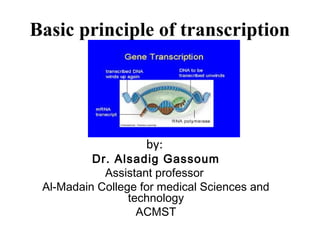
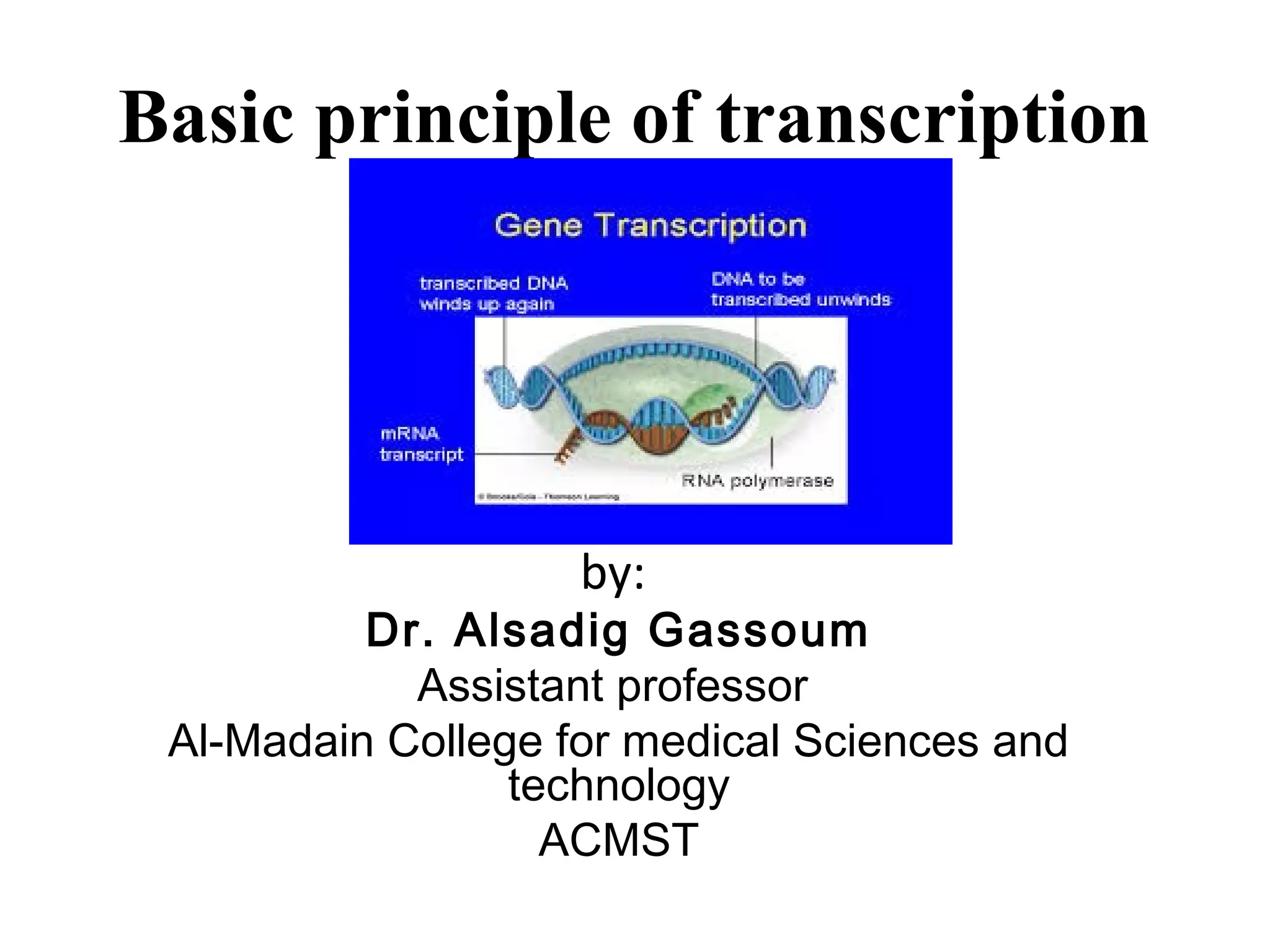
Basic principle of transcription
by:
Dr. Alsadig Gassoum
Assistant professor
Al-Madain College for medical Sciences and
technology
ACMST
Transcription
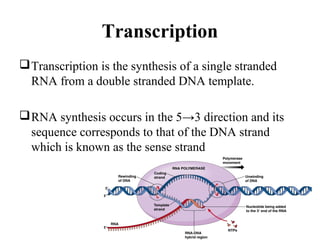
Transcription is the synthesis of a single stranded
RNA from a double stranded DNA template.
RNA synthesis occurs in the 5→3 direction and its
sequence corresponds to that of the DNA strand
which is known as the sense strand
Transcription
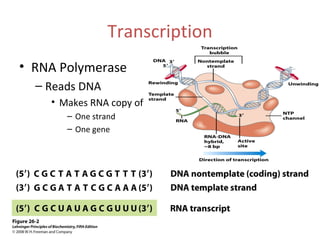
• RNA Polymerase
– Reads DNA
• Makes RNA copy of
– One strand
– One gene
Transcription
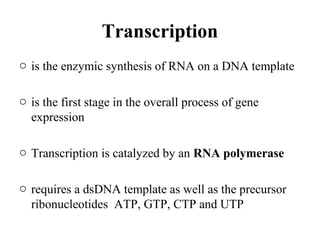
o is the enzymic synthesis of RNA on a DNA template
o is the first stage in the overall process of gene
expression
o Transcription is catalyzed by an RNA polymerase
o requires a dsDNA template as well as the precursor
ribonucleotides ATP, GTP, CTP and UTP
Transcription
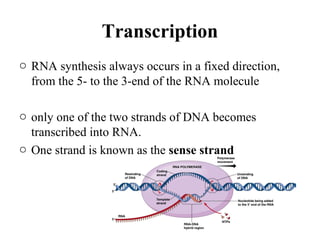
o RNA synthesis always occurs in a fixed direction,
from the 5- to the 3-end of the RNA molecule
o only one of the two strands of DNA becomes
transcribed into RNA.
o One strand is known as the sense strand
Transcription
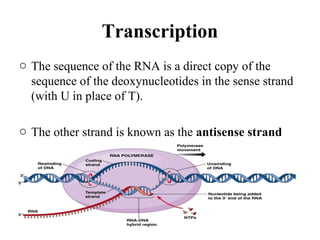
o The sequence of the RNA is a direct copy of the
sequence of the deoxynucleotides in the sense strand
(with U in place of T).
o The other strand is known as the antisense strand
Initiation
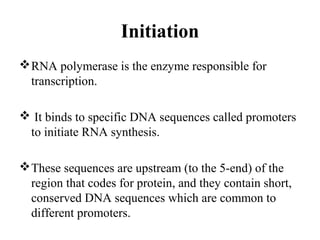
RNA polymerase is the enzyme responsible for
transcription.
 It binds to specific DNA sequences called promoters
to initiate RNA synthesis.
These sequences are upstream (to the 5-end) of the
region that codes for protein, and they contain short,
conserved DNA sequences which are common to
different promoters.
Initiation
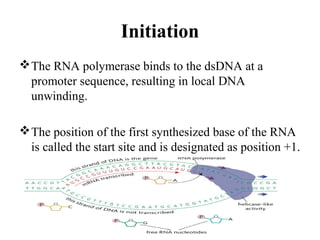
The RNA polymerase binds to the dsDNA at a
promoter sequence, resulting in local DNA
unwinding.
The position of the first synthesized base of the RNA
is called the start site and is designated as position +1.
Initiation
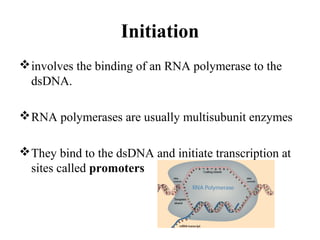
involves the binding of an RNA polymerase to the
dsDNA.
RNA polymerases are usually multisubunit enzymes
They bind to the dsDNA and initiate transcription at
sites called promoters
Initiation
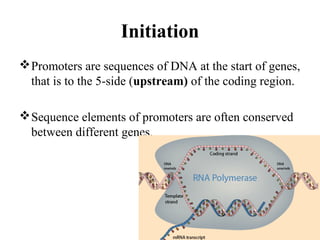
Promoters are sequences of DNA at the start of genes,
that is to the 5-side (upstream) of the coding region.
Sequence elements of promoters are often conserved
between different genes.
Initiation
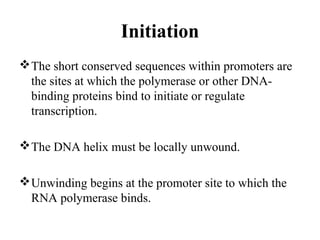
The short conserved sequences within promoters are
the sites at which the polymerase or other DNA-
binding proteins bind to initiate or regulate
transcription.
The DNA helix must be locally unwound.
Unwinding begins at the promoter site to which the
RNA polymerase binds.
Initiation
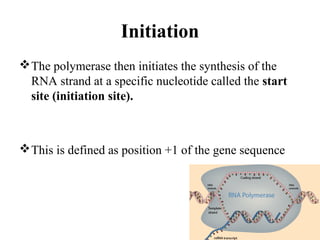
The polymerase then initiates the synthesis of the
RNA strand at a specific nucleotide called the start
site (initiation site).
This is defined as position +1 of the gene sequence
Initiation
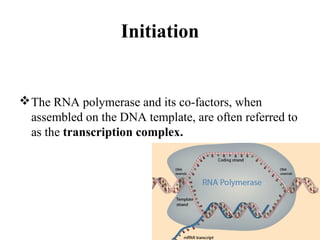
The RNA polymerase and its co-factors, when
assembled on the DNA template, are often referred to
as the transcription complex.
Elongation
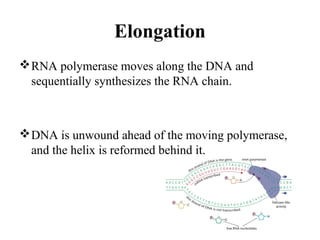
RNA polymerase moves along the DNA and
sequentially synthesizes the RNA chain.
DNA is unwound ahead of the moving polymerase,
and the helix is reformed behind it.
Elongation
The RNA polymerase covalently adds
ribonucleotides to the 3-end of the growing RNA
chain
The polymerase therefore extends the growing RNA
chain in a 5→3 direction.
This occurs while the enzyme itself moves in
a 3→5 direction along the antisense DNA strand
(template).
Elongation
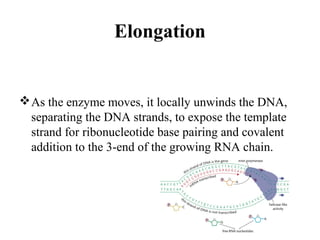
As the enzyme moves, it locally unwinds the DNA,
separating the DNA strands, to expose the template
strand for ribonucleotide base pairing and covalent
addition to the 3-end of the growing RNA chain.
Elongation
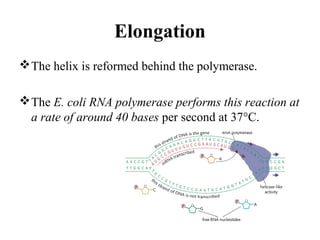
The helix is reformed behind the polymerase.
The E. coli RNA polymerase performs this reaction at
a rate of around 40 bases per second at 37°C.
Termination
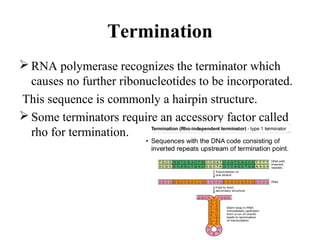
 RNA polymerase recognizes the terminator which
causes no further ribonucleotides to be incorporated.
This sequence is commonly a hairpin structure.
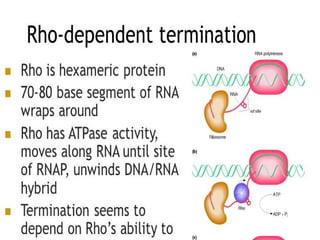
 Some terminators require an accessory factor called
rho for termination.
Termination
 The dissociation of the transcription complex and the
ending of RNA synthesis
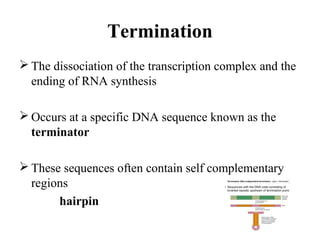
 Occurs at a specific DNA sequence known as the
terminator
 These sequences often contain self complementary
regions
hairpin
Termination
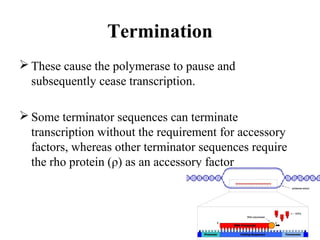
 These cause the polymerase to pause and
subsequently cease transcription.
 Some terminator sequences can terminate
transcription without the requirement for accessory
factors, whereas other terminator sequences require
the rho protein (ρ) as an accessory factor
Transcription in prokaryotes
Escherichia coli RNA polymerase
RNA polymerase is responsible for RNA synthesis
(transcription).
The core enzyme, consisting of 2δ, 1β, 1β and 1ω
(omega) subunits, is responsible for transcription
elongation.
The sigma factor (σ), is also required for correct
transcription initiation.
Transcription in prokaryotes
The complete enzyme, consisting of the core enzyme
plus the factor, is called the holo-enzyme
Subunit
Two alpha (δ) subunits are present in the RNA
polymerase.
They may be involved in promoter binding.
Transcription in prokaryotes
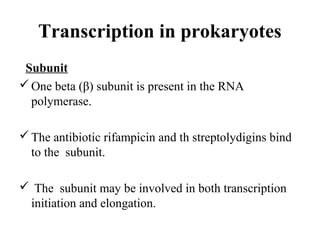
Subunit
One beta (β) subunit is present in the RNA
polymerase.
The antibiotic rifampicin and th streptolydigins bind
to the subunit.
 The subunit may be involved in both transcription
initiation and elongation.
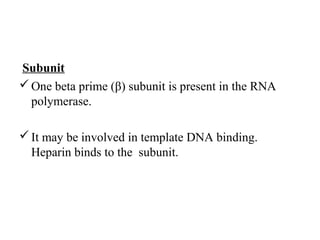
Subunit
One beta prime (β) subunit is present in the RNA
polymerase.
It may be involved in template DNA binding.
Heparin binds to the subunit.
Transcription in prokaryotes
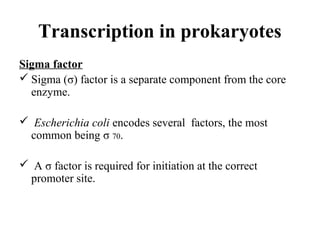
Sigma factor
 Sigma (σ) factor is a separate component from the core
enzyme.
 Escherichia coli encodes several factors, the most
common being σ 70.
 A σ factor is required for initiation at the correct
promoter site.
Transcription in prokaryotes
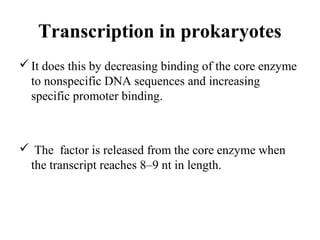
It does this by decreasing binding of the core enzyme
to nonspecific DNA sequences and increasing
specific promoter binding.
 The factor is released from the core enzyme when
the transcript reaches 8–9 nt in length.
Transcription in eukaryotes
Three eukaryotic polymerases transcribe different
sets of genes.
Eukaryotic RNA polymerases
RNA polymerase I is located in the nucleoli.
 It is responsible for the synthesis of the precursors of
most rRNAs.
RNA polymerase II is located in the nucleoplasm
and is responsible for the synthesis of mRNA
precursors and some small nuclear RNAs.
Eukaryotic RNA polymerases
RNA polymerase III is located in the nucleoplasm.
It is responsible for the synthesis of the precursors of
5S rRNA, tRNAs and other small nuclear and
cytosolic RNAs.
RNA polymerase subunits
Each RNA polymerase has 12 or more different
subunits.
The largest two subunits are similar to each other and
to the subunits of E. coli RNA polymerase.
Other subunits in each enzyme have homology to the
subunit of the E. coli enzyme.
Eukaryotic RNA polymerase activities
 Like prokaryotic RNA polymerases, the eukaryotic
enzymes do not require a primer and synthesize RNA
in a 5 to 3 direction.
 Unlike bacterial polymerases, they require
accessory factors for DNA binding.
The CTD of RNA Pol II
The largest subunit of RNA polymerase II has a
seven amino acid repeat at the C terminus called the
carboxy-terminal domain (CTD).
This sequence, Tyr-Ser-Pro-Thr-Ser-Pro-Ser, is
repeated 52 times in the mouse RNA polymerase II
(phosphorylation).
RNA polymerase II
RNA polymerase II (RNA Pol II) is located in the
nucleoplasm.
 It is responsible for the transcription of all protein-
coding genes, some small nuclear RNA genes and
sequences encoding micro RNAs and short
interfering RNAs.
Post transcription modifications
The pre mRNAs must be processed after synthesis by
cap formation at the 5-end of the RNA and poly(A)
addition at the 3-end, as well as removal of introns by
splicing
 Capping
 Splicing
 Poly A tail
Promoters
Many eukaryotic promoters contain a sequence called
the TATA box around 25–35 bp upstream from the
start site of transcription
It has the 7 bp consensus sequence 5-
TATA(A/T)A(A/T)-3
Protein which binds to the TATA box (TBP)
The TATA box acts in a similar way to an E. coli
promoter –10 sequence to position the RNA Pol II for
correct transcription initiation
The low activity of basal promoters is greatly
increased by the presence of other regulatory
elements located upstream of the promoter.
SP1 box play an important role in ensuring
efficient transcription from the promoter.
Enhancers
• Transcription from many eukaryotic promoters can be
stimulated by control elements that are located many
thousands of base pairs away from the transcription
start site.
• This was first observed in the genome of the DNA
virus SV40.
• Enhancer sequences are characteristically 100–200 bp
long and contain multiple sequence elements which
contribute to the total activity of the enhancer.
1. TFIID bind to the TATA box (TBP associated
factors or TAFIIs.)
2. TBP binds to the minor groove of the DNA at the
TATA box, unwinding the DNA and introducing a
45° bend.
3. TFIID binding to the TATA box is enhanced by
TFIIA
4. TFIIB binds to TFIID and acts as a bridge factor for
RNA polymerase binding.
5. The RNA polymerase binds to the complex
associated with TFIIF.
6. After RNA polymerase binding; TFIIE, TFIIH and
TFIIJ associate with the transcription complex in a
defined binding sequence
 TFIIH phosphorylates the carboxy-terminal domain
(CTD) of RNA Pol II.
 This results in formation of a processive polymerase
complex.
Thank you

Basic principle of transcription

  • 1.
    Basic principle oftranscription by: Dr. Alsadig Gassoum Assistant professor Al-Madain College for medical Sciences and technology ACMST
  • 2.
    Transcription Transcription is thesynthesis of a single stranded RNA from a double stranded DNA template. RNA synthesis occurs in the 5→3 direction and its sequence corresponds to that of the DNA strand which is known as the sense strand
  • 3.
    Transcription • RNA Polymerase –Reads DNA • Makes RNA copy of – One strand – One gene
  • 4.
    Transcription o is theenzymic synthesis of RNA on a DNA template o is the first stage in the overall process of gene expression o Transcription is catalyzed by an RNA polymerase o requires a dsDNA template as well as the precursor ribonucleotides ATP, GTP, CTP and UTP
  • 5.
    Transcription o RNA synthesisalways occurs in a fixed direction, from the 5- to the 3-end of the RNA molecule o only one of the two strands of DNA becomes transcribed into RNA. o One strand is known as the sense strand
  • 6.
    Transcription o The sequenceof the RNA is a direct copy of the sequence of the deoxynucleotides in the sense strand (with U in place of T). o The other strand is known as the antisense strand
  • 7.
    Initiation RNA polymerase isthe enzyme responsible for transcription.  It binds to specific DNA sequences called promoters to initiate RNA synthesis. These sequences are upstream (to the 5-end) of the region that codes for protein, and they contain short, conserved DNA sequences which are common to different promoters.
  • 8.
    Initiation The RNA polymerasebinds to the dsDNA at a promoter sequence, resulting in local DNA unwinding. The position of the first synthesized base of the RNA is called the start site and is designated as position +1.
  • 9.
    Initiation involves the bindingof an RNA polymerase to the dsDNA. RNA polymerases are usually multisubunit enzymes They bind to the dsDNA and initiate transcription at sites called promoters
  • 10.
    Initiation Promoters are sequencesof DNA at the start of genes, that is to the 5-side (upstream) of the coding region. Sequence elements of promoters are often conserved between different genes.
  • 11.
    Initiation The short conservedsequences within promoters are the sites at which the polymerase or other DNA- binding proteins bind to initiate or regulate transcription. The DNA helix must be locally unwound. Unwinding begins at the promoter site to which the RNA polymerase binds.
  • 12.
    Initiation The polymerase theninitiates the synthesis of the RNA strand at a specific nucleotide called the start site (initiation site). This is defined as position +1 of the gene sequence
  • 13.
    Initiation The RNA polymeraseand its co-factors, when assembled on the DNA template, are often referred to as the transcription complex.
  • 14.
    Elongation RNA polymerase movesalong the DNA and sequentially synthesizes the RNA chain. DNA is unwound ahead of the moving polymerase, and the helix is reformed behind it.
  • 15.
    Elongation The RNA polymerasecovalently adds ribonucleotides to the 3-end of the growing RNA chain The polymerase therefore extends the growing RNA chain in a 5→3 direction. This occurs while the enzyme itself moves in a 3→5 direction along the antisense DNA strand (template).
  • 16.
    Elongation As the enzymemoves, it locally unwinds the DNA, separating the DNA strands, to expose the template strand for ribonucleotide base pairing and covalent addition to the 3-end of the growing RNA chain.
  • 17.
    Elongation The helix isreformed behind the polymerase. The E. coli RNA polymerase performs this reaction at a rate of around 40 bases per second at 37°C.
  • 18.
    Termination  RNA polymeraserecognizes the terminator which causes no further ribonucleotides to be incorporated. This sequence is commonly a hairpin structure.  Some terminators require an accessory factor called rho for termination.
  • 19.
    Termination  The dissociationof the transcription complex and the ending of RNA synthesis  Occurs at a specific DNA sequence known as the terminator  These sequences often contain self complementary regions hairpin
  • 20.
    Termination  These causethe polymerase to pause and subsequently cease transcription.  Some terminator sequences can terminate transcription without the requirement for accessory factors, whereas other terminator sequences require the rho protein (ρ) as an accessory factor
  • 22.
    Transcription in prokaryotes Escherichiacoli RNA polymerase RNA polymerase is responsible for RNA synthesis (transcription). The core enzyme, consisting of 2δ, 1β, 1β and 1ω (omega) subunits, is responsible for transcription elongation. The sigma factor (σ), is also required for correct transcription initiation.
  • 23.
    Transcription in prokaryotes Thecomplete enzyme, consisting of the core enzyme plus the factor, is called the holo-enzyme Subunit Two alpha (δ) subunits are present in the RNA polymerase. They may be involved in promoter binding.
  • 24.
    Transcription in prokaryotes Subunit Onebeta (β) subunit is present in the RNA polymerase. The antibiotic rifampicin and th streptolydigins bind to the subunit.  The subunit may be involved in both transcription initiation and elongation.
  • 25.
    Subunit One beta prime(β) subunit is present in the RNA polymerase. It may be involved in template DNA binding. Heparin binds to the subunit.
  • 26.
    Transcription in prokaryotes Sigmafactor  Sigma (σ) factor is a separate component from the core enzyme.  Escherichia coli encodes several factors, the most common being σ 70.  A σ factor is required for initiation at the correct promoter site.
  • 27.
    Transcription in prokaryotes Itdoes this by decreasing binding of the core enzyme to nonspecific DNA sequences and increasing specific promoter binding.  The factor is released from the core enzyme when the transcript reaches 8–9 nt in length.
  • 28.
    Transcription in eukaryotes Threeeukaryotic polymerases transcribe different sets of genes.
  • 29.
    Eukaryotic RNA polymerases RNApolymerase I is located in the nucleoli.  It is responsible for the synthesis of the precursors of most rRNAs. RNA polymerase II is located in the nucleoplasm and is responsible for the synthesis of mRNA precursors and some small nuclear RNAs.
  • 30.
    Eukaryotic RNA polymerases RNApolymerase III is located in the nucleoplasm. It is responsible for the synthesis of the precursors of 5S rRNA, tRNAs and other small nuclear and cytosolic RNAs.
  • 31.
    RNA polymerase subunits EachRNA polymerase has 12 or more different subunits. The largest two subunits are similar to each other and to the subunits of E. coli RNA polymerase. Other subunits in each enzyme have homology to the subunit of the E. coli enzyme.
  • 32.
    Eukaryotic RNA polymeraseactivities  Like prokaryotic RNA polymerases, the eukaryotic enzymes do not require a primer and synthesize RNA in a 5 to 3 direction.  Unlike bacterial polymerases, they require accessory factors for DNA binding.
  • 33.
    The CTD ofRNA Pol II The largest subunit of RNA polymerase II has a seven amino acid repeat at the C terminus called the carboxy-terminal domain (CTD). This sequence, Tyr-Ser-Pro-Thr-Ser-Pro-Ser, is repeated 52 times in the mouse RNA polymerase II (phosphorylation).
  • 34.
    RNA polymerase II RNApolymerase II (RNA Pol II) is located in the nucleoplasm.  It is responsible for the transcription of all protein- coding genes, some small nuclear RNA genes and sequences encoding micro RNAs and short interfering RNAs.
  • 35.
    Post transcription modifications Thepre mRNAs must be processed after synthesis by cap formation at the 5-end of the RNA and poly(A) addition at the 3-end, as well as removal of introns by splicing  Capping  Splicing  Poly A tail
  • 36.
    Promoters Many eukaryotic promoterscontain a sequence called the TATA box around 25–35 bp upstream from the start site of transcription It has the 7 bp consensus sequence 5- TATA(A/T)A(A/T)-3
  • 37.
    Protein which bindsto the TATA box (TBP) The TATA box acts in a similar way to an E. coli promoter –10 sequence to position the RNA Pol II for correct transcription initiation
  • 38.
    The low activityof basal promoters is greatly increased by the presence of other regulatory elements located upstream of the promoter. SP1 box play an important role in ensuring efficient transcription from the promoter.
  • 39.
    Enhancers • Transcription frommany eukaryotic promoters can be stimulated by control elements that are located many thousands of base pairs away from the transcription start site.
  • 40.
    • This wasfirst observed in the genome of the DNA virus SV40. • Enhancer sequences are characteristically 100–200 bp long and contain multiple sequence elements which contribute to the total activity of the enhancer.
  • 41.
    1. TFIID bindto the TATA box (TBP associated factors or TAFIIs.) 2. TBP binds to the minor groove of the DNA at the TATA box, unwinding the DNA and introducing a 45° bend. 3. TFIID binding to the TATA box is enhanced by TFIIA
  • 42.
    4. TFIIB bindsto TFIID and acts as a bridge factor for RNA polymerase binding. 5. The RNA polymerase binds to the complex associated with TFIIF. 6. After RNA polymerase binding; TFIIE, TFIIH and TFIIJ associate with the transcription complex in a defined binding sequence
  • 43.
     TFIIH phosphorylatesthe carboxy-terminal domain (CTD) of RNA Pol II.  This results in formation of a processive polymerase complex.
  • 44.