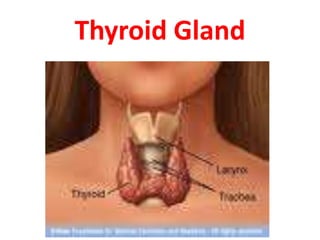
Thyroid Gland
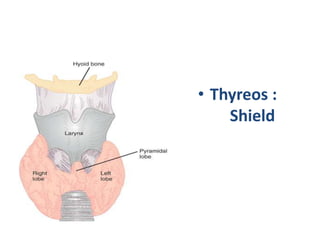
• Thyreos :
Shield
• Largest Endocrine gland
• Follicles 50-500μm in diameter(40 follicles)
• Colloid : Thyroglobulin (6,60,000)
• Highly Vascular : 5ml/g/min
• Functions of Thyroid Cells :
• Collection of iodine
• Thyroglobulin synthesis
• Remove Thyroid Hormones
Colloid
• Thyroglobulin containing iodine
• MW 6,60,000
• Function of Thyroid Cells
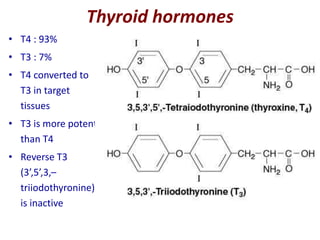
Thyroid hormones
• T4 : 93%
• T3 : 7%
• T4 converted to
T3 in target
tissues
• T3 is more potent
than T4
• Reverse T3
(3’,5’,3,–
triiodothyronine)
is inactive
Iodine Metabolism
• Total I- In ECF :
600 μg (500+60+40
20% : thyroid
80% in urine
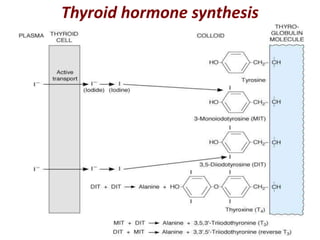
Thyroid hormone synthesis
• Thyroglobulin contains more
than 70 tyrosine molecules
• Iodination of tyrosine takes
place at the apical border of
the thyroid cells while the
molecules are bound in
peptide linkage in
thyroglobulin.
Thyroid hormone
synthesis
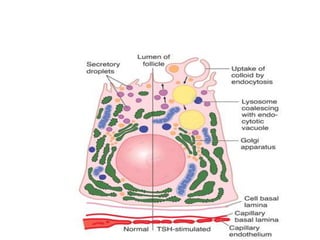
• Cuboidal epithelial cells of follicle helps to
Collect (Na+/I– symporter) & transport
iodine . Synthesize thyroglobulin & secrete
it into colloid
• Remove thyroid hormones from
thyroglobulin & secrete them into
circulation
Thyroid hormone synthesis
Iodine trapping by epithelial cells → Oxidation of iodide
ion by peroxidase enzyme → Iodination (organification) of
tyrosine in thyroglobulin present in colloid → Storage of
thyroglobulin → Pinocytic uptake of thyroglobulin by
epithelial cells → Fusion of lysosome with pinocytic
vesicle → Cleavage of T4 & T3 from thyroglobulin →
Release of T4 & T3 (the MIT & DIT are not released & they
are deiodinated by deiodinase enzyme & iodine is reused)
→ Transported by binding to plasma proteins
Thyroid hormone synthesis
Distribution of Iodinated Compounds
• MIT : 25%
• DIT : 35%
• T3 : 5%
• T4 : 35%
• Secretion T3 : 4 μg/day
T4 : 80 μg/day
Secretion & Interconversion of Thyroid
Hormones in Normal Adult Humans
Regulation of Thyroid Hormone
Synthesis
Binding of Thyroid Hormones
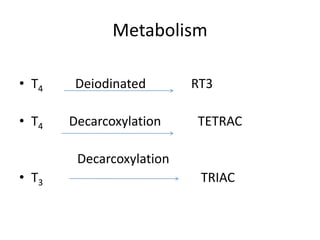
Metabolism
• T4 Deiodinated RT3
• T4 Decarcoxylation TETRAC
Decarcoxylation
• T3 TRIAC
Actions of
thyroid
hormones
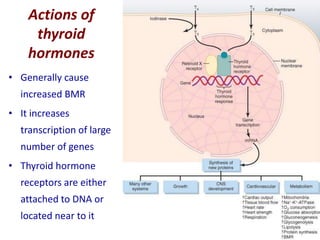
• Generally cause
increased BMR
• It increases
transcription of large
number of genes
• Thyroid hormone
receptors are either
attached to DNA or
located near to it
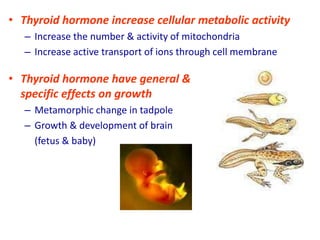
• Thyroid hormone increase cellular metabolic activity
– Increase the number & activity of mitochondria
– Increase active transport of ions through cell membrane
• Thyroid hormone have general &
specific effects on growth
– Metamorphic change in tadpole
– Growth & development of brain
(fetus & baby)
Effects on Metabolism
• Stimulation of carbohydrate metabolism
– ↑ Glucose uptake
– ↑ Glycolysis
– ↑ Gluconeogenesis
– ↑ Absorption from GI tract
– ↑ Insulin secretion
• Stimulation of fat metabolism
– ↑ Lipid mobilization from fat tissues
– ↑ Free fatty acid concentration in plasma
– ↑ Oxidation of free fatty acids by cells
• Stimulation of protein metabolism
– ↑ Protein synthesis (promotes catabolism in hyper condition)
Effect of Starvation
• Effects on various systems
• CVS
– ↑ Blood flow & cardiac output
– ↑ Heart rate
– ↑ Heart strength
– Normal arterial pressure
– High Output Cardiac Failure
• ↑ GI motility
• ↑ Respiration
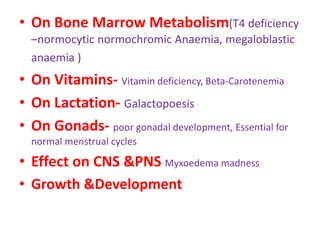
• On Bone Marrow Metabolism(T4 deficiency
–normocytic normochromic Anaemia, megaloblastic
anaemia )
• On Vitamins- Vitamin deficiency, Beta-Carotenemia
• On Lactation- Galactopoesis
• On Gonads- poor gonadal development, Essential for
normal menstrual cycles
• Effect on CNS &PNS Myxoedema madness
• Growth &Development
• Effects on muscle function
–Excess make muscle week
–Hypo make muscle sluggish (relax slowly
after a contraction)
• Excess hormone cause constant
tiredness, but difficulty in sleep
• Water & Mineral Metabolism
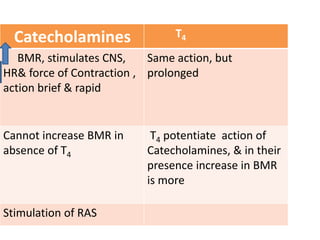
Catecholamines T4
BMR, stimulates CNS,
HR& force of Contraction ,
action brief & rapid
Same action, but
prolonged
Cannot increase BMR in
absence of T4
T4 potentiate action of
Catecholamines, & in their
presence increase in BMR
is more
Stimulation of RAS
TSH
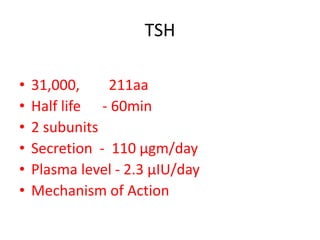
• 31,000, 211aa
• Half life - 60min
• 2 subunits
• Secretion - 110 μgm/day
• Plasma level - 2.3 μIU/day
• Mechanism of Action
Effect of TSH on Thyroid Gland
• Promotes synthesis of thyroid
hormones
• Causes secretion of thyroid
hormones
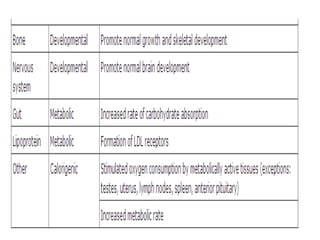
Physiologic Effect of Thyroid Hormones
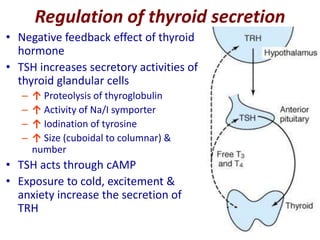
Regulation of thyroid secretion
• Negative feedback effect of thyroid
hormone
• TSH increases secretory activities of
thyroid glandular cells
– ↑ Proteolysis of thyroglobulin
– ↑ Activity of Na/I symporter
– ↑ Iodination of tyrosine
– ↑ Size (cuboidal to columnar) &
number
• TSH acts through cAMP
• Exposure to cold, excitement &
anxiety increase the secretion of
TRH
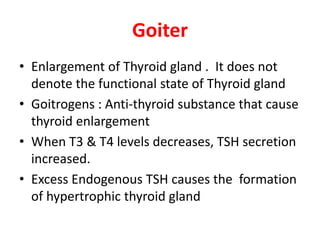
Goiter
• Enlargement of Thyroid gland . It does not
denote the functional state of Thyroid gland
• Goitrogens : Anti-thyroid substance that cause
thyroid enlargement
• When T3 & T4 levels decreases, TSH secretion
increased.
• Excess Endogenous TSH causes the formation
of hypertrophic thyroid gland
Goitrogenic Agents
• Iodide Deficiency : Iodide deficiency Goiter or
Endemic goiter
• Excess Iodide
• Monovalent ions (perchlorate &thiocyanate)
• Thiocarbamides (propylthiouracil, methimazole)
• Aminobenzene (PABA, sulphonamide)
• Vegetables of Brassicaceae Family (progoitrin,
progotrin activator)
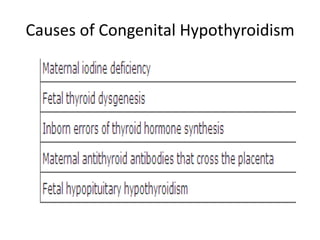
Causes of Congenital Hypothyroidism
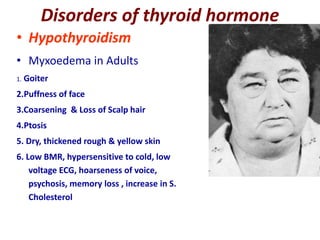
• Hypothyroidism
• Myxoedema in Adults
1. Goiter
2.Puffness of face
3.Coarsening & Loss of Scalp hair
4.Ptosis
5. Dry, thickened rough & yellow skin
6. Low BMR, hypersensitive to cold, low
voltage ECG, hoarseness of voice,
psychosis, memory loss , increase in S.
Cholesterol
Disorders of thyroid hormone
Cretinism
• Due to maternal iodine deficiency & conge-
nital abnormalities of foetal hypothalamo-
pituitary-thyroid axis
1. Gross retardation of Mental Development
2. Dwarfism & Stunted growth
3. Protruded abdomen & Tongue
4. Failure of Sexual Development
5. Flat nose, dry skin, sparse hairs
6. Other Characteristic Features
• At adolescense ; short stature, poor
performance at school, delayed puberty, &
sexual maturation.
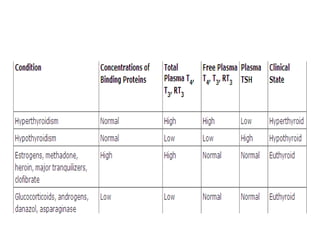
• HASHIMOTO’S THYROIDITIS
Hypoth--
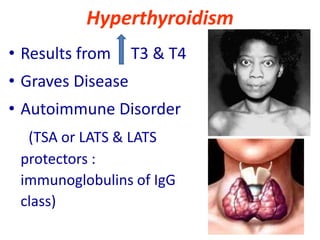
Hyperthyroidism
• Results from T3 & T4
• Graves Disease
• Autoimmune Disorder
(TSA or LATS & LATS
protectors :
immunoglobulins of IgG
class)
Causes of Hyperthyroidism
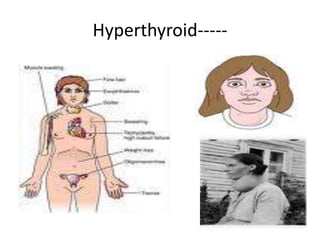
• Exophthalmos
• Lid Retraction
• ↑ Excitability
• Intolerance to heat
• ↑ Sweating
• Weight loss
• Muscle weekness
• Extreme fatigue, but inability to sleep
Hyperthyroid-----
Antithyroid Drugs
• Drugs inhibit trapping of iodide
• Thiourylenes
• Iodine or Iodide
• β adrenergic blocking drugs
(propanolol, atenolol reduce CVS CNS
symptoms)
• Radioactive iodine 131I (5μ curies)
Hypothyroidism Hyperthyroidism
Definition T3 T4
secretion
T3 T4
secretion
Causes Thyroid removal Graves Disease
Primary I2 deficiency
/Hashimotos
Thyroid tumors
Secondary Pitu/Hypothalam
ic Failure
TSH secreting
Tumors
BMR ( N: 10%) -30 to 40% +10 – 100%
Sensitivity Hypersensitive
to cold
Hypersensitive
to heat
Protein
metabolism
Myxoedema Thyrotoxic
myopathy
Fat
Metabolism
S.Cholesterol, Trigly
& Phospho
all lipids
Skin Dry, cold thickened
rough
Warm, moist &
soft
CVS Bradycardia, SV, CO,
Low voltage ECG
Tachycardia, High
output cardiac
failure, exertional
dysnoea
Vitamins Carotenemia B & C
deficiency
Bone marrow Normocytic
normochromic anemia
Increased O2
delivery
lactation Decreases increases
gonads Menstrual
Irregularities
Scanty Periods
CHO metabolism Low Blood
Sugar
Precipitates
DM
CNS Myxoedematous
madness
Overexcitabilty, tremors,
irritability, nervouness
Growth &
Development
Slow Rapid
GIT Constipation &
Anorexia
Hyperphagia &
Diarrhoea
Thyroid Hormone Resistance
• Mutations in TRα coding gene
• Resistance to peripheral tissues &
ant .pituitary gland
• Attention Deficit Hyperactivity
Disorder
Thyroid Gland Dr Sheeba.pptx

Thyroid Gland Dr Sheeba.pptx

  • 1.
  • 2.
  • 4.
    • Largest Endocrinegland • Follicles 50-500μm in diameter(40 follicles) • Colloid : Thyroglobulin (6,60,000) • Highly Vascular : 5ml/g/min • Functions of Thyroid Cells : • Collection of iodine • Thyroglobulin synthesis • Remove Thyroid Hormones
  • 6.
    Colloid • Thyroglobulin containingiodine • MW 6,60,000 • Function of Thyroid Cells
  • 7.
    Thyroid hormones • T4: 93% • T3 : 7% • T4 converted to T3 in target tissues • T3 is more potent than T4 • Reverse T3 (3’,5’,3,– triiodothyronine) is inactive
  • 8.
    Iodine Metabolism • TotalI- In ECF : 600 μg (500+60+40 20% : thyroid 80% in urine
  • 9.
  • 10.
    • Thyroglobulin containsmore than 70 tyrosine molecules • Iodination of tyrosine takes place at the apical border of the thyroid cells while the molecules are bound in peptide linkage in thyroglobulin. Thyroid hormone synthesis
  • 11.
    • Cuboidal epithelialcells of follicle helps to Collect (Na+/I– symporter) & transport iodine . Synthesize thyroglobulin & secrete it into colloid • Remove thyroid hormones from thyroglobulin & secrete them into circulation Thyroid hormone synthesis
  • 12.
    Iodine trapping byepithelial cells → Oxidation of iodide ion by peroxidase enzyme → Iodination (organification) of tyrosine in thyroglobulin present in colloid → Storage of thyroglobulin → Pinocytic uptake of thyroglobulin by epithelial cells → Fusion of lysosome with pinocytic vesicle → Cleavage of T4 & T3 from thyroglobulin → Release of T4 & T3 (the MIT & DIT are not released & they are deiodinated by deiodinase enzyme & iodine is reused) → Transported by binding to plasma proteins Thyroid hormone synthesis
  • 13.
    Distribution of IodinatedCompounds • MIT : 25% • DIT : 35% • T3 : 5% • T4 : 35% • Secretion T3 : 4 μg/day T4 : 80 μg/day
  • 14.
    Secretion & Interconversionof Thyroid Hormones in Normal Adult Humans
  • 15.
    Regulation of ThyroidHormone Synthesis
  • 16.
  • 17.
    Metabolism • T4 DeiodinatedRT3 • T4 Decarcoxylation TETRAC Decarcoxylation • T3 TRIAC
  • 18.
    Actions of thyroid hormones • Generallycause increased BMR • It increases transcription of large number of genes • Thyroid hormone receptors are either attached to DNA or located near to it
  • 19.
    • Thyroid hormoneincrease cellular metabolic activity – Increase the number & activity of mitochondria – Increase active transport of ions through cell membrane • Thyroid hormone have general & specific effects on growth – Metamorphic change in tadpole – Growth & development of brain (fetus & baby)
  • 20.
    Effects on Metabolism •Stimulation of carbohydrate metabolism – ↑ Glucose uptake – ↑ Glycolysis – ↑ Gluconeogenesis – ↑ Absorption from GI tract – ↑ Insulin secretion • Stimulation of fat metabolism – ↑ Lipid mobilization from fat tissues – ↑ Free fatty acid concentration in plasma – ↑ Oxidation of free fatty acids by cells • Stimulation of protein metabolism – ↑ Protein synthesis (promotes catabolism in hyper condition)
  • 21.
  • 22.
    • Effects onvarious systems • CVS – ↑ Blood flow & cardiac output – ↑ Heart rate – ↑ Heart strength – Normal arterial pressure – High Output Cardiac Failure • ↑ GI motility • ↑ Respiration
  • 23.
    • On BoneMarrow Metabolism(T4 deficiency –normocytic normochromic Anaemia, megaloblastic anaemia ) • On Vitamins- Vitamin deficiency, Beta-Carotenemia • On Lactation- Galactopoesis • On Gonads- poor gonadal development, Essential for normal menstrual cycles • Effect on CNS &PNS Myxoedema madness • Growth &Development
  • 24.
    • Effects onmuscle function –Excess make muscle week –Hypo make muscle sluggish (relax slowly after a contraction) • Excess hormone cause constant tiredness, but difficulty in sleep • Water & Mineral Metabolism
  • 25.
    Catecholamines T4 BMR, stimulatesCNS, HR& force of Contraction , action brief & rapid Same action, but prolonged Cannot increase BMR in absence of T4 T4 potentiate action of Catecholamines, & in their presence increase in BMR is more Stimulation of RAS
  • 26.
    TSH • 31,000, 211aa •Half life - 60min • 2 subunits • Secretion - 110 μgm/day • Plasma level - 2.3 μIU/day • Mechanism of Action
  • 27.
    Effect of TSHon Thyroid Gland • Promotes synthesis of thyroid hormones • Causes secretion of thyroid hormones
  • 28.
    Physiologic Effect ofThyroid Hormones
  • 30.
    Regulation of thyroidsecretion • Negative feedback effect of thyroid hormone • TSH increases secretory activities of thyroid glandular cells – ↑ Proteolysis of thyroglobulin – ↑ Activity of Na/I symporter – ↑ Iodination of tyrosine – ↑ Size (cuboidal to columnar) & number • TSH acts through cAMP • Exposure to cold, excitement & anxiety increase the secretion of TRH
  • 31.
    Goiter • Enlargement ofThyroid gland . It does not denote the functional state of Thyroid gland • Goitrogens : Anti-thyroid substance that cause thyroid enlargement • When T3 & T4 levels decreases, TSH secretion increased. • Excess Endogenous TSH causes the formation of hypertrophic thyroid gland
  • 32.
    Goitrogenic Agents • IodideDeficiency : Iodide deficiency Goiter or Endemic goiter • Excess Iodide • Monovalent ions (perchlorate &thiocyanate) • Thiocarbamides (propylthiouracil, methimazole) • Aminobenzene (PABA, sulphonamide) • Vegetables of Brassicaceae Family (progoitrin, progotrin activator)
  • 33.
    Causes of CongenitalHypothyroidism
  • 34.
    • Hypothyroidism • Myxoedemain Adults 1. Goiter 2.Puffness of face 3.Coarsening & Loss of Scalp hair 4.Ptosis 5. Dry, thickened rough & yellow skin 6. Low BMR, hypersensitive to cold, low voltage ECG, hoarseness of voice, psychosis, memory loss , increase in S. Cholesterol Disorders of thyroid hormone
  • 35.
    Cretinism • Due tomaternal iodine deficiency & conge- nital abnormalities of foetal hypothalamo- pituitary-thyroid axis 1. Gross retardation of Mental Development 2. Dwarfism & Stunted growth 3. Protruded abdomen & Tongue 4. Failure of Sexual Development 5. Flat nose, dry skin, sparse hairs 6. Other Characteristic Features
  • 36.
    • At adolescense; short stature, poor performance at school, delayed puberty, & sexual maturation.
  • 37.
  • 38.
  • 39.
    Hyperthyroidism • Results fromT3 & T4 • Graves Disease • Autoimmune Disorder (TSA or LATS & LATS protectors : immunoglobulins of IgG class)
  • 40.
  • 41.
    • Exophthalmos • LidRetraction • ↑ Excitability • Intolerance to heat • ↑ Sweating • Weight loss • Muscle weekness • Extreme fatigue, but inability to sleep
  • 42.
  • 43.
    Antithyroid Drugs • Drugsinhibit trapping of iodide • Thiourylenes • Iodine or Iodide • β adrenergic blocking drugs (propanolol, atenolol reduce CVS CNS symptoms) • Radioactive iodine 131I (5μ curies)
  • 44.
    Hypothyroidism Hyperthyroidism Definition T3T4 secretion T3 T4 secretion Causes Thyroid removal Graves Disease Primary I2 deficiency /Hashimotos Thyroid tumors Secondary Pitu/Hypothalam ic Failure TSH secreting Tumors BMR ( N: 10%) -30 to 40% +10 – 100% Sensitivity Hypersensitive to cold Hypersensitive to heat
  • 45.
    Protein metabolism Myxoedema Thyrotoxic myopathy Fat Metabolism S.Cholesterol, Trigly &Phospho all lipids Skin Dry, cold thickened rough Warm, moist & soft CVS Bradycardia, SV, CO, Low voltage ECG Tachycardia, High output cardiac failure, exertional dysnoea Vitamins Carotenemia B & C deficiency Bone marrow Normocytic normochromic anemia Increased O2 delivery
  • 46.
    lactation Decreases increases gonadsMenstrual Irregularities Scanty Periods CHO metabolism Low Blood Sugar Precipitates DM CNS Myxoedematous madness Overexcitabilty, tremors, irritability, nervouness Growth & Development Slow Rapid GIT Constipation & Anorexia Hyperphagia & Diarrhoea
  • 47.
    Thyroid Hormone Resistance •Mutations in TRα coding gene • Resistance to peripheral tissues & ant .pituitary gland • Attention Deficit Hyperactivity Disorder