MODULE 5
Partnerships and Resources
Partnering is a long term commitment between two or more organization for the
purpose of achieving specific business goals and objectives by maximizing the
effectiveness of each participant’s resources.
5.1. Partnering
Effective partnership requires
* Identify key strategic partnership
* Design and Develop relationships
* Structure value adding supply chain
* Ensure cultural fit
* Mutual Development
* Share knowledge and learning
* Improve processes
* Measure performance of partnership
Benefits of Effective Partnership
* Improved quality
* Increased efficiency
* Lower cost
* Increased opportunity for innovation
* Continuous improvement of products and services
What is Supplier Partnership?
Supplier partnership is the discipline of strategically planning for, and managing, all
interactions with third party organizations that supply good and/or services to
organization, in order to maximize value of those interactions.
Requirements of supplier partnerships
• Supplier personnel should meet with buyer personnel
• Price-only approach to buyer –supplier negotiations should be eliminated
• Quality of supplier products should be guaranteed by the supplier’s quality processes Both partners
should be capable of sharing information electronically
• Supplier should fully understand and be able to practice just-in time (JIT)
5.2. Just-in-time (JIT) Management
Just in time (JIT) is a production strategy that strives to improve a business' return on
investment by reducing in-process inventory and associated carrying costs.
Aim of JIT
Fundamental aims of JIT are to produce or operate to meet the requirements of the
customer exactly, without waste on demand. JIT concepts identify operational problems
by tracking
• Material Movement
• Material Accumulation
• Process Flexibility
• Value added efforts
Operation of JIT
• Batch or lot size reduction.
• Flexible workforce.
• Kanban or cards with material visibility.
• Mistake-proofing.
• Pull-scheduling.
• Set-up time reduction.
• Standardized containers
Benefits of JIT
• Funds tied up in inventories can be used elsewhere
• Areas used to store inventories can be used for other more productive uses
• Throughput time is reduced
• Greater potential output and quicker response to customers
• Defect rates are reduced
• Less waste and greater customer satisfaction
Kanban System
Kanban is a Japanese term referring to sign board or visual signals that authorize
the production or movement of items in manufacturing environment. It works on
the basis that each process on a production line pulls just the number and type of
components the process requires, at just the right time.
A kanban is a card with an inventory number which is attached to a part and before
installation, the kanban card is detached and sent up the supply chain as a request
for another part. A part is only manufactured (or ordered) if there is a kanban card
for it.
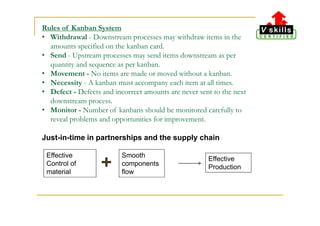
Rules of Kanban System
• Withdrawal - Downstream processes may withdraw items in the
amounts specified on the kanban card.
• Send - Upstream processes may send items downstream as per
quantity and sequence as per kanban.
• Movement - No items are made or moved without a kanban.
• Necessity - A kanban must accompany each item at all times.
• Defect - Defects and incorrect amounts are never sent to the next
downstream process.
• Monitor - Number of kanbans should be monitored carefully to
reveal problems and opportunities for improvement.
Just-in-time in partnerships and the supply chain
Effective
Control of
material
Smooth
components
flow
Effective
Production
Just-in-time in partnerships and the supply chain
Effective
Control of
material
Smooth
components
flow
Effective
Production
Get the complete certification course on TQM.
http://www.vskills.in/certification/Quality/Certified-TQM-Professional

TQM Tutorials - Partnerships and Resources

  • 1.
    MODULE 5 Partnerships andResources Partnering is a long term commitment between two or more organization for the purpose of achieving specific business goals and objectives by maximizing the effectiveness of each participant’s resources. 5.1. Partnering Effective partnership requires * Identify key strategic partnership * Design and Develop relationships * Structure value adding supply chain * Ensure cultural fit * Mutual Development * Share knowledge and learning * Improve processes * Measure performance of partnership
  • 2.
    Benefits of EffectivePartnership * Improved quality * Increased efficiency * Lower cost * Increased opportunity for innovation * Continuous improvement of products and services What is Supplier Partnership? Supplier partnership is the discipline of strategically planning for, and managing, all interactions with third party organizations that supply good and/or services to organization, in order to maximize value of those interactions. Requirements of supplier partnerships • Supplier personnel should meet with buyer personnel • Price-only approach to buyer –supplier negotiations should be eliminated • Quality of supplier products should be guaranteed by the supplier’s quality processes Both partners should be capable of sharing information electronically • Supplier should fully understand and be able to practice just-in time (JIT)
  • 3.
    5.2. Just-in-time (JIT)Management Just in time (JIT) is a production strategy that strives to improve a business' return on investment by reducing in-process inventory and associated carrying costs. Aim of JIT Fundamental aims of JIT are to produce or operate to meet the requirements of the customer exactly, without waste on demand. JIT concepts identify operational problems by tracking • Material Movement • Material Accumulation • Process Flexibility • Value added efforts Operation of JIT • Batch or lot size reduction. • Flexible workforce. • Kanban or cards with material visibility. • Mistake-proofing. • Pull-scheduling. • Set-up time reduction. • Standardized containers
  • 4.
    Benefits of JIT •Funds tied up in inventories can be used elsewhere • Areas used to store inventories can be used for other more productive uses • Throughput time is reduced • Greater potential output and quicker response to customers • Defect rates are reduced • Less waste and greater customer satisfaction Kanban System Kanban is a Japanese term referring to sign board or visual signals that authorize the production or movement of items in manufacturing environment. It works on the basis that each process on a production line pulls just the number and type of components the process requires, at just the right time. A kanban is a card with an inventory number which is attached to a part and before installation, the kanban card is detached and sent up the supply chain as a request for another part. A part is only manufactured (or ordered) if there is a kanban card for it.
  • 5.
    Rules of KanbanSystem • Withdrawal - Downstream processes may withdraw items in the amounts specified on the kanban card. • Send - Upstream processes may send items downstream as per quantity and sequence as per kanban. • Movement - No items are made or moved without a kanban. • Necessity - A kanban must accompany each item at all times. • Defect - Defects and incorrect amounts are never sent to the next downstream process. • Monitor - Number of kanbans should be monitored carefully to reveal problems and opportunities for improvement. Just-in-time in partnerships and the supply chain Effective Control of material Smooth components flow Effective Production
  • 6.
    Just-in-time in partnershipsand the supply chain Effective Control of material Smooth components flow Effective Production Get the complete certification course on TQM. http://www.vskills.in/certification/Quality/Certified-TQM-Professional