Agile Project Management
Sample Material
VS-1255
Certificate in Agile Project Management
www.vskills.in Page 2
1. AGILE METHODOLOGIES
Various agile methodologies, are
Dynamic System Development Methodology (DSDM) - It is an agile framework for software
projects. It was used to fine-tune the traditional approaches. The most recent version of
DSDM is called DSDM Atern. The name Atern is a short for Arctic Tern - a seabird that can
travel vast distances that represents many features of the method which are natural ways of
working such as prioritization and collaboration.
Scrum - It is the most popular agile framework, which concentrates particularly on how to
manage tasks within a team-based development environment. Scrum uses iterative and
incremental development model, with shorter duration of iterations. Scrum is relatively simple
to implement and focuses on quick and frequent deliveries.
Extreme Programming (XP) - It is a type of agile software development. It advocates frequent
releases in short development cycles, which is intended to improve productivity and introduce
checkpoints where new customer requirements can be adopted. The methodology takes its
name from the idea that the beneficial elements of traditional software engineering practices
are taken to extreme levels. (Extreme Programming is a software-development discipline that
organizes people to produce higher-quality software more productively.) XP addresses the
analysis, development, and test phases with novel approaches that make a substantial difference
to the quality of the end-product.
Test-driven Development (TDD) - It is a software development process that relies on the
repetition of a very short development cycle: first the developer writes an automated test case
that defines a desired improvement or a new function, then it produces the least amount of
code to pass that test, and finally brings the new code to acceptable standards.
Lean - It is a production practice that considers the expenditure of resources for any goal other
than the creation of value for the end-customer to be wasteful, and thus a target for elimination.
Working from the perspective of the customer who consumes a product or service, the term
value is defined as any action or process that a customer would be willing to pay for. Lean is
centered on preserving value with less work.
Kanban - It is a system to improve and keep up a high level of production. Kanban is one
method through which Just-In-Time (JIT), the strategy the organizations employ to control the
inventory expenses, is achieved. Kanban became an effective tool in support of running a
production system as a whole, and it proved to be an excellent way for promoting
improvement.
1.1. Scrum
Scrum is an iterative and incremental framework for managing product development. It defines "a
flexible, holistic product development strategy where a development team works as a unit to reach
a common goal", challenges assumptions of the "traditional, sequential approach" to product
development, and enables teams to self-organize by encouraging physical co-location or close
online collaboration of all team members, as well as daily face-to-face communication among all
team members and disciplines involved.
A key principle of Scrum is the dual recognition that customers will change their minds about what
they want or need (often called requirements volatility) and that there will be unpredictable
Certificate in Agile Project Management
www.vskills.in Page 2
1. AGILE METHODOLOGIES
Various agile methodologies, are
Dynamic System Development Methodology (DSDM) - It is an agile framework for software
projects. It was used to fine-tune the traditional approaches. The most recent version of
DSDM is called DSDM Atern. The name Atern is a short for Arctic Tern - a seabird that can
travel vast distances that represents many features of the method which are natural ways of
working such as prioritization and collaboration.
Scrum - It is the most popular agile framework, which concentrates particularly on how to
manage tasks within a team-based development environment. Scrum uses iterative and
incremental development model, with shorter duration of iterations. Scrum is relatively simple
to implement and focuses on quick and frequent deliveries.
Extreme Programming (XP) - It is a type of agile software development. It advocates frequent
releases in short development cycles, which is intended to improve productivity and introduce
checkpoints where new customer requirements can be adopted. The methodology takes its
name from the idea that the beneficial elements of traditional software engineering practices
are taken to extreme levels. (Extreme Programming is a software-development discipline that
organizes people to produce higher-quality software more productively.) XP addresses the
analysis, development, and test phases with novel approaches that make a substantial difference
to the quality of the end-product.
Test-driven Development (TDD) - It is a software development process that relies on the
repetition of a very short development cycle: first the developer writes an automated test case
that defines a desired improvement or a new function, then it produces the least amount of
code to pass that test, and finally brings the new code to acceptable standards.
Lean - It is a production practice that considers the expenditure of resources for any goal other
than the creation of value for the end-customer to be wasteful, and thus a target for elimination.
Working from the perspective of the customer who consumes a product or service, the term
value is defined as any action or process that a customer would be willing to pay for. Lean is
centered on preserving value with less work.
Kanban - It is a system to improve and keep up a high level of production. Kanban is one
method through which Just-In-Time (JIT), the strategy the organizations employ to control the
inventory expenses, is achieved. Kanban became an effective tool in support of running a
production system as a whole, and it proved to be an excellent way for promoting
improvement.
1.1. Scrum
Scrum is an iterative and incremental framework for managing product development. It defines "a
flexible, holistic product development strategy where a development team works as a unit to reach
a common goal", challenges assumptions of the "traditional, sequential approach" to product
development, and enables teams to self-organize by encouraging physical co-location or close
online collaboration of all team members, as well as daily face-to-face communication among all
team members and disciplines involved.
A key principle of Scrum is the dual recognition that customers will change their minds about what
they want or need (often called requirements volatility) and that there will be unpredictable
Certificate in Agile Project Management
www.vskills.in Page 4
A typical Scrum project has six to ten team members. This agile method is more suited to small
teams, however, it can be adapted to large teams as well. Companies and projects that are team,
value, and customer oriented are the best candidates for Scrum methods.
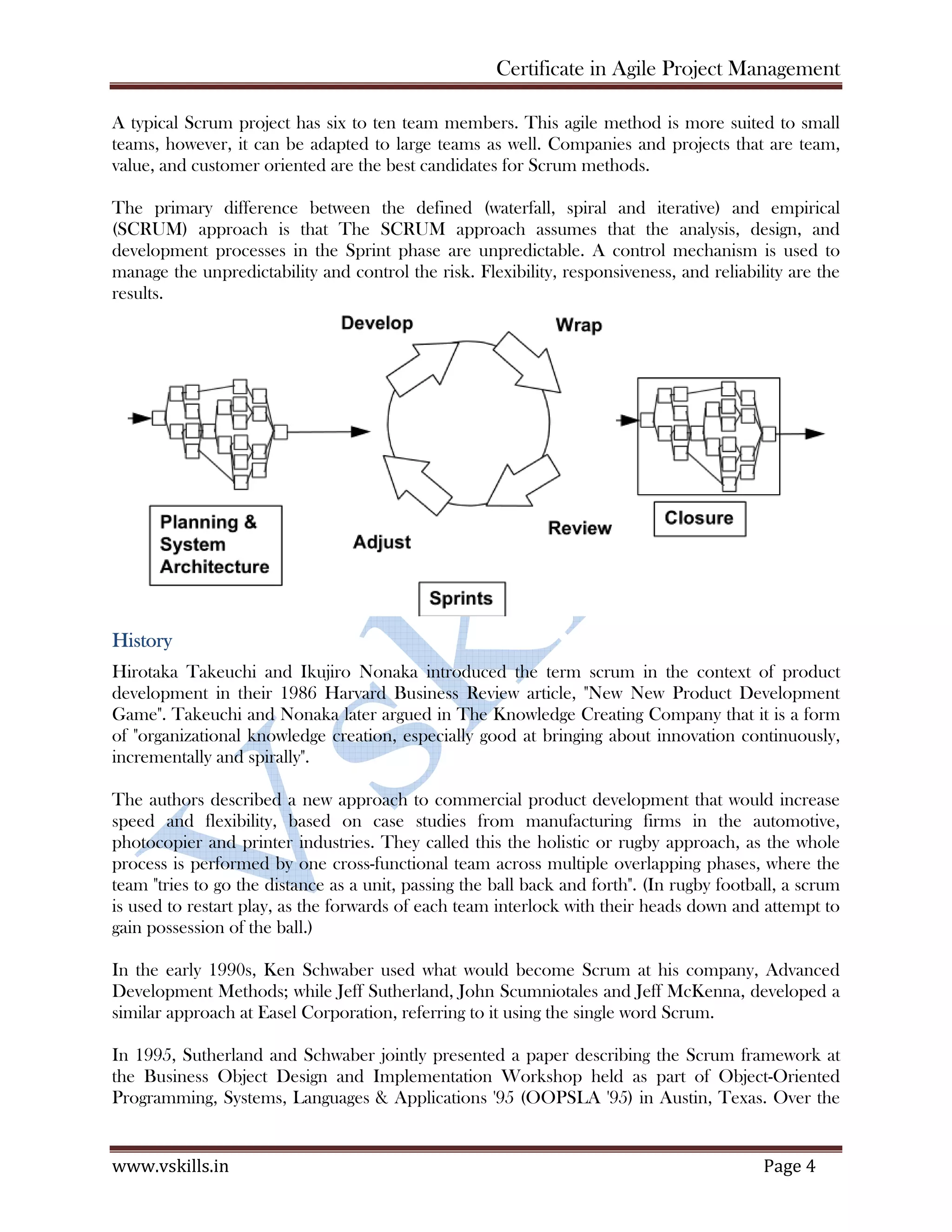
The primary difference between the defined (waterfall, spiral and iterative) and empirical
(SCRUM) approach is that The SCRUM approach assumes that the analysis, design, and
development processes in the Sprint phase are unpredictable. A control mechanism is used to
manage the unpredictability and control the risk. Flexibility, responsiveness, and reliability are the
results.
History
Hirotaka Takeuchi and Ikujiro Nonaka introduced the term scrum in the context of product
development in their 1986 Harvard Business Review article, "New New Product Development
Game". Takeuchi and Nonaka later argued in The Knowledge Creating Company that it is a form
of "organizational knowledge creation, especially good at bringing about innovation continuously,
incrementally and spirally".
The authors described a new approach to commercial product development that would increase
speed and flexibility, based on case studies from manufacturing firms in the automotive,
photocopier and printer industries. They called this the holistic or rugby approach, as the whole
process is performed by one cross-functional team across multiple overlapping phases, where the
team "tries to go the distance as a unit, passing the ball back and forth". (In rugby football, a scrum
is used to restart play, as the forwards of each team interlock with their heads down and attempt to
gain possession of the ball.)
In the early 1990s, Ken Schwaber used what would become Scrum at his company, Advanced
Development Methods; while Jeff Sutherland, John Scumniotales and Jeff McKenna, developed a
similar approach at Easel Corporation, referring to it using the single word Scrum.
In 1995, Sutherland and Schwaber jointly presented a paper describing the Scrum framework at
the Business Object Design and Implementation Workshop held as part of Object-Oriented
Programming, Systems, Languages & Applications '95 (OOPSLA '95) in Austin, Texas. Over the
Certificate in Agile Project Management
www.vskills.in Page 5
following years, Schwaber and Sutherland collaborated to combine this material—with their
experience and evolving good practice—to develop what became known as Scrum.
In 2001, Schwaber worked with Mike Beedle to describe the method in the book, Agile Software
Development with Scrum. Scrum's approach to planning and managing product development
involves bringing decision-making authority to the level of operation properties and certainties.
In 2002, Schwaber with others founded the Scrum Alliance and set up the Certified Scrum
accreditation series. Schwaber left the Scrum Alliance in late 2009 and founded Scrum.org which
oversees the parallel Professional Scrum accreditation series.
Since 2010, there is a public document called The Scrum Guide that defines sort of an official
version of Scrum and is occasionally revised. In 2018 it was expanded upon with the publication of
The Kanban Guide for Scrum Teams.
Roles
There are three core roles in the Scrum framework. These are ideally co-located to deliver
potentially shippable product increments every sprint. Together these three roles form the scrum
team. While many organizations have other roles involved with defining and delivering the
product, Scrum defines only these three.
Product owner - The product owner represents the product's stakeholders and the voice of the
customer; and is accountable for ensuring that the team delivers value to the business. The product
owner defines the product in customer-centric terms (typically user stories), adds them to the
product backlog, and prioritizes them based on importance and dependencies. Scrum teams
should have one product owner. This role should not be combined with that of the scrum master.
The product owner should focus on the business side of product development and spend the
majority of their time liaising with stakeholders and should not dictate how the team reaches a
technical solution. This role is equivalent to the customer representative role in some other agile
frameworks such as extreme programming (XP).
Communication is a core responsibility of the product owner. The ability to convey priorities and
empathize with team members and stakeholders is vital to steer product development in the right
direction. The product owner role bridges the communication gap between the team and its
stakeholders, serving as a proxy for stakeholders to the team and as a team representative to the
overall stakeholder community.
As the face of the team to the stakeholders, the following are some of the communication tasks of
the product owner to the stakeholders:
demonstrates the solution to key stakeholders who were not present at a sprint review;
defines and announces releases;
communicates team status;
organizes milestone reviews;
educates stakeholders in the development process;
negotiates priorities, scope, funding, and schedule;
ensures that the product backlog is visible, transparent, and clear.
Certificate in Agile Project Management
www.vskills.in Page 6
Empathy is a key attribute for a product owner to have—the ability to put one's self in another's
shoes. A product owner converses with different stakeholders, who have a variety of backgrounds,
job roles, and objectives. A product owner must be able to see from these different points of view.
To be effective, it is wise for a product owner to know the level of detail the audience needs. The
development team needs thorough feedback and specifications so they can build a product up to
expectation, while an executive sponsor may just need summaries of progress. Providing more
information than necessary may lose stakeholder interest and waste time. A direct means of
communication is the most preferred by seasoned agile product owners.
A product owner's ability to communicate effectively is also enhanced by being skilled in
techniques that identify stakeholder needs, negotiate priorities between stakeholder interests, and
collaborate with developers to ensure effective implementation of requirements.
Development team - The development team is responsible for delivering potentially shippable
product increments every sprint (the sprint goal).
The team has from three to nine members who carry out all tasks required to build the product
increments (analysis, design, development, testing, technical writing, etc.). Although there will be
several disciplines represented in the team, its members are referred to generically as developers.
To avoid potential confusion that this only refers to programmers, some organizations call this a
delivery team and its members just team members.
The development team in Scrum is self-organizing, even though there may be interaction with
other roles outside the team, such as a project management office (PMO).
Scrum master - Scrum is facilitated by a scrum master, who is accountable for removing
impediments to the ability of the team to deliver the product goals and deliverables. The scrum
master is not a traditional team lead or project manager but acts as a buffer between the team and
any distracting influences. The scrum master ensures that the Scrum framework is followed. The
scrum master helps to ensure the team follows the agreed processes in the Scrum framework,
often facilitates key sessions, and encourages the team to improve. The role has also been referred
to as a team facilitator or servant-leader to reinforce these dual perspectives.
The core responsibilities of a scrum master include (but are not limited to):
Helping the product owner maintain the product backlog in a way that ensures the needed
work is well understood so the team can continually make forward progress
Helping the team to determine the definition of done for the product, with input from key
stakeholders
Coaching the team, within the Scrum principles, in order to deliver high-quality features for its
product
Promoting self-organization within the team
Helping the scrum team to avoid or remove impediments to its progress, whether internal or
external to the team
Facilitating team events to ensure regular progress
Educating key stakeholders in the product on Scrum principles
Coaching the development team in self-organization and cross-functionality
Certificate in Agile Project Management
www.vskills.in Page 7
One of the ways the scrum master role differs from a project manager is that the latter may have
people management responsibilities and the scrum master does not. Scrum does not formally
recognise the role of project manager, as traditional command and control tendencies would cause
difficulties.
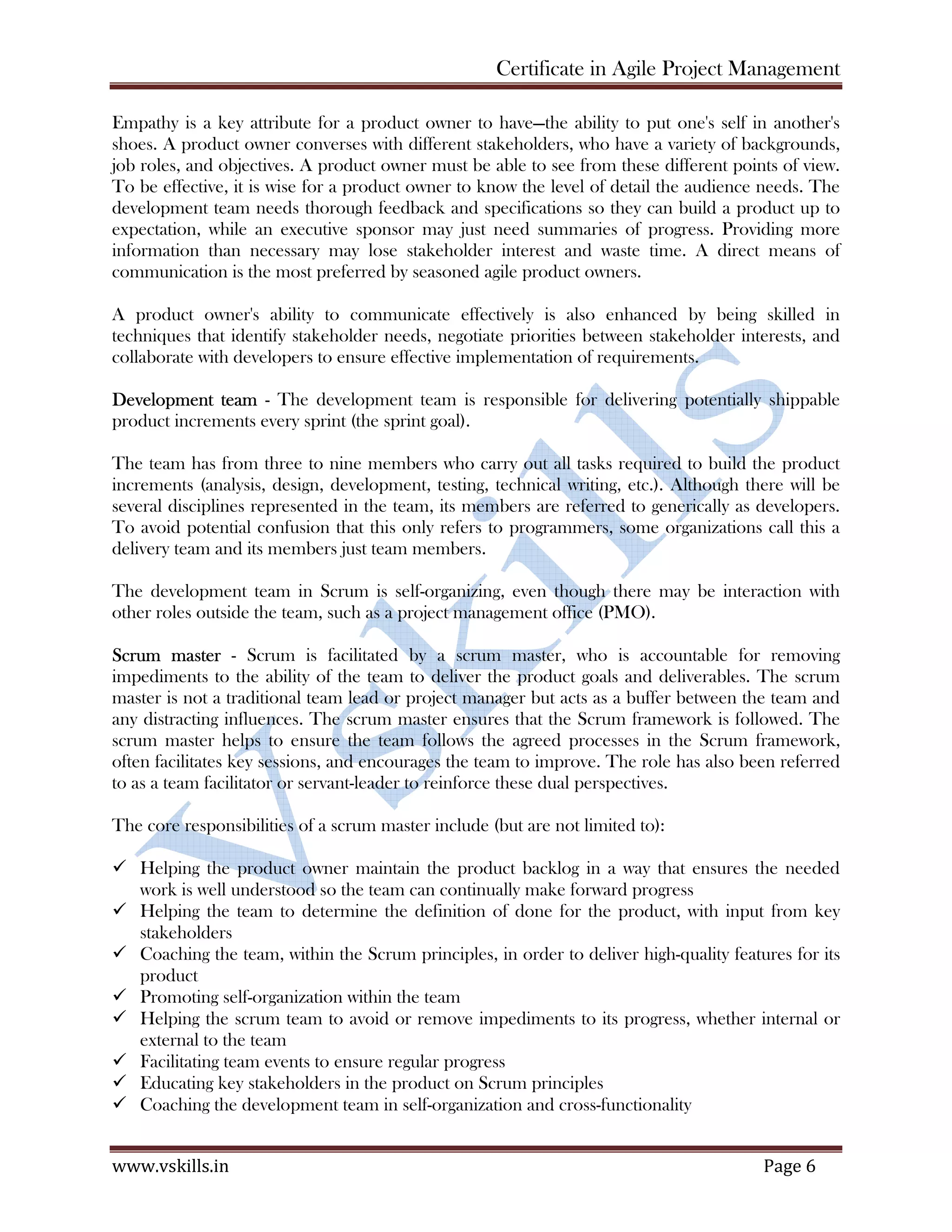
Workflow
Sprint - A sprint (or iteration) is the basic unit of development in Scrum. The sprint is a timeboxed
effort; that is, it is restricted to a specific duration. The duration is fixed in advance for each sprint
and is normally between one week and one month, with two weeks being the most common.
Each sprint starts with a sprint planning event that aims to define a sprint backlog, identify the work
for the sprint, and make an estimated forecast for the sprint goal. Each sprint ends with a sprint
review and sprint retrospective, that reviews progress to show to stakeholders and identify lessons
and improvements for the next sprints.
Scrum emphasizes working product at the end of the sprint that is really done. In the case of
software, this likely includes that the software has been fully integrated, tested and documented,
and is potentially shippable.
certificate in agile project management sample material

certificate in agile project management sample material

  • 1.
  • 2.
    Certificate in AgileProject Management www.vskills.in Page 2 1. AGILE METHODOLOGIES Various agile methodologies, are Dynamic System Development Methodology (DSDM) - It is an agile framework for software projects. It was used to fine-tune the traditional approaches. The most recent version of DSDM is called DSDM Atern. The name Atern is a short for Arctic Tern - a seabird that can travel vast distances that represents many features of the method which are natural ways of working such as prioritization and collaboration. Scrum - It is the most popular agile framework, which concentrates particularly on how to manage tasks within a team-based development environment. Scrum uses iterative and incremental development model, with shorter duration of iterations. Scrum is relatively simple to implement and focuses on quick and frequent deliveries. Extreme Programming (XP) - It is a type of agile software development. It advocates frequent releases in short development cycles, which is intended to improve productivity and introduce checkpoints where new customer requirements can be adopted. The methodology takes its name from the idea that the beneficial elements of traditional software engineering practices are taken to extreme levels. (Extreme Programming is a software-development discipline that organizes people to produce higher-quality software more productively.) XP addresses the analysis, development, and test phases with novel approaches that make a substantial difference to the quality of the end-product. Test-driven Development (TDD) - It is a software development process that relies on the repetition of a very short development cycle: first the developer writes an automated test case that defines a desired improvement or a new function, then it produces the least amount of code to pass that test, and finally brings the new code to acceptable standards. Lean - It is a production practice that considers the expenditure of resources for any goal other than the creation of value for the end-customer to be wasteful, and thus a target for elimination. Working from the perspective of the customer who consumes a product or service, the term value is defined as any action or process that a customer would be willing to pay for. Lean is centered on preserving value with less work. Kanban - It is a system to improve and keep up a high level of production. Kanban is one method through which Just-In-Time (JIT), the strategy the organizations employ to control the inventory expenses, is achieved. Kanban became an effective tool in support of running a production system as a whole, and it proved to be an excellent way for promoting improvement. 1.1. Scrum Scrum is an iterative and incremental framework for managing product development. It defines "a flexible, holistic product development strategy where a development team works as a unit to reach a common goal", challenges assumptions of the "traditional, sequential approach" to product development, and enables teams to self-organize by encouraging physical co-location or close online collaboration of all team members, as well as daily face-to-face communication among all team members and disciplines involved. A key principle of Scrum is the dual recognition that customers will change their minds about what they want or need (often called requirements volatility) and that there will be unpredictable
  • 3.
    Certificate in AgileProject Management www.vskills.in Page 2 1. AGILE METHODOLOGIES Various agile methodologies, are Dynamic System Development Methodology (DSDM) - It is an agile framework for software projects. It was used to fine-tune the traditional approaches. The most recent version of DSDM is called DSDM Atern. The name Atern is a short for Arctic Tern - a seabird that can travel vast distances that represents many features of the method which are natural ways of working such as prioritization and collaboration. Scrum - It is the most popular agile framework, which concentrates particularly on how to manage tasks within a team-based development environment. Scrum uses iterative and incremental development model, with shorter duration of iterations. Scrum is relatively simple to implement and focuses on quick and frequent deliveries. Extreme Programming (XP) - It is a type of agile software development. It advocates frequent releases in short development cycles, which is intended to improve productivity and introduce checkpoints where new customer requirements can be adopted. The methodology takes its name from the idea that the beneficial elements of traditional software engineering practices are taken to extreme levels. (Extreme Programming is a software-development discipline that organizes people to produce higher-quality software more productively.) XP addresses the analysis, development, and test phases with novel approaches that make a substantial difference to the quality of the end-product. Test-driven Development (TDD) - It is a software development process that relies on the repetition of a very short development cycle: first the developer writes an automated test case that defines a desired improvement or a new function, then it produces the least amount of code to pass that test, and finally brings the new code to acceptable standards. Lean - It is a production practice that considers the expenditure of resources for any goal other than the creation of value for the end-customer to be wasteful, and thus a target for elimination. Working from the perspective of the customer who consumes a product or service, the term value is defined as any action or process that a customer would be willing to pay for. Lean is centered on preserving value with less work. Kanban - It is a system to improve and keep up a high level of production. Kanban is one method through which Just-In-Time (JIT), the strategy the organizations employ to control the inventory expenses, is achieved. Kanban became an effective tool in support of running a production system as a whole, and it proved to be an excellent way for promoting improvement. 1.1. Scrum Scrum is an iterative and incremental framework for managing product development. It defines "a flexible, holistic product development strategy where a development team works as a unit to reach a common goal", challenges assumptions of the "traditional, sequential approach" to product development, and enables teams to self-organize by encouraging physical co-location or close online collaboration of all team members, as well as daily face-to-face communication among all team members and disciplines involved. A key principle of Scrum is the dual recognition that customers will change their minds about what they want or need (often called requirements volatility) and that there will be unpredictable
  • 4.
    Certificate in AgileProject Management www.vskills.in Page 4 A typical Scrum project has six to ten team members. This agile method is more suited to small teams, however, it can be adapted to large teams as well. Companies and projects that are team, value, and customer oriented are the best candidates for Scrum methods. The primary difference between the defined (waterfall, spiral and iterative) and empirical (SCRUM) approach is that The SCRUM approach assumes that the analysis, design, and development processes in the Sprint phase are unpredictable. A control mechanism is used to manage the unpredictability and control the risk. Flexibility, responsiveness, and reliability are the results. History Hirotaka Takeuchi and Ikujiro Nonaka introduced the term scrum in the context of product development in their 1986 Harvard Business Review article, "New New Product Development Game". Takeuchi and Nonaka later argued in The Knowledge Creating Company that it is a form of "organizational knowledge creation, especially good at bringing about innovation continuously, incrementally and spirally". The authors described a new approach to commercial product development that would increase speed and flexibility, based on case studies from manufacturing firms in the automotive, photocopier and printer industries. They called this the holistic or rugby approach, as the whole process is performed by one cross-functional team across multiple overlapping phases, where the team "tries to go the distance as a unit, passing the ball back and forth". (In rugby football, a scrum is used to restart play, as the forwards of each team interlock with their heads down and attempt to gain possession of the ball.) In the early 1990s, Ken Schwaber used what would become Scrum at his company, Advanced Development Methods; while Jeff Sutherland, John Scumniotales and Jeff McKenna, developed a similar approach at Easel Corporation, referring to it using the single word Scrum. In 1995, Sutherland and Schwaber jointly presented a paper describing the Scrum framework at the Business Object Design and Implementation Workshop held as part of Object-Oriented Programming, Systems, Languages & Applications '95 (OOPSLA '95) in Austin, Texas. Over the
  • 5.
    Certificate in AgileProject Management www.vskills.in Page 5 following years, Schwaber and Sutherland collaborated to combine this material—with their experience and evolving good practice—to develop what became known as Scrum. In 2001, Schwaber worked with Mike Beedle to describe the method in the book, Agile Software Development with Scrum. Scrum's approach to planning and managing product development involves bringing decision-making authority to the level of operation properties and certainties. In 2002, Schwaber with others founded the Scrum Alliance and set up the Certified Scrum accreditation series. Schwaber left the Scrum Alliance in late 2009 and founded Scrum.org which oversees the parallel Professional Scrum accreditation series. Since 2010, there is a public document called The Scrum Guide that defines sort of an official version of Scrum and is occasionally revised. In 2018 it was expanded upon with the publication of The Kanban Guide for Scrum Teams. Roles There are three core roles in the Scrum framework. These are ideally co-located to deliver potentially shippable product increments every sprint. Together these three roles form the scrum team. While many organizations have other roles involved with defining and delivering the product, Scrum defines only these three. Product owner - The product owner represents the product's stakeholders and the voice of the customer; and is accountable for ensuring that the team delivers value to the business. The product owner defines the product in customer-centric terms (typically user stories), adds them to the product backlog, and prioritizes them based on importance and dependencies. Scrum teams should have one product owner. This role should not be combined with that of the scrum master. The product owner should focus on the business side of product development and spend the majority of their time liaising with stakeholders and should not dictate how the team reaches a technical solution. This role is equivalent to the customer representative role in some other agile frameworks such as extreme programming (XP). Communication is a core responsibility of the product owner. The ability to convey priorities and empathize with team members and stakeholders is vital to steer product development in the right direction. The product owner role bridges the communication gap between the team and its stakeholders, serving as a proxy for stakeholders to the team and as a team representative to the overall stakeholder community. As the face of the team to the stakeholders, the following are some of the communication tasks of the product owner to the stakeholders: demonstrates the solution to key stakeholders who were not present at a sprint review; defines and announces releases; communicates team status; organizes milestone reviews; educates stakeholders in the development process; negotiates priorities, scope, funding, and schedule; ensures that the product backlog is visible, transparent, and clear.
  • 6.
    Certificate in AgileProject Management www.vskills.in Page 6 Empathy is a key attribute for a product owner to have—the ability to put one's self in another's shoes. A product owner converses with different stakeholders, who have a variety of backgrounds, job roles, and objectives. A product owner must be able to see from these different points of view. To be effective, it is wise for a product owner to know the level of detail the audience needs. The development team needs thorough feedback and specifications so they can build a product up to expectation, while an executive sponsor may just need summaries of progress. Providing more information than necessary may lose stakeholder interest and waste time. A direct means of communication is the most preferred by seasoned agile product owners. A product owner's ability to communicate effectively is also enhanced by being skilled in techniques that identify stakeholder needs, negotiate priorities between stakeholder interests, and collaborate with developers to ensure effective implementation of requirements. Development team - The development team is responsible for delivering potentially shippable product increments every sprint (the sprint goal). The team has from three to nine members who carry out all tasks required to build the product increments (analysis, design, development, testing, technical writing, etc.). Although there will be several disciplines represented in the team, its members are referred to generically as developers. To avoid potential confusion that this only refers to programmers, some organizations call this a delivery team and its members just team members. The development team in Scrum is self-organizing, even though there may be interaction with other roles outside the team, such as a project management office (PMO). Scrum master - Scrum is facilitated by a scrum master, who is accountable for removing impediments to the ability of the team to deliver the product goals and deliverables. The scrum master is not a traditional team lead or project manager but acts as a buffer between the team and any distracting influences. The scrum master ensures that the Scrum framework is followed. The scrum master helps to ensure the team follows the agreed processes in the Scrum framework, often facilitates key sessions, and encourages the team to improve. The role has also been referred to as a team facilitator or servant-leader to reinforce these dual perspectives. The core responsibilities of a scrum master include (but are not limited to): Helping the product owner maintain the product backlog in a way that ensures the needed work is well understood so the team can continually make forward progress Helping the team to determine the definition of done for the product, with input from key stakeholders Coaching the team, within the Scrum principles, in order to deliver high-quality features for its product Promoting self-organization within the team Helping the scrum team to avoid or remove impediments to its progress, whether internal or external to the team Facilitating team events to ensure regular progress Educating key stakeholders in the product on Scrum principles Coaching the development team in self-organization and cross-functionality
  • 7.
    Certificate in AgileProject Management www.vskills.in Page 7 One of the ways the scrum master role differs from a project manager is that the latter may have people management responsibilities and the scrum master does not. Scrum does not formally recognise the role of project manager, as traditional command and control tendencies would cause difficulties. Workflow Sprint - A sprint (or iteration) is the basic unit of development in Scrum. The sprint is a timeboxed effort; that is, it is restricted to a specific duration. The duration is fixed in advance for each sprint and is normally between one week and one month, with two weeks being the most common. Each sprint starts with a sprint planning event that aims to define a sprint backlog, identify the work for the sprint, and make an estimated forecast for the sprint goal. Each sprint ends with a sprint review and sprint retrospective, that reviews progress to show to stakeholders and identify lessons and improvements for the next sprints. Scrum emphasizes working product at the end of the sprint that is really done. In the case of software, this likely includes that the software has been fully integrated, tested and documented, and is potentially shippable.