ELECTRICAL SAFETY AUDIT   K. R. Govindan Kavoori Consultants 22, Janakiraman street, West Mambalam Chennai, 600 033. Tele: 044 24846139
SCOPE OF SAFETY AUDIT Inspection of  the electrical equipments and components of a system for safe installation,  adequacy for normal load and  fault levels,  safety for normal operation
System equipments and components : High tension power incoming feeder, isolator and breaker arrangements  Power and distribution transformers Primary power distribution system, Secondary bus duct / cable arrangements  Secondary panel, breakers Indication and annunciation arrangements
System equipments and components : Grounding arrangements  Earthing stations and system,  Feeder arrangements, Neutral grounding and equipment grounding effectiveness,  Cables galleries, tunnels, ducts, laying arrangements and fire protection  Distribution substations M V and LV switchgear and MCC stations Battery bank and battery room
System equipments and components : Lighting distribution: Lighting panels  Fire alarm and mulsifier systems Electrical installations in Process Areas  Electrical installations in Utilities, Effluent and Water Treatment Plants,  Investigation in to recent electrical accidents and cause analysis,
System equipments and components : Fire water system and Main and jockey pumps for their control systems, Static protections employed in hazardous material handling areas, Selection of enclosures for electrical control and  power equipments in hazardous areas, Emergency stand-by power:
System equipments and components : Records Electrical failures records and cause analysis. Operation, Maintenance of these equipments,  Preventive and predictive maintenance practices and
System equipments and components : routine tests carried out on control gears from the safety angle of view, Compliance with Safety and Statutory Requirements Hazardous area classification and equipment compliance.
Operation and maintenance practices Permit work clearances and procedures  Safety precautions and practices  Normal and emergency operation and procedures  Compliance with Safety and Statutory Requirements:
Personnel protective appliances and implements: Adequacy of protective gears available  Adequacy of metering and measuring equipments First aid and safety practices
Fire and safety: Electrical Fire fighting equipments and systems Fire water and pumping systems and their controls.
OBJECTIVES OF ELECTRICAL SAFETY AUDIT: To assess the safety of equipments: From damage during normal operation. Capability of the protective system to protect the equipment’s in the event of electrical faults.
To assess the safety of the personnel : Are the operating and maintenance personnel aware of electrical hazards? Is statutory regulation fulfilled?  During emergencies also?  (Power failures, Electrical fault)
To assess the System’s capability: Is the system adopted safe for maintenance personnel for carrying out electrical job Safely? Does the system adopted satisfies statutory regulations (Maintenance practices) Does the system provide Review mechanism for checking adequacy of electrical safety? Does the system provide amendment of Safety practices & Communication with relevant personnel?
Other aspects: Assessment of the existing systems’ adequacy, strength and weakness, Is the Electrical System adequately protected against external causes? Is there a relevant safety manual available on operation and maintenance and emergency procedures?
Emergency Preparedness: Adequacy, suggestion for improvements. Call for site employees suggestion Involve them in the task Educate them Create awareness and constant consciousness
ELECTRICAL SAFETY MOST IMPORTANT ESPECIALLY FOR  PETROCHEMICAL INDUSTRIES
ELECTRICITY IS   A good servant, but  a bad master You control it, it will serve you nicely Do not allow it to control you  Electricity excuses nobody  Accidents do not happen; they are caused
ELECTRICAL SAFETY  ELECTRICITY Convenient, clean, useful source of energy Easily transformed into other energies  Mechanical, chemical and heat Easily produced Conveniently transmitted to long distances without much loss
BUT POTENTIALLY A SOURCE OF GREAT DANGER AND HAZARD ! Shocks, some times fatal Injuries and burns Permanent deformation of the victim and When used in a hazardous atmosphere, electricity may be a potential source of ignition.
Much development taken place in equipment usage, designed to be safe. But not proof against misuse and neglect Understand hazardous Do not take risk, in doubt ask Electricity does not excuse any one A good servant but a bad master.
Electricity is: A Good Servant  –  But a bad master  Six Golden rules: Follow all safety rules Adhere To established procedures Use proper control gears Never take anything for granted Always be  alert Keep your mind on the job. You control electricity It will serve you nicely! Do not allow it to control you!
Accidents do not happen They are caused Due to   Ignorance  Negligence  Inadvertence  Third person’s ignorance  Not using safety gears Not having enough knowledge or experience Over confidence due to long experience
Accidents do not happen They are caused Not checking the system for *  Alternate power source *  Residual charges  *  Low voltage reverse feeding  *  Ring main system  *  Multiple sources
Accidents do not happen They are caused Inefficient or no supervision  Non co-operation from co-workers Consuming intoxicating drinks, substances  Family problems Natural calamities  Fatigue due to lack of rest
Accidents do not happen They are caused Lack of proper display of caution boards Not checking the conditions of safety gears Improper fire extinguishing equipments Improper protective equipments Lack of maintenance of safety gears
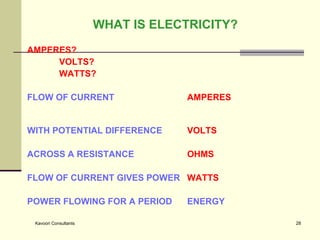
WHAT IS ELECTRICITY? AMPERES? VOLTS? WATTS? FLOW OF CURRENT   AMPERES  WITH POTENTIAL DIFFERENCE VOLTS   ACROSS A RESISTANCE OHMS FLOW OF CURRENT GIVES POWER   WATTS POWER FLOWING FOR A PERIOD ENERGY
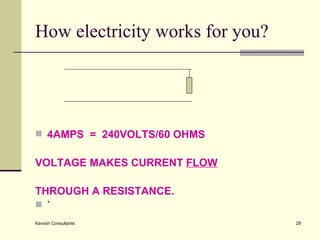
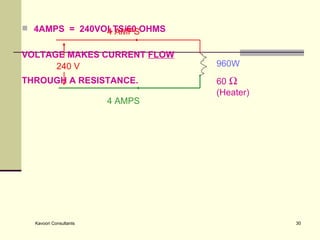
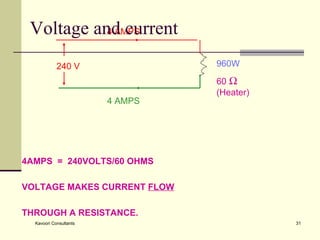
How electricity works for you? 4AMPS  =  240VOLTS/60 OHMS VOLTAGE MAKES CURRENT  FLOW THROUGH A RESISTANCE. `
4AMPS  =  240VOLTS/60 OHMS VOLTAGE MAKES CURRENT  FLOW THROUGH A RESISTANCE. 240 V 960W 60      (Heater) 4 AMPS 4 AMPS
4AMPS  =  240VOLTS/60 OHMS VOLTAGE MAKES CURRENT  FLOW THROUGH A RESISTANCE. Voltage and current 240 V 960W 60      (Heater) 4 AMPS 4 AMPS
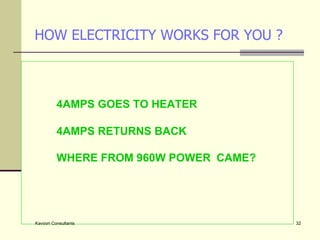
  4AMPS GOES TO HEATER    4AMPS RETURNS BACK   WHERE FROM 960W POWER  CAME? HOW ELECTRICITY WORKS FOR YOU ?
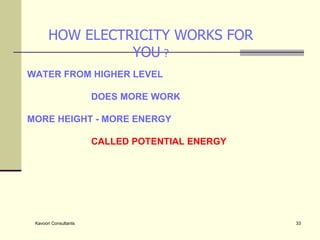
WATER FROM HIGHER LEVEL DOES MORE WORK MORE HEIGHT - MORE ENERGY   CALLED POTENTIAL ENERGY   HOW ELECTRICITY WORKS FOR YOU  ?
HOW ELECTRICITY WORKS FOR YOU ? WATER GOES THRO’ A TURBINE   GIVES THE ENERGY - OR DOES WORK BUT IT IS NOT CONSUMED!   CURRENT -  AMPERE - SAME LIKE WATER   DOES WORK AND RETURNS
HOW ELECTRICITY WORKS FOR YOU ? POTENTIAL DIFFERENCE - VOLTS   LIKE HEIGHT - MORE VOLTS  MORE WORK   1 AMPERE FROM 1 VOLTS - 1 WATT POWER   WATT (POWER) = VOLT X AMPS.(P. D.X CURRENT)
WHAT IS POWER?  WHAT IS ENERGY?   ENERGY IS QUANTITY OF WORK DONE   POWER IS RATE OF DOING WORK.   100LTRS OF WATER TO BE BOILED     1KW HEATER TAKES 2HRS.   2KW HEATER WILL TAKE 1HR.   ENERGY  =  POWER X TIME.   KILO WATT X HOUR  =  KILO WATT HOUR =K W hr
ELECTRICITY -  CONTROL FOR SAFETY   Proper control of electricity assures safety  Electrical power should be isolated before development of a hazardous situation Imminent fault development to be foreseen and preventive action taken  Only control – faulty circuits should be isolated  Immediately and  Automatically
Immediate isolation of faulty section; How? Possible to watch continuously? MAJOR PROBLEM -Insulation failure HAZARDS   Shock to personnel, Fire hazards Total equipment damage, Power system collapse Mechanical damage Fault location impossible ELECTRICITY -  CONTROL FOR SAFETY
How to monitor continuously & isolate automatically ?   Make electricity do it; but, How?   Make fault current grow quickly to a large value  and actuate protective isolating devices. Good, but how? Current will flow from Phase to neutral or,   Phase to phase
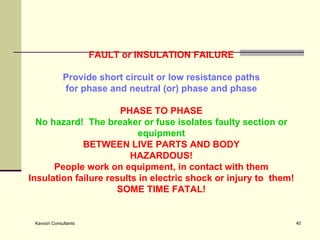
FAULT or INSULATION FAILURE Provide short circuit or low resistance paths for phase and neutral (or) phase and phase PHASE TO PHASE No hazard!  The breaker or fuse isolates faulty section or equipment BETWEEN LIVE PARTS AND BODY HAZARDOUS! People work on equipment, in contact with them Insulation failure results in electric shock or injury to  them! SOME TIME FATAL!
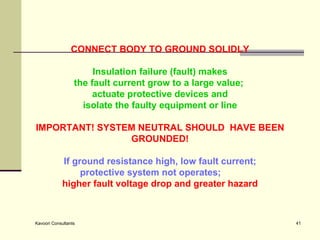
CONNECT BODY TO GROUND SOLIDLY Insulation failure (fault) makes the fault current grow to a large value;  actuate protective devices and isolate the faulty equipment or line    IMPORTANT! SYSTEM NEUTRAL SHOULD  HAVE BEEN GROUNDED! If ground resistance high, low fault current; protective system not operates; higher fault voltage drop and greater hazard
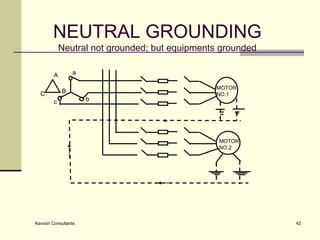
NEUTRAL GROUNDING Neutral not grounded; but equipments grounded A C B a c b MOTOR NO.1 MOTOR NO.2
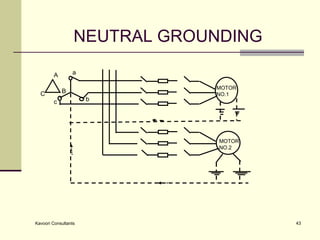
NEUTRAL GROUNDING A C B a c b MOTOR NO.1 MOTOR NO.2
PROPER NEUTRAL GROUNDING ASSURES  Reliability, Safety and Equipment protection Power system transformer neutral Connected  to earth by  Two copper or G. I strips to exclusive neutral electrode, to earth bus Earth electrode resistance to be Less than 2 ohms Transformer and equipment body Two connections to earth bus
WHAT IF NEUTRAL NOT GROUNDED? No current flows to ground. Another fault -  another equipment May be another phase All faults  -  high resistance Low current-  no automatic isolation  Full phase voltage, Danger to human life 415 V SHOCK FATAL! Fault current through available path Fire hazard Sputtering ground
CONTROLING ELECTRICITY Mainly isolation of faultily equipment or circuits  To avoid hazards   Isolation should be  Automatic,  Very fast And very accurate  Protective elements can protect only equipments and systems and not human beings  Human heart is highly sensitive to passage of electrical current
CONTROLING ELECTRICITY Controlling elements are  Fuses  a.  Wire fuses  b.  Enclosed fuses  c.  HRC fuses  Circuit Breakers  a. Automatic circuit breakers  b. Fused switches and switch fuses  c. Manual isolators
PORTABLE  EQUIPMENT   Single phase Use 3  core cable Three phase use 4 core cable Care of safety appliances: Rubber gloves /gauntlets Rubber mat Face shield / goggles Discharge rods aprons Testers/test lamps  Multi-meters
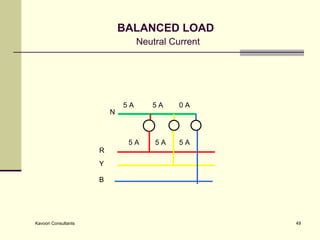
BALANCED LOAD   Neutral Current Y B N R 5 A 5 A 5 A 5 A 5 A 0 A
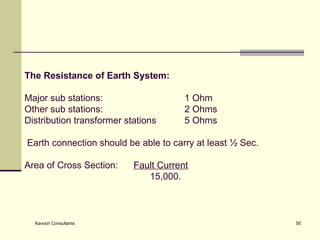
The Resistance of Earth System:   Major sub stations: 1 Ohm Other sub stations: 2 Ohms Distribution transformer stations 5 Ohms    Earth connection should be able to carry at least ½ Sec. Area of Cross Section:  Fault Current     15,000.
Electrical Safety  Permit System: Modern industries   switch boards, M. C.C.S, distribution boards located   ~ Away from the equipments connected   ~ In separate rooms or enclosures Not in direct view of equipments. Only authorized persons can enter or operate. Good practice!
Many crafts work on the same equipment But controlled equipment not seen or in the vicinity Fool proof method required to assure safety of  1.  Persons working 2.  Equipments against damage.
Permit Systems : 1.  Work permit system: Line clear: Written format (permit) signed by issuer after switching off power. Issuer locks switches Receiver signs and returns permit after work is completed. Issuer cancels permit & energizes line-equipment. Not very fool proof - Many crafts involved.
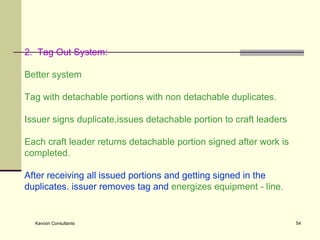
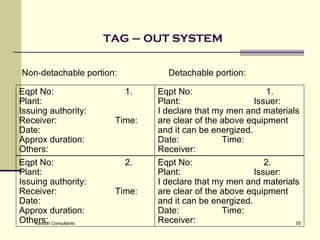
2.  Tag Out System:  Better system Tag with detachable portions with non detachable duplicates. Issuer signs duplicate,issues detachable portion to craft leaders  Each craft leader returns detachable portion signed after work is completed.  After receiving all issued portions and getting signed in the duplicates. i ssuer removes tag and   energizes equipment - line.
TAG – OUT SYSTEM Eqpt No:   1. Plant: Issuing authority: Receiver: Time: Date: Approx duration: Others: Eqpt No:   1. Plant: Issuer: I declare that my men and materials are clear of the above equipment and it can be energized.  Date: Time: Receiver: Non-detachable portion: Detachable portion: Eqpt No:   2. Plant: Issuing authority: Receiver: Time: Date: Approx duration: Others: Eqpt No:   2. Plant: Issuer: I declare that my men and materials are clear of the above equipment and it can be energized.  Date: Time: Receiver:
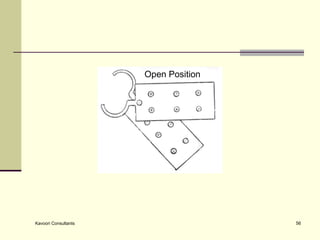
Open Position
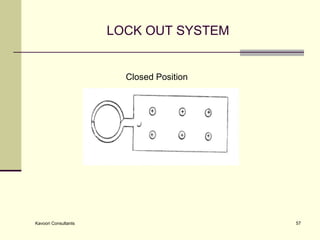
LOCK OUT SYSTEM Closed Position
ELECTRIC CURRENT EFFECT ON HUMAN Less than 0.5 milli amps – not felt 0.5 to 12 milli amps – painful, causes start Above 12 milli amps – muscles contracts Possibility of holding on and heart stopping Less current more time to stop heart 50 milli amperes for 200 milli seconds can stop the heart
DO NOT TAKE THIS AS A GUIDELINE! High skin resistance limits the current Cuts skin and dampness will reduce the resistance Cautions – wet places very dangerous Good bonding and earthing needed
PRECAUTION AGAINST ELECTRIC SHOCKS Good electrical installation and maintenance practice The use of low voltage or High Frequency above 15 kHz.  The earthing and bonding of all metal work which might become live and The installation of special protection such as armoring, screening, and earth leakage circuit breakers.
SHORT CIRCUIT CURRENTS Short circuits causes 20 times normal currents 1000 kVA transformer gives 30,000 ampere Agonizing injuries to the human, fuses metal, ignite flammable liquid and vapors.
MICROWAVE OVENS Articles in microwave ovens are heated by microwaves. The microwaves are at the frequency of approximately 2.45GHZ  A magnetron microwave generator is employed to produce microwaves These waves cause molecules of water and other compounds to rotate or vibrate
MICROWAVE OVENS The vibration creates heat which cooks the food or boils the liquids Efficiency: A typical oven of 1100 Watts delivers 700Watts microwave energy  400 Watts dissipated as heat by the wave generating components
MICRO WAVE OVEN - HAZARDS Liquids in container with smooth surface can super heat.  Reach temperatures above normal boiling point without boiling  Boiling can start explosively when the liquid is disturbed that is when taken out from the container. Closed containers and eggs can explode due to steam generation
MICRO WAVE OVEN - HAZARDS Tin foil, aluminum foil, ceramic decorative metal can cause sparks  RADIATION:  Exposure to micro wave radiation is injurious to health Legal limit of radiation is 1 mW/cm 2 , at 5 cm from a new oven  For used oven five times this limit is acceptable
MICRO WAVE OVEN - HAZARDS Mandatory requirements for radiation leakage limitation for ovens produced after 1971;  Less than 5 mW /cm 2 , approximately at two inches of the surfaces of the oven  Micro waves are not as bad as X-rays or ultra violet radiation. The oven front glass window is made up of special screen which blocks micro wave radiation leakage Shut off the oven if any damage to this noticed This should be immediately repaired
MICROWAVE OVEN- CONSTRUCTION The cooking chamber is a  Faraday cage  enclosure; Prevents radiation from escaping through.  Oven door - glass panel for easy viewing,  But with a layer of conductive mesh for shielding.  Size of the mesh is much less than the microwave radiation  wavelength  of 12 cm,  The radiation can not pass through the door But visible  light , with much shorter wavelength, can pass through the door.
NEUTRAL AND GROUND  (Continued) Never, never use ground wire as neutral Neutral conductor carries return or unbalance current But, earth conductor carries fault current only. Earth conductor as neutral, will carry current-   Any loose connection or high resistance joint, voltage builds up Equipment bodies, earth bus give shock; Arcing, fire hazards etc.
NEUTRAL AND GROUND   (Continued) Our System Is “Neutral Grounded System” or Simply “Grounded System” At all generating, distribution points, the neutral is grounded. That is, the neutral is grounded at: Power transformers  And generators of E.B.,  Distribution Transformer and Generators. System parameters to be: Phase to Phase Voltage 415v Phase to Neutral Voltage 240v Contact Voltage 240v  Insulation Failure Less Hazardous.
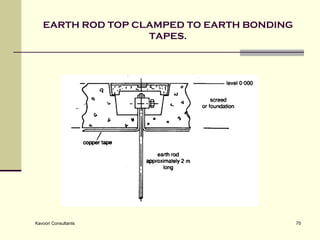
EARTH ROD TOP CLAMPED TO EARTH BONDING TAPES.
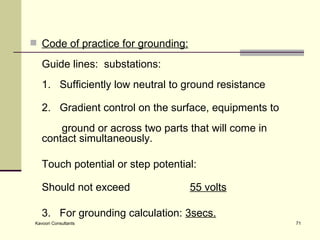
Code of practice for grounding:   Guide lines:  substations:   1.  Sufficiently low neutral to ground resistance 2.  Gradient control on the surface, equipments to  ground or across two parts that will come in  contact simultaneously. Touch potential or step potential: Should not exceed 55 volts 3.  For grounding calculation:  3secs.
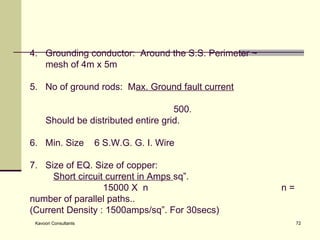
4.  Grounding conductor:  Around the S.S. Perimeter ~    mesh of 4m x 5m 5.  No of ground rods:  M ax. Ground fault current     500.   Should be distributed entire grid. 6.  Min. Size  6 S.W.G. G. I. Wire 7.  Size of EQ. Size of copper:   Short circuit current in Amps  sq”.   15000 X  n  n = number of parallel paths.. (Current Density : 1500amps/sq”. For 30secs)
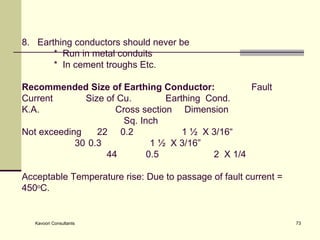
8.  Earthing conductors should never be    *  Run in metal conduits  *  In cement troughs Etc. Recommended Size of Earthing Conductor:  Fault Current Size of Cu.  Earthing  Cond. K.A.  Cross section   Dimension    Sq. Inch   Not exceeding  22  0.2 1 ½  X 3/16“   30  0.3 1 ½  X 3/16”   44  0.5 2  X 1/4 Acceptable Temperature rise: Due to passage of fault current =  450 o C.
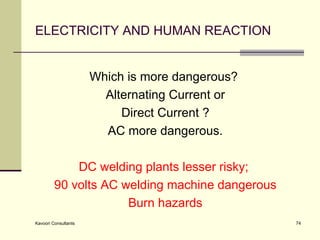
ELECTRICITY AND HUMAN REACTION  Which is more dangerous?  Alternating Current or Direct Current ? AC more dangerous. DC welding plants lesser risky;  90 volts AC welding machine dangerous Burn hazards
CURRENT AND FREQUENCY Higher frequency lesser risk 12 to 13 milliamps at 50 HZ cause hold on At 500 HZ this current no effect But higher frequency deeper the burn Micro exposure cause cataracts High frequency does not cause paralysis. Electrical frequency - effect on human
Electrical frequency - effect on human THRESHOLD OF FEELING: DC 3 milli ampere; AC 50 HZ – 1 milli ampere; 9 milli ampere at 10 KHz DC applied to nerve fibre – muscle moves once, then releases 8 pulses per second – muscles stay contracted Hence, 50 Hz cycle so very dangerous Current through heart stops Death follow if heart stopped between 3 to 8 minutes
HUMAN HEART 4. Heart stops completely – cardiac arrest Failure of heart to deliver oxygenated blood to the head – irreversible  damage – death follow in a very short time Dry skin high voltage, severe burn Not necessary electrocuting the victim  Low voltage at wet or sweating skin cause death No evidence of burning.
If path of the current is through chest  Most fatal accident occur at consumer voltages In mechanical terms the human heart is a compact 280 g assembly, comprising two separate 2-stage displacement pumps working in series and in synchronism.  It has a continuous rating of about 4-5W and a short-time rating of at least 20W. Its ‘specification’ requires it to be  Self-powered by extraction of energy from the pumped medium (I.e, by using some of the oxygen from the blood) Completely maintenance-free Capable of continuous operation at 6—74 strokes/min for at least 600 000 h with 100% reliability
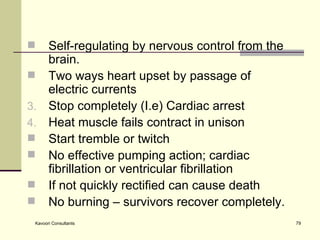
Self-regulating by nervous control from the brain. Two ways heart upset by passage of electric currents Stop completely (I.e) Cardiac arrest Heat muscle fails contract in unison Start tremble or twitch No effective pumping action; cardiac fibrillation or ventricular fibrillation  If not quickly rectified can cause death No burning – survivors recover completely.
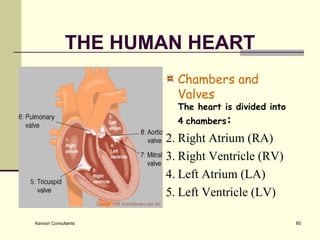
THE HUMAN HEART Chambers and Valves The heart is divided into 4   chambers :   Right Atrium (RA)  Right Ventricle (RV)  Left Atrium (LA)  Left Ventricle (LV)
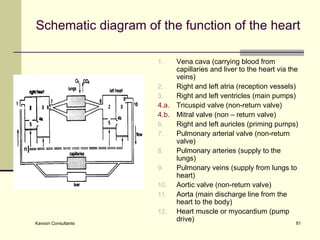
Schematic diagram of the function of the heart Vena cava (carrying blood from capillaries and liver to the heart via the veins)  Right and left atria (reception vessels) Right and left ventricles (main pumps) 4.a. Tricuspid valve (non-return valve) 4.b. Mitral valve (non – return valve)  Right and left auricles (priming pumps) Pulmonary arterial valve (non-return valve) Pulmonary arteries (supply to the lungs) Pulmonary veins (supply from lungs to heart) Aortic valve (non-return valve) Aorta (main discharge line from the heart to the body) Heart muscle or myocardium (pump drive)
THE HUMAN HEART A hallow cone shaped muscle located between the lungs 2/3 rd  is to the left of the middle line of the body and 1/3 rd  to the right Heart muscle contracts (Systole), pumps blood out of the heart Right side of the heart collects oxygen poor blood from the body Pumps to lungs In lungs blood picks up oxygen release CO 2 Left side collects oxygen rich blood and pumps to the body
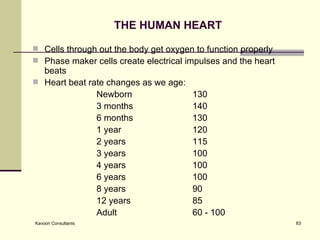
THE HUMAN HEART Cells through out the body get oxygen to function properly Phase maker cells create electrical impulses and the heart beats Heart beat rate changes as we age:  Newborn 130 3 months 140 6 months 130 1 year 120 2 years 115 3 years 100 4 years 100 6 years 100 8 years  90 12 years 85 Adult 60 - 100
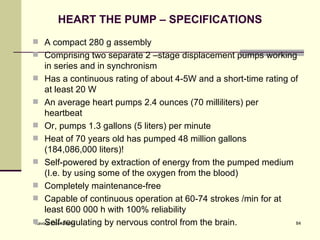
HEART THE PUMP – SPECIFICATIONS A compact 280 g assembly Comprising two separate 2 –stage displacement pumps working in series and in synchronism Has a continuous rating of about 4-5W and a short-time rating of at least 20 W An average heart pumps 2.4 ounces (70 milliliters) per heartbeat Or, pumps 1.3 gallons (5 liters) per minute Heat of 70 years old has pumped 48 million gallons (184,086,000 liters)! Self-powered by extraction of energy from the pumped medium (I.e. by using some of the oxygen from the blood)  Completely maintenance-free Capable of continuous operation at 60-74 strokes /min for at least 600 000 h with 100% reliability Self-regulating by nervous control from the brain.
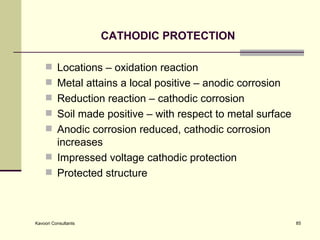
CATHODIC PROTECTION Locations – oxidation reaction Metal attains a local positive – anodic corrosion Reduction reaction – cathodic corrosion  Soil made positive – with respect to metal surface Anodic corrosion reduced, cathodic corrosion increases Impressed voltage cathodic protection Protected structure
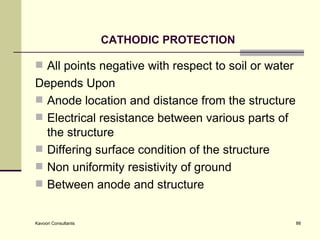
CATHODIC PROTECTION All points negative with respect to soil or water  Depends Upon Anode location and distance from the structure Electrical resistance between various parts of the structure Differing surface condition of the structure Non uniformity resistivity of ground  Between anode and structure
CODES OF PRACTICE (COP) Marking code: Ex o – Oil immersion Marking code: Ex p – Pressuried apparatus  Marking code: Ex q – Powder/sand filling Marking code: Ex d – Flame proof enclosure Marking code: Ex e – Increased safety Marking code; Ex ia and Ex ib ( ia is safer than ib) – Intrinsic safety Marking code: Ex m – Encapsulation  Marking code: Ex ia or Ex ib – Intrinsically safe systems Marking code: Ex N – Type of protection N Marking code: Ex s – Special protection
COMMON UNSAFE PRACTICES Wiring: Working with the mains ON Replacing an open fuse Providing switch in neutral line instead of phase line Working with wet feet or hands Opening a bras lamp-holder which may be live Unprotected socket outlets Portable electrical appliances Ineffective or no earthing Working on live appliances without insulated tools or gloves Damp floor or feet.
STATIC ELECTRICITY  Electricity from word  elektron , Greek for amber Created when two surfaces in contact separate Greater effect if sliding Most effective in insulating material because charges cannot move directly to recombine Conductors – charges recombine and do not build up  Starts with one volt-rises to several thousands volts
STATIC ELECTRICITY Fine powders  Very much subject to static accumulation Become highly charged whenever poured, sieved, mixed, ground or blown  Transfer the charge to the container If container earthed the charges leaks away  Chargers in Liquids: Oils and explosive liquids = non conducting retain charges Charges in liquid generated to dangerous potential level when  Liquid flowing through a pipe
STATIC ELECTRICITY Liquid flowing through a fine mesh filter  Undissolved or immiscible particles moving within the liquid The presence of two different liquid phases Mist, spray or droplets moving through a gas or falling within a vessel Charges in Gases Charging process not like liquids or solids  Gets and streams or containing particles, solid or liquid generates charge from or impart charge two other items of the equipment Release of CO 2  or LPG cause considerable cooling – formation of CO 2  snow and LPG mist – dangerous from static point of view
STATIC ELECTRICITY Cleaning by compressed air – disturbed dust and spray present possible hazard; all nearby metal object should be earthed Particle free – explosive gas will not produce static charge – but readily ignited by a very small low energy ESD High pressure spray painting may generate potentials of kilo Volts Hand held spray gun (1) possible high voltage shock (2) presence flammable atmosphere, danger of fire explosion
LIGHTNING - STATIC ELECTRICITY, Contd., Rate of rise of discharge reach 200 kA/  s  Equivalent to 100 mega hertz.,  Inductance   H, a bend or a loop in the conductor; high impedance  Cause high potential and jumping across  Similarly a very low capacitance – very low impedance discharge reflected in adjacent metallic objects Selections of pipe line are electrically isolated Remain pipe work bonded at site Isolating flanges may have spark gaps

Tpl electrical safety230311

  • 1.
    ELECTRICAL SAFETY AUDIT K. R. Govindan Kavoori Consultants 22, Janakiraman street, West Mambalam Chennai, 600 033. Tele: 044 24846139
  • 2.
    SCOPE OF SAFETYAUDIT Inspection of the electrical equipments and components of a system for safe installation, adequacy for normal load and fault levels, safety for normal operation
  • 3.
    System equipments andcomponents : High tension power incoming feeder, isolator and breaker arrangements Power and distribution transformers Primary power distribution system, Secondary bus duct / cable arrangements Secondary panel, breakers Indication and annunciation arrangements
  • 4.
    System equipments andcomponents : Grounding arrangements Earthing stations and system, Feeder arrangements, Neutral grounding and equipment grounding effectiveness, Cables galleries, tunnels, ducts, laying arrangements and fire protection Distribution substations M V and LV switchgear and MCC stations Battery bank and battery room
  • 5.
    System equipments andcomponents : Grounding arrangements Earthing stations and system, Feeder arrangements, Neutral grounding and equipment grounding effectiveness, Cables galleries, tunnels, ducts, laying arrangements and fire protection Distribution substations M V and LV switchgear and MCC stations Battery bank and battery room
  • 6.
    System equipments andcomponents : Lighting distribution: Lighting panels Fire alarm and mulsifier systems Electrical installations in Process Areas Electrical installations in Utilities, Effluent and Water Treatment Plants, Investigation in to recent electrical accidents and cause analysis,
  • 7.
    System equipments andcomponents : Fire water system and Main and jockey pumps for their control systems, Static protections employed in hazardous material handling areas, Selection of enclosures for electrical control and power equipments in hazardous areas, Emergency stand-by power:
  • 8.
    System equipments andcomponents : Records Electrical failures records and cause analysis. Operation, Maintenance of these equipments, Preventive and predictive maintenance practices and
  • 9.
    System equipments andcomponents : routine tests carried out on control gears from the safety angle of view, Compliance with Safety and Statutory Requirements Hazardous area classification and equipment compliance.
  • 10.
    Operation and maintenancepractices Permit work clearances and procedures Safety precautions and practices Normal and emergency operation and procedures Compliance with Safety and Statutory Requirements:
  • 11.
    Personnel protective appliancesand implements: Adequacy of protective gears available Adequacy of metering and measuring equipments First aid and safety practices
  • 12.
    Fire and safety:Electrical Fire fighting equipments and systems Fire water and pumping systems and their controls.
  • 13.
    OBJECTIVES OF ELECTRICALSAFETY AUDIT: To assess the safety of equipments: From damage during normal operation. Capability of the protective system to protect the equipment’s in the event of electrical faults.
  • 14.
    To assess thesafety of the personnel : Are the operating and maintenance personnel aware of electrical hazards? Is statutory regulation fulfilled? During emergencies also? (Power failures, Electrical fault)
  • 15.
    To assess theSystem’s capability: Is the system adopted safe for maintenance personnel for carrying out electrical job Safely? Does the system adopted satisfies statutory regulations (Maintenance practices) Does the system provide Review mechanism for checking adequacy of electrical safety? Does the system provide amendment of Safety practices & Communication with relevant personnel?
  • 16.
    Other aspects: Assessmentof the existing systems’ adequacy, strength and weakness, Is the Electrical System adequately protected against external causes? Is there a relevant safety manual available on operation and maintenance and emergency procedures?
  • 17.
    Emergency Preparedness: Adequacy,suggestion for improvements. Call for site employees suggestion Involve them in the task Educate them Create awareness and constant consciousness
  • 18.
    ELECTRICAL SAFETY MOSTIMPORTANT ESPECIALLY FOR PETROCHEMICAL INDUSTRIES
  • 19.
    ELECTRICITY IS A good servant, but a bad master You control it, it will serve you nicely Do not allow it to control you Electricity excuses nobody Accidents do not happen; they are caused
  • 20.
    ELECTRICAL SAFETY ELECTRICITY Convenient, clean, useful source of energy Easily transformed into other energies Mechanical, chemical and heat Easily produced Conveniently transmitted to long distances without much loss
  • 21.
    BUT POTENTIALLY ASOURCE OF GREAT DANGER AND HAZARD ! Shocks, some times fatal Injuries and burns Permanent deformation of the victim and When used in a hazardous atmosphere, electricity may be a potential source of ignition.
  • 22.
    Much development takenplace in equipment usage, designed to be safe. But not proof against misuse and neglect Understand hazardous Do not take risk, in doubt ask Electricity does not excuse any one A good servant but a bad master.
  • 23.
    Electricity is: AGood Servant – But a bad master Six Golden rules: Follow all safety rules Adhere To established procedures Use proper control gears Never take anything for granted Always be alert Keep your mind on the job. You control electricity It will serve you nicely! Do not allow it to control you!
  • 24.
    Accidents do nothappen They are caused Due to Ignorance Negligence Inadvertence Third person’s ignorance Not using safety gears Not having enough knowledge or experience Over confidence due to long experience
  • 25.
    Accidents do nothappen They are caused Not checking the system for * Alternate power source * Residual charges * Low voltage reverse feeding * Ring main system * Multiple sources
  • 26.
    Accidents do nothappen They are caused Inefficient or no supervision Non co-operation from co-workers Consuming intoxicating drinks, substances Family problems Natural calamities Fatigue due to lack of rest
  • 27.
    Accidents do nothappen They are caused Lack of proper display of caution boards Not checking the conditions of safety gears Improper fire extinguishing equipments Improper protective equipments Lack of maintenance of safety gears
  • 28.
    WHAT IS ELECTRICITY?AMPERES? VOLTS? WATTS? FLOW OF CURRENT AMPERES WITH POTENTIAL DIFFERENCE VOLTS   ACROSS A RESISTANCE OHMS FLOW OF CURRENT GIVES POWER WATTS POWER FLOWING FOR A PERIOD ENERGY
  • 29.
    How electricity worksfor you? 4AMPS = 240VOLTS/60 OHMS VOLTAGE MAKES CURRENT FLOW THROUGH A RESISTANCE. `
  • 30.
    4AMPS = 240VOLTS/60 OHMS VOLTAGE MAKES CURRENT FLOW THROUGH A RESISTANCE. 240 V 960W 60  (Heater) 4 AMPS 4 AMPS
  • 31.
    4AMPS = 240VOLTS/60 OHMS VOLTAGE MAKES CURRENT FLOW THROUGH A RESISTANCE. Voltage and current 240 V 960W 60  (Heater) 4 AMPS 4 AMPS
  • 32.
      4AMPS GOESTO HEATER   4AMPS RETURNS BACK   WHERE FROM 960W POWER CAME? HOW ELECTRICITY WORKS FOR YOU ?
  • 33.
    WATER FROM HIGHERLEVEL DOES MORE WORK MORE HEIGHT - MORE ENERGY   CALLED POTENTIAL ENERGY   HOW ELECTRICITY WORKS FOR YOU ?
  • 34.
    HOW ELECTRICITY WORKSFOR YOU ? WATER GOES THRO’ A TURBINE   GIVES THE ENERGY - OR DOES WORK BUT IT IS NOT CONSUMED!   CURRENT - AMPERE - SAME LIKE WATER   DOES WORK AND RETURNS
  • 35.
    HOW ELECTRICITY WORKSFOR YOU ? POTENTIAL DIFFERENCE - VOLTS   LIKE HEIGHT - MORE VOLTS MORE WORK   1 AMPERE FROM 1 VOLTS - 1 WATT POWER WATT (POWER) = VOLT X AMPS.(P. D.X CURRENT)
  • 36.
    WHAT IS POWER? WHAT IS ENERGY?   ENERGY IS QUANTITY OF WORK DONE   POWER IS RATE OF DOING WORK.   100LTRS OF WATER TO BE BOILED   1KW HEATER TAKES 2HRS. 2KW HEATER WILL TAKE 1HR.   ENERGY = POWER X TIME.   KILO WATT X HOUR = KILO WATT HOUR =K W hr
  • 37.
    ELECTRICITY - CONTROL FOR SAFETY Proper control of electricity assures safety Electrical power should be isolated before development of a hazardous situation Imminent fault development to be foreseen and preventive action taken Only control – faulty circuits should be isolated Immediately and Automatically
  • 38.
    Immediate isolation offaulty section; How? Possible to watch continuously? MAJOR PROBLEM -Insulation failure HAZARDS   Shock to personnel, Fire hazards Total equipment damage, Power system collapse Mechanical damage Fault location impossible ELECTRICITY - CONTROL FOR SAFETY
  • 39.
    How to monitorcontinuously & isolate automatically ?   Make electricity do it; but, How?   Make fault current grow quickly to a large value and actuate protective isolating devices. Good, but how? Current will flow from Phase to neutral or, Phase to phase
  • 40.
    FAULT or INSULATIONFAILURE Provide short circuit or low resistance paths for phase and neutral (or) phase and phase PHASE TO PHASE No hazard! The breaker or fuse isolates faulty section or equipment BETWEEN LIVE PARTS AND BODY HAZARDOUS! People work on equipment, in contact with them Insulation failure results in electric shock or injury to them! SOME TIME FATAL!
  • 41.
    CONNECT BODY TOGROUND SOLIDLY Insulation failure (fault) makes the fault current grow to a large value; actuate protective devices and isolate the faulty equipment or line    IMPORTANT! SYSTEM NEUTRAL SHOULD HAVE BEEN GROUNDED! If ground resistance high, low fault current; protective system not operates; higher fault voltage drop and greater hazard
  • 42.
    NEUTRAL GROUNDING Neutralnot grounded; but equipments grounded A C B a c b MOTOR NO.1 MOTOR NO.2
  • 43.
    NEUTRAL GROUNDING AC B a c b MOTOR NO.1 MOTOR NO.2
  • 44.
    PROPER NEUTRAL GROUNDINGASSURES  Reliability, Safety and Equipment protection Power system transformer neutral Connected to earth by Two copper or G. I strips to exclusive neutral electrode, to earth bus Earth electrode resistance to be Less than 2 ohms Transformer and equipment body Two connections to earth bus
  • 45.
    WHAT IF NEUTRALNOT GROUNDED? No current flows to ground. Another fault - another equipment May be another phase All faults - high resistance Low current- no automatic isolation Full phase voltage, Danger to human life 415 V SHOCK FATAL! Fault current through available path Fire hazard Sputtering ground
  • 46.
    CONTROLING ELECTRICITY Mainlyisolation of faultily equipment or circuits To avoid hazards Isolation should be Automatic, Very fast And very accurate Protective elements can protect only equipments and systems and not human beings Human heart is highly sensitive to passage of electrical current
  • 47.
    CONTROLING ELECTRICITY Controllingelements are Fuses a. Wire fuses b. Enclosed fuses c. HRC fuses Circuit Breakers a. Automatic circuit breakers b. Fused switches and switch fuses c. Manual isolators
  • 48.
    PORTABLE EQUIPMENT  Single phase Use 3 core cable Three phase use 4 core cable Care of safety appliances: Rubber gloves /gauntlets Rubber mat Face shield / goggles Discharge rods aprons Testers/test lamps  Multi-meters
  • 49.
    BALANCED LOAD Neutral Current Y B N R 5 A 5 A 5 A 5 A 5 A 0 A
  • 50.
    The Resistance ofEarth System:   Major sub stations: 1 Ohm Other sub stations: 2 Ohms Distribution transformer stations 5 Ohms    Earth connection should be able to carry at least ½ Sec. Area of Cross Section: Fault Current 15,000.
  • 51.
    Electrical Safety Permit System: Modern industries switch boards, M. C.C.S, distribution boards located   ~ Away from the equipments connected   ~ In separate rooms or enclosures Not in direct view of equipments. Only authorized persons can enter or operate. Good practice!
  • 52.
    Many crafts workon the same equipment But controlled equipment not seen or in the vicinity Fool proof method required to assure safety of 1. Persons working 2. Equipments against damage.
  • 53.
    Permit Systems :1. Work permit system: Line clear: Written format (permit) signed by issuer after switching off power. Issuer locks switches Receiver signs and returns permit after work is completed. Issuer cancels permit & energizes line-equipment. Not very fool proof - Many crafts involved.
  • 54.
    2. TagOut System: Better system Tag with detachable portions with non detachable duplicates. Issuer signs duplicate,issues detachable portion to craft leaders Each craft leader returns detachable portion signed after work is completed. After receiving all issued portions and getting signed in the duplicates. i ssuer removes tag and energizes equipment - line.
  • 55.
    TAG – OUTSYSTEM Eqpt No: 1. Plant: Issuing authority: Receiver: Time: Date: Approx duration: Others: Eqpt No: 1. Plant: Issuer: I declare that my men and materials are clear of the above equipment and it can be energized. Date: Time: Receiver: Non-detachable portion: Detachable portion: Eqpt No: 2. Plant: Issuing authority: Receiver: Time: Date: Approx duration: Others: Eqpt No: 2. Plant: Issuer: I declare that my men and materials are clear of the above equipment and it can be energized. Date: Time: Receiver:
  • 56.
  • 57.
    LOCK OUT SYSTEMClosed Position
  • 58.
    ELECTRIC CURRENT EFFECTON HUMAN Less than 0.5 milli amps – not felt 0.5 to 12 milli amps – painful, causes start Above 12 milli amps – muscles contracts Possibility of holding on and heart stopping Less current more time to stop heart 50 milli amperes for 200 milli seconds can stop the heart
  • 59.
    DO NOT TAKETHIS AS A GUIDELINE! High skin resistance limits the current Cuts skin and dampness will reduce the resistance Cautions – wet places very dangerous Good bonding and earthing needed
  • 60.
    PRECAUTION AGAINST ELECTRICSHOCKS Good electrical installation and maintenance practice The use of low voltage or High Frequency above 15 kHz. The earthing and bonding of all metal work which might become live and The installation of special protection such as armoring, screening, and earth leakage circuit breakers.
  • 61.
    SHORT CIRCUIT CURRENTSShort circuits causes 20 times normal currents 1000 kVA transformer gives 30,000 ampere Agonizing injuries to the human, fuses metal, ignite flammable liquid and vapors.
  • 62.
    MICROWAVE OVENS Articlesin microwave ovens are heated by microwaves. The microwaves are at the frequency of approximately 2.45GHZ A magnetron microwave generator is employed to produce microwaves These waves cause molecules of water and other compounds to rotate or vibrate
  • 63.
    MICROWAVE OVENS Thevibration creates heat which cooks the food or boils the liquids Efficiency: A typical oven of 1100 Watts delivers 700Watts microwave energy 400 Watts dissipated as heat by the wave generating components
  • 64.
    MICRO WAVE OVEN- HAZARDS Liquids in container with smooth surface can super heat. Reach temperatures above normal boiling point without boiling Boiling can start explosively when the liquid is disturbed that is when taken out from the container. Closed containers and eggs can explode due to steam generation
  • 65.
    MICRO WAVE OVEN- HAZARDS Tin foil, aluminum foil, ceramic decorative metal can cause sparks RADIATION: Exposure to micro wave radiation is injurious to health Legal limit of radiation is 1 mW/cm 2 , at 5 cm from a new oven For used oven five times this limit is acceptable
  • 66.
    MICRO WAVE OVEN- HAZARDS Mandatory requirements for radiation leakage limitation for ovens produced after 1971; Less than 5 mW /cm 2 , approximately at two inches of the surfaces of the oven Micro waves are not as bad as X-rays or ultra violet radiation. The oven front glass window is made up of special screen which blocks micro wave radiation leakage Shut off the oven if any damage to this noticed This should be immediately repaired
  • 67.
    MICROWAVE OVEN- CONSTRUCTIONThe cooking chamber is a Faraday cage enclosure; Prevents radiation from escaping through. Oven door - glass panel for easy viewing, But with a layer of conductive mesh for shielding. Size of the mesh is much less than the microwave radiation wavelength of 12 cm, The radiation can not pass through the door But visible light , with much shorter wavelength, can pass through the door.
  • 68.
    NEUTRAL AND GROUND (Continued) Never, never use ground wire as neutral Neutral conductor carries return or unbalance current But, earth conductor carries fault current only. Earth conductor as neutral, will carry current-   Any loose connection or high resistance joint, voltage builds up Equipment bodies, earth bus give shock; Arcing, fire hazards etc.
  • 69.
    NEUTRAL AND GROUND (Continued) Our System Is “Neutral Grounded System” or Simply “Grounded System” At all generating, distribution points, the neutral is grounded. That is, the neutral is grounded at: Power transformers And generators of E.B., Distribution Transformer and Generators. System parameters to be: Phase to Phase Voltage 415v Phase to Neutral Voltage 240v Contact Voltage 240v Insulation Failure Less Hazardous.
  • 70.
    EARTH ROD TOPCLAMPED TO EARTH BONDING TAPES.
  • 71.
    Code of practicefor grounding:   Guide lines: substations:   1. Sufficiently low neutral to ground resistance 2. Gradient control on the surface, equipments to ground or across two parts that will come in contact simultaneously. Touch potential or step potential: Should not exceed 55 volts 3. For grounding calculation: 3secs.
  • 72.
    4. Groundingconductor: Around the S.S. Perimeter ~ mesh of 4m x 5m 5. No of ground rods: M ax. Ground fault current 500. Should be distributed entire grid. 6. Min. Size 6 S.W.G. G. I. Wire 7. Size of EQ. Size of copper: Short circuit current in Amps sq”. 15000 X n n = number of parallel paths.. (Current Density : 1500amps/sq”. For 30secs)
  • 73.
    8. Earthingconductors should never be * Run in metal conduits * In cement troughs Etc. Recommended Size of Earthing Conductor: Fault Current Size of Cu. Earthing Cond. K.A. Cross section Dimension Sq. Inch Not exceeding 22 0.2 1 ½ X 3/16“ 30 0.3 1 ½ X 3/16” 44 0.5 2 X 1/4 Acceptable Temperature rise: Due to passage of fault current = 450 o C.
  • 74.
    ELECTRICITY AND HUMANREACTION Which is more dangerous? Alternating Current or Direct Current ? AC more dangerous. DC welding plants lesser risky; 90 volts AC welding machine dangerous Burn hazards
  • 75.
    CURRENT AND FREQUENCYHigher frequency lesser risk 12 to 13 milliamps at 50 HZ cause hold on At 500 HZ this current no effect But higher frequency deeper the burn Micro exposure cause cataracts High frequency does not cause paralysis. Electrical frequency - effect on human
  • 76.
    Electrical frequency -effect on human THRESHOLD OF FEELING: DC 3 milli ampere; AC 50 HZ – 1 milli ampere; 9 milli ampere at 10 KHz DC applied to nerve fibre – muscle moves once, then releases 8 pulses per second – muscles stay contracted Hence, 50 Hz cycle so very dangerous Current through heart stops Death follow if heart stopped between 3 to 8 minutes
  • 77.
    HUMAN HEART 4.Heart stops completely – cardiac arrest Failure of heart to deliver oxygenated blood to the head – irreversible damage – death follow in a very short time Dry skin high voltage, severe burn Not necessary electrocuting the victim Low voltage at wet or sweating skin cause death No evidence of burning.
  • 78.
    If path ofthe current is through chest Most fatal accident occur at consumer voltages In mechanical terms the human heart is a compact 280 g assembly, comprising two separate 2-stage displacement pumps working in series and in synchronism. It has a continuous rating of about 4-5W and a short-time rating of at least 20W. Its ‘specification’ requires it to be Self-powered by extraction of energy from the pumped medium (I.e, by using some of the oxygen from the blood) Completely maintenance-free Capable of continuous operation at 6—74 strokes/min for at least 600 000 h with 100% reliability
  • 79.
    Self-regulating by nervouscontrol from the brain. Two ways heart upset by passage of electric currents Stop completely (I.e) Cardiac arrest Heat muscle fails contract in unison Start tremble or twitch No effective pumping action; cardiac fibrillation or ventricular fibrillation If not quickly rectified can cause death No burning – survivors recover completely.
  • 80.
    THE HUMAN HEARTChambers and Valves The heart is divided into 4 chambers : Right Atrium (RA) Right Ventricle (RV) Left Atrium (LA) Left Ventricle (LV)
  • 81.
    Schematic diagram ofthe function of the heart Vena cava (carrying blood from capillaries and liver to the heart via the veins) Right and left atria (reception vessels) Right and left ventricles (main pumps) 4.a. Tricuspid valve (non-return valve) 4.b. Mitral valve (non – return valve) Right and left auricles (priming pumps) Pulmonary arterial valve (non-return valve) Pulmonary arteries (supply to the lungs) Pulmonary veins (supply from lungs to heart) Aortic valve (non-return valve) Aorta (main discharge line from the heart to the body) Heart muscle or myocardium (pump drive)
  • 82.
    THE HUMAN HEARTA hallow cone shaped muscle located between the lungs 2/3 rd is to the left of the middle line of the body and 1/3 rd to the right Heart muscle contracts (Systole), pumps blood out of the heart Right side of the heart collects oxygen poor blood from the body Pumps to lungs In lungs blood picks up oxygen release CO 2 Left side collects oxygen rich blood and pumps to the body
  • 83.
    THE HUMAN HEARTCells through out the body get oxygen to function properly Phase maker cells create electrical impulses and the heart beats Heart beat rate changes as we age: Newborn 130 3 months 140 6 months 130 1 year 120 2 years 115 3 years 100 4 years 100 6 years 100 8 years 90 12 years 85 Adult 60 - 100
  • 84.
    HEART THE PUMP– SPECIFICATIONS A compact 280 g assembly Comprising two separate 2 –stage displacement pumps working in series and in synchronism Has a continuous rating of about 4-5W and a short-time rating of at least 20 W An average heart pumps 2.4 ounces (70 milliliters) per heartbeat Or, pumps 1.3 gallons (5 liters) per minute Heat of 70 years old has pumped 48 million gallons (184,086,000 liters)! Self-powered by extraction of energy from the pumped medium (I.e. by using some of the oxygen from the blood) Completely maintenance-free Capable of continuous operation at 60-74 strokes /min for at least 600 000 h with 100% reliability Self-regulating by nervous control from the brain.
  • 85.
    CATHODIC PROTECTION Locations– oxidation reaction Metal attains a local positive – anodic corrosion Reduction reaction – cathodic corrosion Soil made positive – with respect to metal surface Anodic corrosion reduced, cathodic corrosion increases Impressed voltage cathodic protection Protected structure
  • 86.
    CATHODIC PROTECTION Allpoints negative with respect to soil or water Depends Upon Anode location and distance from the structure Electrical resistance between various parts of the structure Differing surface condition of the structure Non uniformity resistivity of ground Between anode and structure
  • 87.
    CODES OF PRACTICE(COP) Marking code: Ex o – Oil immersion Marking code: Ex p – Pressuried apparatus Marking code: Ex q – Powder/sand filling Marking code: Ex d – Flame proof enclosure Marking code: Ex e – Increased safety Marking code; Ex ia and Ex ib ( ia is safer than ib) – Intrinsic safety Marking code: Ex m – Encapsulation Marking code: Ex ia or Ex ib – Intrinsically safe systems Marking code: Ex N – Type of protection N Marking code: Ex s – Special protection
  • 88.
    COMMON UNSAFE PRACTICESWiring: Working with the mains ON Replacing an open fuse Providing switch in neutral line instead of phase line Working with wet feet or hands Opening a bras lamp-holder which may be live Unprotected socket outlets Portable electrical appliances Ineffective or no earthing Working on live appliances without insulated tools or gloves Damp floor or feet.
  • 89.
    STATIC ELECTRICITY Electricity from word elektron , Greek for amber Created when two surfaces in contact separate Greater effect if sliding Most effective in insulating material because charges cannot move directly to recombine Conductors – charges recombine and do not build up Starts with one volt-rises to several thousands volts
  • 90.
    STATIC ELECTRICITY Finepowders Very much subject to static accumulation Become highly charged whenever poured, sieved, mixed, ground or blown Transfer the charge to the container If container earthed the charges leaks away Chargers in Liquids: Oils and explosive liquids = non conducting retain charges Charges in liquid generated to dangerous potential level when Liquid flowing through a pipe
  • 91.
    STATIC ELECTRICITY Liquidflowing through a fine mesh filter Undissolved or immiscible particles moving within the liquid The presence of two different liquid phases Mist, spray or droplets moving through a gas or falling within a vessel Charges in Gases Charging process not like liquids or solids Gets and streams or containing particles, solid or liquid generates charge from or impart charge two other items of the equipment Release of CO 2 or LPG cause considerable cooling – formation of CO 2 snow and LPG mist – dangerous from static point of view
  • 92.
    STATIC ELECTRICITY Cleaningby compressed air – disturbed dust and spray present possible hazard; all nearby metal object should be earthed Particle free – explosive gas will not produce static charge – but readily ignited by a very small low energy ESD High pressure spray painting may generate potentials of kilo Volts Hand held spray gun (1) possible high voltage shock (2) presence flammable atmosphere, danger of fire explosion
  • 93.
    LIGHTNING - STATICELECTRICITY, Contd., Rate of rise of discharge reach 200 kA/  s Equivalent to 100 mega hertz., Inductance  H, a bend or a loop in the conductor; high impedance Cause high potential and jumping across Similarly a very low capacitance – very low impedance discharge reflected in adjacent metallic objects Selections of pipe line are electrically isolated Remain pipe work bonded at site Isolating flanges may have spark gaps

Editor's Notes

  • #20 Updated on 21 st April 2006.