ELECTRICAL INSTALLATION IN BUILDINGS
PRESENTED BY
Ramnath Panwar
Electrical Installation in Buildings
Electrical Wiring:
-It is a process of connecting cables and wires to the related
devices such as fuse, switches, sockets, lights, fans etc to
the main distribution board is a specific structure to the
utility pole for continues power supply
-It is nothing but the process of combining all the lights,
fans, televisions, motors running in our house and
arranging the wire properly, and bringing it to the
distribution board is known as electrical wiring.
Electrical Installation in Buildings
Methods or types of Electrical Wiring Systems:
• Cleat wiring
• Wooden casing and capping wiring
• CTS or TRS or PVC sheath wiring
• Lead sheathed or metal sheathed wiring
• Conduit wiring
Electrical Installation in Buildings
There are additional types of conduit wiring according to
Pipes installation (Where steel and PVC pipes are used
for wiring connection and installation).
• Surface or open Conduit type
• Concealed or underground type Conduit
Electrical Installation in Buildings
Cleat Wiring:
• This system of wiring comprise of ordinary VIR or PVC
insulated wires (occasionally, sheathed and weather
proof cable) braided and compounded held on walls or
ceilings by means of porcelain cleats, Plastic or wood.
• Cleat wiring system is a temporary wiring system
therefore it is not suitable for domestic premises. The
use of cleat wiring system is over nowadays.
Electrical Installation in Buildings
Casing and Capping wiring:
• This wiring system was famous wiring system in the past
but, it is considered obsolete this days because of
Conduit and sheathed wiring system.
• The cables used in this kind of wiring were either VIR or
PVC or any other approved insulated cables.
• The cables were carried through the wooden casing
enclosures.
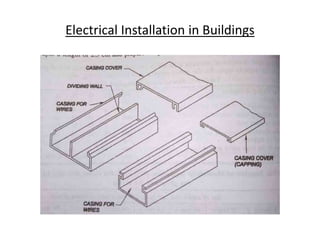
• The casing is made up of a strip of wood with parallel
grooves cut length wise so as to accommodate VIR
cables.
• The grooves were made to separate opposite polarity.
the capping (also made of wood) used to cover the wires
and cables installed and fitted in the casing.
Electrical Installation in Buildings
Buildings & Their types
• Residential- personal houses & home
• Industrial – used for company etc.
• Workshop – used for manufacturing of products
Electrical Installation in Buildings
• End
• Chapter

Electrical Installation in Buildings

  • 1.
    ELECTRICAL INSTALLATION INBUILDINGS PRESENTED BY Ramnath Panwar
  • 2.
    Electrical Installation inBuildings Electrical Wiring: -It is a process of connecting cables and wires to the related devices such as fuse, switches, sockets, lights, fans etc to the main distribution board is a specific structure to the utility pole for continues power supply -It is nothing but the process of combining all the lights, fans, televisions, motors running in our house and arranging the wire properly, and bringing it to the distribution board is known as electrical wiring.
  • 3.
    Electrical Installation inBuildings Methods or types of Electrical Wiring Systems: • Cleat wiring • Wooden casing and capping wiring • CTS or TRS or PVC sheath wiring • Lead sheathed or metal sheathed wiring • Conduit wiring
  • 4.
    Electrical Installation inBuildings There are additional types of conduit wiring according to Pipes installation (Where steel and PVC pipes are used for wiring connection and installation). • Surface or open Conduit type • Concealed or underground type Conduit
  • 5.
    Electrical Installation inBuildings Cleat Wiring: • This system of wiring comprise of ordinary VIR or PVC insulated wires (occasionally, sheathed and weather proof cable) braided and compounded held on walls or ceilings by means of porcelain cleats, Plastic or wood. • Cleat wiring system is a temporary wiring system therefore it is not suitable for domestic premises. The use of cleat wiring system is over nowadays.
  • 6.
    Electrical Installation inBuildings Casing and Capping wiring: • This wiring system was famous wiring system in the past but, it is considered obsolete this days because of Conduit and sheathed wiring system. • The cables used in this kind of wiring were either VIR or PVC or any other approved insulated cables. • The cables were carried through the wooden casing enclosures. • The casing is made up of a strip of wood with parallel grooves cut length wise so as to accommodate VIR cables. • The grooves were made to separate opposite polarity. the capping (also made of wood) used to cover the wires and cables installed and fitted in the casing.
  • 7.
  • 8.
    Electrical Installation inBuildings Buildings & Their types • Residential- personal houses & home • Industrial – used for company etc. • Workshop – used for manufacturing of products
  • 9.
    Electrical Installation inBuildings • End • Chapter