ELECTRICAL SUPPLY &
DISTRIBUTION
Group Assignment (Part 2)
Lee Jin Xuen (0334256) | Kang Ying Hong (0334177) | Gan Lian Wui (0334322) | Hooi Wei Jim (0334764) |
Lim Yi Xin (0335324) | Jordan Lee Dian Liang (0334846)
DIFFERENCE BETWEEN SINGLE & THREE
PHASE SUPPLY
SINGLE PHASE
• Definition:
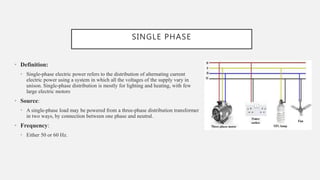
• Single-phase electric power refers to the distribution of alternating current
electric power using a system in which all the voltages of the supply vary in
unison. Single-phase distribution is mostly for lighting and heating, with few
large electric motors
• Source:
• A single-phase load may be powered from a three-phase distribution transformer
in two ways, by connection between one phase and neutral.
• Frequency:
• Either 50 or 60 Hz.
• Definition:
• Three-phase electronic power systems have at least three conductors
carrying alternating current (AC) voltages that are offset in time by
one-third of the period.
• Function:
• It is commonly supplied to industrial area and large houses which
have a lot of electrical appliances. It helps to support and power
high demand of electricity houses or industrial area.
THREE PHASE
DIFFERENCES BETWEEN SINGLE PHASE
& 3-PHASE
Basic For Comparison Single Phase Three Phase
Definition The power supply
through one conductor
The power supply
through three conductor
Voltage 230V 415V
Phase name Split No other name
Power Transfer Capability Minimum Maximum
Power Failure Occurs Do not occur
Efficiency Less High
Application For home appliance In large industries
Source TNB TNB
DIFFERENCES BETWEEN SINGLE PHASE
& 3-PHASE
Basic for
Comparison
Single Phase Three Phase
Wave Shape
Power Supply
Connector
CASE STUDY
Taylors University Lakeside Campus
- Established in 1969
- 250 acres / 1.09e7 sqft
- Building completed in 2010
- Located in Subang Jaya, Selangor,
Malaysia
- Has 5 main building blocks
STAFFS
Mr. Adam
Mr. Pravind Mr. Anthony
MAIN USAGE OF ELECTRICITY IN TULC
• Require constant electricity
• 3 phase electrical main usage for chiller, water pump motor , big
machinery (generator)
• Single phase is for fan , lighting , socket
Water pump motor Lighting
QUESTION 1
Simple building diagram of Single Phase & 3-Phase
Supplies/Wiring
GENERAL DISTRIBUTION
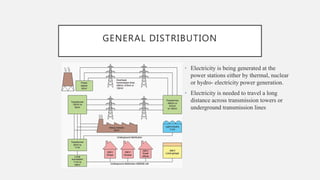
• Electricity is being generated at the
power stations either by thermal, nuclear
or hydro- electricity power generation.
• Electricity is needed to travel a long
distance across transmission towers or
underground transmission lines
SINGLE & THREE PHASE DIAGRAM
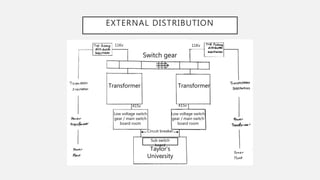
EXTERNAL DISTRIBUTION
Low voltage switch
gear / main switch
board room
Low voltage switch
gear / main switch
board room
Transformer Transformer
Switch gear
Taylor’s
University
Circuit breaker
Sub switch
board
11Kv 11Kv
415v 415v
FLOOR PLAN
Advantages & Disadvantages of a Single Phase & 3-Phase Wiring
QUESTION 2
ADVANTAGES AND DISADVANTAGES OF
SINGLE PHASE SUPPLIES
Advantages Disadvantages
Single phase system is more preferable for
domestic use.
Higher maintenance fee compare to three phase
because more easier to break down.
Simple circuit and low cost results in less
complicated wiring more suited for smaller
buildings.
Needs another winding and a capacitor for
starting
Wiring is cheap and easier to install Carried less power compare to three-phase in
same time
Power delivery is less constant
ADVANTAGES AND DISADVANTAGES OF
3 PHASE SUPPLIES
Advantages Disadvantages
Power delivered is constant. Inconvenience of repairs. Requires
maintenance more frequently.
Three phase induction motors are self starting. Whole unit shut down in case of faulty of one
phase.
Parallel Operation is easy. Greater cost of standby Units.
High efficiency.
Three phase motors have uniform torque.
Three phase motors have higher power factor.
Opinions in terms of costing approach as a Quantity Surveyor
QUESTION 3
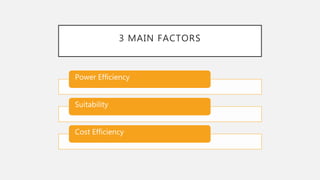
3 MAIN FACTORS
Power Efficiency
Suitability
Cost Efficiency
POWER EFFICIENCY
Single-
phase
Inefficient in factories. Does
not meet minimum load
demand. Circuit will shut
down if it is in a deficiet
More efficient in small
houses. Provides appropriate
power while keeping power
surplus at minimum.
Three-phase
Inefficient for small houses.
Provides much more than
needed which leads to
surplus that is lost.
Efficient in
factories/industries. Able to
provide for high demand of
power.
SUITABILITY
Single
phase
• Would be more suitable in a house no more
than 2 stories tall with few electrical
appliances that requires large amount of
power to operate, e.g. air con.
3-phase
• Is much more suited for large houses that
uses a variety of electrical appliances that
requires large amounts of power.
Comparing suitability of each wiring, single and three phase in a house.
COST EFFICIENCY
While cheaper in
comparison to
Three-Phase, it is
not as cost efficient
to be used where
electricity demand
is high
Single
phase More expensive as
compared to
Single-Phase, but is
much more cost
efficient for large
buildings with high
demand for
electricity
Three
phase
IMAGES TAKEN
Switch gear Transmissio
n tower
Carbon dioxide
cylindrical tank
Fire curtain
Transformer Ammeter and
Multimeter
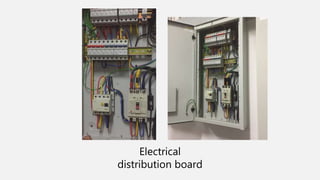
Electrical
distribution board
Rubber matPhase indicating
light
SAFETY PRECAUTION WHEN WORKING WITH
ELECTRICITY
Safety
equipment
(Gloves, Clothes
,Shoes and
Rubber Mat)
When it is necessary to handle equipment that is
plugged in, be sure hands are dry and, when
possible, wear nonconductive gloves, protective
clothes ,shoes with insulated soles and rubber mat.
Disconnecting
the power source
before handling
• If an individual comes in contact with a live
electrical conductor, do not touch the equipment,
cord or person. Disconnect the power source from
the circuit breaker or pull out the plug using a
leather belt.
• It is also a good idea to put up a sign on the
service panel so that nobody turns the main switch
ON by accident or without permission.
Use insulated
tools while
working
• Use only tools and equipment with non-
conducting handles when working on electrical
devices.
• Never use metallic pencils or rulers, or wear rings
or metal watchbands when working with electrical
equipment.
SUMMARY
Differences between
Single and Three phase
wiring
Advantages of the
different wiring
Opinions on factors of
costing affecting choice of
wiring
Names and labels of
various equipments used
for electric distribution
Important safety measures
to be taken when handling
electrical equipment
REFERENCES
• https://electrical-engineering-portal.com/general-principles-of-
electricity-supply-systems
• https://www.google.com/maps/search/tnb+/@3.0599271,101.6019522,1
4z
• https://www.energuide.be/en/questions-answers/what-is-meant-by-
single-phase-or-three-phase-connection/1933/
• https://www.tnb.com.my/

Electrical supply & distribution

  • 1.
    ELECTRICAL SUPPLY & DISTRIBUTION GroupAssignment (Part 2) Lee Jin Xuen (0334256) | Kang Ying Hong (0334177) | Gan Lian Wui (0334322) | Hooi Wei Jim (0334764) | Lim Yi Xin (0335324) | Jordan Lee Dian Liang (0334846)
  • 2.
    DIFFERENCE BETWEEN SINGLE& THREE PHASE SUPPLY
  • 3.
    SINGLE PHASE • Definition: •Single-phase electric power refers to the distribution of alternating current electric power using a system in which all the voltages of the supply vary in unison. Single-phase distribution is mostly for lighting and heating, with few large electric motors • Source: • A single-phase load may be powered from a three-phase distribution transformer in two ways, by connection between one phase and neutral. • Frequency: • Either 50 or 60 Hz.
  • 4.
    • Definition: • Three-phaseelectronic power systems have at least three conductors carrying alternating current (AC) voltages that are offset in time by one-third of the period. • Function: • It is commonly supplied to industrial area and large houses which have a lot of electrical appliances. It helps to support and power high demand of electricity houses or industrial area. THREE PHASE
  • 5.
    DIFFERENCES BETWEEN SINGLEPHASE & 3-PHASE Basic For Comparison Single Phase Three Phase Definition The power supply through one conductor The power supply through three conductor Voltage 230V 415V Phase name Split No other name Power Transfer Capability Minimum Maximum Power Failure Occurs Do not occur Efficiency Less High Application For home appliance In large industries Source TNB TNB
  • 6.
    DIFFERENCES BETWEEN SINGLEPHASE & 3-PHASE Basic for Comparison Single Phase Three Phase Wave Shape Power Supply Connector
  • 7.
    CASE STUDY Taylors UniversityLakeside Campus - Established in 1969 - 250 acres / 1.09e7 sqft - Building completed in 2010 - Located in Subang Jaya, Selangor, Malaysia - Has 5 main building blocks
  • 8.
  • 9.
    MAIN USAGE OFELECTRICITY IN TULC • Require constant electricity • 3 phase electrical main usage for chiller, water pump motor , big machinery (generator) • Single phase is for fan , lighting , socket Water pump motor Lighting
  • 10.
    QUESTION 1 Simple buildingdiagram of Single Phase & 3-Phase Supplies/Wiring
  • 11.
    GENERAL DISTRIBUTION • Electricityis being generated at the power stations either by thermal, nuclear or hydro- electricity power generation. • Electricity is needed to travel a long distance across transmission towers or underground transmission lines
  • 12.
    SINGLE & THREEPHASE DIAGRAM
  • 13.
    EXTERNAL DISTRIBUTION Low voltageswitch gear / main switch board room Low voltage switch gear / main switch board room Transformer Transformer Switch gear Taylor’s University Circuit breaker Sub switch board 11Kv 11Kv 415v 415v
  • 14.
  • 15.
    Advantages & Disadvantagesof a Single Phase & 3-Phase Wiring QUESTION 2
  • 16.
    ADVANTAGES AND DISADVANTAGESOF SINGLE PHASE SUPPLIES Advantages Disadvantages Single phase system is more preferable for domestic use. Higher maintenance fee compare to three phase because more easier to break down. Simple circuit and low cost results in less complicated wiring more suited for smaller buildings. Needs another winding and a capacitor for starting Wiring is cheap and easier to install Carried less power compare to three-phase in same time Power delivery is less constant
  • 17.
    ADVANTAGES AND DISADVANTAGESOF 3 PHASE SUPPLIES Advantages Disadvantages Power delivered is constant. Inconvenience of repairs. Requires maintenance more frequently. Three phase induction motors are self starting. Whole unit shut down in case of faulty of one phase. Parallel Operation is easy. Greater cost of standby Units. High efficiency. Three phase motors have uniform torque. Three phase motors have higher power factor.
  • 18.
    Opinions in termsof costing approach as a Quantity Surveyor QUESTION 3
  • 19.
    3 MAIN FACTORS PowerEfficiency Suitability Cost Efficiency
  • 20.
    POWER EFFICIENCY Single- phase Inefficient infactories. Does not meet minimum load demand. Circuit will shut down if it is in a deficiet More efficient in small houses. Provides appropriate power while keeping power surplus at minimum. Three-phase Inefficient for small houses. Provides much more than needed which leads to surplus that is lost. Efficient in factories/industries. Able to provide for high demand of power.
  • 21.
    SUITABILITY Single phase • Would bemore suitable in a house no more than 2 stories tall with few electrical appliances that requires large amount of power to operate, e.g. air con. 3-phase • Is much more suited for large houses that uses a variety of electrical appliances that requires large amounts of power. Comparing suitability of each wiring, single and three phase in a house.
  • 22.
    COST EFFICIENCY While cheaperin comparison to Three-Phase, it is not as cost efficient to be used where electricity demand is high Single phase More expensive as compared to Single-Phase, but is much more cost efficient for large buildings with high demand for electricity Three phase
  • 23.
  • 24.
  • 25.
  • 26.
  • 27.
  • 28.
  • 29.
    SAFETY PRECAUTION WHENWORKING WITH ELECTRICITY
  • 30.
    Safety equipment (Gloves, Clothes ,Shoes and RubberMat) When it is necessary to handle equipment that is plugged in, be sure hands are dry and, when possible, wear nonconductive gloves, protective clothes ,shoes with insulated soles and rubber mat.
  • 31.
    Disconnecting the power source beforehandling • If an individual comes in contact with a live electrical conductor, do not touch the equipment, cord or person. Disconnect the power source from the circuit breaker or pull out the plug using a leather belt. • It is also a good idea to put up a sign on the service panel so that nobody turns the main switch ON by accident or without permission.
  • 32.
    Use insulated tools while working •Use only tools and equipment with non- conducting handles when working on electrical devices. • Never use metallic pencils or rulers, or wear rings or metal watchbands when working with electrical equipment.
  • 33.
    SUMMARY Differences between Single andThree phase wiring Advantages of the different wiring Opinions on factors of costing affecting choice of wiring Names and labels of various equipments used for electric distribution Important safety measures to be taken when handling electrical equipment
  • 34.
    REFERENCES • https://electrical-engineering-portal.com/general-principles-of- electricity-supply-systems • https://www.google.com/maps/search/tnb+/@3.0599271,101.6019522,1 4z •https://www.energuide.be/en/questions-answers/what-is-meant-by- single-phase-or-three-phase-connection/1933/ • https://www.tnb.com.my/