SUB STATIONS
Introduction
 Sub Stations are important link between
Generating stations and Distribution networks.
 They step down the EHV to HV as per the
requirement of the customers.
 Stability of the system, reliability of power
depends on the type of layout chosen and
components used in the sub stations.
 Hence great care has to be taken to select the
layout and critical equipment for the SS.
~
Transmission line Yard in Receiving
StationOut door yard in Generating Station
Out door yard in
Generating station
Basic Requirements
 Total land area & Ease of extension
 Soil condition & Soil resistivity
 Right of way for incoming and outgoing lines
 Facility to move heavy Equipments
 Load Centre
 System Security
 Operational Flexibility
 Simplicity of protection arrangement
 Ability to limit short circuit levels
 Maintenance
 Cost
Types of layouts
 Single Busbar System
 Single Busbar System sectionalising arrangement
 Double Busbar system
 Single Busbar with ring Bus
 Double Busbar with Transfer Bus
 One and Half Breaker arrangement
 Mesh type arrangement
Standard clearances
VOLTAGE PHASE TO PHASE PHASE TO EARTH
400 KV 4.000 Mtrs 3.50 Mtrs
230 KV 3.350 Mtrs 1.650 Mtrs
110 KV 1.675 Mtrs 1.000 Mtrs
66 KV 1.220 Mtrs 0.750 Mtrs
33 KV 0.915 Mtrs 0.610 Mtrs
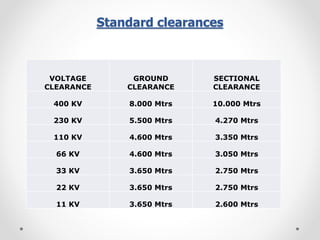
Standard clearances
VOLTAGE
CLEARANCE
GROUND
CLEARANCE
SECTIONAL
CLEARANCE
400 KV 8.000 Mtrs 10.000 Mtrs
230 KV 5.500 Mtrs 4.270 Mtrs
110 KV 4.600 Mtrs 3.350 Mtrs
66 KV 4.600 Mtrs 3.050 Mtrs
33 KV 3.650 Mtrs 2.750 Mtrs
22 KV 3.650 Mtrs 2.750 Mtrs
11 KV 3.650 Mtrs 2.600 Mtrs
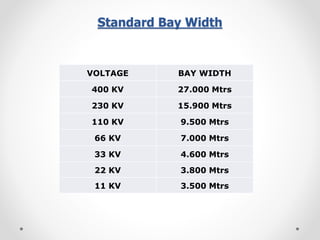
Standard Bay Width
VOLTAGE BAY WIDTH
400 KV 27.000 Mtrs
230 KV 15.900 Mtrs
110 KV 9.500 Mtrs
66 KV 7.000 Mtrs
33 KV 4.600 Mtrs
22 KV 3.800 Mtrs
11 KV 3.500 Mtrs
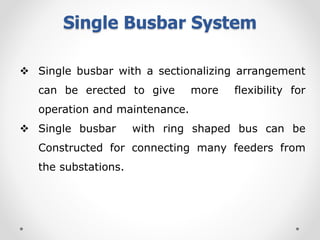
Single Busbar System
 Single busbar with a sectionalizing arrangement
can be erected to give more flexibility for
operation and maintenance.
 Single busbar with ring shaped bus can be
Constructed for connecting many feeders from
the substations.
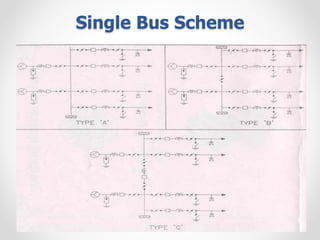
Single Bus Scheme
1
Single Busbar System
 This system consists of a single bus to which
various feeders are connected.
 In case of a fault in bus / maintenance entire
bus bar has to be shut down.
 Provides least flexibility.
 Simple and most economical.
 This type of layout is adopted for Small and
Medium size Substations and Power stations.
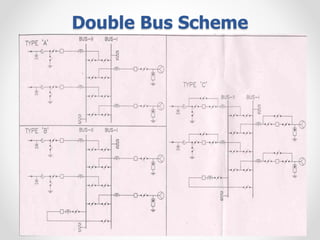
Double Bus Scheme
1
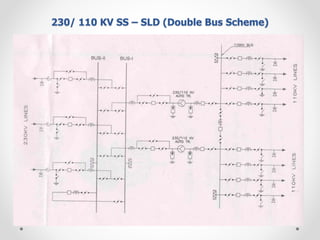
Double Busbar System
 Double Busbar system consists of two buses to which all the
feeders emanating from a substations, are connected by
suitable switching arrangement.
 Provides more flexibility, continuity of supply and periodical
maintenance on the bus is also possible without Total
shutdown.
 In this arrangement the busbars are called Main and Reserve
Busbars.
 A Breaker can be introduced between the buses to have
more operational flexibility.
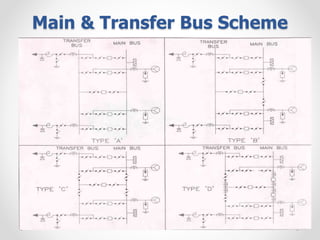
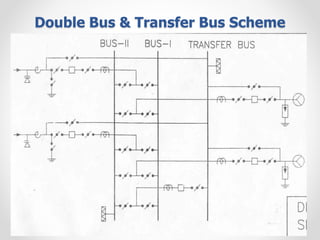
 A double busbar system with a Transfer bus are constructed
to have more reliability and easy maintenance of Equipment.
Main & Transfer Bus Scheme
1
Double Bus & Transfer Bus Scheme
1
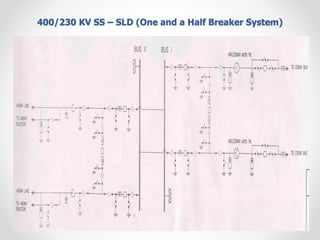
One and a Half Breaker System
1
Double Busbar System
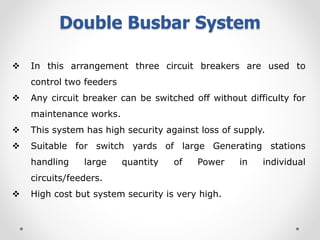
 In this arrangement three circuit breakers are used to
control two feeders
 Any circuit breaker can be switched off without difficulty for
maintenance works.
 This system has high security against loss of supply.
 Suitable for switch yards of large Generating stations
handling large quantity of Power in individual
circuits/feeders.
 High cost but system security is very high.
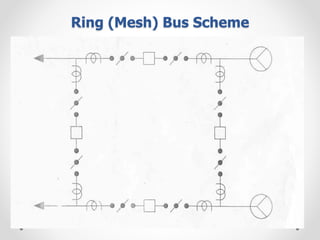
Ring (Mesh) Bus Scheme
1
Ring (Mesh) Bus Scheme
 In this arrangement three circuit breakers are used to
control two feeders
 This type of layout is used to minimize the no of Breakers
used in a Substation.
 The breakers are connected in the mesh formed by the
buses. The circuits are tapped from the node points of the
Mesh.
 Four breakers are utilized to control eight circuits.
 This arrangement is widely used in United Kingdom.
33/11 KV Substation (Regular) - SLD
1
33/11 KV Substation (Regular) - Plan
1
110/22 KV or 110/11 KV Substation - SLD
1
110/22 KV or 110/11 KV Substation - Plan
1
230/ 110 KV Substation – SLD (Single Bus)
1
230/ 110 KV Substation – Plan (Single Bus)
1
230/ 110 KV Substation – Plan (Double Bus)
1
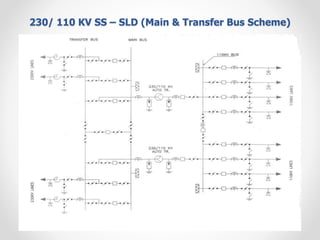
230/ 110 KV SS – SLD (Main & Transfer Bus Scheme)
1
230/ 110 KV SS – Plan (Main & Transfer Bus Scheme)
1
230/ 110 KV SS – SLD (Double Bus Scheme)
1
230/ 110 KV SS – Elevation (Double Bus Scheme)
1
400/230 KV SS – SLD (One and a Half Breaker System)
1
400/230 KV SS – Plan (One and a Half Breaker System)
1
Standard clearances in outdoor sub-stations
1
Main Equipment in Substation
 Power/Auto Transformers,
 Circuit Breakers,
 Instrument Transformers,
 Surge Arresters,
 Control and Relay Panels,
 Station Batteries and Battery Chargers,
 DC and AC Panels,
 Control Cable,
 Isolators with and without Earthing Device,
 Capacitors, Reactors, Busbar materials,
 Insulators, Connecters etc.
Types of SS
 Transformer Substation: Transformer are installed to transform
power from one level to another as per needs.
 Switching Substations: This substation are erected for switching
operation of power lines with out transforming the voltage.
 Power factor correction Substation: This substation installed to
increase the power factor to minimize losses.
 Frequency Changer Substation: This substation installed where
speed controlled of motor required.
 Converting Substation: This substation convert A.C to D.C or vice
versa.
 Industrial Substation: This substation installed for supply power
only to industry.
Types of SS
 Paralleling sub station. The SS where power from
different source of generation are paralleled. Two system
has to get connected (parallel), synchronizing facility
needed .
 Must have reliable Communication with Load dispatcher
and generating stations.
 Double bus with a transfer bus arrangement will be most
ideal type of layout
 Major receiving station : The power handled by the
station is high.
 One and a half breaker layout will be suitable.
 Reliable communication, duplicated protection system,
Spare capacity of Auto transformer , good security in
system are needed.
Generating station layout
 Depends on the Nos of generator in the station.
 Should have a layout which should not affect generation even one unit
is shut down
 Double bus with transfer bus is most suitable. However a single bus
scheme with two feeders can be considered for a station with single
generating unit
 Should have reliable communication with Load dispatcher and
receiving station.
 Located adjacent to the power house.
 Indoor / outdoor AISS or GISS are generally considered suitable
for major generating stations.
 In under ground power generating stations transformer yard is
located near the generators and the EHV is taken thru EHV cables to
the outdoor yard.
Main Equipment in Substation
Selection of right type of Layout, Equipments
of adequate ratings and correct Protection
system will make the Power system Safe,
Secure and also give operational Flexibility.
1.substation  layouts

1.substation layouts

  • 1.
  • 2.
    Introduction  Sub Stationsare important link between Generating stations and Distribution networks.  They step down the EHV to HV as per the requirement of the customers.  Stability of the system, reliability of power depends on the type of layout chosen and components used in the sub stations.  Hence great care has to be taken to select the layout and critical equipment for the SS.
  • 3.
    ~ Transmission line Yardin Receiving StationOut door yard in Generating Station Out door yard in Generating station
  • 4.
    Basic Requirements  Totalland area & Ease of extension  Soil condition & Soil resistivity  Right of way for incoming and outgoing lines  Facility to move heavy Equipments  Load Centre  System Security  Operational Flexibility  Simplicity of protection arrangement  Ability to limit short circuit levels  Maintenance  Cost
  • 5.
    Types of layouts Single Busbar System  Single Busbar System sectionalising arrangement  Double Busbar system  Single Busbar with ring Bus  Double Busbar with Transfer Bus  One and Half Breaker arrangement  Mesh type arrangement
  • 6.
    Standard clearances VOLTAGE PHASETO PHASE PHASE TO EARTH 400 KV 4.000 Mtrs 3.50 Mtrs 230 KV 3.350 Mtrs 1.650 Mtrs 110 KV 1.675 Mtrs 1.000 Mtrs 66 KV 1.220 Mtrs 0.750 Mtrs 33 KV 0.915 Mtrs 0.610 Mtrs
  • 7.
    Standard clearances VOLTAGE CLEARANCE GROUND CLEARANCE SECTIONAL CLEARANCE 400 KV8.000 Mtrs 10.000 Mtrs 230 KV 5.500 Mtrs 4.270 Mtrs 110 KV 4.600 Mtrs 3.350 Mtrs 66 KV 4.600 Mtrs 3.050 Mtrs 33 KV 3.650 Mtrs 2.750 Mtrs 22 KV 3.650 Mtrs 2.750 Mtrs 11 KV 3.650 Mtrs 2.600 Mtrs
  • 8.
    Standard Bay Width VOLTAGEBAY WIDTH 400 KV 27.000 Mtrs 230 KV 15.900 Mtrs 110 KV 9.500 Mtrs 66 KV 7.000 Mtrs 33 KV 4.600 Mtrs 22 KV 3.800 Mtrs 11 KV 3.500 Mtrs
  • 9.
    Single Busbar System Single busbar with a sectionalizing arrangement can be erected to give more flexibility for operation and maintenance.  Single busbar with ring shaped bus can be Constructed for connecting many feeders from the substations.
  • 10.
  • 11.
    Single Busbar System This system consists of a single bus to which various feeders are connected.  In case of a fault in bus / maintenance entire bus bar has to be shut down.  Provides least flexibility.  Simple and most economical.  This type of layout is adopted for Small and Medium size Substations and Power stations.
  • 12.
  • 13.
    Double Busbar System Double Busbar system consists of two buses to which all the feeders emanating from a substations, are connected by suitable switching arrangement.  Provides more flexibility, continuity of supply and periodical maintenance on the bus is also possible without Total shutdown.  In this arrangement the busbars are called Main and Reserve Busbars.  A Breaker can be introduced between the buses to have more operational flexibility.  A double busbar system with a Transfer bus are constructed to have more reliability and easy maintenance of Equipment.
  • 14.
    Main & TransferBus Scheme 1
  • 15.
    Double Bus &Transfer Bus Scheme 1
  • 16.
    One and aHalf Breaker System 1
  • 17.
    Double Busbar System In this arrangement three circuit breakers are used to control two feeders  Any circuit breaker can be switched off without difficulty for maintenance works.  This system has high security against loss of supply.  Suitable for switch yards of large Generating stations handling large quantity of Power in individual circuits/feeders.  High cost but system security is very high.
  • 18.
  • 19.
    Ring (Mesh) BusScheme  In this arrangement three circuit breakers are used to control two feeders  This type of layout is used to minimize the no of Breakers used in a Substation.  The breakers are connected in the mesh formed by the buses. The circuits are tapped from the node points of the Mesh.  Four breakers are utilized to control eight circuits.  This arrangement is widely used in United Kingdom.
  • 20.
    33/11 KV Substation(Regular) - SLD 1
  • 21.
    33/11 KV Substation(Regular) - Plan 1
  • 22.
    110/22 KV or110/11 KV Substation - SLD 1
  • 23.
    110/22 KV or110/11 KV Substation - Plan 1
  • 24.
    230/ 110 KVSubstation – SLD (Single Bus) 1
  • 25.
    230/ 110 KVSubstation – Plan (Single Bus) 1
  • 26.
    230/ 110 KVSubstation – Plan (Double Bus) 1
  • 27.
    230/ 110 KVSS – SLD (Main & Transfer Bus Scheme) 1
  • 28.
    230/ 110 KVSS – Plan (Main & Transfer Bus Scheme) 1
  • 29.
    230/ 110 KVSS – SLD (Double Bus Scheme) 1
  • 30.
    230/ 110 KVSS – Elevation (Double Bus Scheme) 1
  • 31.
    400/230 KV SS– SLD (One and a Half Breaker System) 1
  • 32.
    400/230 KV SS– Plan (One and a Half Breaker System) 1
  • 33.
    Standard clearances inoutdoor sub-stations 1
  • 34.
    Main Equipment inSubstation  Power/Auto Transformers,  Circuit Breakers,  Instrument Transformers,  Surge Arresters,  Control and Relay Panels,  Station Batteries and Battery Chargers,  DC and AC Panels,  Control Cable,  Isolators with and without Earthing Device,  Capacitors, Reactors, Busbar materials,  Insulators, Connecters etc.
  • 35.
    Types of SS Transformer Substation: Transformer are installed to transform power from one level to another as per needs.  Switching Substations: This substation are erected for switching operation of power lines with out transforming the voltage.  Power factor correction Substation: This substation installed to increase the power factor to minimize losses.  Frequency Changer Substation: This substation installed where speed controlled of motor required.  Converting Substation: This substation convert A.C to D.C or vice versa.  Industrial Substation: This substation installed for supply power only to industry.
  • 36.
    Types of SS Paralleling sub station. The SS where power from different source of generation are paralleled. Two system has to get connected (parallel), synchronizing facility needed .  Must have reliable Communication with Load dispatcher and generating stations.  Double bus with a transfer bus arrangement will be most ideal type of layout  Major receiving station : The power handled by the station is high.  One and a half breaker layout will be suitable.  Reliable communication, duplicated protection system, Spare capacity of Auto transformer , good security in system are needed.
  • 37.
    Generating station layout Depends on the Nos of generator in the station.  Should have a layout which should not affect generation even one unit is shut down  Double bus with transfer bus is most suitable. However a single bus scheme with two feeders can be considered for a station with single generating unit  Should have reliable communication with Load dispatcher and receiving station.  Located adjacent to the power house.  Indoor / outdoor AISS or GISS are generally considered suitable for major generating stations.  In under ground power generating stations transformer yard is located near the generators and the EHV is taken thru EHV cables to the outdoor yard.
  • 38.
    Main Equipment inSubstation Selection of right type of Layout, Equipments of adequate ratings and correct Protection system will make the Power system Safe, Secure and also give operational Flexibility.