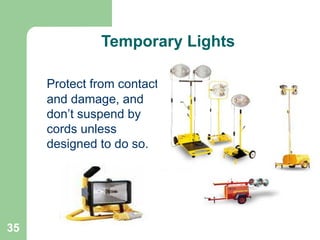
2
Electricity - TheDangers
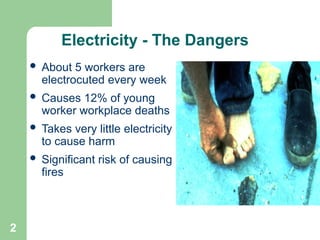
About 5 workers are
electrocuted every week
Causes 12% of young
worker workplace deaths
Takes very little electricity
to cause harm
Significant risk of causing
fires
3.
3
Electricity – Howit Works
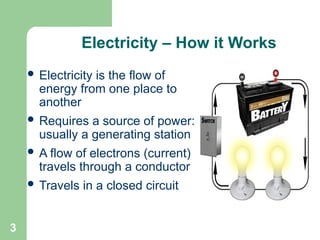
Electricity is the flow of
energy from one place to
another
Requires a source of power:
usually a generating station
A flow of electrons (current)
travels through a conductor
Travels in a closed circuit
4.
4
Electrical Terms
Current-- electrical movement (measured in amps)
Circuit -- complete path of the current. Includes
electricity source, a conductor, and the output device or load (such
as a lamp, tool, or heater)
Resistance -- restriction to electrical flow
Conductors – substances, like metals, with little resistance to
electricity that allow electricity to flow
Grounding – a conductive connection to the earth which acts as a
protective measure
Insulators -- substances with high resistance to electricity like
glass, porcelain, plastic, and dry wood that prevent electricity from
getting to unwanted areas
5.
5
Electrical Injuries
There arefour main types of electrical injuries:
Direct:
1. Electrocution or death due to electrical
shock
2. Electrical shock
3. Burns
Indirect:
4. Falls
6.
6
Electrical Shock
An electricalshock is received when electrical
current passes through the body.
You will get an electrical shock if a part of your
body completes an electrical circuit by…
Touching a live wire and an electrical ground, or
Touching a live wire and another wire at a
different voltage.
7.
7
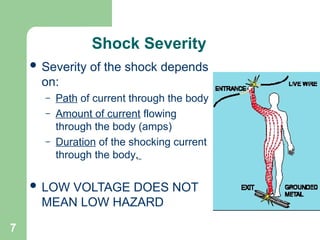
Shock Severity
Severityof the shock depends
on:
– Path of current through the body
– Amount of current flowing
through the body (amps)
– Duration of the shocking current
through the body,
LOW VOLTAGE DOES NOT
MEAN LOW HAZARD
8.
8
Dangers of ElectricalShock
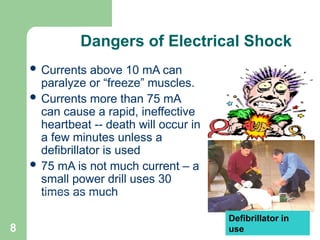
Currents above 10 mA can
paralyze or “freeze” muscles.
Currents more than 75 mA
can cause a rapid, ineffective
heartbeat -- death will occur in
a few minutes unless a
defibrillator is used
75 mA is not much current – a
small power drill uses 30
times as much
Defibrillator in
use
9.
9
Effects of ElectricalShock
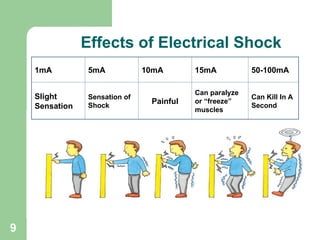
1mA 5mA 10mA 15mA 50-100mA
Slight
Sensation
Sensation of
Shock
Painful
Can paralyze
or “freeze”
muscles
Can Kill In A
Second
10.
10
Burns
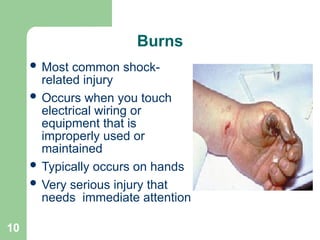
Most commonshock-
related injury
Occurs when you touch
electrical wiring or
equipment that is
improperly used or
maintained
Typically occurs on hands
Very serious injury that
needs immediate attention
11.
11
Falls
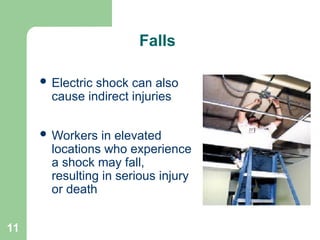
Electric shockcan also
cause indirect injuries
Workers in elevated
locations who experience
a shock may fall,
resulting in serious injury
or death
12.
12
Electrical Hazards andHow to
Control Them
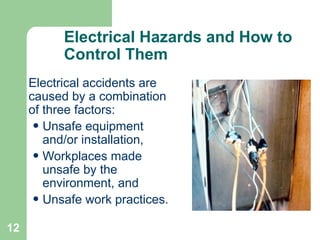
Electrical accidents are
caused by a combination
of three factors:
• Unsafe equipment
and/or installation,
• Workplaces made
unsafe by the
environment, and
• Unsafe work practices.
13.
13
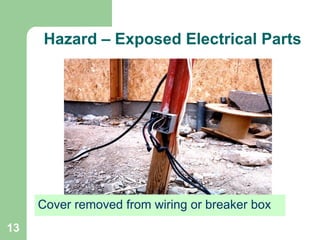
Hazard – ExposedElectrical Parts
Cover removed from wiring or breaker box
14.
14
Control – IsolateElectrical Parts
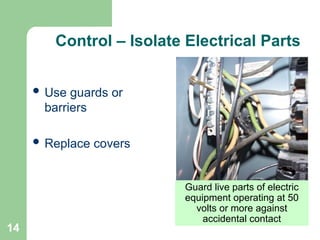
Use guards or
barriers
Replace covers
Guard live parts of electric
equipment operating at 50
volts or more against
accidental contact
15.
15
Control – IsolateElectrical Parts
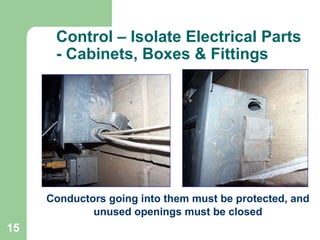
- Cabinets, Boxes & Fittings
Conductors going into them must be protected, and
unused openings must be closed
16.
16
Control – CloseOpenings
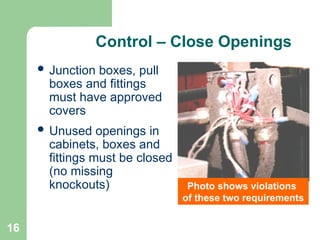
Junction boxes, pull
boxes and fittings
must have approved
covers
Unused openings in
cabinets, boxes and
fittings must be closed
(no missing
knockouts) Photo shows violations
of these two requirements
17.
17
Hazard - OverheadPower Lines
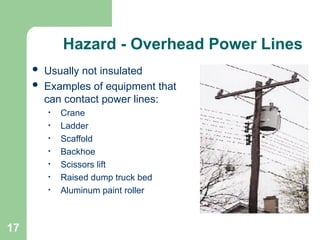
Usually not insulated
Examples of equipment that
can contact power lines:
• Crane
• Ladder
• Scaffold
• Backhoe
• Scissors lift
• Raised dump truck bed
• Aluminum paint roller
18.
18
Control - OverheadPower Lines
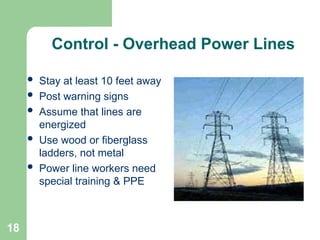
Stay at least 10 feet away
Post warning signs
Assume that lines are
energized
Use wood or fiberglass
ladders, not metal
Power line workers need
special training & PPE
19.
19
Hazard - InadequateWiring
Hazard - wire too small for the
current
Example - portable tool with an
extension cord that has a wire too
small for the tool
• The tool will draw more current than
the cord can handle, causing
overheating and a possible fire
without tripping the circuit breaker
• The circuit breaker could be the right
size for the circuit but not for the
smaller-wire extension cord
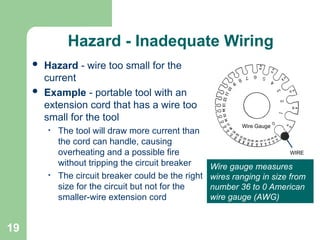
Wire Gauge
WIRE
Wire gauge measures
wires ranging in size from
number 36 to 0 American
wire gauge (AWG)
20.
20
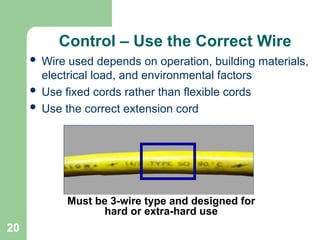
Control – Usethe Correct Wire
Wire used depends on operation, building materials,
electrical load, and environmental factors
Use fixed cords rather than flexible cords
Use the correct extension cord
Must be 3-wire type and designed for
hard or extra-hard use
21.
21
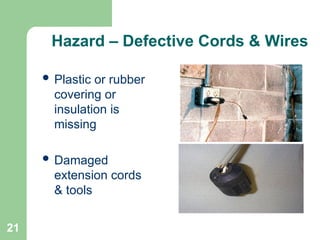
Hazard – DefectiveCords & Wires
Plastic or rubber
covering or
insulation is
missing
Damaged
extension cords
& tools
22.
22
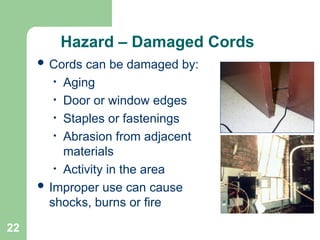
Hazard – DamagedCords
Cords can be damaged by:
• Aging
• Door or window edges
• Staples or fastenings
• Abrasion from adjacent
materials
• Activity in the area
Improper use can cause
shocks, burns or fire
23.
23
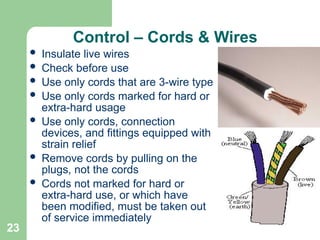
Control – Cords& Wires
Insulate live wires
Check before use
Use only cords that are 3-wire type
Use only cords marked for hard or
extra-hard usage
Use only cords, connection
devices, and fittings equipped with
strain relief
Remove cords by pulling on the
plugs, not the cords
Cords not marked for hard or
extra-hard use, or which have
been modified, must be taken out
of service immediately
24.
24
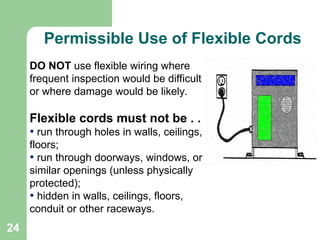
Permissible Use ofFlexible Cords
DO NOT use flexible wiring where
frequent inspection would be difficult
or where damage would be likely.
Flexible cords must not be . . .
• run through holes in walls, ceilings, or
floors;
• run through doorways, windows, or
similar openings (unless physically
protected);
• hidden in walls, ceilings, floors,
conduit or other raceways.
25.
25
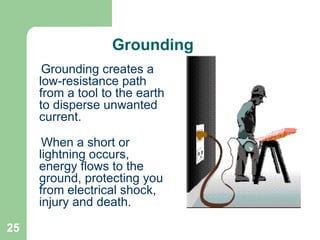
Grounding
Grounding creates a
low-resistancepath
from a tool to the earth
to disperse unwanted
current.
When a short or
lightning occurs,
energy flows to the
ground, protecting you
from electrical shock,
injury and death.
26.
26
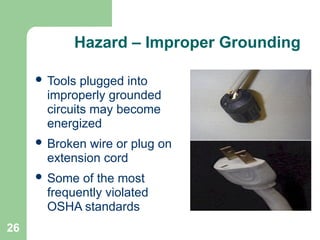
Hazard – ImproperGrounding
Tools plugged into
improperly grounded
circuits may become
energized
Broken wire or plug on
extension cord
Some of the most
frequently violated
OSHA standards
27.
27
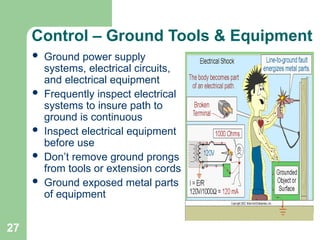
Control – GroundTools & Equipment
Ground power supply
systems, electrical circuits,
and electrical equipment
Frequently inspect electrical
systems to insure path to
ground is continuous
Inspect electrical equipment
before use
Don’t remove ground prongs
from tools or extension cords
Ground exposed metal parts
of equipment
28.
28
Control – UseGFCI (ground-fault
circuit interrupter)
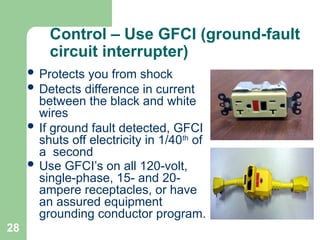
Protects you from shock
Detects difference in current
between the black and white
wires
If ground fault detected, GFCI
shuts off electricity in 1/40th
of
a second
Use GFCI’s on all 120-volt,
single-phase, 15- and 20-
ampere receptacles, or have
an assured equipment
grounding conductor program.
29.
29
Control - AssuredEquipment
Grounding Conductor Program
Program must cover:
• All cord sets
• Receptacles not part of a building or structure
• Equipment connected by plug and cord
Program requirements include:
• Specific procedures adopted by the employer
• Competent person to implement the program
• Visual inspection for damage of equipment connected
by cord and plug
30.
30
Hazard – OverloadedCircuits
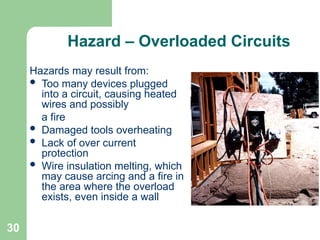
Hazards may result from:
Too many devices plugged
into a circuit, causing heated
wires and possibly
a fire
Damaged tools overheating
Lack of over current
protection
Wire insulation melting, which
may cause arcing and a fire in
the area where the overload
exists, even inside a wall
31.
31
Control - ElectricalProtective
Devices
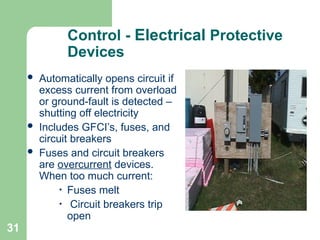
Automatically opens circuit if
excess current from overload
or ground-fault is detected –
shutting off electricity
Includes GFCI’s, fuses, and
circuit breakers
Fuses and circuit breakers
are overcurrent devices.
When too much current:
• Fuses melt
• Circuit breakers trip
open
32.
32
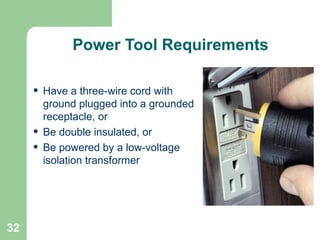
Power Tool Requirements
•Have a three-wire cord with
ground plugged into a grounded
receptacle, or
• Be double insulated, or
• Be powered by a low-voltage
isolation transformer
33.
33
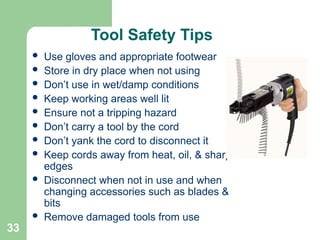
Tool Safety Tips
Use gloves and appropriate footwear
Store in dry place when not using
Don’t use in wet/damp conditions
Keep working areas well lit
Ensure not a tripping hazard
Don’t carry a tool by the cord
Don’t yank the cord to disconnect it
Keep cords away from heat, oil, & sharp
edges
Disconnect when not in use and when
changing accessories such as blades &
bits
Remove damaged tools from use
34.
34
Preventing Electrical Hazards- Tools
Inspect tools before
use
Use the right tool
correctly
Protect your tools
Use double insulated
tools
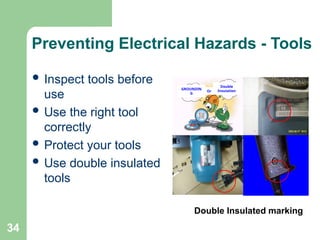
Double Insulated marking
GROUNDIN
G
Double
Insulation
Or
36
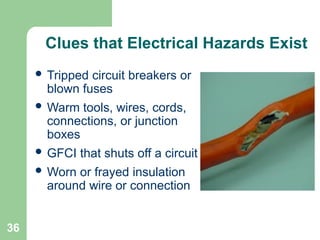
Clues that ElectricalHazards Exist
Tripped circuit breakers or
blown fuses
Warm tools, wires, cords,
connections, or junction
boxes
GFCI that shuts off a circuit
Worn or frayed insulation
around wire or connection
37.
37
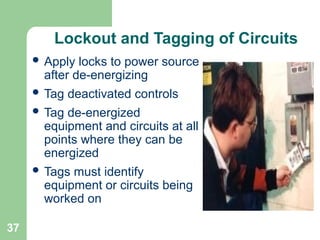
Lockout and Taggingof Circuits
Apply locks to power source
after de-energizing
Tag deactivated controls
Tag de-energized
equipment and circuits at all
points where they can be
energized
Tags must identify
equipment or circuits being
worked on
38.
38
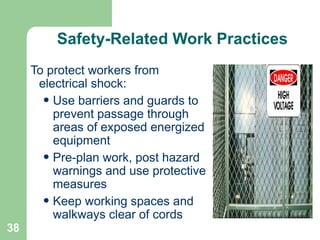
Safety-Related Work Practices
Toprotect workers from
electrical shock:
• Use barriers and guards to
prevent passage through
areas of exposed energized
equipment
• Pre-plan work, post hazard
warnings and use protective
measures
• Keep working spaces and
walkways clear of cords
39.
39
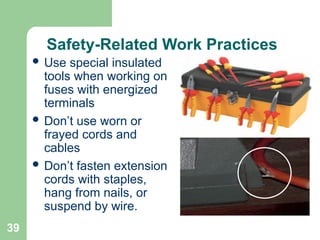
Safety-Related Work Practices
Use special insulated
tools when working on
fuses with energized
terminals
Don’t use worn or
frayed cords and
cables
Don’t fasten extension
cords with staples,
hang from nails, or
suspend by wire.
40.
40
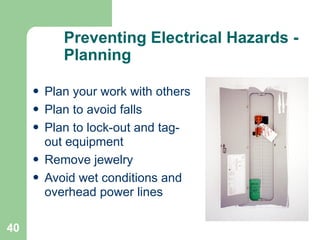
Preventing Electrical Hazards-
Planning
• Plan your work with others
• Plan to avoid falls
• Plan to lock-out and tag-
out equipment
• Remove jewelry
• Avoid wet conditions and
overhead power lines
41.
41
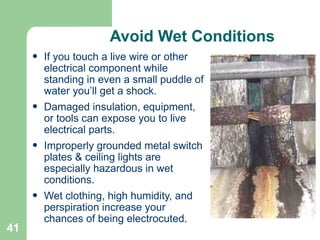
Avoid Wet Conditions
•If you touch a live wire or other
electrical component while
standing in even a small puddle of
water you’ll get a shock.
• Damaged insulation, equipment,
or tools can expose you to live
electrical parts.
• Improperly grounded metal switch
plates & ceiling lights are
especially hazardous in wet
conditions.
• Wet clothing, high humidity, and
perspiration increase your
chances of being electrocuted.
42.
42
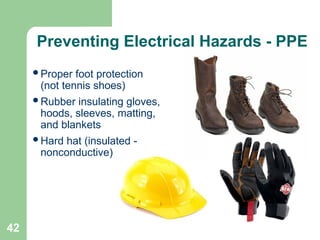
Preventing Electrical Hazards- PPE
Proper foot protection
(not tennis shoes)
Rubber insulating gloves,
hoods, sleeves, matting,
and blankets
Hard hat (insulated -
nonconductive)
43.
43
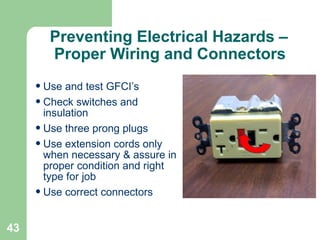
Preventing Electrical Hazards–
Proper Wiring and Connectors
•Use and test GFCI’s
•Check switches and
insulation
•Use three prong plugs
•Use extension cords only
when necessary & assure in
proper condition and right
type for job
•Use correct connectors
44.
44
Training
De-energize electricequipment before
inspecting or repairing
Using cords, cables, and electric tools that
are in good repair
Lockout / Tagout recognition and procedures
Use appropriate protective equipment
Train employees working with electric
equipment in safe work practices, including:
45.
45
Summary – Hazards& Protections
Hazards
Inadequate wiring
Exposed electrical parts
Wires with bad insulation
Ungrounded electrical systems
and tools
Overloaded circuits
Damaged power tools and
equipment
Using the wrong PPE and tools
Overhead powerlines
All hazards are made worse in
wet conditions
Protective Measures
Proper grounding
Use GFCI
Use fuses and circuit
breakers
Guard live parts
Lockout/Tagout
Proper use of flexible
cords
Close electric panels
Training
46.
46
Summary
Electrical equipment mustbe:
• Listed and labeled
• Free from hazards
• Used in the proper manner
If you use electrical tools you must be:
• Protected from electrical shock
• Provided necessary safety equipment