Battery Maintenance 
Solutions for Critical Facilities 
Meeting Regulatory Requirements and Observing Best Practices 
Click a section below 
Executive Summary 
IEEE Guidelines 
Keeping the Nation’s 
Lights On 
NERC Standard 
PRC-005-2 — Protection 
System Maintenance 
Recommended Best Practices 
Conclusion 
EmersonNetworkPower.com
In the previous Emerson Network Power’s eBook entitled “Battery Maintenance Solutions for Critical Facilities,” 
we highlighted the causes of downtime including the misunderstanding of battery lifespan. Additionally, we 
delved into the high costs—both direct and indirect—associated with UPS battery failure that leads to unplanned 
downtime. To help avoid this downtime, we shared that critical facility managers need to fully understand the true 
service life of batteries and then work to implement a proper preventive maintenance program. 
In this ebook, we will look at consensus recommendations for preventive maintenance including industry 
standards from the Institute of Electrical and Electronics Engineers (IEEE) and regulatory requirements specific to 
utilities as stipulated by the North American Electric Reliability Corporation (NERC). 
As these standards and regulations outline minimum maintenance activities, we will also share how many critical 
facilities can and should go beyond these minimums for additional system protection and added peace of mind. 
Emerson Network Power | Battery Maintenance Solutions for Critical Facilities 
PG 2 
Executive Summary 
IEEE Guidelines 
Keeping the Nation’s 
Lights On 
NERC Standard 
PRC-005-2 — Protection 
System Maintenance 
Recommended Best Practices 
Conclusion 
Executive Summary 
EmersonNetworkPower.com
As the leading developer of industry standards in a broad range of technologies, IEEE has the most well known standards 
regarding UPS battery maintenance practices including inspections and capacity testing. In fact, battery manufacturers 
often cite the standards and require adherence in order to maintain a valid product warranty. 
Whether a data center, industrial facility or utility, Emerson encourages adherence to the following standards based on 
the type of battery being serviced: 
„„ IEEE 450 for vented lead-acid (VLA) 
„„ IEEE 1188 for valve-regulated lead-acid (VRLA) 
„„ IEEE 1106 for nickel-cadmium (NiCad) 
All of these standards provide recommended practices for maintenance, testing and replacement of batteries for 
stationary applications. They address the frequency and type of measurements that need to be taken to validate the 
condition of the battery. 
Emerson Network Power | Battery Maintenance Solutions for Critical Facilities 
PG 3 
Executive Summary 
IEEE Guidelines 
Keeping the Nation’s 
Lights On 
NERC Standard 
PRC-005-2 — Protection 
System Maintenance 
Recommended Best Practices 
Conclusion 
IEEE Guidelines 
EmersonNetworkPower.com
Inspections 
The measurements needed such as string/cell voltage or battery float charging current are outlined based on monthly, quarterly 
and annual inspections. The more frequent the inspection or testing intervals, the better. Gathering data on a more regular basis 
can be very helpful for trending battery performance and ultimately extending the useful life of these critical assets. 
Capacity Tests 
Recommendations for capacity testing of VLA and VRLA batteries are very similar. Both should be tested at installation, during 
periodic intervals (no greater than 25% of the expected service life), and annually when the battery shows signs of degradation or 
has reached 85% of the expected service life. However, VLA batteries should have a capacity/discharge test within the first two years 
of service, and VRLA batteries should be tested when internal ohmic values have changed significantly between readings or physical 
changes have occurred. For these two battery groups, degradation is indicated when the battery capacity drops more than 10% 
from its capacity on the previous capacity test or is below 90% of the manufacturer’s rating. 
For NiCad batteries, capacity/discharge testing should be done within the first two years of service, at five-year intervals until the 
battery shows signs of excessive capacity loss, and annually at excessive capacity loss. 
Battery Replacement 
Both IEEE 450 and 1188 recommend replacing the battery if its capacity is below 80% of the manufacturer’s rating. Maximum time 
for replacement is one year. Physical characteristics such as plate condition or abnormally high cell temperatures are often indicators 
for complete battery or individual cell replacements. 
Emerson Network Power | Battery Maintenance Solutions for Critical Facilities 
PG 4 
Executive Summary 
IEEE Guidelines 
Keeping the Nation’s 
Lights On 
NERC Standard 
PRC-005-2 — Protection 
System Maintenance 
Recommended Best Practices 
Conclusion 
IEEE Guidelines 
EmersonNetworkPower.com 
< Back to Top of Article
Keeping the 
Nation’s Lights On 
Emerson Network Power | Battery Maintenance Solutions for Critical Facilities 
Executive Summary 
IEEE Guidelines 
Keeping the Nation’s 
Lights On 
NERC Standard 
PRC-005-2 — Protection 
System Maintenance 
Recommended Best Practices 
Conclusion 
EmersonNetworkPower.com 
PG 5 
The National Electric Reliability Corporation (NERC) recently revised its 
standard PRC-005 to PRC-005-2, which went into effect in 2013. The 
revised standard applies to electric utilities, including all electric utility 
functional entities, including substations and power generating plants. 
It mandates certain minimum maintenance requirements for batteries 
that support equipment connected to the Bulk Electric System (BES)—the 
electrical grid responsible for power across large regions of the United 
States—within a certain amount of time. 
PRC-005, and therefore PRC-005-2, exists because of the major blackout 
on August 14, 2003, in which more than 50 million people lost power. An 
aging electrical grid, technology issues and trees impinging on electrical 
lines created a perfect storm that led to a cascading series of outages 
from New York to Ohio and up into Ontario, Canada. Soon afterward, 
NERC was established to create standards that would ensure total 
reliability of the BES.
NERC Standard PRC-005-2 — 
Protection System Maintenance 
Emerson Network Power | Battery Maintenance Solutions for Critical Facilities 
Executive Summary 
IEEE Guidelines 
Keeping the Nation’s 
Lights On 
NERC Standard 
PRC-005-2 — Protection 
System Maintenance 
Recommended Best Practices 
Conclusion 
EmersonNetworkPower.com 
PG 6 
PRC-005-2 comprises regulations that require the electric utility backup battery “perform as manufactured.” There is some 
controversy, however, about PRC-005-02, because it mandates only the minimum required maintenance be performed, and 
might result in batteries backing up the BES being less reliable. The PRC-005-2 standard does recommend service technicians 
use the best-practice battery maintenance procedures published by IEEE. 
Additionally, the standard allows ohmic testing, which measures the internal qualities of a battery cell on VRLA and VLA 
batteries, in lieu of performance tests as long as the user can verify that the station battery can perform as manufactured. 
Battery manufacturers and other experts in the industry don’t agree that ohmic testing meets this requirement. In fact, a 
study by the Electric Power Research Institute concluded that internal ohmic measurements can provide insight into internal 
degradation, but ohmic measurements alone “do not necessarily provide absolute verification of a battery’s capacity; only a 
battery capacity test can determine the total battery capacity.” If the assumption is true that there is widespread use of the 
faster, less expensive ohmic measurements, this also raises concerns that utility companies can follow PRC-005-2 and still not 
have a reliable battery backup. 
The PRC-005-2 standard for protection system maintenance combines the following older standards: 
„„ PRC-005-1 – Transmission and Generation Protection System Maintenance and Testing 
„„ PRC-008-1 – Underfrequency Load Shedding Equipment Maintenance 
„„ PRC-011-1 – Undervoltage Load Shedding Equipment Maintenance and Testing 
„„ PRC-017-1 – Special Protection System Maintenance and Testing
NERC Standard PRC-005-2 — 
Protection System Maintenance 
Emerson Network Power | Battery Maintenance Solutions for Critical Facilities 
Executive Summary 
IEEE Guidelines 
Keeping the Nation’s 
Lights On 
NERC Standard 
PRC-005-2 — Protection 
System Maintenance 
Recommended Best Practices 
Conclusion 
EmersonNetworkPower.com 
PG 7 
Section 1-4 of the new standard covers the requirements for 
stationary (stand-by/backup) battery maintenance and testing. The 
PRC-005-2 standard requires time-based maintenance for stationary 
batteries. This means that protection systems are maintained or 
verified according to a defined time schedule. 
Tables 1-4(a), (b) and (c) cover the requirements for protection 
system station direct current (DC) supply using VLA, VRLA or 
NiCad batteries. The following tables show the system component; 
maintenance activities for each type of battery; and the 
maximum amount of time before the battery should undergo 
maintenance again.
NERC Standard PRC-005-2 — 
Protection System Maintenance 
Emerson Network Power | Battery Maintenance Solutions for Critical Facilities 
Executive Summary 
IEEE Guidelines 
Keeping the Nation’s 
Lights On 
NERC Standard 
PRC-005-2 — Protection 
System Maintenance 
Recommended Best Practices 
Conclusion 
EmersonNetworkPower.com 
PG 8 
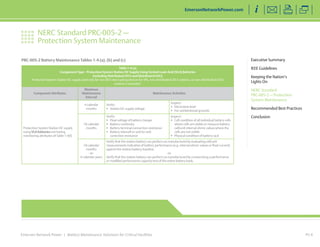
PRC-005-2 Battery Maintenance Tables 1-4 (a), (b) and (c) 
Table 1-4 (a) 
Component Type - Protection System Station DC Supply Using Vented Lead-Acid (VLA) Batteries 
Excluding Distributed UFLS and Distributed UVLS 
Protection System Station DC supply used only for non-BES interrupting devices for SPS, non-distributed UFLS systems, or non-distributed UVLS 
systems is excluded. 
Component Attributes 
Maximun 
Maintenance 
Interval 
Maintenance Activities 
Protection System Station DC supply 
using VLA batteries not having 
monitoring attributes of Table 1-4(f) 
4 calendar 
months 
Verify: 
ƒƒ Station DC supply voltage 
Inspect: 
ƒƒ Electrolyte level 
ƒƒ For unintentional grounds 
18 calendar 
months 
Verify: 
ƒƒ Float voltage of battery charger 
ƒƒ Battery continuity 
ƒƒ Battery terminal connection resistance 
ƒƒ Battery intercell or unit-to-unit 
conection resistance 
Inspect: 
ƒƒ Cell condition of all individual battery cells 
where cells are visible or measure battery 
cell/unit internal ohmic values where the 
cells are not visible 
ƒƒ Physical condition of battery rack 
18 calendar 
months 
-or- 
6 calendar years 
Verify that the station battery can perform as manufactured by evaluating cell/unit 
measurements indicative of battery performance (e.g. internal ohmic values or float current) 
against the station battery baseline. 
-or- 
Verify that the station battery can perform as manufactured by conductiong a performance 
or modified performance capacity test of the entire battery bank.
NERC Standard PRC-005-2 — 
Protection System Maintenance 
Emerson Network Power | Battery Maintenance Solutions for Critical Facilities 
Executive Summary 
IEEE Guidelines 
Keeping the Nation’s 
Lights On 
NERC Standard 
PRC-005-2 — Protection 
System Maintenance 
Recommended Best Practices 
Conclusion 
EmersonNetworkPower.com 
PG 9 
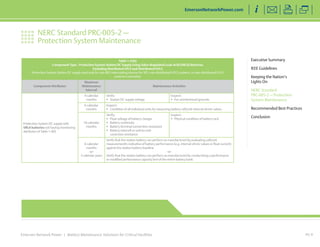
Table 1-4 (b) 
Component Type - Protection System Station DC Supply Using Valve-Regulated Lead-Acid (VRLA) Batteries 
Excluding Distributed UFLS and Distributed UVLS 
Protection System Station DC supply used only for non-BES interrupting devices for SPS, non-distributed UFLS systems, or non-distributed UVLS 
systems is excluded. 
Component Attributes 
Maximun 
Maintenance 
Interval 
Maintenance Activities 
Protection System DC supply with 
VRLA batteries not having monitoring 
attributes of Table 1-4(f) 
4 calendar 
months 
Verify: 
ƒƒ Station DC supply voltage 
Inspect: 
ƒƒ For unintentional grounds 
6 calendar 
months 
Inspect: 
ƒƒ Condition of all individual units by measuring battery cell/unit internal ohmic values 
18 calendar 
months 
Verify: 
ƒƒ Float voltage of battery charger 
ƒƒ Battery continuity 
ƒƒ Battery terminal connection resistance 
ƒƒ Battery intercell or unit-to-unit 
conection resistance 
Inspect: 
ƒƒ Physical condition of battery rack 
6 calendar 
months 
-or- 
3 calendar years 
Verify that the station battery can perform as manufactured by evaluating cell/unit 
measurementts indicative of battery performance (e.g. internal ohmic values or float current) 
against the station battery baseline. 
-or- 
Verify that the station battery can perform as manufactured by conductiong a performance 
or modified performance capacity test of the entire battery bank.
NERC Standard PRC-005-2 — 
Protection System Maintenance 
Emerson Network Power | Battery Maintenance Solutions for Critical Facilities 
Executive Summary 
IEEE Guidelines 
Keeping the Nation’s 
Lights On 
NERC Standard 
PRC-005-2 — Protection 
System Maintenance 
Recommended Best Practices 
Conclusion 
EmersonNetworkPower.com 
PG 10 
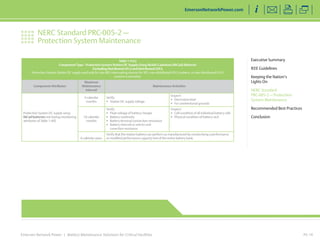
Table 1-4 (c) 
Component Type - Protection System Station DC Supply Using Nickel-Cadmium (NiCad) Batteries 
Excluding Distributed UFLS and Distributed UVLS 
Protection System Station DC supply used only for non-BES interrupting devices for SPS, non-distributed UFLS systems, or non-distributed UVLS 
systems is excluded. 
Component Attributes 
Maximun 
Maintenance 
Interval 
Maintenance Activities 
Protection System DC supply using 
NiCad batteries not having monitoring 
attributes of Table 1-4(f) 
4 calendar 
months 
Verify: 
ƒƒ Station DC supply voltage 
Inspect: 
ƒƒ Electrolyte level 
ƒƒ For unintentional grounds 
18 calendar 
months 
Verify: 
ƒƒ Float voltage of battery charger 
ƒƒ Battery continuity 
ƒƒ Battery terminal connection resistance 
ƒƒ Battery intercell or unit-to-unit 
conection resistance 
Inspect: 
ƒƒ Cell condition of all individual battery cells 
ƒƒ Physical condition of battery rack 
6 calendar years 
Verify that the station battery can perform as manufactured by conductiong a performance 
or modified performance capacity test of the entire battery bank.
NERC Standard PRC-005-2 — 
Protection System Maintenance 
Emerson Network Power | Battery Maintenance Solutions for Critical Facilities 
Executive Summary 
IEEE Guidelines 
Keeping the Nation’s 
Lights On 
NERC Standard 
PRC-005-2 — Protection 
System Maintenance 
Recommended Best Practices 
Conclusion 
EmersonNetworkPower.com 
PG 11 
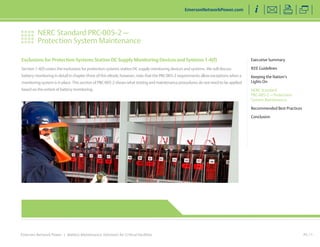
Exclusions for Protection Systems Station DC Supply Monitoring Devices and Systems 1-4(f) 
Section 1-4(f) covers the exclusions for protection systems station DC supply monitoring devices and systems. We will discuss 
battery monitoring in detail in chapter three of this eBook; however, note that the PRC-005-2 requirements allow exceptions when a 
monitoring system is in place. This section of PRC-005-2 shows what testing and maintenance procedures do not need to be applied 
based on the extent of battery monitoring.
NERC Standard PRC-005-2 — 
Protection System Maintenance 
Emerson Network Power | Battery Maintenance Solutions for Critical Facilities 
Executive Summary 
IEEE Guidelines 
Keeping the Nation’s 
Lights On 
NERC Standard 
PRC-005-2 — Protection 
System Maintenance 
Recommended Best Practices 
Conclusion 
EmersonNetworkPower.com 
PG 12 
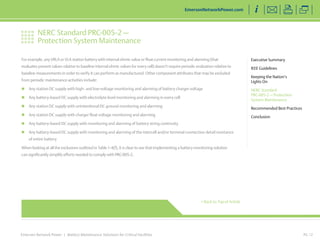
For example, any VRLA or VLA station battery with internal ohmic value or float current monitoring and alarming (that 
evaluates present values relative to baseline internal ohmic values for every cell) doesn’t require periodic evaluation relative to 
baseline measurements in order to verify it can perform as manufactured. Other component attributes that may be excluded 
from periodic maintenance activities include: 
„„ Any station DC supply with high- and low-voltage monitoring and alarming of battery charger voltage 
„„ Any battery-based DC supply with electrolyte level monitoring and alarming in every cell 
„„ Any station DC supply with unintentional DC ground monitoring and alarming 
„„ Any station DC supply with charger float voltage monitoring and alarming 
„„ Any battery-based DC supply with monitoring and alarming of battery string continuity 
„„ Any battery-based DC supply with monitoring and alarming of the intercell and/or terminal connection detail resistance 
of entire battery 
When looking at all the exclusions outlined in Table 1-4(f), it is clear to see that implementing a battery monitoring solution 
can significantly simplify efforts needed to comply with PRC-005-2. 
< Back to Top of Article
Recommended 
Best Practices 
Emerson Network Power | Battery Maintenance Solutions for Critical Facilities 
Executive Summary 
IEEE Guidelines 
Keeping the Nation’s 
Lights On 
NERC Standard 
PRC-005-2 — Protection 
System Maintenance 
Recommended Best Practices 
Conclusion 
EmersonNetworkPower.com 
PG 13 
The reason to test and maintain batteries regularly—whether in a data center, an electric 
utility or industrial facility—is to protect against downtime. When batteries back up critical 
equipment, more care in battery maintenance is preferable to less. 
When compared to the cost of downtime, UPS batteries are inexpensive. Emerson Network 
Power recommends the following activities as part of battery maintenance best practices: 
„„ Ensure batteries are fully charged and properly installed—physically, electrically and 
environmentally—before they are placed in service. 
„„ Verify condition of batteries after installation in order to minimize the likelihood of 
costly retests and equipment damage. 
„„ Inspect batteries before startup and/or load testing to gather valuable information 
that can be applied immediately and serve as a baseline for any testing conducted 
throughout the service life of the batteries. If this basic information is not collected, 
analyzed and understood, there is no guarantee the batteries will perform as needed 
and trend analysis becomes more difficult. 
„„ Implement a battery monitoring solution to improve mean time between 
failures (MTBF). 
„„ Follow the IEEE best practices for the type of battery being used. 
„„ Utilize a service provider with experience specific to your application and one 
that is versed in regulatory requirements.
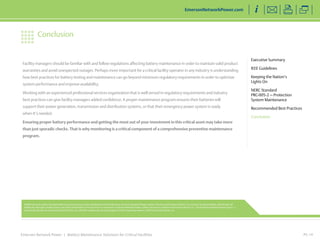
Facility managers should be familiar with and follow regulations affecting battery maintenance in order to maintain valid product 
warranties and avoid unexpected outages. Perhaps more important for a critical facility operator in any industry is understanding 
how best practices for battery testing and maintenance can go beyond minimum regulatory requirements in order to optimize 
system performance and improve availability. 
Working with an experienced professional services organization that is well versed in regulatory requirements and industry 
best practices can give facility managers added confidence. A proper maintenance program ensures their batteries will 
support their power generation, transmission and distribution systems, or that their emergency power system is ready 
when it’s needed. 
Ensuring proper battery performance and getting the most out of your investment in this critical asset may take more 
than just sporadic checks. That is why monitoring is a critical component of a comprehensive preventive maintenance 
program. 
Emerson Network Power | Battery Maintenance Solutions for Critical Facilities 
PG 14 
Executive Summary 
IEEE Guidelines 
Keeping the Nation’s 
Lights On 
NERC Standard 
PRC-005-2 — Protection 
System Maintenance 
Recommended Best Practices 
Conclusion 
EmersonNetworkPower.com 
Conclusion 
While every precaution has been taken to ensure accuracy and completeness in this literature, Emerson Network Power, Liebert Services and Emerson Electric Co. assume no responsibility, and disclaim all 
liability for damages resulting from use of this information or for any errors or omissions. Emerson Network Power, Liebert Services is a division of Emerson Electric Co. The Emerson Network Power logo is a 
trademark and service marks of Emerson Electric Co. All other trademarks are the property of their respective owners. ©2014 Emerson Electric Co.

Battery Maintenance Solutions for Critical Facilities: Meeting Regulatory Requirements and Observing Best Practices Ebook

  • 1.
    Battery Maintenance Solutionsfor Critical Facilities Meeting Regulatory Requirements and Observing Best Practices Click a section below Executive Summary IEEE Guidelines Keeping the Nation’s Lights On NERC Standard PRC-005-2 — Protection System Maintenance Recommended Best Practices Conclusion EmersonNetworkPower.com
  • 2.
    In the previousEmerson Network Power’s eBook entitled “Battery Maintenance Solutions for Critical Facilities,” we highlighted the causes of downtime including the misunderstanding of battery lifespan. Additionally, we delved into the high costs—both direct and indirect—associated with UPS battery failure that leads to unplanned downtime. To help avoid this downtime, we shared that critical facility managers need to fully understand the true service life of batteries and then work to implement a proper preventive maintenance program. In this ebook, we will look at consensus recommendations for preventive maintenance including industry standards from the Institute of Electrical and Electronics Engineers (IEEE) and regulatory requirements specific to utilities as stipulated by the North American Electric Reliability Corporation (NERC). As these standards and regulations outline minimum maintenance activities, we will also share how many critical facilities can and should go beyond these minimums for additional system protection and added peace of mind. Emerson Network Power | Battery Maintenance Solutions for Critical Facilities PG 2 Executive Summary IEEE Guidelines Keeping the Nation’s Lights On NERC Standard PRC-005-2 — Protection System Maintenance Recommended Best Practices Conclusion Executive Summary EmersonNetworkPower.com
  • 3.
    As the leadingdeveloper of industry standards in a broad range of technologies, IEEE has the most well known standards regarding UPS battery maintenance practices including inspections and capacity testing. In fact, battery manufacturers often cite the standards and require adherence in order to maintain a valid product warranty. Whether a data center, industrial facility or utility, Emerson encourages adherence to the following standards based on the type of battery being serviced: „„ IEEE 450 for vented lead-acid (VLA) „„ IEEE 1188 for valve-regulated lead-acid (VRLA) „„ IEEE 1106 for nickel-cadmium (NiCad) All of these standards provide recommended practices for maintenance, testing and replacement of batteries for stationary applications. They address the frequency and type of measurements that need to be taken to validate the condition of the battery. Emerson Network Power | Battery Maintenance Solutions for Critical Facilities PG 3 Executive Summary IEEE Guidelines Keeping the Nation’s Lights On NERC Standard PRC-005-2 — Protection System Maintenance Recommended Best Practices Conclusion IEEE Guidelines EmersonNetworkPower.com
  • 4.
    Inspections The measurementsneeded such as string/cell voltage or battery float charging current are outlined based on monthly, quarterly and annual inspections. The more frequent the inspection or testing intervals, the better. Gathering data on a more regular basis can be very helpful for trending battery performance and ultimately extending the useful life of these critical assets. Capacity Tests Recommendations for capacity testing of VLA and VRLA batteries are very similar. Both should be tested at installation, during periodic intervals (no greater than 25% of the expected service life), and annually when the battery shows signs of degradation or has reached 85% of the expected service life. However, VLA batteries should have a capacity/discharge test within the first two years of service, and VRLA batteries should be tested when internal ohmic values have changed significantly between readings or physical changes have occurred. For these two battery groups, degradation is indicated when the battery capacity drops more than 10% from its capacity on the previous capacity test or is below 90% of the manufacturer’s rating. For NiCad batteries, capacity/discharge testing should be done within the first two years of service, at five-year intervals until the battery shows signs of excessive capacity loss, and annually at excessive capacity loss. Battery Replacement Both IEEE 450 and 1188 recommend replacing the battery if its capacity is below 80% of the manufacturer’s rating. Maximum time for replacement is one year. Physical characteristics such as plate condition or abnormally high cell temperatures are often indicators for complete battery or individual cell replacements. Emerson Network Power | Battery Maintenance Solutions for Critical Facilities PG 4 Executive Summary IEEE Guidelines Keeping the Nation’s Lights On NERC Standard PRC-005-2 — Protection System Maintenance Recommended Best Practices Conclusion IEEE Guidelines EmersonNetworkPower.com < Back to Top of Article
  • 5.
    Keeping the Nation’sLights On Emerson Network Power | Battery Maintenance Solutions for Critical Facilities Executive Summary IEEE Guidelines Keeping the Nation’s Lights On NERC Standard PRC-005-2 — Protection System Maintenance Recommended Best Practices Conclusion EmersonNetworkPower.com PG 5 The National Electric Reliability Corporation (NERC) recently revised its standard PRC-005 to PRC-005-2, which went into effect in 2013. The revised standard applies to electric utilities, including all electric utility functional entities, including substations and power generating plants. It mandates certain minimum maintenance requirements for batteries that support equipment connected to the Bulk Electric System (BES)—the electrical grid responsible for power across large regions of the United States—within a certain amount of time. PRC-005, and therefore PRC-005-2, exists because of the major blackout on August 14, 2003, in which more than 50 million people lost power. An aging electrical grid, technology issues and trees impinging on electrical lines created a perfect storm that led to a cascading series of outages from New York to Ohio and up into Ontario, Canada. Soon afterward, NERC was established to create standards that would ensure total reliability of the BES.
  • 6.
    NERC Standard PRC-005-2— Protection System Maintenance Emerson Network Power | Battery Maintenance Solutions for Critical Facilities Executive Summary IEEE Guidelines Keeping the Nation’s Lights On NERC Standard PRC-005-2 — Protection System Maintenance Recommended Best Practices Conclusion EmersonNetworkPower.com PG 6 PRC-005-2 comprises regulations that require the electric utility backup battery “perform as manufactured.” There is some controversy, however, about PRC-005-02, because it mandates only the minimum required maintenance be performed, and might result in batteries backing up the BES being less reliable. The PRC-005-2 standard does recommend service technicians use the best-practice battery maintenance procedures published by IEEE. Additionally, the standard allows ohmic testing, which measures the internal qualities of a battery cell on VRLA and VLA batteries, in lieu of performance tests as long as the user can verify that the station battery can perform as manufactured. Battery manufacturers and other experts in the industry don’t agree that ohmic testing meets this requirement. In fact, a study by the Electric Power Research Institute concluded that internal ohmic measurements can provide insight into internal degradation, but ohmic measurements alone “do not necessarily provide absolute verification of a battery’s capacity; only a battery capacity test can determine the total battery capacity.” If the assumption is true that there is widespread use of the faster, less expensive ohmic measurements, this also raises concerns that utility companies can follow PRC-005-2 and still not have a reliable battery backup. The PRC-005-2 standard for protection system maintenance combines the following older standards: „„ PRC-005-1 – Transmission and Generation Protection System Maintenance and Testing „„ PRC-008-1 – Underfrequency Load Shedding Equipment Maintenance „„ PRC-011-1 – Undervoltage Load Shedding Equipment Maintenance and Testing „„ PRC-017-1 – Special Protection System Maintenance and Testing
  • 7.
    NERC Standard PRC-005-2— Protection System Maintenance Emerson Network Power | Battery Maintenance Solutions for Critical Facilities Executive Summary IEEE Guidelines Keeping the Nation’s Lights On NERC Standard PRC-005-2 — Protection System Maintenance Recommended Best Practices Conclusion EmersonNetworkPower.com PG 7 Section 1-4 of the new standard covers the requirements for stationary (stand-by/backup) battery maintenance and testing. The PRC-005-2 standard requires time-based maintenance for stationary batteries. This means that protection systems are maintained or verified according to a defined time schedule. Tables 1-4(a), (b) and (c) cover the requirements for protection system station direct current (DC) supply using VLA, VRLA or NiCad batteries. The following tables show the system component; maintenance activities for each type of battery; and the maximum amount of time before the battery should undergo maintenance again.
  • 8.
    NERC Standard PRC-005-2— Protection System Maintenance Emerson Network Power | Battery Maintenance Solutions for Critical Facilities Executive Summary IEEE Guidelines Keeping the Nation’s Lights On NERC Standard PRC-005-2 — Protection System Maintenance Recommended Best Practices Conclusion EmersonNetworkPower.com PG 8 PRC-005-2 Battery Maintenance Tables 1-4 (a), (b) and (c) Table 1-4 (a) Component Type - Protection System Station DC Supply Using Vented Lead-Acid (VLA) Batteries Excluding Distributed UFLS and Distributed UVLS Protection System Station DC supply used only for non-BES interrupting devices for SPS, non-distributed UFLS systems, or non-distributed UVLS systems is excluded. Component Attributes Maximun Maintenance Interval Maintenance Activities Protection System Station DC supply using VLA batteries not having monitoring attributes of Table 1-4(f) 4 calendar months Verify: ƒƒ Station DC supply voltage Inspect: ƒƒ Electrolyte level ƒƒ For unintentional grounds 18 calendar months Verify: ƒƒ Float voltage of battery charger ƒƒ Battery continuity ƒƒ Battery terminal connection resistance ƒƒ Battery intercell or unit-to-unit conection resistance Inspect: ƒƒ Cell condition of all individual battery cells where cells are visible or measure battery cell/unit internal ohmic values where the cells are not visible ƒƒ Physical condition of battery rack 18 calendar months -or- 6 calendar years Verify that the station battery can perform as manufactured by evaluating cell/unit measurements indicative of battery performance (e.g. internal ohmic values or float current) against the station battery baseline. -or- Verify that the station battery can perform as manufactured by conductiong a performance or modified performance capacity test of the entire battery bank.
  • 9.
    NERC Standard PRC-005-2— Protection System Maintenance Emerson Network Power | Battery Maintenance Solutions for Critical Facilities Executive Summary IEEE Guidelines Keeping the Nation’s Lights On NERC Standard PRC-005-2 — Protection System Maintenance Recommended Best Practices Conclusion EmersonNetworkPower.com PG 9 Table 1-4 (b) Component Type - Protection System Station DC Supply Using Valve-Regulated Lead-Acid (VRLA) Batteries Excluding Distributed UFLS and Distributed UVLS Protection System Station DC supply used only for non-BES interrupting devices for SPS, non-distributed UFLS systems, or non-distributed UVLS systems is excluded. Component Attributes Maximun Maintenance Interval Maintenance Activities Protection System DC supply with VRLA batteries not having monitoring attributes of Table 1-4(f) 4 calendar months Verify: ƒƒ Station DC supply voltage Inspect: ƒƒ For unintentional grounds 6 calendar months Inspect: ƒƒ Condition of all individual units by measuring battery cell/unit internal ohmic values 18 calendar months Verify: ƒƒ Float voltage of battery charger ƒƒ Battery continuity ƒƒ Battery terminal connection resistance ƒƒ Battery intercell or unit-to-unit conection resistance Inspect: ƒƒ Physical condition of battery rack 6 calendar months -or- 3 calendar years Verify that the station battery can perform as manufactured by evaluating cell/unit measurementts indicative of battery performance (e.g. internal ohmic values or float current) against the station battery baseline. -or- Verify that the station battery can perform as manufactured by conductiong a performance or modified performance capacity test of the entire battery bank.
  • 10.
    NERC Standard PRC-005-2— Protection System Maintenance Emerson Network Power | Battery Maintenance Solutions for Critical Facilities Executive Summary IEEE Guidelines Keeping the Nation’s Lights On NERC Standard PRC-005-2 — Protection System Maintenance Recommended Best Practices Conclusion EmersonNetworkPower.com PG 10 Table 1-4 (c) Component Type - Protection System Station DC Supply Using Nickel-Cadmium (NiCad) Batteries Excluding Distributed UFLS and Distributed UVLS Protection System Station DC supply used only for non-BES interrupting devices for SPS, non-distributed UFLS systems, or non-distributed UVLS systems is excluded. Component Attributes Maximun Maintenance Interval Maintenance Activities Protection System DC supply using NiCad batteries not having monitoring attributes of Table 1-4(f) 4 calendar months Verify: ƒƒ Station DC supply voltage Inspect: ƒƒ Electrolyte level ƒƒ For unintentional grounds 18 calendar months Verify: ƒƒ Float voltage of battery charger ƒƒ Battery continuity ƒƒ Battery terminal connection resistance ƒƒ Battery intercell or unit-to-unit conection resistance Inspect: ƒƒ Cell condition of all individual battery cells ƒƒ Physical condition of battery rack 6 calendar years Verify that the station battery can perform as manufactured by conductiong a performance or modified performance capacity test of the entire battery bank.
  • 11.
    NERC Standard PRC-005-2— Protection System Maintenance Emerson Network Power | Battery Maintenance Solutions for Critical Facilities Executive Summary IEEE Guidelines Keeping the Nation’s Lights On NERC Standard PRC-005-2 — Protection System Maintenance Recommended Best Practices Conclusion EmersonNetworkPower.com PG 11 Exclusions for Protection Systems Station DC Supply Monitoring Devices and Systems 1-4(f) Section 1-4(f) covers the exclusions for protection systems station DC supply monitoring devices and systems. We will discuss battery monitoring in detail in chapter three of this eBook; however, note that the PRC-005-2 requirements allow exceptions when a monitoring system is in place. This section of PRC-005-2 shows what testing and maintenance procedures do not need to be applied based on the extent of battery monitoring.
  • 12.
    NERC Standard PRC-005-2— Protection System Maintenance Emerson Network Power | Battery Maintenance Solutions for Critical Facilities Executive Summary IEEE Guidelines Keeping the Nation’s Lights On NERC Standard PRC-005-2 — Protection System Maintenance Recommended Best Practices Conclusion EmersonNetworkPower.com PG 12 For example, any VRLA or VLA station battery with internal ohmic value or float current monitoring and alarming (that evaluates present values relative to baseline internal ohmic values for every cell) doesn’t require periodic evaluation relative to baseline measurements in order to verify it can perform as manufactured. Other component attributes that may be excluded from periodic maintenance activities include: „„ Any station DC supply with high- and low-voltage monitoring and alarming of battery charger voltage „„ Any battery-based DC supply with electrolyte level monitoring and alarming in every cell „„ Any station DC supply with unintentional DC ground monitoring and alarming „„ Any station DC supply with charger float voltage monitoring and alarming „„ Any battery-based DC supply with monitoring and alarming of battery string continuity „„ Any battery-based DC supply with monitoring and alarming of the intercell and/or terminal connection detail resistance of entire battery When looking at all the exclusions outlined in Table 1-4(f), it is clear to see that implementing a battery monitoring solution can significantly simplify efforts needed to comply with PRC-005-2. < Back to Top of Article
  • 13.
    Recommended Best Practices Emerson Network Power | Battery Maintenance Solutions for Critical Facilities Executive Summary IEEE Guidelines Keeping the Nation’s Lights On NERC Standard PRC-005-2 — Protection System Maintenance Recommended Best Practices Conclusion EmersonNetworkPower.com PG 13 The reason to test and maintain batteries regularly—whether in a data center, an electric utility or industrial facility—is to protect against downtime. When batteries back up critical equipment, more care in battery maintenance is preferable to less. When compared to the cost of downtime, UPS batteries are inexpensive. Emerson Network Power recommends the following activities as part of battery maintenance best practices: „„ Ensure batteries are fully charged and properly installed—physically, electrically and environmentally—before they are placed in service. „„ Verify condition of batteries after installation in order to minimize the likelihood of costly retests and equipment damage. „„ Inspect batteries before startup and/or load testing to gather valuable information that can be applied immediately and serve as a baseline for any testing conducted throughout the service life of the batteries. If this basic information is not collected, analyzed and understood, there is no guarantee the batteries will perform as needed and trend analysis becomes more difficult. „„ Implement a battery monitoring solution to improve mean time between failures (MTBF). „„ Follow the IEEE best practices for the type of battery being used. „„ Utilize a service provider with experience specific to your application and one that is versed in regulatory requirements.
  • 14.
    Facility managers shouldbe familiar with and follow regulations affecting battery maintenance in order to maintain valid product warranties and avoid unexpected outages. Perhaps more important for a critical facility operator in any industry is understanding how best practices for battery testing and maintenance can go beyond minimum regulatory requirements in order to optimize system performance and improve availability. Working with an experienced professional services organization that is well versed in regulatory requirements and industry best practices can give facility managers added confidence. A proper maintenance program ensures their batteries will support their power generation, transmission and distribution systems, or that their emergency power system is ready when it’s needed. Ensuring proper battery performance and getting the most out of your investment in this critical asset may take more than just sporadic checks. That is why monitoring is a critical component of a comprehensive preventive maintenance program. Emerson Network Power | Battery Maintenance Solutions for Critical Facilities PG 14 Executive Summary IEEE Guidelines Keeping the Nation’s Lights On NERC Standard PRC-005-2 — Protection System Maintenance Recommended Best Practices Conclusion EmersonNetworkPower.com Conclusion While every precaution has been taken to ensure accuracy and completeness in this literature, Emerson Network Power, Liebert Services and Emerson Electric Co. assume no responsibility, and disclaim all liability for damages resulting from use of this information or for any errors or omissions. Emerson Network Power, Liebert Services is a division of Emerson Electric Co. The Emerson Network Power logo is a trademark and service marks of Emerson Electric Co. All other trademarks are the property of their respective owners. ©2014 Emerson Electric Co.