Total Station
Prepared by
P. A.Nadgouda
Assistant Professor
Total Station Surveying
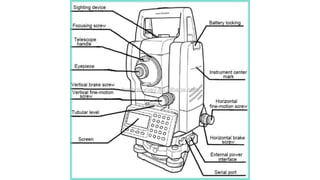
Total Station
• The total station also known as electronic tacheometer is an instrument
used in surveying which is capable of measuring angles and distances
electronically.
• The total station is operated using a multi – function key board which
is connected to a micro – processor built into the instrument.
• The micro processor not only controls both the angle and distance
measuring systems but also used as a small computer that can
electronically calculate slope corrections, vertical components, and
rectangular co – ordinates and in some cases, can also store
observations directly using an internal memory.
Basic Principle
• General principle involves sending a
modulated Electro-Magnetic (EM)beam
from one transmitter at the master station
to a reflector at the remote station and
receive it back to master station.
• The instrument measures slope distance
between transmitter and receiver by
modulating the continuous carrier wave at
different frequencies and then measuring
the phase difference at the master station
between the outgoing and the incoming
signals
Prism Reflector
• It is a combination of
ranging rod, staff and optical
cuboidal mirror.
• having 2/3 lifts with 5cms
interval graduations.
• adjustable height from 1.5m
to 3.75m.
• More number of prisms, will
give more accuracy.
Components of Total Station:
• Distance measuring Instrument(EDM)
• An angle measuring Instrument(Theodolite)
• A simple microprocessor.
• A typical Total Station has the following Characters.
• Graphic Display
• Dual axis compensation
• Levelling and Centering
• Storage Friction clutch and endless drive
• Guide light or Lumiguide tracking light
• Measurement modes
• Automatic target recognition(ATR)
Functions of T.S:
• 1. It simultaneously measures angles & distances and Record
• 2. Correcting the measured distance with:
a. Prism constant
b. Atmospheric Pr.
c. Temperature
d. Curvature of earth
e. Refraction correction
• 3. Computing the point elevation
• 4. Computing the coordinates of every point
• 5. Remote elevation measurement
• 6. Remote distance measurement
• 7. Area calculations
• 8. Data Transferring facility from instrument to S/W and S/W to instrument
• 9. Format of conversion of units
Applications of Total Station
• Updating mapping
• Topographic survey
• Hydrographic survey
• Cadastral survey
• Project construction survey
• Road, Rail Survey
• Mining survey
Operations involved while using Total Stations
1.Establishing the site Datum:
a) Selecting the site Datum
b) Establishing North
2. Setting up the Total station:
a) Placing and leveling Tripod on Datum
b) Placing and leveling the Gun on Tripod
c) Linking the data connector to Gun
3. Data collector options and setting
a) Main menu
b) Basic setting
Operations involved while using Total Stations
4. Creating and Operating Job files:
a) Creating a new Job file
b) Opening an existing file
5. Shooting points
a) Identifying the important points to shoot
b) shooting points
c) Shooting additional points
d) Noting the special features
6.Post Processing – Data down loading,conversion
7.Plotting/Map generation.
Thank you
Questions and Answer

Total Station.pptx

  • 1.
    Total Station Prepared by P.A.Nadgouda Assistant Professor
  • 2.
  • 3.
    Total Station • Thetotal station also known as electronic tacheometer is an instrument used in surveying which is capable of measuring angles and distances electronically. • The total station is operated using a multi – function key board which is connected to a micro – processor built into the instrument. • The micro processor not only controls both the angle and distance measuring systems but also used as a small computer that can electronically calculate slope corrections, vertical components, and rectangular co – ordinates and in some cases, can also store observations directly using an internal memory.
  • 4.
    Basic Principle • Generalprinciple involves sending a modulated Electro-Magnetic (EM)beam from one transmitter at the master station to a reflector at the remote station and receive it back to master station. • The instrument measures slope distance between transmitter and receiver by modulating the continuous carrier wave at different frequencies and then measuring the phase difference at the master station between the outgoing and the incoming signals
  • 7.
    Prism Reflector • Itis a combination of ranging rod, staff and optical cuboidal mirror. • having 2/3 lifts with 5cms interval graduations. • adjustable height from 1.5m to 3.75m. • More number of prisms, will give more accuracy.
  • 8.
    Components of TotalStation: • Distance measuring Instrument(EDM) • An angle measuring Instrument(Theodolite) • A simple microprocessor. • A typical Total Station has the following Characters. • Graphic Display • Dual axis compensation • Levelling and Centering • Storage Friction clutch and endless drive • Guide light or Lumiguide tracking light • Measurement modes • Automatic target recognition(ATR)
  • 9.
    Functions of T.S: •1. It simultaneously measures angles & distances and Record • 2. Correcting the measured distance with: a. Prism constant b. Atmospheric Pr. c. Temperature d. Curvature of earth e. Refraction correction • 3. Computing the point elevation • 4. Computing the coordinates of every point • 5. Remote elevation measurement • 6. Remote distance measurement • 7. Area calculations • 8. Data Transferring facility from instrument to S/W and S/W to instrument • 9. Format of conversion of units
  • 10.
    Applications of TotalStation • Updating mapping • Topographic survey • Hydrographic survey • Cadastral survey • Project construction survey • Road, Rail Survey • Mining survey
  • 11.
    Operations involved whileusing Total Stations 1.Establishing the site Datum: a) Selecting the site Datum b) Establishing North 2. Setting up the Total station: a) Placing and leveling Tripod on Datum b) Placing and leveling the Gun on Tripod c) Linking the data connector to Gun 3. Data collector options and setting a) Main menu b) Basic setting
  • 12.
    Operations involved whileusing Total Stations 4. Creating and Operating Job files: a) Creating a new Job file b) Opening an existing file 5. Shooting points a) Identifying the important points to shoot b) shooting points c) Shooting additional points d) Noting the special features 6.Post Processing – Data down loading,conversion 7.Plotting/Map generation.
  • 13.