BRIDGE CONSTRUCTION
methods
TYPES OF STRUCTURE
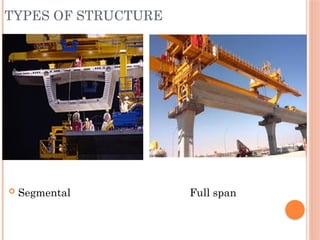
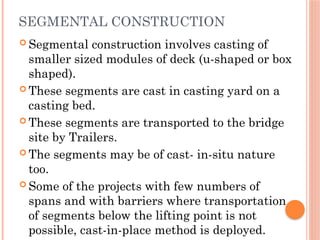
 Segmental Full span
SEGMENTAL CONSTRUCTION
 Segmental construction involves casting of
smaller sized modules of deck (u-shaped or box
shaped).
 These segments are cast in casting yard on a
casting bed.
 These segments are transported to the bridge
site by Trailers.
 The segments may be of cast- in-situ nature
too.
 Some of the projects with few numbers of
spans and with barriers where transportation
of segments below the lifting point is not
possible, cast-in-place method is deployed.
 The precast method of segment casting is
feasible economically only when the
number of segments is in thousands.
That's make it viable for the bridge
construction.
 The initial cost involved in Launching
gantry fabrication and transportation
makes this method less likely to be
adopted for smaller bridges.
 The quality of segments casted in
Casting yard under controlled
environment is always exceptional and
incomparable to cast-in-place production.
SEGMENTAL CONSTRUCTION
METHOD
Span by span method by Launching
gantries.
Balance cantilever construction.
Progressive placement of segments.
SPAN BY SPAN METHOD
 In this method Launching gantries of required
capacity as per the weight of segment is used.
 The Launching gantry can be of box girder type or
twin truss type.
 These Launching gantries are self driven either
hydraulically or electrically.(though hydraulic
system is safer and generally preferred).
 Segments are being cast in factory production
mode at Casting yard on Casting bed.
 These Precast segments are transported to site by
Trailers.
 Segments are match cast at casting yards and
have HDPE ducts placed in position before casting
to insert HT strands after erection.
 Some of pictures showing span by span method by
twin truss as well as by box girder launching
gantries.
BALANCE CANTILEVER METHOD
 By crane
 By lifters/launchers
 Balance cantilever is a method where the
precast segments are lifted on both directions
of a pier .
 If the access beneath the deck is free of any
barrier ,the Cranes are used for lifting and
delivering the segments to the deck level.
 In case the area below deck doesn’t allow to
place big telescopic cranes, then the lifting is
being carried out by lifters attached to the
pier segment either over head or under slung.
 These segments are lifted to the deck level and
attached to the span by pre-stressing cables.
 Generally this method is adopted when the
number of span is on lower side or the span
length is more than 45m.
 For large number of spans this system is not
suitable as it delays the work.
 Generally in any continuous viaduct construction
project like that of LRT or HSR there are certain
junctions where balance cantilever method is
adopted where the span length is more than
45m.
 If the access is not available at all then generally
balance cantilever method is being deployed with
cast-in-place segments can not be transported.
 PICTURES SHOWING BALANCE CANTILEVER
CONSTRUCTION OF PRECAST SEGMENTS-
PROGRESSIVE PLACEMENT
 This is another type of cantilever construction
with only one difference being the direction of
segment placing.
 Here instead of both direction of lifting the
segments are being lifted only in one direction
starting from Pier to end on the second pier.
 This method is adopted when number of spans
are very less and doesn’t require investing in
Launching gantries.
 This method is also being done by crane lifting or
by lifters/launchers attached to the deck either
over head or under slung.
PICTURES SHOWING PROGRESSIVE
PLACEMENT OF PRE CAST SEGEMENTS
INCREMENTAL LAUNCHING
 This method is used in progressive placing where
the casting of segment is done near the abutment
and the segment is then shifted by traveler to the
nose of placing.
 This method is useful where the span is small
and the investment involved in casting yard is
feasible.
 This system is adopted in smaller projects.
PICTURES OF INCREMENTAL
LAUNCHING
CAST –IN-PLACE SEGMENTAL
CONSTRUCTION
 BALANCE CANTILEVER
 PROGRESSIVE PLACEMENT
 Balance Cantilever method- This method adopted
where there is huge barrier below the deck and there is
no possibility of delivering the pre-cast segment
directly to the point of placement.
 Here Form travelers are used to cast segment .
 Segment is cast in each sides of the pier with a
cantilever of half of the length of the segment to make
it balance.
 Progressive casting of segment is similar to
balance cantilever accept here the segments are
cast in one direction only.
 Speed of work is slow as casting is being in only
one direction.
 Form traveler is used to cast the segment at
place.
FULL SPAN BRIDGE
CONSTRUCTION
 Precast
 Cast- in- place
 Precast full span launching is now being adopted as the
most popular method in the construction of LRT and HSR .
 Especially in urban areas it has its own advantages.
 It can be done either by deploying two heavy cranes at
ground level to erect and place the full U girder on the pier
cap by tandem lifting.
 Alternatively it can be done by heavy carriers and launchers
to shift and carry the U girder on the already erected span
to place it on position.
 PICTURES OF PRE CAST U-GIRDER
LAUNCHING
CAST- IN- PLACE U GIRDER
 This method is generally adopted where the
ground barriers are such that the cranes can’t be
used to lift and place U girders.
 This method involves formwork of entire span to
be erected and fixed at position.
 There are two methods of doing this. Generally
the traditional ground support is used in form
scaffolding or cribs (modules).
 Alternatively a new method MSS (Movable
scaffolding system) is now becoming popular to
speed up the work.
 MSS can be over head or under slung.
PICTURES OF FULL SPAN CAST-IN-
PLACE METHOD

407731260-Bridge-Construction-Method.pptx

  • 1.
  • 2.
    TYPES OF STRUCTURE Segmental Full span
  • 3.
    SEGMENTAL CONSTRUCTION  Segmentalconstruction involves casting of smaller sized modules of deck (u-shaped or box shaped).  These segments are cast in casting yard on a casting bed.  These segments are transported to the bridge site by Trailers.  The segments may be of cast- in-situ nature too.  Some of the projects with few numbers of spans and with barriers where transportation of segments below the lifting point is not possible, cast-in-place method is deployed.
  • 4.
     The precastmethod of segment casting is feasible economically only when the number of segments is in thousands. That's make it viable for the bridge construction.  The initial cost involved in Launching gantry fabrication and transportation makes this method less likely to be adopted for smaller bridges.  The quality of segments casted in Casting yard under controlled environment is always exceptional and incomparable to cast-in-place production.
  • 5.
    SEGMENTAL CONSTRUCTION METHOD Span byspan method by Launching gantries. Balance cantilever construction. Progressive placement of segments.
  • 6.
    SPAN BY SPANMETHOD  In this method Launching gantries of required capacity as per the weight of segment is used.  The Launching gantry can be of box girder type or twin truss type.  These Launching gantries are self driven either hydraulically or electrically.(though hydraulic system is safer and generally preferred).  Segments are being cast in factory production mode at Casting yard on Casting bed.  These Precast segments are transported to site by Trailers.  Segments are match cast at casting yards and have HDPE ducts placed in position before casting to insert HT strands after erection.
  • 7.
     Some ofpictures showing span by span method by twin truss as well as by box girder launching gantries.
  • 8.
    BALANCE CANTILEVER METHOD By crane  By lifters/launchers  Balance cantilever is a method where the precast segments are lifted on both directions of a pier .  If the access beneath the deck is free of any barrier ,the Cranes are used for lifting and delivering the segments to the deck level.  In case the area below deck doesn’t allow to place big telescopic cranes, then the lifting is being carried out by lifters attached to the pier segment either over head or under slung.
  • 9.
     These segmentsare lifted to the deck level and attached to the span by pre-stressing cables.  Generally this method is adopted when the number of span is on lower side or the span length is more than 45m.  For large number of spans this system is not suitable as it delays the work.  Generally in any continuous viaduct construction project like that of LRT or HSR there are certain junctions where balance cantilever method is adopted where the span length is more than 45m.  If the access is not available at all then generally balance cantilever method is being deployed with cast-in-place segments can not be transported.
  • 10.
     PICTURES SHOWINGBALANCE CANTILEVER CONSTRUCTION OF PRECAST SEGMENTS-
  • 11.
    PROGRESSIVE PLACEMENT  Thisis another type of cantilever construction with only one difference being the direction of segment placing.  Here instead of both direction of lifting the segments are being lifted only in one direction starting from Pier to end on the second pier.  This method is adopted when number of spans are very less and doesn’t require investing in Launching gantries.  This method is also being done by crane lifting or by lifters/launchers attached to the deck either over head or under slung.
  • 12.
  • 13.
    INCREMENTAL LAUNCHING  Thismethod is used in progressive placing where the casting of segment is done near the abutment and the segment is then shifted by traveler to the nose of placing.  This method is useful where the span is small and the investment involved in casting yard is feasible.  This system is adopted in smaller projects.
  • 14.
  • 15.
    CAST –IN-PLACE SEGMENTAL CONSTRUCTION BALANCE CANTILEVER  PROGRESSIVE PLACEMENT  Balance Cantilever method- This method adopted where there is huge barrier below the deck and there is no possibility of delivering the pre-cast segment directly to the point of placement.  Here Form travelers are used to cast segment .  Segment is cast in each sides of the pier with a cantilever of half of the length of the segment to make it balance.
  • 16.
     Progressive castingof segment is similar to balance cantilever accept here the segments are cast in one direction only.  Speed of work is slow as casting is being in only one direction.  Form traveler is used to cast the segment at place.
  • 17.
    FULL SPAN BRIDGE CONSTRUCTION Precast  Cast- in- place  Precast full span launching is now being adopted as the most popular method in the construction of LRT and HSR .  Especially in urban areas it has its own advantages.  It can be done either by deploying two heavy cranes at ground level to erect and place the full U girder on the pier cap by tandem lifting.  Alternatively it can be done by heavy carriers and launchers to shift and carry the U girder on the already erected span to place it on position.
  • 18.
     PICTURES OFPRE CAST U-GIRDER LAUNCHING
  • 19.
    CAST- IN- PLACEU GIRDER  This method is generally adopted where the ground barriers are such that the cranes can’t be used to lift and place U girders.  This method involves formwork of entire span to be erected and fixed at position.  There are two methods of doing this. Generally the traditional ground support is used in form scaffolding or cribs (modules).  Alternatively a new method MSS (Movable scaffolding system) is now becoming popular to speed up the work.  MSS can be over head or under slung.
  • 20.
    PICTURES OF FULLSPAN CAST-IN- PLACE METHOD