Seminar Report
on
EXPERIMENTAL STUDIES ON
PERVIOUS CONCRETE
Submitted by
Nadgouda Pavan Anil
PhD Research Scholar
Civil Engineering
(Structural Engineering)
Roll no.:215CE022
Submitted to
Dr. Gyani Jail Singh
Assistant Professor
Department of Civil Engineering
National Institute of Technology, Patna
Contents
 Abstract
 Introduction
 Literature Review
 Experimental Program
 Mix Design
 Casting and Testing the sample
 Result
 Conclusion
ABSTRACT
 Use of impervious surfaces on pavements to rapidly
collect and transport rainwater runoff is very important.
 Due to this storm water reaches the water bodies
rapidly, in bigger volume and carries more
contaminants than natural conditions.
 Permeable pavement on parking lots, sidewalks, and
driveways provides a solution to this problem.
ABSTRACT
 This paper presents a study describing a project
pervious concrete system.
 construction technique including details of the
material used are described in this paper.
 On-going tests to monitor the performance of this
test slab are also described.
1.0 INTRODUCTION
 Pavement systems creating about 30-40 per
cent of the total urban fabric have
converted pervious natural ground into
impervious systems.
 as variations in hydrological aspect and
temperature in the surrounding ambience
1.0 INTRODUCTION
Existing dense pavement system being
impervious in nature, increases
the quantity of runoff and reduces the
infiltration of rainwater into the ground,
which may create a flood-like situation in
low-lying areas.
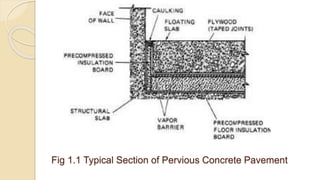
Fig 1.1 Typical Section of Pervious Concrete Pavement
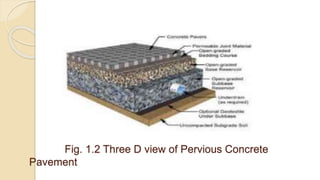
Fig. 1.2 Three D view of Pervious Concrete
Pavement
2.0 Literature Review
 M. UmaMaguesvari and V.L. Narasimha
 This study illustrates angularity number, which
influence properties and behaviour of pervious concrete
with fine aggregate and coarse aggregates. It is observed
that the increase in fine aggregate results in reduction of
volume of voids which in turn increase of compressive
strength, flexural strength and split tensile strength.
Literature Review
Mr. V. R. Patil, Prof. A. K. Gupta, Prof. D. B. Desai
The effects of two types of fine aggregates, i.e. Crushed
Stone and River Sand, on various properties of pervious
concrete were studied.
Cement content was varied from 300 kg/m3 to 340 kg/m3
with an increment of 10 kg/m3. In total 10 different
pervious concrete mixes were prepared considering each
level of cement content and each type of fine aggregate.
Literature Review
Shihui Shen, Maria Burton, Bertram Jobson, Liv
Haselbach
This study investigates the photo catalytic effect of
titanium dioxide (TiO2) applied onto pervious
concrete pavement to remove some of these
pollutants from the air.
Literature Review
Darshan S. Shah, Prof. Jayesh Kumar Pitroda,
Prof.J.J. Bhavsar
studied Pervious concrete and concluded that it is a
relatively new concept for rural road pavement, with
increase into the problems in rural areas related to
the low ground water level, agricultural problem.
Experimental Program
 This study consists of pervious concrete. Six
concrete cubes of size 150 mm x 150 mm
x 150mm samples are taken from each mix design.
M 30 mix design is chosen for the test.
Four design mix is done as void ratio
20%,25%,30%,35%
Mix Design
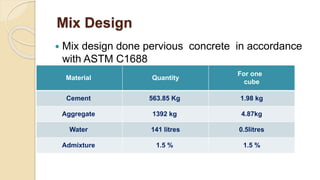
 Mix design done pervious concrete in accordance
with ASTM C1688
Material Quantity
For one
cube
Cement 563.85 Kg 1.98 kg
Aggregate 1392 kg 4.87kg
Water 141 litres 0.5litres
Admixture 1.5 % 1.5 %
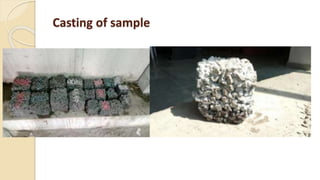
Casting of sample
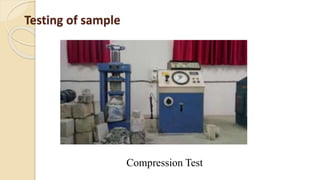
Testing of sample
Compression Test
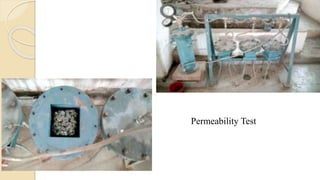
Permeability Test
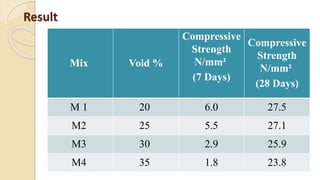
Result
Mix Void %
Compressive
Strength
N/mm²
(7 Days)
Compressive
Strength
N/mm²
(28 Days)
M 1 20 6.0 27.5
M2 25 5.5 27.1
M3 30 2.9 25.9
M4 35 1.8 23.8
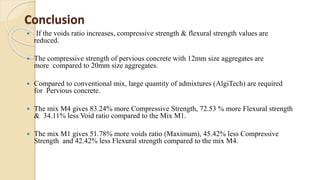
Conclusion
 If the voids ratio increases, compressive strength & flexural strength values are
reduced.
 The compressive strength of pervious concrete with 12mm size aggregates are
more compared to 20mm size aggregates.
 Compared to conventional mix, large quantity of admixtures (AlgiTech) are required
for Pervious concrete.
 The mix M4 gives 83.24% more Compressive Strength, 72.53 % more Flexural strength
& 34.11% less Void ratio compared to the Mix M1.
 The mix M1 gives 51.78% more voids ratio (Maximum), 45.42% less Compressive
Strength and 42.42% less Flexural strength compared to the mix M4.
References
 M.UmaMaguesvaria,c and V.L. Narasimhab, “Studies on
Characterization of Pervious Concrete for Pavement
Applications.”, 2nd Conference of Transportation Research
Group of India (2nd CTRG), Social and Behavioral Sciences
104(2013 ) 198 – 207,Elsevier.
 Hariyadia,*, Hiroki Tamaib, “Enhancing the performance of
porous concrete by utilizing the pumice aggregate” The 5th
International Conference of Euro Asia Civil Engineering Forum
(EACEF-5),Elsevier.
References
 Rishi Gupta,”Monitoring in situ performance of pervious
concrete in British Columbia—A pilot study”, Case Studies
in Construction Materials.
 S. Rajesh Kumar ,”Characteristic Study On
Pervious Concrete.”Volume 6, Issue 6, June (2015), Pp.
165-176 Article Id: 20320150606017International Journal of
Civil Engineering and Technology (IJCIET)
Thank you

Seminar &report writting.pptx

  • 1.
    Seminar Report on EXPERIMENTAL STUDIESON PERVIOUS CONCRETE Submitted by Nadgouda Pavan Anil PhD Research Scholar Civil Engineering (Structural Engineering) Roll no.:215CE022 Submitted to Dr. Gyani Jail Singh Assistant Professor Department of Civil Engineering National Institute of Technology, Patna
  • 2.
    Contents  Abstract  Introduction Literature Review  Experimental Program  Mix Design  Casting and Testing the sample  Result  Conclusion
  • 3.
    ABSTRACT  Use ofimpervious surfaces on pavements to rapidly collect and transport rainwater runoff is very important.  Due to this storm water reaches the water bodies rapidly, in bigger volume and carries more contaminants than natural conditions.  Permeable pavement on parking lots, sidewalks, and driveways provides a solution to this problem.
  • 4.
    ABSTRACT  This paperpresents a study describing a project pervious concrete system.  construction technique including details of the material used are described in this paper.  On-going tests to monitor the performance of this test slab are also described.
  • 5.
    1.0 INTRODUCTION  Pavementsystems creating about 30-40 per cent of the total urban fabric have converted pervious natural ground into impervious systems.  as variations in hydrological aspect and temperature in the surrounding ambience
  • 6.
    1.0 INTRODUCTION Existing densepavement system being impervious in nature, increases the quantity of runoff and reduces the infiltration of rainwater into the ground, which may create a flood-like situation in low-lying areas.
  • 7.
    Fig 1.1 TypicalSection of Pervious Concrete Pavement
  • 8.
    Fig. 1.2 ThreeD view of Pervious Concrete Pavement
  • 9.
    2.0 Literature Review M. UmaMaguesvari and V.L. Narasimha  This study illustrates angularity number, which influence properties and behaviour of pervious concrete with fine aggregate and coarse aggregates. It is observed that the increase in fine aggregate results in reduction of volume of voids which in turn increase of compressive strength, flexural strength and split tensile strength.
  • 10.
    Literature Review Mr. V.R. Patil, Prof. A. K. Gupta, Prof. D. B. Desai The effects of two types of fine aggregates, i.e. Crushed Stone and River Sand, on various properties of pervious concrete were studied. Cement content was varied from 300 kg/m3 to 340 kg/m3 with an increment of 10 kg/m3. In total 10 different pervious concrete mixes were prepared considering each level of cement content and each type of fine aggregate.
  • 11.
    Literature Review Shihui Shen,Maria Burton, Bertram Jobson, Liv Haselbach This study investigates the photo catalytic effect of titanium dioxide (TiO2) applied onto pervious concrete pavement to remove some of these pollutants from the air.
  • 12.
    Literature Review Darshan S.Shah, Prof. Jayesh Kumar Pitroda, Prof.J.J. Bhavsar studied Pervious concrete and concluded that it is a relatively new concept for rural road pavement, with increase into the problems in rural areas related to the low ground water level, agricultural problem.
  • 13.
    Experimental Program  Thisstudy consists of pervious concrete. Six concrete cubes of size 150 mm x 150 mm x 150mm samples are taken from each mix design. M 30 mix design is chosen for the test. Four design mix is done as void ratio 20%,25%,30%,35%
  • 14.
    Mix Design  Mixdesign done pervious concrete in accordance with ASTM C1688 Material Quantity For one cube Cement 563.85 Kg 1.98 kg Aggregate 1392 kg 4.87kg Water 141 litres 0.5litres Admixture 1.5 % 1.5 %
  • 15.
  • 16.
  • 17.
  • 18.
    Result Mix Void % Compressive Strength N/mm² (7Days) Compressive Strength N/mm² (28 Days) M 1 20 6.0 27.5 M2 25 5.5 27.1 M3 30 2.9 25.9 M4 35 1.8 23.8
  • 19.
    Conclusion  If thevoids ratio increases, compressive strength & flexural strength values are reduced.  The compressive strength of pervious concrete with 12mm size aggregates are more compared to 20mm size aggregates.  Compared to conventional mix, large quantity of admixtures (AlgiTech) are required for Pervious concrete.  The mix M4 gives 83.24% more Compressive Strength, 72.53 % more Flexural strength & 34.11% less Void ratio compared to the Mix M1.  The mix M1 gives 51.78% more voids ratio (Maximum), 45.42% less Compressive Strength and 42.42% less Flexural strength compared to the mix M4.
  • 20.
    References  M.UmaMaguesvaria,c andV.L. Narasimhab, “Studies on Characterization of Pervious Concrete for Pavement Applications.”, 2nd Conference of Transportation Research Group of India (2nd CTRG), Social and Behavioral Sciences 104(2013 ) 198 – 207,Elsevier.  Hariyadia,*, Hiroki Tamaib, “Enhancing the performance of porous concrete by utilizing the pumice aggregate” The 5th International Conference of Euro Asia Civil Engineering Forum (EACEF-5),Elsevier.
  • 21.
    References  Rishi Gupta,”Monitoringin situ performance of pervious concrete in British Columbia—A pilot study”, Case Studies in Construction Materials.  S. Rajesh Kumar ,”Characteristic Study On Pervious Concrete.”Volume 6, Issue 6, June (2015), Pp. 165-176 Article Id: 20320150606017International Journal of Civil Engineering and Technology (IJCIET)
  • 22.