

TOTAL QUALITY MANAGEMENT VS QUALITY CIRCLES, TOOLS, 
ADVANTAGES OF TOTAL QUALITY MANAGEMENT 
YASIR HASHMI 01
TOTAL QUALITY MANAGEMENT: 
According to John Gilbert, 
Total Quality Management is "A process designed to focus on customer expectations, 
preventing problems, building commitment to quality in the workforce and promoting 
open decision-making."
QUALITY CIRCLES: 
According to Maurice Alston, 
"Quality Circles are small groups of people doing similar work who, together with their 
supervisors volunteer to meet for an hour a week to study and solve work related 
problems which affect them. Circle leaders and members are trained in simple problem 
solving techniques which identify causes and develop solutions. At an appropriate 
time, presentations are made by the quality circles to the management who decide 
whether to accept, modify or decline the proposals".
DIFFERENCE BETWEEN TOTAL QUALITY MANAGEMENT & 
QUALITY CIRCLES: 
• TQM is a system that not only emphasises on the quality of product but the 
application of high quality standards such as ISO 9000 etc in all the aspects of 
business management. 
• Quality circles is an employee based tool, which is a primary area for 
implementation of tools.
Objectives of Quality Circles: 
• Promote job involvement 
• Create problem solving capability 
• Improve communication 
• Promote leadership qualities 
• Promote personal development 
• Develop a greater awareness for 
cleanliness 
• Develop greater awareness for safety 
• Improve morale through closer identity 
of employee objectives 
• Reduce errors. 
• Enhance quality 
• Inspire more effective team work 
• Build an attitude of problem prevention 
• Promote cost reduction 
• Develop harmonious manager, 
supervisor and worker relationship 
• Improve productivity 
• Reduce downtime of machines and 
equipment 
• Increase employee motivation
Other Names of Quality Circles 
• Small Groups 
• Action Circles 
• Excellence Circles 
• Human Resources Circles 
• Productivity Circles
Quality Circle Meetings 
• Meetings are attended by all the members of the quality circle. 
• In general, meetings take place once a week or once in a fortnight. 
• Each meeting lasts for approximately one hour, though variations are possible. 
• Apart from the frequency of the meetings, what is important is the regularity of the 
meetings.
Areas of interest to quality circle 
• Quality improvement. 
• Efficiency improvement in service organization. 
• Cost reduction. 
• Process control during manufacturing. 
• Safety in materials handling and equipment operations. 
• Equipment and manpower utilization. 
• Reduction in work in progress. 
• Job improvement. 
• Reduction in machine maintenance problems 
• Reduction in human errors.
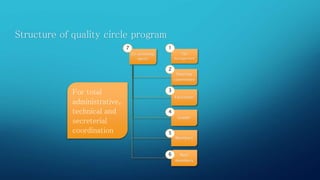
Co-ordinating 
agency 
Top 
management 
Steering 
commettee 
Facilitator 
Leader 
Members 
Non 
members 
Structure of quality circle program 
For total 
administrative, 
technical and 
secreterial 
coordination 
1 
2 
3 
4 
5 
6 
7
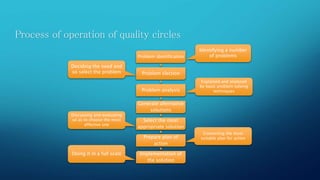
Process of operation of quality circles 
Problem identification 
Problem slection 
Problem analysis 
Generate alternative 
solutions 
Select the most 
appropriate solution 
Prepare plan of 
action 
Implementation of 
the solution 
Identifying a number 
of problems 
Deciding the need and 
so select the problem 
Explained and analysed 
by basic problem solving 
techniques 
Discussing and evaluating 
so as to choose the most 
effective one 
Converting the most 
suitable plan for action 
Doing it in a full scale
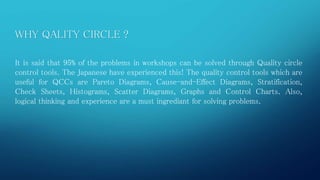
WHY QALITY CIRCLE ? 
It is said that 95% of the problems in workshops can be solved through Quality circle 
control tools. The Japanese have experienced this! The quality control tools which are 
useful for QCCs are Pareto Diagrams, Cause-and-Effect Diagrams, Stratification, 
Check Sheets, Histograms, Scatter Diagrams, Graphs and Control Charts. Also, 
logical thinking and experience are a must ingrediant for solving problems.
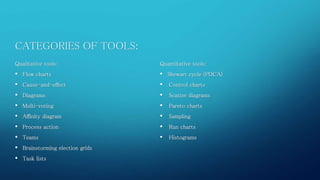
TOOLS OF TOTAL QUALITY MANAGEMENT: 
Total quality management (TQM) tools help organizations to identify, analyze and 
assess qualitative and quantitative data that is relevant to their business. These tools 
can identify procedures, ideas, statistics, cause and effect concerns and other issues 
relevant to their organizations.
CLASSIFICATION OF TOOLS: 
• Qualitative tools: Consist mainly of subjective inputs, which often do not intend to 
measure something of a numerical nature. 
• Quantitative tools: Involve either the extension of historical data or the analysis of 
objective data, which usually avoid personal bases that sometimes contaminate 
qualitative tools.
CATEGORIES OF TOOLS:
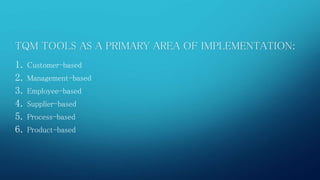
TQM TOOLS AS A PRIMARY AREA OF IMPLEMENTATION: 
1. Customer-based 
2. Management-based 
3. Employee-based 
4. Supplier-based 
5. Process-based 
6. Product-based
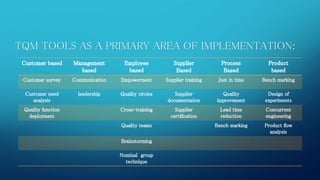
TQM TOOLS AS A PRIMARY AREA OF IMPLEMENTATION:
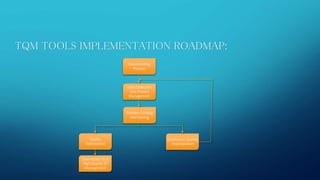
TQM TOOLS IMPLEMENTATION ROADMAP: 
Documenting 
Process 
Data Collection 
And Process 
Management 
Problem Finding 
And Solving 
Quality 
Stabilization 
Take Action To A 
High Quality Of 
Management 
Continuous Quality 
Improvement
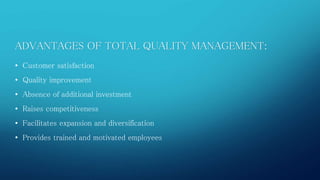
ADVANTAGES OF TOTAL QUALITY MANAGEMENT: 
• Customer satisfaction 
• Quality improvement 
• Absence of additional investment 
• Raises competitiveness 
• Facilitates expansion and diversification 
• Provides trained and motivated employees
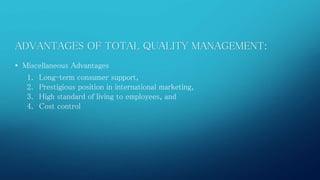
ADVANTAGES OF TOTAL QUALITY MANAGEMENT: 
• Miscellaneous Advantages 
1. Long-term consumer support, 
2. Prestigious position in international marketing, 
3. High standard of living to employees, and 
4. Cost control
THANKS

Total quality management vs quality circles, tools

  • 1.
    TOTAL QUALITY MANAGEMENTVS QUALITY CIRCLES, TOOLS, ADVANTAGES OF TOTAL QUALITY MANAGEMENT YASIR HASHMI 01
  • 2.
    TOTAL QUALITY MANAGEMENT: According to John Gilbert, Total Quality Management is "A process designed to focus on customer expectations, preventing problems, building commitment to quality in the workforce and promoting open decision-making."
  • 3.
    QUALITY CIRCLES: Accordingto Maurice Alston, "Quality Circles are small groups of people doing similar work who, together with their supervisors volunteer to meet for an hour a week to study and solve work related problems which affect them. Circle leaders and members are trained in simple problem solving techniques which identify causes and develop solutions. At an appropriate time, presentations are made by the quality circles to the management who decide whether to accept, modify or decline the proposals".
  • 4.
    DIFFERENCE BETWEEN TOTALQUALITY MANAGEMENT & QUALITY CIRCLES: • TQM is a system that not only emphasises on the quality of product but the application of high quality standards such as ISO 9000 etc in all the aspects of business management. • Quality circles is an employee based tool, which is a primary area for implementation of tools.
  • 5.
    Objectives of QualityCircles: • Promote job involvement • Create problem solving capability • Improve communication • Promote leadership qualities • Promote personal development • Develop a greater awareness for cleanliness • Develop greater awareness for safety • Improve morale through closer identity of employee objectives • Reduce errors. • Enhance quality • Inspire more effective team work • Build an attitude of problem prevention • Promote cost reduction • Develop harmonious manager, supervisor and worker relationship • Improve productivity • Reduce downtime of machines and equipment • Increase employee motivation
  • 6.
    Other Names ofQuality Circles • Small Groups • Action Circles • Excellence Circles • Human Resources Circles • Productivity Circles
  • 7.
    Quality Circle Meetings • Meetings are attended by all the members of the quality circle. • In general, meetings take place once a week or once in a fortnight. • Each meeting lasts for approximately one hour, though variations are possible. • Apart from the frequency of the meetings, what is important is the regularity of the meetings.
  • 8.
    Areas of interestto quality circle • Quality improvement. • Efficiency improvement in service organization. • Cost reduction. • Process control during manufacturing. • Safety in materials handling and equipment operations. • Equipment and manpower utilization. • Reduction in work in progress. • Job improvement. • Reduction in machine maintenance problems • Reduction in human errors.
  • 9.
    Co-ordinating agency Top management Steering commettee Facilitator Leader Members Non members Structure of quality circle program For total administrative, technical and secreterial coordination 1 2 3 4 5 6 7
  • 10.
    Process of operationof quality circles Problem identification Problem slection Problem analysis Generate alternative solutions Select the most appropriate solution Prepare plan of action Implementation of the solution Identifying a number of problems Deciding the need and so select the problem Explained and analysed by basic problem solving techniques Discussing and evaluating so as to choose the most effective one Converting the most suitable plan for action Doing it in a full scale
  • 11.
    WHY QALITY CIRCLE? It is said that 95% of the problems in workshops can be solved through Quality circle control tools. The Japanese have experienced this! The quality control tools which are useful for QCCs are Pareto Diagrams, Cause-and-Effect Diagrams, Stratification, Check Sheets, Histograms, Scatter Diagrams, Graphs and Control Charts. Also, logical thinking and experience are a must ingrediant for solving problems.
  • 12.
    TOOLS OF TOTALQUALITY MANAGEMENT: Total quality management (TQM) tools help organizations to identify, analyze and assess qualitative and quantitative data that is relevant to their business. These tools can identify procedures, ideas, statistics, cause and effect concerns and other issues relevant to their organizations.
  • 13.
    CLASSIFICATION OF TOOLS: • Qualitative tools: Consist mainly of subjective inputs, which often do not intend to measure something of a numerical nature. • Quantitative tools: Involve either the extension of historical data or the analysis of objective data, which usually avoid personal bases that sometimes contaminate qualitative tools.
  • 14.
  • 15.
    TQM TOOLS ASA PRIMARY AREA OF IMPLEMENTATION: 1. Customer-based 2. Management-based 3. Employee-based 4. Supplier-based 5. Process-based 6. Product-based
  • 16.
    TQM TOOLS ASA PRIMARY AREA OF IMPLEMENTATION:
  • 17.
    TQM TOOLS IMPLEMENTATIONROADMAP: Documenting Process Data Collection And Process Management Problem Finding And Solving Quality Stabilization Take Action To A High Quality Of Management Continuous Quality Improvement
  • 18.
    ADVANTAGES OF TOTALQUALITY MANAGEMENT: • Customer satisfaction • Quality improvement • Absence of additional investment • Raises competitiveness • Facilitates expansion and diversification • Provides trained and motivated employees
  • 19.
    ADVANTAGES OF TOTALQUALITY MANAGEMENT: • Miscellaneous Advantages 1. Long-term consumer support, 2. Prestigious position in international marketing, 3. High standard of living to employees, and 4. Cost control
  • 20.