Total Quality Management
Presented by:
Aakash.s
Harshini.k
Piyush.k
Aditya.h
Darshan.g
Sanjay.k
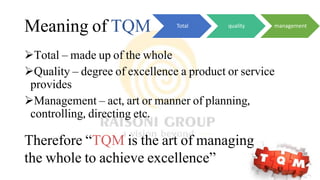
Meaning of TQM
Total – made up of the whole
Quality – degree of excellence a product or service
provides
Management – act, art or manner of planning,
controlling, directing etc.
Therefore “TQM is the art of managing
the whole to achieve excellence”
Total quality management
Defination of TQM
“Total quality management(TQM) has been defined as
an integrated organizational effort designed to improve
quality at every level”
 “The process to produce a perfect product by a series
of measures require an organized effort by the entire
company to prevent or eliminate errors at every stage in
production is called total quality management”
Features of TQM
Closer customer relations.
Increased training.
Employee empowerment.
Quality chains.
Company Policy and accountability.
Monitoring the process.
Consumer views.
Benchmarking.
Advantages of TQM
Enhanced market image
Elimination of defect and waste
Reduced costs and cost management
Higher profitability
Improved customer focus and satisfaction
Increased customer loyalty and retention
Improved employee morale
Enhanced shareholder value
Improved and innovative process
Disadvantages of TQM
It is not a quick fix. TQM takes years to implement.
It can lead to too much attention.
Extremely demanding of management and staff time.
Benefits may not be seen for several years.
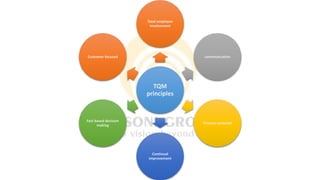
TQM
principles
Total employee
involvement
communication
Process centered
Continual
improvement
Fact based decision
making
Customer focused

Total Quality Management(TQM)

  • 1.
    Total Quality Management Presentedby: Aakash.s Harshini.k Piyush.k Aditya.h Darshan.g Sanjay.k
  • 2.
    Meaning of TQM Total– made up of the whole Quality – degree of excellence a product or service provides Management – act, art or manner of planning, controlling, directing etc. Therefore “TQM is the art of managing the whole to achieve excellence” Total quality management
  • 3.
    Defination of TQM “Totalquality management(TQM) has been defined as an integrated organizational effort designed to improve quality at every level”  “The process to produce a perfect product by a series of measures require an organized effort by the entire company to prevent or eliminate errors at every stage in production is called total quality management”
  • 4.
    Features of TQM Closercustomer relations. Increased training. Employee empowerment. Quality chains. Company Policy and accountability. Monitoring the process. Consumer views. Benchmarking.
  • 5.
    Advantages of TQM Enhancedmarket image Elimination of defect and waste Reduced costs and cost management Higher profitability Improved customer focus and satisfaction Increased customer loyalty and retention Improved employee morale Enhanced shareholder value Improved and innovative process
  • 6.
    Disadvantages of TQM Itis not a quick fix. TQM takes years to implement. It can lead to too much attention. Extremely demanding of management and staff time. Benefits may not be seen for several years.
  • 7.