QUALITY CIRCLES
INTRODUCTION
Worldwide competition, deregulation and rapid
technology changes are bringing focus on
quality awareness. The organization will be
required to be consumer focused instead of
product focused.
In order to stay in competitive international
market, TQM is an important area which will
require maximum attention of top
management.
WHAT IS QUALITY?
• Performances
• Features
• Conformance
• Reliability
• Aesthetics
TOTAL QUALITY MANAGEMENT
• Effective system for
integrating the quality
development.
• Quality maintenance and
quality improvement
efforts of various
functions of business
• Enabling production and
service at the most
economical levels to meet
full customer
satisfaction.
Armand Feigenbaum 1954
QUALITY CIRCLES
• It is a small group of 6 to 12 employees.
• Performing similar work who voluntarily meet
together on a regular basis to identify
improvements in their respective work areas.
• Using proven techniques for analyzing and
solving work related problems
• Achieving and sustaining excellence leading to
mutual upliftment of employees as well as the
organization
OTHER NAMES OF QUALITY CIRCLES
Small Groups
Action Circles
Excellence Circles
Human Resources Circles
Productivity Circles
ORIGIN OF QUALITY CIRCLES
• Nippon Wireless and
Telegraph Company but
then spread to more than
35 other companies in
the first year.
• By 1978 more than one
million quality circles
involving some 10 million
Japanese workers.
• In most East Asian
countries; it was recently
claimed that there were
more than 20 million
quality circles in China.
JAPAN-1962 Kaoru
Ishikawa
OBJECTIVES OF QC
• Creates problem solving capability.
• Develop a greater awareness for cleanliness
• Develop greater awareness for safety
• Reduce errors.
• Enhance quality
• Promote cost reduction
• Improve productivity
• Reduce downtime of machines and
equipment
PROCESS OF QUALITY CIRCLES
• Problem identification
• Problem selection
• Problem Analysis
• Generate alternative solutions
• Select the most appropriate solution
• Prepare plan of action
• Present solution to management circles
• Implementation of solution
TECHNIQUES OF QUALITY CIRCLE
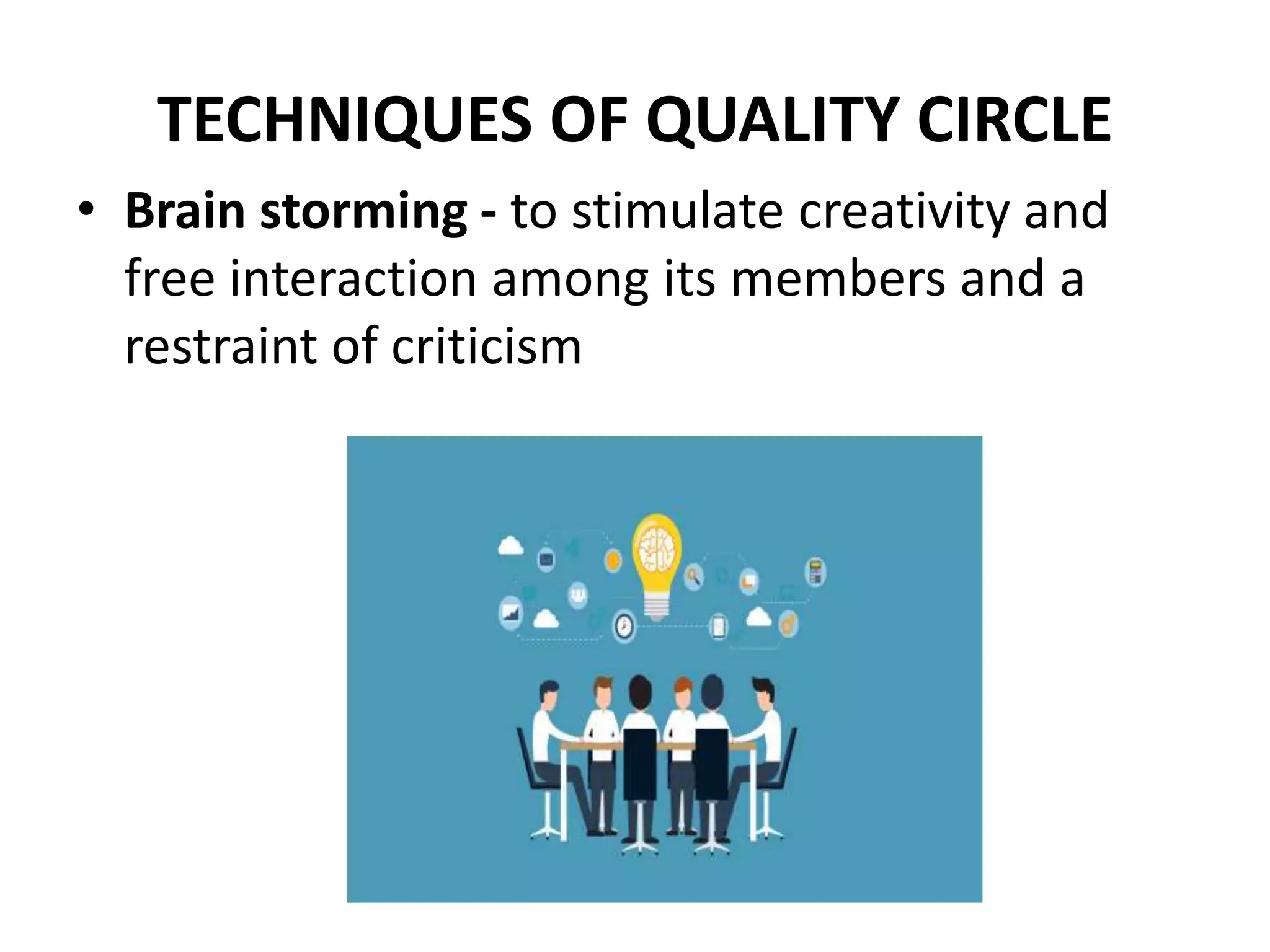
• Brain storming - to stimulate creativity and
free interaction among its members and a
restraint of criticism
• Cause and effect diagram- After a problem
has been identified, members are called to
present cause for the same. Through
discussions cause and effect relationships can
be arrived at after a number of meetings.
• Sampling and charting methods-QC members
are trained to observe key events at the work
place and chart them in the specific sequence
and interrelationships
SEVEN QUALITY IMPROVEMENT
TOOLS
• Cause-and-effect diagrams (sometimes called
Ishikawa or "fishbone" diagrams)
• Pareto charts
• Process mapping, data gathering tools such as
check sheets
• Graphical tools such as histograms, frequency
diagrams, spot charts and pie charts
• Run charts and control charts
• Scatter plots and correlation analysis
• Flowcharts
MYTHS
• The Quality Circle is to be used solely to solve
problems in product quality.
• The quality circle concept is applicable anywhere
provided the workers are trained in problem
solving
• The need is to train only the workers. The
managers and supervisors already have all the
training needed.
• The quality circle is the only way ever invented to
make use of the education, experience and
creativity of the worker
FACTS
• Quality Circles can be used (and are being used)
to solve problems in productivity, safety and cost
as well as quality.
• The quality circle concept involves a significant
amount of worker participation in decision
making on matters previously regarded solely the
responsibility of Supervisors. Managers must be
willing to accept such participation.
• The training of managers and supervisors must
precede that of the workers. This training is not
only in techniques but in the entire idea of how
to work with quality circles.
QUALITY CIRCLES IN INDIA
Introduced by BHEL, Ramachandrapuram
Hyderabad in the year 1981 in India with the
initiation of Mr. S.R. Udpa - GM-Operations.
VISION
• Quality Circle Forum of India shall be a national centre
for propagation of quality concepts and philosophy
with special focus on Quality Circles for promoting
material, human and spiritual level of people.
MISSION
• To impart training, knowledge and practice of Quality
concepts and philosophy with special attention to
Quality Circles in the organizations and enable people
of our nation to face challenges and achieve success in
this fierce competitive world.
• To disseminate, share and keep abreast in the
knowledge of Quality concepts.
• To create Total Quality People.
CONVENTIONS
• CCQC-Chapter Conventions on Quality Circles
• NCQC-National Conventions on Quality Circles
• ICQC- International Conventions on Quality
Circles
THANK YOU

Quality circle

  • 1.
  • 2.
    INTRODUCTION Worldwide competition, deregulationand rapid technology changes are bringing focus on quality awareness. The organization will be required to be consumer focused instead of product focused. In order to stay in competitive international market, TQM is an important area which will require maximum attention of top management.
  • 3.
    WHAT IS QUALITY? •Performances • Features • Conformance • Reliability • Aesthetics
  • 4.
    TOTAL QUALITY MANAGEMENT •Effective system for integrating the quality development. • Quality maintenance and quality improvement efforts of various functions of business • Enabling production and service at the most economical levels to meet full customer satisfaction. Armand Feigenbaum 1954
  • 5.
    QUALITY CIRCLES • Itis a small group of 6 to 12 employees. • Performing similar work who voluntarily meet together on a regular basis to identify improvements in their respective work areas. • Using proven techniques for analyzing and solving work related problems • Achieving and sustaining excellence leading to mutual upliftment of employees as well as the organization
  • 6.
    OTHER NAMES OFQUALITY CIRCLES Small Groups Action Circles Excellence Circles Human Resources Circles Productivity Circles
  • 7.
    ORIGIN OF QUALITYCIRCLES • Nippon Wireless and Telegraph Company but then spread to more than 35 other companies in the first year. • By 1978 more than one million quality circles involving some 10 million Japanese workers. • In most East Asian countries; it was recently claimed that there were more than 20 million quality circles in China. JAPAN-1962 Kaoru Ishikawa
  • 8.
    OBJECTIVES OF QC •Creates problem solving capability. • Develop a greater awareness for cleanliness • Develop greater awareness for safety • Reduce errors. • Enhance quality • Promote cost reduction • Improve productivity • Reduce downtime of machines and equipment
  • 10.
    PROCESS OF QUALITYCIRCLES • Problem identification • Problem selection • Problem Analysis • Generate alternative solutions • Select the most appropriate solution • Prepare plan of action • Present solution to management circles • Implementation of solution
  • 11.
    TECHNIQUES OF QUALITYCIRCLE • Brain storming - to stimulate creativity and free interaction among its members and a restraint of criticism
  • 12.
    • Cause andeffect diagram- After a problem has been identified, members are called to present cause for the same. Through discussions cause and effect relationships can be arrived at after a number of meetings. • Sampling and charting methods-QC members are trained to observe key events at the work place and chart them in the specific sequence and interrelationships
  • 14.
    SEVEN QUALITY IMPROVEMENT TOOLS •Cause-and-effect diagrams (sometimes called Ishikawa or "fishbone" diagrams) • Pareto charts • Process mapping, data gathering tools such as check sheets • Graphical tools such as histograms, frequency diagrams, spot charts and pie charts • Run charts and control charts • Scatter plots and correlation analysis • Flowcharts
  • 15.
    MYTHS • The QualityCircle is to be used solely to solve problems in product quality. • The quality circle concept is applicable anywhere provided the workers are trained in problem solving • The need is to train only the workers. The managers and supervisors already have all the training needed. • The quality circle is the only way ever invented to make use of the education, experience and creativity of the worker
  • 16.
    FACTS • Quality Circlescan be used (and are being used) to solve problems in productivity, safety and cost as well as quality. • The quality circle concept involves a significant amount of worker participation in decision making on matters previously regarded solely the responsibility of Supervisors. Managers must be willing to accept such participation. • The training of managers and supervisors must precede that of the workers. This training is not only in techniques but in the entire idea of how to work with quality circles.
  • 17.
    QUALITY CIRCLES ININDIA Introduced by BHEL, Ramachandrapuram Hyderabad in the year 1981 in India with the initiation of Mr. S.R. Udpa - GM-Operations.
  • 18.
    VISION • Quality CircleForum of India shall be a national centre for propagation of quality concepts and philosophy with special focus on Quality Circles for promoting material, human and spiritual level of people. MISSION • To impart training, knowledge and practice of Quality concepts and philosophy with special attention to Quality Circles in the organizations and enable people of our nation to face challenges and achieve success in this fierce competitive world. • To disseminate, share and keep abreast in the knowledge of Quality concepts. • To create Total Quality People.
  • 19.
    CONVENTIONS • CCQC-Chapter Conventionson Quality Circles • NCQC-National Conventions on Quality Circles • ICQC- International Conventions on Quality Circles
  • 20.