Quality CirclesA tool for Total Quality Management
Total Quality ManagementTotal – “Made up of whole”Management – ‘An art of planning, organizing, directing and controlling the assigned activities that takes place to accomplish objectives.’According to F.W. Taylor (Father of scientific Management), ‘Knowing exactly what you want men to do and seeing that they do it in the best and cheapest way.’Quality - “Quality is an attribute of a product or service that fulfills or exceeds the human expectations. These expectations are based on the intended use and selling / service price. “According to definition of ISO 8402, “ Totality of characteristics of an entity that bears on its ability to satisfy stated and implied needs.”
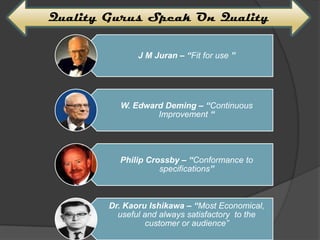
Quality Gurus Speak On Quality
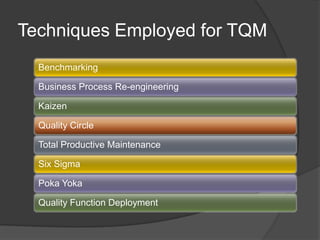
Techniques Employed for TQM
WHY Quality CirclesQuality Circle is one of the employee participation methods.It creates conditions and environment of work that stimulates  commitment towards excellence.Quality Circles utilize the potential of people for improvement in quality.
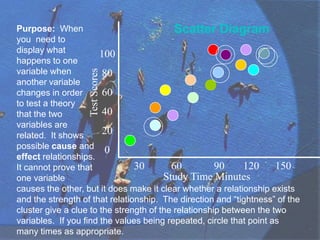
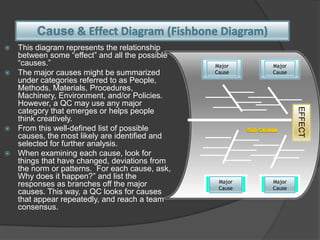
Genesis of Quality CirclesBefore the World War II, quality control pioneers existed in Japanese companies such as Toshiba.In 1949, after the war the Union of Japanese Scientists and Engineers (JUSE) was established to educate people about Quality Circle.On July 10, 1950, W.Edwards Deming started an eight day seminar on the theory of statistical Quality Control.Deming discussed how to make control charts and how to sample and inspect products. From this solid foundations, the Japanese established quality   control departments in their companies.They found that some aspects had to be altered to fit the Japanese workplace.One of these alterations resulted in the formation of “QUALITY CIRCLE”.Pioneers like, K. Ishikawa, Juran were the basis for creating quality circles.They used such statistical quality control techniques as Pareto charts, cause and effect diagrams.The spirit of quality circle embodied in the efforts of all those pioneers who recognized the need for improvement.
PhilosophyQuality Circles are a people – building philosophy It represents a philosophy of managing people specially those at the grass root level as well as a clearly defined mechanism and methodology for translating this philosophy into practice and a required structure to make it a way of life.It is bound to succeed where people are respected and are involved in decisions, concerning their work life, and in environments where people’s capabilities are looked upon as assets to solve work-area problems.The Quality Circle philosophy calls for a progressive attitude on the part of the management
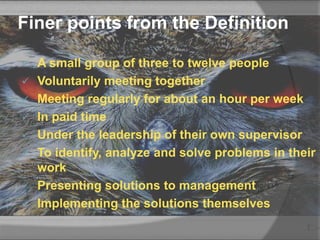
Definition of Quality CircleA small group of between three and twelve people who do the same or similar work, voluntarily meeting together regularly for about an hour per weekin paid time, usually under the Leadership of their own supervisor, and trained to identify, analyze, and solve some of the problems in their work, presenting solutions to management, and where possible, implementing the solutions themselves.'Finer points from the DefinitionA small group of three to twelve people
Voluntarily meeting together
Meeting regularly for about an hour per week
In paid time
Under the leadership of their own supervisor
To identify, analyze and solve problems in their work
Presenting solutions to management
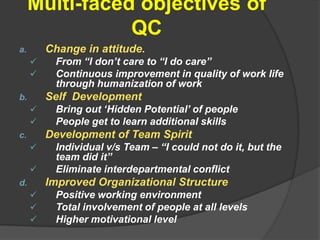
Implementing the solutions themselvesMulti-faced objectives of QCChange in attitude.From “I don’t care to “I do care”
Continuous improvement in quality of work life through humanization of workSelf  DevelopmentBring out ‘Hidden Potential’ of people
People get to learn additional skillsDevelopment of Team SpiritIndividual v/s Team – “I could not do it, but the team did it”
Eliminate interdepartmental conflictImproved Organizational StructurePositive working environment
Total involvement of people at all levels
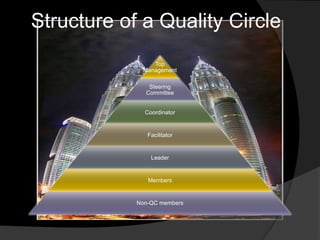
Higher motivational levelStructure of a Quality Circle
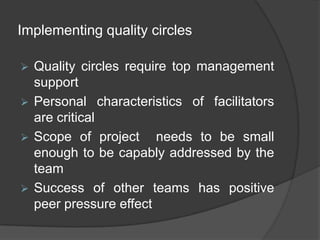
Roles and ResponsibilitiesThe Success of the quality circle depends solely on the attitude of the  topmanagement and plays an important role to ensure the success of implementation of quality circles in the organization.
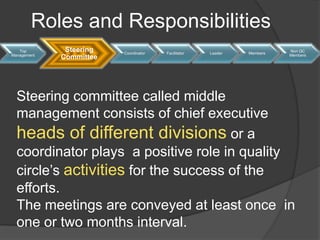
Roles and ResponsibilitiesSteering committee called middle management consists of chief executive heads of different divisions or a coordinator plays  a positive role in quality circle’s activities for the success of the efforts.The meetings are conveyed at least once  in one or two months interval.
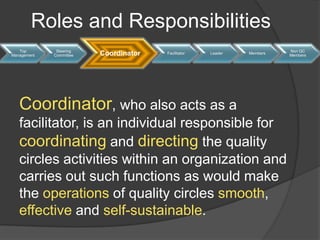
Roles and ResponsibilitiesCoordinator, who also acts as a facilitator, is an individual responsible for coordinating and directing the quality circles activities within an organization and carries out such functions as would make the operations of quality circles smooth, effective and self-sustainable.
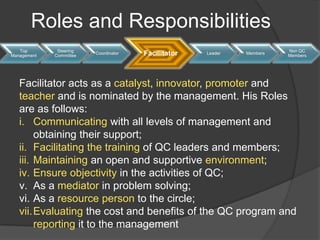
Roles and ResponsibilitiesFacilitator acts as a catalyst, innovator, promoter and teacher and is nominated by the management. His Roles are as follows:Communicating with all levels of management and obtaining their support;Facilitating the training of QC leaders and members;Maintaining an open and supportive environment;Ensureobjectivity in the activities of QC;As a mediator in problem solving;As a resourceperson to the circle;Evaluating the cost and benefits of the QC program and reporting it to the management
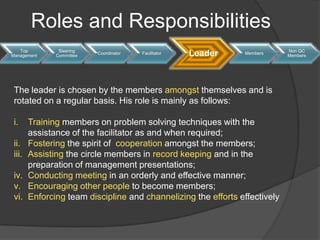
Roles and ResponsibilitiesThe leader is chosen by the members amongst themselves and is rotated on a regular basis. His role is mainly as follows:Training members on problem solving techniques with the assistance of the facilitator as and when required;Fostering the spirit of  cooperation amongst the members;Assisting the circle members in recordkeeping and in the preparation of management presentations;Conductingmeeting in an orderly and effective manner;Encouragingotherpeople to become members;Enforcing team discipline and channelizing the efforts effectively
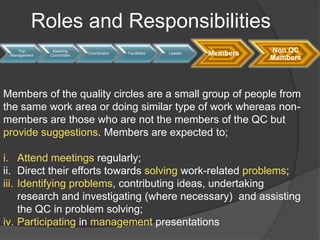
Roles and ResponsibilitiesMembers of the quality circles are a small group of people from the same work area or doing similar type of work whereas non-members are those who are not the members of the QC but providesuggestions. Members are expected to;Attendmeetings regularly;Direct their efforts towards solving work-related problems;Identifyingproblems, contributing ideas, undertaking research and investigating (where necessary)  and assisting the QC in problem solving;Participating in management presentations
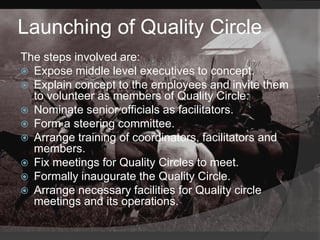
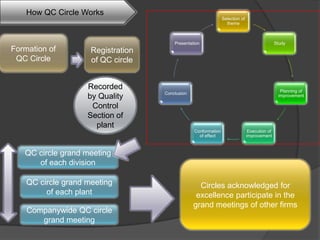
Launching of Quality CircleThe steps involved are:Expose middle level executives to concept.Explain concept to the employees and invite them to volunteer as members of Quality Circle.Nominate senior officials as facilitators.Form a steering committee.Arrange training of coordinators, facilitators and members.Fix meetings for Quality Circles to meet.Formally inaugurate the Quality Circle.Arrange necessary facilities for Quality circle meetings and its operations.
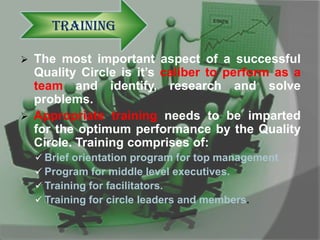
TrainingThe most important aspect of a successful Quality Circle is it’s caliber to perform as a team and identify, research and solve problems.
Appropriate training needs to be imparted for the optimum performance by the Quality Circle. Training comprises of:
Brief orientation program for top management
Program for middle level executives.
Training for facilitators.
Training for circle leaders and members.  Organizational Readiness    The readiness of the management to sanction and support Quality Circle is fundamental to it’s success. Organizational Readiness can be assessed by scrutiny of answers to the following questions:Is the organization and management competent enough?Is management willing to settle for long term benefits if short term ones do not materialize?Is the management flexible and committed enough?Is management willing to accept involvement and share power?
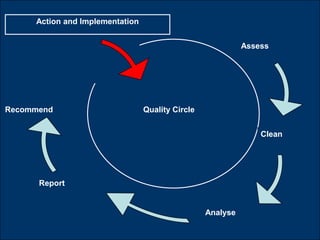
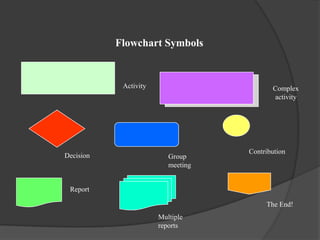
Action and ImplementationAssessRecommendQuality CircleCleanReportAnalyse
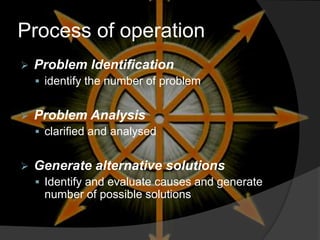
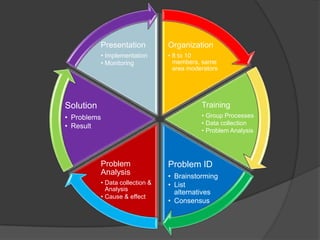
Process of operation	Problem Identification
identify the number of problem
Problem Analysis
clarified and analysed
Generate alternative solutions
Identify and evaluate causes and generate number of possible solutionsSelect most appropriate solutions
Identify & generate causes
Generate possible alternative solutions
Prepare plan for action
convert solutions to reality
Present solution to management
Fore approval
Implement of solution
Evaluated recommended solutionHow to use the concept	With the help of 3 main parts:Identifying

Qcc

  • 1.
    Quality CirclesA toolfor Total Quality Management
  • 2.
    Total Quality ManagementTotal– “Made up of whole”Management – ‘An art of planning, organizing, directing and controlling the assigned activities that takes place to accomplish objectives.’According to F.W. Taylor (Father of scientific Management), ‘Knowing exactly what you want men to do and seeing that they do it in the best and cheapest way.’Quality - “Quality is an attribute of a product or service that fulfills or exceeds the human expectations. These expectations are based on the intended use and selling / service price. “According to definition of ISO 8402, “ Totality of characteristics of an entity that bears on its ability to satisfy stated and implied needs.”
  • 3.
  • 4.
  • 5.
    WHY Quality CirclesQualityCircle is one of the employee participation methods.It creates conditions and environment of work that stimulates commitment towards excellence.Quality Circles utilize the potential of people for improvement in quality.
  • 6.
    Genesis of QualityCirclesBefore the World War II, quality control pioneers existed in Japanese companies such as Toshiba.In 1949, after the war the Union of Japanese Scientists and Engineers (JUSE) was established to educate people about Quality Circle.On July 10, 1950, W.Edwards Deming started an eight day seminar on the theory of statistical Quality Control.Deming discussed how to make control charts and how to sample and inspect products. From this solid foundations, the Japanese established quality control departments in their companies.They found that some aspects had to be altered to fit the Japanese workplace.One of these alterations resulted in the formation of “QUALITY CIRCLE”.Pioneers like, K. Ishikawa, Juran were the basis for creating quality circles.They used such statistical quality control techniques as Pareto charts, cause and effect diagrams.The spirit of quality circle embodied in the efforts of all those pioneers who recognized the need for improvement.
  • 7.
    PhilosophyQuality Circles area people – building philosophy It represents a philosophy of managing people specially those at the grass root level as well as a clearly defined mechanism and methodology for translating this philosophy into practice and a required structure to make it a way of life.It is bound to succeed where people are respected and are involved in decisions, concerning their work life, and in environments where people’s capabilities are looked upon as assets to solve work-area problems.The Quality Circle philosophy calls for a progressive attitude on the part of the management
  • 8.
    Definition of QualityCircleA small group of between three and twelve people who do the same or similar work, voluntarily meeting together regularly for about an hour per weekin paid time, usually under the Leadership of their own supervisor, and trained to identify, analyze, and solve some of the problems in their work, presenting solutions to management, and where possible, implementing the solutions themselves.'Finer points from the DefinitionA small group of three to twelve people
  • 9.
  • 10.
    Meeting regularly forabout an hour per week
  • 11.
  • 12.
    Under the leadershipof their own supervisor
  • 13.
    To identify, analyzeand solve problems in their work
  • 14.
  • 15.
    Implementing the solutionsthemselvesMulti-faced objectives of QCChange in attitude.From “I don’t care to “I do care”
  • 16.
    Continuous improvement inquality of work life through humanization of workSelf DevelopmentBring out ‘Hidden Potential’ of people
  • 17.
    People get tolearn additional skillsDevelopment of Team SpiritIndividual v/s Team – “I could not do it, but the team did it”
  • 18.
    Eliminate interdepartmental conflictImprovedOrganizational StructurePositive working environment
  • 19.
    Total involvement ofpeople at all levels
  • 20.
  • 21.
    Roles and ResponsibilitiesTheSuccess of the quality circle depends solely on the attitude of the topmanagement and plays an important role to ensure the success of implementation of quality circles in the organization.
  • 22.
    Roles and ResponsibilitiesSteeringcommittee called middle management consists of chief executive heads of different divisions or a coordinator plays a positive role in quality circle’s activities for the success of the efforts.The meetings are conveyed at least once in one or two months interval.
  • 23.
    Roles and ResponsibilitiesCoordinator,who also acts as a facilitator, is an individual responsible for coordinating and directing the quality circles activities within an organization and carries out such functions as would make the operations of quality circles smooth, effective and self-sustainable.
  • 24.
    Roles and ResponsibilitiesFacilitatoracts as a catalyst, innovator, promoter and teacher and is nominated by the management. His Roles are as follows:Communicating with all levels of management and obtaining their support;Facilitating the training of QC leaders and members;Maintaining an open and supportive environment;Ensureobjectivity in the activities of QC;As a mediator in problem solving;As a resourceperson to the circle;Evaluating the cost and benefits of the QC program and reporting it to the management
  • 25.
    Roles and ResponsibilitiesTheleader is chosen by the members amongst themselves and is rotated on a regular basis. His role is mainly as follows:Training members on problem solving techniques with the assistance of the facilitator as and when required;Fostering the spirit of cooperation amongst the members;Assisting the circle members in recordkeeping and in the preparation of management presentations;Conductingmeeting in an orderly and effective manner;Encouragingotherpeople to become members;Enforcing team discipline and channelizing the efforts effectively
  • 26.
    Roles and ResponsibilitiesMembersof the quality circles are a small group of people from the same work area or doing similar type of work whereas non-members are those who are not the members of the QC but providesuggestions. Members are expected to;Attendmeetings regularly;Direct their efforts towards solving work-related problems;Identifyingproblems, contributing ideas, undertaking research and investigating (where necessary) and assisting the QC in problem solving;Participating in management presentations
  • 27.
    Launching of QualityCircleThe steps involved are:Expose middle level executives to concept.Explain concept to the employees and invite them to volunteer as members of Quality Circle.Nominate senior officials as facilitators.Form a steering committee.Arrange training of coordinators, facilitators and members.Fix meetings for Quality Circles to meet.Formally inaugurate the Quality Circle.Arrange necessary facilities for Quality circle meetings and its operations.
  • 28.
    TrainingThe most importantaspect of a successful Quality Circle is it’s caliber to perform as a team and identify, research and solve problems.
  • 29.
    Appropriate training needsto be imparted for the optimum performance by the Quality Circle. Training comprises of:
  • 30.
    Brief orientation programfor top management
  • 31.
    Program for middlelevel executives.
  • 32.
  • 33.
    Training for circleleaders and members. Organizational Readiness The readiness of the management to sanction and support Quality Circle is fundamental to it’s success. Organizational Readiness can be assessed by scrutiny of answers to the following questions:Is the organization and management competent enough?Is management willing to settle for long term benefits if short term ones do not materialize?Is the management flexible and committed enough?Is management willing to accept involvement and share power?
  • 34.
  • 35.
  • 36.
  • 37.
  • 38.
  • 39.
  • 40.
    Identify and evaluatecauses and generate number of possible solutionsSelect most appropriate solutions
  • 41.
  • 42.
  • 43.
  • 44.
  • 45.
  • 46.
  • 47.
  • 48.
    Evaluated recommended solutionHowto use the concept With the help of 3 main parts:Identifying