ROOT CAUSE ANALYSIS –
TOOLS AND PROCESS
CHARLES COTTER
15-16 MAY 2014
TRAINING PROGRAMME
OVERVIEW
• Defining the fundamental concepts
• Building a Business Case for RCA
• 10 General Principles of RCA
• 3 Basic types of causes
• Foremost RCA tools and techniques
• The 5-step RCA process
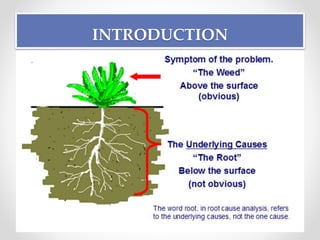
INTRODUCTION
DEFINING THE FUNDAMENTAL
CONCEPTS
• Root cause
• Root Cause Analysis (RCA)
• Problem-solving
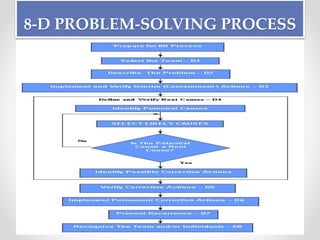
• 8-D Problem-solving process
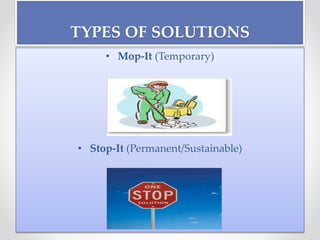
TYPES OF SOLUTIONS
• Mop-It (Temporary)
• Stop-It (Permanent/Sustainable)
DEFINING ROOT CAUSE
ANALYSIS (RCA)
• RCA is a useful process for understanding and solving a problem. RCA is a
systematic process for identifying “root causes” of problems or events and an
approach for responding to them.
• Wilson et al. (1993) have defined the Root Cause Analysis (RCA) as an analytic
tool that can be used to perform a comprehensive, system-based review of
critical incidents.
• It includes the identification of the root and contributory factors,
determination of risk reduction strategies and development of action plans
along with measurement strategies to evaluate the effectiveness of the plans.
• RCA is based on the basic idea that effective management requires more than
merely “putting out fires” for problems that develop, but finding a way to
prevent them.
• Essentially, RCA means finding the specific source(s) that created the problem
so that effective action can be taken to prevent recurrence of the situation.
8-D PROBLEM-SOLVING PROCESS
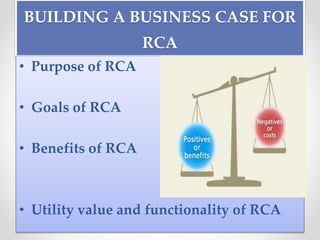
BUILDING A BUSINESS CASE FOR
RCA
• Purpose of RCA
• Goals of RCA
• Benefits of RCA
• Utility value and functionality of RCA
BENEFITS OF RCA
• Identify barriers and the causes of problems, so that
permanent solutions can be found
• Develop a logical approach to problem-solving, using
data that already exists in the organization
• Identify current and future needs for organizational
improvement
• Establish repeatable, step-by-step processes, in which
one process can confirm the results of another
10 GENERAL PRINCIPLES OF RCA
• RCA is a diagnostic and analytical tool
• Effective RCA is a systematic process
• Effective implementation of RCA requires a fundamental
shift in attitudes and mindset
• RCA requires supportive organizational and
management cultures
• Persistence and sustainability in the RCA effort
10 GENERAL PRINCIPLES OF RCA
• RCA is an efficient and economical process
• Effective problem statements and event descriptions are
helpful, or even required
• RCA can help transform a reactive culture into a forward-
looking culture and it also reduces the frequency of
problems occurring over time within the environment
• RCA requires a collaborative, multidisciplinary team effort
• The focal points of RCA are corrective measures of root
causes and not simply treating the symptoms of a problem or
event
The focus of investigation and analysis through
problem identification is WHY the event
occurred, and not who made the error i.e.
“Hard on the problem, soft on the person.”
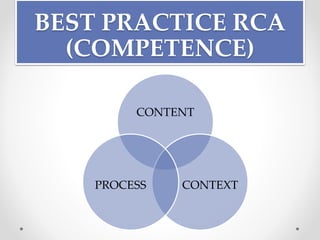
BEST PRACTICE RCA
(COMPETENCE)
CONTENT
CONTEXTPROCESS
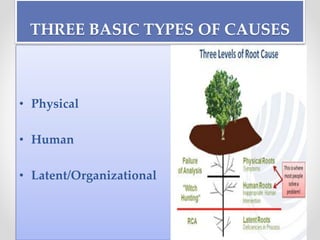
THREE BASIC TYPES OF CAUSES
• Physical
• Human
• Latent/Organizational
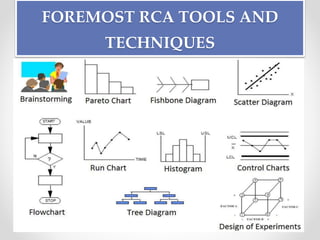
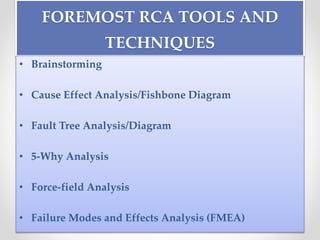
FOREMOST RCA TOOLS AND
TECHNIQUES
FOREMOST RCA TOOLS AND
TECHNIQUES
• Brainstorming
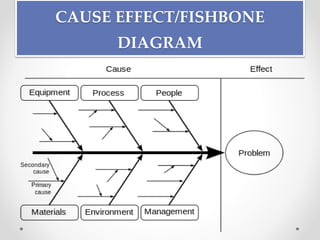
• Cause Effect Analysis/Fishbone Diagram
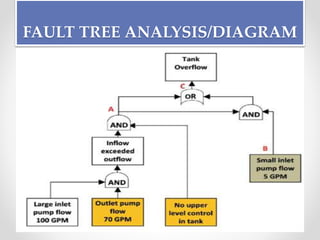
• Fault Tree Analysis/Diagram
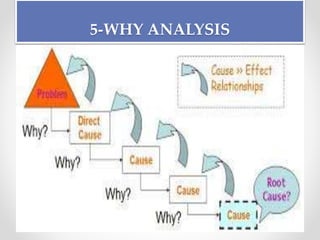
• 5-Why Analysis
• Force-field Analysis
• Failure Modes and Effects Analysis (FMEA)
CAUSE EFFECT/FISHBONE
DIAGRAM
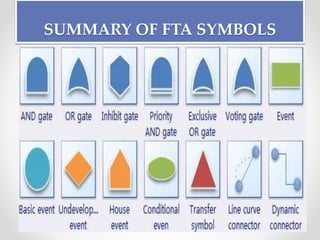
FAULT TREE ANALYSIS/DIAGRAM
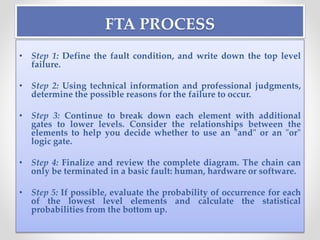
FTA PROCESS
• Step 1: Define the fault condition, and write down the top level
failure.
• Step 2: Using technical information and professional judgments,
determine the possible reasons for the failure to occur.
• Step 3: Continue to break down each element with additional
gates to lower levels. Consider the relationships between the
elements to help you decide whether to use an "and" or an "or"
logic gate.
• Step 4: Finalize and review the complete diagram. The chain can
only be terminated in a basic fault: human, hardware or software.
• Step 5: If possible, evaluate the probability of occurrence for each
of the lowest level elements and calculate the statistical
probabilities from the bottom up.
SUMMARY OF FTA SYMBOLS
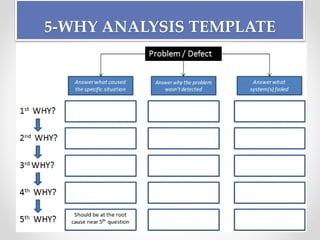
5-WHY ANALYSIS
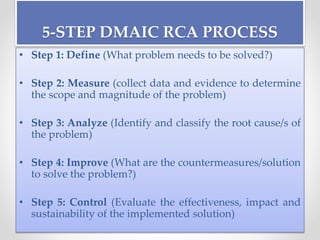
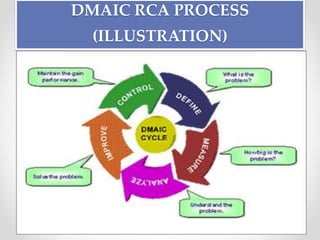
5-STEP DMAIC RCA PROCESS
• Step 1: Define (What problem needs to be solved?)
• Step 2: Measure (collect data and evidence to determine
the scope and magnitude of the problem)
• Step 3: Analyze (Identify and classify the root cause/s of
the problem)
• Step 4: Improve (What are the countermeasures/solution
to solve the problem?)
• Step 5: Control (Evaluate the effectiveness, impact and
sustainability of the implemented solution)
DMAIC RCA PROCESS
(ILLUSTRATION)
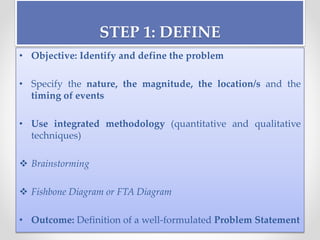
STEP 1: DEFINE
• Objective: Identify and define the problem
• Specify the nature, the magnitude, the location/s and the
timing of events
• Use integrated methodology (quantitative and qualitative
techniques)
 Brainstorming
 Fishbone Diagram or FTA Diagram
• Outcome: Definition of a well-formulated Problem Statement
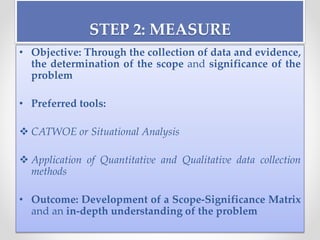
STEP 2: MEASURE
• Objective: Through the collection of data and evidence,
the determination of the scope and significance of the
problem
• Preferred tools:
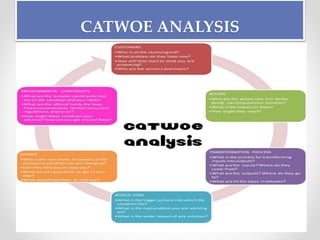
 CATWOE or Situational Analysis
 Application of Quantitative and Qualitative data collection
methods
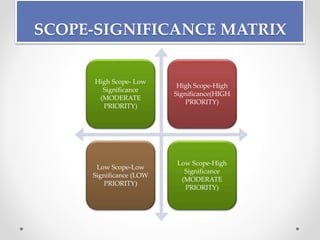
• Outcome: Development of a Scope-Significance Matrix
and an in-depth understanding of the problem
CATWOE ANALYSIS
SCOPE-SIGNIFICANCE MATRIX
High Scope- Low
Significance
(MODERATE
PRIORITY)
High Scope-High
Significance(HIGH
PRIORITY)
Low Scope-Low
Significance (LOW
PRIORITY)
Low Scope-High
Significance
(MODERATE
PRIORITY)
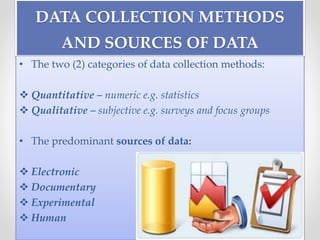
DATA COLLECTION METHODS
AND SOURCES OF DATA
• The two (2) categories of data collection methods:
 Quantitative – numeric e.g. statistics
 Qualitative – subjective e.g. surveys and focus groups
• The predominant sources of data:
 Electronic
 Documentary
 Experimental
 Human
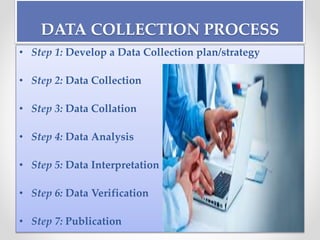
DATA COLLECTION PROCESS
• Step 1: Develop a Data Collection plan/strategy
• Step 2: Data Collection
• Step 3: Data Collation
• Step 4: Data Analysis
• Step 5: Data Interpretation
• Step 6: Data Verification
• Step 7: Publication
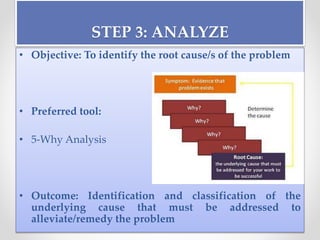
STEP 3: ANALYZE
• Objective: To identify the root cause/s of the problem
• Preferred tool:
• 5-Why Analysis
• Outcome: Identification and classification of the
underlying cause that must be addressed to
alleviate/remedy the problem
5-WHY ANALYSIS TEMPLATE
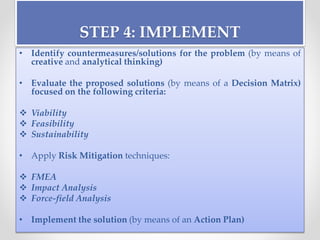
STEP 4: IMPLEMENT
• Identify countermeasures/solutions for the problem (by means of
creative and analytical thinking)
• Evaluate the proposed solutions (by means of a Decision Matrix)
focused on the following criteria:
 Viability
 Feasibility
 Sustainability
• Apply Risk Mitigation techniques:
 FMEA
 Impact Analysis
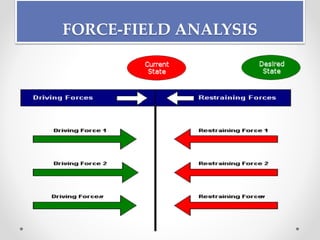
 Force-field Analysis
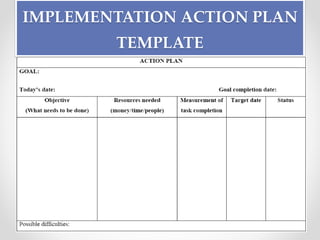
• Implement the solution (by means of an Action Plan)
FORCE-FIELD ANALYSIS
IMPLEMENTATION ACTION PLAN
TEMPLATE
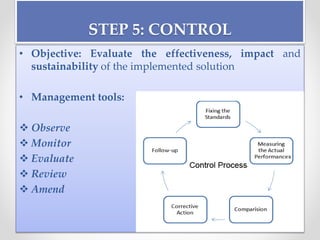
STEP 5: CONTROL
• Objective: Evaluate the effectiveness, impact and
sustainability of the implemented solution
• Management tools:
 Observe
 Monitor
 Evaluate
 Review
 Amend
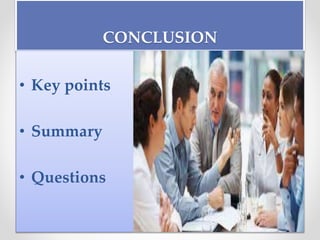
CONCLUSION
• Key points
• Summary
• Questions
CONTACT DETAILS
• Charles Cotter
• (+27) 84 562 9446
• charlescot@polka.co.za
• LinkedIn
• Twitter: Charles_Cotter

Root cause analysis - tools and process

  • 1.
    ROOT CAUSE ANALYSIS– TOOLS AND PROCESS CHARLES COTTER 15-16 MAY 2014
  • 2.
    TRAINING PROGRAMME OVERVIEW • Definingthe fundamental concepts • Building a Business Case for RCA • 10 General Principles of RCA • 3 Basic types of causes • Foremost RCA tools and techniques • The 5-step RCA process
  • 3.
  • 4.
    DEFINING THE FUNDAMENTAL CONCEPTS •Root cause • Root Cause Analysis (RCA) • Problem-solving • 8-D Problem-solving process
  • 6.
    TYPES OF SOLUTIONS •Mop-It (Temporary) • Stop-It (Permanent/Sustainable)
  • 7.
    DEFINING ROOT CAUSE ANALYSIS(RCA) • RCA is a useful process for understanding and solving a problem. RCA is a systematic process for identifying “root causes” of problems or events and an approach for responding to them. • Wilson et al. (1993) have defined the Root Cause Analysis (RCA) as an analytic tool that can be used to perform a comprehensive, system-based review of critical incidents. • It includes the identification of the root and contributory factors, determination of risk reduction strategies and development of action plans along with measurement strategies to evaluate the effectiveness of the plans. • RCA is based on the basic idea that effective management requires more than merely “putting out fires” for problems that develop, but finding a way to prevent them. • Essentially, RCA means finding the specific source(s) that created the problem so that effective action can be taken to prevent recurrence of the situation.
  • 9.
  • 10.
    BUILDING A BUSINESSCASE FOR RCA • Purpose of RCA • Goals of RCA • Benefits of RCA • Utility value and functionality of RCA
  • 11.
    BENEFITS OF RCA •Identify barriers and the causes of problems, so that permanent solutions can be found • Develop a logical approach to problem-solving, using data that already exists in the organization • Identify current and future needs for organizational improvement • Establish repeatable, step-by-step processes, in which one process can confirm the results of another
  • 12.
    10 GENERAL PRINCIPLESOF RCA • RCA is a diagnostic and analytical tool • Effective RCA is a systematic process • Effective implementation of RCA requires a fundamental shift in attitudes and mindset • RCA requires supportive organizational and management cultures • Persistence and sustainability in the RCA effort
  • 13.
    10 GENERAL PRINCIPLESOF RCA • RCA is an efficient and economical process • Effective problem statements and event descriptions are helpful, or even required • RCA can help transform a reactive culture into a forward- looking culture and it also reduces the frequency of problems occurring over time within the environment • RCA requires a collaborative, multidisciplinary team effort • The focal points of RCA are corrective measures of root causes and not simply treating the symptoms of a problem or event
  • 14.
    The focus ofinvestigation and analysis through problem identification is WHY the event occurred, and not who made the error i.e. “Hard on the problem, soft on the person.”
  • 15.
  • 16.
    THREE BASIC TYPESOF CAUSES • Physical • Human • Latent/Organizational
  • 17.
    FOREMOST RCA TOOLSAND TECHNIQUES
  • 18.
    FOREMOST RCA TOOLSAND TECHNIQUES • Brainstorming • Cause Effect Analysis/Fishbone Diagram • Fault Tree Analysis/Diagram • 5-Why Analysis • Force-field Analysis • Failure Modes and Effects Analysis (FMEA)
  • 19.
  • 20.
  • 21.
    FTA PROCESS • Step1: Define the fault condition, and write down the top level failure. • Step 2: Using technical information and professional judgments, determine the possible reasons for the failure to occur. • Step 3: Continue to break down each element with additional gates to lower levels. Consider the relationships between the elements to help you decide whether to use an "and" or an "or" logic gate. • Step 4: Finalize and review the complete diagram. The chain can only be terminated in a basic fault: human, hardware or software. • Step 5: If possible, evaluate the probability of occurrence for each of the lowest level elements and calculate the statistical probabilities from the bottom up.
  • 22.
  • 23.
  • 24.
    5-STEP DMAIC RCAPROCESS • Step 1: Define (What problem needs to be solved?) • Step 2: Measure (collect data and evidence to determine the scope and magnitude of the problem) • Step 3: Analyze (Identify and classify the root cause/s of the problem) • Step 4: Improve (What are the countermeasures/solution to solve the problem?) • Step 5: Control (Evaluate the effectiveness, impact and sustainability of the implemented solution)
  • 25.
  • 26.
    STEP 1: DEFINE •Objective: Identify and define the problem • Specify the nature, the magnitude, the location/s and the timing of events • Use integrated methodology (quantitative and qualitative techniques)  Brainstorming  Fishbone Diagram or FTA Diagram • Outcome: Definition of a well-formulated Problem Statement
  • 28.
    STEP 2: MEASURE •Objective: Through the collection of data and evidence, the determination of the scope and significance of the problem • Preferred tools:  CATWOE or Situational Analysis  Application of Quantitative and Qualitative data collection methods • Outcome: Development of a Scope-Significance Matrix and an in-depth understanding of the problem
  • 29.
  • 30.
    SCOPE-SIGNIFICANCE MATRIX High Scope-Low Significance (MODERATE PRIORITY) High Scope-High Significance(HIGH PRIORITY) Low Scope-Low Significance (LOW PRIORITY) Low Scope-High Significance (MODERATE PRIORITY)
  • 31.
    DATA COLLECTION METHODS ANDSOURCES OF DATA • The two (2) categories of data collection methods:  Quantitative – numeric e.g. statistics  Qualitative – subjective e.g. surveys and focus groups • The predominant sources of data:  Electronic  Documentary  Experimental  Human
  • 32.
    DATA COLLECTION PROCESS •Step 1: Develop a Data Collection plan/strategy • Step 2: Data Collection • Step 3: Data Collation • Step 4: Data Analysis • Step 5: Data Interpretation • Step 6: Data Verification • Step 7: Publication
  • 33.
    STEP 3: ANALYZE •Objective: To identify the root cause/s of the problem • Preferred tool: • 5-Why Analysis • Outcome: Identification and classification of the underlying cause that must be addressed to alleviate/remedy the problem
  • 34.
  • 35.
    STEP 4: IMPLEMENT •Identify countermeasures/solutions for the problem (by means of creative and analytical thinking) • Evaluate the proposed solutions (by means of a Decision Matrix) focused on the following criteria:  Viability  Feasibility  Sustainability • Apply Risk Mitigation techniques:  FMEA  Impact Analysis  Force-field Analysis • Implement the solution (by means of an Action Plan)
  • 36.
  • 37.
  • 38.
    STEP 5: CONTROL •Objective: Evaluate the effectiveness, impact and sustainability of the implemented solution • Management tools:  Observe  Monitor  Evaluate  Review  Amend
  • 39.
    CONCLUSION • Key points •Summary • Questions
  • 40.
    CONTACT DETAILS • CharlesCotter • (+27) 84 562 9446 • charlescot@polka.co.za • LinkedIn • Twitter: Charles_Cotter