By
VISHAL KUMAR SINGH
1CR12CV057
Guided by:
Vibha N. Dalawai
CONTENTS
 Introduction
 Objective
 Major construction of TBM
 Tunnel lining
 Surveying
 Geotechnical consideration
 Different types of TBM
 Annulus grouts & Mortars
 References
INTRODUCTION
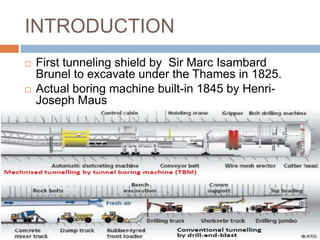
 First tunneling shield by Sir Marc Isambard
Brunel to excavate under the Thames in 1825.
 Actual boring machine built-in 1845 by Henri-
Joseph Maus
OBJECTIVES
 To give an understanding of what is a
TBM.
 To build up an awareness of the wide
variety of perils TBMs are exposed to.
 Role of civil engineers in this machine
tunneling work.
 How we utilizes our geotechnical and
survey knowledge.
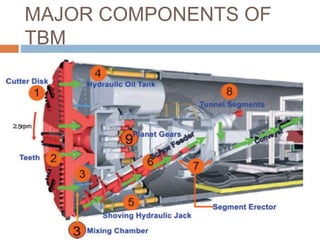
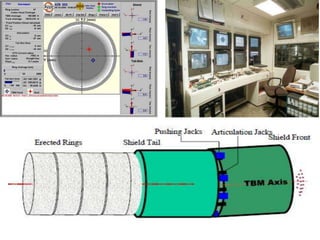
MAJOR COMPONENTS OF
TBM
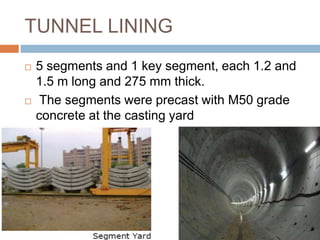
TUNNEL LINING
 5 segments and 1 key segment, each 1.2 and
1.5 m long and 275 mm thick.
 The segments were precast with M50 grade
concrete at the casting yard
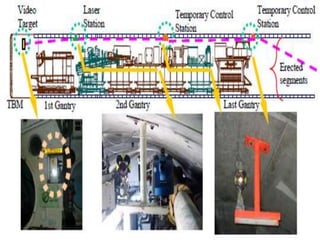
SURVEYING
 After doing general survey i.e. identifying
geographical extent of the construction work,
reconnaissance survey, establishing new
survey stations from known control stations.
 Computation of global coordinates of control
stations are performed
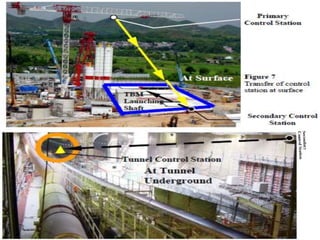
 Secondary control station established for TBM
launching shaft at surface & then transfer that
to tunnel control station at underground level
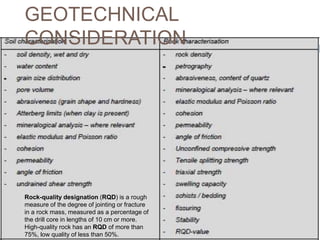
GEOTECHNICAL
CONSIDERATION
Rock-quality designation (RQD) is a rough
measure of the degree of jointing or fracture
in a rock mass, measured as a percentage of
the drill core in lengths of 10 cm or more.
High-quality rock has an RQD of more than
75%, low quality of less than 50%.
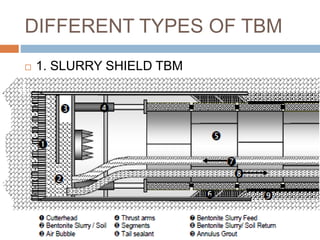
DIFFERENT TYPES OF TBM
 1. SLURRY SHIELD TBM
slurry test programmed will generally include the above parameters[ 2]
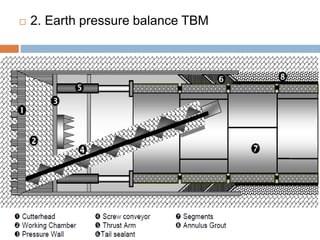
 2. Earth pressure balance TBM
indicates typical particle size distributions for the use of EPBM[ 3 ]
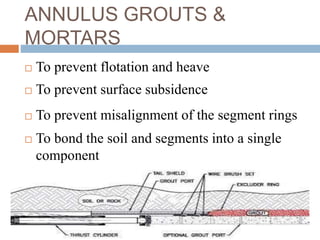
ANNULUS GROUTS &
MORTARS
 To prevent flotation and heave
 To prevent surface subsidence
 To prevent misalignment of the segment rings
 To bond the soil and segments into a single
component
REFERENCES
 1).To my training, which I did in tunneling, on the metro site of Delhi, which was under
construction under Shanghai Urban Construction Group (SUCG), joint venture with L&T.
 2). Andrew Hung Shing Lee, “ENGINEERING SURVEY SYSTEM FOR TBM (Tunnel
Boring Machine TUNNEL CONSTRUCTION)”, Hong Kong ISBN 978-56-56-65-55
 3). Kolymbass, 2005 “TUNNELING & TUNNEL MECHANICS”, 2005, ISBN 456-23-
59-20-12
 4). “A GENERAL OVERVIEW ON TUNNEL BORING MACHINES” By Prof. jian
ZHAQ, rock mechanics and tunnelling. UK ISBN 111-419-23-45-71-83
 M. Cigla, S. Yagiz & l.Ozdemir,"APPLICATION OF TUNNEL BORING MACHINES IN
THANK YOU

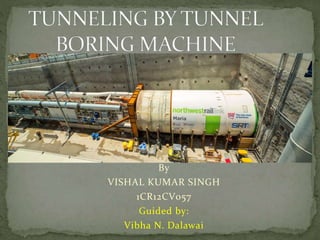
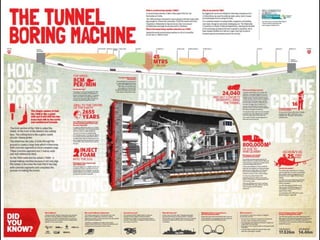
Tunneling by tunnel boring machine

  • 1.
  • 2.
    CONTENTS  Introduction  Objective Major construction of TBM  Tunnel lining  Surveying  Geotechnical consideration  Different types of TBM  Annulus grouts & Mortars  References
  • 3.
    INTRODUCTION  First tunnelingshield by Sir Marc Isambard Brunel to excavate under the Thames in 1825.  Actual boring machine built-in 1845 by Henri- Joseph Maus
  • 4.
    OBJECTIVES  To givean understanding of what is a TBM.  To build up an awareness of the wide variety of perils TBMs are exposed to.  Role of civil engineers in this machine tunneling work.  How we utilizes our geotechnical and survey knowledge.
  • 5.
  • 6.
    TUNNEL LINING  5segments and 1 key segment, each 1.2 and 1.5 m long and 275 mm thick.  The segments were precast with M50 grade concrete at the casting yard
  • 7.
    SURVEYING  After doinggeneral survey i.e. identifying geographical extent of the construction work, reconnaissance survey, establishing new survey stations from known control stations.  Computation of global coordinates of control stations are performed  Secondary control station established for TBM launching shaft at surface & then transfer that to tunnel control station at underground level
  • 11.
    GEOTECHNICAL CONSIDERATION Rock-quality designation (RQD)is a rough measure of the degree of jointing or fracture in a rock mass, measured as a percentage of the drill core in lengths of 10 cm or more. High-quality rock has an RQD of more than 75%, low quality of less than 50%.
  • 12.
    DIFFERENT TYPES OFTBM  1. SLURRY SHIELD TBM
  • 13.
    slurry test programmedwill generally include the above parameters[ 2]
  • 14.
     2. Earthpressure balance TBM
  • 15.
    indicates typical particlesize distributions for the use of EPBM[ 3 ]
  • 16.
    ANNULUS GROUTS & MORTARS To prevent flotation and heave  To prevent surface subsidence  To prevent misalignment of the segment rings  To bond the soil and segments into a single component
  • 18.
    REFERENCES  1).To mytraining, which I did in tunneling, on the metro site of Delhi, which was under construction under Shanghai Urban Construction Group (SUCG), joint venture with L&T.  2). Andrew Hung Shing Lee, “ENGINEERING SURVEY SYSTEM FOR TBM (Tunnel Boring Machine TUNNEL CONSTRUCTION)”, Hong Kong ISBN 978-56-56-65-55  3). Kolymbass, 2005 “TUNNELING & TUNNEL MECHANICS”, 2005, ISBN 456-23- 59-20-12  4). “A GENERAL OVERVIEW ON TUNNEL BORING MACHINES” By Prof. jian ZHAQ, rock mechanics and tunnelling. UK ISBN 111-419-23-45-71-83  M. Cigla, S. Yagiz & l.Ozdemir,"APPLICATION OF TUNNEL BORING MACHINES IN
  • 19.