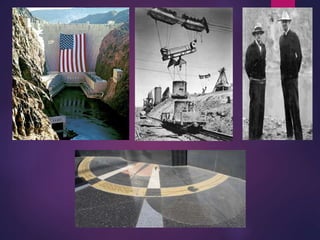
What is DAM?
A dam is a barrier that impounds water or
underground streams. Reservoirs created by
dams not only suppress floods but also provide
water for activities such as irrigation, human
consumption, industrial use, aquaculture,
and navigability. Hydropower is often used in
conjunction with dams to generate electricity
TYPES OF DAMS:
Dams can be grouped according to the type of material of which
they are constructed as follows;
CONCRETE DAMS:
 Concrete dams are further grouped according to how they
achieve their strength and stability.
 Concrete Gravity Dams
 Concrete Arch Dams
 Concrete Buttress Dams
FILL (EMBANKMENT) DAMS:
 Earth Dams
 Earth and Rock Fill Dams
 Concrete Faced Rock Fill Dams
HOOVER DAM
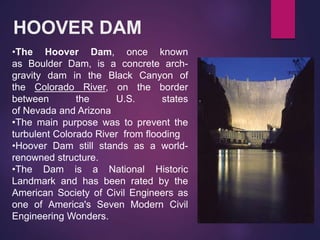
•The Hoover Dam, once known
as Boulder Dam, is a concrete arch-
gravity dam in the Black Canyon of
the Colorado River, on the border
between the U.S. states
of Nevada and Arizona
•The main purpose was to prevent the
turbulent Colorado River from flooding
•Hoover Dam still stands as a world-
renowned structure.
•The Dam is a National Historic
Landmark and has been rated by the
American Society of Civil Engineers as
one of America's Seven Modern Civil
Engineering Wonders.
DAM DATA
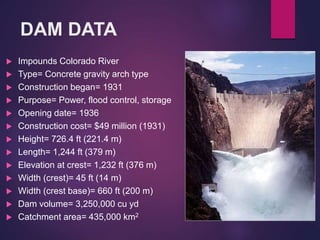
 Impounds Colorado River
 Type= Concrete gravity arch type
 Construction began= 1931
 Purpose= Power, flood control, storage
 Opening date= 1936
 Construction cost= $49 million (1931)
 Height= 726.4 ft (221.4 m)
 Length= 1,244 ft (379 m)
 Elevation at crest= 1,232 ft (376 m)
 Width (crest)= 45 ft (14 m)
 Width (crest base)= 660 ft (200 m)
 Dam volume= 3,250,000 cu yd
 Catchment area= 435,000 km2
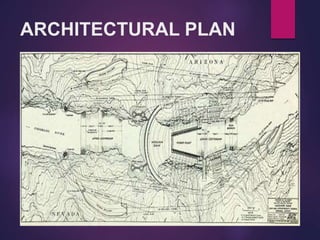
ARCHITECTURAL PLAN
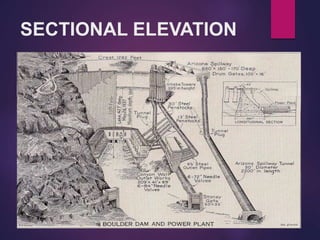
SECTIONAL ELEVATION
CONTRACTING
 On January 10, 1931, the Bureau made the bid
documents available to interested parties, at five
dollars a copy. The Bureau officials eventually
decided on a massive concrete arch-gravity dam, the
design of which was overseen by the Bureau's chief
design engineer John L. Savage.
 Bid was won by Six Companies, Inc.
 The monolithic dam would be thick at the bottom and
thin near the top, and would present a convex face
towards the water above the dam. The curving arch
of the dam would transmit the water's force into the
abutments
CONSTRUCTION
 8.5 million pounds of dynamite was used to blast the Canyon to
construct the foundation for the dam
 4.4 million cubic yards of concrete
 88 million pounds of plate steel and outlet pipes
 6.7 million pounds of pipe and fittings
 45 million pounds of reinforced steel
 50,000 tools and machines were used during construction
 To make the concrete durable, strong and increasing its overall
performance, the engineers specified a new innovation in concrete
admixtures: Pozzolith water-reducing admixtures
1. Labour force
2. Ground works and rock clearance
3. River diversion
4. Concreting
RIVER DIVERSION
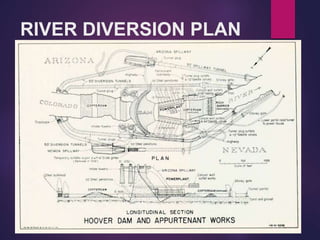
 Four diversion tunnels were driven through the canyon
walls, two on the Nevada side and two on
the Arizona side. These tunnels were 56 ft (17 m) in
diameter. Their combined length was nearly 16,000 ft, or
more than 3 miles (5 km).
 First the base, or invert, was poured. Gantry cranes,
running on rails through the entire length of each tunnel
were used to place the concrete. The sidewalls were
poured next.
 Movable sections of steel forms were used for the
sidewalls. Finally, using pneumatic guns, the overheads
were filled in. The concrete lining is 3 feet (1 m) thick,
reducing the finished tunnel diameter to 50 ft (15 m).The
river was diverted into the two Arizona tunnels on
November 13, 1932; the Nevada tunnels were kept in
reserve for high water
RIVER DIVERSION PLAN
CONCRETING
 Concrete heats and contracts as it cures, the
potential for uneven cooling and contraction of
the concrete posed a serious problem
 Engineers calculated that if the dam was built in
a single continuous pour, the concrete would take
125 years to cool, and the resulting stresses
would cause the dam to crack and crumble.
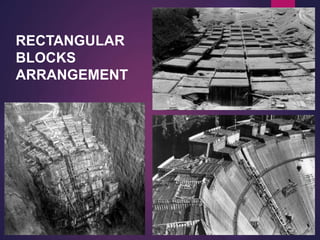
Instead, the ground where the dam would rise
was marked with rectangles, and concrete blocks
in columns were poured, some as large as 50 ft
square (15 m) and 5 feet (1.5 m) high
Contd.
 Each five-foot form contained a series of 1-inch
(25 mm) steel pipes; cool river water would be
poured through the pipes, followed by ice-cold
water from a refrigeration plant.
 When an individual block had cured and had
stopped contracting, the pipes were filled
with grout.
 Grout was also used to fill the hairline spaces
between columns, which were grooved to
increase the strength of the joints.
RECTANGULAR
BLOCKS
ARRANGEMENT
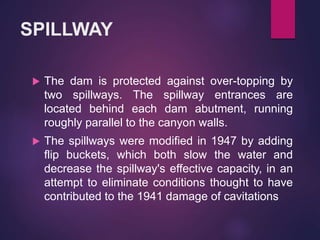
SPILLWAY
 The dam is protected against over-topping by
two spillways. The spillway entrances are
located behind each dam abutment, running
roughly parallel to the canyon walls.
 The spillways were modified in 1947 by adding
flip buckets, which both slow the water and
decrease the spillway's effective capacity, in an
attempt to eliminate conditions thought to have
contributed to the 1941 damage of cavitations
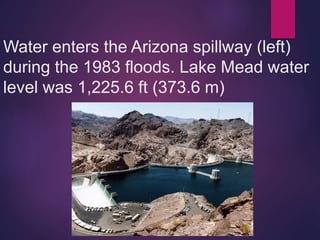
Water enters the Arizona spillway (left)
during the 1983 floods. Lake Mead water
level was 1,225.6 ft (373.6 m)
ROADWAYS AND
TOURISM
 Nearly 100 million people tour the dam each
year
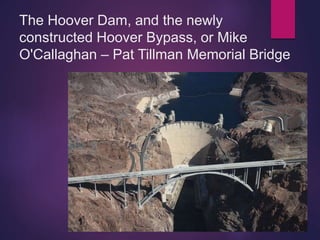
 The Hoover Dam, and the newly constructed
Hoover Bypass, or Mike O'Callaghan – Pat
Tillman Memorial Bridge, is engineering
marvels that shows American integrity and
power. They stand out as monuments of
determination and exemplify how technology
contribute to engineering success
The Hoover Dam, and the newly
constructed Hoover Bypass, or Mike
O'Callaghan – Pat Tillman Memorial Bridge
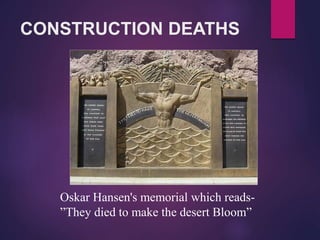
CONSTRUCTION DEATHS
Oskar Hansen's memorial which reads-
”They died to make the desert Bloom”
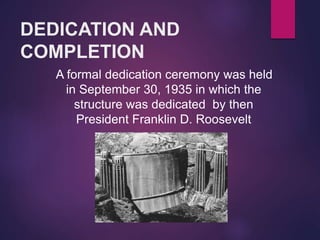
DEDICATION AND
COMPLETION
A formal dedication ceremony was held
in September 30, 1935 in which the
structure was dedicated by then
President Franklin D. Roosevelt
Other Facts.
 Nearly 100 million people tour the dam each year
 Lake Mead’s water is enough to flood the whole New
York city
 Concrete used was enough to pave 2 lane roads from
San-Francisco and New York
 By its completion in 1935, the Hoover Dam was the
greatest concrete project ever recorded, using more
masonry than the Great Pyramid at Giza (4.5 million cu
yd)
 Equal to the amount needed to build a two-lane highway
from Seattle to Miami, or a 4-ft-wide sidewalk around the
Equator
 It remains as the highest dam in the Western
Hemisphere
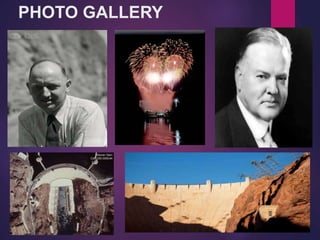
PHOTO GALLERY
REFERENCES
 Official website of Hoover Dam
 Historic Construction Company Project – Hoover Dam
 Frank Crowe – Builder of Hoover Dam
 The Hoover Dam – A Nat -GEO Documentary
 The Majesty of Hoover Dam by David Rogers, Ph.D.,
P.E., R.G, C.E.G., C.HG, M.ASCE
THANK YOU

Ranjitha.S.H

  • 2.
    What is DAM? Adam is a barrier that impounds water or underground streams. Reservoirs created by dams not only suppress floods but also provide water for activities such as irrigation, human consumption, industrial use, aquaculture, and navigability. Hydropower is often used in conjunction with dams to generate electricity
  • 3.
    TYPES OF DAMS: Damscan be grouped according to the type of material of which they are constructed as follows; CONCRETE DAMS:  Concrete dams are further grouped according to how they achieve their strength and stability.  Concrete Gravity Dams  Concrete Arch Dams  Concrete Buttress Dams FILL (EMBANKMENT) DAMS:  Earth Dams  Earth and Rock Fill Dams  Concrete Faced Rock Fill Dams
  • 4.
    HOOVER DAM •The HooverDam, once known as Boulder Dam, is a concrete arch- gravity dam in the Black Canyon of the Colorado River, on the border between the U.S. states of Nevada and Arizona •The main purpose was to prevent the turbulent Colorado River from flooding •Hoover Dam still stands as a world- renowned structure. •The Dam is a National Historic Landmark and has been rated by the American Society of Civil Engineers as one of America's Seven Modern Civil Engineering Wonders.
  • 5.
    DAM DATA  ImpoundsColorado River  Type= Concrete gravity arch type  Construction began= 1931  Purpose= Power, flood control, storage  Opening date= 1936  Construction cost= $49 million (1931)  Height= 726.4 ft (221.4 m)  Length= 1,244 ft (379 m)  Elevation at crest= 1,232 ft (376 m)  Width (crest)= 45 ft (14 m)  Width (crest base)= 660 ft (200 m)  Dam volume= 3,250,000 cu yd  Catchment area= 435,000 km2
  • 6.
  • 7.
  • 8.
    CONTRACTING  On January10, 1931, the Bureau made the bid documents available to interested parties, at five dollars a copy. The Bureau officials eventually decided on a massive concrete arch-gravity dam, the design of which was overseen by the Bureau's chief design engineer John L. Savage.  Bid was won by Six Companies, Inc.  The monolithic dam would be thick at the bottom and thin near the top, and would present a convex face towards the water above the dam. The curving arch of the dam would transmit the water's force into the abutments
  • 9.
    CONSTRUCTION  8.5 millionpounds of dynamite was used to blast the Canyon to construct the foundation for the dam  4.4 million cubic yards of concrete  88 million pounds of plate steel and outlet pipes  6.7 million pounds of pipe and fittings  45 million pounds of reinforced steel  50,000 tools and machines were used during construction  To make the concrete durable, strong and increasing its overall performance, the engineers specified a new innovation in concrete admixtures: Pozzolith water-reducing admixtures 1. Labour force 2. Ground works and rock clearance 3. River diversion 4. Concreting
  • 10.
    RIVER DIVERSION  Fourdiversion tunnels were driven through the canyon walls, two on the Nevada side and two on the Arizona side. These tunnels were 56 ft (17 m) in diameter. Their combined length was nearly 16,000 ft, or more than 3 miles (5 km).  First the base, or invert, was poured. Gantry cranes, running on rails through the entire length of each tunnel were used to place the concrete. The sidewalls were poured next.  Movable sections of steel forms were used for the sidewalls. Finally, using pneumatic guns, the overheads were filled in. The concrete lining is 3 feet (1 m) thick, reducing the finished tunnel diameter to 50 ft (15 m).The river was diverted into the two Arizona tunnels on November 13, 1932; the Nevada tunnels were kept in reserve for high water
  • 11.
  • 12.
    CONCRETING  Concrete heatsand contracts as it cures, the potential for uneven cooling and contraction of the concrete posed a serious problem  Engineers calculated that if the dam was built in a single continuous pour, the concrete would take 125 years to cool, and the resulting stresses would cause the dam to crack and crumble. Instead, the ground where the dam would rise was marked with rectangles, and concrete blocks in columns were poured, some as large as 50 ft square (15 m) and 5 feet (1.5 m) high
  • 13.
    Contd.  Each five-footform contained a series of 1-inch (25 mm) steel pipes; cool river water would be poured through the pipes, followed by ice-cold water from a refrigeration plant.  When an individual block had cured and had stopped contracting, the pipes were filled with grout.  Grout was also used to fill the hairline spaces between columns, which were grooved to increase the strength of the joints.
  • 14.
  • 15.
    SPILLWAY  The damis protected against over-topping by two spillways. The spillway entrances are located behind each dam abutment, running roughly parallel to the canyon walls.  The spillways were modified in 1947 by adding flip buckets, which both slow the water and decrease the spillway's effective capacity, in an attempt to eliminate conditions thought to have contributed to the 1941 damage of cavitations
  • 16.
    Water enters theArizona spillway (left) during the 1983 floods. Lake Mead water level was 1,225.6 ft (373.6 m)
  • 17.
    ROADWAYS AND TOURISM  Nearly100 million people tour the dam each year  The Hoover Dam, and the newly constructed Hoover Bypass, or Mike O'Callaghan – Pat Tillman Memorial Bridge, is engineering marvels that shows American integrity and power. They stand out as monuments of determination and exemplify how technology contribute to engineering success
  • 18.
    The Hoover Dam,and the newly constructed Hoover Bypass, or Mike O'Callaghan – Pat Tillman Memorial Bridge
  • 19.
    CONSTRUCTION DEATHS Oskar Hansen'smemorial which reads- ”They died to make the desert Bloom”
  • 20.
    DEDICATION AND COMPLETION A formaldedication ceremony was held in September 30, 1935 in which the structure was dedicated by then President Franklin D. Roosevelt
  • 21.
    Other Facts.  Nearly100 million people tour the dam each year  Lake Mead’s water is enough to flood the whole New York city  Concrete used was enough to pave 2 lane roads from San-Francisco and New York  By its completion in 1935, the Hoover Dam was the greatest concrete project ever recorded, using more masonry than the Great Pyramid at Giza (4.5 million cu yd)  Equal to the amount needed to build a two-lane highway from Seattle to Miami, or a 4-ft-wide sidewalk around the Equator  It remains as the highest dam in the Western Hemisphere
  • 22.
  • 24.
    REFERENCES  Official websiteof Hoover Dam  Historic Construction Company Project – Hoover Dam  Frank Crowe – Builder of Hoover Dam  The Hoover Dam – A Nat -GEO Documentary  The Majesty of Hoover Dam by David Rogers, Ph.D., P.E., R.G, C.E.G., C.HG, M.ASCE
  • 25.