TUNNELS
TERMINOLOGY for UNDERGROUND 
STRUCTURES 
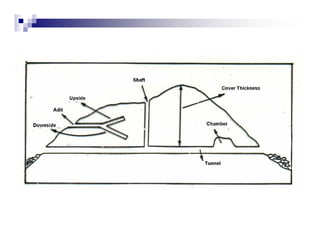
„ Adit 
„ Tunnel 
„ Subway 
„ Shaft 
„ Chamber 
„ Portal 
„ Pilot adit 
„ Centre 
„ Face 
„ Wall ~ site 
„ Floor 
„ Roof
„ Overbreak 
„ Excavated profile 
„ Natural archling 
„ Load 
„ Support 
„ Failure 
„ Gentle failure 
„ Rock burst 
„ Squeezing ground 
„ Swelling ground 
„ Clay-filled joint 
„ Long term stability 
„ Ground treatment 
„ Support before excavation
„ Jet grouted roof cover 
„ Shotcrete initial lining 
„ Jet grouted floor cover 
„ Top heading 
„ Invert 
„ Bench 
„ Final concrete lining 
„ SHIELD tunnelling method 
„ CUT & COVER tunnelling method 
„ TBM (Full face ~ Total Boring Machine)
TERMINOLOGY for EXCAVATIONS of 
ROCKS & SOILS 
„ DRILLING 
„ Hardness 
„ Toughness 
„ Abrasiveness 
„ Structure 
„ Drilkling fluids 
„ AUGERING 
„ MACHINE BORING 
„ Total Boring Machine (TBM) 
„ Full face excavation 
„ BLASTING
„ SCRAPING 
„ RIPPING 
„ DIGGING 
„ GROUND WATER 
„ Control of groundwater 
„ Groundwater flow 
„ Rate of flow 
„ Volume of flow 
„ Boundaries
TUNNEL DESCRIPTION 
1. Made into natural material (rocks) 
2. Empty inside 
3. Carry the loads itself 
4. Both ends are open to atmosphere 
5. Generally horizontal 
6. Thick walled structure looks like cylinder
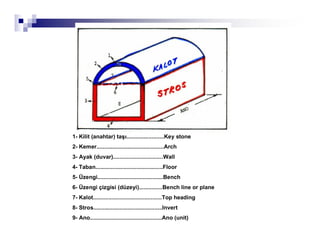
1- Kilit (anahtar) taúÕ........................Key stone 
2- Kemer...........................................Arch 
3- Ayak (duvar)................................Wall 
4- Taban...........................................Floor 
5- Üzengi..........................................Bench 
6- Üzengi çizgisi (düzeyi)...............Bench line or plane 
7- Kalot............................................Top heading 
8- Stros............................................Invert 
9- Ano..............................................Ano (unit)
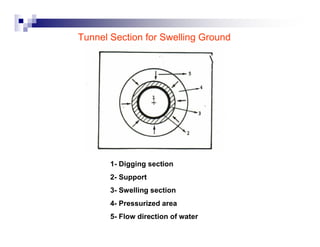
Tunnel Section for Swelling Ground 
1- Digging section 
2- Support 
3- Swelling section 
4- Pressurized area 
5- Flow direction of water
SURFACE EXCAVATIONS 
„ Deformation & failure
UNDERGROUND EXCAVATIONS 
„ In Rock 
„ In Sediment 
„ Stability & Arching 
„ Water 
… Dry tunnel...............above water table 
… Wet tunnel..............below water table 
„ Gases 
… Carbon dioxide (CO2) 
… Carbon monoxide (CO) 
… Methane (CH4) 
… Hydrogen sulphide (H2S) 
… Other gases
„ Gas bursts......................gaz patlamasÕ 
„ Rock falls........................kaya düúmesi 
„ Rock bursts....................kaya fÕrlamasÕ 
„ Squeezing ground..........úLúen – kabaran zemin 
„ Temperature 
„ Subsidence
EXPLORATION & INVESTIGATIONS 
RELATED of SLOPE STABILITY 
„ Geomorphologic maping and preparation of 
longitudinal & cross sections 
„ Geological maping & surveyings (aerial 
photographs) 
„ Geophysical surveyings 
„ Underground explorations, boreholes 
„ Ground water surveyings 
„ Laboratory tests 
„ Model studies
SURFACE EXCAVATIONS 
„ Permanent 
„ Short term excavations
SUBSURFACE EXCAVATIONS 
1. GEOLOGY 
1. Soil profile or hard rock geology 
2. Structure 
3. Ground water (hydrogeology) 
4. Stability
2. INVESTIGATIONS 
1. Mapping (Topographic, geologic, etc...) 
2. Geophysical surveying (especially seismic 
velocity of rocks) 
3. Trial pits & boreholes 
4. General and local stability analysis 
5. Decide to excavation method
UNDERGROUND EXCAVATIONS 
„ Adit, shaft, incline, large chamber 
„ Tunnel 
„ Subway ~ metro 
„ Underpass 
„ Shelter 
„ Power house 
„ Ware house, store, mining ...etc
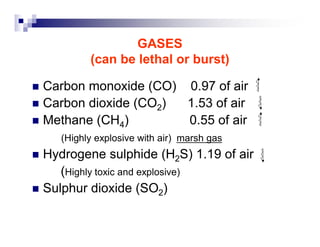
GASES 
(can be lethal or burst) 
„ Carbon monoxide (CO) 0.97 of air 
„ Carbon dioxide (CO2) 1.53 of air 
„ Methane (CH4) 0.55 of air 
(Highly explosive with air) marsh gas 
„ Hydrogene sulphide (H2S) 1.19 of air 
(Highly toxic and explosive) 
„ Sulphur dioxide (SO2)
„ ROCK FALL 
„ SQUEEZING GROUND (sand, silt, shale, clay) 
„ ROCK BURST 
„ BULKING (Increase in volume, 10-40%)
FACTORS EFFECTING 
EXCAVATION of ROCKS 
„ Mineralogical composition of rocks 
„ Texture & fabric 
„ Petrographic features 
„ Structure 
„ Rock mass 
„ Strike & dip of beds in relation to face of 
excavation 
„ Intensity of tectonic disturbances 
„ Degreee of weathering
RESISTANCE of ROCKS to 
EXCAVATION 
„ Loose soils 
„ Soil easy to spade (bel ile kazmak) 
„ Soil easy to dig 
„ Crumbling weak rocks (ufalamak) 
„ Rocks easy to blast 
„ Rocks difficult to blast 
„ Rocks very difficult to blast
TUNNELLING METHODS
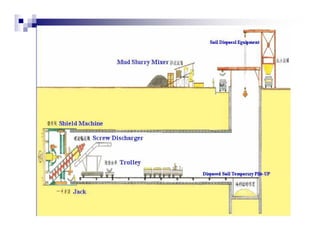
SHIELD TUNNELLING METHOD 
„ This method involves the use of shield machine to drive 
the tunnels below the ground. 
„ After completion of a work shaft, the shield machine is 
lowered into the shaft and assembled there before 
excavation and construction of the tunnels using precast 
concrete lining segments of about 1.2 meter width. 
„ This construction method causes minimal disruption to 
traffic and the environment because all the work takes 
place below ground and the ground level environment is 
unaffected.
CUT and COVER TUNNELLING 
METHOD 
„ This construction method, whereby the site is fully 
excavated, the structure built and then covered over, 
uses diaphragm walls as temporary retaining walls within 
the site area. 
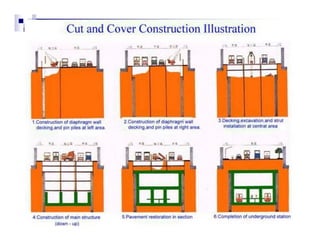
„ Step one :Construction of diaphragm walls, pin piles, and 
decking. 
„ Step two :Excavation within the diaphragm walls, 
installing struts as work progresses. 
„ Step three :Construction of permanent floor slabs and 
walls. 
„ Step four : Fitting out the internal structures, backfilling, 
and reinstating the surface structures.
TBM (Tunnel Boring Machine) 
1. Mechanical-support TBM 
2. Compressed-air TBM 
3. Slurry shield TBM 
4. Earth pressure balance machine 
5. Mixed-face shield TBM
1- Mechanical Support TBM 
„ A mechanical-support TBM has a full-face 
cutterhead which provides face support by 
constantly pushing the excavated material 
ahead of the cutterhead against the 
surrounding ground.
2- Compressed-Air TBM 
„ A compressed-air TBM can have either a 
full-face cutterhead or excavating arms. 
Confinement is achieved by pressurizing 
the air in the cutter chamber.
3- Slurry Shield TBM 
„ A slurry shield TBM has a full-face 
cutterhead. Confinement is achieved by 
pressurizing boring fluid inside the 
cutterhead chamber.
4- Earth Pressure Balance Machine 
„ An earth pressure balance machine has a 
full-face cutterhead. Confinement is 
achieved by pressurizing the excavated 
material in the cutterhead chamber.
5- Mix-Face Shield TBM 
„ Mix-face shield TBMs have full-face 
cutterheads and can work inclosed or 
open mode and with different confinement 
techniques.
EFFECT of GEOLOGICAL STRUCTURES 
to TUNNEL EXCAVATION 
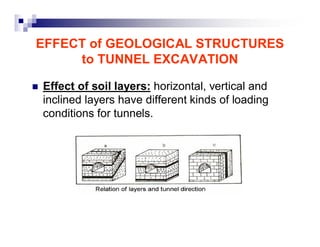
„ Effect of soil layers: horizontal, vertical and 
inclined layers have different kinds of loading 
conditions for tunnels.
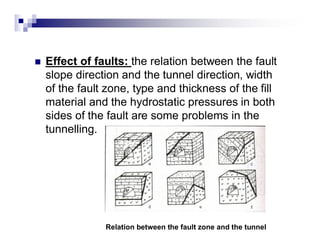
„ Effect of faults: the relation between the fault 
slope direction and the tunnel direction, width 
of the fault zone, type and thickness of the fill 
material and the hydrostatic pressures in both 
sides of the fault are some problems in the 
tunnelling. 
Relation between the fault zone and the tunnel
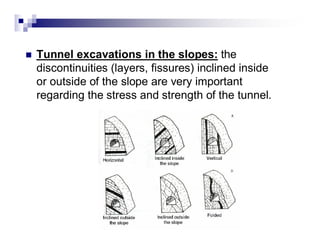
„ Tunnel excavations in the slopes: the 
discontinuities (layers, fissures) inclined inside 
or outside of the slope are very important 
regarding the stress and strength of the tunnel.
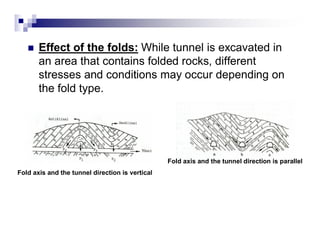
„ Effect of the folds: While tunnel is excavated in 
an area that contains folded rocks, different 
stresses and conditions may occur depending on 
the fold type. 
Fold axis and the tunnel direction is vertical 
Fold axis and the tunnel direction is parallel
CLASSIFICATION of 
ROCKS for TUNNELING 
PURPOSES
„ Classification of rocks for engineering purposes 
is needed in analyzing the project costs and to 
obtain an economic and reliable solution. 
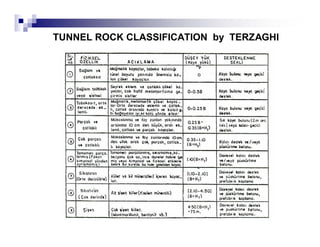
„ The classification of the rocks, that the tunnel 
will be constructed in, is first done by Terzaghi. 
But, it is too general and gives qualitative 
results.
TUNNEL ROCK CLASSIFICATION by TERZAGHI
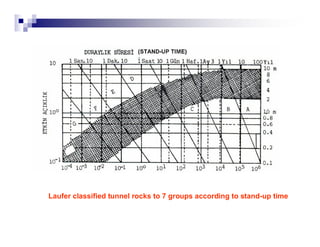
Laufer classified tunnel rocks to 7 groups according to stand-up time
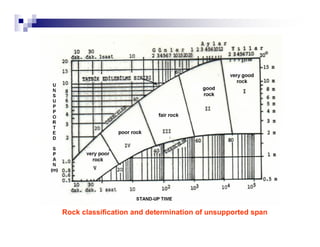
Rock classification and determination of unsupported span
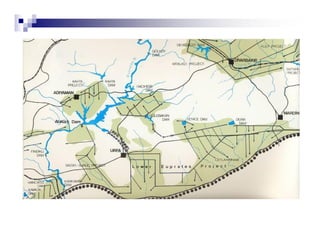
URFA IRRIGATION 
TUNNEL
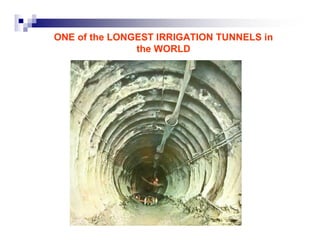
ONE of the LONGEST IRRIGATION TUNNELS in 
the WORLD
Consist of two concrete lined tunnels 
each of which is 7.62 m in diameter and 
26.4 km in length discharging water 
from the reservoir of Atatürk Dam.

Tunnels concepts

  • 1.
  • 2.
    TERMINOLOGY for UNDERGROUND STRUCTURES „ Adit „ Tunnel „ Subway „ Shaft „ Chamber „ Portal „ Pilot adit „ Centre „ Face „ Wall ~ site „ Floor „ Roof
  • 3.
    „ Overbreak „Excavated profile „ Natural archling „ Load „ Support „ Failure „ Gentle failure „ Rock burst „ Squeezing ground „ Swelling ground „ Clay-filled joint „ Long term stability „ Ground treatment „ Support before excavation
  • 4.
    „ Jet groutedroof cover „ Shotcrete initial lining „ Jet grouted floor cover „ Top heading „ Invert „ Bench „ Final concrete lining „ SHIELD tunnelling method „ CUT & COVER tunnelling method „ TBM (Full face ~ Total Boring Machine)
  • 5.
    TERMINOLOGY for EXCAVATIONSof ROCKS & SOILS „ DRILLING „ Hardness „ Toughness „ Abrasiveness „ Structure „ Drilkling fluids „ AUGERING „ MACHINE BORING „ Total Boring Machine (TBM) „ Full face excavation „ BLASTING
  • 6.
    „ SCRAPING „RIPPING „ DIGGING „ GROUND WATER „ Control of groundwater „ Groundwater flow „ Rate of flow „ Volume of flow „ Boundaries
  • 7.
    TUNNEL DESCRIPTION 1.Made into natural material (rocks) 2. Empty inside 3. Carry the loads itself 4. Both ends are open to atmosphere 5. Generally horizontal 6. Thick walled structure looks like cylinder
  • 9.
    1- Kilit (anahtar)taúÕ........................Key stone 2- Kemer...........................................Arch 3- Ayak (duvar)................................Wall 4- Taban...........................................Floor 5- Üzengi..........................................Bench 6- Üzengi çizgisi (düzeyi)...............Bench line or plane 7- Kalot............................................Top heading 8- Stros............................................Invert 9- Ano..............................................Ano (unit)
  • 10.
    Tunnel Section forSwelling Ground 1- Digging section 2- Support 3- Swelling section 4- Pressurized area 5- Flow direction of water
  • 11.
    SURFACE EXCAVATIONS „Deformation & failure
  • 12.
    UNDERGROUND EXCAVATIONS „In Rock „ In Sediment „ Stability & Arching „ Water … Dry tunnel...............above water table … Wet tunnel..............below water table „ Gases … Carbon dioxide (CO2) … Carbon monoxide (CO) … Methane (CH4) … Hydrogen sulphide (H2S) … Other gases
  • 13.
    „ Gas bursts......................gazpatlamasÕ „ Rock falls........................kaya düúmesi „ Rock bursts....................kaya fÕrlamasÕ „ Squeezing ground..........úLúen – kabaran zemin „ Temperature „ Subsidence
  • 14.
    EXPLORATION & INVESTIGATIONS RELATED of SLOPE STABILITY „ Geomorphologic maping and preparation of longitudinal & cross sections „ Geological maping & surveyings (aerial photographs) „ Geophysical surveyings „ Underground explorations, boreholes „ Ground water surveyings „ Laboratory tests „ Model studies
  • 15.
    SURFACE EXCAVATIONS „Permanent „ Short term excavations
  • 16.
    SUBSURFACE EXCAVATIONS 1.GEOLOGY 1. Soil profile or hard rock geology 2. Structure 3. Ground water (hydrogeology) 4. Stability
  • 17.
    2. INVESTIGATIONS 1.Mapping (Topographic, geologic, etc...) 2. Geophysical surveying (especially seismic velocity of rocks) 3. Trial pits & boreholes 4. General and local stability analysis 5. Decide to excavation method
  • 19.
    UNDERGROUND EXCAVATIONS „Adit, shaft, incline, large chamber „ Tunnel „ Subway ~ metro „ Underpass „ Shelter „ Power house „ Ware house, store, mining ...etc
  • 20.
    GASES (can belethal or burst) „ Carbon monoxide (CO) 0.97 of air „ Carbon dioxide (CO2) 1.53 of air „ Methane (CH4) 0.55 of air (Highly explosive with air) marsh gas „ Hydrogene sulphide (H2S) 1.19 of air (Highly toxic and explosive) „ Sulphur dioxide (SO2)
  • 21.
    „ ROCK FALL „ SQUEEZING GROUND (sand, silt, shale, clay) „ ROCK BURST „ BULKING (Increase in volume, 10-40%)
  • 22.
    FACTORS EFFECTING EXCAVATIONof ROCKS „ Mineralogical composition of rocks „ Texture & fabric „ Petrographic features „ Structure „ Rock mass „ Strike & dip of beds in relation to face of excavation „ Intensity of tectonic disturbances „ Degreee of weathering
  • 23.
    RESISTANCE of ROCKSto EXCAVATION „ Loose soils „ Soil easy to spade (bel ile kazmak) „ Soil easy to dig „ Crumbling weak rocks (ufalamak) „ Rocks easy to blast „ Rocks difficult to blast „ Rocks very difficult to blast
  • 24.
  • 25.
    SHIELD TUNNELLING METHOD „ This method involves the use of shield machine to drive the tunnels below the ground. „ After completion of a work shaft, the shield machine is lowered into the shaft and assembled there before excavation and construction of the tunnels using precast concrete lining segments of about 1.2 meter width. „ This construction method causes minimal disruption to traffic and the environment because all the work takes place below ground and the ground level environment is unaffected.
  • 27.
    CUT and COVERTUNNELLING METHOD „ This construction method, whereby the site is fully excavated, the structure built and then covered over, uses diaphragm walls as temporary retaining walls within the site area. „ Step one :Construction of diaphragm walls, pin piles, and decking. „ Step two :Excavation within the diaphragm walls, installing struts as work progresses. „ Step three :Construction of permanent floor slabs and walls. „ Step four : Fitting out the internal structures, backfilling, and reinstating the surface structures.
  • 29.
    TBM (Tunnel BoringMachine) 1. Mechanical-support TBM 2. Compressed-air TBM 3. Slurry shield TBM 4. Earth pressure balance machine 5. Mixed-face shield TBM
  • 30.
    1- Mechanical SupportTBM „ A mechanical-support TBM has a full-face cutterhead which provides face support by constantly pushing the excavated material ahead of the cutterhead against the surrounding ground.
  • 31.
    2- Compressed-Air TBM „ A compressed-air TBM can have either a full-face cutterhead or excavating arms. Confinement is achieved by pressurizing the air in the cutter chamber.
  • 32.
    3- Slurry ShieldTBM „ A slurry shield TBM has a full-face cutterhead. Confinement is achieved by pressurizing boring fluid inside the cutterhead chamber.
  • 33.
    4- Earth PressureBalance Machine „ An earth pressure balance machine has a full-face cutterhead. Confinement is achieved by pressurizing the excavated material in the cutterhead chamber.
  • 34.
    5- Mix-Face ShieldTBM „ Mix-face shield TBMs have full-face cutterheads and can work inclosed or open mode and with different confinement techniques.
  • 35.
    EFFECT of GEOLOGICALSTRUCTURES to TUNNEL EXCAVATION „ Effect of soil layers: horizontal, vertical and inclined layers have different kinds of loading conditions for tunnels.
  • 36.
    „ Effect offaults: the relation between the fault slope direction and the tunnel direction, width of the fault zone, type and thickness of the fill material and the hydrostatic pressures in both sides of the fault are some problems in the tunnelling. Relation between the fault zone and the tunnel
  • 37.
    „ Tunnel excavationsin the slopes: the discontinuities (layers, fissures) inclined inside or outside of the slope are very important regarding the stress and strength of the tunnel.
  • 38.
    „ Effect ofthe folds: While tunnel is excavated in an area that contains folded rocks, different stresses and conditions may occur depending on the fold type. Fold axis and the tunnel direction is vertical Fold axis and the tunnel direction is parallel
  • 39.
    CLASSIFICATION of ROCKSfor TUNNELING PURPOSES
  • 40.
    „ Classification ofrocks for engineering purposes is needed in analyzing the project costs and to obtain an economic and reliable solution. „ The classification of the rocks, that the tunnel will be constructed in, is first done by Terzaghi. But, it is too general and gives qualitative results.
  • 41.
  • 42.
    Laufer classified tunnelrocks to 7 groups according to stand-up time
  • 43.
    Rock classification anddetermination of unsupported span
  • 44.
  • 46.
    ONE of theLONGEST IRRIGATION TUNNELS in the WORLD
  • 47.
    Consist of twoconcrete lined tunnels each of which is 7.62 m in diameter and 26.4 km in length discharging water from the reservoir of Atatürk Dam.