TUNNELING
 TYPES OF TUNNELS & ADVANCED
METHODS USED FOR DIGGING THE
VARIOUS TUNNELS
BY
JAGDISH R. LAWADIYA
INDEX
 1) Introductiion about tunneling
 2) Types of tunnels
 a) Rested on the sea bed
 b) Floating in the sea
 c) Tunnels through the earth /below
sea
 bed
 3) Need
 4) How it is constructed
 5) Channel Tunnel
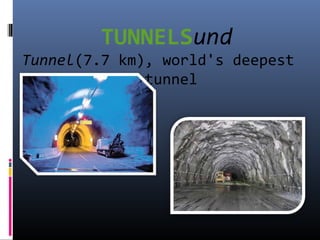
TUNNELSund
Tunnel(7.7 km), world's deepest
undersea road tunnel
What is
submerged
floating
tunnel……???
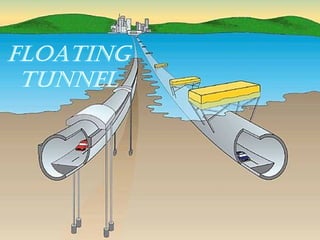
 Submerged floating tunnel is basically
making a tunnel to float underwater
which is balanced by its buoyancy, self
weight and constraint forces resulted
from cable system and thus submerged
to a certain depth underwater.
 It is basically tube like structure
floating at some depth below water
surface and fixed against excessive
movements. The tube is designed to
accommodate road and or rail traffic
NEED FOR SUBMERGED
FLOATING TUNNEL
 A “SFT” is considered when the
depth of sea or ocean is too deep so
that no tunnel or any solid body
could sustain the pressure acting on
it at such a deep level.
 In that case the tunnel is lifted up
such as about 30 to 100m deep from
the sea surface where the water
pressure is comparatively lower than
what is at the bottom depth.
Why floating tunnels ?????
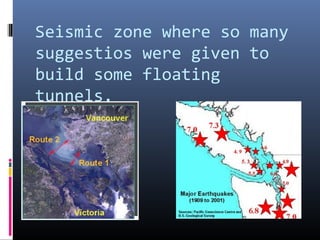
 In the more seismic zones,pier or cassion type
constructions of bridges gets collapsed.
 Also the submerged or underground tunnels
may also get damaged due to the
earthquakes.
 So the floating tunnel is an solution which
would not damage that much compared to
the other types bridges or tunnels.
Seismic zone where so many
suggestios were given to
build some floating
tunnels.
PRINCIPLE
 Any object wholly or partially immersed in an
fluid, is buoyed up by a force equal to the weight
of the fluid displaced by the object.
 this means if more surface area exposed to water
surface more are the chances of floating it.
 Ships, submarines, offshore oil rigs etc. work on
this principle.
 Research shows that the buoyancy to weight
ratio for the tunnel to float should be less than
one and between 0.5 to 0.8
Advantages of “S.F.T.”
 Allows construction of tunnel in extremely deep water,
where conventional bridges or tunnels are technically
difficult or prohibitively expensive.
 Construction activities has less harmful effects on
aquatic life.
 No harmful environmental effects such as fog or storm
since the whole structure is covered and is present
inside the water.
Step by step
procedure...!!!!
1) Construction of tunnel segments on
dry dock.
2) Transporting the tunnel segments to
their final places and placing them
over their successive positions.
3) Joining of different tunnel segments
by using rubber gasket.
4) Anchoring the tunnel to the cables.
TUNNELS RESTING ON THE SEA
BED
 The owesome example of this type of tunnel
is in between Busan and Korea.
 First the precast concrete columns of high
grade were placed and a path was made over
which the casted tunnel members are gonna
be placed.
How this is constructed…….
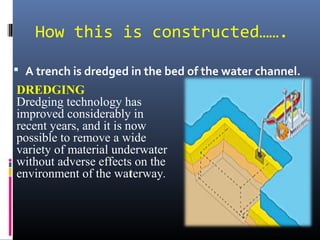
 A trench is dredged in the bed of the water channel.
DREDGING
Dredging technology has
improved considerably in
recent years, and it is now
possible to remove a wide
variety of material underwater
without adverse effects on the
environment of the waterway.
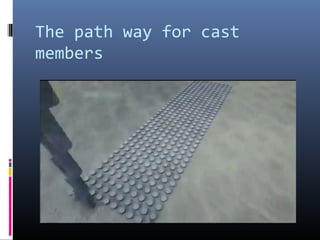
The path way for cast
members
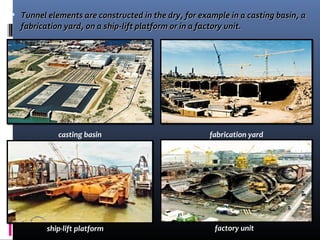
 Tunnel elements are constructed in the dry, for example in a casting basin, aTunnel elements are constructed in the dry, for example in a casting basin, a
fabrication yard, on a ship-lift platform or in a factory unit.fabrication yard, on a ship-lift platform or in a factory unit.
casting basin fabrication yard
ship-lift platform factory unit
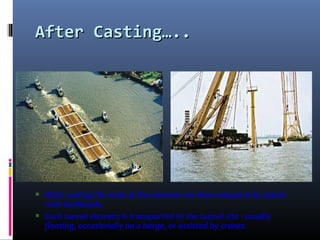
After Casting…..After Casting…..
∗ After casting the ends of the element are then temporarily sealed
with bulkheads.
∗ Each tunnel element is transported to the tunnel site - usually
floating, occasionally on a barge, or assisted by cranes.
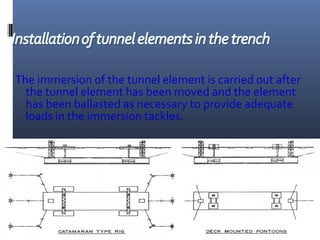
The immersion of the tunnel element is carried out after
the tunnel element has been moved and the element
has been ballasted as necessary to provide adequate
loads in the immersion tackles.
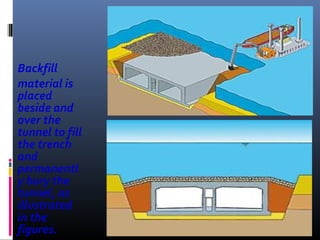
Backfill
material is
placed
beside and
over the
tunnel to fill
the trench
and
permanentl
y bury the
tunnel, as
illustrated
in the
figures.
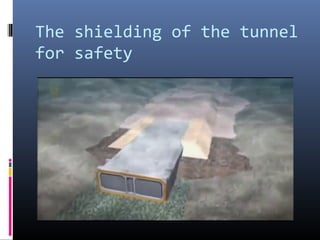
The shielding of the tunnel
for safety
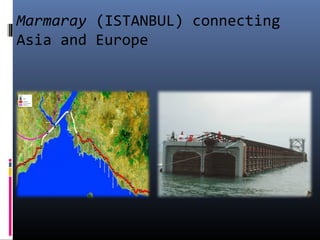
Marmaray (ISTANBUL) connecting
Asia and Europe
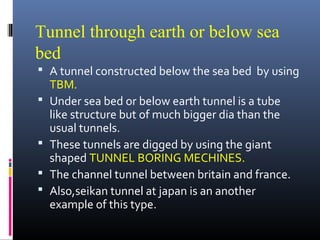
Tunnel through earth or below sea
bed
 A tunnel constructed below the sea bed by using
TBM.
 Under sea bed or below earth tunnel is a tube
like structure but of much bigger dia than the
usual tunnels.
 These tunnels are digged by using the giant
shaped TUNNEL BORING MECHINES.
 The channel tunnel between britain and france.
 Also,seikan tunnel at japan is an another
example of this type.
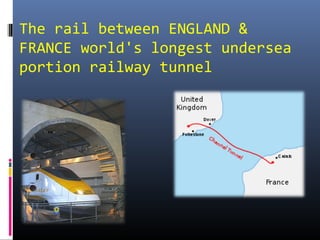
The rail between ENGLAND &
FRANCE world's longest undersea
portion railway tunnel
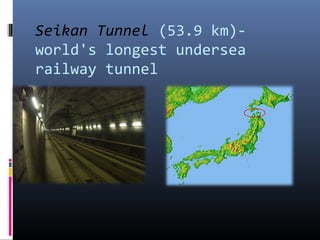
Seikan Tunnel (53.9 km)-
world's longest undersea
railway tunnel
TUNNEL BORING MECHINE(TBM)
 First successful TBM mechine was built by
henri joseph.
 The shape of TBM is circular and its weight is
about the weight of 12 AIRCRAFTS.
 TBMs are also known as mole and these are
used to dig soil and stones beneath the earth.
 The diameter of the cutting core ranges from
1 to 19.25 meters.
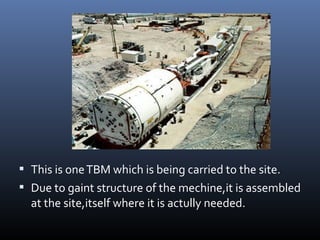
 This is oneTBM which is being carried to the site.
 Due to gaint structure of the mechine,it is assembled
at the site,itself where it is actully needed.
WORKING OF TBM
 The core ofTBM is circular in shape and it rotates
contineously .
 The disc cutters are mounted at the head of cutting core
which produces compressive stress ,which causes
fractures in the rocks.
 The excavated stones are then transferred to the
conveyer belt at the back of the cutting core.
 Total 8 segments are present over these segments cores
and drill holes are mounted.
 One complete rotation of the core of TBM excavates
about 2-4 tonnes of the stones,and this depends upon
the type of strata
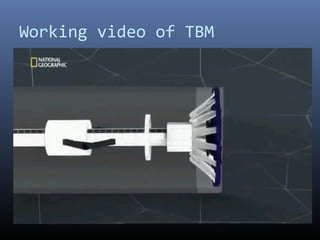
Working video of TBM
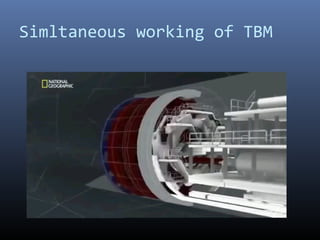
 while rotating it not only digs but also constructs
the inner lining of the tunnel.
 The inner lining of the tunnel is composed of pre-
casted curved concrete structures made up from
highly graded concrete.
 Each segment contains about 300 kg of steel
reinforced bars for the strength of the cast
members.
Simltaneous working of TBM
Channel Tunnel
 I t is t he one of t he wonders of t he
modern world.
 I t is const ruct ed bet ween Brit ain and
France and needed 7 years t o
complet e t he const ruct ion work.
 I t is 34 km long and digged below t he
sea bed about 100 met res dept h
 Agreement t o const ruct such a t unnel
was passed at 1986 and as est imat ed
it s cost was about 4.5 t o 5 billion
pounds
 As per the estimation the tunnel was gonna be
the BIGGEST DIGGED TUNNEL in the
world,everyone on the site were feeling too
much proud to work over such a
realistic,huge,and terrific project.
 The actual work of biggest dig started at
december 1987
 They were needing three TBMs to construct
the mega chaannel tunnel.
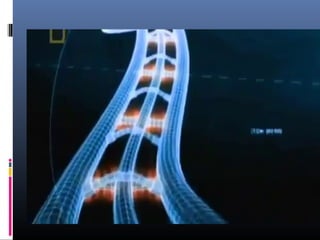
 Two main tunnels for the transport of the
supersonic trains and one middle service tunnel
for the maintanance
Construction of channel
tunnel
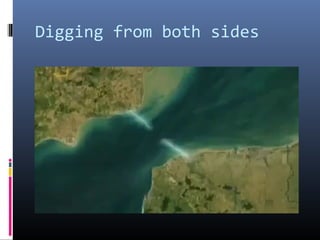
 The excavation was started from both
sides,i.e. both france and britain started to
dig the strata 100 metres below the sea bed.
 It was just a kind of race for both of them,for
contineous and straight digging they
followed the TBMs laser guidening system.
 It is much more imaginary method first
successfully used by britishans
Digging from both sides
Difficulties faced
 1) First major difficulty they faced was the
leakage of water inside the tunnel.
 2) Second was the technical fault inside the
TBMs and they stopped working
 3) Third one was not while construction but it
was after the completion of the project,the
fire occurred inside the tunnel
TBMs laser guidening system
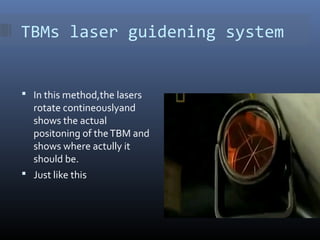
 In this method,the lasers
rotate contineouslyand
shows the actual
positoning of theTBM and
shows where actully it
should be.
 Just like this
ADVANTAGES
 The bridges allow shiping may cause traffic
congestion so tunnel will allow shipping to
pass without any disturbance.
 The downward ramp leading to tunnel leaves
smaller footprints compared to the ramp
required for bridges.
 Tunnling will generate soil that has ben
excavated and used to create new land.
 Tunnels required for higher costs of security and
construction than bridges. This may mean that over short
distances bridges may be preferred rather than tunnels
(for example Dartford Crossing).
 Bridges may not allow shipping to pass, so solutions such
as the Oresund Bridge have been constructed.
 Implementation of this project is very tough & requiring
skilled labours & heavy machinery & facing very adverse
situations.
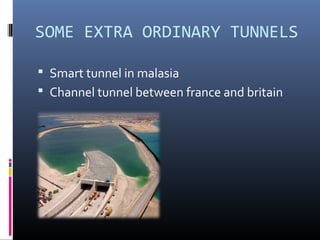
SOME EXTRA ORDINARY TUNNELS
 Smart tunnel in malasia
 Channel tunnel between france and britain
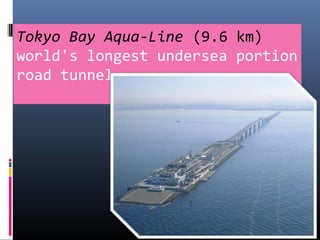
Tokyo Bay Aqua-Line (9.6 km)
world's longest undersea portion
road tunnel
Tunneling

Tunneling

  • 1.
    TUNNELING  TYPES OFTUNNELS & ADVANCED METHODS USED FOR DIGGING THE VARIOUS TUNNELS BY JAGDISH R. LAWADIYA
  • 2.
    INDEX  1) Introductiionabout tunneling  2) Types of tunnels  a) Rested on the sea bed  b) Floating in the sea  c) Tunnels through the earth /below sea  bed  3) Need  4) How it is constructed  5) Channel Tunnel
  • 3.
    TUNNELSund Tunnel(7.7 km), world'sdeepest undersea road tunnel
  • 5.
    What is submerged floating tunnel……???  Submergedfloating tunnel is basically making a tunnel to float underwater which is balanced by its buoyancy, self weight and constraint forces resulted from cable system and thus submerged to a certain depth underwater.  It is basically tube like structure floating at some depth below water surface and fixed against excessive movements. The tube is designed to accommodate road and or rail traffic
  • 6.
    NEED FOR SUBMERGED FLOATINGTUNNEL  A “SFT” is considered when the depth of sea or ocean is too deep so that no tunnel or any solid body could sustain the pressure acting on it at such a deep level.  In that case the tunnel is lifted up such as about 30 to 100m deep from the sea surface where the water pressure is comparatively lower than what is at the bottom depth.
  • 7.
    Why floating tunnels?????  In the more seismic zones,pier or cassion type constructions of bridges gets collapsed.  Also the submerged or underground tunnels may also get damaged due to the earthquakes.  So the floating tunnel is an solution which would not damage that much compared to the other types bridges or tunnels.
  • 8.
    Seismic zone whereso many suggestios were given to build some floating tunnels.
  • 9.
    PRINCIPLE  Any objectwholly or partially immersed in an fluid, is buoyed up by a force equal to the weight of the fluid displaced by the object.  this means if more surface area exposed to water surface more are the chances of floating it.  Ships, submarines, offshore oil rigs etc. work on this principle.  Research shows that the buoyancy to weight ratio for the tunnel to float should be less than one and between 0.5 to 0.8
  • 10.
    Advantages of “S.F.T.” Allows construction of tunnel in extremely deep water, where conventional bridges or tunnels are technically difficult or prohibitively expensive.  Construction activities has less harmful effects on aquatic life.  No harmful environmental effects such as fog or storm since the whole structure is covered and is present inside the water.
  • 11.
    Step by step procedure...!!!! 1)Construction of tunnel segments on dry dock. 2) Transporting the tunnel segments to their final places and placing them over their successive positions. 3) Joining of different tunnel segments by using rubber gasket. 4) Anchoring the tunnel to the cables.
  • 12.
    TUNNELS RESTING ONTHE SEA BED  The owesome example of this type of tunnel is in between Busan and Korea.  First the precast concrete columns of high grade were placed and a path was made over which the casted tunnel members are gonna be placed.
  • 13.
    How this isconstructed…….  A trench is dredged in the bed of the water channel. DREDGING Dredging technology has improved considerably in recent years, and it is now possible to remove a wide variety of material underwater without adverse effects on the environment of the waterway.
  • 14.
    The path wayfor cast members
  • 15.
     Tunnel elementsare constructed in the dry, for example in a casting basin, aTunnel elements are constructed in the dry, for example in a casting basin, a fabrication yard, on a ship-lift platform or in a factory unit.fabrication yard, on a ship-lift platform or in a factory unit. casting basin fabrication yard ship-lift platform factory unit
  • 16.
    After Casting…..After Casting….. ∗After casting the ends of the element are then temporarily sealed with bulkheads. ∗ Each tunnel element is transported to the tunnel site - usually floating, occasionally on a barge, or assisted by cranes.
  • 17.
    The immersion ofthe tunnel element is carried out after the tunnel element has been moved and the element has been ballasted as necessary to provide adequate loads in the immersion tackles.
  • 18.
    Backfill material is placed beside and overthe tunnel to fill the trench and permanentl y bury the tunnel, as illustrated in the figures.
  • 19.
    The shielding ofthe tunnel for safety
  • 20.
  • 21.
    Tunnel through earthor below sea bed  A tunnel constructed below the sea bed by using TBM.  Under sea bed or below earth tunnel is a tube like structure but of much bigger dia than the usual tunnels.  These tunnels are digged by using the giant shaped TUNNEL BORING MECHINES.  The channel tunnel between britain and france.  Also,seikan tunnel at japan is an another example of this type.
  • 22.
    The rail betweenENGLAND & FRANCE world's longest undersea portion railway tunnel
  • 23.
    Seikan Tunnel (53.9km)- world's longest undersea railway tunnel
  • 24.
    TUNNEL BORING MECHINE(TBM) First successful TBM mechine was built by henri joseph.  The shape of TBM is circular and its weight is about the weight of 12 AIRCRAFTS.  TBMs are also known as mole and these are used to dig soil and stones beneath the earth.  The diameter of the cutting core ranges from 1 to 19.25 meters.
  • 25.
     This isoneTBM which is being carried to the site.  Due to gaint structure of the mechine,it is assembled at the site,itself where it is actully needed.
  • 26.
    WORKING OF TBM The core ofTBM is circular in shape and it rotates contineously .  The disc cutters are mounted at the head of cutting core which produces compressive stress ,which causes fractures in the rocks.  The excavated stones are then transferred to the conveyer belt at the back of the cutting core.  Total 8 segments are present over these segments cores and drill holes are mounted.  One complete rotation of the core of TBM excavates about 2-4 tonnes of the stones,and this depends upon the type of strata
  • 27.
  • 28.
     while rotatingit not only digs but also constructs the inner lining of the tunnel.  The inner lining of the tunnel is composed of pre- casted curved concrete structures made up from highly graded concrete.  Each segment contains about 300 kg of steel reinforced bars for the strength of the cast members.
  • 29.
  • 30.
    Channel Tunnel  It is t he one of t he wonders of t he modern world.  I t is const ruct ed bet ween Brit ain and France and needed 7 years t o complet e t he const ruct ion work.  I t is 34 km long and digged below t he sea bed about 100 met res dept h  Agreement t o const ruct such a t unnel was passed at 1986 and as est imat ed it s cost was about 4.5 t o 5 billion pounds
  • 31.
     As perthe estimation the tunnel was gonna be the BIGGEST DIGGED TUNNEL in the world,everyone on the site were feeling too much proud to work over such a realistic,huge,and terrific project.  The actual work of biggest dig started at december 1987  They were needing three TBMs to construct the mega chaannel tunnel.  Two main tunnels for the transport of the supersonic trains and one middle service tunnel for the maintanance
  • 33.
    Construction of channel tunnel The excavation was started from both sides,i.e. both france and britain started to dig the strata 100 metres below the sea bed.  It was just a kind of race for both of them,for contineous and straight digging they followed the TBMs laser guidening system.  It is much more imaginary method first successfully used by britishans
  • 34.
  • 35.
    Difficulties faced  1)First major difficulty they faced was the leakage of water inside the tunnel.  2) Second was the technical fault inside the TBMs and they stopped working  3) Third one was not while construction but it was after the completion of the project,the fire occurred inside the tunnel
  • 36.
    TBMs laser guideningsystem  In this method,the lasers rotate contineouslyand shows the actual positoning of theTBM and shows where actully it should be.  Just like this
  • 37.
    ADVANTAGES  The bridgesallow shiping may cause traffic congestion so tunnel will allow shipping to pass without any disturbance.  The downward ramp leading to tunnel leaves smaller footprints compared to the ramp required for bridges.  Tunnling will generate soil that has ben excavated and used to create new land.
  • 38.
     Tunnels requiredfor higher costs of security and construction than bridges. This may mean that over short distances bridges may be preferred rather than tunnels (for example Dartford Crossing).  Bridges may not allow shipping to pass, so solutions such as the Oresund Bridge have been constructed.  Implementation of this project is very tough & requiring skilled labours & heavy machinery & facing very adverse situations.
  • 39.
    SOME EXTRA ORDINARYTUNNELS  Smart tunnel in malasia  Channel tunnel between france and britain
  • 40.
    Tokyo Bay Aqua-Line(9.6 km) world's longest undersea portion road tunnel