Introduction to Data communication
Topic: Spread Spectrum
Lecture #4
Dr Rajiv Srivastava
Director
Sagar Institute of Research & Technology
(SIRT)
Sagar Group of Institutions, Bhopal
http://www.sirtbhopal.ac.in
Unit 2
Lecture 4
Course Lecture 21
Spread Spectrum
• In some applications, we have someIn some applications, we have some
concerns that outweigh bandwidthconcerns that outweigh bandwidth
efficiency.efficiency.
• In wireless applications, stations must beIn wireless applications, stations must be
able to share this medium withoutable to share this medium without
interception by an eavesdropper andinterception by an eavesdropper and
without being subject to jamming from awithout being subject to jamming from a
malicious intruder to achieve these goalsmalicious intruder to achieve these goals
• spread spectrum techniques addspread spectrum techniques add
redundancyredundancy
6.3
 Spread spectrum is a form of wireless communications in which
the frequency of the transmitted signal is deliberately varied.
 This results in a much greater bandwidth than the signal would
have if its frequency were not varied.
 This wireless technique is used in LAN & WAN that requires a
bandwidth several times more than original bandwidth
 In SS signals from different sources are also combined to fit
into larger bandwidth
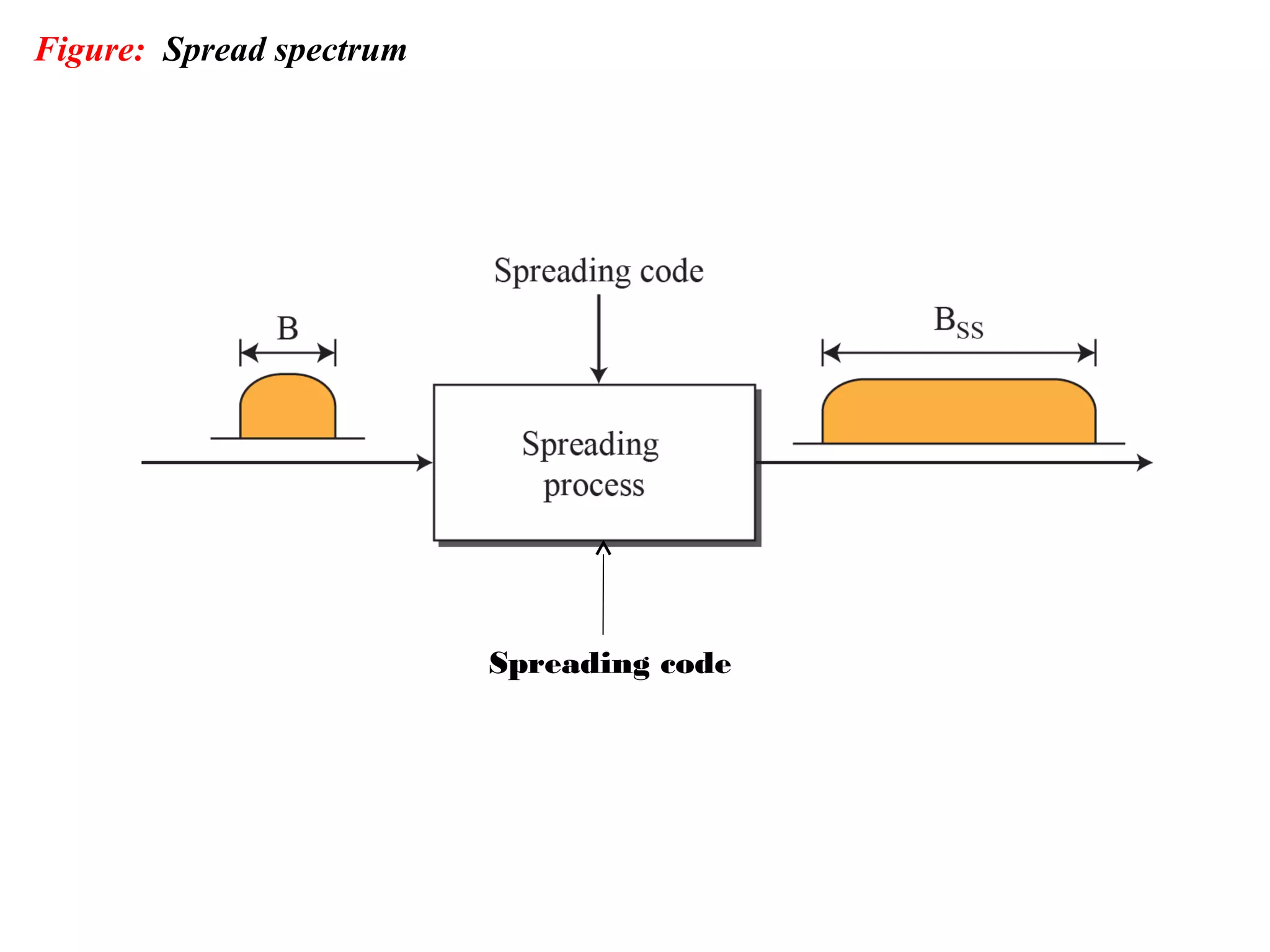
 SS spread the original spectrum needed for each station
Bandwidth required by station =B
Bandwidth spreaded by SS is Bss
Bss >> B
 The expanded bandwidth allows the source to wrap its
message in a protective envelope for more secure
transmission; like we send a delicate costly gift
 Figure explains the technique:
Figure: Spread spectrum
Spreading code
How is the SS signal different from the
normal signal?
The signal is different from a normal signal, in
the following aspects :
1.This signal occupies a larger bandwidth than
that of a normal signal. (Therefore the name
Spread Spectrum).
2.The spread spectrum signal invariably uses
some kind of coding.
 Code word is used to find original signal at the
receiving end.
3. The most important point is that the SS signal is
“pseudorandom” in nature.
Applications of Spread Spectrum Modulation
The spread spectrum signals are used in the
following application:
1.In overcoming the intentional interference
(jamming).
2.In rejecting the unintentional interference from
some other user
3.To avoid the self interference due to multipath
propagation
4.For making low probability of intercept (LPI)
signals
5.In obtaining the message privacy
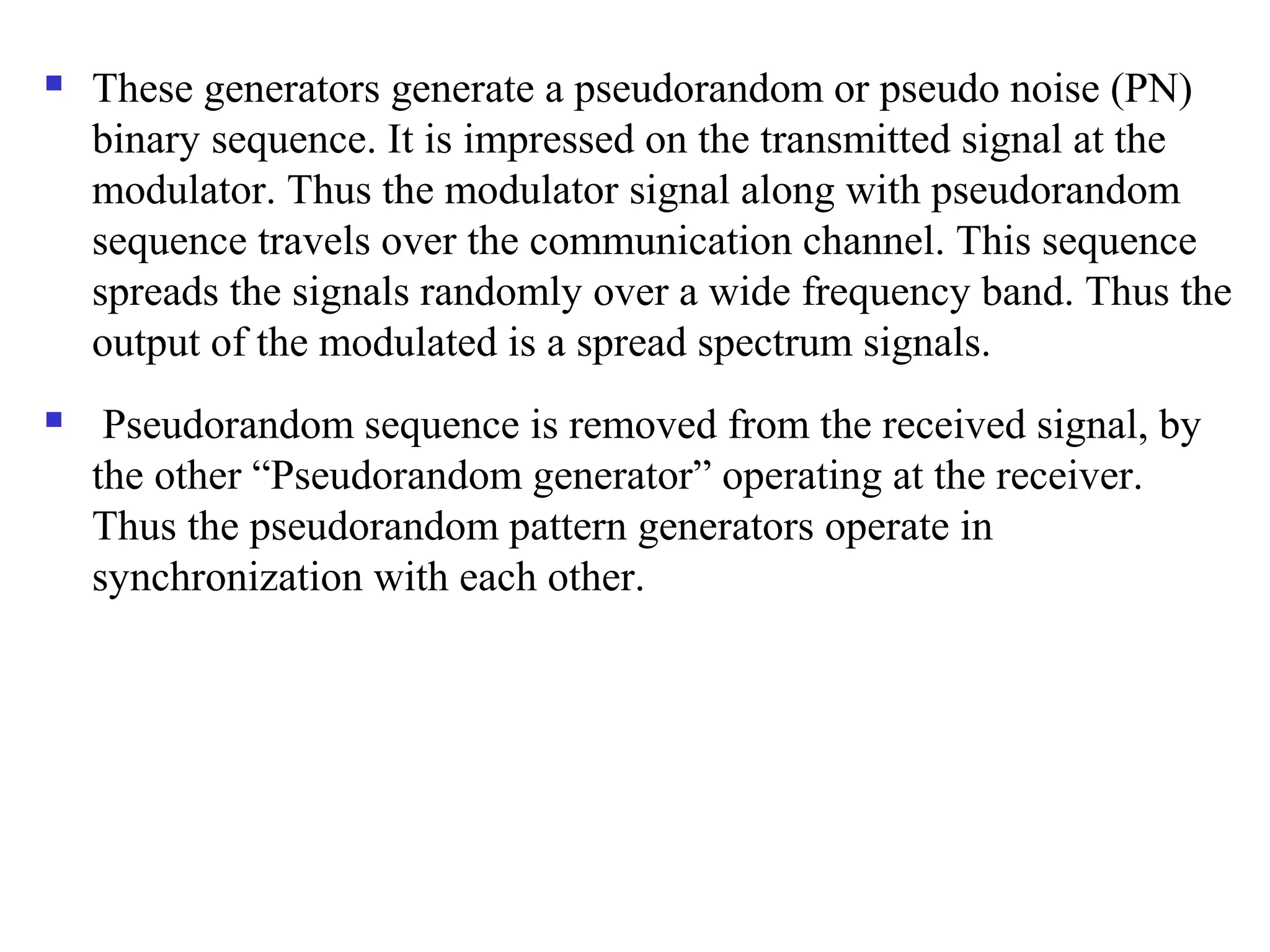
Informatio
n sequence
Spread
spectrum
signal
Channel
encoder
Modulator Channel Demodulator
Channel
decoder
Pseudorandom
pattern
generator
Pseudorand
om pattern
generator
Output
data
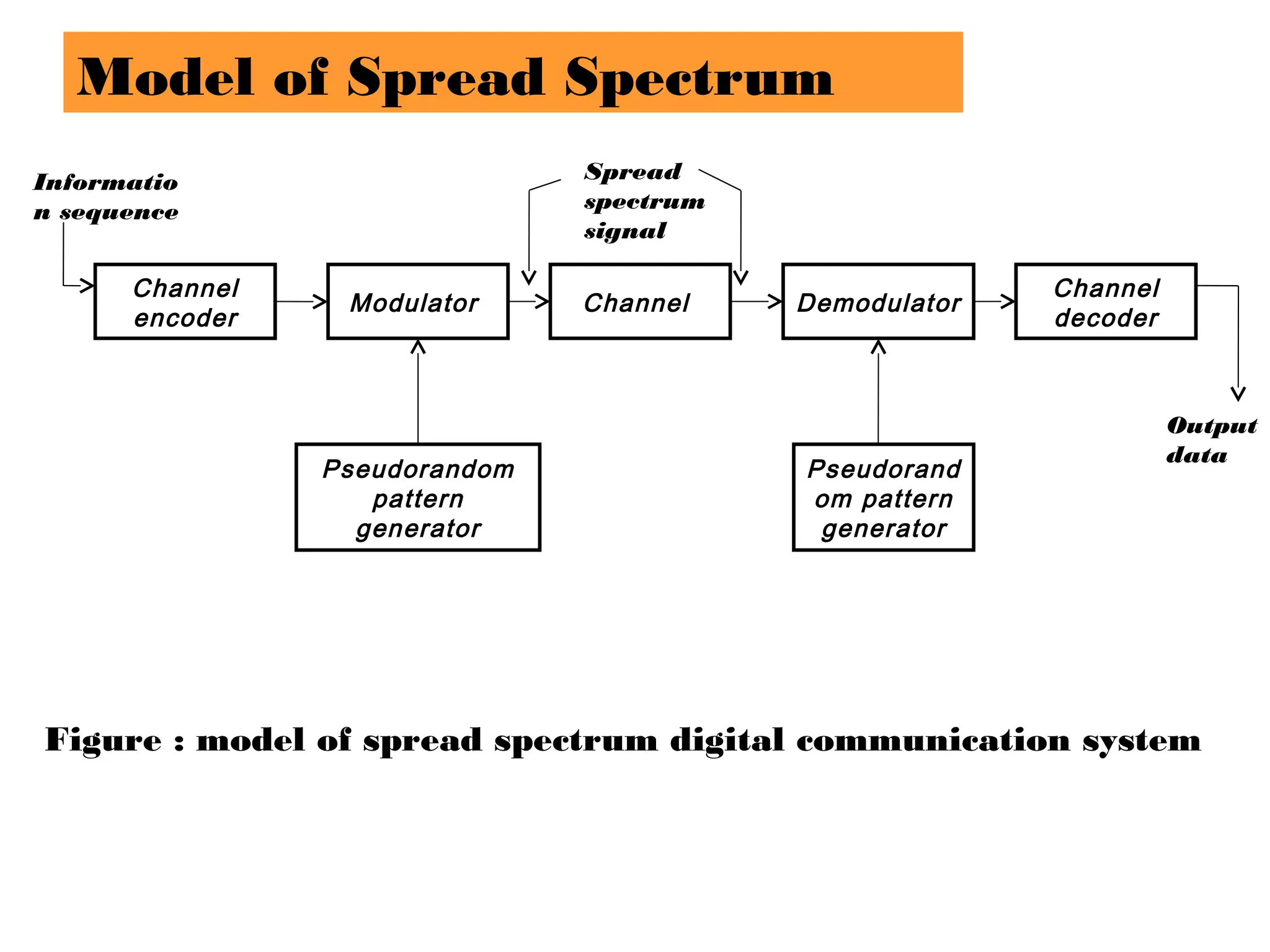
Figure : model of spread spectrum digital communication system
Model of Spread Spectrum
Operation of The Model of spread
spectrum System
 The information sequence at the input of the system is a binary
information sequence. The same signal is recovered at the output of
the system as output data signals.
 This model is also using channel encoder, channel decoder,
modulator and demodulator.
 In digital communication system, two additional blocks called
“pseudo-random” are also used. One of them is connected to the
modulator one the transmitter side whereas the other is connected to
the demodulator on the receiving side. Both these generators are
identical to each other.
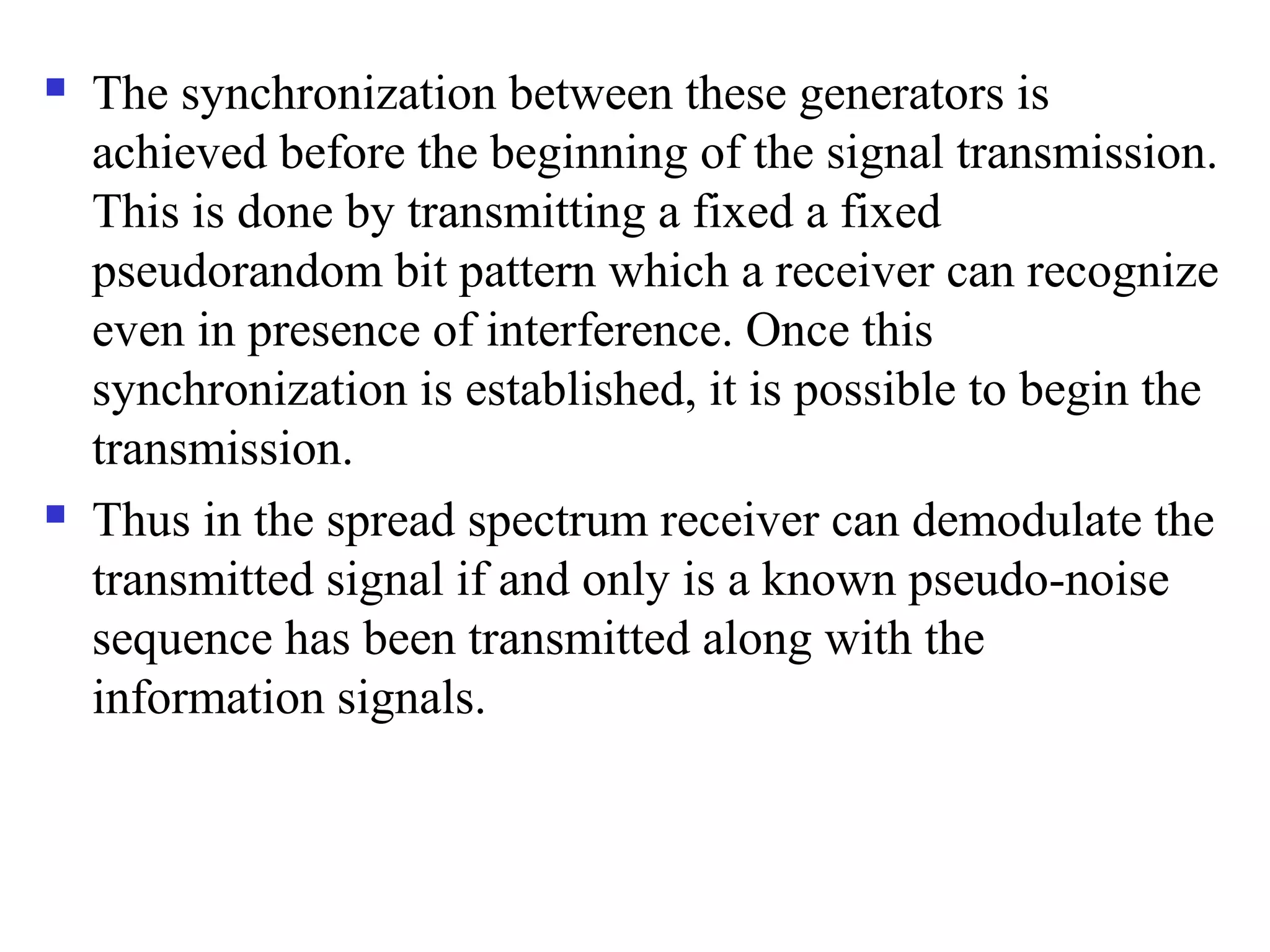
 These generators generate a pseudorandom or pseudo noise (PN)
binary sequence. It is impressed on the transmitted signal at the
modulator. Thus the modulator signal along with pseudorandom
sequence travels over the communication channel. This sequence
spreads the signals randomly over a wide frequency band. Thus the
output of the modulated is a spread spectrum signals.
 Pseudorandom sequence is removed from the received signal, by
the other “Pseudorandom generator” operating at the receiver.
Thus the pseudorandom pattern generators operate in
synchronization with each other.
 The synchronization between these generators is
achieved before the beginning of the signal transmission.
This is done by transmitting a fixed a fixed
pseudorandom bit pattern which a receiver can recognize
even in presence of interference. Once this
synchronization is established, it is possible to begin the
transmission.
 Thus in the spread spectrum receiver can demodulate the
transmitted signal if and only is a known pseudo-noise
sequence has been transmitted along with the
information signals.
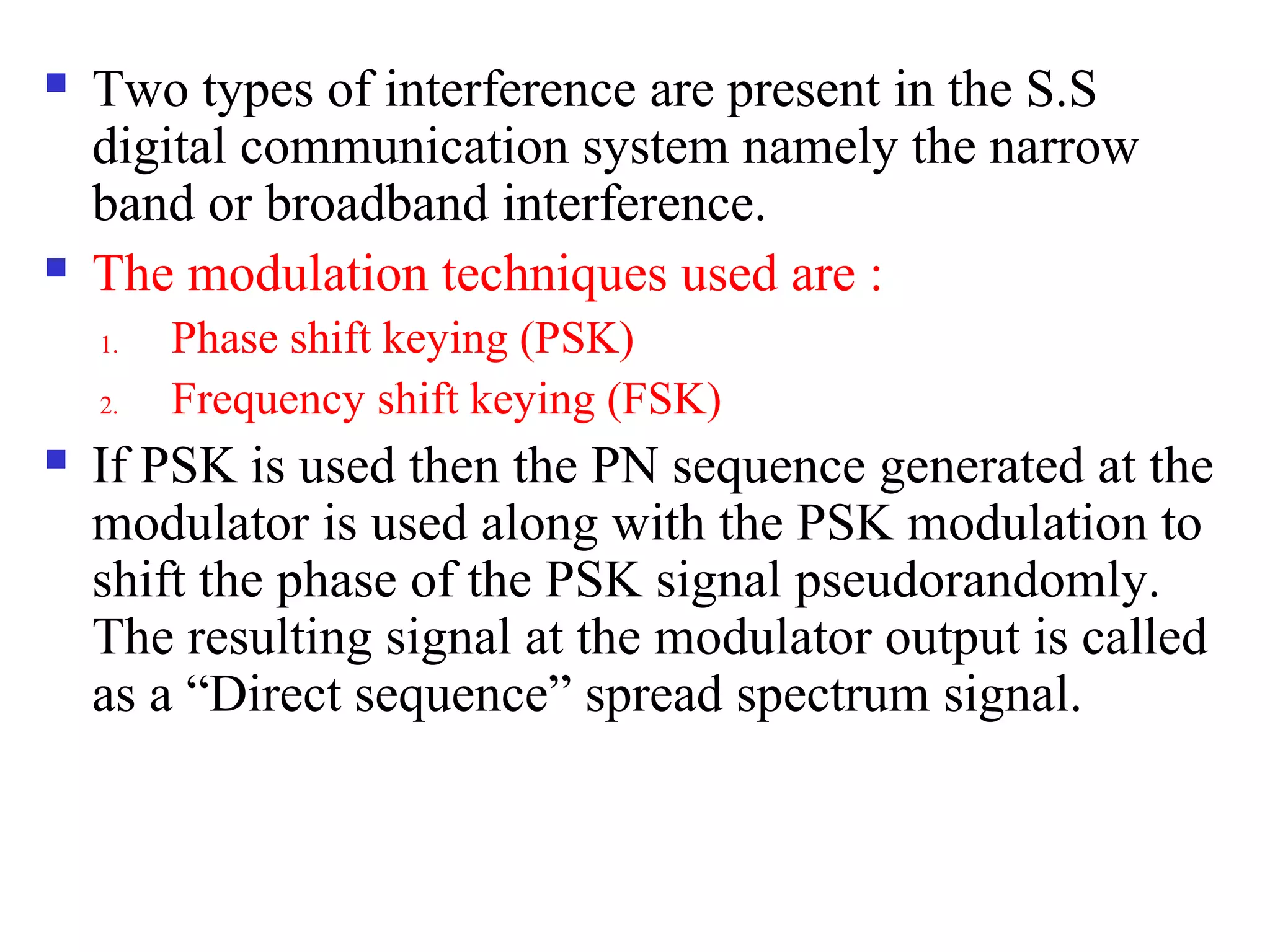
 Two types of interference are present in the S.S
digital communication system namely the narrow
band or broadband interference.
 The modulation techniques used are :
1. Phase shift keying (PSK)
2. Frequency shift keying (FSK)
 If PSK is used then the PN sequence generated at the
modulator is used along with the PSK modulation to
shift the phase of the PSK signal pseudorandomly.
The resulting signal at the modulator output is called
as a “Direct sequence” spread spectrum signal.
 If binary or M-ary FSK is being used, then the
frequency of the FSK signals is shifted
pseudorandomly. The resulting signals at the output
of the modulator is called as “Frequency Hopped”
(FH) spread spectrum signal.
 SS works on following 2 principles :
1. The bandwidth allocated to each station needs to be, by far,
larger than what is needed. This allows redundancy.
2. The expanding the original bandwidth to B to the bandwidth
Bss must be done by a process that is independent of the
original signal. In other words, the spreading process occurs
after signal is created by the source
After the signal is created by source, the spreading
process uses a spreading code & spreads the
bandwidth.
Spreading code is a series of numbers that look like
pattern.
Techniques of Spread Spectrum
1. Frequency Hopping Spread
Spectrum(FHSS)
2. Direct Sequence Spread Spectrum(DSSS)
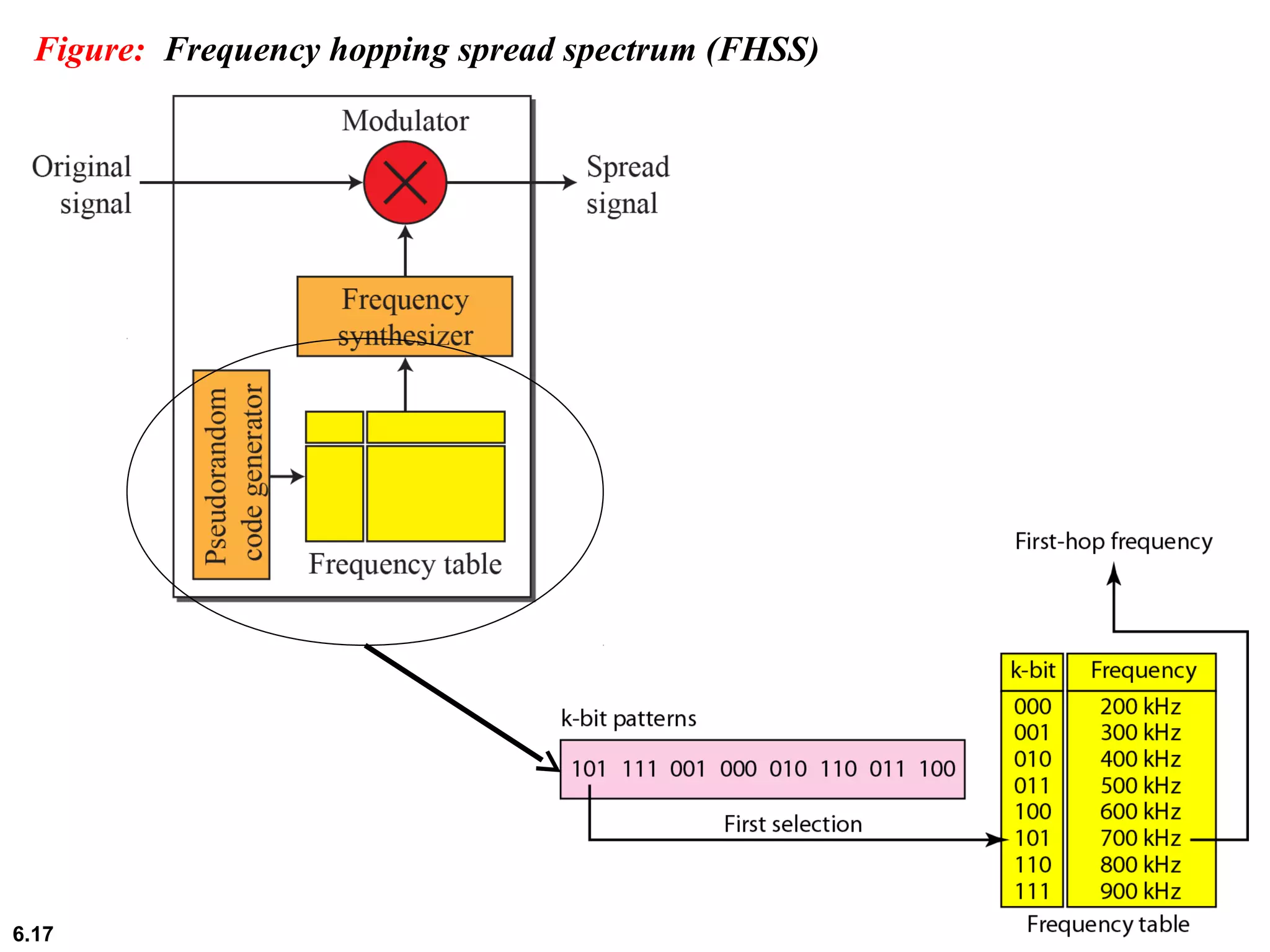
Frequency Hopping Spread Spectrum (FHSS)Frequency Hopping Spread Spectrum (FHSS)
Frequency-hopping spread spectrum
(FHSS) is a method of transmitting
radio signals by rapidly switching a
carrier among many frequency
channels, using a pseudorandom
sequence known to both transmitter and
receiver.
6.17
Figure: Frequency hopping spread spectrum (FHSS)
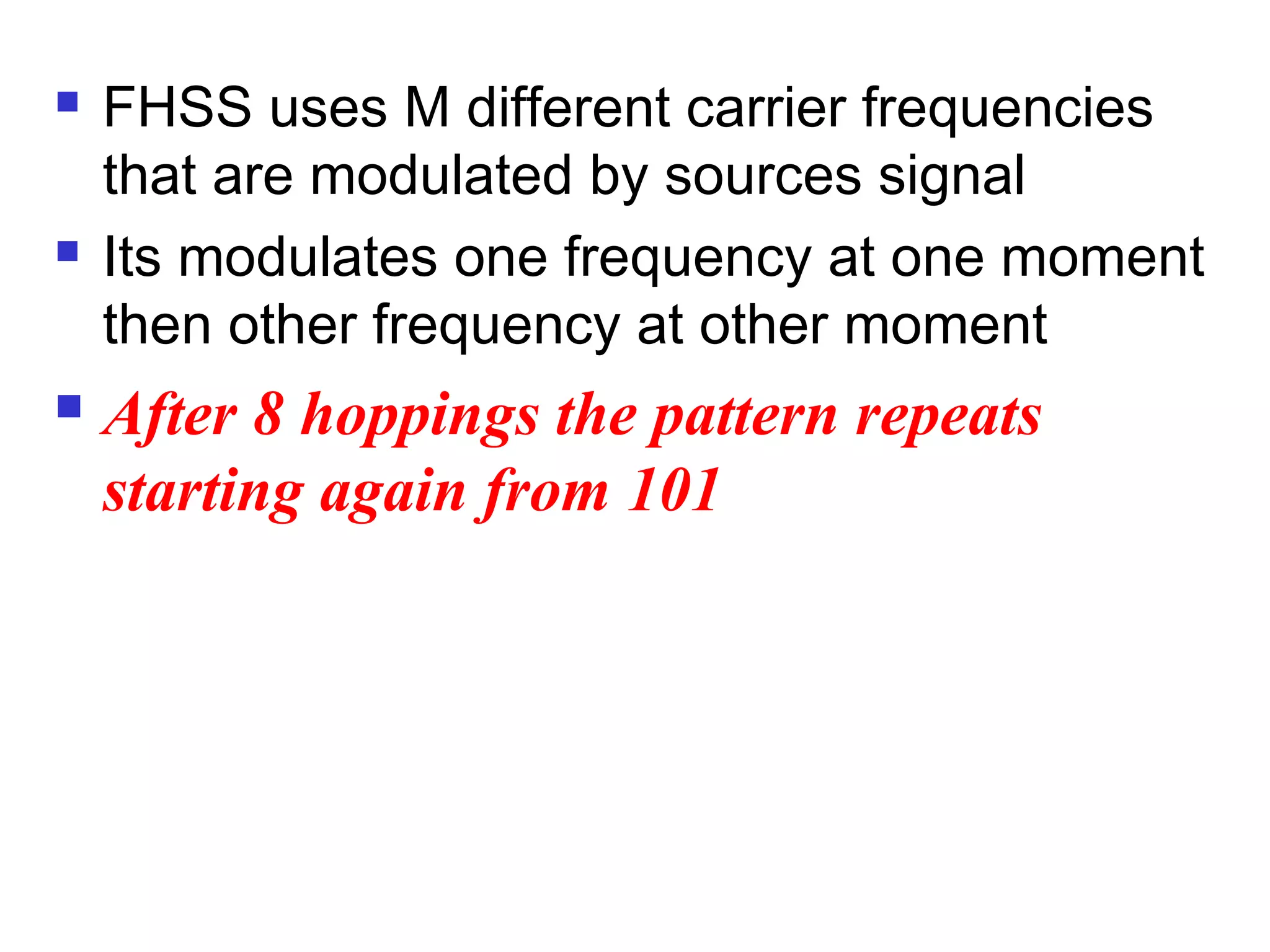
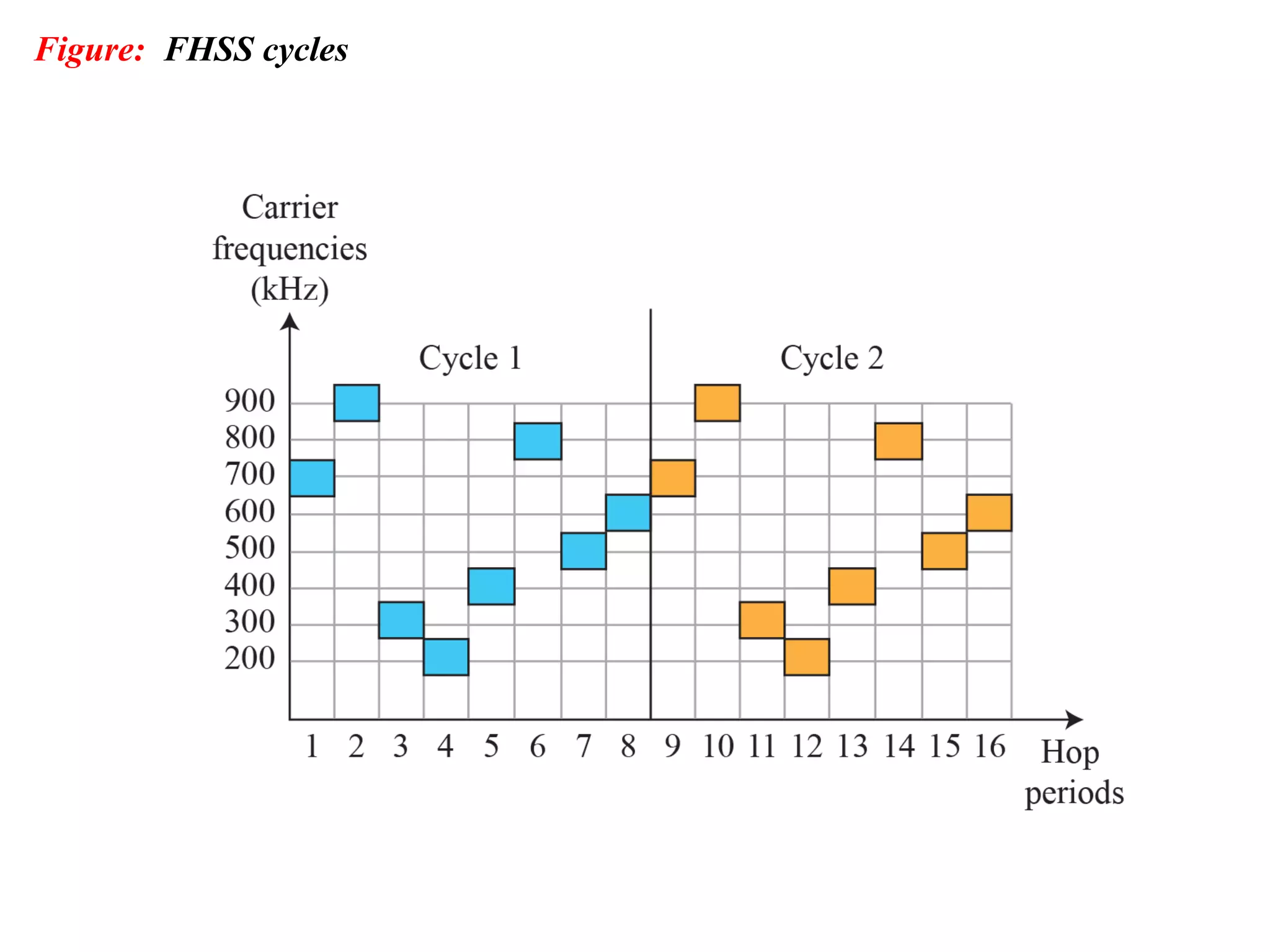
 FHSS uses M different carrier frequencies
that are modulated by sources signal
 Its modulates one frequency at one moment
then other frequency at other moment
 After 8 hoppings the pattern repeats
starting again from 101
Figure: FHSS cycles
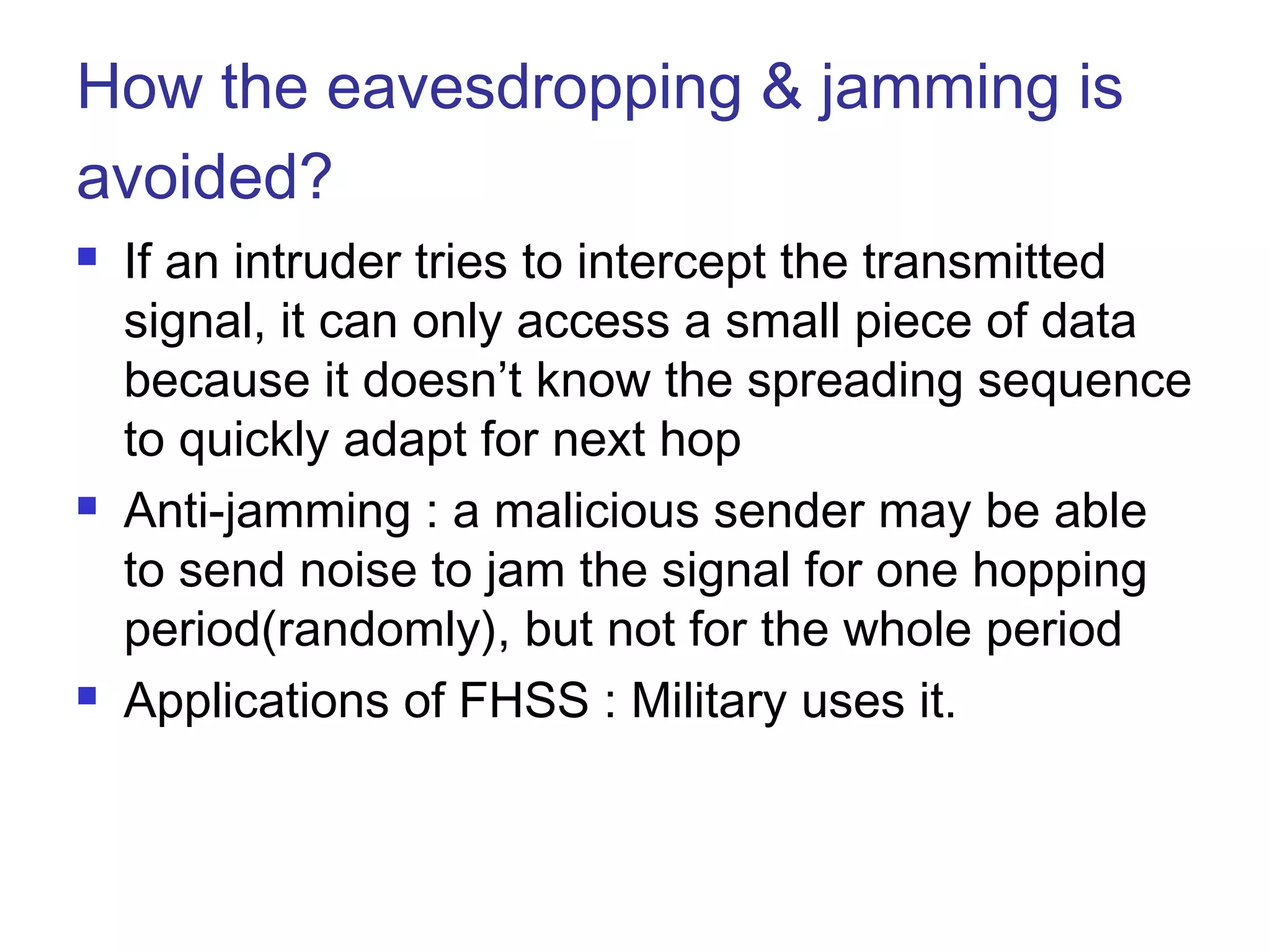
How the eavesdropping & jamming is
avoided?
 If an intruder tries to intercept the transmitted
signal, it can only access a small piece of data
because it doesn’t know the spreading sequence
to quickly adapt for next hop
 Anti-jamming : a malicious sender may be able
to send noise to jam the signal for one hopping
period(randomly), but not for the whole period
 Applications of FHSS : Military uses it.
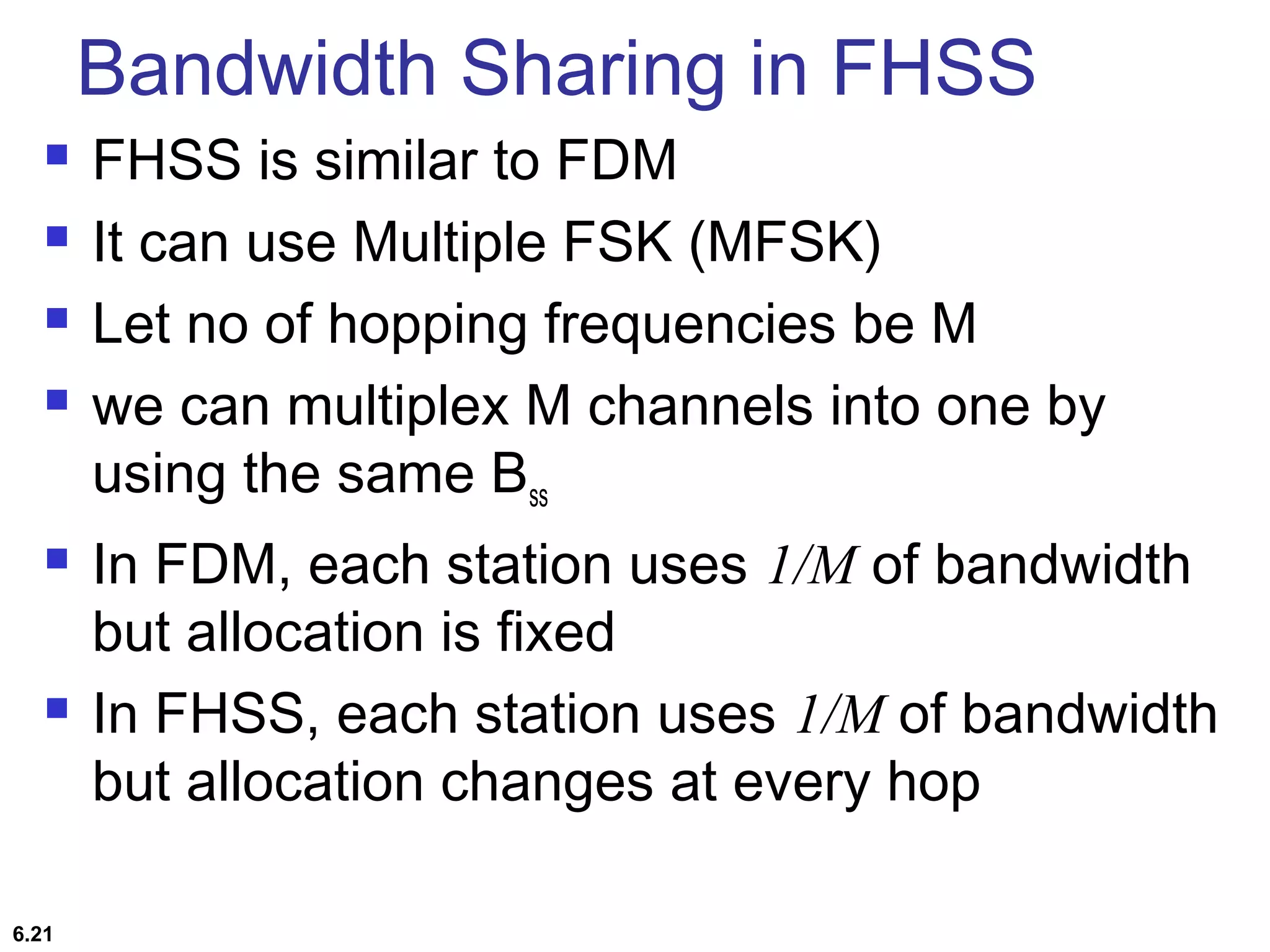
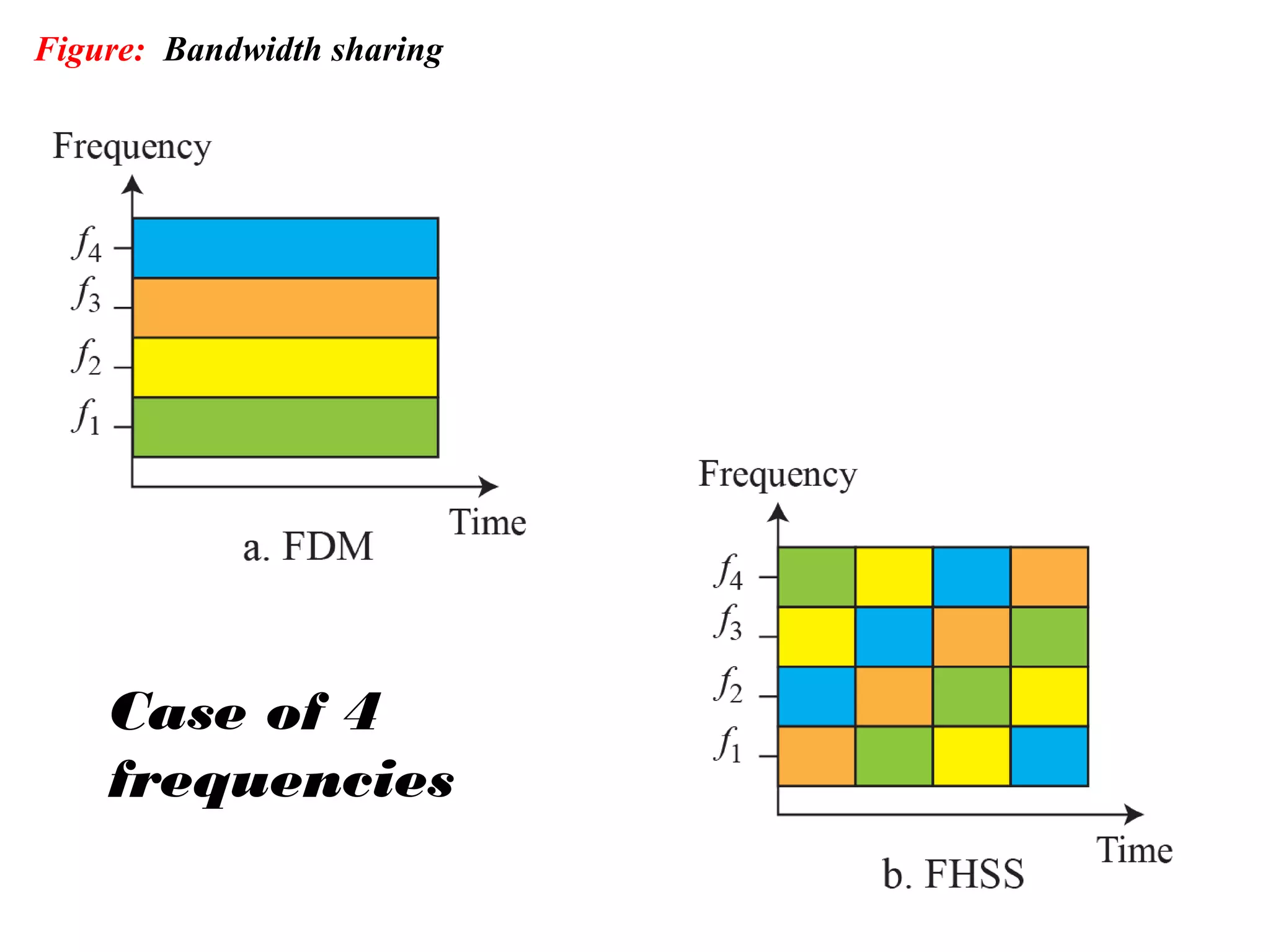
Bandwidth Sharing in FHSS
 FHSS is similar to FDM
 It can use Multiple FSK (MFSK)
 Let no of hopping frequencies be M
 we can multiplex M channels into one by
using the same Bss
 In FDM, each station uses 1/M of bandwidth
but allocation is fixed
 In FHSS, each station uses 1/M of bandwidth
but allocation changes at every hop
6.21
Figure: Bandwidth sharing
Case of 4
frequencies
Direct Sequence Spread Spectrum (DSSS)Direct Sequence Spread Spectrum (DSSS)
• The direct sequence spread spectrum (DSSS)
technique also expands the bandwidth of the
original signal, but the process is different.
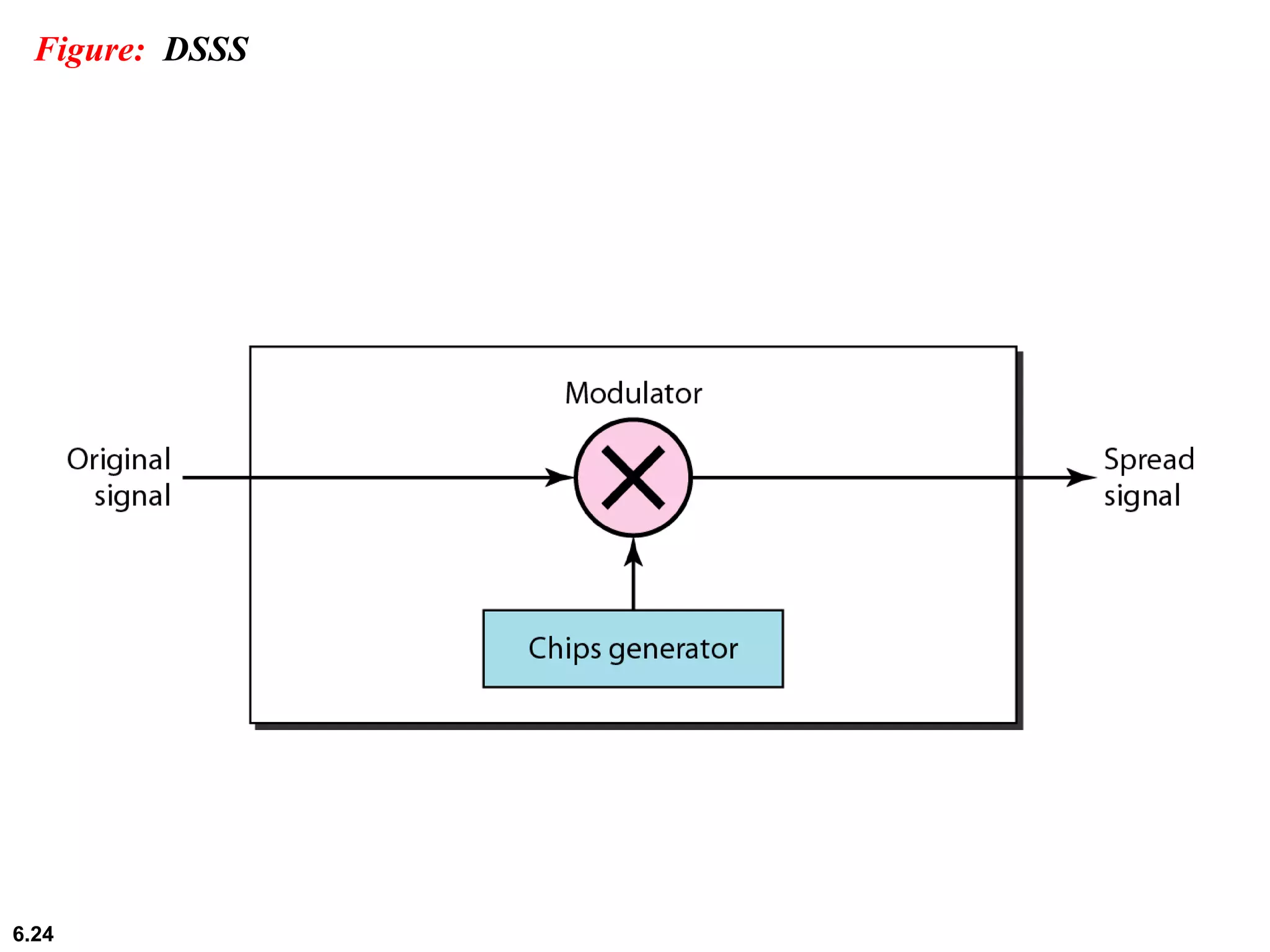
• In DSSS, we replace each data bit with n bits
using a spreading code.
• In other words, each bit is assigned a code of n
bits, called chips, where the chip rate is n times
that of the data bit.
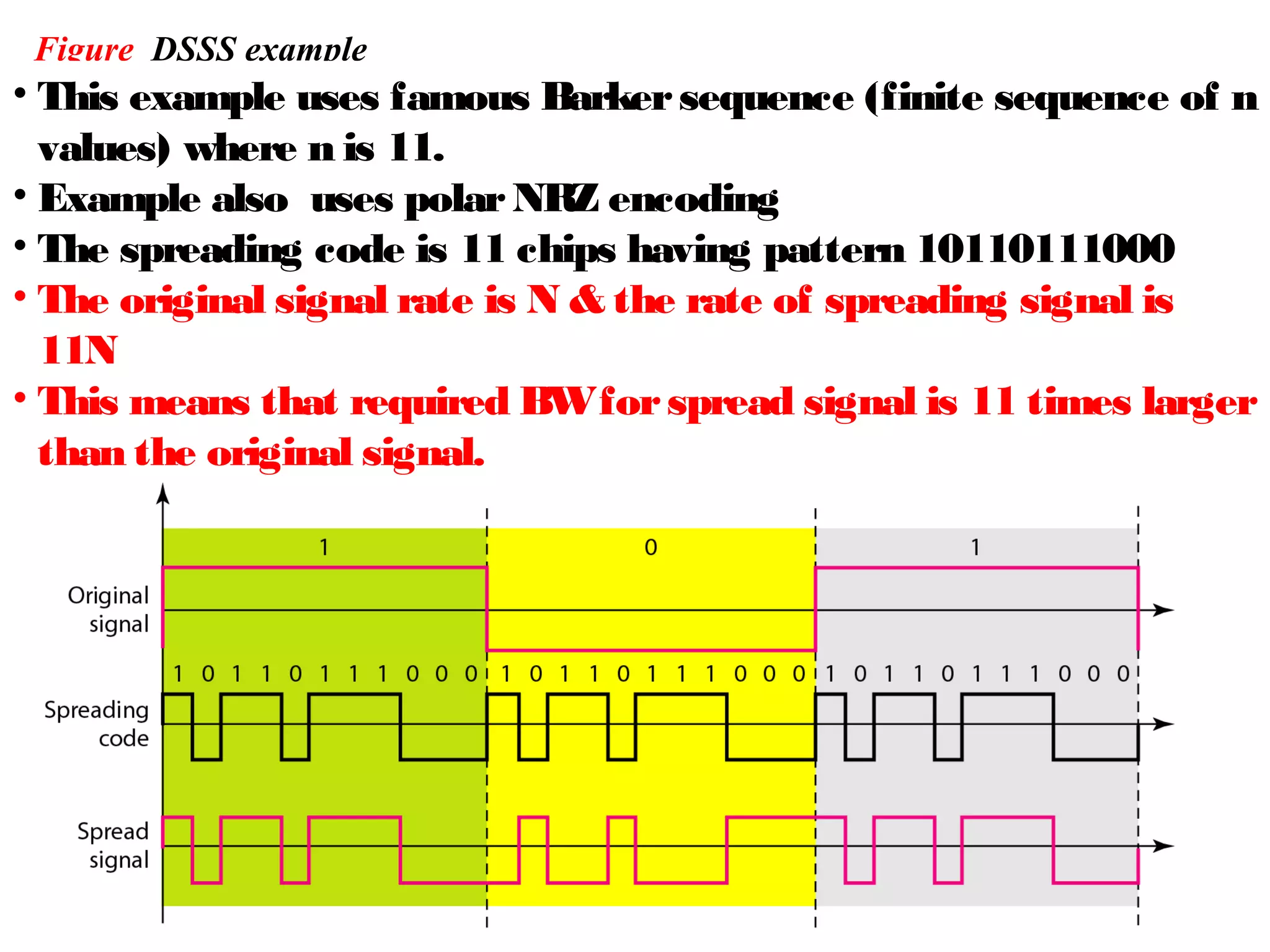
• Figure shows the concept of DSSS.
6.24
Figure: DSSS
Figure DSSS example
• This example uses famous Barkersequence (finite sequence of n
values) where n is 11.
• Example also uses polarNRZ encoding
• The spreading code is 11 chips having pattern 10110111000
• The original signal rate is N & the rate of spreading signal is
11N
• This means that required BWforspread signal is 11 times larger
than the original signal.
Bandwidth sharing in DSSS
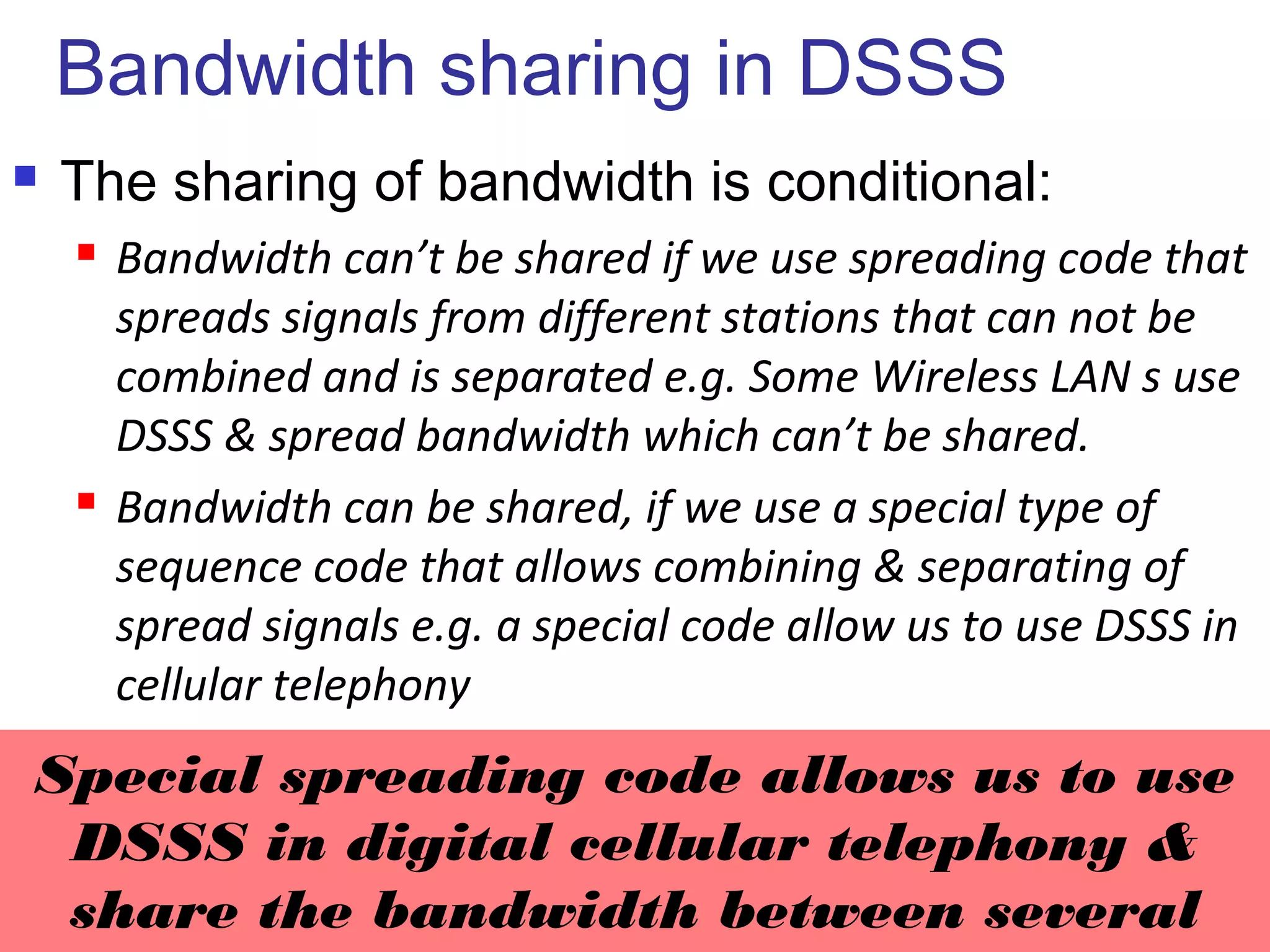
 The sharing of bandwidth is conditional:
 Bandwidth can’t be shared if we use spreading code that
spreads signals from different stations that can not be
combined and is separated e.g. Some Wireless LAN s use
DSSS & spread bandwidth which can’t be shared.
 Bandwidth can be shared, if we use a special type of
sequence code that allows combining & separating of
spread signals e.g. a special code allow us to use DSSS in
cellular telephony
6.26
Special spreading code allows us to use
DSSS in digital cellular telephony &
share the bandwidth between several
Advantages and Disadvantages of
DSSS systems
Advantages
 This system has a very high degree of
discrimination against the multipath signals.
Therefore the interference caused by the
multipath reception is minimized successfully.
 The performance of DSSS system in presence of
noise is superior to other system such as FHSS
system.
 This system combats the intentional interference
(jamming) most effectively.
Disadvantages
 With the serial search system, the acquisition
time is too large. This makes the DSSS system
slow.
 The channel bandwidth required, is very large.
But this bandwidth is less than that of a FHSS
system.
 The synchronization is affected by the variable
distance between the transmitter and
receiver.
Advantages and disadvantages
of the FHSS system
Advantages
 The synchronization is not greatly dependent
on the distance.
 The serial search system with FHSS needs
shorter time for acquisition.
 The processing gain PG is higher than that of
DSSS system.
Disadvantages
 The bandwidth of FHSS system is too large (in
GHz).
 Complex and expensive digital frequency
synthesizers are required to be used.
Thank You
Dr Rajiv Srivastava
Director
Sagar Institute of Research & Technology
(SIRT)
Sagar Group of Institutions, Bhopal
http://www.sirtbhopal.ac.in

Topic: Spread Spectrum

  • 1.
    Introduction to Datacommunication Topic: Spread Spectrum Lecture #4 Dr Rajiv Srivastava Director Sagar Institute of Research & Technology (SIRT) Sagar Group of Institutions, Bhopal http://www.sirtbhopal.ac.in
  • 2.
    Unit 2 Lecture 4 CourseLecture 21 Spread Spectrum
  • 3.
    • In someapplications, we have someIn some applications, we have some concerns that outweigh bandwidthconcerns that outweigh bandwidth efficiency.efficiency. • In wireless applications, stations must beIn wireless applications, stations must be able to share this medium withoutable to share this medium without interception by an eavesdropper andinterception by an eavesdropper and without being subject to jamming from awithout being subject to jamming from a malicious intruder to achieve these goalsmalicious intruder to achieve these goals • spread spectrum techniques addspread spectrum techniques add redundancyredundancy 6.3
  • 4.
     Spread spectrumis a form of wireless communications in which the frequency of the transmitted signal is deliberately varied.  This results in a much greater bandwidth than the signal would have if its frequency were not varied.  This wireless technique is used in LAN & WAN that requires a bandwidth several times more than original bandwidth  In SS signals from different sources are also combined to fit into larger bandwidth  SS spread the original spectrum needed for each station Bandwidth required by station =B Bandwidth spreaded by SS is Bss Bss >> B  The expanded bandwidth allows the source to wrap its message in a protective envelope for more secure transmission; like we send a delicate costly gift  Figure explains the technique:
  • 5.
  • 6.
    How is theSS signal different from the normal signal? The signal is different from a normal signal, in the following aspects : 1.This signal occupies a larger bandwidth than that of a normal signal. (Therefore the name Spread Spectrum). 2.The spread spectrum signal invariably uses some kind of coding.  Code word is used to find original signal at the receiving end. 3. The most important point is that the SS signal is “pseudorandom” in nature.
  • 7.
    Applications of SpreadSpectrum Modulation The spread spectrum signals are used in the following application: 1.In overcoming the intentional interference (jamming). 2.In rejecting the unintentional interference from some other user 3.To avoid the self interference due to multipath propagation 4.For making low probability of intercept (LPI) signals 5.In obtaining the message privacy
  • 8.
    Informatio n sequence Spread spectrum signal Channel encoder Modulator ChannelDemodulator Channel decoder Pseudorandom pattern generator Pseudorand om pattern generator Output data Figure : model of spread spectrum digital communication system Model of Spread Spectrum
  • 9.
    Operation of TheModel of spread spectrum System  The information sequence at the input of the system is a binary information sequence. The same signal is recovered at the output of the system as output data signals.  This model is also using channel encoder, channel decoder, modulator and demodulator.  In digital communication system, two additional blocks called “pseudo-random” are also used. One of them is connected to the modulator one the transmitter side whereas the other is connected to the demodulator on the receiving side. Both these generators are identical to each other.
  • 10.
     These generatorsgenerate a pseudorandom or pseudo noise (PN) binary sequence. It is impressed on the transmitted signal at the modulator. Thus the modulator signal along with pseudorandom sequence travels over the communication channel. This sequence spreads the signals randomly over a wide frequency band. Thus the output of the modulated is a spread spectrum signals.  Pseudorandom sequence is removed from the received signal, by the other “Pseudorandom generator” operating at the receiver. Thus the pseudorandom pattern generators operate in synchronization with each other.
  • 11.
     The synchronizationbetween these generators is achieved before the beginning of the signal transmission. This is done by transmitting a fixed a fixed pseudorandom bit pattern which a receiver can recognize even in presence of interference. Once this synchronization is established, it is possible to begin the transmission.  Thus in the spread spectrum receiver can demodulate the transmitted signal if and only is a known pseudo-noise sequence has been transmitted along with the information signals.
  • 12.
     Two typesof interference are present in the S.S digital communication system namely the narrow band or broadband interference.  The modulation techniques used are : 1. Phase shift keying (PSK) 2. Frequency shift keying (FSK)  If PSK is used then the PN sequence generated at the modulator is used along with the PSK modulation to shift the phase of the PSK signal pseudorandomly. The resulting signal at the modulator output is called as a “Direct sequence” spread spectrum signal.
  • 13.
     If binaryor M-ary FSK is being used, then the frequency of the FSK signals is shifted pseudorandomly. The resulting signals at the output of the modulator is called as “Frequency Hopped” (FH) spread spectrum signal.
  • 14.
     SS workson following 2 principles : 1. The bandwidth allocated to each station needs to be, by far, larger than what is needed. This allows redundancy. 2. The expanding the original bandwidth to B to the bandwidth Bss must be done by a process that is independent of the original signal. In other words, the spreading process occurs after signal is created by the source After the signal is created by source, the spreading process uses a spreading code & spreads the bandwidth. Spreading code is a series of numbers that look like pattern.
  • 15.
    Techniques of SpreadSpectrum 1. Frequency Hopping Spread Spectrum(FHSS) 2. Direct Sequence Spread Spectrum(DSSS)
  • 16.
    Frequency Hopping SpreadSpectrum (FHSS)Frequency Hopping Spread Spectrum (FHSS) Frequency-hopping spread spectrum (FHSS) is a method of transmitting radio signals by rapidly switching a carrier among many frequency channels, using a pseudorandom sequence known to both transmitter and receiver.
  • 17.
    6.17 Figure: Frequency hoppingspread spectrum (FHSS)
  • 18.
     FHSS usesM different carrier frequencies that are modulated by sources signal  Its modulates one frequency at one moment then other frequency at other moment  After 8 hoppings the pattern repeats starting again from 101
  • 19.
  • 20.
    How the eavesdropping& jamming is avoided?  If an intruder tries to intercept the transmitted signal, it can only access a small piece of data because it doesn’t know the spreading sequence to quickly adapt for next hop  Anti-jamming : a malicious sender may be able to send noise to jam the signal for one hopping period(randomly), but not for the whole period  Applications of FHSS : Military uses it.
  • 21.
    Bandwidth Sharing inFHSS  FHSS is similar to FDM  It can use Multiple FSK (MFSK)  Let no of hopping frequencies be M  we can multiplex M channels into one by using the same Bss  In FDM, each station uses 1/M of bandwidth but allocation is fixed  In FHSS, each station uses 1/M of bandwidth but allocation changes at every hop 6.21
  • 22.
  • 23.
    Direct Sequence SpreadSpectrum (DSSS)Direct Sequence Spread Spectrum (DSSS) • The direct sequence spread spectrum (DSSS) technique also expands the bandwidth of the original signal, but the process is different. • In DSSS, we replace each data bit with n bits using a spreading code. • In other words, each bit is assigned a code of n bits, called chips, where the chip rate is n times that of the data bit. • Figure shows the concept of DSSS.
  • 24.
  • 25.
    Figure DSSS example •This example uses famous Barkersequence (finite sequence of n values) where n is 11. • Example also uses polarNRZ encoding • The spreading code is 11 chips having pattern 10110111000 • The original signal rate is N & the rate of spreading signal is 11N • This means that required BWforspread signal is 11 times larger than the original signal.
  • 26.
    Bandwidth sharing inDSSS  The sharing of bandwidth is conditional:  Bandwidth can’t be shared if we use spreading code that spreads signals from different stations that can not be combined and is separated e.g. Some Wireless LAN s use DSSS & spread bandwidth which can’t be shared.  Bandwidth can be shared, if we use a special type of sequence code that allows combining & separating of spread signals e.g. a special code allow us to use DSSS in cellular telephony 6.26 Special spreading code allows us to use DSSS in digital cellular telephony & share the bandwidth between several
  • 27.
    Advantages and Disadvantagesof DSSS systems Advantages  This system has a very high degree of discrimination against the multipath signals. Therefore the interference caused by the multipath reception is minimized successfully.  The performance of DSSS system in presence of noise is superior to other system such as FHSS system.  This system combats the intentional interference (jamming) most effectively.
  • 28.
    Disadvantages  With theserial search system, the acquisition time is too large. This makes the DSSS system slow.  The channel bandwidth required, is very large. But this bandwidth is less than that of a FHSS system.  The synchronization is affected by the variable distance between the transmitter and receiver.
  • 29.
    Advantages and disadvantages ofthe FHSS system Advantages  The synchronization is not greatly dependent on the distance.  The serial search system with FHSS needs shorter time for acquisition.  The processing gain PG is higher than that of DSSS system.
  • 30.
    Disadvantages  The bandwidthof FHSS system is too large (in GHz).  Complex and expensive digital frequency synthesizers are required to be used.
  • 31.
    Thank You Dr RajivSrivastava Director Sagar Institute of Research & Technology (SIRT) Sagar Group of Institutions, Bhopal http://www.sirtbhopal.ac.in