By
S.Rajapriya,MS(IT).,
Assistant Professor of IT
V.V.Vanniaperumal College for Women
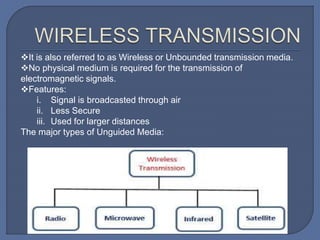
It is also referred to as Wireless or Unbounded transmission media.
No physical medium is required for the transmission of
electromagnetic signals.
Features:
i. Signal is broadcasted through air
ii. Less Secure
iii. Used for larger distances
The major types of Unguided Media:
Wireless transmission is a form of unguided media.
 Wireless communication involves no physical link established
between two or more devices, communicating wirelessly.
Wireless signals are spread over in the air and are received and
interpreted by appropriate antennas.
When an antenna is attached to electrical circuit of a computer or
wireless device, it converts the digital data into wireless signals and
spread all over within its frequency range.
 The receptor on the other end receives these signals and converts
them back to digital data.
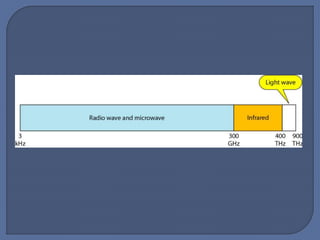
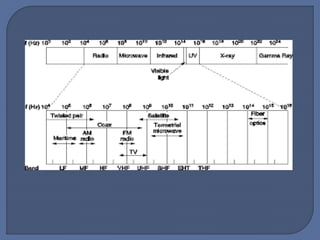
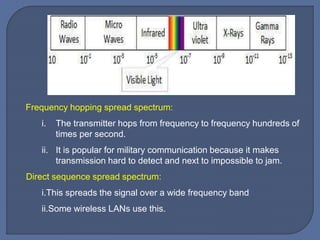
A little part of electromagnetic spectrum can be used for wireless
transmission.
Frequency hopping spread spectrum:
i. The transmitter hops from frequency to frequency hundreds of
times per second.
ii. It is popular for military communication because it makes
transmission hard to detect and next to impossible to jam.
Direct sequence spread spectrum:
i.This spreads the signal over a wide frequency band
ii.Some wireless LANs use this.
These are easy to generate and can penetrate through buildings.
 The sending and receiving antennas need not be aligned.
 Frequency Range:3KHz – 1GHz. AM and FM radios and cordless
phones use Radiowaves for transmission.
Radio frequencies are sub-divided into six bands.
Radio waves at lower frequencies can travel through walls whereas
higher RF can travel in straight line and bounce back.
The power of low frequency waves decreases sharply as they cover
long distance. High frequency radio waves have more power.
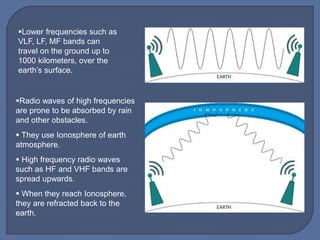
Radio waves of high frequencies
are prone to be absorbed by rain
and other obstacles.
 They use Ionosphere of earth
atmosphere.
 High frequency radio waves
such as HF and VHF bands are
spread upwards.
 When they reach Ionosphere,
they are refracted back to the
earth.
Lower frequencies such as
VLF, LF, MF bands can
travel on the ground up to
1000 kilometers, over the
earth’s surface.
Electromagnetic waves above 100 MHz tend to travel in a straight
line and signals over them can be sent by beaming those waves
towards one particular station.
Because Microwaves travels in straight lines, both the sending and
receiving antennas need to be properly aligned with each other.
The distance covered by the signal is directly proportional to the
height of the antenna.
Frequency Range:1GHz – 300GHz.
 These are majorly used for mobile phone communication and
television distribution.
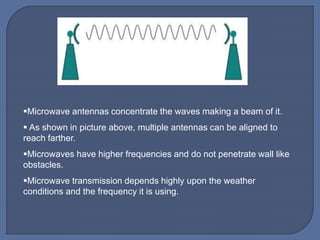
Microwave antennas concentrate the waves making a beam of it.
 As shown in picture above, multiple antennas can be aligned to
reach farther.
Microwaves have higher frequencies and do not penetrate wall like
obstacles.
Microwave transmission depends highly upon the weather
conditions and the frequency it is using.
Infrared waves are used for very short distance communication.
 They cannot penetrate through obstacles.
This prevents interference between systems.
 Frequency Range:300GHz – 400THz.
It is used in TV remotes, wireless mouse, keyboard, printer, etc.
Infrared wave lies in between visible light spectrum and microwaves.
Infrared travels in a straight line hence it is directional by nature.
 Because of high frequency range, Infrared cannot cross wall-like
obstacles.
Highest most electromagnetic spectrum which can be used for data
transmission is light or optical signaling. This is achieved by means of
LASER.
Because of frequency light uses, it tends to travel strictly in straight
line.
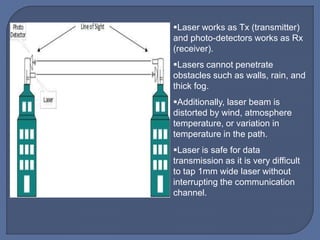
Hence the sender and receiver must be in the line-of-sight.
Because laser transmission is unidirectional, at both ends of
communication the laser and the photo-detector needs to be installed.
Laser beam is generally 1mm wide hence it is a work of precision to
align two far receptors each pointing to lasers source.
Laser works as Tx (transmitter)
and photo-detectors works as Rx
(receiver).
Lasers cannot penetrate
obstacles such as walls, rain, and
thick fog.
Additionally, laser beam is
distorted by wind, atmosphere
temperature, or variation in
temperature in the path.
Laser is safe for data
transmission as it is very difficult
to tap 1mm wide laser without
interrupting the communication
channel.
Wireless transmission

Wireless transmission

  • 1.
    By S.Rajapriya,MS(IT)., Assistant Professor ofIT V.V.Vanniaperumal College for Women
  • 2.
    It is alsoreferred to as Wireless or Unbounded transmission media. No physical medium is required for the transmission of electromagnetic signals. Features: i. Signal is broadcasted through air ii. Less Secure iii. Used for larger distances The major types of Unguided Media:
  • 4.
    Wireless transmission isa form of unguided media.  Wireless communication involves no physical link established between two or more devices, communicating wirelessly. Wireless signals are spread over in the air and are received and interpreted by appropriate antennas. When an antenna is attached to electrical circuit of a computer or wireless device, it converts the digital data into wireless signals and spread all over within its frequency range.  The receptor on the other end receives these signals and converts them back to digital data. A little part of electromagnetic spectrum can be used for wireless transmission.
  • 6.
    Frequency hopping spreadspectrum: i. The transmitter hops from frequency to frequency hundreds of times per second. ii. It is popular for military communication because it makes transmission hard to detect and next to impossible to jam. Direct sequence spread spectrum: i.This spreads the signal over a wide frequency band ii.Some wireless LANs use this.
  • 7.
    These are easyto generate and can penetrate through buildings.  The sending and receiving antennas need not be aligned.  Frequency Range:3KHz – 1GHz. AM and FM radios and cordless phones use Radiowaves for transmission. Radio frequencies are sub-divided into six bands. Radio waves at lower frequencies can travel through walls whereas higher RF can travel in straight line and bounce back. The power of low frequency waves decreases sharply as they cover long distance. High frequency radio waves have more power.
  • 8.
    Radio waves ofhigh frequencies are prone to be absorbed by rain and other obstacles.  They use Ionosphere of earth atmosphere.  High frequency radio waves such as HF and VHF bands are spread upwards.  When they reach Ionosphere, they are refracted back to the earth. Lower frequencies such as VLF, LF, MF bands can travel on the ground up to 1000 kilometers, over the earth’s surface.
  • 9.
    Electromagnetic waves above100 MHz tend to travel in a straight line and signals over them can be sent by beaming those waves towards one particular station. Because Microwaves travels in straight lines, both the sending and receiving antennas need to be properly aligned with each other. The distance covered by the signal is directly proportional to the height of the antenna. Frequency Range:1GHz – 300GHz.  These are majorly used for mobile phone communication and television distribution.
  • 10.
    Microwave antennas concentratethe waves making a beam of it.  As shown in picture above, multiple antennas can be aligned to reach farther. Microwaves have higher frequencies and do not penetrate wall like obstacles. Microwave transmission depends highly upon the weather conditions and the frequency it is using.
  • 11.
    Infrared waves areused for very short distance communication.  They cannot penetrate through obstacles. This prevents interference between systems.  Frequency Range:300GHz – 400THz. It is used in TV remotes, wireless mouse, keyboard, printer, etc. Infrared wave lies in between visible light spectrum and microwaves. Infrared travels in a straight line hence it is directional by nature.  Because of high frequency range, Infrared cannot cross wall-like obstacles.
  • 12.
    Highest most electromagneticspectrum which can be used for data transmission is light or optical signaling. This is achieved by means of LASER. Because of frequency light uses, it tends to travel strictly in straight line. Hence the sender and receiver must be in the line-of-sight. Because laser transmission is unidirectional, at both ends of communication the laser and the photo-detector needs to be installed. Laser beam is generally 1mm wide hence it is a work of precision to align two far receptors each pointing to lasers source.
  • 13.
    Laser works asTx (transmitter) and photo-detectors works as Rx (receiver). Lasers cannot penetrate obstacles such as walls, rain, and thick fog. Additionally, laser beam is distorted by wind, atmosphere temperature, or variation in temperature in the path. Laser is safe for data transmission as it is very difficult to tap 1mm wide laser without interrupting the communication channel.