Introduction to Data communication
Topic: Applications of TDM ( T & E Lines ) &
Statistical TDM
Lecture #3
Dr Rajiv Srivastava
Director
Sagar Institute of Research & Technology (SIRT)
Sagar Group of Institutions, Bhopal
http://www.sirtbhopal.ac.in
Unit 2
Lecture 3
Course Lecture 20
Applications of TDM ( T & E Lines )
&
Statistical TDM
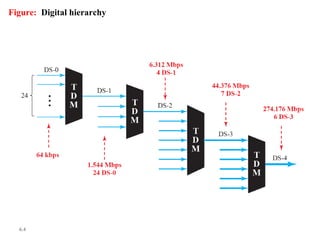
Digital Signal Service
• Telephone companies & Internet service
provides implement TDM through a hierarchy
of signals, called Digital Signal (DS) service or
digital hierarchy.
• Figure given next shows data rates supported
by each level.
6.4
Figure: Digital hierarchy
T Lines
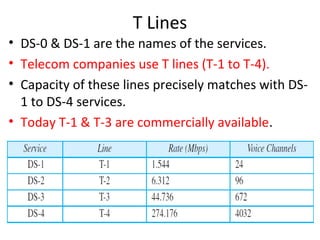
• DS-0 & DS-1 are the names of the services.
• Telecom companies use T lines (T-1 to T-4).
• Capacity of these lines precisely matches with DS-
1 to DS-4 services.
• Today T-1 & T-3 are commercially available.
T Lines for Analog transmission
• T lines are digital lines
• They can be used for analog service such as
voice calling
• For this purpose analog signal is first sampled
& then time division multiplexed.
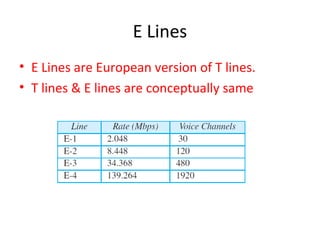
E Lines
• E Lines are European version of T lines.
• T lines & E lines are conceptually same
• STDM, or statistical time division multiplexing, is one
method for transmitting several types of data
simultaneously across a single transmission cable or line
(such as a T1 or T3 line).
• STDM is often used for managing data being transmitted via
a local area network (LAN) or a wide area network (WAN).
• In these situations, the data is often simultaneously
transmitted from any number of input devices attached to
the network, including computers, printers, or fax machines.
Statistical Time Division Multiplexing
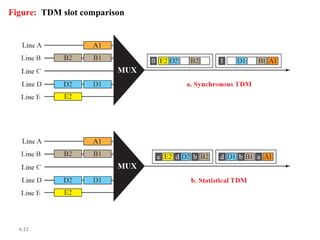
• In synchronous TDM, each input has a reserved slot in
the output frame. This can be inefficient if some input
lines have no data to send.
• In statistical time-division multiplexing, slots are
dynamically allocated to improve bandwidth efficiency.
• Only when an input line has a slot’s worth of data to send
is it given a slot in the output frame.
Statistical Time Division Multiplexing
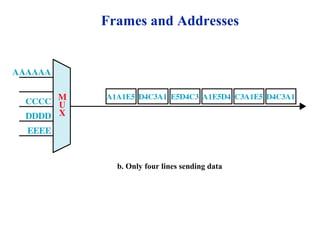
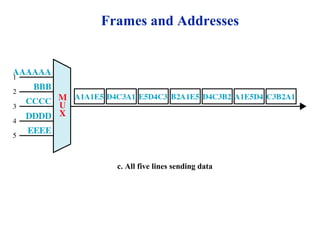
• In statistical multiplexing, the number of slots
in each frame is less than the number of input
lines.
• The multiplexer checks each input line in
round-robin fashion; it allocates a slot for an
input line if the line has data to send
• otherwise, it skips the line and checks the
next line.
Statistical Time Division Multiplexing
• Statistical TDM is a more flexible method of TDM.
With static TDM the length of time allocated is
not fixed for each device but time is given to
devices that have data to transmit.
• STDM can also be used in telephone
switchboard settings to manage the
simultaneous calls going to or coming from
multiple, internal telephone lines
6.12
Figure: TDM slot comparison
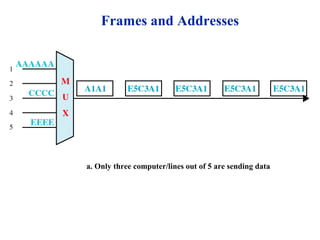
Frames and Addresses
a. Only three computer/lines out of 5 are sending data
Frames and Addresses
b. Only four lines sending data
Frames and Addresses
c. All five lines sending data
Animation of STDM
• http://www.mhhe.com/engcs/compsci/forouz
an/dcn/graphics/animations/08_17.swf
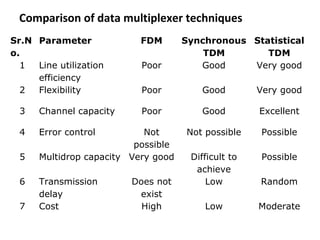
Comparison of data multiplexer techniques
Sr.N
o.
Parameter FDM Synchronous
TDM
Statistical
TDM
1 Line utilization
efficiency
Poor Good Very good
2 Flexibility Poor Good Very good
3 Channel capacity Poor Good Excellent
4 Error control Not
possible
Not possible Possible
5 Multidrop capacity Very good Difficult to
achieve
Possible
6 Transmission
delay
Does not
exist
Low Random
7 Cost High Low Moderate
No Synchronization Bit
• There is another difference between synchronous and
statistical TDM, but this time it is at the frame level.
• The frames in statistical TDM need not be synchronized, so
we do not need synchronization bits.
Bandwidth
• In statistical TDM, the capacity of the link is normally less
than the sum of the capacities of each channel.
Animation of TDM Switching
• http://www.mhhe.com/engcs/compsci/forouz
an/dcn/graphics/animations/14_10.swf
• http://www.mhhe.com/engcs/compsci/forouz
an/dcn/graphics/animations/14_11.swf
Thank You
Dr Rajiv Srivastava
Director
Sagar Institute of Research & Technology (SIRT)
Sagar Group of Institutions, Bhopal
http://www.sirtbhopal.ac.in

Applications of Time Division multiplexing : statistical TDM

  • 1.
    Introduction to Datacommunication Topic: Applications of TDM ( T & E Lines ) & Statistical TDM Lecture #3 Dr Rajiv Srivastava Director Sagar Institute of Research & Technology (SIRT) Sagar Group of Institutions, Bhopal http://www.sirtbhopal.ac.in
  • 2.
    Unit 2 Lecture 3 CourseLecture 20 Applications of TDM ( T & E Lines ) & Statistical TDM
  • 3.
    Digital Signal Service •Telephone companies & Internet service provides implement TDM through a hierarchy of signals, called Digital Signal (DS) service or digital hierarchy. • Figure given next shows data rates supported by each level.
  • 4.
  • 5.
    T Lines • DS-0& DS-1 are the names of the services. • Telecom companies use T lines (T-1 to T-4). • Capacity of these lines precisely matches with DS- 1 to DS-4 services. • Today T-1 & T-3 are commercially available.
  • 6.
    T Lines forAnalog transmission • T lines are digital lines • They can be used for analog service such as voice calling • For this purpose analog signal is first sampled & then time division multiplexed.
  • 7.
    E Lines • ELines are European version of T lines. • T lines & E lines are conceptually same
  • 8.
    • STDM, orstatistical time division multiplexing, is one method for transmitting several types of data simultaneously across a single transmission cable or line (such as a T1 or T3 line). • STDM is often used for managing data being transmitted via a local area network (LAN) or a wide area network (WAN). • In these situations, the data is often simultaneously transmitted from any number of input devices attached to the network, including computers, printers, or fax machines. Statistical Time Division Multiplexing
  • 9.
    • In synchronousTDM, each input has a reserved slot in the output frame. This can be inefficient if some input lines have no data to send. • In statistical time-division multiplexing, slots are dynamically allocated to improve bandwidth efficiency. • Only when an input line has a slot’s worth of data to send is it given a slot in the output frame. Statistical Time Division Multiplexing
  • 10.
    • In statisticalmultiplexing, the number of slots in each frame is less than the number of input lines. • The multiplexer checks each input line in round-robin fashion; it allocates a slot for an input line if the line has data to send • otherwise, it skips the line and checks the next line.
  • 11.
    Statistical Time DivisionMultiplexing • Statistical TDM is a more flexible method of TDM. With static TDM the length of time allocated is not fixed for each device but time is given to devices that have data to transmit. • STDM can also be used in telephone switchboard settings to manage the simultaneous calls going to or coming from multiple, internal telephone lines
  • 12.
  • 13.
    Frames and Addresses a.Only three computer/lines out of 5 are sending data
  • 14.
    Frames and Addresses b.Only four lines sending data
  • 15.
    Frames and Addresses c.All five lines sending data
  • 16.
    Animation of STDM •http://www.mhhe.com/engcs/compsci/forouz an/dcn/graphics/animations/08_17.swf
  • 17.
    Comparison of datamultiplexer techniques Sr.N o. Parameter FDM Synchronous TDM Statistical TDM 1 Line utilization efficiency Poor Good Very good 2 Flexibility Poor Good Very good 3 Channel capacity Poor Good Excellent 4 Error control Not possible Not possible Possible 5 Multidrop capacity Very good Difficult to achieve Possible 6 Transmission delay Does not exist Low Random 7 Cost High Low Moderate
  • 18.
    No Synchronization Bit •There is another difference between synchronous and statistical TDM, but this time it is at the frame level. • The frames in statistical TDM need not be synchronized, so we do not need synchronization bits. Bandwidth • In statistical TDM, the capacity of the link is normally less than the sum of the capacities of each channel.
  • 19.
    Animation of TDMSwitching • http://www.mhhe.com/engcs/compsci/forouz an/dcn/graphics/animations/14_10.swf • http://www.mhhe.com/engcs/compsci/forouz an/dcn/graphics/animations/14_11.swf
  • 20.
    Thank You Dr RajivSrivastava Director Sagar Institute of Research & Technology (SIRT) Sagar Group of Institutions, Bhopal http://www.sirtbhopal.ac.in