Introduction to Data communication
Topic : LZW compression method
Lecture #15
Dr Rajiv Srivastava
Director
Sagar Institute of Research & Technology (SIRT)
Sagar Group of Institutions, Bhopal
http://www.sirtbhopal.ac.in
Unit 1
Lecture 15
2
LZW (Lempel-Ziv-welch) compression
method
• The LZW method to compress data is an
evolution of the method originally created by
Abraham Lempel and Jacob Ziv (Lempel-Ziv
method).
• Later the algorithm was improved by the two
originators (called LZ77 and LZ 78). Terry welch
further modified the algorithm and it is now
called the LZW (Lempel-Ziv-welch) method.
• The beauty of the method is that it is lossless
compression method, in which the whole text
can be totally recovered. The method is
sometimes preferable to Huffman encoding
because prior knowledge of the symbol
frequencies is not required.
Compression
• The compression, which takes place at the
sender site, has the following components :
1. a dictionary,
2. a buffer, and
3. an algorithm.
Dictionary
• To compress and decompress, LZW uses a
dictionary made of two rows (or columns).
The first row defines the code; the second row
defines the string corresponding to that code.
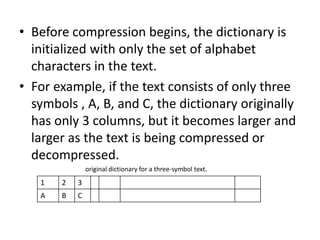
• Before compression begins, the dictionary is
initialized with only the set of alphabet
characters in the text.
• For example, if the text consists of only three
symbols , A, B, and C, the dictionary originally
has only 3 columns, but it becomes larger and
larger as the text is being compressed or
decompressed.
original dictionary for a three-symbol text.
1 2 3
A B C
Buffer
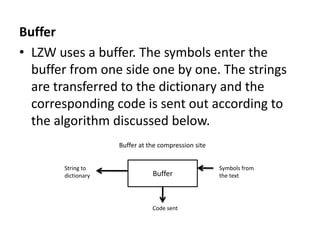
• LZW uses a buffer. The symbols enter the
buffer from one side one by one. The strings
are transferred to the dictionary and the
corresponding code is sent out according to
the algorithm discussed below.
Buffer at the compression site
Buffer
String to
dictionary
Code sent
Symbols from
the text
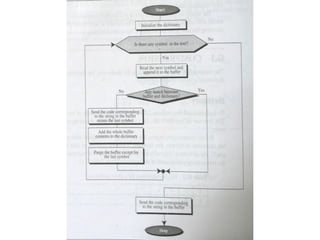
• Compression Algorithm
• Figure shows the flowchart for the
compression algorithm.
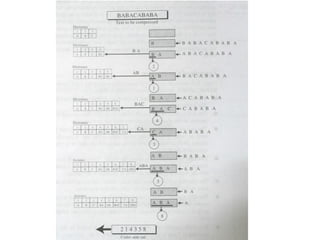
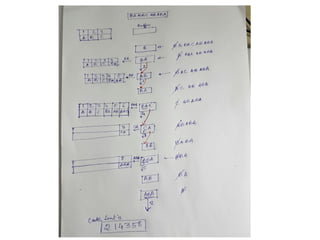
• Example of Compression
• Figure shows an example of compression
using the LZW method. The input text,
BABACABABA, is compressed to 214358 as
follow.
Decompression
• The decompression process, which takes place at
the receiver site, uses the same components as
the compression.
Dictionary
• A very interesting point is that the sender does not
send the dictionary created by the compression
process; instead, the dictionary will be created at
the receiver site and ,surprisingly, it is the exact
replica of the dictionary created at the sender site.
In other words, the information in the dictionary is
somehow embedded in the codes transmitted.
Buffer
• The decompression process uses two buffers.
The arriving codes are decoded and the
resulting symbols are kept in a temporary
buffer before entering, one symbol at a time,
the main buffer.
• Since each code may represent more than one
symbol, the temporary buffer is needed to
hold symbols before individual consumption
by the main buffer (see figure G.4)
• Buffer at the decompression site
Buffer
String to
dictionary
Symbols to be
printed
Code sent
Temporary
buffer
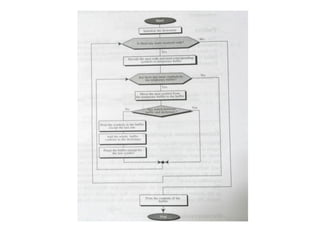
• Decompression Algorithm
• Figure G.5 shows the flowchart for the
decompression algorithm. Our algorithm, which
again is a very simplified version of the one in the
literature, has two loops.
• The first loop, in the iteration, decodes each code
received and sends the resulting symbols to the
temporary buffer.
• The second loop reads the symbols one by one
from the temporary buffer and eventually does
the same thing as the compression algorithm.
Thank You
Dr Rajiv Srivastava
Director
Sagar Institute of Research & Technology (SIRT)
Sagar Group of Institutions, Bhopal
http://www.sirtbhopal.ac.in

Data Communication & Computer Networks : LZW compression method

  • 1.
    Introduction to Datacommunication Topic : LZW compression method Lecture #15 Dr Rajiv Srivastava Director Sagar Institute of Research & Technology (SIRT) Sagar Group of Institutions, Bhopal http://www.sirtbhopal.ac.in
  • 2.
  • 3.
    LZW (Lempel-Ziv-welch) compression method •The LZW method to compress data is an evolution of the method originally created by Abraham Lempel and Jacob Ziv (Lempel-Ziv method). • Later the algorithm was improved by the two originators (called LZ77 and LZ 78). Terry welch further modified the algorithm and it is now called the LZW (Lempel-Ziv-welch) method.
  • 4.
    • The beautyof the method is that it is lossless compression method, in which the whole text can be totally recovered. The method is sometimes preferable to Huffman encoding because prior knowledge of the symbol frequencies is not required.
  • 5.
    Compression • The compression,which takes place at the sender site, has the following components : 1. a dictionary, 2. a buffer, and 3. an algorithm. Dictionary • To compress and decompress, LZW uses a dictionary made of two rows (or columns). The first row defines the code; the second row defines the string corresponding to that code.
  • 6.
    • Before compressionbegins, the dictionary is initialized with only the set of alphabet characters in the text. • For example, if the text consists of only three symbols , A, B, and C, the dictionary originally has only 3 columns, but it becomes larger and larger as the text is being compressed or decompressed. original dictionary for a three-symbol text. 1 2 3 A B C
  • 7.
    Buffer • LZW usesa buffer. The symbols enter the buffer from one side one by one. The strings are transferred to the dictionary and the corresponding code is sent out according to the algorithm discussed below. Buffer at the compression site Buffer String to dictionary Code sent Symbols from the text
  • 8.
    • Compression Algorithm •Figure shows the flowchart for the compression algorithm. • Example of Compression • Figure shows an example of compression using the LZW method. The input text, BABACABABA, is compressed to 214358 as follow.
  • 12.
    Decompression • The decompressionprocess, which takes place at the receiver site, uses the same components as the compression. Dictionary • A very interesting point is that the sender does not send the dictionary created by the compression process; instead, the dictionary will be created at the receiver site and ,surprisingly, it is the exact replica of the dictionary created at the sender site. In other words, the information in the dictionary is somehow embedded in the codes transmitted.
  • 13.
    Buffer • The decompressionprocess uses two buffers. The arriving codes are decoded and the resulting symbols are kept in a temporary buffer before entering, one symbol at a time, the main buffer. • Since each code may represent more than one symbol, the temporary buffer is needed to hold symbols before individual consumption by the main buffer (see figure G.4)
  • 14.
    • Buffer atthe decompression site Buffer String to dictionary Symbols to be printed Code sent Temporary buffer
  • 15.
    • Decompression Algorithm •Figure G.5 shows the flowchart for the decompression algorithm. Our algorithm, which again is a very simplified version of the one in the literature, has two loops. • The first loop, in the iteration, decodes each code received and sends the resulting symbols to the temporary buffer. • The second loop reads the symbols one by one from the temporary buffer and eventually does the same thing as the compression algorithm.
  • 18.
    Thank You Dr RajivSrivastava Director Sagar Institute of Research & Technology (SIRT) Sagar Group of Institutions, Bhopal http://www.sirtbhopal.ac.in