Spread Spectrum
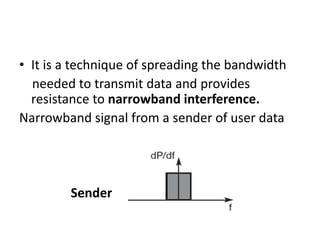
• It is a technique of spreading the bandwidth
needed to transmit data and provides
resistance to narrowband interference.
Narrowband signal from a sender of user data
Sender
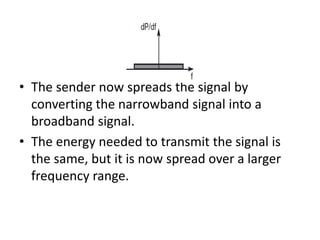
• The sender now spreads the signal by
converting the narrowband signal into a
broadband signal.
• The energy needed to transmit the signal is
the same, but it is now spread over a larger
frequency range.
reciever
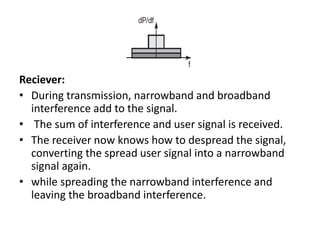
Reciever:
• During transmission, narrowband and broadband
interference add to the signal.
• The sum of interference and user signal is received.
• The receiver now knows how to despread the signal,
converting the spread user signal into a narrowband
signal again.
• while spreading the narrowband interference and
leaving the broadband interference.
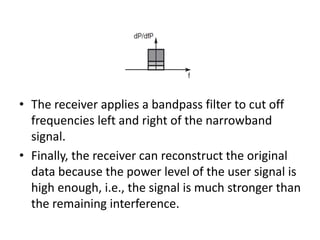
• The receiver applies a bandpass filter to cut off
frequencies left and right of the narrowband
signal.
• Finally, the receiver can reconstruct the original
data because the power level of the user signal is
high enough, i.e., the signal is much stronger than
the remaining interference.
• spread spectrum helps to deal with narrowband
interference for a single channel, it can be used
for several channels.
• Consider the situation, six different channels use
FDM for multiplexing, which means that each
channel has its own narrow frequency band for
transmission.
• Between each frequency band a guard space is
needed to avoid adjacent channel interference.
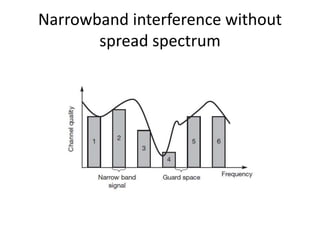
Narrowband interference without
spread spectrum
• Depending on receiver characteristics, channels 1, 2, 5,
and 6 could be received while the quality of channels 3
and 4 is too bad to reconstruct transmitted data.
• Narrowband interference destroys the transmission of
channels 3 and 4.
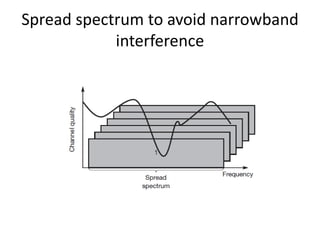
• All narrowband signals are now spread into broadband
signals using the same frequency range.
• No more frequency planning is needed and all senders
use the same frequency band.
• But how can receivers recover their signal?
Spread spectrum to avoid narrowband
interference
• To separate different channels, CDM is now used
instead of FDM.
• Spreading of a narrowband signal is achieved
using a special code.
• Each channel is allotted its own code, which the
receivers have to apply to recover the signal.
• Without knowing the code, the signal cannot be
recovered and behaves like background noise.
Features
• CDM is very attractive for military
• Robustness against narrowband interference,
• high security
• background noise.
• Only the appropriate (secret) codes have to
be exchanged.
Disadvantage
• Increased complexity of receivers that have to
despread a signal.
• Despreading can be performed up to high
data rates can use digital signal processing.
• large frequency band that is needed due to
the spreading of the signal.
• spread signals appear more like noise.
Spread Spectrum Techniques
• Direct sequence spread spectrum (DSSS)-
take a user bit stream and perform an (XOR)
with a so-called chipping sequence
• Frequency hopping spread spectrum (FHSS)-
the total available bandwidth is split into
many channels of smaller bandwidth plus
guard spaces between the channels.
Direct sequence spread spectrum
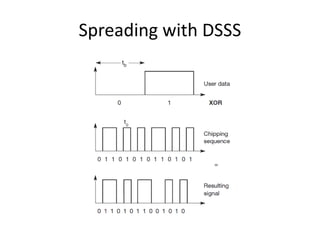
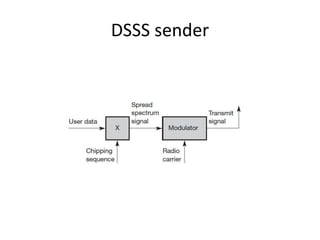
• DSSS systems take a user bit stream and perform
an (XOR) with a so-called chipping sequence.
• The example shows that the result is either the
sequence 0110101 (if the user bit equals 0) or its
complement 1001010 (if the user bit equals 1).
• If the chipping sequence is generated properly
appears as random noise: this sequence is also
sometimes called pseudo-noise sequence.
Spreading with DSSS
DSSS sender
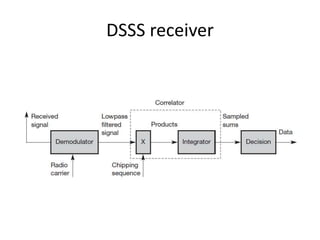
DSSS receiver
Frequency hopping spread spectrum
(FHSS)
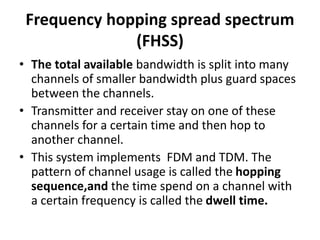
• The total available bandwidth is split into many
channels of smaller bandwidth plus guard spaces
between the channels.
• Transmitter and receiver stay on one of these
channels for a certain time and then hop to
another channel.
• This system implements FDM and TDM. The
pattern of channel usage is called the hopping
sequence,and the time spend on a channel with
a certain frequency is called the dwell time.
FHSS
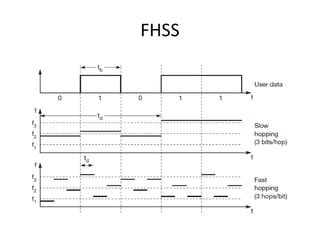
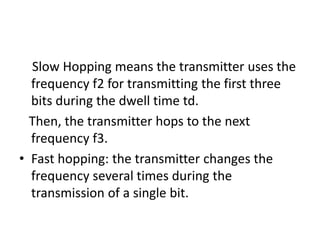
Slow Hopping means the transmitter uses the
frequency f2 for transmitting the first three
bits during the dwell time td.
Then, the transmitter hops to the next
frequency f3.
• Fast hopping: the transmitter changes the
frequency several times during the
transmission of a single bit.
Advantages
• In FHSS systems spreading is simpler.
• FHSS systems use a portion of the total band
at any time, while DSSS systems always use
the total bandwidth available.
• DSSS systems on the other hand are more
resistant to fading and multi-path effects.
DSSS signals are much harder to detect
without knowing the spreading code.

Spread spectrum

  • 1.
  • 2.
    • It isa technique of spreading the bandwidth needed to transmit data and provides resistance to narrowband interference. Narrowband signal from a sender of user data Sender
  • 3.
    • The sendernow spreads the signal by converting the narrowband signal into a broadband signal. • The energy needed to transmit the signal is the same, but it is now spread over a larger frequency range.
  • 4.
    reciever Reciever: • During transmission,narrowband and broadband interference add to the signal. • The sum of interference and user signal is received. • The receiver now knows how to despread the signal, converting the spread user signal into a narrowband signal again. • while spreading the narrowband interference and leaving the broadband interference.
  • 5.
    • The receiverapplies a bandpass filter to cut off frequencies left and right of the narrowband signal. • Finally, the receiver can reconstruct the original data because the power level of the user signal is high enough, i.e., the signal is much stronger than the remaining interference.
  • 6.
    • spread spectrumhelps to deal with narrowband interference for a single channel, it can be used for several channels. • Consider the situation, six different channels use FDM for multiplexing, which means that each channel has its own narrow frequency band for transmission. • Between each frequency band a guard space is needed to avoid adjacent channel interference.
  • 7.
  • 8.
    • Depending onreceiver characteristics, channels 1, 2, 5, and 6 could be received while the quality of channels 3 and 4 is too bad to reconstruct transmitted data. • Narrowband interference destroys the transmission of channels 3 and 4. • All narrowband signals are now spread into broadband signals using the same frequency range. • No more frequency planning is needed and all senders use the same frequency band. • But how can receivers recover their signal?
  • 9.
    Spread spectrum toavoid narrowband interference
  • 10.
    • To separatedifferent channels, CDM is now used instead of FDM. • Spreading of a narrowband signal is achieved using a special code. • Each channel is allotted its own code, which the receivers have to apply to recover the signal. • Without knowing the code, the signal cannot be recovered and behaves like background noise.
  • 11.
    Features • CDM isvery attractive for military • Robustness against narrowband interference, • high security • background noise. • Only the appropriate (secret) codes have to be exchanged.
  • 12.
    Disadvantage • Increased complexityof receivers that have to despread a signal. • Despreading can be performed up to high data rates can use digital signal processing. • large frequency band that is needed due to the spreading of the signal. • spread signals appear more like noise.
  • 13.
    Spread Spectrum Techniques •Direct sequence spread spectrum (DSSS)- take a user bit stream and perform an (XOR) with a so-called chipping sequence • Frequency hopping spread spectrum (FHSS)- the total available bandwidth is split into many channels of smaller bandwidth plus guard spaces between the channels.
  • 14.
    Direct sequence spreadspectrum • DSSS systems take a user bit stream and perform an (XOR) with a so-called chipping sequence. • The example shows that the result is either the sequence 0110101 (if the user bit equals 0) or its complement 1001010 (if the user bit equals 1). • If the chipping sequence is generated properly appears as random noise: this sequence is also sometimes called pseudo-noise sequence.
  • 15.
  • 16.
  • 17.
  • 18.
    Frequency hopping spreadspectrum (FHSS) • The total available bandwidth is split into many channels of smaller bandwidth plus guard spaces between the channels. • Transmitter and receiver stay on one of these channels for a certain time and then hop to another channel. • This system implements FDM and TDM. The pattern of channel usage is called the hopping sequence,and the time spend on a channel with a certain frequency is called the dwell time.
  • 19.
  • 20.
    Slow Hopping meansthe transmitter uses the frequency f2 for transmitting the first three bits during the dwell time td. Then, the transmitter hops to the next frequency f3. • Fast hopping: the transmitter changes the frequency several times during the transmission of a single bit.
  • 21.
    Advantages • In FHSSsystems spreading is simpler. • FHSS systems use a portion of the total band at any time, while DSSS systems always use the total bandwidth available. • DSSS systems on the other hand are more resistant to fading and multi-path effects. DSSS signals are much harder to detect without knowing the spreading code.