Introduction to Data communication
Topic: B-ISDN
Lecture # 11
Dr Rajiv Srivastava
Director
Sagar Institute of Research & Technology (SIRT)
Sagar Group of Institutions, Bhopal
http://www.sirtbhopal.ac.in
Unit 2
Lecture 11
Course Lecture 28
B-ISDN
Broadband ISDN
• In 1988, CCITT issued the first two
recommendations relating to the broadband
ISDN called B-ISDN.
• This system is defined as a service requiring
transmission channels capable of supporting
the rates greater than the primary rates.
• With B-ISDN, services such as video services
which require very high data rates can
become available.
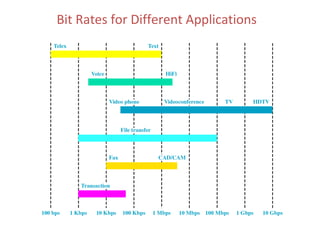
Bit Rates for Different Applications
B-ISDN Services
• Services of b-isdn
• P 493, f2e
Architecture of B-ISDN
•B-ISDN differs from the narrowband ISDN in
different ways. In order to meet the
requirement of high resolution video, an upper
channel rate of the order of 150 Mbps is
required.
•In order to support one or more interactive
services and distribution, a total subscriber
line rate of about 600 Mbps is needed.
•Such high data rates can be supported only by
using the optical fiber. Hence B-ISDN depends
completely on the development of optical fiber.
• Internally, it is necessary to use a switching
technique, which is capable of handling a
wide range of different bit rates and traffic
parameters.
• The best suitable switching technique used is
called ATM. It is used at the user-network
interface.
Functional Architecture off B-ISDN
Figure: Functional architecture of B-ISDN
Functional Architecture
• The functional architecture of B-ISDN is shown in Fig.
6.17.1. Similar to the narrowband ISDN, control of B-ISDN is
based on common channel signaling.
• B-ISDN supports all the 64 kbps transmission services, both
circuit switching and packet switching which are present in
the narrowband ISDN.
• In addition to these, B-ISDN also provides the broadband
capabilities for higher data rate transmission.
• At the user network interface, these capabilities will be
provided with the connection oriented asynchronous
transfer mode (ATM) facility.
• Fig. 6.17.1 clearly indicates that the reference
configuration defined for the narrowband ISDN is
being used for the B-ISDN as well.
Access Methods
• 155.520 Mbps Full Duplex
–Three new transmission services are defined in
terms of the data rates available to B-ISDN
subscribers. The first one consists of a fully duplex
155.52 Mbps service.
• 155.520/622.080 Mbps Input
– The second service is asymmetrical. It provides
transmission from the subscriber to the network at
155252 Mbps and in the other direction at 622.08
Mbps. The third service is of the highest capacity
which is a full duplex 622.08 Mbps service.
• The data rate of 155.52 Mbps can support
most of the B-ISDN services. At this rate it is
possible to transmit one or more video
channels. Hence the full duplex 155.52 Mbps
service will be the most common B-ISDN
service.
• The higher data rate of 622.08 Mbps is
required for transmitting multiple video
distributions such as multiple simultaneous
video conferences.
B-ISDN Accesses
B-ISDN Protocols
• 6.17.3, P 6-40, K
Advantages of B-ISDN
• P 6-41, K
Thank You
Dr Rajiv Srivastava
Director
Sagar Institute of Research & Technology (SIRT)
Sagar Group of Institutions, Bhopal
http://www.sirtbhopal.ac.in

Topic : B ISDN

  • 1.
    Introduction to Datacommunication Topic: B-ISDN Lecture # 11 Dr Rajiv Srivastava Director Sagar Institute of Research & Technology (SIRT) Sagar Group of Institutions, Bhopal http://www.sirtbhopal.ac.in
  • 2.
    Unit 2 Lecture 11 CourseLecture 28 B-ISDN
  • 3.
    Broadband ISDN • In1988, CCITT issued the first two recommendations relating to the broadband ISDN called B-ISDN. • This system is defined as a service requiring transmission channels capable of supporting the rates greater than the primary rates. • With B-ISDN, services such as video services which require very high data rates can become available.
  • 4.
    Bit Rates forDifferent Applications
  • 5.
  • 6.
    • Services ofb-isdn • P 493, f2e
  • 7.
    Architecture of B-ISDN •B-ISDNdiffers from the narrowband ISDN in different ways. In order to meet the requirement of high resolution video, an upper channel rate of the order of 150 Mbps is required. •In order to support one or more interactive services and distribution, a total subscriber line rate of about 600 Mbps is needed. •Such high data rates can be supported only by using the optical fiber. Hence B-ISDN depends completely on the development of optical fiber.
  • 8.
    • Internally, itis necessary to use a switching technique, which is capable of handling a wide range of different bit rates and traffic parameters. • The best suitable switching technique used is called ATM. It is used at the user-network interface.
  • 9.
    Functional Architecture offB-ISDN Figure: Functional architecture of B-ISDN
  • 10.
    Functional Architecture • Thefunctional architecture of B-ISDN is shown in Fig. 6.17.1. Similar to the narrowband ISDN, control of B-ISDN is based on common channel signaling. • B-ISDN supports all the 64 kbps transmission services, both circuit switching and packet switching which are present in the narrowband ISDN. • In addition to these, B-ISDN also provides the broadband capabilities for higher data rate transmission. • At the user network interface, these capabilities will be provided with the connection oriented asynchronous transfer mode (ATM) facility.
  • 11.
    • Fig. 6.17.1clearly indicates that the reference configuration defined for the narrowband ISDN is being used for the B-ISDN as well.
  • 12.
    Access Methods • 155.520Mbps Full Duplex –Three new transmission services are defined in terms of the data rates available to B-ISDN subscribers. The first one consists of a fully duplex 155.52 Mbps service. • 155.520/622.080 Mbps Input – The second service is asymmetrical. It provides transmission from the subscriber to the network at 155252 Mbps and in the other direction at 622.08 Mbps. The third service is of the highest capacity which is a full duplex 622.08 Mbps service.
  • 13.
    • The datarate of 155.52 Mbps can support most of the B-ISDN services. At this rate it is possible to transmit one or more video channels. Hence the full duplex 155.52 Mbps service will be the most common B-ISDN service. • The higher data rate of 622.08 Mbps is required for transmitting multiple video distributions such as multiple simultaneous video conferences.
  • 14.
  • 15.
  • 16.
  • 17.
    Thank You Dr RajivSrivastava Director Sagar Institute of Research & Technology (SIRT) Sagar Group of Institutions, Bhopal http://www.sirtbhopal.ac.in