1
Human Body Systems
Learning Objectives
Be able to :
1. Identify 5 body cavities and major
structures in each cavity.
2. Identify 8 body systems and major
structures in each system.
3. Describe the primary functions of body
systems.
4. Understand how body systems work
together.
2
Cells & Tissues
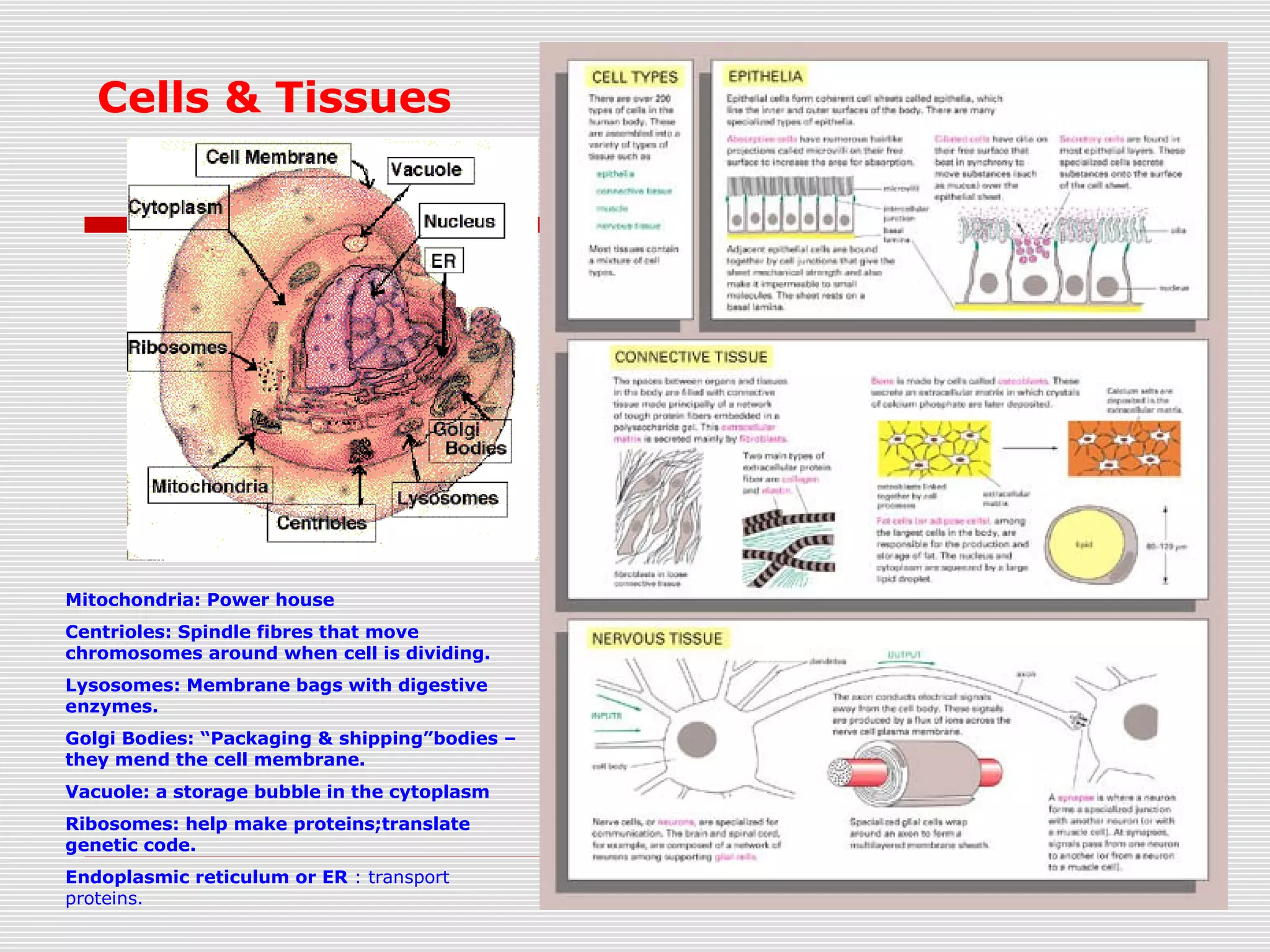
Mitochondria: Power house
Centrioles: Spindle fibres that move
chromosomes around when cell is dividing.
Lysosomes: Membrane bags with digestive
enzymes.
Golgi Bodies: “Packaging & shipping”bodies –
they mend the cell membrane.
Vacuole: a storage bubble in the cytoplasm
Ribosomes: help make proteins;translate
genetic code.
Endoplasmic reticulum or ER : transport
proteins.
3
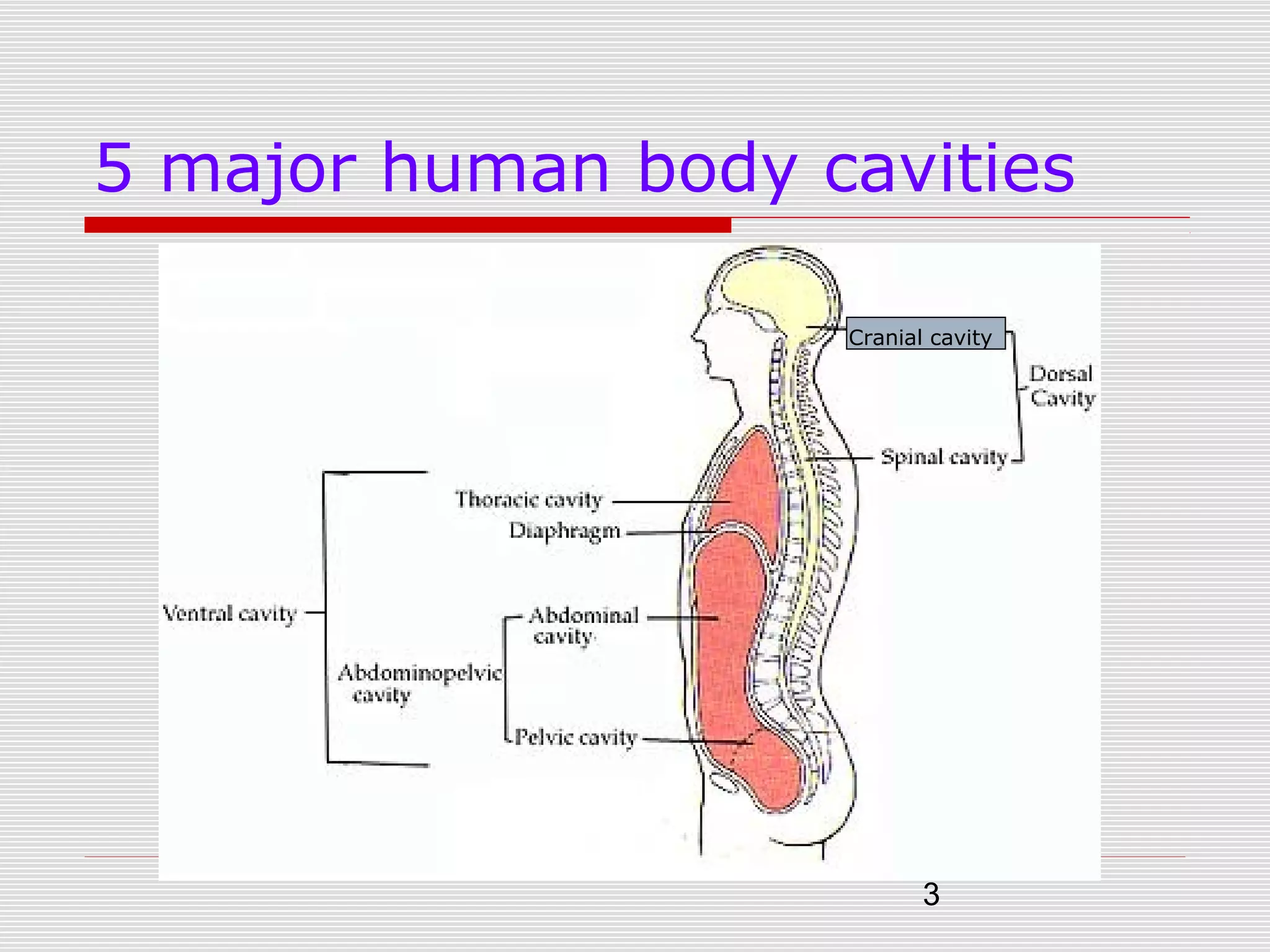
5 major human body cavities
Cranial cavity
4
5 major human body cavities
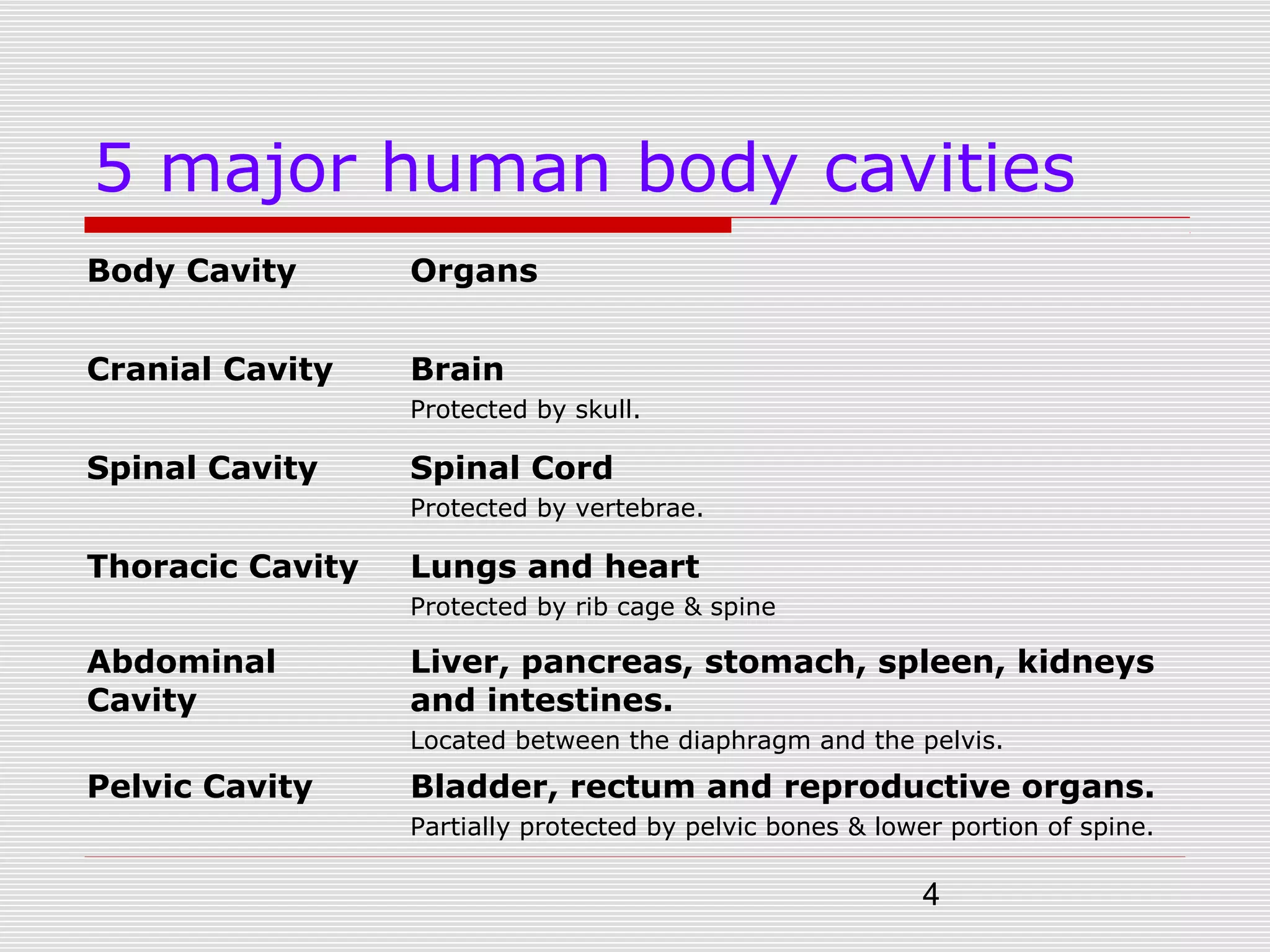
Body Cavity Organs
Cranial Cavity Brain
Protected by skull.
Spinal Cavity Spinal Cord
Protected by vertebrae.
Thoracic Cavity Lungs and heart
Protected by rib cage & spine
Abdominal
Cavity
Liver, pancreas, stomach, spleen, kidneys
and intestines.
Located between the diaphragm and the pelvis.
Pelvic Cavity Bladder, rectum and reproductive organs.
Partially protected by pelvic bones & lower portion of spine.
5
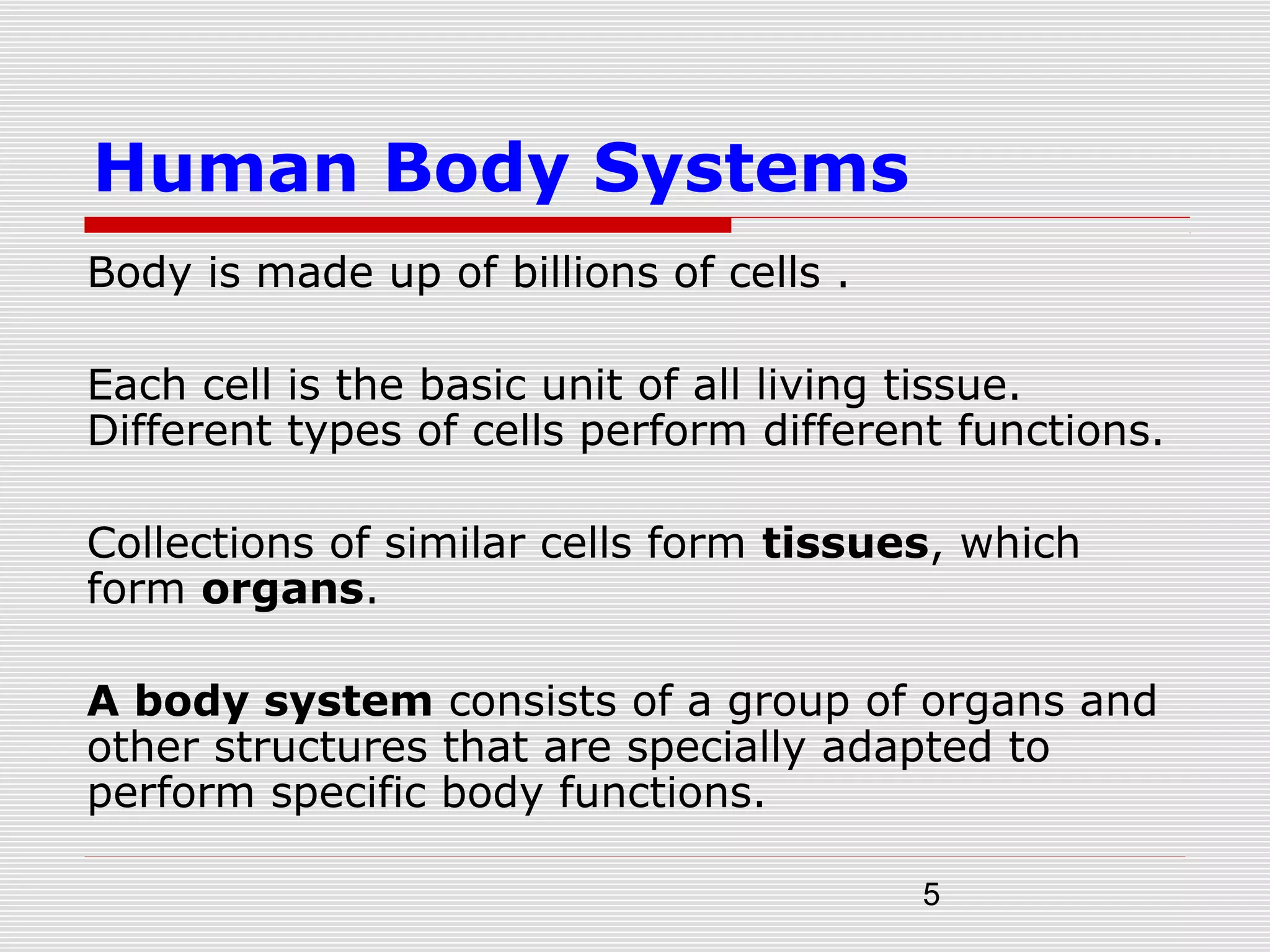
Human Body Systems
Body is made up of billions of cells .
Each cell is the basic unit of all living tissue.
Different types of cells perform different functions.
Collections of similar cells form tissues, which
form organs.
A body system consists of a group of organs and
other structures that are specially adapted to
perform specific body functions.
6
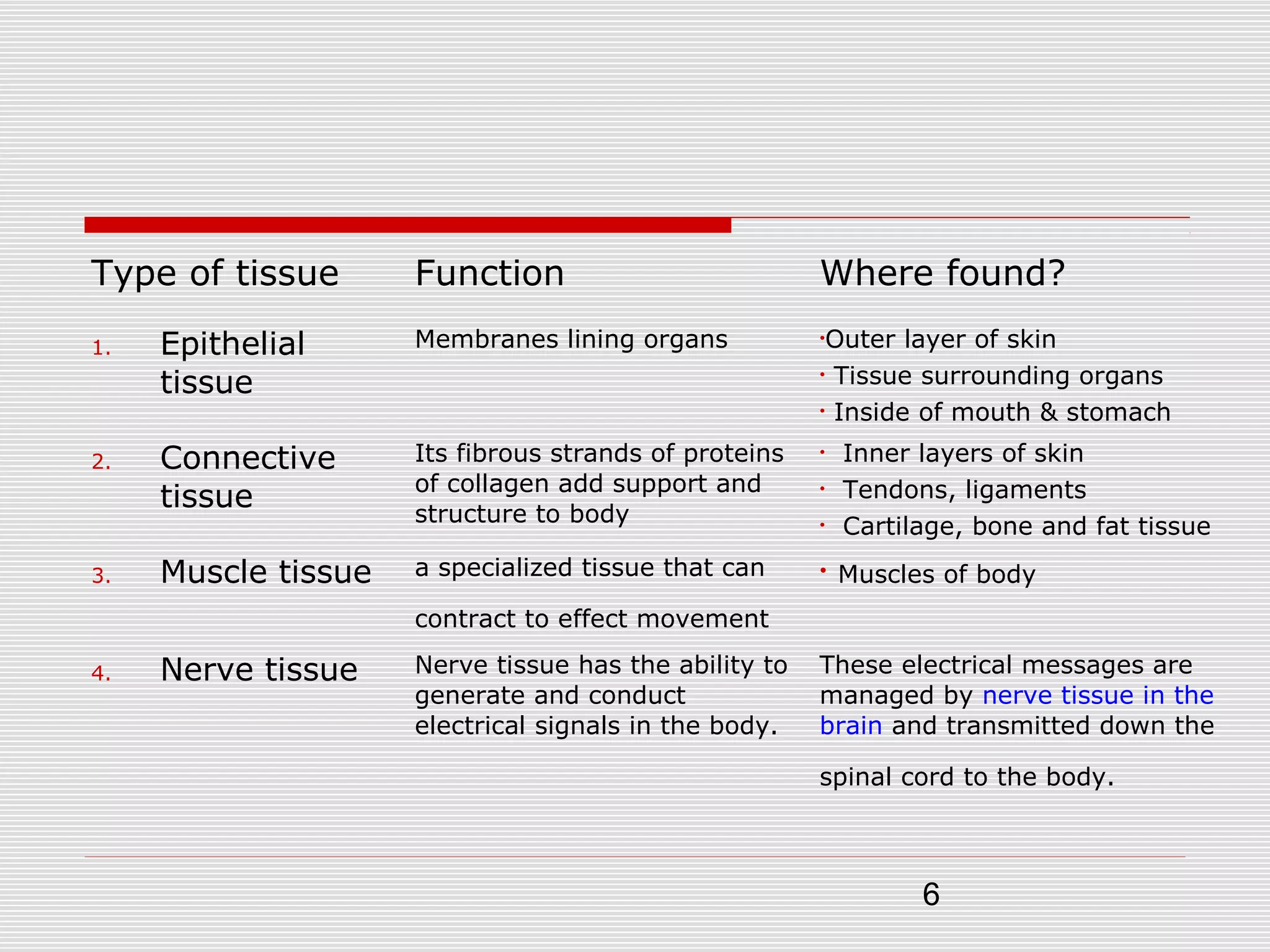
Type of tissue Function Where found?
1. Epithelial
tissue
Membranes lining organs •Outer layer of skin
• Tissue surrounding organs
• Inside of mouth & stomach
2. Connective
tissue
Its fibrous strands of proteins
of collagen add support and
structure to body
• Inner layers of skin
• Tendons, ligaments
• Cartilage, bone and fat tissue
3. Muscle tissue a specialized tissue that can
contract to effect movement
• Muscles of body
4. Nerve tissue Nerve tissue has the ability to
generate and conduct
electrical signals in the body.
These electrical messages are
managed by nerve tissue in the
brain and transmitted down the
spinal cord to the body.
7
Human Body Systems
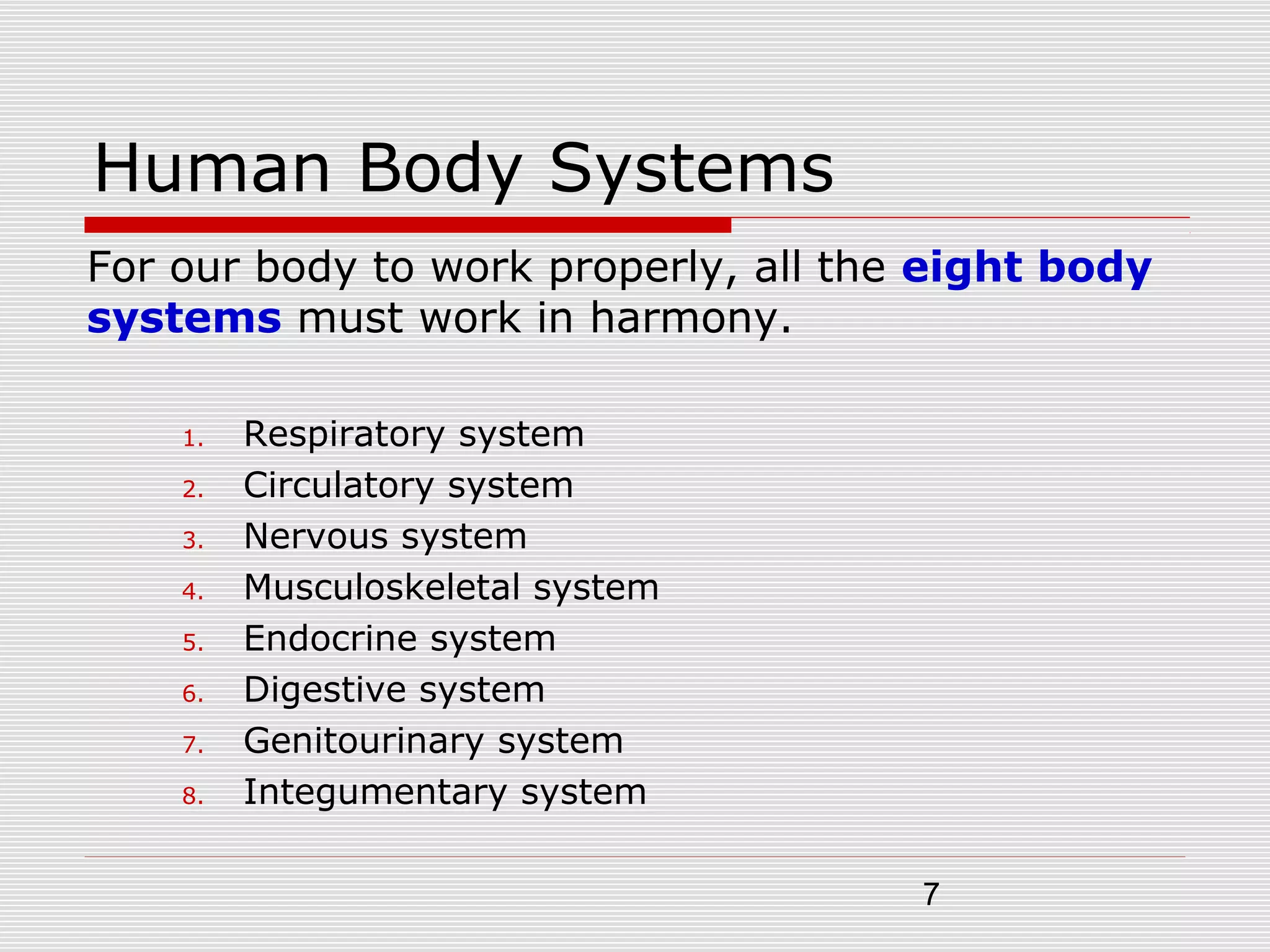
For our body to work properly, all the eight body
systems must work in harmony.
1. Respiratory system
2. Circulatory system
3. Nervous system
4. Musculoskeletal system
5. Endocrine system
6. Digestive system
7. Genitourinary system
8. Integumentary system
8
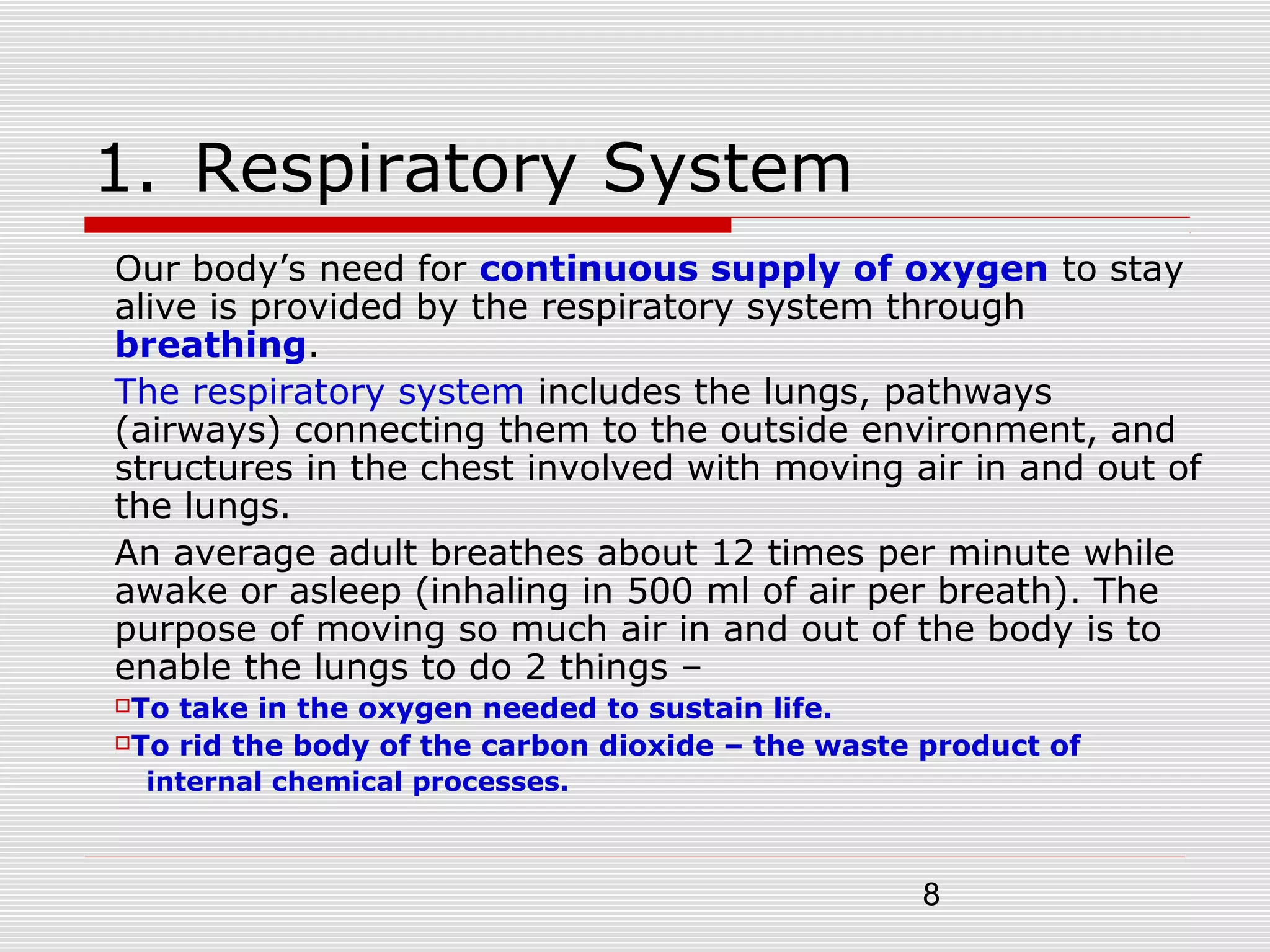
1. Respiratory System
Our body’s need for continuous supply of oxygen to stay
alive is provided by the respiratory system through
breathing.
The respiratory system includes the lungs, pathways
(airways) connecting them to the outside environment, and
structures in the chest involved with moving air in and out of
the lungs.
An average adult breathes about 12 times per minute while
awake or asleep (inhaling in 500 ml of air per breath). The
purpose of moving so much air in and out of the body is to
enable the lungs to do 2 things –
To take in the oxygen needed to sustain life.
To rid the body of the carbon dioxide – the waste product of
internal chemical processes.
9
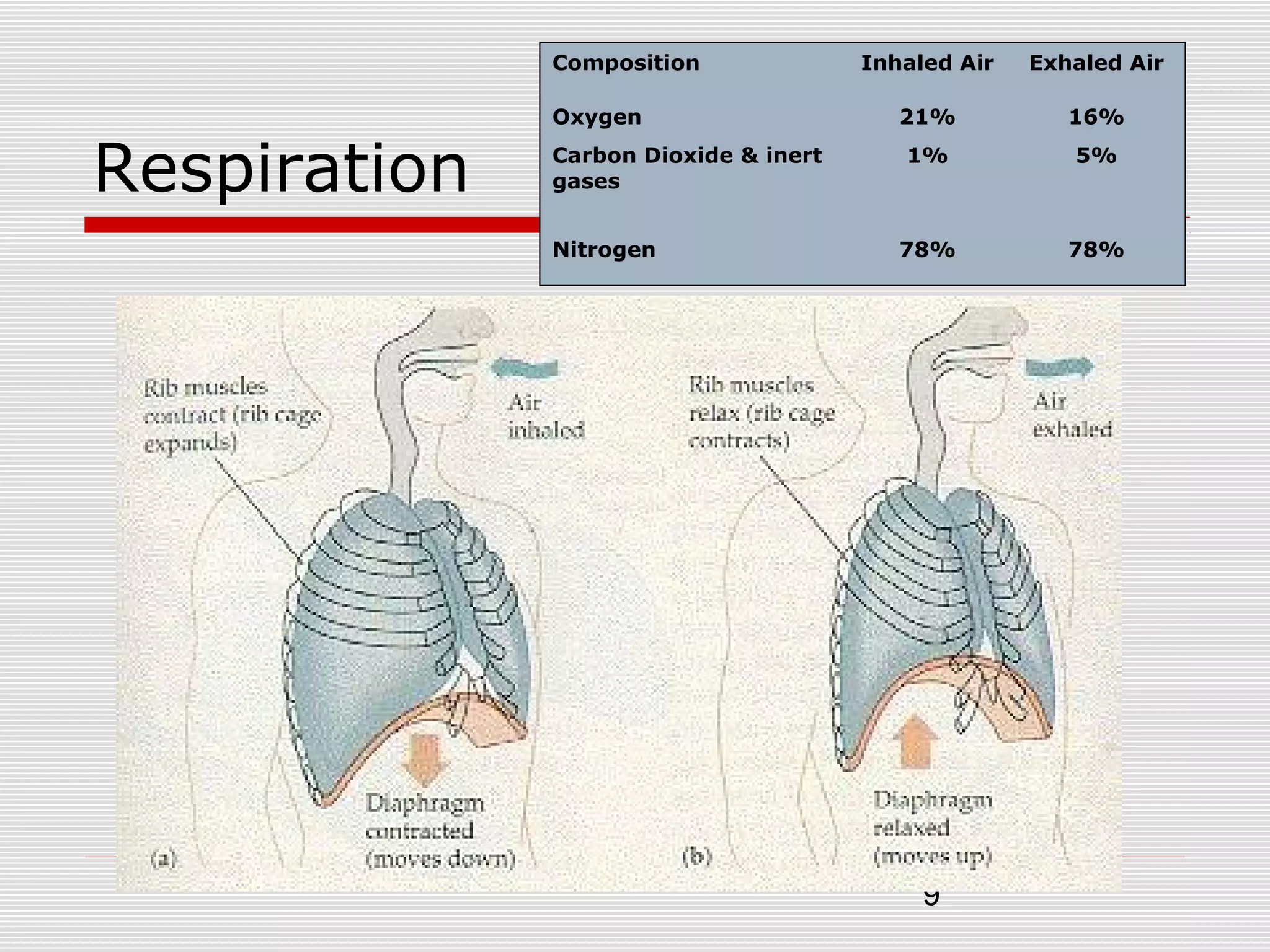
Respiration
Composition Inhaled Air Exhaled Air
Oxygen 21% 16%
Carbon Dioxide & inert
gases
1% 5%
Nitrogen 78% 78%
10
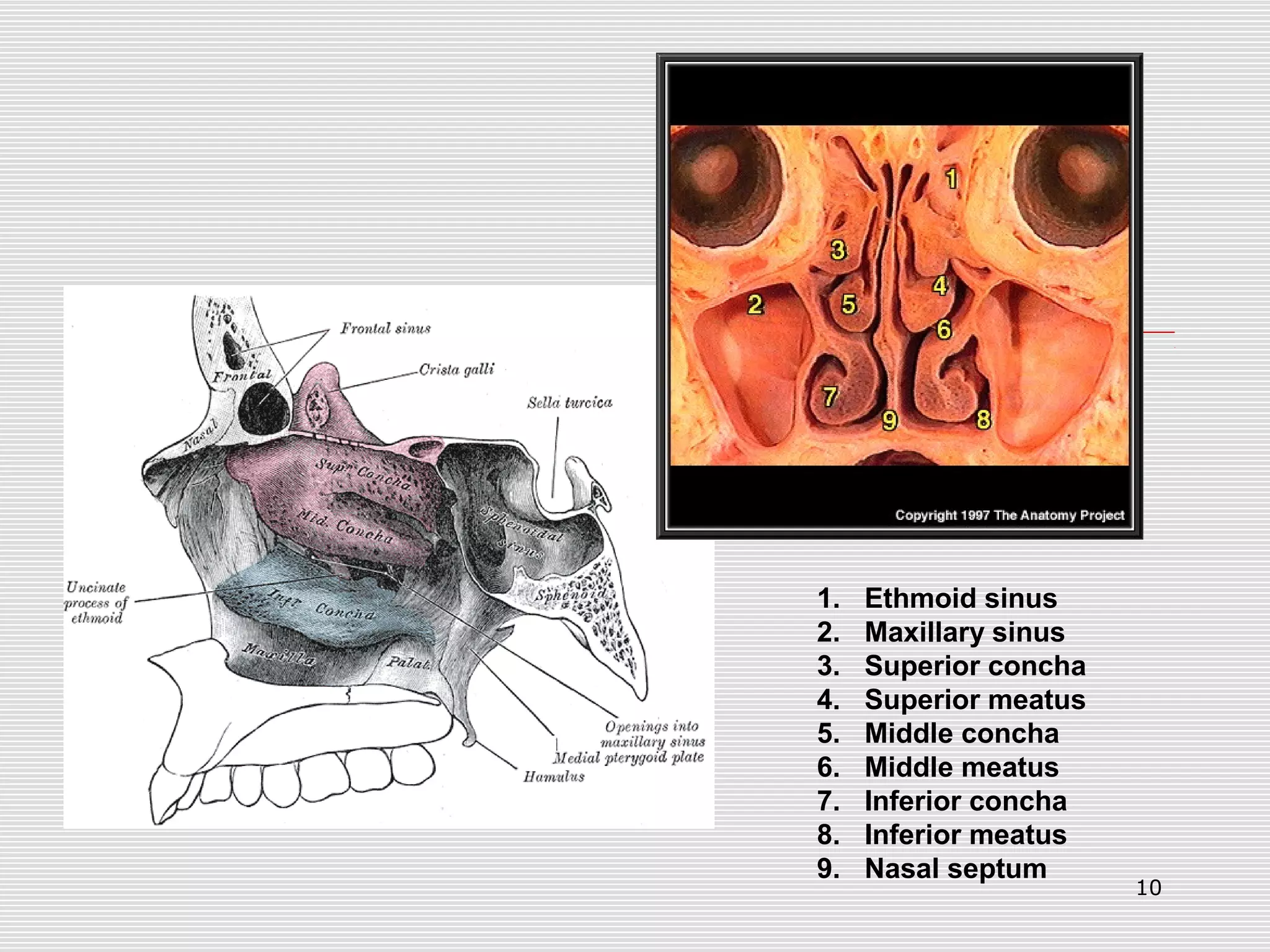
1. Ethmoid sinus
2. Maxillary sinus
3. Superior concha
4. Superior meatus
5. Middle concha
6. Middle meatus
7. Inferior concha
8. Inferior meatus
9. Nasal septum
11
Respiratory System
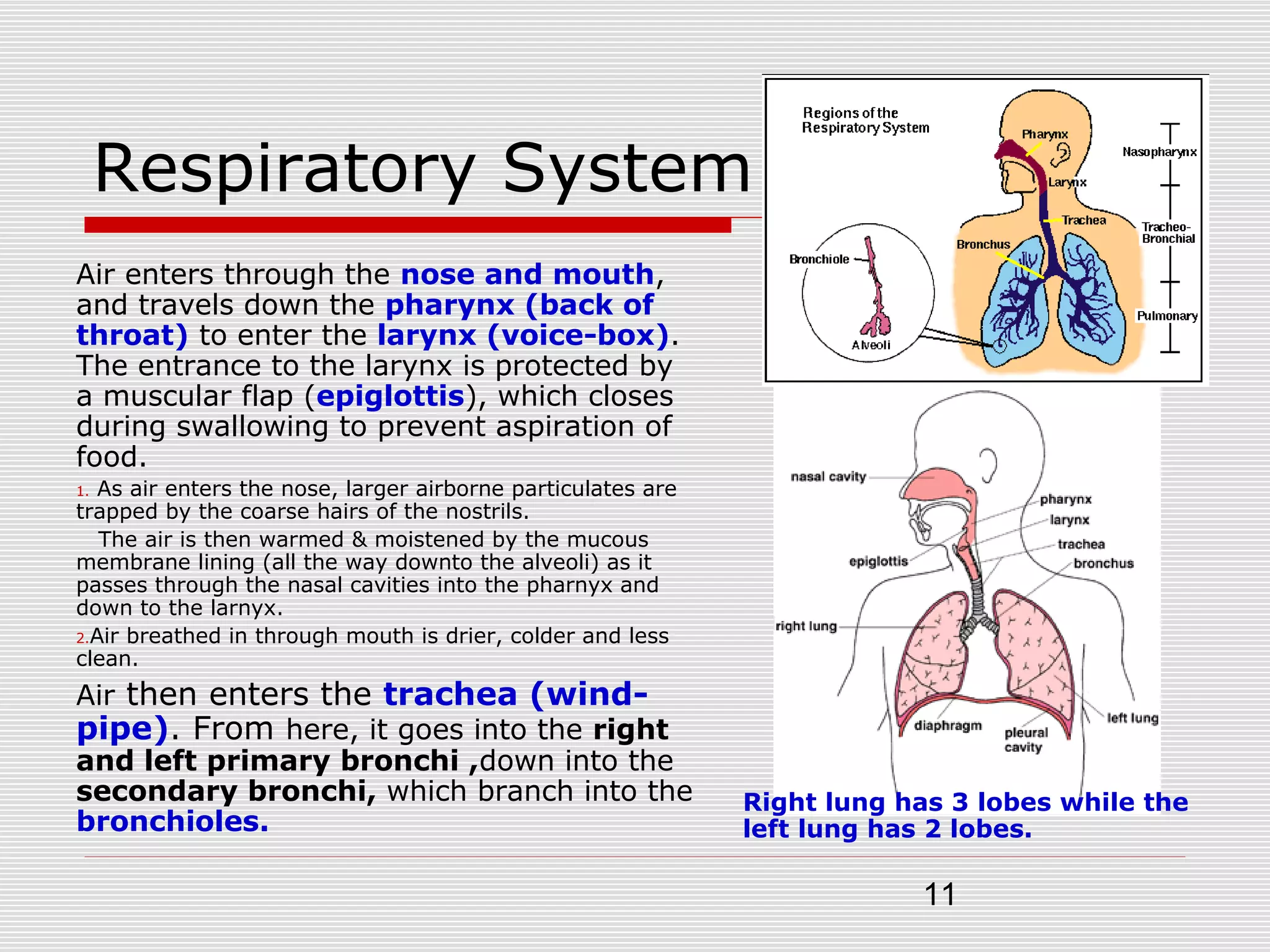
Air enters through the nose and mouth,
and travels down the pharynx (back of
throat) to enter the larynx (voice-box).
The entrance to the larynx is protected by
a muscular flap (epiglottis), which closes
during swallowing to prevent aspiration of
food.
1. As air enters the nose, larger airborne particulates are
trapped by the coarse hairs of the nostrils.
The air is then warmed & moistened by the mucous
membrane lining (all the way downto the alveoli) as it
passes through the nasal cavities into the pharnyx and
down to the larnyx.
2.Air breathed in through mouth is drier, colder and less
clean.
Air then enters the trachea (wind-
pipe). From here, it goes into the right
and left primary bronchi ,down into the
secondary bronchi, which branch into the
bronchioles.
Right lung has 3 lobes while the
left lung has 2 lobes.
12
Respiratory System
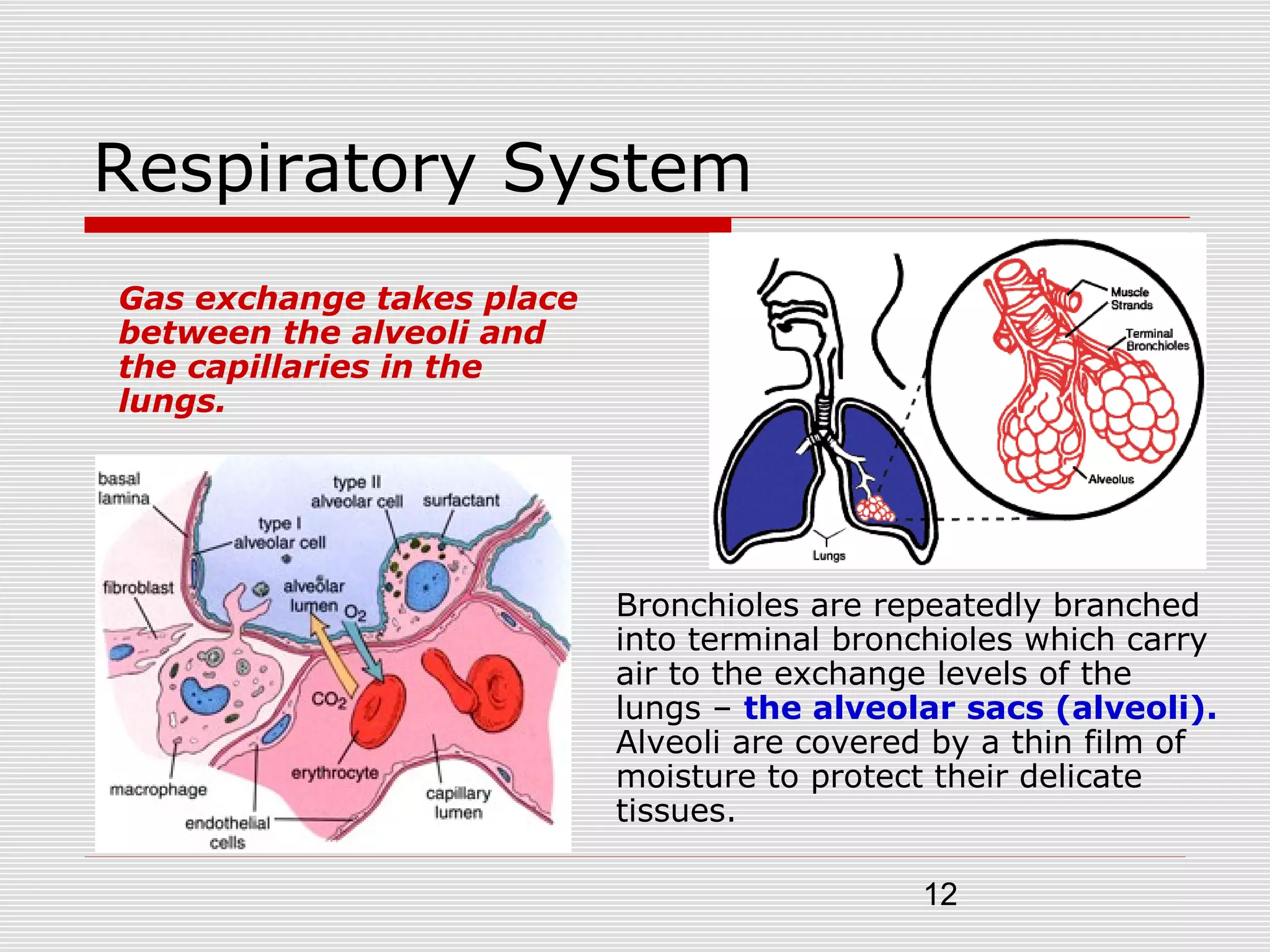
Gas exchange takes place
between the alveoli and
the capillaries in the
lungs.
Bronchioles are repeatedly branched
into terminal bronchioles which carry
air to the exchange levels of the
lungs – the alveolar sacs (alveoli).
Alveoli are covered by a thin film of
moisture to protect their delicate
tissues.
13
Respiratory Protection System
 Physical Filtration
1. Large airborne particulates are trapped by the moist hairs
in the nose and nasal sinuses, and subsequently washed out.
2. As air travels through the twists and bends of the nasal cavity
airborne particulates collide with the sticky mucus lining and
become trapped. They are then washed down the pharynx,
where they are either swallowed or coughed out.
3. Sneezing occurs if airborne dust concentrations are high or
have irritant effects.
4. The repeatedly branching of airways from the lower end of
trachea down to bronchioles with gradual narrowing of their
lumen slows down the airflow allowing some particulates to
sediment on the mucus lining, and subsequently propelled
by the cilia in constant motion up the pharynx to be
swallowed or coughed out.
14
Efficiency of the Filtration System
 Depends of the sizes of the particulates. The smallest size of a
particulate that can be seen by our naked eyes is 25 μm
Nose & nasal
sinuses
Particulates 10 to
100 μm
(diameter) can be
removed
Particulates <10 μm can
pass through.
Trachea to terminal
bronchioles
Particulates up to 7 μm can be removed.
Alveoli Particulates
ranging from 7
μm to 0.5 μm may
be deposited.
Particulates < 0.5 μm
may be exhaled out to the
outside environment or
may be deposited in the
alveoli by diffusion.
Note: Particulates with size-range 7 μm to 0.5 μm is termed as
the respirable dust.
15
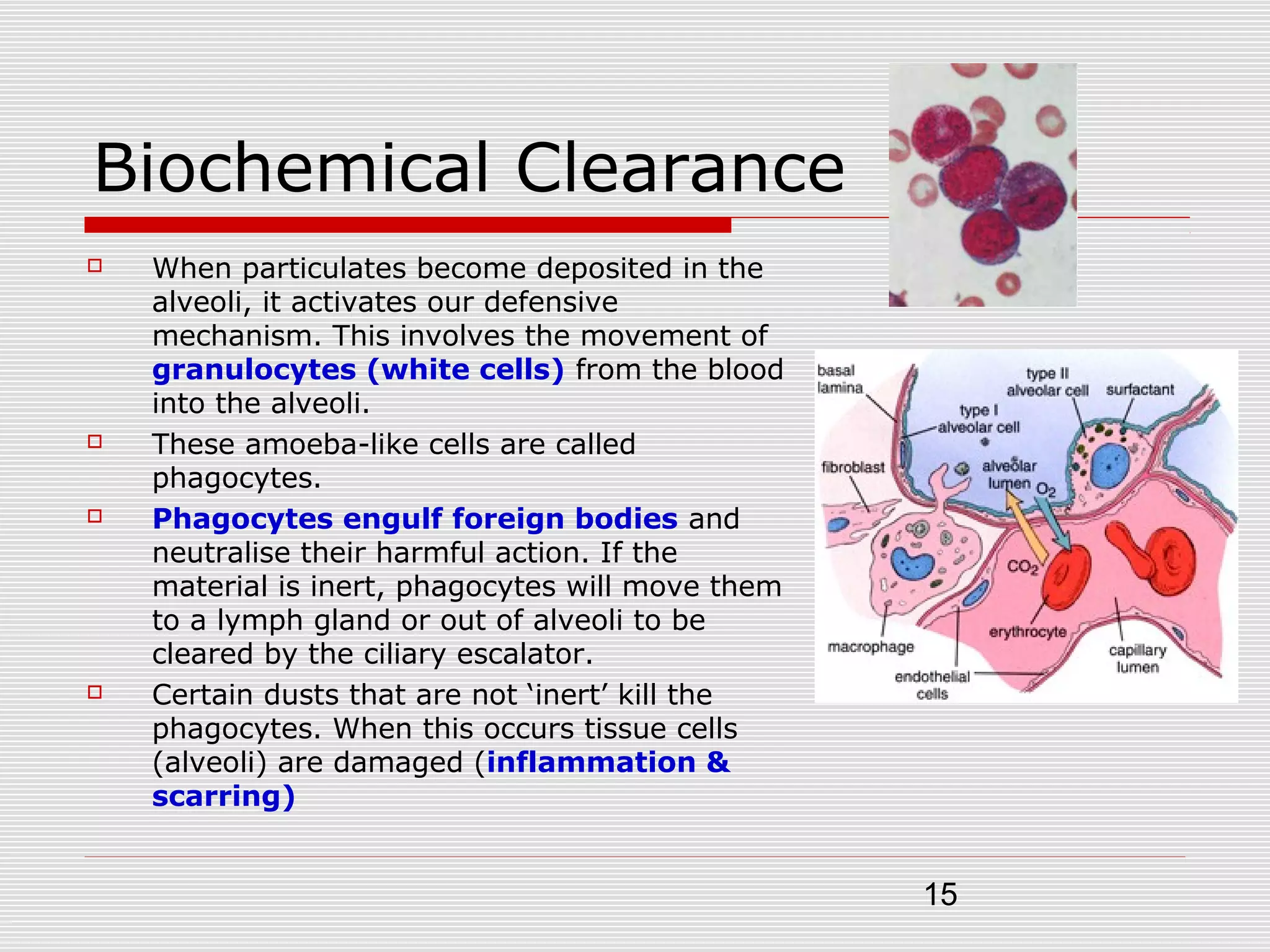
Biochemical Clearance
 When particulates become deposited in the
alveoli, it activates our defensive
mechanism. This involves the movement of
granulocytes (white cells) from the blood
into the alveoli.
 These amoeba-like cells are called
phagocytes.
 Phagocytes engulf foreign bodies and
neutralise their harmful action. If the
material is inert, phagocytes will move them
to a lymph gland or out of alveoli to be
cleared by the ciliary escalator.
 Certain dusts that are not ‘inert’ kill the
phagocytes. When this occurs tissue cells
(alveoli) are damaged (inflammation &
scarring)
16
Class Discussion Exercise
 As an adult, how many times do we breath in air per
minute while at rest or asleep? How much air (in
millilitres, mls) do we breathe in per breath?
 What is the main function of our lungs?
 What is the function of epiglottis?
 How do our respiratory system prevent airborne
particulates from entering into the lungs?
 Particulates of sizes PM10 and PM2.5. Which one can
travel a longer distance in air, and which one is more
harmful to our human body?

Topic no.3 human body systems (dip) part 1

  • 1.
    1 Human Body Systems LearningObjectives Be able to : 1. Identify 5 body cavities and major structures in each cavity. 2. Identify 8 body systems and major structures in each system. 3. Describe the primary functions of body systems. 4. Understand how body systems work together.
  • 2.
    2 Cells & Tissues Mitochondria:Power house Centrioles: Spindle fibres that move chromosomes around when cell is dividing. Lysosomes: Membrane bags with digestive enzymes. Golgi Bodies: “Packaging & shipping”bodies – they mend the cell membrane. Vacuole: a storage bubble in the cytoplasm Ribosomes: help make proteins;translate genetic code. Endoplasmic reticulum or ER : transport proteins.
  • 3.
    3 5 major humanbody cavities Cranial cavity
  • 4.
    4 5 major humanbody cavities Body Cavity Organs Cranial Cavity Brain Protected by skull. Spinal Cavity Spinal Cord Protected by vertebrae. Thoracic Cavity Lungs and heart Protected by rib cage & spine Abdominal Cavity Liver, pancreas, stomach, spleen, kidneys and intestines. Located between the diaphragm and the pelvis. Pelvic Cavity Bladder, rectum and reproductive organs. Partially protected by pelvic bones & lower portion of spine.
  • 5.
    5 Human Body Systems Bodyis made up of billions of cells . Each cell is the basic unit of all living tissue. Different types of cells perform different functions. Collections of similar cells form tissues, which form organs. A body system consists of a group of organs and other structures that are specially adapted to perform specific body functions.
  • 6.
    6 Type of tissueFunction Where found? 1. Epithelial tissue Membranes lining organs •Outer layer of skin • Tissue surrounding organs • Inside of mouth & stomach 2. Connective tissue Its fibrous strands of proteins of collagen add support and structure to body • Inner layers of skin • Tendons, ligaments • Cartilage, bone and fat tissue 3. Muscle tissue a specialized tissue that can contract to effect movement • Muscles of body 4. Nerve tissue Nerve tissue has the ability to generate and conduct electrical signals in the body. These electrical messages are managed by nerve tissue in the brain and transmitted down the spinal cord to the body.
  • 7.
    7 Human Body Systems Forour body to work properly, all the eight body systems must work in harmony. 1. Respiratory system 2. Circulatory system 3. Nervous system 4. Musculoskeletal system 5. Endocrine system 6. Digestive system 7. Genitourinary system 8. Integumentary system
  • 8.
    8 1. Respiratory System Ourbody’s need for continuous supply of oxygen to stay alive is provided by the respiratory system through breathing. The respiratory system includes the lungs, pathways (airways) connecting them to the outside environment, and structures in the chest involved with moving air in and out of the lungs. An average adult breathes about 12 times per minute while awake or asleep (inhaling in 500 ml of air per breath). The purpose of moving so much air in and out of the body is to enable the lungs to do 2 things – To take in the oxygen needed to sustain life. To rid the body of the carbon dioxide – the waste product of internal chemical processes.
  • 9.
    9 Respiration Composition Inhaled AirExhaled Air Oxygen 21% 16% Carbon Dioxide & inert gases 1% 5% Nitrogen 78% 78%
  • 10.
    10 1. Ethmoid sinus 2.Maxillary sinus 3. Superior concha 4. Superior meatus 5. Middle concha 6. Middle meatus 7. Inferior concha 8. Inferior meatus 9. Nasal septum
  • 11.
    11 Respiratory System Air entersthrough the nose and mouth, and travels down the pharynx (back of throat) to enter the larynx (voice-box). The entrance to the larynx is protected by a muscular flap (epiglottis), which closes during swallowing to prevent aspiration of food. 1. As air enters the nose, larger airborne particulates are trapped by the coarse hairs of the nostrils. The air is then warmed & moistened by the mucous membrane lining (all the way downto the alveoli) as it passes through the nasal cavities into the pharnyx and down to the larnyx. 2.Air breathed in through mouth is drier, colder and less clean. Air then enters the trachea (wind- pipe). From here, it goes into the right and left primary bronchi ,down into the secondary bronchi, which branch into the bronchioles. Right lung has 3 lobes while the left lung has 2 lobes.
  • 12.
    12 Respiratory System Gas exchangetakes place between the alveoli and the capillaries in the lungs. Bronchioles are repeatedly branched into terminal bronchioles which carry air to the exchange levels of the lungs – the alveolar sacs (alveoli). Alveoli are covered by a thin film of moisture to protect their delicate tissues.
  • 13.
    13 Respiratory Protection System Physical Filtration 1. Large airborne particulates are trapped by the moist hairs in the nose and nasal sinuses, and subsequently washed out. 2. As air travels through the twists and bends of the nasal cavity airborne particulates collide with the sticky mucus lining and become trapped. They are then washed down the pharynx, where they are either swallowed or coughed out. 3. Sneezing occurs if airborne dust concentrations are high or have irritant effects. 4. The repeatedly branching of airways from the lower end of trachea down to bronchioles with gradual narrowing of their lumen slows down the airflow allowing some particulates to sediment on the mucus lining, and subsequently propelled by the cilia in constant motion up the pharynx to be swallowed or coughed out.
  • 14.
    14 Efficiency of theFiltration System  Depends of the sizes of the particulates. The smallest size of a particulate that can be seen by our naked eyes is 25 μm Nose & nasal sinuses Particulates 10 to 100 μm (diameter) can be removed Particulates <10 μm can pass through. Trachea to terminal bronchioles Particulates up to 7 μm can be removed. Alveoli Particulates ranging from 7 μm to 0.5 μm may be deposited. Particulates < 0.5 μm may be exhaled out to the outside environment or may be deposited in the alveoli by diffusion. Note: Particulates with size-range 7 μm to 0.5 μm is termed as the respirable dust.
  • 15.
    15 Biochemical Clearance  Whenparticulates become deposited in the alveoli, it activates our defensive mechanism. This involves the movement of granulocytes (white cells) from the blood into the alveoli.  These amoeba-like cells are called phagocytes.  Phagocytes engulf foreign bodies and neutralise their harmful action. If the material is inert, phagocytes will move them to a lymph gland or out of alveoli to be cleared by the ciliary escalator.  Certain dusts that are not ‘inert’ kill the phagocytes. When this occurs tissue cells (alveoli) are damaged (inflammation & scarring)
  • 16.
    16 Class Discussion Exercise As an adult, how many times do we breath in air per minute while at rest or asleep? How much air (in millilitres, mls) do we breathe in per breath?  What is the main function of our lungs?  What is the function of epiglottis?  How do our respiratory system prevent airborne particulates from entering into the lungs?  Particulates of sizes PM10 and PM2.5. Which one can travel a longer distance in air, and which one is more harmful to our human body?